
THE SOUND SHE FOLLOWED
The conference room on the forty-second floor of Mercer Global Holdings overlooked half of downtown Cedar Rapids, Iowa. Floor-to-ceiling glass caught the late afternoon sun and turned the polished table into a strip of gold. Around it sat attorneys, analysts, board members, and two men from Chicago waiting for billionaire CEO Declan Mercer to approve a multimillion-dollar acquisition.
A screen glowed with charts and projected profits. Numbers climbed in clean blue lines. Someone was speaking about market expansion in medical logistics. Someone else was asking for final authority to proceed.
Declan heard none of it.
He sat at the head of the table in a charcoal suit that had cost more than most people’s rent, one hand on a fountain pen, the other wrapped around a phone he had turned face down three times in ten minutes. On the table beside his legal pad was a tiny pink plastic barrette. He had found it in his daughter’s room that morning, caught beneath the leg of her rocking chair, and for some reason had slipped it into his pocket before leaving for work.
“Mr. Mercer?” said his chief financial officer, Brooks Hanley. “If we move before market open tomorrow, we can lock this in.”
Declan looked up too late. “What?”
There was a faint pause around the table, the kind wealthy men were too trained to call awkward.
Brooks cleared his throat. “The acquisition. We need your signature.”
Declan nodded once. “Right.”
He picked up the pen. His phone buzzed.
A message flashed across the screen from Mrs. Willa Grayson, the household manager at his estate outside Cedar Rapids.
Miss Evie would not eat lunch again. Cried during physical therapy. New nanny candidate coming at six. Agency says she is the only one left available.
His grip tightened.
Only one left available.
Across the table, an attorney slid the contract closer. “Sir?”
Declan signed where he was told. His signature, sharp and practiced, settled millions of dollars in under five seconds.
The room relaxed. Chairs shifted. People smiled carefully. Someone said, “Excellent decision.”
Excellent. The word landed like an insult.
Declan leaned back and stared at his own name drying on the page while all he could think of was his daughter’s face that morning. Evelyn Mercer. Evie. Two years old. Fine blonde hair soft as dandelion silk. Big blue eyes that looked too solemn for a child her age. She had been sitting by the window in the nursery with both legs stretched out in front of her, one hand resting on a stuffed rabbit, not speaking, not fussing, not reaching for him when he knelt in front of her.
He had said, “Good morning, sweetheart.”
Nothing.
He had tried again. “Daddy has to go to the office, but I’ll be back for dinner.”
No smile. No little hands lifted. No sign she had heard him at all, though he knew she had. Her eyes had moved to his tie for half a second and then back to the rain on the glass.
Before the storm that killed his wife, Declan had thought silence was a luxury.
Now silence was the loudest thing in his life.
The meeting ended in handshakes and congratulatory murmurs. Declan stood because everyone else did. Brooks followed him into the hallway.
“You all right?” Brooks asked quietly.
Declan gave the automatic answer. “Fine.”
Brooks had worked for him for twelve years. He was one of the few people who didn’t step back from the ice in Declan’s voice. “That would be more convincing if you looked like you’d slept this week.”
Declan loosened his tie as they walked toward the elevator. “I don’t have time for sleep.”
“That isn’t what I asked.”
The elevator doors opened. Declan stepped in alone and faced the mirrored wall. For a moment he saw himself the way the world did: forty years old, self-made billionaire, owner of an estate, private jet, three companies, two magazines had called him visionary, one had called him ruthless.
The mirror did not show the man who stood helpless in a nursery every night.
It did not show the father who came home to a mansion full of staff and still felt like his daughter was abandoned.
By the time he reached the estate, dusk had fallen. Mercer House rose behind iron gates and long stone driveways, elegant and cold under the fading sky. Gardens spread across the grounds in careful symmetry. The fountain in the courtyard glimmered silver. Everything was beautiful.
Everything was empty.
His wife, Maris, had loved storms. She had called them alive. A spring tornado had ripped through a river town in Missouri eighteen months ago while she was there for a children’s hospital fundraiser. The building had partially collapsed. Declan had learned two things in one night: that wealth could not stop weather, and that a life could split cleanly in half without warning.
Inside, the mansion smelled faintly of lemon polish and untouched dinner.
Mrs. Grayson met him in the foyer. “Good evening, Mr. Mercer.”
“How was she today?”
Mrs. Grayson, who had managed the home for years with military precision and a hidden softness for children, lowered her voice. “Difficult. Therapy upset her. She wouldn’t put weight on her legs. Mr. Calder said she has the muscle to try, but she simply refuses.”
Refuses. As if Evie were being stubborn instead of frightened.
Declan shut his eyes for a second. “Where is she?”
“In the nursery.”
He climbed the stairs two at a time.
Evie’s room glowed with muted lamplight. White shelves held books she never asked to hear. Plush animals lined the window seat. Expensive therapy toys sat untouched on a rug patterned with stars. In the middle of that soft, perfect room, his daughter sat exactly where he had left her.
Her small legs were covered by a yellow blanket though the room was warm. She did that now, as if hiding them made them less disappointing to the adults around her.
“Hey, baby girl.” Declan crouched before her. “I’m home.”
Her eyes lifted to his face. Blue, clear, solemn. She was beautiful enough to stop his heart every single time.
He smiled, trying to coax one back. “Did you save any energy for me?”
No answer.
He reached for the wooden stacking rings beside her. “Look what I can do.” He stacked the blue ring, then the green one, then balanced the red ring crookedly on top. “Terrible, right? You could do better than that.”
Evie’s gaze moved to the rings. Then to his hands. Then away.
“Come on, sweetheart,” he whispered. “Give me something.”
When she had been younger, before Maris died, Evie had laughed at everything. At sneezes, at jingling keys, at the dog next door barking at squirrels. After the tornado and the weeks of hospitals and strange faces and too many hands, she had gone inward. The doctors explained her weak legs had worsened because of delayed development and lack of confident use, but nothing in their careful language touched the truth Declan lived with: his daughter was afraid of the world beneath her.
He tried every evening. He read books. He rolled balls. He sang under his breath though he could not carry a tune. He held out his arms and said, “Come to Daddy,” while she sat motionless with panic tightening her tiny face if anyone so much as encouraged her to stand.
He had built companies from nothing. He could negotiate with men who wanted to destroy him and leave smiling.
He could not get his child to trust her own body.
At the far end of the nursery stood a framed photograph on the dresser. Maris in a cream sweater, laughing into the wind, holding a six-month-old Evie against her shoulder. Declan looked at it too often and never enough.
“Your mama would know what to do,” he said before he could stop himself.
Evie turned her head slightly toward the photo.
That, more than anything, broke him.
By nine that night, after another failed attempt to feed her more than a few bites and another silent bedtime, Declan stood alone in his study with three reports from pediatric specialists spread across his desk. Physical therapy recommendations. Home exercise structures. Notes from two child development experts. All useful. All expensive. All powerless against a little girl who had decided the floor was not safe.
Mrs. Grayson appeared in the doorway. “The candidate from the agency can come tomorrow morning instead, if you prefer.”
Declan stared at the reports. “How old?”
“Twenty-three, I believe.”
“Experience?”
“Not enough for this house,” Mrs. Grayson said honestly. “But perhaps enough for a child.”
He gave a humorless laugh. “What does that even mean anymore?”
“She’s the only one willing to accept the position after reading the file.”
Of course she was.
How many nannies had quit? Seven? Nine? He had stopped counting after one cried in the kitchen and said she couldn’t bear to watch a little girl look through her as if she weren’t there. Another had pushed too hard, insisting on strict therapy schedules until Evie screamed herself sick. Another had treated her like a porcelain doll.
Declan braced both hands on the desk. “Bring her.”
“Tomorrow at ten.”
He nodded.
When Mrs. Grayson left, he looked at the family photo on his bookshelf, then at the dark window reflecting only himself.
“One more time,” he said into the empty room.
He didn’t know if he was speaking to his wife, his daughter, or the man he used to be.
The next morning began badly.
Declan was supposed to leave for a two-day business trip to Denver by noon. His private driver waited outside. His assistant had called twice. Brooks had texted him three reminders about an investor lunch. None of it mattered once he heard crying from upstairs.
He found Evie in the physical therapy room adjacent to the nursery, tears running down her flushed cheeks, both tiny fists clenched in the fabric of her dress. A male therapist, Nolan Calder, knelt in front of her with practiced patience.
“Evie,” Nolan was saying, “we just need to try one step. Just one. I’ve got you.”
She shook her head so hard her fine blonde hair stuck to her wet face.
Declan crossed the room. “That’s enough.”
Nolan stood. “Mr. Mercer, if we stop every time she resists—”
“We’re stopping.”
Evie’s crying softened the second Declan lifted her. She buried her face against his shoulder, not in comfort exactly, but in retreat.
Nolan gathered his equipment with a frustrated sigh. “Avoidance is becoming her strongest habit.”
Declan’s jaw tightened. “Then perhaps she learned it from all the adults who keep failing her.”
The therapist left without answering.
At ten exactly, the doorbell rang.
Mrs. Grayson went to receive the nanny while Declan stood in the nursery, still holding Evie. He expected another polished professional with a perfect resume and cautious eyes. He expected sympathy. He hated sympathy.
Instead, a young woman in scuffed brown boots and a pale green dress walked into the room carrying no briefcase, no formal folder, just a canvas tote bag with a sunflower stitched onto the side. Her hair was dark copper, gathered in a loose braid that looked as if she’d done it in the car. She couldn’t have been more than twenty-three or twenty-four. There was nothing reckless about her face, but there was something unarranged about her, as if she had never learned to perform proper behavior for rich people.
“Mr. Mercer,” she said. “I’m Sadie Kline. Sorry I’m two minutes late. The gate is beautiful, but it’s long.”
Declan stared at her. “You’re the candidate?”
“I’m the desperate candidate for the desperate job, yes.”
Mrs. Grayson looked mildly horrified.
Declan almost sent her away on the spot. “You read the file?”
“I did.”
“And you still came?”
Sadie shrugged lightly. “A file can tell me what adults think. I’d rather meet the kid.”
There was no pity in her expression when she looked at Evie. No sharpened interest either. Just simple attention.
“She’s not responding well to new people,” Declan said.
Sadie nodded. “That’s fine.”
“Fine?”
“Yes.” She set her canvas bag down by the wall. “She doesn’t owe me a performance.”
Mrs. Grayson made a tiny sound in her throat, as if that sentence itself was improper.
Declan held Evie a little tighter. “This is not a normal nanny position, Miss Kline.”
“I guessed that from the salary.”
He should have disliked her immediately. Maybe he did. But he was also too tired to reject the first honest person who had walked through his door in months.
“What experience do you have?” he asked.
“I worked at an inclusive preschool in Moline. I’ve done summer childcare, respite work, and one very dramatic six-month stretch with twin boys who thought pants were a government conspiracy.”
Mrs. Grayson blinked.
Declan did not smile. “And you think that qualifies you for this?”
“No,” Sadie said simply. “I think paying attention qualifies me to begin.”
That answer unsettled him more than any polished speech would have.
He looked at Evie. She had lifted her head and was watching Sadie’s braid swing over one shoulder.
“Fine,” Declan said. “You have today. If it’s a disaster, we end it.”
Sadie nodded as if that were reasonable. “Can I meet her now?”
Declan hesitated, then set Evie back down on the padded rug. Instantly she folded her legs inward and fixed her gaze on the edge of the blanket near her knees.
Most adults rushed to fill the silence around her.
Sadie did not.
She crossed the room, but instead of approaching Evie directly, she stopped six feet away and sat on the floor near the bookshelf. Not facing the child. Not crowding her. Just present, like a person waiting in a park.
Mrs. Grayson frowned. “Miss Kline, perhaps you should introduce yourself.”
Sadie glanced up. “I think I just did.”
Then she looked at the bottom shelf, pulled out a board book, and opened it for herself.
She read in a soft voice, not to Evie exactly, but into the room.
“‘The bear found a red boot. It was too small for the bear, too big for the rabbit, and exactly right for nobody.’ That’s rude,” she murmured to the page. “What kind of boot is exactly right for nobody?”
Evie did not look at her.
Sadie turned another page. “Ah. A duck is involved. That explains the bad planning.”
A pause.
Then Evie’s eyes shifted.
It was tiny, almost invisible if you didn’t know how little she usually gave. Her gaze lifted from the blanket to Sadie’s hands holding the book.
Declan noticed and felt his pulse jump.
Sadie kept her face calm, as if nothing at all had happened.
She read another page. “The duck stole the boot. I support this choice.”
A soft breath escaped Evie. Not a laugh. Not even close. But not the hard stillness she usually wore either.
Declan took a step forward.
Sadie raised one finger without looking at him.
The nerve of her.
But he stopped.
After a minute, Sadie closed the book and reached into her canvas tote. She pulled out a small wooden spoon, tapped it gently against the floor once, then set it beside her. Next came a metal measuring cup. Tap. Then a plastic container. Tap-tap.
Not loud. Just different sounds, offered without demand.
Evie stared.
Sadie arranged the objects in a neat line and said conversationally, “I like knowing how things sound. Some things sound shiny. Some sound sleepy. Some sound like they have opinions.”
Still not speaking to Evie directly. Still not asking for anything.
At last she looked up and met the little girl’s blue eyes.
“Hi, Evie,” she said softly. “I’m Sadie. You don’t have to do a single thing today.”
For the first time in weeks, Evie did not immediately turn away from a stranger.
She looked. Just looked.
And in this house, that was almost a miracle.
An hour later, Declan was in the foyer preparing to leave for the airport when he asked Mrs. Grayson, “How is she?”
The older woman seemed unsettled. “They are in the nursery. Miss Kline is sitting on the floor talking to a saucepan.”
“A saucepan?”
“She asked Cook for old kitchen items. I objected. She said she was borrowing ‘future orchestra members.’”
Declan rubbed a hand over his face. “And Evie?”
Mrs. Grayson paused. “Watching.”
He almost turned back upstairs. Instead he forced himself toward the front doors. He had a company to run. He had obligations built long before grief entered his home.
Yet as the car pulled down the driveway, he looked up at the nursery windows.
He did not see his daughter.
But for the first time in months, he wondered whether someone inside truly did.
When Declan returned from Denver two days later, the mansion sounded different.
Not louder, exactly. But less dead.
As he entered the foyer, he heard a rhythmic clanging from somewhere toward the back of the house. It was not elegant. It was not controlled. It sounded like a kitchen mutiny.
Mrs. Grayson met him with the expression of a woman carrying five complaints at once. “Mr. Mercer, I need to discuss Miss Kline.”
“Has something happened?”
“Several things.”
The clanging continued. Tap-tap. Clang. Tap.
“She sits on the floor in the pantry with the child.”
Declan removed his coat. “The pantry.”
“She says the acoustics are better.”
He almost laughed, which irritated him enough to straighten his face. “Anything else?”
“She moved a chair from the formal breakfast room into the sunroom without permission. She allowed Evie to hold a wooden spoon unsupervised.”
“It’s a spoon, Mrs. Grayson.”
“She opens windows. She sings made-up songs. Yesterday she told the gardener not to stop blowing bubbles near the rose terrace because Evie was ‘studying the wind.’”
Declan looked toward the hallway where the sounds were coming from. “And my daughter?”
Mrs. Grayson hesitated, which meant the answer mattered. “She is… less distressed in Miss Kline’s company.”
He followed the noise to the morning room beside the kitchen. Sunlight poured through the tall windows. Copper pots hung from a rack. On the rug, Sadie sat cross-legged with a saucepan in front of her, a row of measuring cups beside it like silver bells. Evie sat three feet away on a quilt, watching with intense concentration.
Sadie tapped the pan with a wooden spoon. “That one says absolutely not.”
She tapped a smaller pot. “This one says maybe, but only if there are cookies.”
Evie’s eyes tracked each movement.
Then Sadie set one spoon halfway between them and looked at the pot, not at Evie. “I wonder if anybody else in this room has an opinion.”
Declan stood in the doorway without speaking.
For a long moment nothing happened.
Then Evie leaned.
It was a tiny shift, more weight on one hand than usual, the smallest stretch of her body toward the spoon. She did not take it. But she wanted to.
Sadie noticed without pouncing. “No rush,” she said.
Declan felt something tighten in his chest.
Later, in his study, he called Sadie in. She came with a smudge of flour on one wrist and no sign she understood she was in a billionaire’s private office.
“You wanted to see me?”
Declan gestured to the chair. She sat.
“I’ve had reports,” he said.
“I’m sure you have.”
“From the staff.”
“That I’m a menace to household order?”
“That you’re unconventional.”
Sadie nodded. “Accurate.”
He folded his hands on the desk. “I hired you to help my daughter, not to turn my kitchen into a percussion studio.”
“She likes the sounds.”
“She likes watching them.”
“For now.”
He narrowed his eyes. “For now?”
Sadie leaned back. “Your daughter has spent a long time being asked to perform. Stand now. Try now. Smile now. Reach now. Everybody walks into her space wanting proof that their method works.”
“And what are you doing?”
“Waiting until she believes I’m not another person who wants something from her before I’ve earned it.”
Declan stared at her.
She continued more gently, “She watches before she risks. That’s not defiance. That’s intelligence.”
He looked away toward the window, out over the gardens Maris had designed. “You think I don’t know my own child is afraid?”
“I think you know she’s afraid,” Sadie said quietly. “I’m not sure you know she’s also listening.”
That hit harder than it should have.
He said, “Her therapists insist she needs structure and repetition.”
“She does. But structure doesn’t have to mean pressure.”
“And music with cookware is therapeutic?”
“It’s shared attention. It’s rhythm. It’s predictability. It’s invitation without force. Also, yes, it’s fun.”
Declan gave a short exhale. “You don’t seem intimidated by this house.”
Sadie looked around the office lined with art, leather, and glass. “It’s a nice house.”
“That’s all?”
“It’s still just a place where a little girl lives.”
For a moment he heard Maris in that answer.
He dismissed Sadie, but he did not stop her methods.
Over the next week, trust grew in increments so small they could have been missed by anyone who wanted dramatic proof.
Sadie never entered Evie’s space first. She let Evie watch from the nursery doorway while she folded tiny sweaters and hummed nonsense melodies. She sat on the terrace tapping patterns on upside-down mixing bowls while birds hopped across the stone. She read aloud to stuffed animals. She spoke to the sunshine on the rug. She treated the house itself like a playground of quiet possibilities.
Only after Evie had watched a ritual three or four times would Sadie shift an object a little closer to the child.
A spoon left within reach.
A tin cup rolled near her foot.
A scarf spread between them like a tiny river.
“Good morning, Miss Evie,” Sadie would say. “I’ll be over here being deeply interesting if you need me.”
One afternoon she sat by the nursery window with three pots arranged in a row, drumming a heartbeat rhythm against them.
Boom. Tap-tap. Boom.
Evie listened.
Sadie changed it.
Tap. Tap. Pause. Tap.
Evie’s fingers twitched on her blanket.
Sadie repeated the pattern. Tap. Tap. Pause. Tap.
This time, Evie lifted her hand and patted the rug once in the pause.
Sadie turned slowly, widening her eyes with playful seriousness. “Did the rug just answer me?”
Evie blinked.
Sadie tapped again. Evie patted again. The third time, Evie’s mouth softened at the corners.
Not a smile. But the shape before a smile.
When Declan came home that evening, he found Sadie in the nursery floor space and Mrs. Grayson standing by the dresser with folded lips.
“Something you should know, sir,” Mrs. Grayson said at once. “Miss Kline took Evie onto the back lawn.”
Declan looked sharply at Sadie. “Why?”
“The weather was nice,” Sadie said.
“She sat her on a picnic blanket near damp grass. Then she let the gardener’s grandson run around making mud prints nearby.”
Declan’s gaze hardened. “Mud?”
Sadie crossed her arms. “Evie liked watching him.”
“This is not a public park.”
“No,” Sadie said, “it’s a very lonely estate.”
Mrs. Grayson looked scandalized.
Declan’s temper flickered. “You do not get to lecture me about my house.”
Sadie held his stare. “Then I won’t. I’ll talk about Evie. She leaned forward every time she heard the kid laugh. She tracked his feet. She wanted to know how movement made sound.”
Nolan Calder, the therapist, chose that moment to appear at the nursery door with his tablet in hand. “Mr. Mercer, if I may.”
Of course. Another report.
Nolan stepped inside. “The child’s compliance during sessions has not improved. In fact, I’m concerned this unstructured approach may be reinforcing passivity. She observes but does not attempt.”
Sadie looked at him. “Observation is attempt for her.”
“It isn’t measurable progress.”
“It is if you’re paying attention.”
Nolan turned to Declan. “With respect, sir, if you want real outcomes, she needs disciplined intervention.”
Evie flinched at the sharper tone in the room. Her shoulders went rigid. Her hand clutched the blanket. The almost-softness in her face vanished.
Sadie immediately lowered her voice. “Hey, honey, nobody’s talking to you. You’re okay.”
Nolan sighed. “See? Everything becomes emotional management. She needs mobility work.”
Declan stood in the center of his daughter’s room with professionals and staff around him, all claiming to know what his child needed. Wealth had given him experts on demand. It had not given him certainty.
“Enough,” he said.
Everyone fell silent.
He looked at Evie. Her eyes were fixed on the floor. Gone again.
Then he looked at Sadie. “If I continue this, I need a reason.”
Sadie’s expression changed. Less fire. More truth.
“The reason,” she said, “is that your daughter has stopped bracing every second I’m near her. She anticipates me now. She waits for me. She’s beginning to trust that being with another person won’t always end in fear or failure. If you crush that because it doesn’t fit a weekly report, you’ll teach her the same lesson the rest of the world already has. That she is only valuable when she performs.”
The room held its breath.
Declan felt as if someone had struck a hidden bruise.
Mrs. Grayson spoke carefully. “Mr. Mercer, the staff only wants what is best.”
“I know,” he said quietly.
But for the first time, he was no longer sure “best” looked like polished routines and measured goals.
The conflict did not disappear. If anything, it sharpened.
Every unusual thing Sadie did reached him by evening. She let Evie bang lids together. She spread a blanket under a maple tree on the grounds and sat there doing nothing while Evie watched leaves move. She put the child’s therapy braces beside the toy basket instead of treating them like punishment. She laughed too easily. She did not dress like staff. She sometimes carried Evie on her hip through the kitchen while talking to the chef about cinnamon.
The house judged her constantly.
And yet, each night, when Declan checked on his daughter, he saw signs he could not deny.
Evie’s eyes followed sound more eagerly.
She no longer cried when Sadie entered the room.
Once, he saw his daughter waiting by the nursery door at nap’s end, as if listening for footsteps she had begun to recognize.
Progress, in this house, still looked fragile.
But it was no longer absent.
By the third week, the estate had divided itself into silent sides.
There were those who believed Sadie Kline was chaos in pretty shoes.
And there was Evie.
Declan noticed the split in a hundred small ways. Mrs. Grayson now announced meal changes with the restrained tone of a diplomat navigating a crisis because Sadie sometimes preferred feeding Evie in the sunroom instead of the nursery. The chef complained that his stainless-steel mixing bowls had become “instruments.” The gardener, Amos Tate, privately admitted to Declan that Miss Kline had asked him to leave a section of the lawn less manicured because “children deserve interesting ground.”
Interesting ground. On an estate where every hedge had once been measured.
Yet none of those disruptions unsettled Declan as much as what happened when he entered a room unexpectedly and Evie lit with alertness before realizing it was him.
Not rejection. Never that. But he saw it clearly now: she had learned Sadie’s rhythms. The soft approach. The waiting. The way no request came hidden inside kindness.
He wanted to be grateful.
Instead he sometimes felt replaced in his own daughter’s healing.
One rainy afternoon, he found Sadie and Evie in the covered back terrace. Pans, measuring cups, and wooden spoons were arranged around them. Rain drummed on the slate roof overhead. Sadie tapped a simple pattern on a pot, then paused.
Evie, sitting propped against pillows with her braces beside her and not on her legs, reached for a spoon.
Declan froze before either of them saw him.
Her fingers closed around the handle. She lifted it awkwardly, as if the choice itself weighed something. Then she struck the nearest cup.
Ting.
Sadie’s whole face softened, but she kept her response small. “I heard that.”
Evie hit it again. Ting.
Then, astonishingly, she looked pleased with herself.
Declan felt emotion rush up so suddenly he had to grip the doorframe.
He should have gone in. Should have dropped to his knees and celebrated. But he stayed hidden because the moment was not about him, and some ashamed part of him feared his presence might break it.
Then Sadie looked up and saw him.
She did not call him out. She only met his eyes briefly, and in hers was no accusation, only a quiet challenge.
Come closer the right way.
That evening he asked her to walk with him on the back terrace after Evie was asleep. Rain had stopped. The estate grounds smelled of wet earth and roses.
“You knew I was there,” he said.
“Yes.”
“You should have said something.”
“No.” Sadie rested her hands on the stone railing. “That moment belonged to her.”
Declan stared out at the dark gardens. “I’m her father.”
“I know.”
“I’m trying.”
“I know that too.”
He let the silence stretch. “Then why does it feel like she reaches for you and not me?”
Sadie answered carefully. “Because she doesn’t think you’ll wait.”
The words landed hard.
He turned toward her. “That’s unfair.”
“It’s true.”
He laughed once without humor. “You’ve known us three weeks.”
“And in three weeks I’ve watched you love her like a man trying to stop a fire with his bare hands.”
That took the anger out of him.
“She’s not a deal to close, Mr. Mercer,” Sadie said more softly. “She’s a person who got scared. Every time you kneel in front of her with that look on your face, she feels your fear before she hears your voice.”
He rubbed a hand across his mouth. “What am I supposed to do? Watch her struggle and pretend it doesn’t kill me?”
“No. Stay with her without making her responsible for your heartbreak.”
He looked away.
They stood under the terrace lights while water dripped from the gutters. Finally Declan said, “Tell me what to do.”
Sadie leaned against the railing. “Tomorrow morning, don’t ask her to stand. Don’t ask her to come to you. Sit near us. Follow our rhythm. If she bangs a pot once, you bang a pot once. If she stops, you stop.”
“That’s your advice?”
“For now, yes.”
He almost smiled. “You are impossible.”
“I’ve been called worse.”
The next morning Declan canceled his first meeting.
He entered the sunroom in shirtsleeves instead of a suit jacket. Sadie was already there on the floor with Evie and a small collection of kitchen tools arranged over a quilt. Sunlight spilled across the carpet. Birds moved in the garden outside.
Sadie looked up. “You’re late.”
“It’s eight-oh-five.”
“We begin at eight.”
Declan glanced at Evie. “Good morning, sweetheart.”
Her eyes found him. Then shifted to Sadie, as if checking whether anything was expected of her.
Sadie patted the rug beside the window, not beside Evie. “Sit there.”
He did.
For ten full minutes, Sadie barely spoke. She tapped a cup. Evie watched. She rolled a spoon. Evie tracked it. Declan felt ridiculous and restless and far too aware of the emails piling up on his phone.
Then Sadie slid a metal bowl toward him and handed him a wooden spoon.
“What am I doing with this?”
“Listening first,” she said.
He exhaled.
Sadie tapped a slow pattern. Declan copied it. Badly.
Evie looked from one to the other.
Sadie tapped again. Evie lifted her hand and patted the quilt.
Declan almost said, “Good job,” but Sadie’s eyes cut to him and he stopped.
Another pattern. Another pat from Evie.
Then Sadie changed the game and deliberately made a ridiculous off-beat racket with two measuring cups. “Oh no,” she gasped. “The kitchen band has lost all standards.”
A tiny sound came from Evie’s throat.
Declan looked at her sharply.
It wasn’t a word. It was not even a true laugh. But it was the closest thing to one he had heard from her in over a year.
His vision blurred instantly.
Sadie kept going as if nothing historic had happened. “Sir,” she told Declan in a solemn tone, “you are dismissed from this orchestra for poor rhythm.”
He surprised himself by answering, “I own the orchestra.”
“No, you own the house. Big difference.”
And because Sadie grinned, because the sunlight was warm, because Evie’s face was turned toward the sound instead of away from it, Declan let a laugh escape.
Evie stared at him.
Then she hit the bowl in front of her with the spoon Sadie had left within reach.
Clang.
It was ugly and perfect.
For the first time, father and daughter occupied the same moment without one chasing and the other retreating.
It should have been enough.
But healing, Declan was learning, rarely moved in a straight line.
That afternoon Nolan Calder returned for a scheduled therapy session. He observed Evie’s increased interest in movement and sound but remained skeptical.
“She’s engaging more, yes,” he admitted. “But she still refuses supported standing.”
Sadie stood by the toy shelf. “Then maybe today is not a standing day.”
Nolan frowned. “With respect, Miss Kline, if we wait for the child to lead every session, we surrender clinical progress.”
Declan, exhausted by weeks of push and pull, said, “Then what do you suggest?”
“A more intensive mobility plan. Perhaps even a short residential pediatric program in Des Moines.”
The room went still.
A program. A facility. Another place. More strangers.
Sadie looked at Declan sharply. “You’re considering that?”
“I’m considering everything,” he said.
Evie, hearing the strained voices, began to whimper.
Nolan continued, “I’m not saying permanently. But a structured environment may produce better results than this… improvisation.”
The whimper became a cry.
Sadie moved immediately, kneeling by Evie, not touching her until the little girl leaned first. “Hey. Hey, I know. Too many loud voices.”
Declan stood paralyzed.
A residential program. He had looked at brochures once at two in the morning and hated himself for it. The idea had returned now because fear made cowards of loving people.
“We’ll discuss it later,” he said curtly.
But the damage was done.
For the rest of the day Evie withdrew. She would not lift the spoon. Would not meet Declan’s eyes. At dinner she turned her face from food and sat rigid in Sadie’s lap, one hand fisted in the young woman’s dress.
That night Sadie confronted him in the hallway outside the nursery.
“If you send her away now,” she said, voice low and shaking with controlled anger, “you will teach her that connection disappears the second she cannot progress on schedule.”
Declan’s own voice sharpened. “You think I don’t know what separation would do?”
“I think fear is making your decisions again.”
“And what would you have me do? Hope forever? Wait forever?”
Sadie’s gaze flashed. “No. Stay. There’s a difference.”
He stepped back as if slapped.
Inside the nursery, Evie cried out in her sleep.
Both of them turned toward the sound at once.
The next morning dawned bright after a night of hard rain. The grounds steamed gently in the spring sun. Sadie asked to take Evie to the side garden near the old glass greenhouse where the stone path stayed warm.
Mrs. Grayson objected. “The ground will be damp.”
Sadie lifted a shoulder. “So are most real places.”
Declan, still raw from the argument, said only, “Take the phone.”
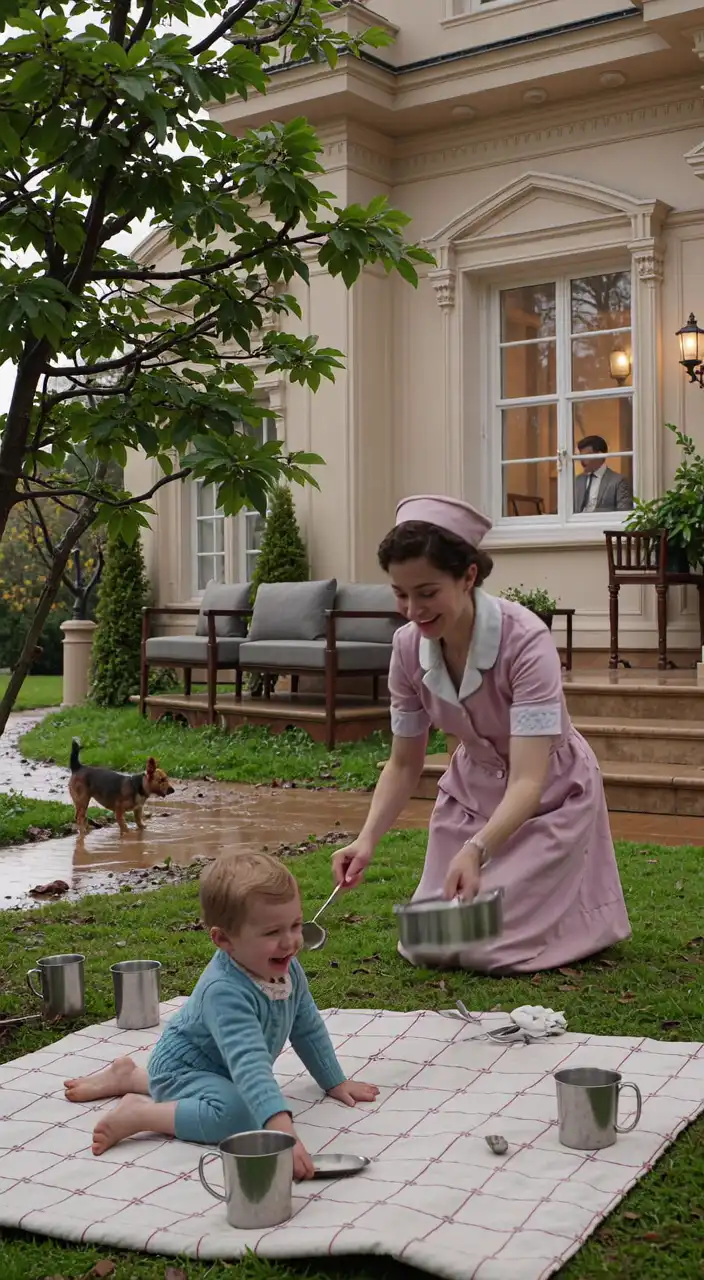
He watched from his study window as Sadie spread a thick blanket under a flowering crabapple tree. Evie sat on it in a pale blue sweater, surrounded by metal cups, spoons, and two pots that glinted in the light. Sadie sat a short distance away, giving her room. She tapped one pot softly. Evie listened.
Declan told himself he was not hovering.
Then he saw Amos the gardener wheeling supplies across the lawn near the greenhouse. A hose, left too close to the walkway, had made the stone slick. Amos bent to shift it.
At that exact moment a startled terrier from the neighboring estate squeezed through a hedge gap and bounded across the grass, barking wildly.
The sound cracked through the calm.
Evie jerked. One of the metal cups rolled off the blanket toward the damp stone path, spinning bright in the sun. The barking dog lunged after it, all excitement and movement.
Sadie stood quickly. “Easy, buddy, easy—”
The dog skidded against the hose. Amos shouted. The hose jerked loose, spraying a sudden arc of water across the path and toward the blanket.
It was small. No true danger. No catastrophe.
But to a two-year-old who hated instability, it was chaos.
Declan was already out of his chair and running before he consciously decided to move. He tore through the French doors and down the terrace steps, heart hammering.
From a distance he saw it happen.
The spray hit the edge of the blanket. The barking dog came too close. Sadie slipped slightly on the wet stone as she reached to block it from Evie.
“Sadie!” Declan shouted.
Sadie caught herself on one hand, not fallen, but off balance enough to make the moment feel dangerous.
And Evie saw it.
Saw the person who always stayed steady for her suddenly unsteady.
Something changed in the child’s face. Not panic alone. Decision.
“No!” Sadie gasped, not as a command, but in surprise.
Evie had pushed herself forward.
Her hands planted on the blanket. Her body shook. She dragged one leg under her, then the other. Declan slowed, stunned, as his daughter—his tiny terrified daughter who refused every standing exercise—hauled herself upright by grabbing the low edge of an overturned wooden crate beside the blanket.
She wobbled violently.
Sadie, half-kneeling, froze. “Evie, sweetheart—”
The dog barked again. Evie’s eyes fixed on Sadie.
Then she let go with one hand.
One step.
A crooked, desperate, miraculous half-step with her weak little legs trembling so hard Declan thought she would fall.
But she did not.
She pitched forward and caught herself against Sadie’s shoulder, standing for one second, then another, then collapsing into Sadie’s arms.
The world seemed to stop.
Water hissed uselessly across stone. Amos snatched up the dog. Mrs. Grayson cried out from the terrace. Declan stood ten feet away, unable to breathe.
Sadie was crying and laughing at the same time, holding Evie close. “You came,” she whispered. “Oh, baby, you came to me.”
Evie clung to her, chest heaving, face buried in Sadie’s neck.
Declan had imagined first steps a hundred ways. In a therapy room. Across a rug. Into his open arms.
He had never imagined them born from fear.
He had never imagined the beauty of them would hurt this much.
He took one more step closer and then stopped.
Evie turned her wet, flushed face over Sadie’s shoulder and looked at him. Not through him. At him.
His daughter had moved.
The child he had begged, coaxed, and mourned had moved because love overcame fear for one impossible second.
And Declan Mercer, who had signed billion-dollar deals without blinking, stood in the wet spring grass and wept where everyone could see.
The story spread through the house in less than an hour, but the truth of it belonged first to the people who had seen it with their own eyes.
Amos swore under his breath all afternoon, blaming himself for the hose. Mrs. Grayson ordered the neighboring terrier escorted out with offended dignity. Nolan Calder, called immediately and summoned to review what had happened, arrived skeptical and left shaken.
“She stood?” he asked for the third time in the nursery, as if repetition might make the fact less astonishing.
Sadie sat in the rocking chair with Evie curled against her, exhausted from crying and excitement. “She stood and stepped.”
Nolan looked to Declan.
Declan was by the window, hands in his pockets because he did not trust them not to tremble. “I saw it.”
Nolan crouched in front of Evie, softer than Declan had ever heard him. “Evie, can you show me how brave you were today?”
At once her body stiffened.
Sadie answered before any pressure could build. “No performance.”
Nolan looked up, perhaps ready to argue. Then he saw the warning in Declan’s face and chose wisdom for once.
“Right,” he said quietly. “No performance.”
He stood and exhaled. “Then we adjust. If she initiated movement under emotional motivation, our approach has been too mechanical.”
Mrs. Grayson, who had remained respectfully near the door, looked almost tearful. “So Miss Kline was right?”
Sadie gave her a lopsided smile. “I don’t need that in writing, but I’ll take it.”
To everyone’s surprise, Nolan actually laughed.
The atmosphere in the room shifted then. Not into celebration exactly, because Evie was still fragile, still frightened by what she had done, still clinging to the safety she knew. But opposition lost its authority. The experts had not been useless; they had simply mistaken compliance for readiness. The staff had not been cruel; they had mistaken order for care.
And Declan, standing apart, understood he had mistaken urgency for love.
He left the nursery only once, long enough to step into the hallway and put a hand over his eyes. Sadie found him there ten minutes later after Mrs. Grayson brought tea and Nolan departed with a revised therapy plan and an uncharacteristically humble expression.
“You okay?” Sadie asked.
Declan laughed roughly. “No. Yes. I don’t know.”
Sadie leaned against the wall across from him. “That seems fair.”
He lowered his hand and looked at her. “I almost sent her away.”
“You didn’t.”
“I considered it.”
Sadie’s voice softened. “Fear does ugly math.”
He nodded once.
From inside the nursery came the faintest metallic tap.
Both of them turned.
Evie had picked up a spoon from the tray Mrs. Grayson had forgotten to remove. She tapped it gently against the teacup saucer. Once. Then again. Looking toward the doorway.
Sadie smiled. “She’s calling us.”
Declan’s chest tightened. “Us?”
“Go in,” Sadie said.
“What if I ruin it?”
“You might,” Sadie replied honestly. “Then you’ll try again.”
There was no miracle in those words. That was why they mattered.
He went back into the nursery slowly. Evie watched him. He sat on the floor, not too close, and picked up another spoon. He tapped the carpet once, making no useful sound at all.
Evie blinked.
Sadie hid a smile.
Declan tried again, this time against the wooden leg of the rocking chair. Tok.
Evie lifted her spoon and answered with a tiny clink against the saucer.
A conversation.
Small. Strange. Perfect.
“Hi,” Declan whispered.
Her eyes stayed on him.
“Hi, baby girl.”
She did not speak. She did not need to.
From the doorway, Mrs. Grayson dabbed at one eye and left quietly to preserve everyone’s dignity.
That night, after Evie was asleep, Declan stood alone in the nursery before Maris’s photograph. Moonlight silvered the room. One of the little pots from Sadie’s “orchestra” still sat by the window, absurd and beloved.
“She moved,” he said to the woman in the frame. His voice broke anyway. “You should have seen her. God, Maris, you should have seen her.”
He had spent so long grieving what was gone that he had nearly failed to witness what remained.
Later, on the back terrace, he found Sadie wrapped in a cardigan against the night air, staring out over the dark grounds where the breakthrough had happened. He stopped beside her.
“Mrs. Grayson says the staff have stopped filing reports on your criminal use of cookware.”
Sadie smiled. “That’s growth.”
He looked toward the side garden. “I watched from a distance for so long because I thought if I pushed hard enough, I could force a better ending.”
“And now?”
“Now I think endings are the wrong thing to chase.”
Sadie glanced at him. “That’s also growth.”
He was quiet for a moment. “Thank you.”
She shook her head. “Don’t make me a miracle worker. She did the brave part.”
“I know.” He swallowed. “But you taught us how to see it.”
The wind moved gently through the trees. Somewhere in the house, a floorboard settled.
Declan had built a life on control, on predictions, on leverage and outcomes. None of that had prepared him for the unbearable tenderness of watching his child choose movement for love.
The breakthrough did not cure anything. Evie’s legs were still weak. Her fear would return. There would be therapy and tears and setbacks and long days ahead.
But the family was no longer organized around despair.
That changed everything.
The next weeks did not unfold like a fairy tale.
Evie did not wake up walking. She did not suddenly race across the gardens in sunlight while everyone cried. Some mornings she still refused her braces. Some afternoons she tired quickly and buried her face in Sadie’s shoulder when too much was asked of her. She took no great interest in proving what she could do.
But now there was memory inside her body.
She had stood.
She had stepped.
And because of that, the world no longer ended at the edge of her blanket.
Declan changed too, though less dramatically from the outside. He began coming home before dark three nights a week, then four. He moved one standing investor call to remote so he could sit in the sunroom at eight o’clock with a spoon and a bowl while his daughter considered whether to include him. He learned not to fill silences with pleading. He learned to sit near her and let her blue eyes find him in their own time.
One morning, while Sadie sorted laundry on the rug and Evie leaned against a cushion tapping a measuring cup, Declan sat nearby reading from a board book in a ridiculous dramatic voice.
Sadie murmured, “You sound like a pirate with allergies.”
He looked offended. “This is excellent character work.”
Evie made that almost-laugh sound again.
Declan stopped reading and smiled at her, but gently this time, not grabbing at the moment. “You agree with her, huh?”
Evie lifted her spoon and tapped the cup once.
“Yes,” Sadie translated. “Devastating review.”
The house changed around them. Mrs. Grayson stopped correcting every deviation from routine and started leaving acceptable “orchestra supplies” in a basket by the sunroom. Amos planted a softer patch of clover off the side garden path where little feet could one day practice. Even Nolan Calder adjusted, designing sessions around trust and motivation instead of force.
One late afternoon, Declan stood at the nursery door and watched Sadie by the window while Evie held the crib rail and bore weight on both legs for three trembling seconds. It was not dramatic. It was not witnessed by doctors or servants or fate.
It was just another step in a long road.
Sadie looked over and saw him there. This time she did not signal him to stay back.
She only smiled as if to say, Come when you’re ready.
So he did.
In the months ahead, there would still be hard days. Evie’s fear would not vanish because one brave moment had cracked it open. Sadie’s place in their lives had no neat label yet, and none of them seemed in a hurry to force one.
What mattered was movement. Not only in Evie’s legs, but in the whole house.
The mansion no longer sounded like grief holding its breath. Sometimes, from the open windows facing the gardens, there came the bright, uneven music of pots and pans, and the softer answering rhythm of a family learning, at last, how to follow.
Disclaimer: Mention of any brand or trademark is for identification only and does not imply partnership or endorsement