CRYSTAL GALA, RED HANDS
The doors hit the walls hard enough to shake the brass handles.
Three camera lights snapped on at once.
Then five more.
The room, which had gone dim under the chandeliers, suddenly looked harsher than before. White light cut across sequins, diamonds, rented tuxedos, and frozen smiles. A woman near the silent auction table actually tried to duck behind a flower arrangement. A man from one of the local banks put his champagne flute behind his back like that might erase the logo on the step-and-repeat ten feet away.
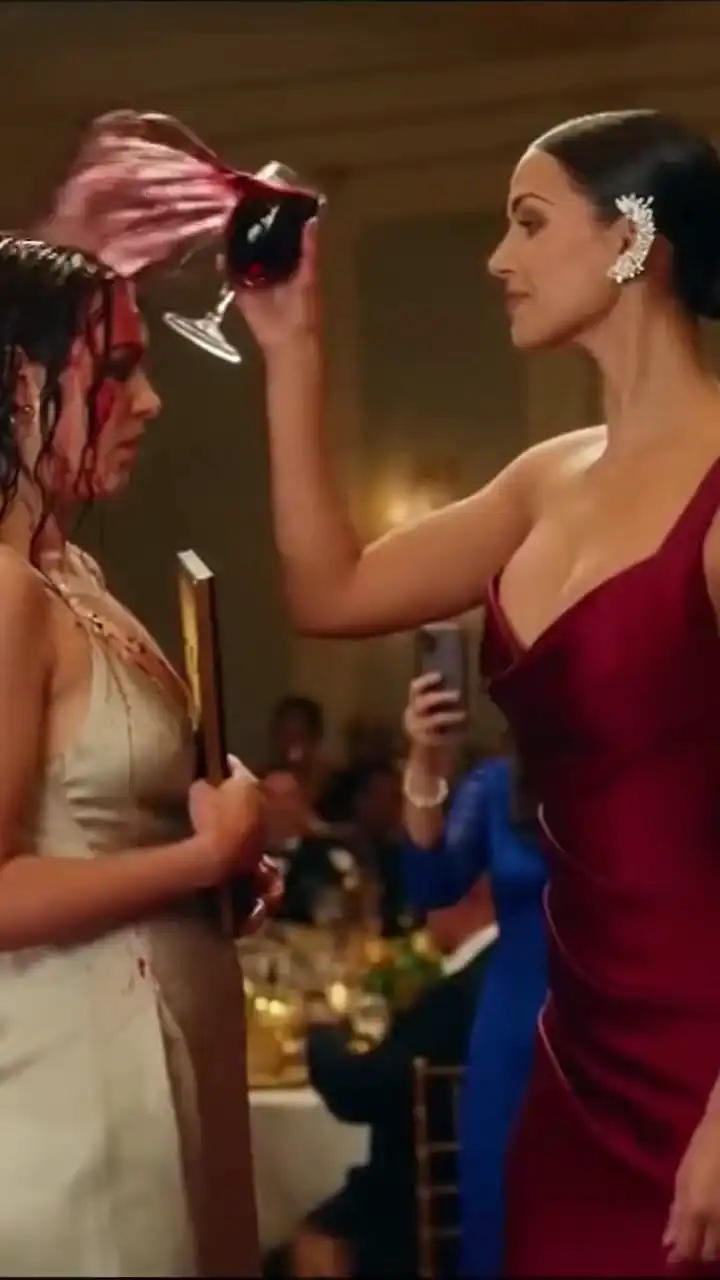
The patron who had poured the wine on me was still holding the stem of her glass.
Empty now.
Her hand shook once.
Then she did what people like her always do first.
She recovered for the room.
“This is a stunt,” she said, sharp and clear, turning her face toward the cameras as if she were choosing her best angle. “Remove her.”
She pointed at me like the whole ballroom hadn’t just watched her soak a server and order her to kneel.
One of her bodyguards reached for my arm.
The tablet under my apron buzzed again.
I tapped it once.
Every microphone in the room went live.
The sound of her own voice came back through the ceiling speakers, just a half-second delayed, metallic and cruel.
“You being alive is already a waste.”
It echoed under the crystal chandeliers.
Nobody laughed this time.
The bodyguard let go of me.
Good instinct.
Because the first reporter through the doors already had his phone held high and was saying, “Ma’am, can you explain the vendor payouts on the screen? Are these forged invoices tied to your foundation?”
The giant display above the stage kept scrolling.
Not dramatically.
Methodically.
Line items.
Transfers.
Shell vendors.
Payments split into clean-looking amounts designed not to trigger automatic review.
The patron finally looked at the screen the way someone looks at a staircase that has vanished under their foot. Her mascara was still perfect. Her mouth wasn’t.
“Turn that off,” she hissed.
I didn’t move.
Neither did the room.
The auctioneer had stepped back from his podium and was staring up at the donor screen like it had become a weapon. To his right, the charity’s executive director was pressing both hands to her own chest, not from shock exactly, but from calculation. I could see it happen in real time. She was deciding how much she had known, how much she could deny, and whether standing next to the patron another ten seconds would ruin the rest of her career.
The answer arrived fast.
She took one careful step away.
Then another.
That was when the reporters recognized her movement for what it was.
Separation.
Abandonment.
Blood in the water.
Questions started flying over each other.
“Did the foundation knowingly route donor money through Mercer Events Group?”
“Why is the same address attached to three separate contractors?”
“Who approved the auction settlement transfers?”
“Is it true the gala staff were paid cash under market to avoid payroll reporting?”
That one turned half the service staff toward the stage.
Including me.
Because that part was true.
Not just tonight.
For months.
I had been in that ballroom in a black server dress for three hours.
I had been inside her system for eleven weeks.
Not because I cared about rich people humiliating workers.
Though I did.
Not because of the fake charity branding.
Though that was rotten enough.
I was there because six months earlier my younger brother’s clinic lost its funding after the patron’s foundation publicly promised emergency grants, announced them on every local channel, then quietly rerouted the money through “event outreach” and “donor engagement initiatives.” Those phrases sounded polished. They looked clean on paper. In practice, the pediatric dialysis chairs were sold off two months later.
My brother never said her name.
He just showed me the letter.
Grant delayed.
Resources reallocated.
Community impact strategy under review.
He folded the paper once, very neatly, and put it on the kitchen table beside his medication schedule.
He was twenty-four.
He still believed letters meant something.
I did not.
I worked operations for a media systems contractor then, mostly temporary installs for conferences and hotel events. Screens. Lighting bridges. Donor dashboards. Streaming backups nobody noticed unless they failed. The kind of work rich people ignore until the room stops obeying them.
Three weeks after the clinic lost funding, I saw her on television.
Same smile.
Same posture.
She stood under a chandelier at a luncheon and talked about dignity, access, and service while a lower-third graphic praised her as a visionary patron of public health.
I looked at the screen and recognized the AV vendor logo in the corner.
Then I recognized something better.
The donation platform.
Cheap backbone.
Lazy permissions.
Too many admin levels given to too many subcontractors because wealthy people always assume anyone wearing black and carrying cables is invisible.
I didn’t come tonight to ruin a party.
I came because I knew she was using this gala to close a matching-funds campaign with three local hospital boards in attendance, plus two city reporters she thought were coming for lifestyle coverage. If the numbers went public during the event, while donors, press, trustees, and cameras were all in one room, denial would get slower and consequences would get faster.
But none of that was why she poured wine on me.
That part was almost stupid.
She thought I was someone else.
I saw it in her face the moment she did it.
Not recognition.
Projection.
Earlier, while I was collecting glasses near the silent auction wall, she had stared at me too long. I had dark hair pinned back, a plain black dress, white apron, service badge. She came closer with two women orbiting behind her and said, “You worked at the Lakeview launch, didn’t you?”
I said, “No.”
She kept looking.
Then: “Right. You all blur together.”
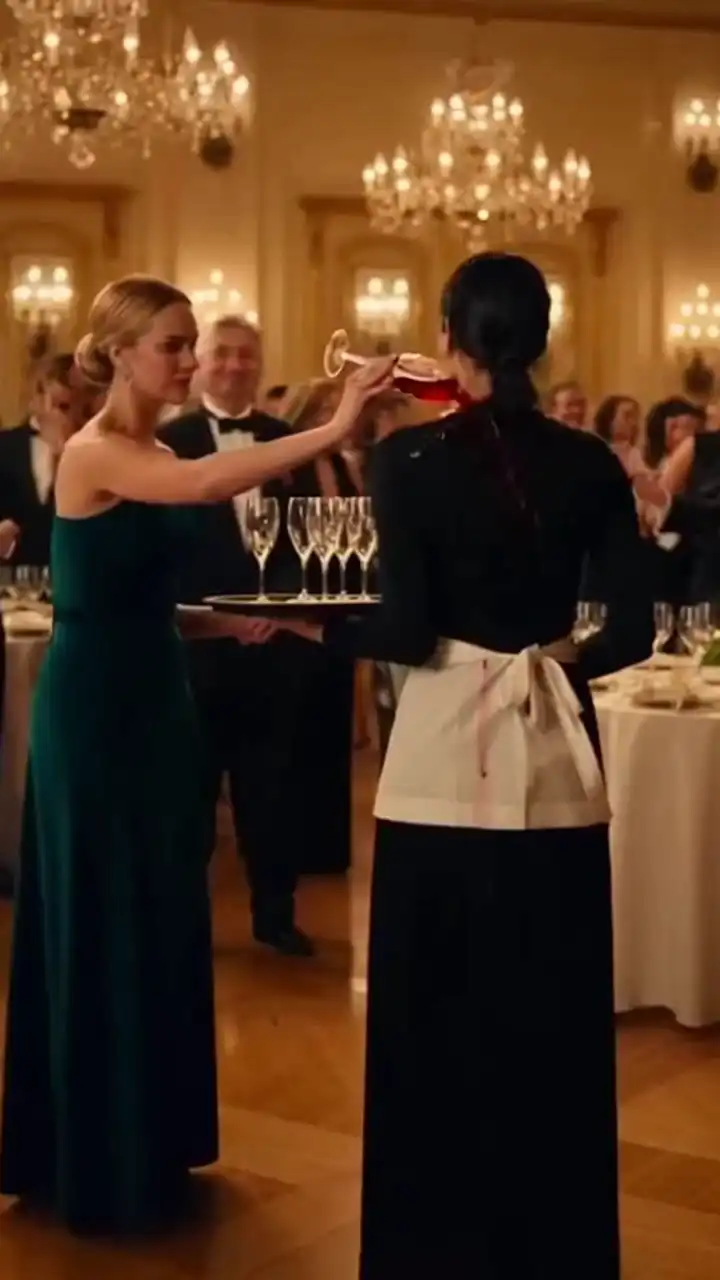
An hour later, after the first auction round, I passed near her table again carrying a tray of Bordeaux refills.
One of the women beside her said, not quietly enough, “Is that the blogger?”
The patron’s mouth changed.
There it was.
Wrong target.
Some younger woman had apparently embarrassed her somewhere else, maybe with a story, maybe with a camera, maybe just by existing without enough deference. She looked at me, saw a class position she disliked, and decided resemblance was enough.
That was the backstory of the wine.
Not vengeance.
Convenience.
Cruelty likes shortcuts.
On stage, under the donor screen, she was running out of them.
“Those records are stolen,” she said. “This woman infiltrated a private event.”
A reporter answered before I could.
“She was invited by your staffing contractor.”
Another camera turned toward the back of the room where the staffing manager stood visibly shrinking inside his dinner jacket. He had spent the night barking at waiters like we were furniture. Now he looked like he wanted to crawl into one of the floral centerpieces and stay there.
The patron tried again.
“She assaulted the integrity of a charitable foundation.”
That landed badly.
Mostly because the screen changed just then.
I hadn’t planned it as theater, but the timing was perfect.
The donor leaderboard dissolved into a set of internal messages, each stamped with date, time, and sender ID. Her name sat at the top of multiple chains. Beneath one of them was a sentence I had read at least twenty times during prep, partly to confirm it was real and partly because of how casually evil it was.
Move the clinic allotment into gala acquisition and bury the variance after Q4.
A reporter near the stage read it aloud.
No one in the room pretended not to hear.
The executive director actually made a sound. Not a word. More like a dropped breath.
One of the hospital trustees, an older man with silver hair and a lapel pin shaped like a cross, turned toward the patron and said, “Did you do that?”
He sounded less outraged than offended to be made a witness.
That mattered.
People like him forgive theft.
They resent embarrassment.
The patron straightened. “Those messages are incomplete.”
“Are they fake?” the trustee asked.
She didn’t answer quickly enough.
That was enough answer.
I could feel the entire room recalibrating around her. Donors were stepping away in smooth little half-moons. The bodyguards, who had looked huge five minutes ago, suddenly seemed ornamental. One of them touched his earpiece and looked toward the side exit, not at me but at his principal, measuring the route.
Too late for that too.
Because more media had arrived.
Not society pages.
Not lifestyle bloggers.
Actual investigative desks.
A producer I recognized from the city station came through the doorway talking into her headset while two camera operators spread left and right to capture the room. Behind them came a print reporter who had been chasing nonprofit procurement scandals for almost a year. I knew her byline because I had emailed her from a burner account nine days earlier with three redacted screenshots and a note that said, If you want the full ledger, be at the Mercer Children’s Benefit at 8:40 p.m. sharp.
8:40 had become 8:52.
Mostly because red wine takes time.
The print reporter saw me, saw the soaked apron, saw the screen, and knew instantly where the center of the story was.
Not charity fraud.
Humiliation plus fraud.
That would run hotter.
She crossed the ballroom fast.
“Did she pour wine on you after the screen changed?” she asked.
“Before,” I said.
“Why?”
“She thought I was disposable.”
The reporter wrote that down.
The patron heard me.
For the first time all night, the look she gave me wasn’t dismissive.
It was focused.
Dangerously so.
“You planned this,” she said.
“Yes.”
She took one step toward me, then stopped when six cameras swung with her.
“You came here under false pretenses.”
“You built a charity under false pretenses.”
That one hit.
A few heads turned sharply.
A donor near the front actually muttered, “Jesus,” to nobody.
The patron lifted her chin. “Do you know what you’ve done?”
I looked at the screen above her.
“Enough.”
For a second I thought she might slap me.
Instead she smiled.
Worse.
People like her trust the second line of defense more than the first. If cruelty fails, they reach for contamination. They try to make the accuser look dirty enough that facts become impolite to examine.
“She’s blackmailing us,” the patron said loudly. “She contacted members of the press in advance and manipulated internal records. This is extortion.”
It was a smart move.
Not morally.
Operationally.
She wasn’t trying to convince everyone. Just enough people, for just long enough, to get herself out the side door and into a car.
So I gave the room something cleaner than my word.
I reached beneath the wet apron, unclipped the tablet, and held it out to the nearest camera.
On the display was a mirrored feed from the ballroom’s own server stack. Live directory logs. User IDs. Access timestamps. The top administrative credentials weren’t mine.
They were hers.
And below them, the scheduled purge command set to run at 11:59 p.m.
Delete archives.
Clear reconciliations.
Push donor summary export.
Smile for photos.
Start over tomorrow.
The producer from the city station saw it first.
“Get that,” she snapped to her camera operator.
The lens pushed close.
Her face changed.
Then she looked up at the patron and said, “Were you planning to erase these records tonight?”
The patron didn’t answer.
Another reporter asked, “Did you divert restricted donations from a pediatric clinic?”
Still no answer.
Then the room delivered the thing no one rich ever expects when they publicly degrade a worker.
Witnesses.
Real ones.
Not moral witnesses.
Practical ones.
The catering captain raised her hand first, voice shaking but loud. “She told us to cut staff meals and bill them as floral overflow.”
A valet from the entrance said, “Her office paid us in envelopes at two events.”
One bartender, still standing behind a row of untouched coupe glasses, said, “We were told to backdate invoices.”
The staffing manager tried to shut them up.
He made it one word.
“Quiet—”
The print reporter rounded on him so hard he actually flinched.
“No,” she said.
And the room understood.
This was no longer her stage.
It belonged to whoever spoke next.
That’s when the patron broke.
Not in tears.
Not dramatically.
She just stopped performing elegance.
Her voice dropped half an octave and all the polish burned off.
“You stupid girl,” she said to me, low but still picked up by three live mics. “Do you have any idea how many people you just hurt?”
The line hung there.
Wrong choice.
Because the answer was waiting in me, ready long before the wine.
“Yes,” I said. “That’s why I came.”
Silence again.
Different this time.
Heavy.
No laughter.
No violin track from hidden speakers.
No auctioneer trying to recover the mood.
Just cameras, the hum of the lighting rig, and the click of a donor setting down his glass because his hand had started to shake.
Security from the hotel finally entered the ballroom, but by then they weren’t looking at me. They were looking at the fight between public scandal and private power and deciding which side their incident report needed to survive.
Then came the thing I hadn’t arranged.
Actual law enforcement.
Not federal agents with dramatic timing.
Two city financial crimes investigators and one uniformed officer who had clearly been pulled from the lobby after reporters started shouting words like fraud and embezzlement into their phones.
They didn’t rush.
They walked straight to the executive director first.
Smart.
Separate the frightened institution from the falling patron.
The executive director began talking immediately, hands open, palms visible, already converting herself into a cooperating witness.
The patron saw that and went pale for real.
Not camera pale.
Administrative pale.
She tried one last move.
She turned toward the side corridor.
One bodyguard shifted with her.
The uniformed officer stepped into the lane without touching her.
“Ma’am,” he said.
That was all.
She stopped.
The reporters surged a little closer.
Questions again.
“Did you retaliate against clinic grants?”
“Did you assault a worker?”
“Were donors misled tonight?”
“Is your family office tied to Mercer Events Group?”
The patron finally said the only honest sentence she had spoken in hours.
“I want my attorney.”
No one answered.
No one needed to.
By then the giant screen had frozen on the message about the clinic allotment. Her name sat above it like a signature carved in glass. Behind her, on the stage she paid for, under the chandelier she had chosen, in front of the donor board built to glorify her, she looked smaller than the soaked bill still stuck to the front of my apron.
The next thirty minutes were just consequences finding parking spaces.
Trustees moved into side rooms.
Reporters occupied the foyer.
Guests who had arrived for a charity spectacle left through a corridor lined with cameras and questions. Some covered their faces. Some gave statements they would regret by morning. One donor loudly announced he was “suspending future commitments pending review,” which was rich-person language for I need plausible distance immediately.
Hotel management shut down the remainder of the event.
The auction lots stayed on velvet pedestals under dead spotlights.
The quartet packed in silence.
A little after ten, someone from the station asked if I would go on camera.
I said no.
Not then.
I gave them copies instead.
Encrypted drive.
Mirror logs.
Message exports.
Payroll discrepancies.
The things that mattered more than my face.
By midnight, the foundation’s website was offline.
By dawn, three board members had resigned.
By noon the next day, the attorney general’s office announced an inquiry into restricted donation misuse and financial reporting irregularities tied to the foundation and affiliated vendors.
Within forty-eight hours, the hospital boards suspended all joint campaigns.
The staffing contractor blamed the patron.
The patron blamed a rogue finance consultant.
The finance consultant produced emails.
Then came the clinic list.
That part hit hardest.
Not because the numbers were biggest.
Because the names were small.
Neighborhoods.
Programs.
Mobile screenings.
Pediatric dialysis.
Transportation vouchers.
The things people call supplemental until they disappear.
My brother saw the headlines before I did.
He texted me one screenshot and six words.
So it was really her.
I stared at that message for a long time.
Then I wrote back: Yes.
He didn’t ask what I had done.
Maybe he knew.
Maybe the answer was already on every local channel, looped beneath footage of a woman in a silver evening gown pouring wine on a server seconds before her own donor screen turned against her.
They played that clip for three days.
Then for one more week in compilation segments about power, optics, and charity fraud.
The patron’s family office dropped her from public operations first.
Then the museum board.
Then the hospital gala circuit.
One luxury brand quietly erased her from a campaign archive.
A university committee removed her name from an advisory page overnight, leaving a blank space in the layout until someone fixed the design the next morning.
The foundation itself didn’t survive the quarter.
Asset freeze.
Audit hold.
Emergency oversight.
Then dissolution.
Not clean.
Never clean.
Donors sued.
Vendors sued.
Former employees talked.
The executive director cooperated fully, which is the legal phrase for saving yourself by carrying documents with both hands.
As for the assault charge over the wine, the hotel cameras had excellent angles.
Crystal-clear, actually.
Her attorney pushed for a quiet settlement.
No admission.
Standard language.
I declined the private version.
The public one arrived instead in the form of a plea to a reduced charge and a civil payment large enough to reopen two treatment chairs at the clinic that had lost funding.
Not enough.
Specific, though.
Irreversible in its own way.
Months later, after the noise dropped and the city found a newer scandal to chew on, I went back to that hotel once.
Daytime.
No gala lighting.
No carpet runners.
The ballroom doors were open for a corporate luncheon setup. Round tables again. White cloths. Water glasses waiting in straight lines for hands that would assume they had always belonged there.
A worker on a ladder was replacing one of the ballroom screens.
I stood in the doorway for a second and looked at the stage.
Same chandelier.
Same polished floor.
No donor names.
No violin music.
No woman in silver with a glass in her hand.
Just a coil of black cable on the wood where the podium usually stood, catching the light like a line someone had finally stopped pretending not to see.
Disclaimer: Mention of any brand or trademark is for identification only and does not imply partnership or endorsement