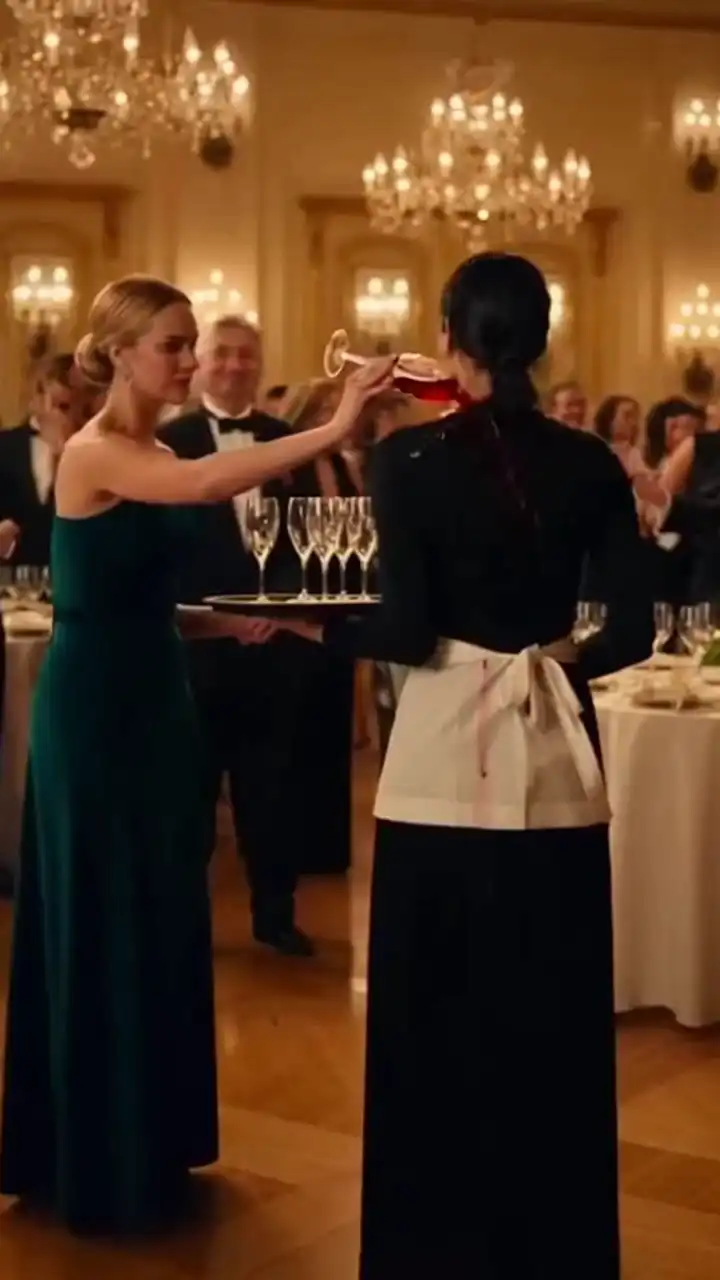

THE WINE EXPOSED THE WRONG PERSON
The room stayed still for half a second after the title page appeared.
Then every head turned from the screen to me.
My mother-in-law was still standing over my chair, two fingers lifted from my soaked shoulder as if the touch itself had burned her.
On the projector behind the cake was a line nobody at that table expected to see at a birthday dinner.
PRIMARY VOTING CONTROL — HAN RIVER HOSPITALITY TRUST.
Under it, in black lettering sharp enough to read from the back wall:
Interim Controlling Signatory: Elena Vale.
My name.
No one spoke.
Then the speakers repeated the clipped line they had just pulled from the live mic.
“She is not family.”
It echoed harder the second time.
A cousin lowered his phone.
An uncle near the elder seat stood up too fast and knocked his chair back.
My husband looked at the screen, then at me, then at his mother. “What is this?”
I wiped wine from my chin with the back of my wrist. “Evidence.”
That was all I said.
Because the next ten seconds said the rest for me.
The side screens changed again.
Not to photos.
Not to music.
To a document index.
Trust transfer notice.
Board emergency proxy.
Operating covenant.
Breach review trigger.
Someone at the far table whispered, “Turn it off.”
A younger woman near the cake table tried to laugh it away. “This has to be some weird joke.”
“It isn’t,” I said.
My mother-in-law found her voice before anyone else found theirs.
“You did this?” she snapped. “At my husband’s birthday?”
Her husband.
The old man at the head of the main table.
The one everyone called Chairman even after retirement because no one in that family had learned how to separate family from ownership.
He hadn’t moved much during the humiliation.
He moved now.
He turned, slowly, from the screen toward me. His napkin was still folded over one knee. His cake knife sat untouched by his plate.
“Elena,” he said, calm enough to cut the room in half. “Explain.”
I could have.
I could have started with the legal language.
I could have started with the acquisition.
I could have started with the deathbed amendment from a woman half the family never mentioned.
Instead I looked at my mother-in-law.
“At the exact moment she poured that wine,” I said, “the room mics were already recording to the event archive. When she said I was not family and not fit to sit at this table, she triggered the review clause.”
A few faces went blank.
The chairman’s did not.
He knew enough to understand exactly which clause.
My husband did not.
He looked between us like someone had opened a floor panel under his feet.
“What review clause?” he asked.
The answer came from his grandfather, not me.
“The one your grandmother wrote,” the old man said.
That landed like a dropped tray.
No one used her name at family events.
Not because they forgot her.
Because she had been the one person in that family who believed assets should be insulated from bloodline stupidity.
She built the original trust structure before she died.
She built it after watching her sons use businesses as leverage, marriages as transactions, and family dinners as little courts.
She had written one ugly sentence into the covenant years ago, and every major heir had signed around it because they were too proud to imagine it would ever be used against them.
Any publicly documented act of familial exclusion against a lawful spouse, adopted heir, or designated dependent by a voting family member during a formal family event would trigger a temporary review of suitability over hospitality-related holdings.
Hospitality-related holdings.
Hotels.
Venues.
The private club.
The banquet properties.
The resort licenses.
Not all their wealth.
Just enough of it to matter.
Just enough to hurt.
And six months earlier, without anyone at that table noticing, the only person positioned to hold that temporary voting block during any review was me.
Not by marriage.
By contract.
By quiet purchase.
By timing.
By one dead lawyer and one living trustee who still honored exact words.
A woman at the second table said, “That’s insane.”
“No,” the chairman said. “That’s your grandmother.”
He was still looking at the screen.
My mother-in-law laughed once, sharp and ugly. “A dinner speech cannot strip me of anything.”
“No,” I said. “Your speech can trigger scrutiny. The signatures did the rest.”
The ballroom doors opened.
That was the moment Part 1 ended.
And the next thirty seconds began.
Three people came in wearing dark suits, no drama, no raised voices. Behind them was the venue’s general manager, pale and sweating through his collar. Behind him was a woman carrying a hard portfolio case.
Not police.
Worse for this family.
Outside counsel.
The lead attorney was older, silver-haired, expressionless. He did not rush. He did not apologize for arriving at a birthday dinner. He walked straight past the cake and stopped where everyone could see him.
“Mr. Vale,” he said to the chairman, “we received the alert and reviewed the live event archive. Under the covenant, we are required to preserve all recordings and serve notice immediately.”
My mother-in-law stepped toward him. “You will leave.”
He didn’t look at her.
The woman with the portfolio opened it and removed a packet with colored tabs.
“Judith Vale,” she said.
My mother-in-law actually flinched at hearing her own first name in that tone.
“You are hereby notified,” the attorney continued, “that your voting privileges over Han River Hospitality assets are suspended pending formal review, effective now.”
The silence after that was so complete I could hear the soft electrical hum from the projector above us.
Then everything broke at once.
“What?”
“Suspended?”
“This is insane.”
“There are guests here.”
One of the older uncles barked at the lawyer. “You can’t ambush family at a private event.”
The lawyer finally looked at him. “The event became legally relevant when a designated review trigger was recorded.”
My husband stared at me like he had never seen my face before.
“When were you going to tell me?” he said.
“When you were ready to hear it without asking your mother what to think first.”
That hit him harder than the legal notice.
Because it was true.
He was not a cruel man.
That was the problem.
Cruel people are easier to read.
He was soft in all the places where softness becomes permission.
He let things slide.
He let comments pass.
He let seating charts become messages.
He let me be introduced as “his wife” and never by my name.
He let his mother turn every gathering into a test of how much humiliation could be disguised as tradition.
Tonight she had stopped disguising it.
And now there was a record.
The chairman finally rose from his seat.
At his age, nobody interrupted him when he stood. Not even his daughter-in-law.
He walked to the projector screen with the steadiness of someone who had built his life by never hurrying in public. He read the title page. He read the timestamp in the lower corner. He read the trust seal.
Then he turned to me.
“Did you arrange tonight?” he asked.
“No.”
“Did you arrange the system link?”
“Yes.”
That got a stir from the room.
I didn’t bother softening it.
The birthday montage, the family crest loop, the photo reel, the event archive, the mic feed, the emergency projection path — all of it ran through one of the venue companies under the trust.
My team had upgraded that system three months earlier.
Not because of this dinner.
Because I owned the company that serviced the entire chain.
A company I had acquired quietly the previous year through a holding group no one in the family had bothered to track because they assumed I was decorative.
That was the real mistake.
Not the wine.
Not even the speech.
The mistake was deciding what kind of woman I was before asking what I controlled.
My mother-in-law pointed at me with a shaking hand. “You trapped me.”
I looked down at the wine on my dress.
“No,” I said. “I gave you a microphone.”
A sound came from one of the side tables that might have been a gasp or a choked laugh.
She heard it.
Her face darkened.
Then she did what small tyrants do when the stage turns.
She searched for a smaller person to crush.
“Mark,” she snapped at my husband, “say something. Fix this.”
He didn’t move.
For maybe the first time in his life, he did not answer her immediately.
The chairman noticed.
So did everyone else.
The attorney began placing packets on the nearest table, one by one, careful not to disturb the centerpieces. “Notice of review. Preservation directive. Interim governance instructions.”
The words sounded dry.
Their effect was not.
Phones came back up, but now they weren’t filming me.
They were filming her.
An aunt reached for a packet and stopped when she saw her own husband’s name in the cc list.
The venue manager spoke quietly to one of the staff.
Within seconds, the house music did not return.
Neither did the birthday slideshow.
The giant screen stayed frozen on the trust seal over my name.
My mother-in-law turned to the chairman. “Say this is temporary.”
“It is temporary,” he said.
She exhaled.
Then he finished.
“If you survive review.”
That ended her.
Not publicly.
Not in one clean fall.
People like her rarely collapse all at once.
They lose altitude in visible layers.
First came authority.
She reached for it and found no one moving on command.
She told the staff to shut off the projector.
No one did.
She told a bodyguard-looking family retainer to remove the lawyers.
He looked at the chairman first.
The chairman said nothing.
So the man stayed where he was.
Then came image.
A younger guest forwarded the clip before anyone could stop him.
I knew because my own phone vibrated twice inside my clutch.
The first message was from my operations director:
Did you mean for this to happen on-site?
The second was from a trustee I had never met in person:
Clause activated. Hold position. Do not leave before signatures.
Then came fracture.
One uncle began loudly blaming the chairman for allowing “that dead woman’s madness” into the trust. Another blamed Judith for speaking at all. A cousin accused the lawyers of staging a power play. The aunt who had laughed behind her napkin quietly moved two seats away from my mother-in-law without being told.
My husband still hadn’t spoken.
I watched him look at the stain on my dress, then at the packet in front of his mother, then at the screen with my name.
When he finally did speak, it wasn’t to me.
“Did you really plan to make her clean the floor?” he asked his mother.
Judith stared at him.
Of all the legal damage landing in that room, that was the question that made her look offended.
“She should know her place,” she said.
There it was again.
Not strategy.
Not denial.
Belief.
The chairman closed his eyes for one brief second.
When he opened them, he looked older.
“Leave the table,” he told her.
She laughed, disbelieving. “You’re dismissing me?”
“I am preventing further damage.”
“This is my family.”
“No,” he said. “Tonight you proved you think it is your audience.”
She looked around for support.
She found almost none.
That was the thing about public humiliation.
It feels powerful only while the room believes the target is alone.
The second the room senses power has shifted, cruelty becomes embarrassing.
People started studying their plates.
Checking messages.
Adjusting jackets.
Suddenly no one wanted to be on record as having enjoyed the show.
Judith turned on me again because I was the only person still meeting her eyes.
“How much?” she said.
The question was so naked the room actually reacted.
Not outrage.
Recognition.
They all understood that this was how she thought. Every problem had a purchase price. Every silence could be bought. Every loyalty rented.
“How much to bury this before review?” she said.
The attorney answered for me.
“You just attempted interference in front of witnesses,” he said, and wrote something in the margin of his copy.
She went pale under her makeup.
That was the first real sign of fear.
The second came when the chairman asked, “Who drafted the side agreements for your preferred vendor contracts?”
She blinked. “What?”
“The floral company. The event staffing shell. The transport invoices. If review opens, they open too.”
A crack ran through her composure.
Because of course there were side agreements.
There always are.
The family preached elegance and ran on petty extraction.
Every birthday, anniversary, memorial lunch, club gala, and charity brunch had a chain of cousins and favored friends taking percentages through little approved vendors.
Not enormous theft.
The sort that survives by looking tacky rather than criminal.
But tacky theft looks different under legal light.
She sat down slowly.
That was new.
I had never seen her sit because a room made her.
The lawyers moved through signatures.
Preserve footage.
Freeze nonessential transfers.
Schedule board review at nine a.m.
The chairman signed with a hand that did not shake.
Then the packet came to me.
My wine-stained sleeve brushed the paper as I signed the interim acceptance.
Elena Vale.
Again.
Again.
Again.
Every signature made the role more visible to the room.
Not guest.
Not tolerated wife.
Not outsider.
Gatekeeper.
That word never had to be spoken.
Everyone could see it.
My husband stepped toward me while the lawyers collected the documents.
“I didn’t know,” he said.
“I know.”
“You should have told me.”
“I should have needed to?”
He had no answer.
Because both things were true.
I had hidden the extent of my control.
And he had accepted a house where I was treated as if I brought none.
He looked at the stain on my dress again.
“I’m sorry,” he said.
This time he meant it in a way that did not ask for immediate forgiveness.
That mattered.
A little.
Not enough.
But a little.
At the far end of the room, staff quietly removed the ruined chair cover and mopped the floor around my place setting.
No one asked me to do it.
No one looked at me while they did.
Good.
Humiliation had already had enough audience for one night.
The birthday cake began to sag under the heat of its own candles.
No one had blown them out.
One by one, the little flames shortened and bent.
Judith was still seated, very straight, hands flat on the tablecloth, as if posture alone could keep rank from leaking out of her.
The chairman addressed the room without raising his voice.
“Dinner is over,” he said.
No one argued.
Chairs moved.
Phones disappeared.
People began leaving in clumps, each cluster already deciding on a version of the story that made them look less complicit.
I knew how that worked.
Tomorrow some would say they were shocked.
Some would say they tried to intervene.
Some would say Judith had been under stress.
A few would privately admit they had always wondered who actually controlled the hospitality trust.
By noon, everyone would know.
Outside the ballroom, the attorneys wanted ten more minutes.
Inside a side lounge, beneath framed black-and-white photos of the family’s first hotel, they completed the interim handover checklist.
Account access notifications.
Communications freeze.
Property managers to be briefed before dawn.
No disposals without countersignature.
Judith was barred from directing event operations, vendor payments, and venue staffing until review concluded.
Specific.
Irreversible enough.
Even if she somehow clawed back status later, tonight’s image would not wash off.
The clip was already moving.
Her words.
Her hand.
The wine.
My name on the screen.
In family businesses, legal consequences hurt.
Public pattern recognition hurts more.
When I came back through the emptying hall, the old man was alone at the head table.
The cake had been cut by staff, not family.
The first slice still sat untouched near his plate.
He looked up when I approached.
“You knew she’d show herself eventually,” he said.
“Yes.”
“You did not know it would be tonight.”
“No.”
He nodded like that answer satisfied something private in him.
“She underestimated the wrong woman.”
“She underestimated contracts,” I said.
That almost made him smile.
Almost.
He glanced at the stain on my dress. “Your grandmother would have liked that line.”
Not my grandmother.
His wife.
The architect of the clause.
The woman who wrote traps into polished documents because she knew exactly what this family became when it thought no one was keeping score.
“I never met her,” I said.
“No,” he said. “But she planned for you anyway.”
That sat between us for a moment.
Then he pushed the untouched cake plate aside.
“Tomorrow will be ugly.”
“I know.”
“Will you keep the properties?”
“For now.”
He nodded again.
Business answer.
Good enough.
When I turned to leave, my husband was standing near the ballroom doors with my coat over his arm.
I took it.
He did not try to touch me.
Smart.
“Are you coming home?” he asked.
“Not tonight.”
He lowered his eyes once, then looked back up. “I’ll speak to counsel in the morning. On my own.”
That was also new.
I gave him the smallest nod I could honestly offer.
Outside, the night air caught the wine still drying on the silk. The valet lane reflected the chandeliers in broken gold strips across wet pavement.
Behind me, through the ballroom doors left open a crack, I could still see the screen.
The trust seal had not changed.
Neither had my name beneath it.
A busboy carried out the white tablecloth from my place setting, folded inward around the dark red stain so it wouldn’t show until someone opened it again.
Disclaimer: Mention of any brand or trademark is for identification only and does not imply partnership or endorsement