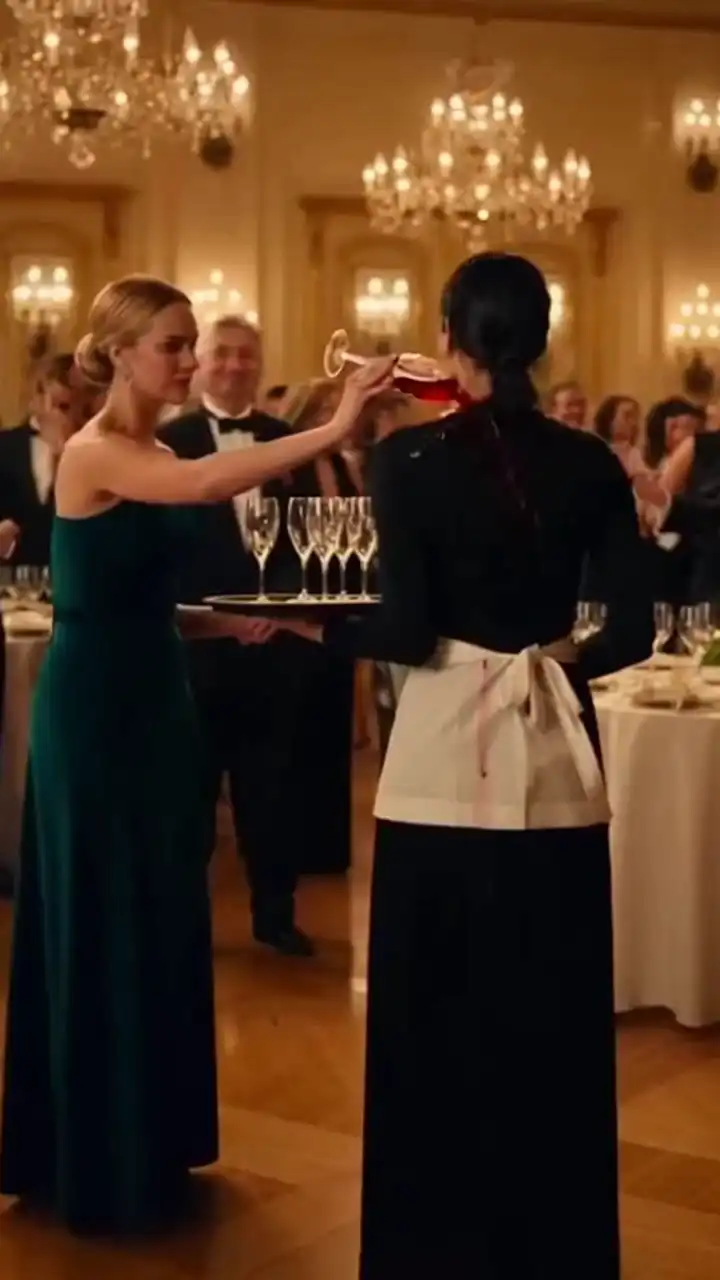

CRIMSON ON GLASS
The terrace went so quiet I could hear the pool filter turning over beneath the infinity edge.
Rex stared at the screen.
Not at me.
At his own name, twenty feet tall, hanging over the wine bar.
The woman in front of the agents didn’t rush. She had a dark suit, a low bun, and the kind of calm that makes rich men understand money won’t help.
“Rex Halden,” she said, stopping just inside the glass doors. “Do not leave the property.”
His driver moved first.
Bad choice.
One of the agents stepped in front of him so smoothly it looked rehearsed, because it was. The driver froze with one hand half-raised, glanced at Rex, then lowered it.
The guests started doing what guests always do when power changes hands.
They stepped backward without wanting to look like they were stepping backward.
Rex found his face again before he found his voice.
“This is insane,” he said. “Who the hell let them in?”
I looked down at the red wine drying across my blouse, then at the badge case by my heel.
“You did,” I said.
His eyes snapped to me.
Really saw me.
For six months I had been the invisible one in his orbit. Scheduling flights. Confirming guest lists. Reprinting contracts at 1:00 a.m. Standing three steps behind his shoulder while he lied to investors and flirted with their wives and called people “assets” when he meant disposable.
Invisible is useful.
Especially around men like Rex.
He laughed once, but there was no audience left in it.
“She’s my assistant.”
The woman with the folder opened it.
“She’s a cooperating federal investigator,” she said. “And at this point, probably the least of your problems.”
Something changed in the room then.
Not volume.
Shape.
People who had been pressed around Rex all night opened away from him like oil from water.
A woman in silver heels lowered her phone, then raised it again when she realized this was even better than what she’d already recorded.
The linen-jacket guy who had whistled at me took two steps toward the hedge as if a hedge could make him uninvolved.
Rex looked at the screens again.
The file tree was still there.
So were the transfers.
Dates. Amounts. Holding companies with forgettable names. Consulting fees routed through three countries and back into a real-estate vehicle that technically belonged to his cousin and practically belonged to Rex.
He pointed at the display with a shaking finger.
“That isn’t verified. That’s a manipulated presentation.”
“It’s from your mirrored server,” I said.
He turned fully toward me.
“You set me up.”
I almost smiled.
That word always comes when men like him realize consequences have a schedule.
“No,” I said. “You documented yourself.”
One of the agents moved toward the control panel by the wall and unplugged the audio feed for the DJ, who was standing motionless with his headphones hanging around his neck like a surrendered weapon.
The guests had begun sorting themselves into categories.
The ones who wanted to escape.
The ones who wanted to be seen staying calm.
The ones secretly checking whether their own names might appear next.
And the few, the dangerous few, who were already editing the story in their heads so they could later claim they had always suspected something.
Rex took a step toward me.
Not fast.
Not wild.
Worse.
Measured.
That was his real habit. He saved his biggest anger for close range.
“You wore a wire in my home?”
His voice had dropped so low only the people nearest us heard it.
I bent, picked up the cracked badge case, and slid the loose card back inside.
“No,” I said. “I wore your trust.”
He lunged for my wrist.
An agent caught his forearm before he reached me.
The movement broke the last illusion in the room. Until then, this had still looked, to some guests, like a misunderstanding between rich people and lawyers. The grab made it physical. Cheap. Visible.
A few people gasped.
Someone whispered, “Oh my God,” with real delight.
Rex jerked free.
“I haven’t been charged with anything,” he said loudly, now performing for the room again because performance was the only muscle he had left. “Nobody touches me. Nobody searches anything. This is harassment.”
The woman with the folder gave him a look so flat it almost sounded like pity.
“Your general counsel signed the preservation order forty-two minutes ago.”
That landed.
He blinked.
Not because he respected law.
Because he knew what general counsel meant.
Mara.
His lawyer never signed anything without reading every page twice and calling three outside firms to check the commas. If Mara had signed, she had seen enough to stop asking whether the blood was hers.
He pulled out his phone.
No signal panic doesn’t look dramatic. It looks tiny. Thumb. Screen. Thumb again.
He turned it over as if the problem might be on the back.
“The network’s isolated,” I said.
He stared at me.
That had been tonight’s hardest piece to arrange. Not the invitation list. Not the timing. Not even getting the mirrored server image pulled cleanly without tipping off internal security. The network isolation had required the villa’s event vendor, a subpoena sealed until execution, and exactly one terrified IT subcontractor who decided perjury for Rex was not a career path.
I hadn’t known if it would hold.
Then the screens had blinked.
Then the music died.
Then the room had belonged to gravity.
Rex scanned the terrace.
He was looking for allies.
He found accounting.
Not literally.
But that was the expression on the face of his lead investor, a bald man in a navy dinner jacket who had arrived by helicopter and spent half the night talking about expansion into Singapore. He wasn’t angry yet. Angry would come later. First came subtraction.
“How much?” the investor asked.
Not to me.
To Rex.
Rex stared at him.
“David, don’t do this here.”
“How much?” the investor repeated.
On the wall behind them, one transfer line expanded, then another. The agents hadn’t touched the display, but the feed was timed to cycle once the trigger went live. That had been my addition. Not required for the case.
Required for certainty.
The second page showed consultant payouts to two regulators’ relatives.
The third showed acquisition funds diverted through a wellness foundation fronted by a woman Rex had introduced all evening as a “family friend.”
The family friend quietly put down her champagne and disappeared through the side corridor without saying goodbye.
I remembered the first time I suspected the foundation.
Rex had asked me to hand-deliver gift baskets to a children’s hospital fundraiser because “optics matter.” In the receipts folder was a discrepancy so lazy it felt insulting: the same invoice number used three times, different totals, different entities, same typo in the footer.
Men who think nobody is looking stop being careful.
At first I was not there for him.
That part mattered.
I had been embedded in a labor-kickback inquiry involving one of his subcontractors, a construction firm that staffed luxury projects with undocumented crews, withheld wages, then blamed “paperwork delays.” Rex’s name surfaced as noise at the edge of a much smaller fire.
Noise grows.
A shell company linked to a vendor.
A wire routed through a hospitality group.
A dinner guest list that matched a rezoning vote two weeks later.
By the time my task force pulled the thread tight enough to feel resistance, Rex wasn’t edge noise anymore. He was a junction.
So I stayed.
Longer than planned.
Long enough to learn his rhythms.
He liked cruelty most when the room was beautiful. Glass walls. Water view. Imported flowers. He thought elegance cleaned the blood off whatever happened inside it.
Tonight’s private wine reception had been designed, on paper, to celebrate a financing round and soften three investors before a merger announcement next month. In reality it was a pressure chamber. Rex had been pushing me out for two weeks.
Too many questions, he’d said.
Too many mistakes, he’d told others.
I had made none.
That was the problem.
This afternoon he told me to wear white.
That was how certain he was.
He wanted a scene.
Not because he hated me specifically.
Because public humiliation is efficient. It warns everyone else without requiring separate meetings.
The woman in silver heels stepped closer to the agents and held out her phone.
“I filmed the wine,” she said. “And what he said after.”
Useful.
Not heroic.
Still useful.
An agent took her name.
Rex heard that and snapped, “Put that away. Anyone recording me is violating—”
“Sit down,” the woman with the folder said.
He didn’t.
He looked toward the hall again.
Toward escape.
Toward maybe his office upstairs, maybe a second phone, maybe a safe, maybe just distance.
Two more agents appeared in the doorway behind the first three.
He stopped looking.
David, the investor, rubbed a hand over his mouth.
“If investor funds touched personal vehicles,” he said, still to Rex, “I’m done.”
Rex turned on him with sudden contempt, as if betrayal by equals offended him more than exposure by me.
“You’re done? Half your board dinners were paid through those same accounts.”
There it was.
The room inhaled.
A woman near the bar lowered her eyes instantly, the human version of deleting browser history.
David went very still.
“Careful,” he said.
Rex laughed again.
This one frayed at the edges.
“No. No, let’s be honest. Everyone here ate.”
That was nearly true, which is why it frightened them.
Not everyone had committed a crime.
Many had committed convenience.
Accepted upgrades.
Looked away from invoices.
Nodded through impossible numbers because impossible numbers were profitable.
That’s the thing about collapse in rooms like that. It doesn’t fall cleanly. It sprays.
One agent approached me quietly.
“You all right?”
I looked at the stain on my blouse.
The red had darkened to brown at the edges.
“I’m working,” I said.
He almost smiled, then stopped himself.
Rex’s phone finally buzzed.
Not signal.
Stored voicemails loading once the network restrictions shifted.
He saw the notification and listened to one on speaker by accident when his hand slipped.
Mara’s voice filled the silent terrace.
“Rex, if you are seeing this in real time, do not destroy anything else. I am no longer representing you personally. The board has voted to suspend your authority pending—”
He stabbed at the phone.
Too late.
Nobody moved.
That, more than the agents, seemed to hit him.
No one rushed to save his dignity.
No one pretended not to hear.
A bodyguard by the staircase quietly removed the earpiece from his own ear and set it on a side table, as if even wearing company hardware had become embarrassing.
Rex looked around with naked disbelief.
These were his people.
The guests he flew to Napa.
The consultants he overpaid.
The fixers he invited onto yachts and into photos and behind velvet ropes.
He had built his whole life on leased loyalty and was shocked to learn the lease ended at seizure risk.
He pointed at me again.
“What did you tell them?”
The answer was too long for him and too short for me.
“Enough.”
He took another step, then seemed to remember the agents, the screens, the phones aimed like little black mirrors. He straightened his jacket instead, smearing a crescent of wine from where his sleeve had brushed my blouse during the pour.
For the first time all night, he looked messy.
I had seen him messy before.
Not physically.
Operationally.
Three months ago, he made me rebook a flight for a “consultant” whose legal name didn’t match her invoice passport. Two months ago, he instructed me to shred printed drafts of an acquisition memo, then asked if the office shredder bin had been emptied by “trusted staff.” Six weeks ago, he called a state commissioner from the back seat of his car and spoke in coded not-code so clumsy it sounded like satire.
I never had to bait him much.
Just leave silence where an honest person would have felt caution.
He filled it.
That was the hardest part to explain to people later. Not how dangerous he was.
How easy.
The woman in silver heels started crying.
Not because of me.
Because her husband’s name had just appeared on the fourth screen under “Advisory Payments,” and she realized crying early might be strategically useful.
An older man near the fireplace muttered, “Jesus Christ.”
Another guest said, “I’m calling my attorney,” to nobody in particular.
“You may want to,” one of the agents said.
Rex heard that and snapped at the room, “Nobody says another word.”
For one strange second, command memory held. Spines straightened. Eyes flicked to him.
Then David spoke over him.
“I want all board access revoked tonight.”
That broke it.
People started talking all at once.
Not shouting.
Worse.
Urgent low voices.
Lawyers. Accountants. Spouses. Partners. A publicist whispering into her wrist mic that there was no press outside yet but there would be. Someone asking whether the driveway gate had been closed. Someone else asking whether their car could leave before “this became a scene,” as if it had not already become the purest form of one.
The agents separated Rex from the center of the terrace and moved him toward a stone bench beside the fire feature.
He resisted in tiny ways.
Twisting his shoulder.
Demanding names.
Threatening suits.
Men like him always think litigation is weather control.
One agent began reading him the warrant scope for device seizure and on-site evidence preservation. Another collected the villa manager, the bartender, and the event coordinator for statements.
The bartender was the first to look directly at me with something like shame.
He had watched the pour from five feet away and polished a glass through it.
He opened his mouth.
Closed it.
I gave him nothing to do.
A phone on the bar started ringing. Then another. Then another from purses, jacket pockets, inside dinner bags. News didn’t arrive by camera van anymore. It arrived as vibration.
David’s assistant appeared from nowhere, holding a tablet with her face drained blank.
“Sir,” she said, “trading on Halden Group has been halted pending material—”
David raised a hand.
Not now.
But yes, now.
Rex heard every word.
That one cut.
Stock halts are public. Public is permanent.
He sat down finally, not because he accepted anything, but because his knees made the decision before his pride could object.
I stood where he had spilled wine on me.
Same terrace.
Same glass walls.
The city below looked expensive and very far away.
Rex looked up from the bench.
“You planned this whole night.”
I thought about that.
Not the whole night.
I hadn’t planned the exact phrasing of his insult. Men like him improvise their own cruelty. I hadn’t planned the driver blocking the exit, or the linen-jacket whistle, or the folded bills at my shoes.
But I had planned enough.
“The warrant service window,” I said. “The mirrored feed. The guests.”
His mouth tightened.
“So yes.”
He gave me a long look.
Not remorse.
Recognition.
He finally understood why I had never flinched when he raised his voice in the office, why I wrote everything down, why I volunteered to manage the donor foundation files, why I stayed late without complaint, why I asked once, very lightly, whether the villa’s display system could mirror from local input.
He had thought I was useful.
I had been.
Just not to him.
One of the agents approached with an evidence bag.
“Phone.”
Rex held it a second longer than necessary, then surrendered it.
There are gestures that divide a life into before and after.
That was one.
No shouting.
No dramatic tackle.
Just his hand unclenching around a black rectangle while forty feet of glass reflected the whole thing back at him.
I stepped aside as they escorted him through the open doors toward his office.
The guests made a path without being asked.
A woman who had laughed at the beginning kept her eyes on the floor as he passed.
The linen-jacket guy turned his phone screen inward.
The driver stood by the wall, suddenly just a man in a suit.
As Rex crossed the threshold, he looked back once.
At me.
At the stain.
At the screens.
Then he was gone into the house with the agents around him.
The terrace didn’t recover.
It unraveled.
Investors left in pairs, speaking too quietly. The DJ packed cables with trembling hands. The event florist began removing centerpieces before anyone told her to, probably from instinct, probably because flowers are easier to carry away than scandal.
I went to the bar, took a clean napkin, and blotted the edge of the wine on my cuff.
The bartender set a glass of water near me.
On the house.
A pointless phrase, considering whose house it was.
“Thanks,” I said.
He nodded once.
Beyond the glass, blue lights began to pulse at the far end of the drive, faint against the line of imported cypress and parked exotic cars.
The pool caught the flashes and broke them into red, blue, red again.
By morning, Rex would lose his board seat, his company access, three properties to immediate restraint, and the illusion that private meant hidden.
By afternoon, half the people from tonight would deny ever being close to him.
By next week, his face would be in financial papers beside words like probe, fraud, seizure, and misconduct, and strangers would study photos of this terrace looking for clues as if marble itself could testify.
None of that was the real ending.
The real ending was smaller.
On the bar beside me sat the two folded bills Rex had thrown at my shoes. Someone must have picked them up and set them there, maybe to be tidy, maybe as a joke.
They were damp with spilled Cabernet.
I left them where they were.
Disclaimer: Mention of any brand or trademark is for identification only and does not imply partnership or endorsement