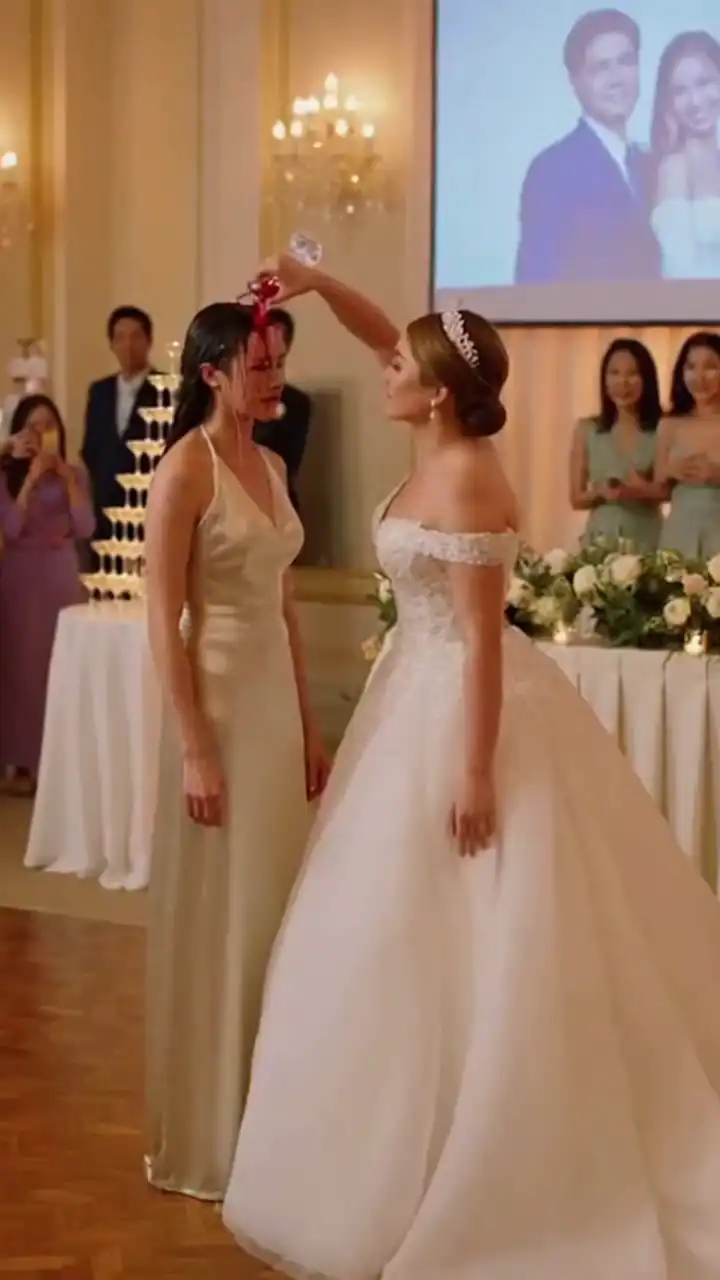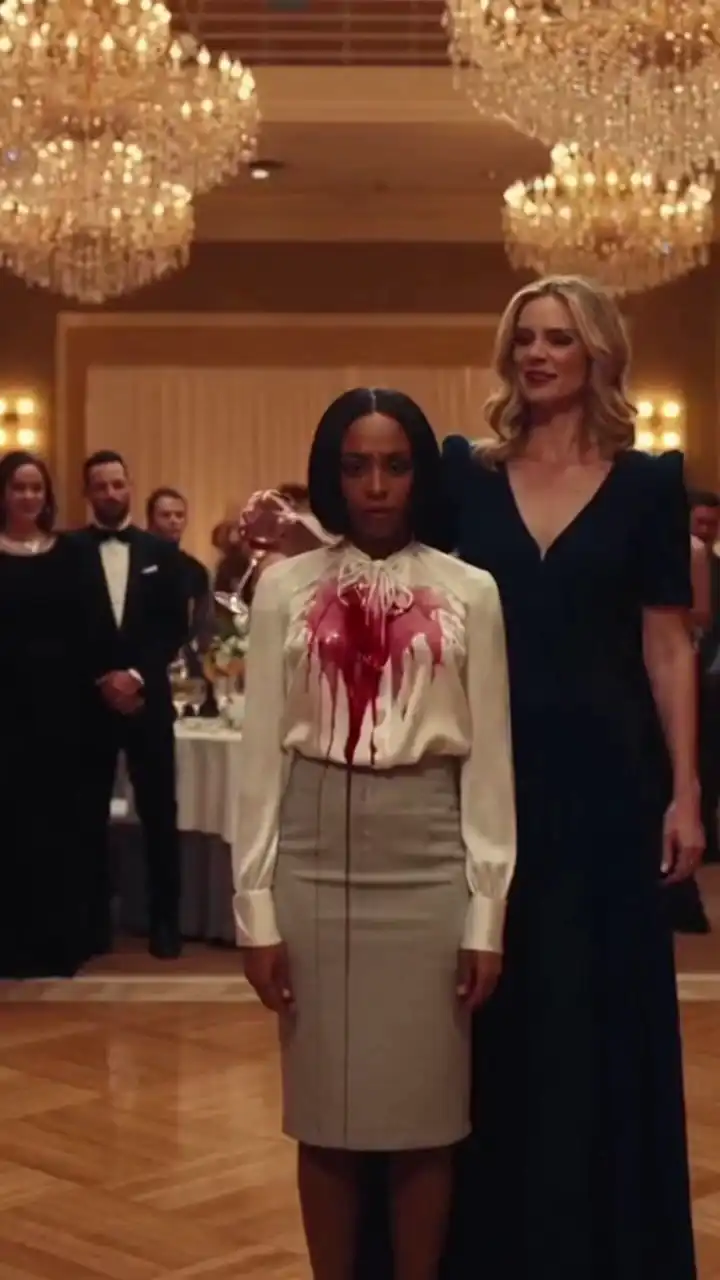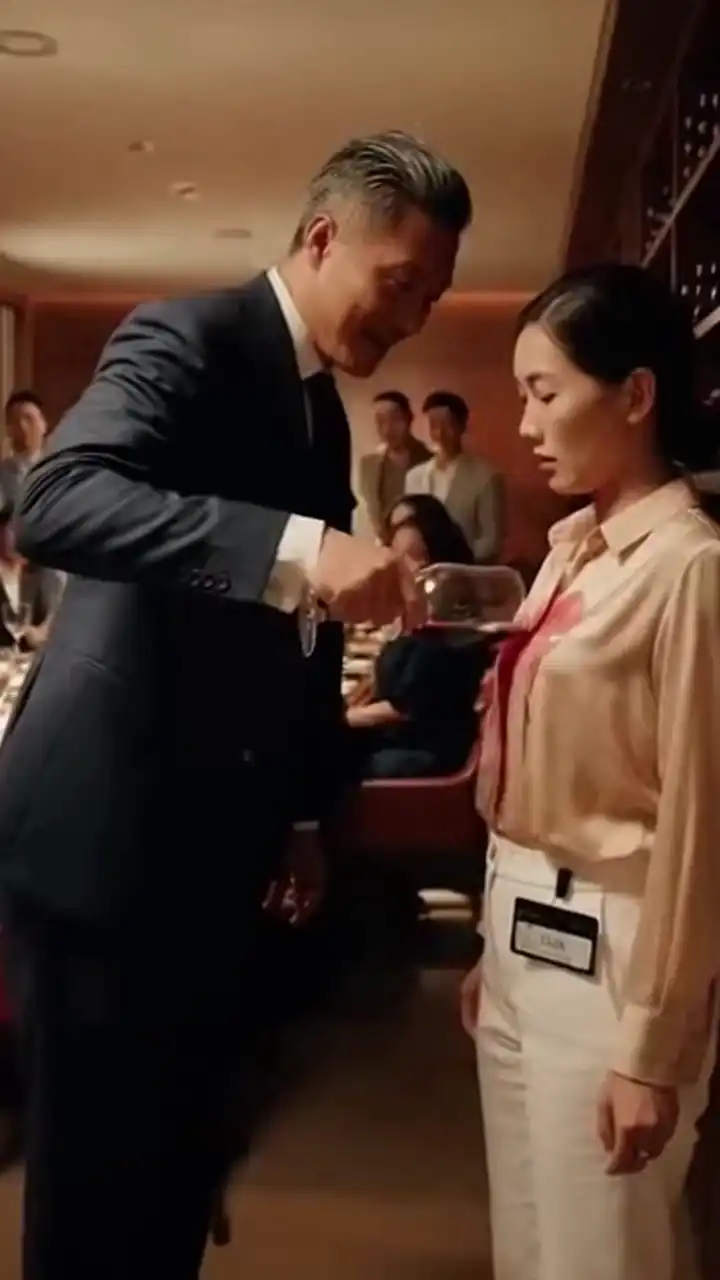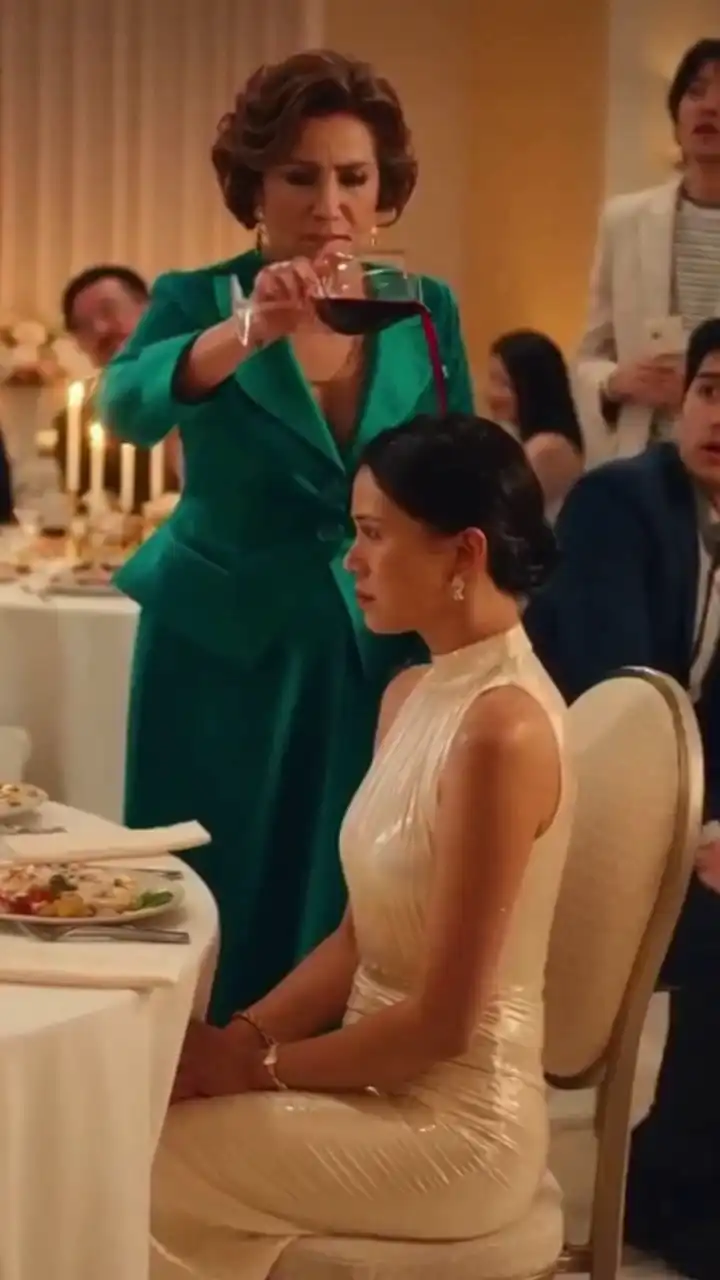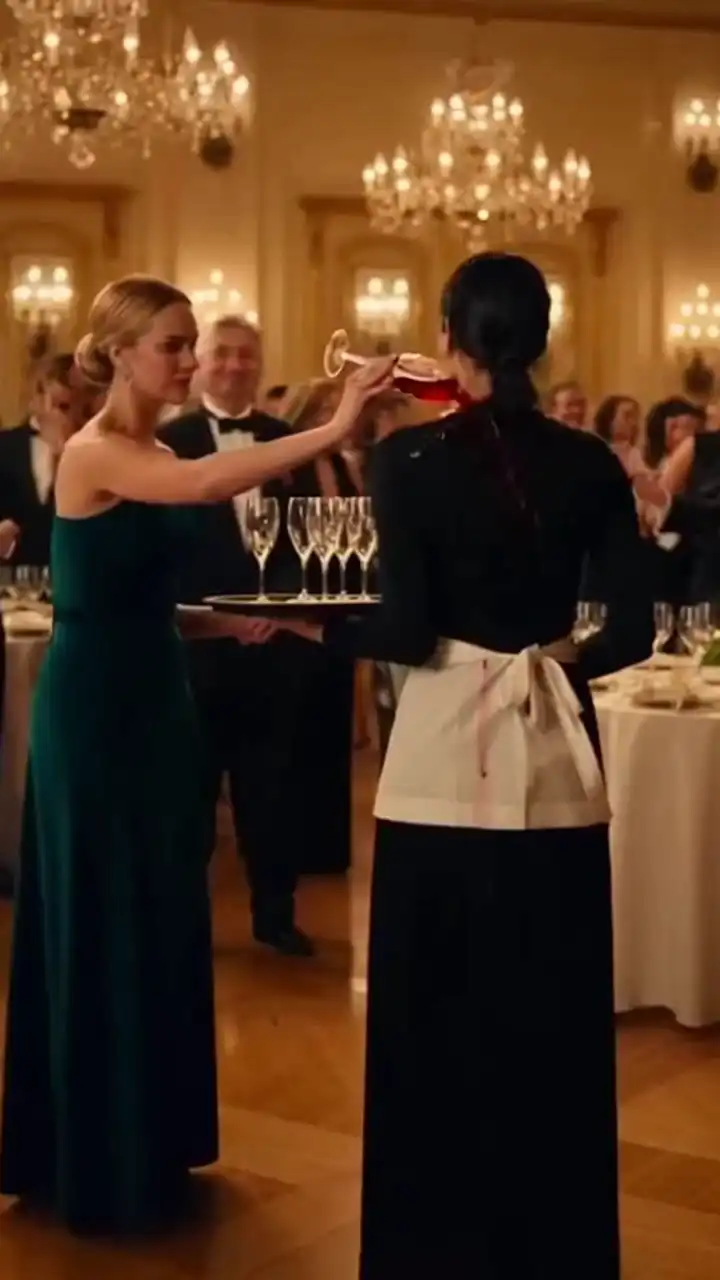
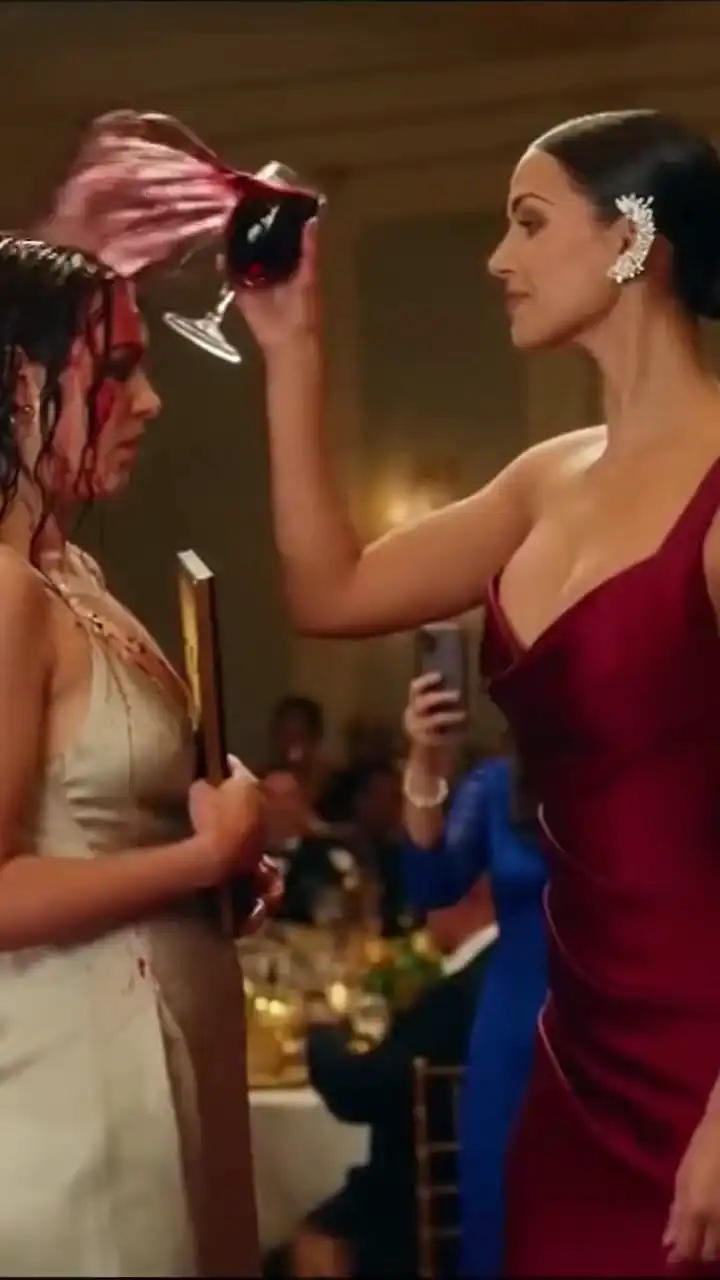
SHE POURED RED WINE OVER MY AWARD PLAQUE AND MY DRESS, SMILED AT the cameras, and said, “Assistants don’t get acceptance speeches.”
<<
That was the part that changed the room.
He just walked in, dark suit, badge out, eyes already on the stage like he had seen the layout before he arrived.
Two more came behind him.
Then a woman with a hard black folder under her arm.
The bodyguards Meredith liked to pose with online looked at each other, then stepped backward at the exact same time.
Not loyal.
Just paid.
Meredith still had one hand stretched toward the microphone.
Her other hand was red with wine.
“Turn that off,” she snapped, but her voice broke in the middle, and everyone heard it.
No one touched the screens.
The files kept cycling.
Contract pages.
Wire transfers.
Nondisclosure agreements.
A paused video clip with a production slate in the corner and Meredith’s face twisted into the expression she never wore in public.
The white-haired man near the sponsor table — Halden Price, the producer who had built three charity empires and six television careers — stared up at the screens like they had been written in another language.
Then he looked at me.
Not confused.
Recognizing.
That was better.
The lead agent stopped below the stage and said, “Ms. Vale, step away from the podium.”
Meredith laughed.
It sounded horrible.
“I think you’re making a very public mistake.”
“No,” I said.
That got her eyes on me instead.
For one second, I saw the old reflex in her face. The one that had worked for years. Assess. Smile. Reframe. Use me before I speak.
It had worked on me once.
She turned to the room and spread her hands, red wine still shining on her fingers. “This is what obsession looks like. A disgruntled former employee hacks a private event because she can’t handle being left behind.”
I held up the award plaque.
There was a recessed fingerprint pad on the back, hidden by the velvet grip.
Her eyes dropped to it.
Then to me.
Then back to the screen where the folder title still sat in plain view: PAYMENTS — SILENCE AGREEMENTS — MINORS.
That was the moment she understood two things.
First, this was not a bluff.
Second, I had not come there hoping she would let me speak.
I had come there because I knew she wouldn’t.
The female agent moved around the stairs and onto the stage.
“Hands where I can see them.”
Meredith took a step backward.
The ballroom gasped like one person.
Behind me, the emcee had flattened himself against the curtain, holding his cue cards like they could save him from being in the video everyone was now recording.
Meredith’s publicist tried to climb onto the stage.
An agent blocked him with one arm.
“Sir.”
That was all he needed to hear.
He stopped.
Halden Price finally found his legs and started toward the front. “Meredith,” he said, too loudly, “tell me this is fabricated.”
She turned toward him so fast one of her earrings flew loose.
“Halden, of course it is.”
The giant screen changed again.
This time it showed an invoice with his foundation letterhead.
His name.
His signature block.
The room made a different sound then.
Not shock.
Calculation.
Sponsors at the left tables were already picking up their phones.
A woman from a streaming outlet was speaking in a fierce whisper to someone on speaker.
One of the younger influencers slipped out the side door without bothering to hide it.
Meredith saw that too.
Her whole career was built on reading a room before the room knew what it felt.
Tonight the room was leaving her.
She pointed at me.
“She stole those files.”
“I made them,” I said.
That landed harder.
A few people near the front looked from me to the screens and back again.
Yes.
That assistant.
The quiet one.
The woman in the background of photos, carrying garment bags, holding coffee trays, fixing mic packs, smiling with half her face because the other half was busy listening.
I had started with Meredith six years earlier, when she was still called “promising” instead of “untouchable.”
Back then she was brilliant in ways that were easy to love.
Fast onstage.
Funnier in private.
Able to look straight at a donor, a host, a grieving parent, a camera, and become exactly who the moment required.
I handled her calendars, contracts, speech drafts, appearance packets, and eventually the one thing she trusted nobody else with:
The edits.
That was the organic center of her machine.
Meredith was a public-image animal. Everything lived or died in postproduction. A speech line could be softened. A meltdown clipped. A threat buried. A child-centered campaign made tearful or triumphant depending on what tested better with women over forty-five in the suburbs.
That was my job.
Not carrying bags.
Building her public self.
And because I built it, I knew where all the seams were.
The first crack had come eighteen months earlier during a youth initiative shoot in Palm Springs.
A seventeen-year-old performer had frozen before a testimonial segment. Normal. It happened all the time. The girl asked for ten minutes.
Meredith smiled for the cameras.
Then, the second they cut, she walked behind a light panel and hissed, “If she wastes this setup, make her mother sign whatever legal wants. I’m not paying for another day.”
I had heard worse.
That wasn’t the crack.
The crack was what happened later in the edit bay.
The girl’s hands were shaking in the raw footage.
Meredith wanted me to remove the pause, tighten the breath, clean the eyes, and splice in a line from another take so it looked like the girl had delivered a perfect grateful sound bite.
“Just make her look happy,” Meredith had said, standing behind my chair.
I did what I always did.
Then I kept the raw file.
Not because I was brave.
Because I was beginning to be afraid.
After that, the files accumulated the way mold does: unnoticed until the wall is rotten.
Threats to former interns.
Transfers labeled consulting that ended in hush agreements.
A beauty campaign shoot where a nineteen-year-old model was pressured to drink before a brand dinner and later paid to “avoid confusion.”
Meredith never typed the ugliest things herself. She used phrases. Others translated. Lawyers cleaned. Publicists softened. Producers invoiced.
But the edit archive remembered everything.
Unused audio.
Metadata.
Timestamps.
Export histories.
Version chains.
People think image is made onstage.
It isn’t.
It’s made in folders.
That’s why the reversal could only happen this way.
A chef could not have done it.
A driver could not have done it.
Even a lawyer would have had fragments.
I had the before, the after, and the hand that changed one into the other.
Onstage, Meredith straightened her shoulders like she was posing for a magazine cover.
“I want my attorney.”
The agent said, “You can have one.”
Halden reached the stairs.
“Meredith,” he said again, lower now, almost pleading.
He looked old suddenly.
Not physically.
Structurally.
Like one beam had been pulled from a house and the whole thing had shifted.
She reached for him with her eyes first, then her voice. “You know me.”
He looked up at the invoice still hanging over the room.
Then at the transfer records.
Then at a still frame from a backstage camera that showed Meredith taking an envelope from her publicist and sliding it into a donor packet.
“I know what I financed,” he said.
That was the turn.
He did not protect her.
He did not even hesitate.
He stepped back from the stage and lifted his own phone. “General counsel. Now. Lock every outgoing payment and every event account tied to Meredith Vale Media. Tonight.”
Meredith stared at him as if she’d been slapped.
She had expected him to shield first and ask questions later.
He had done that before.
Years before, when a stylist accused Meredith of blacklisting her over a ruined dress contract, Halden paid a settlement and called it “noise control.”
When a former intern posted about panic attacks and intimidation, Halden’s foundation buried the story under a scholarship announcement.
He had always believed that keeping the brand alive served the larger good.
Tonight the evidence was too visible, too ugly, and too immediate to launder.
Especially with minors in the title line.
There are words rich men can survive.
That isn’t one of them.
Meredith tried one last pivot.
She pointed to the wine-soaked plaque in my hand and said to the room, “She’s doing this because she thought she deserved my award.”
I almost laughed.
Instead I turned the plaque over and pressed the side latch.
The front gold plate slid free.
Inside was the drive.
Very small.
Very silver.
Very real.
The same drive she had not noticed when she drenched the plaque for effect.
A murmur went through the room.
The sponsor from a luxury skin-care brand sat down so abruptly she missed her chair and had to catch the tablecloth.
The emcee closed his eyes.
One influencer whispered, “Oh my God,” to nobody.
Meredith looked at the drive like it was a snake.
“That is company property.”
“No,” I said. “It’s evidence.”
The female agent held out her hand.
I gave it to her.
Meredith lunged.
It wasn’t graceful.
Her heel skidded in the wine she had poured on me, and for half a second she windmilled under the giant screen where her own face stared down from a paused clip.
Then the agent caught her wrist, turned her, and cuffed her with a movement so clean it looked rehearsed.
The room went silent.
Not movie silent.
Ballroom silent.
Air vents.
Phone camera autofocus ticks.
Someone’s ice settling in a glass.
Meredith twisted once and shouted, “You all know this is how they destroy women who win too loudly.”
No one answered.
Because the clip changing on the screen behind her was not political.
Not ideological.
Not ambiguous.
It was raw audio synced to backstage footage.
Her voice.
Sharp.
Clear.
“Get her mother to sign. If she cries, fine. Just don’t let that kid near a reporter.”
A sponsor at table nine stood and walked out.
Then two more.
Then a local councilman removed the event pin from his lapel and set it on the tablecloth beside his plate like it had become contaminated.
Halden got his lawyer on speaker.
I could hear enough to know the words:
Independent audit.
Emergency board meeting.
Immediate suspension.
Digital preservation notice.
Outside counsel.
Meredith sagged a little then.
Not with remorse.
With arithmetic.
She was counting exits and finding none.
The next thirty minutes moved strangely fast.
Agents cleared the stage.
Hotel security finally found courage once federal badges had done the dangerous part.
The AV team, after three contradictory orders from three panicking executives, froze the screens on a seizure warning slide, which only made everyone more certain the files were real.
A woman in diamonds cornered me near the curtain and said, “How long have you had this?”
“Long enough.”
She nodded as if that answered something she had not asked well.
Reporters were not supposed to be there, but there are always reporters at charity galas if enough vanity is involved. A lifestyle columnist I recognized from morning television tried to ask for comment while I was still dripping wine onto the carpet.
An agent stepped between us.
Bless him.
Backstage, someone handed me a towel.
I did not use it.
The stains were useful.
Visible humiliation has a strange authority.
No one can later say they misunderstood the temperature of the night.
Meredith was led through the ballroom instead of out the service corridor.
I think the agents chose that on purpose.
As she passed the tables, people who had spent years angling for photos with her looked away with intense concentration. One man busied himself folding his napkin into quarters. Another pretended to read the dessert menu.
Only one person tried to touch her.
Her publicist.
He got as far as, “Mer, listen—”
She jerked her shoulder away from him and hissed, “You made me keep those files.”
He actually flinched.
Good.
Because that was another truth. She had not acted alone. She had simply been the face people found easiest to worship.
By midnight, the first clips were online.
Not the minors file.
The ballroom footage.
Wine over my dress.
Her line about assistants.
The screens flickering alive.
Her mentor standing up.
The badge.
The cuffs.
People love a reversal they can understand in ten seconds.
By two in the morning, the longer story was everywhere.
Former staff started sending materials to the same federal contact the agents had circulated.
A junior editor I barely remembered forwarded archived cloud logs.
A driver sent photos of envelopes, dates scrawled on the backs.
A former intern wrote three lines: She did this to all of us. I thought nobody would believe me. Tell them I’ll talk.
That was the part Meredith had never understood.
Silence is expensive to maintain.
Once it breaks, it gets very cheap.
By sunrise, Halden Price’s foundation had issued a statement postponing all campaigns associated with Meredith Vale.
At nine, two sponsors terminated contracts.
At ten-thirty, her daytime segment was pulled from a national women’s summit.
At noon, the board of her nonprofit announced an external investigation and removed her from all youth-facing initiatives effective immediately.
By three, her talent agency dropped her.
Not “parted ways.”
Dropped.
The language in the release was bloodless enough to be cruel.
Her cosmetics partnership suspended distribution of a limited-edition line with her name on it. Warehouses do not care about charisma. Inventory can be relabeled.
The real losses were harder.
Three sealed settlements were reopened under subpoena pressure.
A state labor inquiry began examining her companies’ classification of assistants and interns.
The mother of the seventeen-year-old from Palm Springs retained counsel.
The nineteen-year-old model did too.
A donor family demanded forensic accounting for every “crisis management” disbursement connected to youth programming over the last four years.
A week later, Halden resigned from two boards before anyone could vote him off.
He sent me one email.
No greeting.
No self-defense.
Just one sentence.
I should have asked what it cost to keep her perfect.
I didn’t answer.
As for me, I gave formal statements for nine hours over two days.
I turned over my mirrored archives, export records, edit logs, and the physical drive from the plaque.
The plaque itself sat in an evidence bag, the gold plate warped from pressure where I had popped it open.
I had not gone there expecting safety.
I had packed a second dress in my car and emailed timed copies to three places in case my phone disappeared.
I had expected humiliation.
Maybe rough handling.
Maybe being laughed out of the room before the files hit.
What I had not expected was how quickly everyone who had benefited from her would become a witness once there was proof enough to protect themselves.
That was ugly.
But useful.
Two weeks later, the gala venue replaced the carpet runner in front of the stage.
The hotel manager told investigators the wine stain never fully lifted.
I liked hearing that.
Not because of vengeance.
Because some marks refuse the script written for them.
Months passed.
Charges came.
Then more.
Fraud.
Witness tampering.
Labor violations.
Endangerment-related counts tied to concealed incidents on sponsored youth sets.
Her attorneys fought everything.
They also requested continuance after continuance while sponsors, former staff, and one very careful forensic editor walked prosecutors through the architecture of her image machine.
Me.
That was my profession, after all.
Architecture of appearances.
I did not become famous.
Thank God.
For three days online I was “the assistant with the drive.”
By the fourth, people found a newer fire.
Fine.
Real change happened in conference rooms, hard drives, revised contracts, and frightened legal departments. Three production companies rewrote youth-content oversight policies after subpoenas started flying. Two brands created independent on-set advocates for minors. Assistants from half a dozen celebrity nonprofits began comparing pay structures and nondisclosure clauses in encrypted group chats.
Concrete things.
Not hashtags.
As for the award she had tried to hold over me, it was revoked from her before the month ended.
The foundation said it was “under review.”
Then it vanished from the website.
No announcement.
Just absence.
I kept the duplicate plaque shell after evidence processing released it.
Empty inside now.
The velvet backing still smelled faintly of spilled red wine.
It sits in a bottom drawer of my desk.
Some nights I take it out and turn it over in my hands, feeling the hidden latch catch under my thumb, remembering the exact expression on Meredith’s face when she realized the thing she had used to mock me was the thing that broke her.
Last winter I attended another event in the same ballroom.
Different cause.
Different people.
The stage lights had been replaced, cooler and cleaner than before.
No one recognized me.
I stood near the back with a glass of sparkling water and watched a young coordinator adjust a podium mic for a woman about to give a speech.
The coordinator stepped away before the applause started.
Efficient.
Invisible.
Essential.
When the woman onstage thanked “the whole team,” the coordinator did not look up.
I did.
And for one second, under the cold white lights, I could still see the dark shape of wine spreading over gold.
Disclaimer: Mention of any brand or trademark is for identification only and does not imply partnership or endorsement