
WHEN THE BOY IN THE WINDOW DANCED
The household manager waited just outside the glass doors of the study with the careful posture of a man who had spent years delivering bad news inside expensive homes.
Gideon Mercer looked up from a stack of reports he had not truly read. Beyond the windows of his penthouse, the lights of Bellevue, Washington, glittered across the evening like a thousand calm lies. Inside, the room smelled faintly of leather, old books, and the single whiskey he had poured but barely touched.
“Say it, Harold,” Gideon said quietly.
Harold adjusted his tie. He was in his sixties, silver-haired and precise, and he had worked for the Mercer family longer than Gideon had been old enough to understand what inherited wealth could protect and what it never could. “She’s the third this month, sir.”
For a second Gideon didn’t respond.
The words seemed to settle over the study the way dust settled over untouched things.
“Did she leave a reason?” Gideon asked.
Harold hesitated. “She said she was not equipped for the situation. She also said…” He paused. “She said your son never looks at her. Never speaks. And when he cries, it is as if nothing reaches him.”
Gideon closed his eyes.
Across the room, on the mantel, stood a framed photo taken three summers earlier on the terrace of their family estate outside the city. His wife, Tessa, was laughing into the wind, one hand on her pregnant stomach. Back then, the future had looked so certain it had felt rude to doubt it.
Now Tessa had been gone for almost two years.
A car accident on a wet November evening. A truck that drifted across a lane. A call from a state trooper. A hospital corridor so white and bright it had looked unreal. Gideon could still remember reaching for his wife’s hand and finding only a bed rail.
Their son had been six months old then.
At two years old now, Rowan Mercer had Tessa’s pale lashes, his father’s straight nose, and a silence that hollowed out rooms.
“Where is he?” Gideon asked.
“In the nursery sitting room,” Harold said. “Marisol is with him, but he has not eaten much dinner.”
Gideon rose at once.
He crossed the penthouse in long strides, passing a dining area big enough for twenty guests and set tonight for one. The custom chandelier over the table cast warm gold over untouched silverware. On the far wall hung family photographs from magazine-worthy holidays and charity galas, from ski trips in Aspen and summers in Maine, from a life with too much beauty in it to have broken this badly.
The nursery suite was at the quiet end of the hall, away from the entertaining rooms and Gideon’s office. When he pushed the door open, he found the night nanny sitting nearby while Rowan sat on the rug beside a low shelf of carefully arranged toys.
He was not playing.
He was staring at the spinning top Marisol had set in motion for him, watching it as if movement belonged to another species.
“Buddy,” Gideon said softly.
No response.
Rowan’s blond hair curled slightly at the back of his neck. He wore a tiny navy sweater and gray knit pants. His profile, lit by the lamp near the reading chair, was so delicate and beautiful it made Gideon feel physically weak.
Marisol rose. “Mr. Mercer.”
“You can go,” Gideon said.
She gave him a sympathetic look and slipped from the room.
Gideon lowered himself to the rug, his suit jacket pulling tight across his shoulders. “Hey, Rowan. It’s Dad.”
He picked up a wooden train and rolled it gently across the carpet.
“Choo-choo,” he said, hating the effort in his own voice. “Look what I found.”
Rowan’s eyes flicked once toward the train, then away. He put his small hand on the edge of the shelf and rubbed the smooth wood with two fingers, over and over, as if he could disappear into the repetition.
Gideon swallowed.
“Did Harold tell you Daddy came home early?” he asked. “I did. I came home early for you.”
Nothing.
The silence in the room was not tantrum or defiance. That would have been easier. It was absence. A small boy sitting only inches away and still unreachable.
Gideon reached toward him carefully, resting a hand on his son’s back. Rowan did not pull away, but he did not lean in either. He simply sat there, small and still and far from him.
On the bookshelf above them was another photograph. Tessa sitting in this very room with baby Rowan on her lap, pressing a kiss to his temple while he looked up at her with wide blue eyes. Gideon had once walked in on them and found her singing nonsense songs while folding laundry on the floor.
“You don’t always have to entertain him,” Gideon had teased.
“I know,” she had said, smiling. “I just like being where he is.”
That sentence came back to him now like a wound.
Gideon looked at the photo, then back at his son.
“You used to babble all the time,” he whispered. “Do you know that? You said ma-ma before anything else. You’d yell at the dog, at the blender, at your bath toys. You had opinions about everything.”
His throat tightened. Rowan kept tracing the wood grain with his fingers.
After Tessa died, Rowan had spoken less and less. First a few words disappeared, then all of them. Doctors called it trauma-linked selective mutism. Therapists used words like response pattern, emotional shutdown, protected withdrawal. Specialists recommended structured interventions, intensive plans, controlled environments.
None of them had told Gideon how to survive hearing his son laugh one month and never hearing his voice the next.
He lifted the train again, trying one more time. “Can you give this to Daddy?”
Rowan looked past him, toward the dark window.
The city reflected there, and the room reflected too: a man in a seven-thousand-dollar suit kneeling helplessly on a rug, trying to buy his way through a silence money could not touch.
Gideon set the train down.
He sat there for a long time, until Rowan’s eyelids drooped and his small body leaned sideways with sleep. Only then did Gideon gather him into his arms. The boy was warm, light, and trusting in the most basic physical way, but even with Rowan’s cheek against his shoulder, Gideon felt the ache of distance.
He laid him in the crib bed, tucked the blanket around him, and stood staring down.
“Good night, son,” he said. “I’m sorry.”
In the study later, Harold brought him the folder for a new residential treatment consultation.
“There is also the matter of replacing the caregiver,” Harold said carefully.
Gideon looked at the folder, then at the photograph on his desk of Tessa barefoot on the penthouse terrace, holding Rowan against her chest while the wind blew her hair loose.
He had hired speech experts, developmental specialists, grief therapists, sleep consultants, and rotating nannies with polished resumes and careful smiles. One had lasted ten days. One had lasted six. One had cried after an hour and asked never to be assigned upstairs again.
He had built companies, inherited an empire, negotiated acquisitions before breakfast, and sat across from senators without blinking. But his own child’s silence defeated him every day.
“One more,” Gideon said at last.
Harold blinked. “Sir?”
“One more try.” Gideon’s voice was flat with exhaustion. “One more person. Then…” He couldn’t finish the sentence.
Then maybe the facility brochure.
Then maybe surrender dressed as treatment.
Harold nodded once. “Yes, sir.”
When the room was quiet again, Gideon sat alone under the city lights, his wife gone, his son unreachable, and his fortune useless as ash.
Three days later, the woman who would change everything arrived by accident.
Her name was Delaney Brooks, and she came to the Mercer penthouse not to apply as a nanny but to fill in for a housekeeper who had injured her ankle.
Harold explained it that morning while Gideon stood in the kitchen with coffee gone cold in his hand.
“She was sent by the staffing agency for temporary domestic coverage,” Harold said. “Apparently she also has coursework in child development and experience at an early intervention center. I did not consider that relevant until now.”
Gideon barely looked up. “We are not hiring another miracle worker from an agency brochure.”
“She is not applying for that role, sir.”
“Good. Then let her dust things and go home.”
But an hour later, as Gideon crossed the hallway toward his office after a call with attorneys in New York, he stopped.
The nursery sitting room door stood slightly open.
Inside, Rowan was standing at the window, one hand against the glass, looking down at the street twenty floors below. Usually he stayed where staff placed him, orbiting within the smallest safe radius of his own quiet habits.
Near the doorway, crouched several feet away and not approaching, was a young woman in jeans, a plain cream sweater, and her dark brown hair tied in a loose knot. She held a feather duster in one hand and was speaking in a low, easy voice as if she had all the time in the world.
“That’s a city crow,” she said. “Not fancy, but very confident. I respect that.”
Rowan did not turn.
She continued dusting the baseboard without moving any closer. “If I were a bird, I’d probably be a terrible one. I don’t think I’d like worms. What about you?”
Gideon frowned. He started to interrupt, then didn’t.
The girl sat back on her heels and looked out the window too, though from her position she could not possibly see what Rowan saw. “I had a goldfish when I was seven. Named him Pancake. He hated me instantly.”
There was a pause.
Then Rowan’s fingers, still against the glass, flexed.
It was tiny. Barely anything.
But Gideon saw it.
He pushed the door wider. The young woman looked up quickly and stood.
“Oh,” she said. “I’m sorry. I didn’t mean to intrude. I was cleaning and found him here.”
“Who are you?” Gideon asked.
“Delaney Brooks.” She set the duster aside. “I’m the temporary housekeeper from Alder Staffing.”
Harold appeared behind Gideon like a discreet shadow. “Miss Brooks was in the hall when Rowan wandered from the play area.”
“I didn’t touch him,” Delaney said quickly. “He didn’t seem upset. I just stayed where he could see me if he wanted.”
Gideon studied her. She was young, maybe twenty-three, with clear skin, observant hazel eyes, and a steadiness that did not match the nervous energy most temporary staff brought into his home.
“You said you have child development experience,” he said.
She nodded. “Two years as an aide in a preschool inclusion classroom. Then I worked at an early learning center in Spokane before moving west. Mostly toddlers. Some speech delays, some trauma cases, some kids who just needed adults to stop hovering over them like broken machinery.”
Harold made a faint sound at that phrasing.
Gideon’s jaw tightened. “My son is not broken machinery.”
“I know,” Delaney said, and she said it so simply that it disarmed him. “That’s my point.”
Rowan had turned now. He was looking at Delaney, not Gideon, his serious blue eyes fixed on her sweater sleeve where a loose thread dangled from the cuff.
Delaney noticed but did not step nearer. “Hi again,” she said softly to him. “I’m still the weird cleaning lady.”
No smile. No sound. But Rowan kept looking.
Gideon felt a sharp, wary flicker inside him. Hope was dangerous. Hope made fools of grieving men.
“What exactly are you doing?” he asked.
“Nothing dramatic,” Delaney said. “He was watching outside. I watched too. That seemed polite.”
“You expect me to believe that’s a professional strategy?”
She shrugged lightly. “Sometimes the best strategy is not barging into a child’s space because adults are uncomfortable with silence.”
Harold looked scandalized. Gideon should have asked her to leave.
Instead he heard himself say, “And if he never speaks to you?”
“Then I won’t measure him only by speech.”
The answer landed harder than Gideon expected.
He glanced at Rowan. The boy had lowered himself to the rug again and was now rolling the loose thread from Delaney’s fallen duster between his fingers.
Delaney slowly sat on the floor several feet away, careful not to invade. “That’s a good choice,” she told him. “Textures are important.”
Gideon folded his arms. “He doesn’t respond well to strangers.”
“He doesn’t have to,” Delaney said. “I can be the stranger who stays calm about that.”
For reasons he couldn’t explain, Gideon remained in the doorway and watched.
Delaney did not thrust toys at Rowan or ask him to identify shapes or colors. She did not perform concern. She simply dusted the lower shelves while narrating occasional ridiculous observations.
“This room has the cleanest blocks in Washington.”
A beat later: “That stuffed rabbit has seen things.”
Then, after another minute, she sat cross-legged and became quiet.
The room settled.
Rowan glanced at her once.
Then again.
Then he moved one block from one pile to another while keeping her in the corner of his vision.
Delaney’s face did not change, but Gideon saw the softness in it. She had noticed.
After several more minutes she rose slowly. “I need to finish the hallway,” she said to Rowan, as if informing an equal. “But I’ll be around.”
She walked to the door.
Rowan looked up and followed her with his eyes.
The motion was so small no one else might have called it anything. But after months of blankness, Gideon felt as if the air had shifted.
Delaney passed him. “Sorry if I overstepped, Mr. Mercer.”
He should have dismissed her.
Instead he asked, “Would you consider a different position?”
She blinked. “As what?”
He looked through the doorway at his son, still holding the thread. “As someone who stays.”
Delaney was silent for a moment. “I’d meet him first,” she said. “Not the job. Him.”
“You just did.”
“No,” she said gently. “I introduced myself. Meeting takes longer.”
And for the first time in many months, Gideon Mercer watched a stranger walk away from him without trying to impress him, flatter him, or reassure him. She only glanced back once toward the nursery.
On the rug, Rowan was still looking at the door she had gone through.
The first small moment was almost nothing.
But in that home, almost nothing was enough to feel like a beginning.
Delaney started the following Monday.
Harold had misgivings. The chef had questions. The regular staff, used to polished specialists with clipboards and schedules, were openly skeptical of the temporary housekeeper who had somehow become the child’s daytime caregiver.
Delaney seemed not to notice.
On her first official day, she did not march into Rowan’s room carrying flashcards, sensory kits, or a plan printed in color-coded rows. She came in wearing sneakers, soft clothes, and a green cardigan with one mismatched button.
Rowan sat by the low bookshelf, turning a toy car over and over in his hands.
Delaney paused at the doorway.
“Morning, Rowan,” she said. “I’m back. That was either good news or deeply annoying. You can decide later.”
Then she sat in the hall just outside the room.
Not beside him. Not across from him. Outside.
From his office, Gideon had asked for updates every hour. By eleven, curiosity overcame pride and he went looking for them.
He found Delaney exactly where Harold said she would be: on the floor in the hallway outside the nursery, leaning against the wall with a board book in her lap.
“Why are you out here?” Gideon asked.
She looked up. “Because he hasn’t invited me in yet.”
“That’s absurd. He’s two.”
“He’s two, not furniture.”
Gideon exhaled slowly. “Miss Brooks—”
“Delaney.”
“Delaney. We hired you to engage my son.”
“I am engaging him.” She tipped her chin toward the doorway. “He can see me. He knows I’m here. He also knows I’m not going to rush him because adults get nervous when children don’t perform.”
Gideon looked into the room. Rowan was in the same spot, but every few seconds his eyes slid toward the hallway where Delaney sat.
“He’s watching,” Delaney said softly. “That matters.”
She opened the board book and began to read aloud, not to him exactly, but near him.
“‘The bear went over the mountain,’” she read. “‘Which frankly sounds exhausting for the bear.’”
Gideon frowned. “That is not the text.”
“I know. I’m improving it.”
From the room came the faintest shift of movement. Rowan had crawled closer to the doorway.
Delaney didn’t look at him. She kept reading in a low, warm voice, adding commentary about overworked bears and underappreciated blueberries. After several minutes, Rowan settled just inside the threshold.
Not in her lap. Not beside her.
But near.
That became the pattern over the next week. Delaney let Rowan watch before she joined him. She never entered his rhythm like an invader. She circled the edges of it until he made space.
At snack time she sat across the kitchen island and ate apple slices too, talking lightly. “Mine are less dramatic than yours,” she told him. “You chew with great conviction.”
In the playroom she stacked blocks alone until he knocked them over from a distance. “A critic,” she said gravely. “Every artist needs one.”
In the reading nook she hummed while folding tiny socks. Rowan began bringing one sock at a time and placing it near her knee.
“Thank you,” she whispered each time, as if he had given her treasure.
The first real change was not speech.
It was anticipation.
By the tenth day, Rowan waited near the hallway around the hour Delaney usually arrived. When the elevator chimed in the morning, his head lifted. When she walked in and said, “Good morning, sir,” with a little bow, he blinked and stood straighter, as if bracing for something he did not want to miss.
One sunny afternoon she took him to the terrace garden that wrapped around part of the penthouse. It had been designed by landscape architects and rarely used except for formal entertaining. The planters overflowed with lavender, climbing roses, and summer flowers. Butterflies drifted there sometimes, startlingly delicate against the steel and glass skyline.
Rowan stood near the door at first, uncertain.
Delaney did not take his hand. She crouched a few feet ahead and whispered, “I think that yellow one is showing off.”
A butterfly bobbed over the lavender.
Rowan watched.
Delaney moved slowly after it, not grabbing, not urging. “You don’t have to chase it,” she said. “I just thought I’d let it know I saw it.”
After a long moment, Rowan took three tiny steps onto the terrace.
Then four more.
The breeze lifted his blond hair. Delaney smiled but said nothing.
The butterfly darted toward the far planter, and Delaney followed with exaggerated stealth. “I’m terrible at this,” she confided. “It has the advantage.”
Rowan’s mouth parted slightly. Not a laugh. Not yet. But something loosened in his face.
From inside the glass doors, Gideon watched with one hand on the frame.
Harold stood beside him. “He hasn’t gone out there willingly in months.”
Gideon nodded, unable to answer.
Then came the pressure.
Two weeks into Delaney’s employment, Dr. Elaine Kessler arrived for Rowan’s quarterly review. She was a respected pediatric specialist in trauma-linked developmental disorders, and Gideon had paid enough for her private consultations that her opinions carried the weight of a board ruling.
She observed Rowan for thirty minutes in the playroom while Delaney remained seated on the floor nearby, saying almost nothing.
Afterward, in Gideon’s office, Dr. Kessler removed her glasses and spoke with calm authority.
“I understand this young woman has had some success making him more comfortable,” she said. “That is not the same as measurable therapeutic advancement.”
Gideon leaned back in his chair. “He’s calmer.”
“Calmer is not a treatment plan.”
Delaney, standing by the window, crossed her arms. “He’s also initiating proximity.”
Dr. Kessler turned to her. “And you are?”
“The person spending six hours a day actually with him.”
Harold looked as if he might faint.
Dr. Kessler’s smile thinned. “Mr. Mercer, with respect, informal attachment can become a hindrance if it delays evidence-based intervention.”
Gideon rubbed his jaw. “What are you recommending?”
“A residential day program in Seattle. Structured trauma therapy, speech integration, developmental assessment, behavior tracking. Immediate enrollment would be ideal.”
Delaney stepped forward. “He’s two.”
“He is also clinically withdrawn,” Dr. Kessler said. “If you wait for sentimental instincts to fix this, you may lose valuable time.”
Delaney’s cheeks flushed. “Attachment isn’t sentimental. It’s developmental.”
“Training matters, Miss Brooks.”
“I have training.”
“Not at the level this child requires.”
Gideon stood. “Enough.”
The room went still.
Dr. Kessler softened her tone. “Mr. Mercer, I know you want to believe progress is being made. But children like Rowan need consistency rooted in formal methods, not improvisation from a caregiver with good intentions.”
The phrase children like Rowan made Delaney’s expression change.
Gideon noticed.
“What would the program involve?” he asked.
“Daily transport. Full assessment. Limited outside interference while baseline is established.”
“Outside interference?” Delaney repeated. “You mean me.”
Dr. Kessler did not deny it.
That evening the staff whispered. Harold quietly assembled brochures. A driver was put on alert for potential school-route scheduling. Delaney finished her shift in silence and left without her usual soft goodbye at Rowan’s door.
Gideon found his son at dusk sitting by the terrace window, one hand on the glass.
“He did better today,” Gideon said aloud, though he did not know if he was speaking to Rowan or himself.
Rowan kept staring toward the darkening garden.
Gideon knelt beside him. “They say I need to do more. Maybe something more official. Maybe this isn’t enough.”
He reached for his son’s shoulder. Rowan allowed it, but his eyes remained fixed on the door where Delaney usually disappeared.
For the first time, Gideon wondered if the experts were asking him to choose control over connection.
And for the first time, the choice frightened him.
The next few days felt unsteady, as if the penthouse itself had become uncertain what kind of home it was meant to be.
Dr. Kessler sent files, schedules, intake forms, and a direct recommendation for immediate placement in the Seattle program. Harold, ever efficient, placed everything in a leather folder on Gideon’s desk. Calls were arranged. Evaluations were discussed. A start date, still unofficial, began hovering over the household like weather.
Delaney knew.
She never asked Gideon directly, but her quiet became sharper around the edges.
She still came every morning. She still sat where Rowan could find her. She still followed him to the terrace garden, still narrated butterflies and clouds and the suspicious behavior of crows. But now Gideon often caught her watching Rowan with an expression that looked a little like preparation.
As if she were memorizing him.
One afternoon Rowan had a setback. A deliveryman he didn’t know entered through the service hall. The unfamiliar voice, the clatter of boxes, the interruption of routine sent him into sudden distress. He dropped to the floor, hands over his ears, face crumpling soundlessly before the crying came.
A jagged, breathless cry.
Harold froze. One of the housekeepers took a step forward.
“Back up,” Delaney said instantly, kneeling several feet away. “Everybody back up.”
Gideon arrived from his office in time to see her lower herself fully onto the carpet, not touching Rowan, only making herself smaller.
“It’s loud,” she said softly. “I know. You don’t have to like it.”
Rowan rocked hard, crying.
“You’re safe,” Delaney said. “I’m staying right here.”
Gideon moved toward them. “Should I pick him up?”
“No,” Delaney said without looking at him. “Not fast. Sit down first.”
He stared at her.
“Please,” she said.
Something in her voice made him obey. Gideon, billionaire heir and chairman of Mercer Holdings, sat on the hallway floor in a white dress shirt while his son shook with overwhelm three feet away.
Delaney looked at him then. “Breathe slower,” she said quietly. “He watches your body even when he doesn’t look at your face.”
Gideon swallowed and tried.
“In through your nose,” she murmured. “Good. Again.”
Rowan’s crying hiccupped.
Delaney spoke to the child. “The box man is gone. Harold already fixed it. The noise is over. Your dad’s here. I’m here. No one’s making you stop feeling bad. We’re just waiting with you.”
Minute by minute, Rowan’s sobs softened. His shoulders lowered.
Then, slowly, he crawled not to Delaney but toward Gideon’s knee.
Gideon went still.
Delaney gave the tiniest nod. Don’t rush.
Gideon rested his hand palm-up on the carpet.
After a long moment, Rowan placed his fingers in it.
The contact lasted maybe five seconds.
It shook Gideon more than any boardroom crisis ever had.
Later that night, he found Delaney in the kitchen rinsing a sippy cup.
“You told me not to pick him up,” he said.
She nodded. “He was already overloaded. More input can feel like pressure.”
“You made it look simple.”
“It isn’t simple.” She set the cup aside. “It’s just slow.”
Gideon leaned against the counter. “Dr. Kessler says I’m wasting time.”
Delaney dried her hands. “Maybe. Or maybe everyone keeps trying to fix his silence before they make him feel safe inside it.”
“You disagree with a nationally respected specialist.”
“I disagree with anybody who sees a two-year-old boy as a project before they see him as a person.”
Gideon looked down at the marble countertop. “And if I’m choosing wrong?”
Delaney’s voice gentled. “Then choose to be with him while you figure it out.”
The trigger for everything came two mornings later.
Gideon had finally agreed to tour the Seattle day program. The appointment was set for Friday afternoon. Harold, misunderstanding and trying to be helpful, mentioned logistical changes within Rowan’s hearing while Delaney was in the playroom.
“If Miss Brooks’s services conclude after this week,” Harold said to Gideon near the door, “we can transition gradually.”
The sentence was not meant for the child.
But Rowan heard it.
At first nothing happened. He sat by the low table turning a blue crayon in his fingers while Delaney quietly drew lopsided stars on butcher paper. Gideon barely noticed the change in the boy’s posture, the way stillness suddenly turned rigid.
Harold continued, “Transportation to Seattle can be arranged by Monday.”
“Not now,” Gideon said sharply, glancing at Rowan.
Harold bowed his head and withdrew.
Delaney set down the crayon. “I can step out if you need—”
“No,” Gideon said. “Stay.”
But the damage had been done.
For the rest of the morning Rowan would not go to the terrace. He would not sit near Delaney in the reading nook. He remained close to the playroom door, clutching the blue crayon so tightly his knuckles blanched.
Delaney didn’t push.
She sat on the rug and stacked blocks alone.
“I’m building a very bad castle,” she said lightly.
No response.
“It has serious structural problems.”
Nothing.
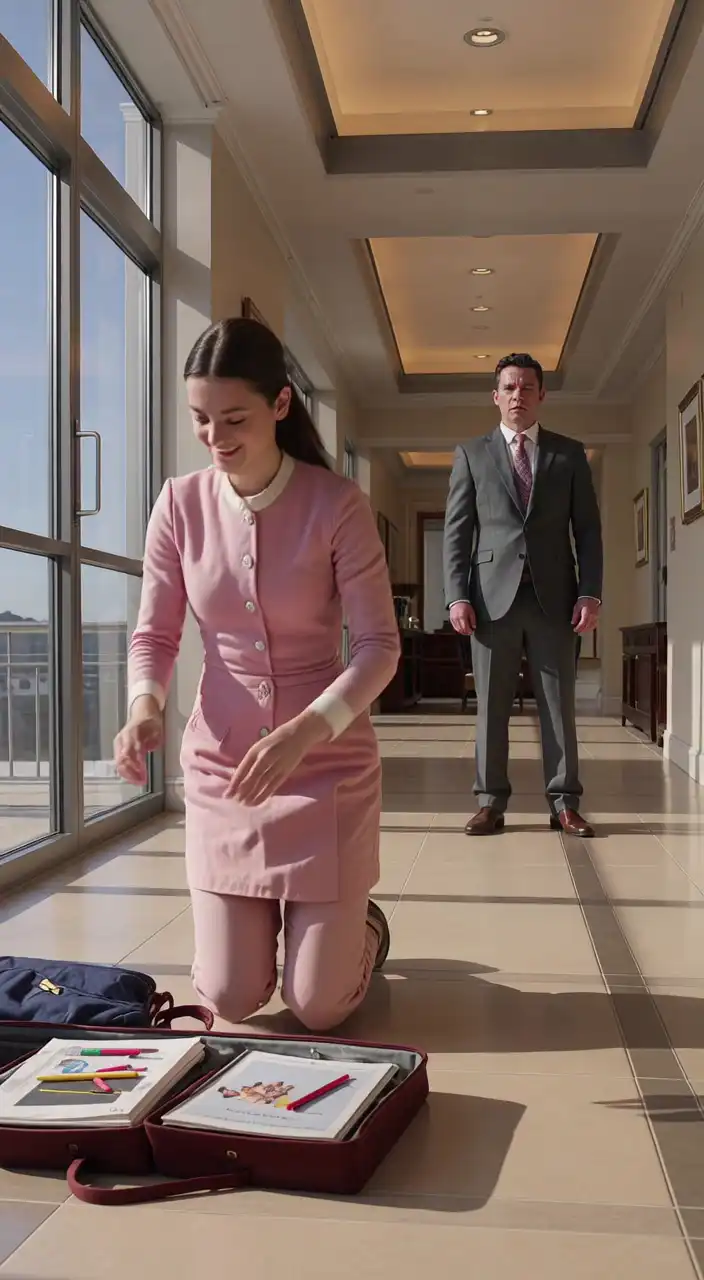
Around noon, Gideon was called into an urgent conference with London and left the room. When he came back forty minutes later, he found Delaney in the hallway near the coat closet, kneeling beside an open tote bag.
She was packing art supplies.
“What are you doing?” he asked.
Delaney looked up, startled. “I’m not leaving. Rowan got upset when Harold said…” She hesitated. “I thought maybe if I showed him I was only moving my things to the other room for lunch, not disappearing, it might help.”
Before Gideon could answer, there was a small sound behind him.
Not a word.
A breath torn by panic.
He turned.
Rowan stood at the end of the hall, eyes huge, chest fluttering. He had seen the open bag. Seen crayons, books, the cardigan Delaney had draped over one arm.
To a child who had already lost his mother, it meant only one thing.
Leaving.
“Rowan,” Delaney said softly at once. “Hey. No, sweetheart. I’m not going.”
His face crumpled. He took one stumbling step forward, then another. The blue crayon dropped from his hand and rolled across the hardwood.
Gideon had never seen him move that fast toward anyone.
Rowan’s breath hitched into a cry. He reached Delaney and grabbed fistfuls of her sweater with desperate, shaking hands.
She froze, tears springing to her eyes.
“I’m here,” she whispered. “I’m here.”
Rowan made a broken sound in his throat and pressed himself against her, not silent now in his fear but fighting through it, small body trembling.
Gideon stood motionless, stunned.
Then it happened.
Delaney, still holding herself very still so as not to startle him, said, “You thought I was leaving?”
Rowan lifted his wet face.
And in a voice rusty with disuse, thin as paper and raw with terror, he said, “No go.”
Everything in the hall stopped.
Harold, halfway out of the service corridor, went white.
Gideon felt the world narrow to that one impossible sound.
Delaney’s hand flew to her mouth. “Oh, baby,” she breathed, crying now. “I’m not going. I’m right here.”
Rowan clung tighter. “No go,” he said again, clearer this time, as if the words had been trapped behind a locked door and grief had finally kicked it open.
Gideon took one step forward and then another, afraid even his breathing might break the moment.
“Rowan?” he said, his voice shaking. “Buddy?”
The little boy turned his head. Tears soaked his lashes. His lip trembled.
For one terrible second Gideon feared the silence would slam shut again.
Then Delaney looked at him over Rowan’s head and said quietly, “Come sit. Slow.”
He lowered himself to the floor beside them.
Rowan’s gaze flicked from Delaney to his father. His chest still hitched with aftershocks of crying.
Gideon swallowed hard. “She’s not leaving,” he said. “Nobody is taking her away right now. Do you hear me? You’re safe.”
Rowan stared at him.
Delaney gently loosened one of his fists from her sweater and laid his hand against Gideon’s arm. “You can hold both,” she whispered to the child.
And Rowan did.
He clutched Delaney with one hand and his father’s sleeve with the other, as if anchoring himself to the two people in the room who finally felt real enough to lose.
Gideon broke then, not loudly, but in the silent way a man breaks when amazement and grief strike the same place. Tears ran down his face before he could stop them.
“I heard you,” he whispered. “I heard you, son.”
Rowan blinked at him, startled by the emotion.
Delaney gave a watery little laugh through her tears. “That was very good talking, Rowan.”
He made a small exhausted sound and buried his face against her shoulder.
They stayed there on the floor a long time.
Later, after Rowan slept curled against Delaney on the nursery couch, Gideon stood in the doorway and watched the rise and fall of his son’s back.
“He spoke because he thought he was losing you,” Gideon said quietly.
Delaney looked down at the child, smoothing his blond hair. “He spoke because love was stronger than fear for a minute.”
Gideon had no answer.
That evening, at dusk, Rowan woke calmer than anyone expected. Delaney carried him to the terrace garden, and Gideon followed.
The sky over Bellevue was brushed in pink and silver. Butterflies drifted among the flowers as if nothing miraculous had happened in the hallway below.
Rowan stood between them, unsteady with sleep.
Delaney spotted music coming faintly from a neighboring terrace, some distant jazz floating up from another penthouse level. She smiled and swayed once in place.
“Terrible song for butterflies,” she said. “Good song for standing.”
Rowan watched her.
Then, to Gideon’s astonishment, Delaney held out both hands—not demanding, only offering.
Rowan looked at them. Looked at her face. Then at his father.
Gideon, remembering every instruction, did not rush. He only crouched nearby and smiled through the ache in his chest.
“It’s okay,” he said.
Rowan placed one hand in Delaney’s.
With the other, after a tiny hesitation, he reached for Gideon.
They stood that way, linked in the evening breeze.
Delaney shifted her weight side to side in an exaggerated little sway. Rowan wobbled, then copied her. A step. A pause. Another step. Not proper dancing, not by adult standards. But rhythm. Participation. Joy trying on a body that had forgotten it.
Gideon let out a breath that sounded almost like a laugh.
“There you go,” Delaney whispered. “That’s it.”
Rowan looked up, and for the first time since Tessa’s death, delight lit his face openly. He bounced once, then twice, tiny knees bending, feet pattering against stone in a clumsy toddler dance while butterflies lifted from the lavender as if startled into applause.
Gideon stared, completely stunned.
His son was dancing.
Not for a therapist. Not for a chart. Not on command.
Because he wanted to stay inside a shared moment.
Because he was alive in it.
And because a young woman with no fear of silence had taught the broken household how to wait long enough for wonder.
The next morning, Dr. Elaine Kessler returned at Gideon’s request.
She seemed mildly irritated to have been summoned without advance notes. “I hope this is important,” she said as Harold led her through the penthouse.
“It is,” Gideon replied.
He did not bring her to his office.
He brought her to the terrace.
Delaney was already there with Rowan bundled in a little oatmeal-colored sweater despite the mild air. The boy stood near a planter of lavender, tracking a pale butterfly with grave concentration.
Delaney crouched a few feet away. “He’s undecided about us,” she said to the butterfly. “That’s fair.”
Rowan looked at her. Then, after a pause, he took three deliberate steps toward her and touched her sleeve.
Dr. Kessler watched without speaking.
Gideon said quietly, “Wait.”
Delaney slowly straightened. “Should we show Dr. Kessler your excellent butterfly feet?” she asked Rowan.
He glanced at the new adult, wary but not shut down.
Gideon did what he had once never known to do. He moved into Rowan’s line of sight and crouched. “I’m here too, buddy,” he said gently. “No rush.”
Rowan stared at him.
Then Delaney began that same ridiculous side-to-side sway from the night before. “Very advanced choreography,” she murmured.
To Gideon’s astonishment, Rowan’s mouth twitched.
He took one small hand step in the air, then another, knees bobbing.
“Good,” Delaney said.
Gideon copied her movement carefully, awkward in loafers on terrace stone.
Rowan watched both of them.
Then he did it again—his tiny body shifting with shy, emerging rhythm, a toddler’s dance, hesitant but unmistakable. Half sway, half bounce, all miracle.
Dr. Kessler let out a soft breath.
And as if the movement unlocked something else, Rowan turned toward Delaney and said, still rough but audible, “Again.”
Delaney’s eyes filled. “Again,” she echoed.
Gideon actually gripped the back of a garden chair to steady himself.
Dr. Kessler removed her glasses slowly. “How long has this been happening?”
“Since yesterday,” Gideon said, his voice uneven. “The first words. The dancing last night.”
The specialist looked from the child to Delaney, then back to Gideon. “What was the trigger?”
Gideon answered before Delaney could. “He thought she was leaving.”
Dr. Kessler was silent for a moment. “Attachment distress,” she said softly, but now it did not sound dismissive. It sounded like reconsideration.
Delaney remained focused on Rowan. “Want to show your dad the butterfly turn?”
Rowan looked at Gideon and swayed once.
Gideon mirrored him.
It was imperfect and absurd and the most precious thing he had ever done.
The collapse of opposition was not dramatic. No one apologized grandly. No violin swelled. But things shifted with the force of truth finally witnessed.
Dr. Kessler closed her folder before she had written a single note. “I was wrong about one thing,” she said to Gideon at last. “This should not be interrupted.”
Gideon stared at her.
She continued, “He may still benefit from formal support in time. But what you are seeing is not random. It is relational emergence. Safety first, then language, then expansion. If you remove the foundation now, you may do harm.”
Gideon looked toward Delaney and Rowan.
The boy had taken Delaney’s hand and was tapping one foot on the stone, waiting for the game to continue.
Dr. Kessler added, “You need to be part of this, Mr. Mercer. Not adjacent to it.”
Her words landed because now he understood them.
That afternoon he canceled the Seattle intake.
He canceled two investor dinners, one charity appearance, and a weekend flight to San Francisco. He moved meetings. He told his assistant to protect mornings and evenings unless the world was literally on fire.
When Harold cautiously asked if this was temporary, Gideon replied, “No. This is my son.”
For Delaney, the change was quieter but no less profound. She had entered the Mercer home as temporary help and nearly been erased by experts and schedules. Now even the staff looked at her differently. Not as a rule-breaker. As someone Rowan had chosen.
That evening, Gideon found her in the playroom putting blocks back into baskets.
“I owe you an apology,” he said.
Delaney glanced up. “For what part?”
“For thinking I could outsource fatherhood and call it responsible.”
She sat back on her heels. “You were grieving.”
“That’s not the same as being present.”
“No,” she said. “But it can make presence feel impossible.”
He nodded slowly. “I don’t want to be impossible to him anymore.”
Delaney studied him for a moment, then smiled faintly. “Then start small.”
“How small?”
“Small enough to repeat.” She held up one finger. “Same breakfast chair every morning.” A second finger. “Five minutes on the terrace at sunset.” A third. “One song before bed, even if he doesn’t react.” She tilted her head. “Children build trust out of what happens over and over.”
Gideon let out a shaky breath. “You make it sound doable.”
“It is doable,” she said. “It’s just not glamorous.”
He looked around the playroom, at the scattered signs of ordinary life that had become holy in his eyes. “I can negotiate mergers worth billions,” he said. “But I’m terrified of singing to a toddler.”
Delaney laughed softly. “Good. It means you care.”
From the doorway came a tiny voice, husky with sleep.
“Dad.”
Gideon turned so fast he nearly stumbled.
Rowan stood there in footed pajamas, hair tousled, rubbing one eye.
For a heartbeat no one moved.
Then Gideon crossed the room slowly, dropping to his knees in front of him. “Yeah,” he whispered. “Yeah, I’m here.”
Rowan leaned forward, placing both hands on Gideon’s cheeks with solemn concentration, as if confirming the shape of him.
Delaney quietly looked away and gave them privacy in the most graceful way possible.
Gideon closed his eyes against the force of joy.
The new life did not arrive all at once. It came in rituals.
Every morning Gideon sat in the same chair at the kitchen island while Rowan ate fruit and oatmeal beside him. Some days the boy said nothing. Some days he offered one hard-won word. “Blue.” “Bird.” “More.” Every word was received like a gift, but never demanded like payment.
Every evening, no matter what market opened overseas or which attorney wanted his signature, Gideon met Rowan on the terrace at sunset.
At first Delaney led the routine. “We listen first,” she would remind him. “Then we look. Then we move if he wants.”
Soon Gideon no longer needed instruction.
“Crow,” Rowan whispered one evening, pointing to the rail.
“A very confident crow,” Gideon said.
Delaney hid a smile.
At bedtime, Gideon sang badly and consistently. Rowan sometimes covered his ears in mild protest. Delaney called that an honest review. Gideon kept singing anyway.
Weeks passed. The penthouse changed with them. It grew louder in the gentlest ways: the thud of toddler feet in the hallway, Delaney’s laughter from the playroom, Gideon’s voice no longer reserved for conference calls and condolences. The silence left room by room.
Gideon did not become a perfect father. He became an available one.
That mattered more.
One Sunday morning, months after Delaney first sat in the hallway and waited to be seen, Gideon found Rowan already by the terrace door with two hands lifted insistently.
“One for me?” Gideon asked.
Rowan nodded. “One for Laney.”
Delaney looked up from the kitchen, startled and bright-eyed.
Gideon took his son’s hand. “Then let’s go get her.”
They stepped onto the terrace together, the city spread below them, the lavender bending in the breeze, and the future no longer feeling like something fragile that had to be feared before it could be loved.
Gideon still kept Tessa’s photographs in every room. He no longer looked at them only as proof of what was gone. He looked at them as part of what still guided them forward. Sometimes he told Rowan stories about her while they watched butterflies drift between the flowers, and Rowan listened with his head against his father’s shoulder.
Delaney remained in their lives, not as a miracle worker and not as a replacement for anyone, but as the steady young woman who had taught a grieving man that children do not always need us to fix them first. Sometimes they need us to sit down, stay close, and learn their rhythm before asking for ours.
And on clear evenings in Bellevue, when the music from another terrace floated through the air, a small blond boy with blue eyes would sway on uncertain feet between the people who loved him, and his father would follow his steps until they both learned the dance.
Disclaimer: Mention of any brand or trademark is for identification only and does not imply partnership or endorsement