THE HOUSE THAT LEARNED TO LAUGH
On the morning of her second birthday, Maisie Calder sat in a white painted high chair in the breakfast sunroom of Blackthorn Manor and stared at the slice of banana on her tray as if it were part of another world.
The room was beautiful in the old-money way the entire estate was beautiful. Tall windows. Polished wood. Fresh flowers arranged by staff before dawn. Silver-framed family photographs lined the console against the far wall. In one, a smiling woman with dark hair held a newborn wrapped in pink. In another, the same woman stood on the front steps laughing into the wind while her husband leaned toward her as if he had no idea anyone else existed.
That woman was gone.
The child she had left behind was very much alive, but the house had learned to go quiet around her.
Rhett Calder stood at the head of the long breakfast table with his jacket draped over one arm, his phone buzzing every thirty seconds with messages from Manhattan, London, and Hong Kong. He was one of the most successful investment bankers on Wall Street, a man whose name moved markets and whose firm had just closed a deal worth more than most towns would see in a decade. But this morning, in a Virginia manor bigger than any one family needed, he could not convince his daughter to look at him.
“Happy birthday, Bug,” he said softly.
Maisie did not turn.
Her golden hair curled against the back of her neck. Her brown eyes stayed fixed on the tray. Her legs, thin beneath her little cotton dress, hung still. When the housekeeper, Eileen, tried to place a pink paper crown near her hand, Maisie only pressed her lips together and looked away.
Rhett swallowed.
The chef had made tiny pancakes shaped like stars. There were balloons tied to the backs of chairs. A frosted cake sat in the refrigerator for later, decorated with pale yellow flowers because Dahlia had once said she never wanted their daughter’s life drowned in cartoon noise.
Dahlia.
Even thinking her name felt like pressing on a bruise.
The rare disease had taken her slowly and then all at once. In the final months, she had still smiled at Maisie, still sung to her, still insisted on picking nursery curtains and baby shoes and books with thick pages. She had died when Maisie was barely eight months old. Sometimes Rhett told himself his daughter had been too young to remember her mother. Sometimes he saw the way Maisie stared at one particular photograph and knew memory had more forms than language.
Eileen cleared her throat. “Mr. Calder, should I bring the gift boxes?”
Rhett nodded, though he already knew how it would go.
Wrapped presents appeared on the rug by the breakfast chair. Soft blocks. A plush rabbit. A musical toy from Switzerland. A hand-carved puzzle from Vermont. A miniature walker recommended by a pediatric specialist in Boston. Rhett had bought everything anyone had suggested, everything money could place in his hands within hours.
“Look, Maisie,” he said, crouching beside her. “These are for you.”
He peeled the paper from the rabbit and squeezed its paw. It played a gentle melody. Maisie blinked once, then looked past it.
Rhett set it down and reached for her carefully. “Can Daddy hold you?”
For a moment she stiffened. Not screaming, not crying. Just that familiar retreat, like a tide pulling away from shore. He lifted her from the chair and held her against his chest, breathing in baby shampoo and the faint scent of toast.
“Hey,” he whispered. “Hey, sweetheart. It’s your birthday.”
He carried her to the window and pointed toward the back lawn where the groundskeeper had set up a little party tent no one would use. “See? Balloons. Pretty colors.”
Nothing.
He turned her toward the photographs. “That’s Mommy. You know Mommy.”
At that, her gaze paused. It landed on the silver frame with Dahlia in the hospital garden, a scarf tied over her hair, smiling with brave brightness into the camera while infant Maisie slept in her arms.
Rhett’s chest tightened. “I miss her too.”
Maisie touched the edge of the frame with two fingers. Then she pulled her hand back and folded it into the fabric of his shirt.
It was the closest thing to reaching for comfort he had felt from her in weeks, and even then he didn’t know if it was him she wanted or only the familiar cloth.
At ten-thirty, the physical therapist arrived. At eleven, Maisie refused the standing exercise again.
“Just a little pressure on the legs,” the therapist coaxed, kneeling on the rug. “Come on, birthday girl. We can try together.”
Maisie’s face crumpled. Not in a tantrum. In fear.
Her legs seemed to shrink inward whenever anyone encouraged them. She had weakness from the hips down, not paralysis, the specialists had explained, but severe instability and a growing resistance. The more adults hovered, urged, measured, and corrected, the more she refused even to try. She would sit. Crawl if she had to. Pull away if someone tried to brace her upright. Her world had become one of floors, rugs, low furniture, and arms that carried her.
Rhett stepped in anyway, because what else could he do?
“Maisie, sweetheart, listen to me,” he said, lowering himself to her eye level. “You can do hard things. Daddy’s right here.”
She looked through him.
That hurt more than crying would have.
After the therapist left, promising another revised plan, Rhett carried his daughter upstairs for her nap. Her room was soft and bright and heartbreakingly neat. Toys sat untouched in baskets. Storybooks stood in precise rows. A mobile of stars turned slowly above the crib that had been converted into a toddler bed but still looked too large for its small sleeper.
He laid her down. She turned immediately toward the framed photograph on the bedside table: Dahlia kissing her tiny forehead.
“I know,” Rhett whispered.
Maisie blinked at the image, then at the ceiling.
Rhett sat on the floor beside the bed long after he should have left for a conference call. His phone flashed over and over. The market in Asia was opening. An attorney needed his approval. A client wanted revised numbers before lunch. He ignored them all and studied the little girl who had half his face and all of his helplessness.
“I don’t know how to reach you,” he admitted to the room, to the sleeping child, to the dead woman in the photo. “I don’t know what I’m doing.”
The silence of Blackthorn Manor answered him with old floorboards and distant kitchen sounds.
There had been specialists. Pediatric neurologists in Baltimore. Orthopedic consultations in New York. Early intervention teams, home aides, two live-in nannies, one daytime nanny, and an infant development consultant who spoke to everyone in careful clinical phrases and had once referred to Maisie as “the case” in front of him. One nanny had lasted three weeks. Another had cried in the laundry room. A third had told Eileen the child “didn’t like people.”
As if a grieving two-year-old with weak legs and a vanished mother were simply difficult.
Rhett stood and walked to the dresser, where a leather-framed photo showed the three of them together on a terrace in Charleston the summer before Dahlia died. He picked it up.
“You were supposed to know how to do this,” he said to his wife’s smiling face. “You were supposed to teach me.”
His voice broke on the last word.
By evening, a small cake had been lit and extinguished by Eileen so the candles would not drip. Maisie watched the flames but made no sound. Rhett’s guests had all been canceled. No colleagues, no family friends, no polite celebration. Just father, child, and staff moving carefully around grief.
When Maisie finally fell asleep that night, Rhett went to his study, loosened his tie, and opened yet another email from a pediatric rehabilitation doctor.
The subject line read: REALISTIC LONG-TERM OUTLOOK.
He read it twice.
Low probability of major functional improvement.
Avoid unrealistic emotional investment in sudden changes.
Focus on adaptation, not hope.
Rhett closed his eyes.
Then his phone rang. The caller ID showed a name he had not seen in nearly a year.
June Whitaker.
Dahlia’s younger cousin.
He answered with a tired, rough, “Hello?”
“Rhett,” the young woman said. “Eileen told my mother today was Maisie’s birthday.”
He leaned back in his chair. “Yeah.”
There was a pause. “I know this is sudden, but I’m in Roanoke finishing a training placement. I heard things haven’t been easy.”
He gave a hollow laugh. “That’s one way to put it.”
“I work with toddlers now,” June said. “Development support, adaptive play, family care. Not miracles. Just children. Real ones.” Her voice softened. “Let me come help for a while.”
Rhett stared into the dim study, at contracts and screens and the ghost of the life he once knew.
He should have said no. He should have protected the careful systems, the schedules, the professionalism.
Instead he heard himself ask, “When can you get here?”
“Tomorrow,” she said.
And because despair had finally exhausted pride, Rhett answered, “Come.”
June Whitaker arrived at Blackthorn Manor just after noon the next day with one canvas duffel bag, a faded denim jacket, and no trace of the awe most people showed when they first came through the iron gates of the Calder estate.
She stepped out of a rideshare, pushed a strand of chestnut hair behind one ear, and looked up at the manor as if it were only a large house with too many windows. She was twenty-three, slim and sun-warmed, with clear blue eyes and the calm face of someone who knew how to stay steady around other people’s storms. She wore white sneakers instead of polished shoes and carried a folder thick with notes, though she held it tucked under her arm like an afterthought.
Rhett met her in the front hall.
For a moment he saw Dahlia in the shape of her smile, and the sight hit him unexpectedly hard. June was not her cousin exactly in appearance, but there was something of the same softness around the eyes, the same unhurried way of noticing a person before speaking.
“June,” he said.
“Hi, Rhett.”
He took her bag automatically. “You should have let the driver wait. Someone could have picked you up.”
“That’s kind, but I know how to call a car.” She glanced around at the sweeping staircase and portraits and polished marble. “Dahlia used to joke this place looked like it belonged to a senator with a secret.”
Against his will, a smile pulled at his mouth. “That sounds like her.”
Eileen appeared from the hallway and embraced June warmly. “You look like a breath of fresh air.”
“I packed extra,” June said.
But when they sat in the library and Rhett explained the routines, the medications, the therapy schedule, the orthopedic consultations, the speech observations, and the growing list of things that did not work, his tone turned formal again.
“I want to be clear,” he said. “This isn’t temporary babysitting. Maisie has weakness in both legs. She refuses assisted standing most days. She can be difficult to engage. We follow a structured program.”
June listened without interrupting.
“She doesn’t respond well to strangers,” he continued. “And I don’t want anyone trying experimental nonsense because they think love is enough.”
June folded her hands in her lap. “Good. Because love is not enough.”
That made him pause.
She nodded toward the stack of medical folders. “But pressure isn’t enough either. And neither is money. I know you know that.”
Rhett sat back.
“I’m not here to outsmart doctors,” June went on. “I’m here because Dahlia loved that little girl, and because a child is more than her chart. If Maisie hates me, you can send me away in two days.”
“You came all this way for two days?”
“I came because family should have shown up sooner.”
That landed somewhere deep and uncomfortable.
He looked away first. “She’s upstairs.”
June rose. “Then let’s not make this dramatic.”
He almost called after her with a warning not to expect much, but something in her easy confidence stopped him.
Maisie was in the nursery playroom, sitting on a quilt near the window. Wooden blocks lay untouched around her. A stuffed fox was tucked under one arm. She wore a pale green dress and white socks. Her golden hair, fine and bright, caught the afternoon light like thread.
When June entered, the child did not turn.
Eileen hovered at the door with the instinctive tension of someone prepared for rejection. Rhett stood behind her, one hand in his pocket, every muscle set for disappointment.
June took in the room with one glance. Then, instead of approaching Maisie with the bright false enthusiasm every specialist seemed to think children required, she quietly set her folder on a chair, slipped off her denim jacket, and sat cross-legged on the rug six feet away.
No greeting song. No outstretched toy. No “Can you say hi?”
Just presence.
“Hey, Maisie,” she said, as if speaking to an equal. “I’m June.”
Maisie kept staring at a patch of sunlight on the floor.
June followed her gaze. “That’s a good one. Best spot in the room.”
Rhett frowned faintly.
June picked up one wooden block near her knee and balanced it on top of another. The tower fell over. “Wow,” she said mildly. “Tragic.”
No reaction.
She built two blocks this time. They toppled again.
“Still tragic,” she reported.
Maisie’s fingers tightened around the stuffed fox.
June did not move closer. “Your mom used to beat me at card games,” she said into the quiet. “She cheated by smiling first.”
Rhett felt his breath catch.
Maisie’s head turned a fraction. Barely anything. But enough.
June saw it and did not pounce on it. “I never won unless she got distracted by dessert.”
She stacked three blocks. They held. “There we go. Personal growth.”
Eileen glanced back at Rhett as if to ask whether this counted as proper technique.
June tipped the tower over herself and shrugged. “Never mind.”
A tiny sound came from Maisie. Not a word. Not quite a laugh. More like a breath pushed through surprise.
Rhett straightened.
June looked down at the fallen blocks as if she had heard nothing at all. “I think this floor is against me,” she said.
Then she rolled a single block across the rug, not toward Maisie exactly, but into the open space between them. It stopped halfway.
Maisie looked at it.
June waited.
The child did not reach for the block. She did not smile. She did not speak. But after a long moment, she lifted her eyes and studied June’s face with solemn, searching concentration.
It was the first time Rhett had seen her willingly look at a new person that long.
June smiled, small and warm. “Hi there.”
Maisie blinked once.
Rhett took a step forward, but Eileen touched his sleeve. “Wait,” she whispered.
So he stood still while June remained on the floor, saying almost nothing, existing without demand. After another minute, Maisie shifted her stuffed fox from one arm to the other and let her gaze drop back to the block.
Not much.
But not nothing.
Later, in the hallway, Rhett kept his voice careful. “She looks at people sometimes.”
June leaned against the wall. “Not like that.”
He didn’t answer.
“She’s bracing for everyone’s agenda,” June said. “Most adults walk in wanting something from her. Stand up. Try harder. Look here. Hold this. Perform progress.”
“That’s therapy.”
“That’s pressure,” June replied. “Therapy can be kinder than that.”
He crossed his arms. “You met her for ten minutes.”
“And in those ten minutes she learned I wasn’t going to force her into a stranger’s idea of success.”
Rhett stared at her.
June softened her tone. “I’m not criticizing you.”
“It sounds like you are.”
“I think,” she said gently, “you are a man who can solve almost any problem except the one that breaks your heart.”
The words should have irritated him. Instead they left him quiet.
From inside the playroom came the faint tap of wood against wood. June looked in.
Maisie had picked up the rolled block.
June’s smile was almost private. “There she is.”
That evening, after dinner, June sat in the nursery again while Rhett worked from his study down the hall. He could hear her voice through the half-open door.
“You don’t have to talk to me,” she told Maisie. “I’m pretty chatty all by myself.”
A pause.
“I like your fox. He looks like he knows secrets.”
Another pause.
“When I was little, I had a stuffed whale named Pickles. Horrible name. I stand by it.”
Silence, then the soft scrape of a toy being moved.
Rhett rose from his desk and glanced in without entering.
June sat on the floor with a board book open in her lap. Maisie was still several feet away, but she was turned toward her now. Not fully relaxed. Not openly trusting. Yet present.
June looked up and caught Rhett in the doorway. She did not say anything. She only gave the slightest nod, as if to say, See? She’s listening.
He almost dismissed the feeling that stirred in him.
Almost.
When Maisie was put to bed, June met him in the kitchen for tea instead of wine.
“She noticed me,” June said.
“That doesn’t mean anything yet.”
“No,” June agreed. “It means one thing. We can begin.”
June did not start by trying to make Maisie walk.
To Rhett, this seemed either foolish or reckless. Every professional they had hired had made leg work the center of every day. Strengthening. Assisted standing. Supportive bracing. Prompting. Repetition. Progress charts. June glanced at all of it and then spent the first morning helping Maisie build a “mail route” for toy animals across the nursery rug.
“This fox has a package for the bear,” she announced.
Maisie sat opposite her, legs tucked to one side, watching with grave concentration.
“The problem,” June continued, “is there’s a river.”
She laid a blue scarf across the floor.
“And a bridge?” Rhett asked from the doorway before he could stop himself.
June looked up. “Collapsed under suspicious circumstances.”
That actually made Eileen laugh.
June placed blocks in a loose line. “We need help.”
She handed Maisie a wooden square. Not directly into her palm. She held it out and waited. After a few seconds, Maisie took it.
“Teamwork,” June said. “Excellent. Can you put it there?”
Maisie leaned forward and set it beside the others.
“Perfect,” June said with no exaggerated praise. “Now the fox doesn’t fall in.”
They spent twenty minutes creating problems that required solutions: a bridge too short, a tunnel too low, a blanket hill a toy wagon had to climb. June turned everything into shared mission instead of exercise. Reaching became helping. Weight shifting became fixing. Scooting became chasing the runaway package. Even lifting one leg over a cushion became part of rescuing a bear from “lava.”
Rhett watched more than he intended.
June was not pretending Maisie’s weak legs did not matter. She simply refused to make them the whole story.
By the third day, she had invented what she called “captain jobs.” Maisie was captain of deliveries. Captain of matching socks for stuffed animals. Captain of ice cubes in bowls on the terrace when the afternoon was hot. Captain of deciding which toy got the green cup and which got the yellow one.
“Children like competence,” June told Rhett when he questioned the silliness of it. “Especially children who feel watched all the time.”
“She’s two,” he said.
“She’s a person.”
He exhaled through his nose. “Everyone in this house keeps acting like I’ve failed some hidden test.”
June looked at him steadily. “Have you ever sat on the floor with her for an hour without asking her to do something hard?”
He opened his mouth, then closed it.
“That’s not accusation,” June said. “That’s data.”
He hated how reasonable she sounded.
The first real change came five days after June arrived.
It was raining. The manor windows blurred with gray water, and Rhett had canceled a trip to the city after a call with one of Maisie’s doctors left him in a dark mood. He had been told again, gently and efficiently, not to expect emotional milestones to correlate with motor gains. Not every child bonds typically. Not every parent gets the version of parenting they imagined. Focus on management.
Management.
As if his daughter were a portfolio.
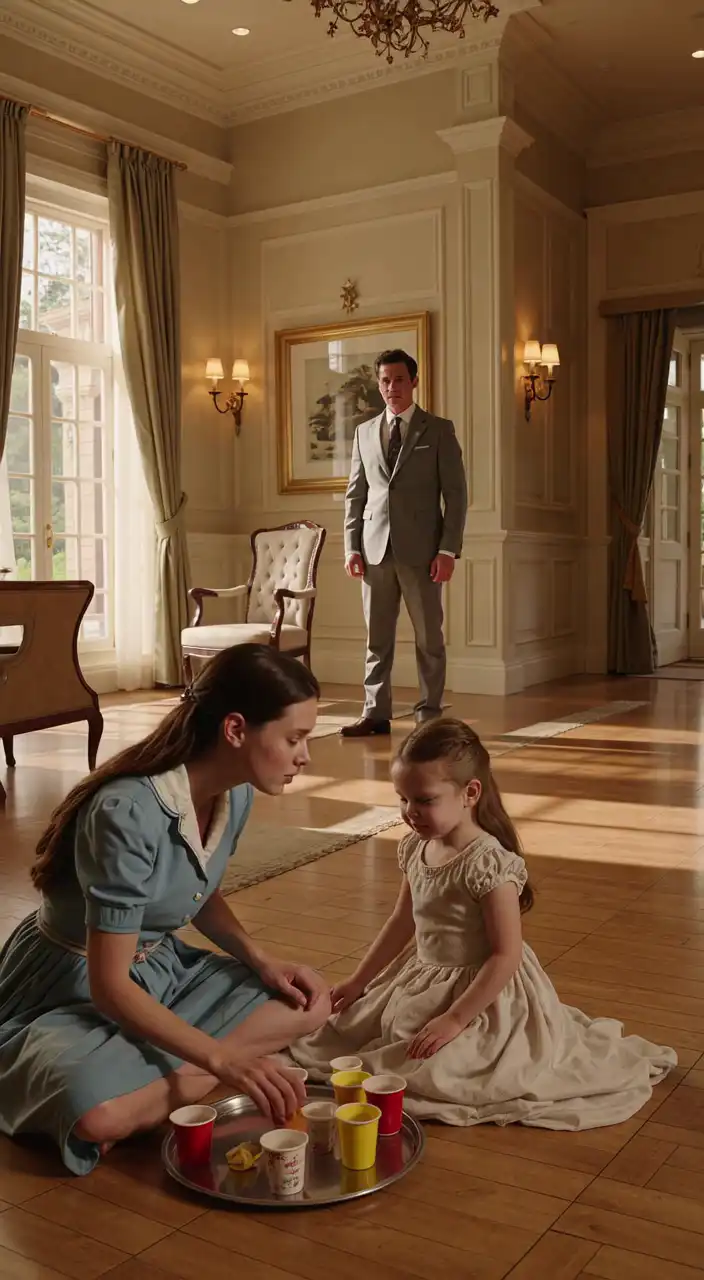
He came out of the study in time to see June and Maisie on the sunroom floor with a row of plastic cups and a spoon.
“What is this?” he asked.
June looked up. “A very high-level engineering project.”
Maisie tapped a cup.
“We’re building an ice cream store,” June said. “Invisible customers are rude, but they tip well.”
There was a carton of vanilla ice cream melting in a chilled bowl on the table.
Rhett frowned. “Before lunch?”
June lifted one shoulder. “It’s raining. Morale is low.”
Maisie was watching her carefully now, not with suspicion but anticipation. That alone was new. When June hid the spoon behind her back and gasped, “Oh no, a spoon thief,” Maisie’s eyes widened. Then, unexpectedly, she reached out and tugged on June’s sleeve.
Rhett froze.
June slowly brought the spoon forward. “Was it you?”
Maisie’s mouth twitched.
Not quite a smile. But near enough to steal the air from the room.
June scooped the smallest bit of vanilla onto the spoon and held it out. Maisie leaned forward and tasted it. A drip slid onto her chin. June pretended shock.
“Disaster,” she said. “You’ve got ice cream face.”
With a soft cloth she dabbed at Maisie’s cheek, then deliberately dabbed a tiny dot onto her own nose.
Maisie stared.
June crossed her eyes trying to look at it. “Can’t reach it. Tragic again.”
A sound broke from Maisie then—clearer, brighter, unmistakably amused.
Rhett had not heard his daughter make that sound since before Dahlia’s last hospitalization.
His hand went to the back of a chair for support.
June glanced at him quickly but kept the moment light. “Captain, should I panic?”
Maisie tapped the tray and let out the sound again, this time almost laugh-shaped.
That evening Rhett called the pediatric rehab specialist to report the behavioral change. He expected interest. Instead he got caution.
“These emotional fluctuations can happen,” Dr. Leonard Mays said over speakerphone. “Families often overinterpret novelty responses.”
Rhett stood at the library window, jaw tight. “She laughed.”
“That’s encouraging, of course. But I would be careful about unstructured care replacing therapy priorities.”
June, passing the doorway with folded laundry, heard enough to stop.
The doctor continued, “Given her bilateral weakness and avoidance patterns, the emphasis should remain on measurable functional goals. This cousin or nanny or whatever her role is—”
“Her name is June,” Rhett said sharply.
A pause. “Of course. My point is, attachment is valuable, but hope can become counterproductive if it leads to denial.”
After the call ended, June set the laundry on a chair. “He doesn’t like me.”
“He doesn’t know you.”
“He doesn’t have to. I’m not on his spreadsheet.”
Rhett rubbed his forehead. “He’s one of the best in the field.”
“I’m sure he is.”
“He says emotional excitement can mislead parents.”
June nodded slowly. “And fear can mislead experts.”
He looked at her. “You think I’m afraid.”
“I think you’ve been trained by grief to trust disappointment first.”
That night, Dr. Mays emailed a revised program and requested a video review of all home sessions. He recommended reducing “non-goal-directed play” and increasing structured standing trials.
Rhett printed the email.
By morning, the pressure had entered the household like bad weather. Eileen became cautious. The part-time therapist raised her eyebrows at June’s obstacle games. Even Rhett, despite what he had seen, found himself listening for evidence that this new tenderness was inefficient.
Then came the setback.
June had created a game on the terrace with cushions and painter’s tape roads. Maisie usually loved it. But that day, after a poor nap and a stormy sky, June encouraged her toward a low padded bench they used for supported kneeling and side standing.
“Only if you want,” June said. “We can help the bear look out the window.”
Maisie’s whole body stiffened.
“It’s okay,” June said immediately. “No rush.”
Rhett, already frayed from markets and medical opinions and the humiliating possibility of false hope, stepped in.
“We have to keep trying,” he said.
Maisie flinched at his tone.
June looked up. “Not like this.”
He heard authority in her voice and bristled. “She cannot avoid it forever.”
“She’s scared.”
“She’s always scared.”
The words came out harsher than he intended. Maisie’s face crumpled. She shoved the bear away and began to cry—the thin, helpless cry that made every room in the manor feel unbearable.
June gathered her without lifting immediately, grounding first, hand to back, voice low. “I know. I know. Too much. I’ve got you.”
Rhett stepped backward, guilt slamming into him.
An hour later Dr. Mays called again after reviewing old notes and urged firmer consistency.
“You’re allowing dependency to deepen,” he said. “If she prefers this young woman’s unstructured style, that may feel comforting now, but in the long term it could reinforce avoidance.”
Rhett stared at the speakerphone, exhaustion burning behind his eyes.
When he ended the call, June was waiting in the doorway.
“So now I’m the problem,” she said quietly.
“No one said that.”
“They didn’t have to.”
He ran a hand through his hair. “I’m trying to do what’s best for my daughter.”
“So am I.”
“You don’t know what it’s like,” he snapped, then regretted it instantly.
June’s face changed, not to anger but hurt. “No. I don’t know what it’s like to lose my wife. But I do know what it’s like to be treated like a disruption when a child finally starts feeling safe.”
Rhett said nothing.
June drew in a breath. “If you want charts, routines, and someone who can make adults feel organized while your little girl disappears inward, hire somebody else.”
She turned and walked away.
The house went still again.
And for the first time since June arrived, hope felt fragile enough to break.
For two days after the argument, Blackthorn Manor lived in an uneasy truce.
June did not leave. Rhett did not ask her to. But something tender had been bruised between them, and the bruise showed in small ways. Their conversations turned practical. Meal times. Nap times. Therapy windows. Medication reminders. Weather. Nothing deeper.
Maisie noticed.
Children always did, June had once said. They listened with their bodies.
Now Maisie became watchful again. Not entirely closed, but cautious. She still sought June with her eyes when she entered a room, still settled more easily when June read to her, still allowed the silly mail-route games and the toy-animal missions. Yet the bright little spark of anticipation had dimmed. She seemed to be waiting for the world to choose whether it was safe after all.
Rhett saw it and hated himself.
The pressure from Dr. Mays increased. He called for a case review. He suggested a residential evaluation program in Philadelphia. “Short term only,” he said, “to establish a more clinically effective structure.”
Rhett knew what that meant. It meant fluorescent hallways, professional distance, and strangers documenting his daughter’s resistance while calling it data.
Still, he asked for the brochures.
He told himself it was responsible.
He did not tell June.
Instead he found her one afternoon in the back courtyard drawing roads in sidewalk chalk while Maisie watched from a blanket, clutching her stuffed fox.
June looked up. “She likes the blue one better.”
“The blue what?”
“The chalk.” June held up a dusty hand. “She won’t touch the yellow. She glares at it like it owes her money.”
Against his mood, he almost smiled.
Maisie looked from June to him, then back.
Rhett took a step closer. “I spoke to Dr. Mays.”
June went still. “And?”
“He wants stronger adherence to the standing plan.”
“Of course he does.”
“And he mentioned a short residential assessment.”
The chalk in June’s fingers snapped.
Maisie startled.
June lowered her voice at once. “Sorry, baby.”
Rhett felt the damage as it happened.
June placed the broken chalk down carefully. “You’re considering sending her away?”
“It’s an evaluation.”
“She’s two.”
He said nothing.
June rose from the ground, blue dust on her knees. “Do you know what she hears when people keep changing the rules around her? What she feels when every safe thing becomes conditional?”
“You think I want this?” he asked.
“I think you are panicking in a suit.”
He flinched.
“And I think,” June said, tears pressing into her anger, “that every time she begins to trust, somebody with credentials tells you not to believe your own child.”
Maisie made a soft distressed sound.
June knelt immediately. “Hey, hey. It’s okay. Grown-up storm. Not yours.”
But the moment was ruined.
That evening, Eileen told Rhett that June had asked about train schedules. Not bought one. Only asked.
That frightened him more than it should have.
The next morning, he found a printed packet on his desk from the residential program. He also found, beside it, a folded sheet of construction paper from Maisie’s playroom. On the front was a blue scribble June had labeled with neat handwriting: MAIL ROAD TO DADDY.
Inside, in June’s smaller note, were six words:
She keeps choosing connection. Please see it.
Rhett sat down heavily.
He did see it. He had seen the gaze shifts, the waiting, the small vocal sounds, the way Maisie calmed faster with June’s hand on her back than with any trained intervention he had paid for. He had seen his daughter become more present in one week than in months of expensive expertise.
But seeing a thing and trusting it were not the same.
That afternoon the conflict finally broke open.
Dr. Mays came in person.
He arrived in a dark sedan with a leather briefcase and a polished certainty that seemed to harden every room he entered. He was not cruel. That almost made it worse. He was controlled, successful, and convinced that his caution was compassion.
June met him in the therapy room with Maisie on the rug and Rhett at the window.
Dr. Mays observed quietly at first. June rolled a small red truck toward a line of blocks.
“Oh no,” she told Maisie. “Bridge inspection. This looks serious.”
Maisie watched, one hand resting on June’s shoe.
“That hand on your shoe,” Dr. Mays murmured to Rhett. “Dependence cue.”
June heard him and did not respond.
She placed two toy figures by the truck. “They need a mechanic.”
Maisie picked up a block and added it to the line.
“Good,” June said. “Now we can try the bumpy road.”
The bumpy road was simply a folded blanket. To cross it, Maisie usually shifted forward and planted one knee higher, using more leg effort than she realized.
Dr. Mays scribbled notes. “Compensatory floor pattern.”
June inhaled slowly.
After twenty minutes he requested a formal standing attempt.
Maisie’s body tightened before he even touched the braces.
“Let’s not,” June said quietly. “She’s already overwhelmed.”
“We need objective observation,” he replied.
Rhett hesitated. “Maybe just one trial.”
June looked at him in disbelief. “You can see her shutting down.”
Dr. Mays reached for Maisie with efficient gentleness. “Come on, sweetheart.”
Maisie recoiled so suddenly that the toy truck tipped. She let out a frightened cry and grabbed for June’s shirt with both hands.
“It’s all right,” June said, pulling back just enough to shield without escalating. “No standing right now.”
Dr. Mays rose, displeased. “This is precisely the issue. Your emotional centrality is obstructing therapeutic authority.”
June’s cheeks flushed. “My emotional centrality?”
“You have become the preferred regulator. That may feel rewarding, but it impedes progress.”
“Because she trusts me?”
“Because she avoids challenge.”
June stood. “She is not avoiding challenge. She is surviving adults who keep turning her body into a project.”
Rhett stepped between them. “Enough.”
Silence hit the room.
Dr. Mays adjusted his cuff. “Mr. Calder, if you wish to optimize your daughter’s outcomes, I strongly recommend transition to a more clinically disciplined environment. This arrangement is clouding judgment.”
June stared at Rhett. Waiting.
He should have defended her.
Instead, tired and cornered and ashamed of his own uncertainty, he said the worst possible thing.
“Maybe we all need to step back.”
June went still.
Maisie began to cry again, louder now, face blotched, arms reaching upward. “Ah—ah—ah—”
June looked down at her, devastated. Then at Rhett.
“All right,” she said softly. “If that’s what you want.”
Rhett’s mouth opened. “June, I didn’t mean—”
But she had already bent to kiss Maisie’s hair. “Hey, sweetheart. I know.”
She handed the child gently to Eileen, who had appeared pale-faced at the door. Maisie twisted immediately, reaching back with panic sharpened in every line of her tiny body.
“June,” Eileen whispered.
“I’m just going to pack a bag,” June said. “She doesn’t need more arguing.”
Rhett followed her into the hallway. “I didn’t ask you to leave.”
“You didn’t have to.” Her voice shook now. “You let him call her trust a problem, and you let him call me one too.”
“That’s not fair.”
“No,” she said, turning on him at last. “What isn’t fair is that a child finally attached to someone, and everyone decided attachment was dangerous because it couldn’t be graphed.”
He reached for words and found none.
June went upstairs.
Below them, Maisie’s crying grew worse.
It was not the fretful cry of frustration. It was terror. Full-bodied, desperate, breathless. Rhett rushed back to the therapy room and found Eileen trying to soothe her, Dr. Mays frowning as if this too were information, and Maisie arching away from everyone.
“Dada,” Eileen said urgently, “she won’t calm.”
Rhett took her. She trembled against him, sobbing hard enough to hiccup. He rocked her, murmuring, “I know, I know, sweetheart.” But she kept straining toward the door.
Dr. Mays spoke from behind him. “This confirms dysregulation around caregiver shift. It’s difficult, but clinically—”
“Stop talking,” Rhett said.
The doctor fell silent.
Then something happened no report, no prognosis, no expensive program could have predicted.
On the rug beside the overturned truck lay Maisie’s favorite toy from the past two weeks: a small plush hedgehog June had brought from a training center prize box and stitched one loose ear back on herself. Maisie saw it through tears. She reached for it blindly.
Rhett picked it up and placed it in her hand.
She clutched it, then shoved it against his chest, pushing, insisting, turning toward the open hallway with frantic purpose.
“You want—what?” he whispered.
She pushed the hedgehog toward the stairs.
Again.
Then, gasping through sobs, she pointed.
Not random. Not vague.
Straight toward June’s room.
Every person in that hallway stopped.
Rhett stared down at his daughter.
“Do you want June?” he asked, stunned.
Maisie let out a broken cry and shoved the toy toward the stairs again.
Dr. Mays said nothing.
Rhett was already moving.
He carried her up the staircase two steps at a time and reached the guest room just as June zipped her duffel. She turned, eyes red.
Maisie lunged so suddenly from Rhett’s arms that he nearly lost hold of her. Her weak legs curled uselessly, but her arms stretched with absolute certainty. June dropped the bag and took her at once.
And Maisie buried her face in June’s neck.
Not politely. Not by accident. With total, visible, desperate attachment.
The room went silent except for the child’s sobs fading into ragged breaths.
June held her and rocked. “Hey, hey, I’m here. I’m here. I’m here.”
Maisie’s fist tangled in June’s shirt.
Rhett stood frozen in the doorway, every defense inside him collapsing at once.
Then Maisie did one more thing.
Still clinging to June with one arm, she reached the other toward the plush hedgehog in Rhett’s hand. He stepped forward automatically and offered it. Maisie took it, looked at it, then looked at June’s lap where the small red truck had somehow been tucked under the edge of the duffel from the playroom chaos below.
She grabbed the truck too.
June sniffed, confused. “What is it, honey?”
Maisie made a little sound, focused and urgent. She pushed the hedgehog into June’s hand. Then, after a moment of effort that seemed to draw on everything in her, she pressed the red truck into Rhett’s palm.
June looked up.
Rhett looked down at the toy in disbelief.
Maisie had never intentionally shared a favored toy with him. Not once. She barely tolerated others entering her play. But now, cheeks wet, body still shaking, she was giving one piece to June and one to her father.
A bridge.
A team.
The language June had been building all along.
“Oh my God,” Rhett whispered.
June’s eyes filled. “Maisie…”
The child leaned back enough to look between them both. Then she tapped the truck in Rhett’s hand and the hedgehog in June’s hand, as if assigning roles.
“Together?” June said softly.
Maisie stilled.
Rhett felt something crack open so deeply inside him it almost hurt to breathe.
He sank to his knees in front of them. “You want us both?”
Maisie stared at him. Really stared.
Then, with solemn effort, she placed her tiny hand over his on the truck.
It lasted maybe two seconds.
It was enough to change the world.
In the doorway, Eileen began to cry quietly. Even Dr. Mays, who had followed them up the stairs, had no clipboard ready now, no polished phrase to file this under.
Because the child everyone had reduced to weakness and avoidance had just made herself unmistakably clear.
Not with a miracle cure.
With love.
The first person to break the silence was not Rhett.
It was Dr. Mays.
He stepped back from the doorway as if he had intruded on something sacred. For once his voice had lost its tidy authority.
“I may,” he said slowly, “have underestimated the role of secure attachment in her tolerance for challenge.”
June, still holding Maisie, did not bother hiding her exhaustion. “That’s one way to put it.”
Rhett would have laughed on any other day.
Instead he rose from the floor with the red truck still in his hand and turned to the doctor. “You called her trust a barrier.”
Dr. Mays did not defend himself immediately. He looked at the child, now calmer against June’s shoulder, one hand still reaching occasionally toward Rhett’s sleeve as if checking he remained there.
“I was wrong about this arrangement,” he said at last. “Not about the physical difficulty. That remains real. But… I was wrong to treat emotional dependence and emotional safety as the same thing.”
June closed her eyes briefly, as though the apology cost less than the damage but mattered anyway.
Eileen, dabbing her face with her apron, whispered, “She chose them both.”
Yes.
That was what changed everything. Not only that Maisie wanted June. Not only that she had publicly fought to keep the bond everyone else was ready to disrupt. It was that she had reached for her father too. She had not chosen one against the other. In the language available to a two-year-old with grief and weak legs and no trust in force, she had made a family shape with her own hands.
Rhett followed June and Maisie back downstairs, but the house felt different under his feet. The staircase, the portraits, the polished banisters, the heavy old wealth of the manor—none of it had changed, yet all of it had. For months he had moved through Blackthorn like a man managing a museum of loss. Now there was a crack in the glass.
In the playroom, June sat on the rug and let Maisie settle beside her rather than on her lap. Rhett did something he had not done in far too long.
He sat on the floor too.
Maisie looked at him warily. Then at the truck in his hand.
“Am I the truck driver?” he asked.
June wiped under her eyes and gave a small smile. “Only if you can handle the responsibility.”
He rolled the truck an inch. “I’ve chaired merger negotiations.”
June nodded gravely. “This is much harder.”
For the first time, Maisie made that soft laugh-sound while looking directly at him.
Rhett stopped moving. “You heard that?”
“I think she’s saying your truck credentials are weak,” June said.
He looked at his daughter with wonder so naked it almost embarrassed him. “Again?”
Maisie tapped the truck.
So he rolled it to the blue scarf river.
“It seems,” June narrated, “we have a bridge emergency.”
Maisie picked up a block and, after a tiny hesitation, held it out.
Not to June.
To him.
Rhett stared, then accepted it carefully, as though taking a jewel. “For me?”
June’s voice lowered. “Take the assignment, Calder.”
He placed the block where Maisie pointed.
Her shoulders loosened.
That evening, after Dr. Mays left with revised recommendations and far more humility than he had brought, Rhett found June on the back terrace under the fading gold of sunset. She stood with her arms wrapped around herself, looking over the grounds where the grass rolled away toward old trees and stone walls.
“June,” he said.
She did not turn right away. “If you’re thanking me, don’t make it polished. I’m too tired.”
He stepped beside her. “I was going to apologize.”
That got her attention.
He faced the gardens. “I let fear make me stupid.”
June said nothing.
“I kept thinking if I listened hard enough to experts, spent enough money, followed enough plans, I could force this into becoming manageable.” He swallowed. “And every time Maisie showed me something human and fragile and real, I distrusted it because it wasn’t measurable.”
June’s expression softened, but only slightly. “You were trying not to get your heart broken again.”
“Yes.”
They stood in the quiet.
Finally she said, “That little girl is not asking you to save her from every hard thing. She’s asking you to come into it with her.”
Rhett let out a breath that felt years old. “I don’t know how.”
“You can learn.”
He looked at her then. “Will you stay? Not for two days. Not for a trial period. Stay.”
June studied him for a long moment. “As what?”
He answered honestly. “As the person Maisie trusts. As the person this house needs. As family, if you can bear that word from me after today.”
June blinked fast and looked away toward the darkening lawn. “Dahlia would haunt me if I left now.”
A small laugh escaped him, cracked with relief. “She’d probably haunt me too.”
“She definitely would.”
Inside, through the terrace doors, they could see Eileen helping set the small birthday cake back on the dining table. The one from the day before. The one no one had really celebrated.
June turned. “Then let’s do it properly.”
So they carried Maisie down in her soft pajamas and sat around the smaller breakfast table instead of the formal dining room. No guests. No staff performance. No carefully staged perfection. Just candles relit, frosting slightly smudged, and a child on June’s lap with one hand reaching toward her father.
“Ready?” June asked.
Rhett looked at Maisie. “Happy birthday, Bug.”
He expected the old stillness.
Instead, as they began to sing, Maisie leaned forward, eyes reflecting candlelight, and rested her hand over his wrist while he held the plate.
It was such a tiny thing.
Rhett was completely stunned by it.
He had negotiated nine-figure deals without blinking. He had spoken before investors and senators and cameras. Yet that small warm hand on his wrist undid him more thoroughly than any collapse ever could.
He bowed his head and cried in front of both of them.
Not with despair this time.
With gratitude.
June did not look away. She simply kept one arm around Maisie and said softly, “There you are.”
Maisie watched the tears on his face with solemn curiosity, then touched one with her fingertip.
Rhett laughed through it. “Yeah, that’s a mess, huh?”
June smiled. “Good thing this family is learning to tolerate mess.”
And when he helped Maisie taste the birthday frosting and some of it stuck at the corner of her mouth, June brought out a tiny cup of vanilla ice cream from the freezer.
“Official celebration upgrade,” she declared.
Maisie took one bite, then another, and a pale streak melted down her chin. June pretended horror. “Ice cream face returns.”
Rhett, understanding now, dabbed a little on his own nose.
Maisie stared.
Then laughed.
This time there was no mistaking it.
The sound filled the kitchen, ran down the old hallways, climbed the staircase, and touched every silent room that had forgotten what joy felt like.
Blackthorn Manor heard it.
And so did the man who finally believed it.
June moved into the blue guest room at the end of the family hallway the next week, not as temporary help but as part of the living heart of the house.
The formal paperwork called her a private developmental caregiver with full authority to coordinate play-based support alongside medical care. Eileen called her “our June.” Maisie, who still did not use many words, developed her own answer: whenever June left a room, one tiny hand lifted in immediate search.
Rhett changed too.
He cut travel in half. He moved key meetings to Richmond or handled them by video from his study. He learned how to sit on the rug in expensive trousers and let toy animals assign him humiliating jobs. He stopped asking every interaction to prove something. Some mornings he simply followed Maisie’s gaze to the sunlight on the floor and said, “Best spot in the room,” and her eyes would find his with the beginning of shared understanding.
Progress with her legs came slowly, as real progress often does. There were still tears, still refusals, still frightened days. But now challenge lived inside trust. June and Rhett made little team games together. A truck needed a bridge. A fox needed a package delivered. Daddy and June needed the captain to show them how.
And sometimes she did.
The house itself softened. Meals grew noisier. The nursery door stayed open. Laughter appeared in odd corners—the terrace, the library rug, the kitchen where vanilla ice cream kept melting faster than anyone could eat it. Dahlia’s photograph remained by Maisie’s bed, no less precious, no less painful. But it no longer looked like the only warmth in the room.
One evening in early fall, Rhett stood in the hallway and watched June and Maisie at the far end near the window seat. June had built a ridiculous block bridge. Maisie held the red truck. Instead of clutching it to herself, she looked back over her shoulder until she found him.
Then she lifted the truck and waited.
“For me?” he asked.
Her smile was tiny, but certain.
For the first time in a long time, Rhett did not feel like a man standing outside his daughter’s world.
He walked toward it, and the two people who had saved his home made room for him there.
In the months that followed, no one called June a miracle. She would have hated that. She was steadier and truer than miracles. She stayed through hard therapy mornings and easy ice cream afternoons, through regressions and laughter and the slow work of teaching a grieving house how to become a home again.
Maisie’s steps, when they eventually came with support, were not taken toward perfection. They were taken toward people who had learned to wait, to listen, and to love her without turning away.
And at Blackthorn Manor, where silence had once ruled every polished room, the sweetest sound became a little girl laughing before anyone else had even reached the punch line.
Disclaimer: Mention of any brand or trademark is for identification only and does not imply partnership or endorsement