
WHEN THE STORM FINALLY BROKE
The glossy brochure lay open across the dark walnut desk like a threat.
Specialized Residential Development Program for Early Childhood Trauma.
Five-star accommodations. Clinical staff on site. Structured support. Security. Progress tracking.
Landon Pierce stared at the smiling stock photo of a little boy holding wooden blocks while a woman in pastel scrubs crouched beside him. The child in the picture looked calm. Reachable. Safe.
His son did not.
Beyond the floor-to-ceiling windows of his study, the estate in Barrington Hills, Illinois, stretched into a moonlit silence of clipped hedges, stone paths, and sleeping fountains. The mansion was large enough to impress senators, attorneys, and the hedge fund founders who spent weekends trying to earn Landon’s approval. Tonight it felt like a museum built around grief.
He turned the page.
Transportation available. Family transition counseling provided.
Family transition.
The phrase made something inside him recoil.
A soft knock came at the study door. Miriam, the household manager, stood there in her navy dress, hands clasped too tightly.
"Mr. Pierce."
He looked up. "What happened?"
She hesitated just long enough to answer him before speaking. "Elliot woke again."
Landon closed his eyes.
"How bad?" he asked.
"He screamed for twenty-two minutes. Luis tried to comfort him, but he wouldn't let anyone near the bed. He knocked over the night-light and bit his own wrist hard enough to leave marks."
Landon stood so fast his chair slid back against the rug. "Why didn't anyone call me?"
Miriam’s expression flickered. "You asked not to be interrupted during the call with Tokyo."
Of course he had.
That was how his life worked now. Global markets, private drivers, silent chefs, endless meetings, and a three-year-old boy screaming alone while his father discussed cross-border acquisitions.
He brushed past her and took the stairs two at a time.
At the end of the second-floor hall, Elliot’s bedroom door stood open. Warm lamp light spilled over the threshold. A rocking chair sat in one corner, untouched. Plush animals lined a shelf like witnesses. The room should have belonged to a little boy with muddy knees and loud laughter. Instead, it felt like a place built around fear.
Elliot sat rigid in the center of his bed, knees pulled to his chest, his small body trembling under dinosaur-print blankets. His brown hair was damp against his forehead. His blue eyes looked huge in his pale face, not wild exactly, but far away, as if terror had carried him to some place no adult could follow.
Landon slowed his breathing before stepping closer.
"Elliot," he said softly. "Hey, buddy. It's Dad."
The boy flinched.
That tiny movement hit harder than a scream.
Landon sat carefully at the edge of the bed, leaving space between them. "You're okay. You're at home."
Elliot's gaze fixed on the corner near the curtains.
"There’s nothing there," Landon said. "See? Just your train table."
No response.
The child’s fingers worked frantically at the hem of the blanket, twisting, releasing, twisting again. It was one of his rituals now, one of the many things he did when fear overtook him. Count the folds. Check the shadows. Pull the blanket to his chin. Look toward the door. Then the window. Then the door again.
Landon knew the pattern the way other fathers knew their sons’ favorite cartoons.
He reached out, then stopped himself before touching Elliot’s arm. Too sudden, and the boy would jerk away.
"Do you want me to stay?" Landon asked.
Elliot did not answer. He almost never did anymore.
Before Lydia got sick, Elliot had been a bright, babbling baby who named birds from the patio and shouted "more" whenever his mother sang to him. During the last year of her illness, as the house filled with nurses, medications, and whispered updates, his words had dwindled. He had watched his mother grow thinner and quieter. He had stood at the doorway of her room clutching a toy truck while machines hummed around her bed. By the time she died, nine months ago, he had fallen into near silence.
Doctors called it emotional trauma with severe anxiety response. Sleep disturbances. Hypervigilance. Fear-based regression.
Landon called it losing both of them at once.
He tried again. "Elliot, look at me."
Nothing.
He forced himself to wait. Seconds stretched. The old grandfather clock from Lydia’s family, downstairs in the hall, marked the silence with a distant, elegant pulse.
Finally Elliot’s eyes moved, but not to him. To the nightstand.
The framed photo was there. Lydia in a white sweater on the terrace in Charleston, South Carolina, the wind lifting her blonde hair, Elliot on her hip at two years old. Both of them laughing at something outside the frame.
Landon followed his son’s gaze and felt the familiar fracture split through him.
"You miss her," he said hoarsely.
Elliot’s mouth trembled.
Landon tried to smile, though it felt like cutting glass. "I miss her too."
He sat there until Elliot’s breathing evened out enough to become shallow instead of ragged. Then he walked to the dresser and picked up the photo. He carried it back and held it where Elliot could see.
"Mom loved you bigger than this whole house," he whispered. "Bigger than all the gardens. Bigger than everything."
Elliot stared at the frame. One small hand lifted, hovered, then dropped back to the blanket.
A father worth anything should have known what to do with that.
Landon had negotiated billion-dollar mergers before turning forty. He could read a room of hostile investors in under three minutes. He could tell when a market would panic before the first public tremor appeared. But his son’s fear defeated him every night.
When Elliot finally lay down, Landon remained in the chair until dawn smeared gray across the windows. He watched his child sleep in restless bursts and thought about the brochure waiting downstairs.
Specialized care. Professional support. Better equipped than family.
At seven-thirty, after showering and changing into a charcoal suit, he stood in the breakfast room where sunlight fell across polished stone floors and untouched pastries. A silver-framed family portrait sat beside the coffee service. Lydia in a cream dress. Landon with one hand on her back. Elliot between them, still round-cheeked and grinning.
He picked it up.
"I’m failing him," he said to the empty room.
No one answered. Not Lydia from the still photograph. Not the staff quietly moving through the distant kitchen. Not the enormous, beautiful house that had held too much silence for too long.
Miriam entered carrying a leather folder. "The center in Connecticut can schedule an intake assessment next week. Their director called again."
Landon set the frame down.
"Fine," he said, though the word scraped on the way out. "Set the call."
Miriam studied his face. "Are you certain?"
"No."
He looked toward the gardens where morning sun lit the dew on the grass, and for one irrational second he imagined Lydia standing there, arms folded, telling him he was being an idiot.
Instead there was only wind moving through the hedges.
"I've done the therapists. The sleep specialists. The private nurses. Three live-in nannies. Home-based intervention. Medication consultations." He gave a short, joyless laugh. "What exactly am I supposed to be certain of?"
Miriam said nothing.
Landon straightened his cuffs. "If this place can help him, I don't get to care how it makes me feel."
Yet even as he said it, all he could picture was Elliot in a strange bed, checking the corners for shadows, waiting for a father who had sent him away.
Two days later, Landon arrived early to a luncheon in Winnetka he did not want to attend.
The event had been organized by Vanessa Holt, a donor whose family office wanted into a real estate fund Landon’s bank was structuring. It was hosted on the grounds of a lakeside estate filled with polished people wearing cream linen and speaking in low, expensive voices about schools, tax strategies, and summer houses in Nantucket.
Landon had planned to stay twenty minutes.
Then he heard a child laughing.
The sound was so unexpected it stopped him in the stone walkway between hydrangea borders.
Near the far side of the garden, beyond the white reception tent, a little girl in a yellow dress was crouched in the grass beside a young woman in jeans and a pale green blouse. The little girl, maybe four years old, had one red shoe on and one missing. She was upset about something important in the absolute way only children can be.
"My shoe got scared," the girl announced.
The young woman nodded solemnly. "That happens. Shoes are weak under pressure."
The little girl blinked. "Really?"
"Absolutely. Especially left shoes. They panic first."
Landon found himself watching.
The young woman did not rush to fix the problem. She sat directly on the grass, tucked one leg beneath her, and examined the flowerbeds as if the missing shoe had likely developed independent political opinions and fled. The child mirrored her seriousness.
"There," the woman said, pointing beneath a bench. "Coward."
The girl squealed and retrieved it herself.
"Do we scold it?" she asked.
"We forgive it," the young woman said. "But we don't trust it."
The little girl laughed again, clear and bright.
Vanessa appeared beside Landon, balancing a wineglass and a smile. "You look like you've discovered religion."
He glanced at her. "Who is that?"
Vanessa followed his gaze. "Oh. That's not the nanny we hired."
"What?"
"Our regular sitter canceled an hour before guests arrived. My sister's au pair recommended someone she knows. That girl was supposed to help at another house this weekend, but their family left for Aspen early, so she came here instead." Vanessa lowered her voice. "I was skeptical. No resume packet. No polished agency pitch. But the children adore her. Which is honestly more useful than references."
"What’s her name?"
"Delaney Brooks."
He looked back at Delaney. She had dark honey-brown hair pulled into a loose braid, and there was something unstudied about her that made the carefully managed people around her seem overproduced. She was young, maybe twenty-three or twenty-four, but there was no uncertainty in the way she held herself with the child. Warm, yes. Soft, no.
Vanessa watched him watch Delaney. "Why do I feel this is not about my luncheon anymore?"
"My son needs help."
Vanessa’s face changed. Everyone in their circle knew about Lydia’s death. Most knew, at least vaguely, that Elliot had not been well since.
"I’m sorry," she said quietly. "I didn’t realize..."
"I need someone different from the people we've had." Landon hesitated. Asking strangers for personal recommendations was not a skill he possessed. "Can you introduce us?"
Ten minutes later, Delaney stood in front of him near the terrace steps, wiping dirt from her hands onto a napkin she had borrowed from a waiter.
Vanessa made the introduction and drifted away with tactful speed.
Delaney met his gaze directly. "Mr. Pierce."
"Landon is fine."
"Delaney is fine too."
That almost sounded like a challenge.
He appreciated it.
Vanessa had been right about Delaney’s age. She was twenty-four, from Madison, Wisconsin, recently living in Evanston while finishing graduate coursework in child development. She had worked in respite care, early intervention classrooms, and a pediatric therapy center. Nothing about her suggested the glossy agencies that marketed candidates as luxury-compatible household assets.
"You understand trauma responses in young children?" he asked.
"I understand that adults often get scared of them and call it treatment."
Landon stared at her.
Delaney didn’t flinch. "That was blunt. Sorry."
"No," he said. "Keep going."
She folded the napkin once, neatly. "I don't know your son. I don't know his history. But people see distress and immediately organize around control. Better routines, better techniques, better compliance. Sometimes the child just learns that everyone around him is trying to manage him."
"He needs support."
"Yes. Support isn't the same as pressure."
"Have you worked with children who don't speak?"
"Yes."
"Children with night terrors?"
"Yes."
"Children who refuse touch, food, transitions, strangers?"
Delaney nodded. "Yes."
Landon studied her for a moment. "Would you consider meeting him?"
She looked toward the lawn where the little girl in yellow was now building a fortress from folded place cards. "I was only booked here for today."
"I can pay whatever rate you ask."
Delaney’s expression cooled a little. "Money isn't the first thing I'd ask about."
That landed harder than he expected.
"What would you ask?" he said.
She did not answer immediately. "I'd ask whether you want someone to help your son feel safe, or someone who makes your house look under control."
The truth was ugly enough that he said it plainly. "I don't care what the house looks like."
"Good."
"I care whether my son is slipping further away every week while I stand there useless."
Some gentleness entered her face then. "All right. I can come tomorrow afternoon for a trial visit."
The next day, the estate seemed to brace itself when Delaney arrived.
Miriam opened the front door with professional reserve and took in the nanny’s canvas tote, practical flats, and lack of intimidation.
"Miss Brooks," she said.
"Hi." Delaney smiled. "You can call me Delaney."
Miriam led her through the foyer, where sunlight spilled over the marble floor and an enormous arrangement of white lilies perfumed the air. "Mr. Pierce is in the library."
Landon stood as Delaney entered. She noticed the stack of child psychology books on his desk, the facility brochure half-hidden beneath them, and the fatigue he had failed to shave away.
"You came," he said.
"I said I would."
He almost apologized for being relieved.
Before he could speak again, a sound came from the hall upstairs. Not crying. A rhythmic tap.
Tap. Tap-tap. Tap.
Delaney tilted her head. "What's that?"
"Elliot's morning ritual when he's anxious," Landon said. "He takes a wooden train car and taps it against the bannister posts as he walks from one end of the hall to the other. Twenty-three posts. He does it until he calms down."
"No one interrupts him?"
"We tried. It made things worse."
"Good. Then don't."
Landon led her upstairs.
Elliot was in the corridor outside his room in gray pajamas with tiny foxes on them, one fist wrapped around a red train car. Tap. Tap-tap. Tap. He moved from post to post with grave concentration, his small face fixed and pale, blue eyes skating away from any sudden movement.
At the sight of strangers, he usually ran or froze.
When Delaney stepped into the hall, she did neither approach nor speak. She simply sat cross-legged on the runner rug three feet from the wall, not blocking his path.
Landon watched, tense.
Elliot reached the next post, tapped it, and glanced at her.
Delaney looked at the bannister instead of at him. "That one sounds heavier," she said softly.
Elliot stopped.
She waited.
After a few seconds, he tapped the same post again.
Tok.
Delaney picked up nothing. She used only her finger, gently tapping the floor beside her. "Mine doesn't sound as good."
Tok.
Elliot stared.
She tapped again, matching his pace but not his exact rhythm. "Maybe you have the expert tool."
The boy's fingers tightened on the train. He took one step closer to the next post. Tap.
Delaney answered from the rug. Tok.
No one in the house breathed.
Another post. Tap-tap.
Delaney copied it on the hardwood floor. Tok-tok.
Elliot looked fully at her then.
It lasted less than a second, but it was real. Alert. Curious.
Landon felt a foolish impulse to move, to speak, to mark the moment, and stopped himself only because Delaney lifted one hand very slightly without turning.
Wait.
So he did.
Elliot completed the row of posts with Delaney answering from the floor like someone joining a song she had just heard. When he reached the end of the hall, he did not run. He stood there clutching the train car, chest rising and falling.
Delaney smiled, small and private, as if she had been handed exactly the answer she expected.
"Hi, Elliot," she said. "I'm Delaney."
The boy said nothing.
But he did not leave.
For Landon, that alone felt like weather shifting.
Later, after Elliot retreated to his room and Delaney prepared to go, Landon walked her to the door.
"That was..." He stopped, because he had no word for it that didn't sound desperate.
"A beginning," Delaney said.
"He never stays when someone new enters."
"He stayed because I didn't enter like I owned the space."
Landon leaned one hand against the foyer table. "Did he actually respond to you?"
"He noticed me. That's different, and it's enough for one day."
"You sound very certain."
"I've learned not to confuse small with meaningless."
She adjusted the strap of her tote. A green crayon peeked from an outer pocket. "If you want me back tomorrow, I can come."
Landon looked upstairs toward the quiet hall. For the first time in months, the silence did not feel entirely empty.
"Yes," he said. "Come back tomorrow."
Delaney nodded. "Then tomorrow."
As she stepped outside, Landon glanced toward Elliot’s room and thought, with a caution that hurt, that something new had just entered the house.
By the end of the first week, Delaney had learned the map of Elliot’s fear.
He was most fragile in the hour before sunset, when the shadows in his room grew long and blue. He hated the click of deadbolts, the shrill start of the vacuum, and the low mechanical beep of the elevator in the service wing. He wouldn’t walk barefoot on stone floors. He would only drink water from the same green cup, only if he saw it rinsed first. If a door that was normally open stood half-closed, he froze.
And every morning, no matter how he had slept, he walked the upstairs corridor with the red train car and tapped each bannister post.
Tap. Tap-tap. Tap.
On the third day, Delaney joined him with a wooden spoon from the kitchen after asking permission from no one but Elliot’s eyes. He glanced at the spoon, suspicious at first, then resumed his route. She followed his pattern from her side of the hall, a respectful distance away, never crowding, never stealing the ritual, only stepping into it as if it belonged to both of them for a few minutes.
On the fourth day, she added words.
"Good morning, Number One," she told the first post.
Elliot tapped it.
"Number Two is grumpy."
Tap-tap.
"Number Three thinks he's very important."
Tok.
Elliot blinked. His mouth moved, not speech, but almost the shape of one.
On the fifth day, he paused beside post fourteen and waited.
Delaney, standing three steps behind him, looked deliberately confused. "Oh no. Did Fourteen not get introduced?"
Elliot held out the train car without letting go.
It was the first thing he had ever offered her.
She did not take it. "You do it," she said. "I'll say his name."
Tap.
"Fourteen."
He watched her, then moved to the next one.
That was how trust began in the Pierce house: not with dramatic progress, but with a young woman willing to learn the grammar of a frightened child’s private world.
Delaney treated him like a little boy with preferences and wit hidden under pain, not a problem to be solved. When he lined toy animals in a perfect row facing the window, she sat nearby and gave them weather reports. When he refused lunch because the apple slices were cut wrong, she did not coax or bribe. She simply said, "Those apples are clearly unacceptable. Let's try again with more dignity," and had the chef recut them into tiny moons.
He watched her then, blue-eyed and solemn, as if evaluating whether adults were allowed to be this unreasonable on purpose.
Landon saw changes he would have dismissed as invisible if he had not been starving for them.
Elliot no longer screamed when Delaney entered his room after a nightmare. Sometimes he allowed her to sit by his bed and hum under her breath. He accepted a blanket from her hands. Once, when the sprinkler system hissed alive across the back lawn and startled him into rigid panic, Delaney crouched beside him and breathed audibly until his own breathing began to match hers.
"You're safe," she would say, never demanding eye contact. "Scared doesn't mean unsafe."
One afternoon, Landon came home earlier than usual and found the two of them in the breakfast room. Delaney sat at the table with crayons spread around her. Elliot stood pressed to her side, not touching exactly, but close enough that his pajama sleeve brushed her elbow when he shifted.
Landon stopped in the doorway.
Delaney looked up. "Hi."
Elliot saw his father and stiffened.
The change was immediate, painful in its clarity. Around Delaney, the child had been softening. Around Landon, he snapped back into alertness like a wire pulled tight.
Landon put his briefcase down gently. "Hey, buddy."
Elliot looked at the floor.
Delaney did not rush to fill the silence. She only said, "We were making maps."
"Maps?" Landon asked.
"Of the house. Elliot likes knowing where all the doors are."
Landon looked at the paper. Instead of childish scribbles, there were rectangles, tiny circles, and lines that marked windows, stairs, hallways. Delaney had labeled some rooms. Kitchen. Library. Elliott’s spelling of Elliot was wrong, but close enough to make Landon’s throat tighten.
"He did this?" he asked.
"He pointed. I drew. Then he corrected me when I put the terrace door in the wrong place."
Landon glanced at his son. "You did?"
Elliot's fingers curled into Delaney’s shirt.
The movement was tiny. Defensive. Protective.
Protective of her.
For the first time, Landon understood that progress with Elliot might also mean becoming the outsider in his own home.
That realization sharpened into conflict faster than he expected.
The call with the Connecticut facility had already been scheduled for Friday. His sister Paige, a corporate attorney in Naperville who loved him fiercely and trusted specialists instinctively, arrived that morning with printouts and practical concern.
"This isn't surrender," she told him in the library while Delaney and Elliot were somewhere in the garden room. "It's medical care. If he had a heart condition, you'd send him to the best center in the country."
"He's not a damaged asset to be outsourced," Landon said.
Paige sighed. "Don't turn this into guilt theater. You've tried. Nobody thinks you're cruel."
He rubbed a hand over his jaw. "He had a decent week."
"A decent week because a temporary caregiver got him to tolerate crayons?"
The word tolerate landed badly.
Before Landon could answer, Miriam appeared at the door. "I'm sorry to interrupt, but Miss Brooks asked if Elliot may go outside."
Landon frowned. "Outside where?"
"The south garden."
"He doesn't like being outside unless the paths are empty."
"She said she'll stay with him."
Paige crossed her arms. "This is exactly the issue. No structure. No protocol. Just vibes."
Landon ignored that. "Fine," he told Miriam. "But stay near the terrace."
He went himself.
From behind the French doors, he saw Delaney kneeling in the grass while Elliot stood just beyond her, his body tense but not retreating. The south garden was the gentlest part of the estate, a long walled space with climbing roses, lavender borders, and a sweep of late-summer flowers beyond the clipped yews. Lydia had loved it best.
A yellow butterfly lifted over the salvia.
Elliot's eyes followed it.
Delaney pointed, not directly at the insect but near it. "That one doesn't care about us at all."
The butterfly drifted lower.
Elliot took one step forward.
Landon barely breathed.
"He's allowed to be curious and scared at the same time," Delaney said, as if continuing a conversation only Elliot could hear. "Most brave things start there."
Another butterfly, white this time, fluttered across the path. Elliot made a soft sound. Not a word. More like a catch of air shaped by wonder.
Delaney rose slowly. "Want to follow from a respectful distance?"
Elliot hesitated, then walked after the butterflies into the grass.
Paige joined Landon at the doors. "What is she doing?"
"Letting him be a child," he said before he could stop himself.
Paige looked at him sharply. "And when she leaves?"
He had no answer.
That afternoon the facility director called. Dr. Helena Voss spoke with polished confidence about stabilization, intensive observation, and peer-modeled routines. She used phrases like age-appropriate social reintegration and therapeutic sleep interventions.
Landon listened, asked questions, and hated himself for how reasonable it all sounded.
When the call ended, Paige said, "There. You know what you need to do."
He looked through the library window toward the garden. Delaney was seated on the stone edge of the fountain now. Elliot stood between her knees, both of them watching a butterfly settle on lavender. The boy's shoulders were not locked. His hands were open.
"Do I?" Landon asked.
The next morning, the conflict came to him in harder form.
Miriam appeared in his study before eight. "Miss Brooks needs to speak with you."
Delaney stepped in behind her, expression controlled.
"What happened?" Landon asked.
"Elliot heard Luis and one of the kitchen staff talking," Delaney said. "About Connecticut."
His stomach dropped. "How much did he hear?"
"Enough to know he's being sent away."
"He's three," Paige said from the sofa, where she had stayed overnight after another late strategy discussion. "He doesn't understand what that means."
Delaney turned to her. "He understands separation."
Paige's mouth thinned. "And you understand a week in this house."
Delaney did not rise to it. She looked back at Landon. "He wouldn't let me near him for half an hour. He hid in the linen closet. He thought everyone was going to make him leave."
"I haven't decided anything."
"But the house has," Delaney said.
Landon felt heat climb into his neck. "You are an employee, Delaney. You don't get to speak to me as if—"
"As if you're about to break trust he barely started building?" she cut in.
Silence slammed down.
No one spoke to Landon Pierce like that. Not analysts. Not partners. Not family.
Yet the worst part was that she was probably right.
Paige stood. "This is inappropriate."
Delaney's hands tightened at her sides. "Maybe. But so is discussing a traumatized child's removal where he can hear it."
Miriam quietly withdrew, closing the door behind her.
Landon held Delaney’s gaze. "You think I don't know I'm failing?"
"I think you're panicking," she said. "And panic makes adults call distance a solution."
"He needs help beyond this house."
"Maybe. But not because fear got branded as inconvenience."
Paige looked between them, furious. "You are not qualified to overrule physicians."
"I'm not trying to. I'm asking for time."
"Based on what?" Paige demanded.
Delaney answered without looking at her. "Based on the fact that he waits for me at post fourteen now. Based on the fact that he stood in the grass yesterday because butterflies mattered more than fear for thirty seconds. Based on the fact that last night after his nightmare, he reached for the blanket instead of hitting himself."
Landon's expression shifted. "He what?"
Delaney nodded. "Progress doesn't always arrive making speeches."
That line stayed with him all day.
By evening, however, Elliot had a brutal setback.
A delivery truck backfired near the service drive while he and Delaney were in the mudroom. The explosive sound sent him into full panic. He screamed, dropped to the floor, clawed at the tile, and struck his own head with both fists before Delaney could block him with a cushion. When Landon ran in from the foyer, Elliot shrank from him so violently he slid under the bench and shook there like a trapped animal.
The sight gutted the last of Landon’s fragile hope.
Paige was standing behind him when Delaney finally got Elliot upstairs and asleep.
"You can't build a treatment plan around butterflies," Paige said quietly.
Landon did not answer.
At ten-thirty that night, he signed the preliminary admission papers for the Connecticut program.
He told himself it was love.
But when he heard Delaney moving down the hall outside his study a few minutes later, he could not bring himself to call her in and say it aloud.
Delaney found out the next morning because Miriam, incapable of cruelty even in silence, left the admissions folder half-hidden beneath a stack of mail in the breakfast room.
She brought it to Landon’s study without knocking.
"Is this true?" she asked.
He looked up from his laptop, exhausted, already angry with himself. "You shouldn't go through paperwork on my table."
"I wasn't going through anything. It was sitting in plain sight."
He pushed back his chair. "Then yes. It's true."
Delaney held the folder in both hands as if it might burn her. "When were you going to tell me?"
"After I confirmed transport."
Her face changed then, not dramatic, just hurt in a way that made him feel smaller than he had in years.
"He trusts me," she said.
"He needs treatment."
"He needs stability."
"He needs more than one young woman improvising in my hallway."
"That isn't what I've been doing and you know it."
Landon stood. "What I know is that one good week and one half-good week are not the same as recovery."
Delaney set the folder down carefully on the desk. "No. They're what recovery looks like at the beginning."
He turned away, jaw tight. "I can't gamble with him."
"You already are. You're gambling that separation won't confirm every fear he has."
He faced her again. "And what if you leave in a month? Or get a better offer? Or decide this is too much, like everyone else did?"
She inhaled sharply. "Is that what this is really about?"
He said nothing.
Delaney nodded once, as if some private equation had finally balanced. "You don't trust anything temporary."
"My wife died," he said flatly. "I don't trust much at all."
The room went still.
When Delaney spoke again, her voice had softened. "I know."
He laughed once under his breath. "No, you don't."
"I know what it looks like when grief makes people organize their lives around losing the next thing first."
That hit because it was precise.
Landon sat back down slowly, suddenly tired beyond anger. "The car comes Monday."
Delaney closed her eyes for a second. "Then I need today."
"For what?"
"For Elliot."
He rubbed his temple. "This is not a movie, Delaney. There is no perfect final day that fixes his nervous system."
"I know that. I just want one day where no one lies to him with their bodies."
"What does that mean?"
"It means everyone in this house has been moving around him like they're preparing for a funeral. He feels it."
Landon could not argue. The staff had become subdued, careful, whispering. Even the chef had stopped humming in the kitchen.
"One day," Delaney said. "No decisions in front of him. No talk about Connecticut. No pressure."
He looked past her toward the rain-heavy sky beyond the windows. A storm was building over the estate, dark clouds gathering above the gardens Lydia had planted.
"Fine," he said at last. "One day."
Delaney nodded. "Thank you."
She turned to leave, then stopped. "If you're going to send him away, at least spend the day watching him first."
By noon the air had gone close and electric. Wind bent the rose canes along the south wall. The sky deepened from gray to bruised green.
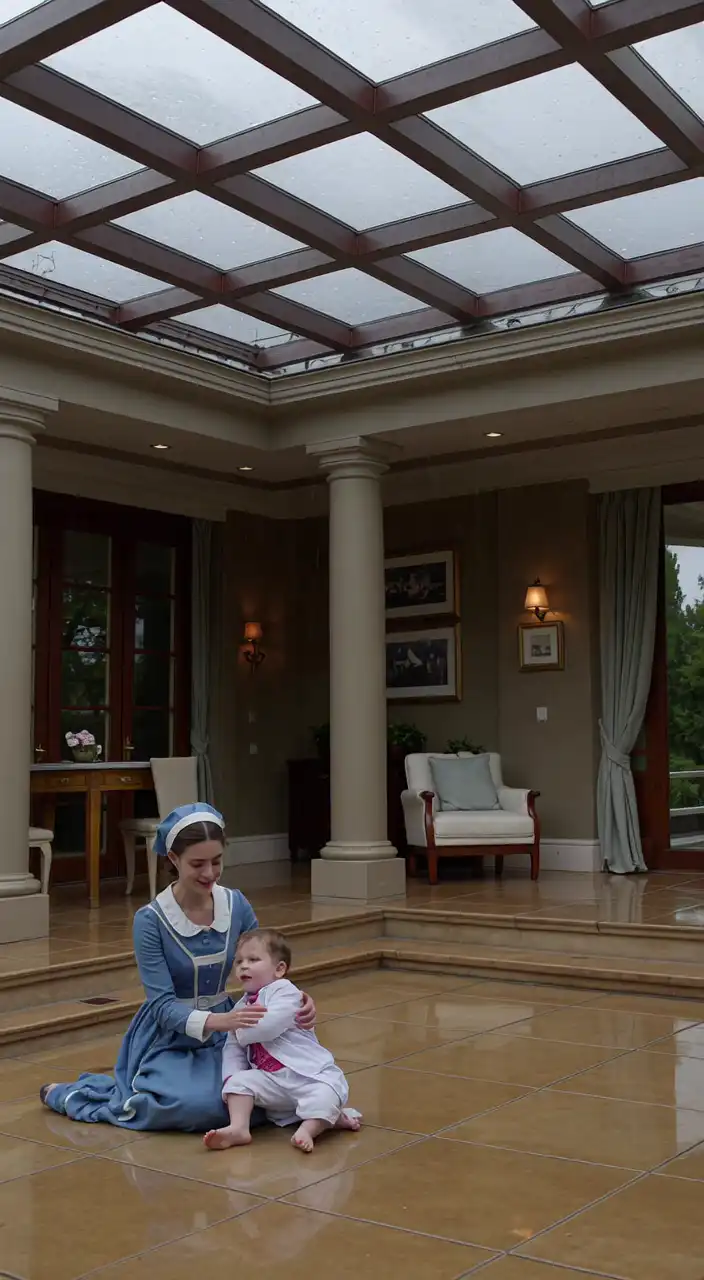
Delaney had taken Elliot to the covered terrace just before the weather broke. She sat wrapped in a light cardigan, one knee up, while Elliot arranged smooth garden stones in a line beside her. Every so often he looked toward the flowerbeds, as if hoping for butterflies despite the thickening clouds.
Landon watched from the doorway for several minutes before Delaney looked up.
"You can come out," she said.
Elliot stiffened at the sound of his father's approaching steps.
Landon stopped. "Should I stay back?"
Delaney considered that, then shook her head. "Sit on the other side of me."
He did.
For a few quiet minutes, the three of them watched the wind move through the hydrangeas. The estate felt suspended between weather systems, between choices.
Delaney picked up one of Elliot’s stones. "This one looks like a potato with ambition."
Elliot glanced at her hand, then at the stone.
Landon almost smiled.
Delaney handed the stone to him. "Your turn."
"My turn?"
"You're in the game now."
He looked at the rock in his palm. It was flat and oval, completely unremarkable. Elliot was watching him from beneath his lashes.
Landon cleared his throat. "This one... looks like a banker who forgot how vacations work."
Delaney let out a short laugh.
To his astonishment, Elliot's mouth twitched.
"Again," Delaney said lightly.
Landon chose another stone. "This one looks like Aunt Paige when someone uses the wrong salad fork."
This time Elliot made a sound. Not quite laughter, but close enough that Landon felt it in his chest like impact.
A low roll of thunder moved across the sky.
Elliot froze.
Delaney's voice remained calm. "That was sky noise."
Another rumble, louder.
The boy dropped the stone and scrambled backward until his shoulders hit the terrace wall. His breathing turned sharp and shallow.
"It's all right," Landon said, moving instinctively.
"Stop," Delaney said quietly.
He did, every muscle resisting.
Delaney turned her body slightly toward Elliot without crowding him. "Storms are loud. Loud isn't the same as dangerous here."
Lightning flashed beyond the far trees. A beat later, thunder cracked directly overhead.
Elliot let out a terrified cry and ran.
Not away from them.
To Delaney.
He launched himself across the rug and buried his face against her side, both fists twisted in her cardigan.
Landon went still.
Delaney wrapped one arm around the boy but kept her voice steady, not triumphant. "I've got you. I've got you."
Rain slammed suddenly against the terrace roof, violent and drumming. Wind drove silver sheets across the garden. Somewhere in the distance, a branch snapped.
Elliot shook so hard his teeth chattered.
Landon looked at Delaney helplessly. "Tell me what to do."
For the first time, she didn't answer like an employee. She answered like someone inviting him into a language he should have learned earlier.
"Get lower," she said. "Not over him. Beside him."
Landon moved to the rug. His expensive trousers darkened against the damp stone where rain had blown in. He hardly noticed.
Delaney spoke softly to Elliot. "Listen to my voice. One thing you hear."
The child cried into her sweater.
"That's okay. I'll go first. I hear rain."
She looked at Landon.
He swallowed. "I hear... the gutter spilling."
Delaney nodded. "One thing you feel. I feel this rug under my hand."
Landon understood. "I feel the cold from the floor."
Elliot's breathing hitched.
Delaney rubbed a slow circle between his shoulder blades. "One thing you see. I see Dad's blue tie."
Landon looked down at it, absurdly moved.
Elliot did not lift his head.
Another thunderclap split the air. The boy whimpered and grabbed Delaney harder, one hand now flung outward in blind panic. It struck Landon's wrist.
Landon held perfectly still.
Elliot's fingers curled around him by accident first, then on purpose.
Small hand. Tight grip.
Father and son connected through terror and Delaney’s steady presence.
"There you go," she whispered. "You can hold both."
Rain battered the terrace for what felt like hours and was probably nine minutes. During that time, Landon did exactly what Delaney told him. He named sounds. He named textures. He slowed his breathing. He stopped trying to erase Elliot’s fear and instead stayed near it without flinching.
The storm shifted. Thunder moved farther off. The rain softened from assault to steady fall.
Elliot's cries dwindled to hiccuping breaths. He remained pressed against Delaney, but he had not let go of Landon's wrist.
Landon dared not move.
Then Delaney said quietly, "Elliot, can you tell Dad what scared you?"
Landon almost protested. He won't. Don't ask that. Don't make him fail.
But Delaney only waited.
The boy’s face was still hidden against her shoulder. His voice, when it came, was raw and tiny, a sound unused for too long.
"Loud."
Everything in the world stopped.
Landon stared.
Delaney did not gasp or celebrate. Her eyes filled, but her tone stayed level. "Yes. It was loud."
Elliot swallowed. His fingers tightened around Landon’s wrist until the tendons hurt.
"Stay," he whispered.
The word was not to Delaney alone.
It was to both of them. Maybe to the storm. Maybe to the world.
But Landon heard it like absolution and accusation at once.
He broke.
A sound left him that he had not made since the hospital room where Lydia stopped breathing. He covered his mouth with his free hand, shoulders shaking, tears arriving too hard to be contained. He was dimly aware that somewhere inside the house, staff had gathered in the doorway and then quietly retreated. This moment belonged only to the three of them.
Delaney looked at him once, no victory in her face, only compassion.
"Answer him," she said.
Landon leaned closer, rain-cooled air against his skin, his son's hand locked around his wrist.
"I'm here," he said thickly. "I'm staying. I promise. I'm staying."
Elliot made a small broken sound and finally lifted his head. His cheeks were blotched pink from crying, eyelashes wet, brown hair damp with sweat. He looked at Landon directly, really looked, blue eyes enormous and uncertain.
Then, slowly, he reached his other hand out of Delaney’s cardigan folds.
Not to the blanket. Not to the wall. Not to the photo of Lydia.
To Delaney.
He took her hand and held it.
The gesture was simple enough that another person might have missed its force. But Landon understood. Elliot was naming safety the only way he could. One hand on his father. One hand on the girl who had entered his world by learning the rhythm of his fear.
For a while, none of them spoke.
When the storm passed completely, the garden outside glittered under a thin blade of returning sun. Water clung to the rose leaves. A single butterfly, impossibly, skimmed low over the drenched lavender.
Elliot saw it first.
His grip loosened. He pointed with one trembling finger.
"Butterfly," Delaney said softly.
Elliot's lips parted. The word came out more breath than sound.
"Fuh..."
Delaney smiled through tears. "Yeah. Butterfly."
Landon watched his son watch the living world return after fear, and something in him rearranged.
Later that evening, Dr. Helena Voss called to confirm Monday’s intake transport.
Landon took the call in the library while the storm’s last water dripped from the gutters outside.
"Mr. Pierce?" she said. "We'll need final approval by six."
He looked through the open door toward the family room. Delaney sat on the floor with a stack of board books. Elliot, wrapped in a blanket, leaned against her knee. Every so often he turned to check that Landon was still visible from where he sat.
For once, Landon did not disappear into work while his son searched rooms for him.
"No," he said.
A pause. "I'm sorry?"
"We won't be proceeding with placement."
Dr. Voss's professional tone thinned. "May I ask why?"
"Because my son doesn't need to be sent away from home to feel safe in it."
He ended the call before she could answer.
When he stepped back into the family room, Delaney looked up from the book in her lap. She searched his face once and understood.
"You canceled it," she said.
"Yes."
Elliot glanced between them, wary of adult tones he did not trust.
Landon sat down on the rug opposite him. "No one is sending you away."
The child's lower lip trembled.
"No one," Landon repeated.
Delaney lowered the book. "Can I ask what changed your mind?"
He looked at Elliot, then at her. "I finally saw him."
The next few days changed the household not because Elliot transformed overnight, but because everyone had witnessed the moment fear cracked open enough for connection to enter.
Miriam stopped using the hushed, clinical voice that had settled over the estate since Lydia’s death. The chef, Marcus, began leaving small butter cookies on the counter shaped like animals because Delaney had once mentioned that Elliot liked looking at things before tasting them. Even Paige, who arrived the morning after the storm prepared to argue again, found herself silenced by evidence.
She walked into the south garden to discover Elliot sitting on the stone path beside Delaney, one damp fist wrapped around a stalk of lavender. Landon was on the grass in shirtsleeves, tie gone, expensive watch set aside on the bench as if time itself had become negotiable. A pale yellow butterfly drifted just above the flowers.
"Don't rush him," Delaney murmured.
"I'm not rushing," Landon said quietly.
"You are internally."
He exhaled. "Fair."
Paige stood there, unseen for a moment, as Elliot took three careful steps away from the path and into the grass. He looked back once, making sure Delaney and Landon were both there.
"We're here," Delaney told him.
Landon echoed, "Right here."
Elliot lifted his hand toward the butterfly. It rose out of reach, as butterflies do, and instead of collapsing into fear or frustration, he watched it go.
Then he turned, ran back two wobbling steps, and hid against Landon's leg.
Paige made a small sound before she could stop herself.
Landon looked up. Their eyes met.
She walked over slowly. "He came back on his own."
"Yes," Landon said.
Paige crouched near Elliot, though not too near. "Hi, sweetheart."
Elliot peered at her from behind Landon's knee.
Paige’s face softened. "I was wrong."
Landon blinked. His sister did not say that often.
"I thought structure meant distance," she continued. "I thought experts automatically meant better. Maybe sometimes they do. But this..." She looked toward Delaney. "This is real."
Delaney nodded once. "He may still need outside support. It just doesn't have to begin with exile."
Paige absorbed that. "Can I help?"
The question, humble and awkward, would have been impossible from her a week earlier.
"Yes," Delaney said. "By not talking about him like he's not in the room."
Paige gave a short laugh through suspiciously bright eyes. "Noted."
The therapist who came twice a week noticed the difference too. Dr. Naomi Sellers had spent months earning only fragments of Elliot’s attention. During her next session, he still avoided direct play for long stretches, still startled at unexpected sounds, still checked the corners of the room. But when thunder rumbled faintly in the distance, he did not spiral. He looked toward Delaney, then toward Landon, who had taken the afternoon off and was seated near the door.
"Can you tell me what you do when it feels loud?" Dr. Sellers asked gently.
Elliot's mouth pressed into a line.
Delaney did not prompt. Neither did Landon.
After a long pause, Elliot lifted one hand and placed it over his own chest.
"Breathe," he whispered.
Dr. Sellers looked up so quickly she almost dropped her notebook.
Landon's eyes filled again. He turned away, but not before Delaney saw.
When the session ended, Dr. Sellers stepped into the hall with Landon.
"This is the most self-directed regulation I've seen from him," she said. "Whatever changed after the storm, keep building on it."
"It was Delaney," he said.
Dr. Sellers considered that. "Maybe. But from what Elliot showed today, I don't think it was only her. He used you too."
Landon stood with one hand in his pocket, absorbing the weight of that sentence.
Used you too.
Not tolerated. Not endured.
Needed.
That night he found Delaney in the kitchen pouring tea after Elliot finally fell asleep.
"You should have told me sooner that he was changing," he said.
She glanced at him over the rim of the kettle. "I did. You were measuring the wrong things."
He leaned against the counter. "You're not easy on me."
"No."
"Why?"
Delaney set two mugs on the marble island, though he had not asked for one. "Because your son doesn't need another adult more committed to seeming competent than being present."
He gave a tired half-smile. "There it is."
"There what is?"
"The thing you do. You say the harsh truth like you're discussing weather."
Delaney slid a mug toward him. "And yet you keep listening."
"I didn't, at first."
"No."
He looked down at the steam rising between them. "When Elliot said 'stay'..." He stopped and tried again. "I realized I've spent nine months arranging everything except myself. Best doctors. Best therapists. Best staff. Best house. Best possible resources. As if I could outsource steadiness and still call it parenting."
Delaney was quiet.
"I loved Lydia," he said. "But when she got sick, I worked more. I told myself I was protecting us, building safety, keeping things stable. By the time I looked up, she was dying and Elliot had learned that all the important things in life disappear into closed rooms."
Delaney’s face gentled. "You're looking up now."
He laughed without humor. "Late."
"Late isn't the same as never."
The kitchen fell into a warm stillness. Somewhere above them, old pipes shifted softly in the walls.
Landon spoke before he could reconsider. "Stay on permanently."
Delaney did not answer immediately.
He added, "Not because Elliot clung to you in one storm. Because you've done what no one else has done. Because he trusts you. Because I trust you."
She wrapped both hands around her mug. "That isn't a small offer."
"No."
"It's also not a simple job."
"I know."
She met his eyes. "If I stay, things change. Not just for him. For you."
"What does that mean?"
"It means I won't work in a house where the father keeps choosing conference calls over bedtime and then asks why trust isn't compounding."
The investment metaphor made him wince. "Fair."
"It means if he needs you on the floor, you get on the floor. If he needs you in the garden, you go to the garden. If he melts down at five-thirty and Frankfurt wants you at five-thirty, somebody else handles Frankfurt."
Landon took a long breath. This was not about affection or gratitude. This was terms of reentry into his son's life.
"All right," he said.
Delaney searched his face. "You say that now."
"I'm saying it because I mean it."
"Then prove it before I answer."
The challenge was clean and deserved.
Over the next week, he did.
He moved his market calls later where he could. He delegated the London account he had clung to out of habit and ego. He instructed his assistant that from five to eight each evening he was unavailable except for genuine emergencies. He canceled a Friday dinner at the Union League Club and spent it in fox-pattern pajamas reading the same picture book four times because Elliot kept bringing it back.
The first time he sat on the hallway runner during morning train taps, Elliot paused in visible confusion.
Delaney, standing in the doorway with coffee, said nothing.
Landon tapped post one with his knuckle.
Tok.
Elliot studied him, then tapped it properly with the red train car.
Tap.
Post two.
Tok.
Tap-tap.
By post six, Elliot had edged close enough that his sleeve brushed Landon's knee. By post fourteen, he was waiting for his father the same way he once waited only for Delaney.
Landon looked up then and saw Delaney leaning against the doorframe, arms folded, smiling faintly. Not like someone pleased with herself. Like someone witnessing a bridge finally being used.
That evening, after Elliot fell asleep without terror for the first time in weeks, Delaney found Landon in the library turning over the old Connecticut brochure in his hands.
He looked up. "I was about to throw this away."
"About to?"
He dropped it in the fire.
Paper blackened, curled, and vanished.
Delaney watched the flames reflect in the window glass. "That feels symbolic."
"It is symbolic."
"And dramatic."
He gave a low laugh. "Also that."
When he sobered, he said, "Will you stay?"
She was quiet long enough that he wondered if he had already lost the answer.
"I'll stay," she said at last. "But not as a miracle worker."
"I wouldn't insult you like that."
"As part of a team."
Landon nodded. "Yes."
"One where your son has a father in it."
He held her gaze. "Yes."
From the upstairs hall came a small sleepy cry.
"Dad?"
One word. Soft. Uncertain. A summons.
Landon closed his eyes for a brief second as if taking the blow of joy straight to the ribs.
Delaney smiled. "You should get that."
He was already moving.
Autumn settled over Barrington Hills in amber and gold.
The estate changed with it. Windows opened more often. Staff spoke at normal volume again. The house no longer felt arranged around an absence so much as learning to live beside one.
Delaney stayed, exactly as she had promised, not as a savior but as a steady presence woven into the rhythms of the home. She helped build plans with Dr. Sellers instead of against her. She taught Marcus to announce the blender before turning it on. She showed Miriam that Elliot handled transitions better when he could move a marker on a visual schedule himself. She turned ordinary things into bridges: washing blueberries together, matching socks from the dryer, tapping rainy-window rhythms while waiting out afternoon nerves.
But the largest change was Landon.
He reduced travel. He converted a small conference room at the downtown office into secure video space so he could come home between meetings more often. He stopped telling people, "I can't," when what he meant was, "I haven't chosen to yet." The markets survived without him for ninety minutes at dinner. Entire continents continued to function while he knelt in the garden identifying butterflies with a three-year-old boy who now laughed in startled little bursts whenever one escaped his reach.
One Saturday morning, Elliot stood between Landon and Delaney in the south garden, a tiny knit sweater hanging crooked over his shoulders, brown hair blown into wild soft tufts by the wind. A monarch drifted past the lavender. Elliot took off after it, then stopped halfway and looked back.
That was his new habit now. Not to check for danger.
To make sure his people were coming too.
Landon reached him first and crouched beside him in the grass. "Where did it go?"
Elliot pointed toward the roses. "There."
Delaney joined them, her hand briefly resting at Elliot’s back.
The boy looked from one to the other, blue eyes bright, and smiled without fear.
The future was not magically simple. There were still bad nights, still storms, still moments when grief reached through the walls of the house and touched all three of them in different ways. Lydia was still gone. Elliot still carried memories too large for a child. Healing had not erased what happened.
But the mansion no longer held its breath.
It breathed with them.
And when evening came, and the lights warmed the windows against the early dark, Landon no longer stood in his study wondering whether love could be delegated. He was on the floor for train taps, in the doorway for bedtime, on the terrace when thunder rolled, and in the garden when butterflies rose from the flowers like fragile, living proof that fear was not the end of every story.
Outside, the wind moved gently through the lavender. Inside, a little boy's laughter traveled down the hall, followed by Delaney’s voice and then his father's.
This time, no one disappeared.
Disclaimer: Mention of any brand or trademark is for identification only and does not imply partnership or endorsement