
THE HOUSE THAT LEARNED TO BREATHE
The resignation letter lay in the center of the walnut desk like a verdict.
Graham Mercer stood in the glass-walled study of his beach house in Seabrook Island, South Carolina, and read the same three lines for the fourth time.
I am sorry, Mr. Mercer. I am not equipped to meet Daisy’s needs. I wish your family the best.
There was nothing dramatic about it. No anger. No complaint. Just surrender.
Beyond the floor-to-ceiling windows, the Atlantic moved in slow gray bands under a cloud-heavy sky. The private stretch of beach below the house looked untouched, almost staged, as if beauty could be arranged by money and held in place by gates. Graham had built companies that predicted markets, bought struggling startups before anyone else saw their worth, and turned data into fortunes. Business magazines had called him visionary, ruthless, brilliant. Last year, one of them had put him on the cover beneath the words THE BILLIONAIRE WHO NEVER MISSES.
He looked at the letter again and thought, Not true.
He missed every day.
He missed his wife when he woke up. He missed her voice in the hallway. He missed the way she used to leave half-finished cups of tea on every flat surface in the house and laugh when he pretended to be annoyed. He missed her so hard that sometimes the silence after sunset felt like pressure on his chest.
Most of all, he missed the daughter who was right down the hall.
A soft knock came at the open study door. His house manager, Lenora Pike, stood there with her hands folded in front of her apron. She had been with the family long before the companies, long before the security team, long before the second wing had been added to the house. She looked tired.
“She packed her bags,” Lenora said gently. “The driver took her to the airport shuttle.”
Graham set the letter down. “Did she say anything else?”
Lenora hesitated. “Only that she didn’t think Daisy knew she was there.”
That landed harder than the resignation itself.
He turned toward the window so Lenora would not see the way his jaw tightened. “Where is Daisy?”
“In the nursery. Mara from the kitchen has been sitting with her, but Daisy hasn’t touched lunch.”
“I’ll go.”
Lenora didn’t move. “Mr. Mercer.”
He looked back.
“You need rest.”
He almost laughed. “Is that what I need?”
“No,” she said. “But it’s the only thing in this house that can still be offered easily.”
He gave her a tired nod and walked out of the study, letter still in hand.
The mansion was too quiet for a place built for family. The long hallway overlooking the ocean had polished oak floors and framed photographs from another life: Graham and his wife, Tessa, barefoot on a dock in Maine; Tessa laughing into the wind on their wedding weekend in California; Tessa holding a newborn Daisy in a hospital blanket, exhausted and glowing. In every photo, Tessa was the warmth at the center. Even the rooms seemed to know she was gone.
He stopped in front of one frame where Tessa sat cross-legged on a blanket, a six-month-old Daisy in her lap. Tessa was grinning at something outside the frame. Daisy’s tiny hand was reaching for her mother’s face.
Graham pressed his thumb against the edge of the glass.
“I’m trying,” he said quietly, to the picture, to himself, to the woman who would never answer. “I don’t know what else to do.”
When he entered Daisy’s room, Mara stood immediately. The young cook looked relieved to be dismissed from a duty she had never signed up for.
“She didn’t nap,” Mara whispered. “She just sat there.”
“Thank you, Mara.”
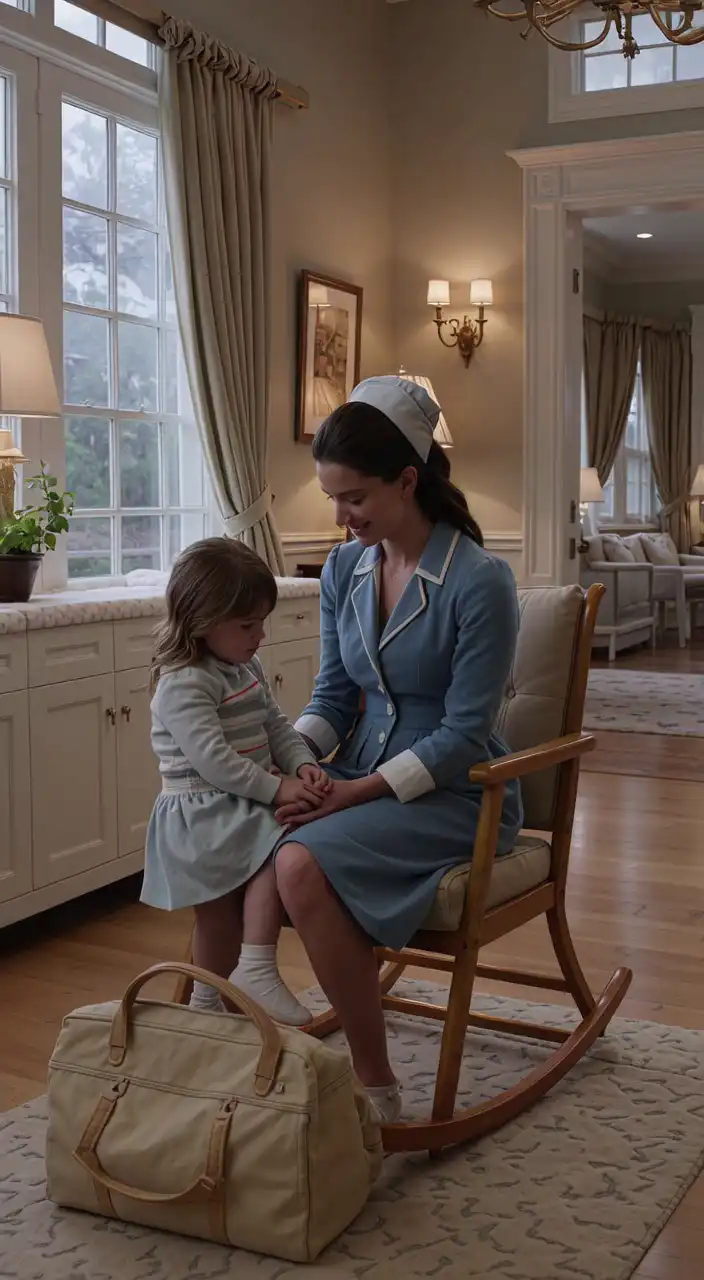
The room was full of soft colors and expensive things chosen with desperate care. Shelves of handmade toys. Stacks of developmental cards. A sensory tent recommended by a specialist in Boston. Cushioned corners. Low lighting. A white rocking chair no one used anymore.
And in the middle of the rug, beside a basket of untouched stuffed animals, sat Daisy.
She was two years old, all pale gold curls and hazel eyes that should have sparkled and didn’t. She wore a soft blue sweater and white leggings, one sock half-off, as if someone had tried and failed to complete the small task of dressing a child who did not participate in being dressed. Her face was beautiful in the heartbreaking way some children are—so open, so delicate, so absent from the room that every instinct in a person rose up to protect them.
“Hey, Bug,” Graham said.
No reaction.
He crouched in front of her, suit pants wrinkling at the knees. “Daisy. Daddy’s here.”
Her gaze remained fixed somewhere beyond his shoulder. Not frightened. Not upset. Just unreachable.
The specialists called it developmental delay. They had softer language for it in reports: reduced emotional reciprocity, delayed social response, minimal expressive communication. Graham hated every phrase. They all meant the same thing in practice. Daisy did not smile. Daisy did not reach for comfort. Daisy did not answer excitement with excitement or sadness with sadness. He could pick her up, and sometimes she would lean against him because gravity demanded it, not because she wanted him.
The fire had happened when Daisy was barely over a year old. Tessa had been in the guest cottage on the far side of the property during a storm-induced power issue. The old wiring nobody thought about until too late had sparked. Tessa had made sure the staff got out. By the time anyone realized she was still inside, the roof was already burning.
People said words like heroic and tragic. Graham remembered smoke, sirens, rain, and a sound torn out of his own throat that he did not recognize.
After that, Daisy changed. Or maybe Graham had changed and could no longer tell what had already been there. She stopped doing the little things babies were supposed to do. She did not babble much. She did not mirror smiles. She drifted farther every month, as if grief had reached into a child too young to understand death and simply dimmed the lights.
He sat fully on the rug, ignoring the ache in his back. “I know lunch looks terrible,” he said, trying for lightness. “I didn’t make it, so we can both be suspicious.”
Nothing.
He picked up a cloth rabbit from beside her. “Mr. Rabbit has concerns about management. He says this house is underperforming.”
Still nothing.
His throat tightened. “Daisy, please.”
The word slipped out before he could stop it.
He hated himself the second it did—please, as if she were withholding affection on purpose, as if she owed him the right response.
He set the rabbit down and lowered his voice. “I’m sorry.”
He reached out slowly, touched a curl near her temple, and watched her not react.
That was the worst part. Not tantrums, not tears, not screaming. Silence. Silence from a child who should have been all need and wonder. Silence in a house with twelve rooms and three levels and a panoramic ocean view. Silence where laughter should have lived.
That night, after Daisy had been put to bed and the waves had gone black beyond the windows, Graham returned to his study with the resignation letter and a thick folder labeled CARE OPTIONS.
Inside were businesslike solutions to private grief. Elite live-in specialists. Residential early intervention campuses. Family support estates in Connecticut and Arizona. Places with glossy brochures and smiling children on the front. Places that used words like immersive and structured and outcomes.
He stared at one photo of a bright classroom and imagined Daisy there among strangers. He imagined signing another check, arranging another schedule, outsourcing another part of love because he did not know how to hold it himself.
Lenora knocked once and stepped in with a tray of untouched dinner. “You need to eat.”
“I hired six nannies in eight months,” he said without looking up. “Three specialists. Two new therapists. A child psychologist who billed more per hour than my lead attorney.”
Lenora set the tray down. “I know.”
“And still when I walk into that room, it feels like I’m standing outside a locked house.”
She was quiet for a moment. “Then stop trying to break the door down.”
He looked at her.
“There’s temporary staff coming tomorrow,” she said. “Marlene’s niece had an emergency, so the agency sent someone to fill in for the weekend. Young girl. Probably won’t last.”
“Then cancel it.”
Lenora’s face softened. “Do you want me to?”
He looked past her, toward the dark hallway where his daughter slept in stillness.
After a long silence, he said, “No. Let her come.”
The next morning, the ocean was silver and restless, the kind of coastal weather that made the whole house smell faintly of salt even with the windows shut.
Graham was halfway through a call with investors in San Francisco when he saw her from the upstairs landing.
She stood in the front foyer holding a canvas duffel bag, damp from sea mist, and looking entirely wrong for the Mercer house.
The temporary nanny could not have been more than twenty-three. She wore worn brown boots, jeans, a green rain jacket, and her dark blond hair in a loose braid that had half-fallen apart from the wind. No designer handbag. No polished agency suit. No carefully neutral smile. She looked like someone who would rather be on a trail than in a mansion.
Lenora was speaking to her in the formal tone she reserved for all new staff. The girl nodded, then crouched to greet the old Labrador stretched beside the entry table.
“Hi, handsome,” she murmured, scratching behind the dog’s ears. “You look like you know all the secrets.”
The dog thumped his tail once.
Graham ended his call with a clipped promise to follow up and came down the stairs.
Lenora turned. “Mr. Mercer, this is June Holloway. She was sent over from Charleston Child & Home Services for the weekend coverage.”
June rose and faced him with clear blue eyes and a steadiness he did not trust at first.
“Mr. Mercer,” she said.
“You understand this is temporary.”
“So I was told.”
Lenora added, “June has experience with toddlers and special needs support at a children’s nature program outside Asheville. Her references were strong.”
June gave a small shrug. “I also know how to read stories the same way fifty times without losing my mind. That tends to matter with two-year-olds.”
It was such an unpolished answer that Graham almost frowned. Every other candidate had arrived with terms like sensory-informed and milestone-centered and child-led engagement. This girl said fifty times.
“You’ve worked in private homes before?” he asked.
“Not homes like this,” she said honestly. “But children don’t usually care how big a house is.”
Lenora looked alarmed by the answer. Graham should have dismissed her on the spot.
Instead he said, “My daughter is two. Her name is Daisy. She has developmental delays. She does not respond much. She doesn’t smile. She rarely makes eye contact. Most people mistake her quiet for ease, and it isn’t.”
June listened without interrupting.
“She has therapists,” he continued. “A schedule. Preferred foods. Quiet windows. Sensory accommodations. I expect staff to follow the routine.”
“Of course,” June said.
Then she added, “May I meet her before I read the binder?”
He studied her. “Why?”
“Because I’d rather meet a child than meet instructions about a child.”
Something in him stiffened at that. It sounded too close to criticism. Too close to everything he feared—that there were rules because he did not know his own daughter well enough to go without them.
Lenora stepped in quickly. “The binder is extensive.”
“I’m sure it is,” June said, not rude, just calm. “I’ll read every page. I just want her face first.”
For reasons he could not explain, Graham said, “Fine.”
He led her upstairs.
Daisy was in the sunroom attached to the nursery, sitting near the window where she often spent long stretches watching light move over the floorboards. A set of stacking cups lay tipped on their side beside her. She didn’t look up when they entered.
Graham began automatically, his voice taking on the clipped caution of briefing another caretaker. “She usually remains here until ten-thirty. Then snack. Then—”
June touched his sleeve lightly, enough to interrupt but not enough to offend. “Can I just say hello?”
He fell silent.
June did not approach Daisy with exaggerated cheer. She did not kneel directly in front of her, wave toys, or ask a string of questions into the child’s stillness. She crossed the room quietly, took off her boots by the wall, and sat on the floor several feet away.
Not facing Daisy exactly. Just nearby.
The room changed around that simple act.
“Hi, Daisy,” June said softly. “I’m June.”
Daisy looked through her.
“That’s okay,” June went on. “You don’t have to say hi back.”
She folded her legs, set her hands on her knees, and did nothing else.
Graham waited for the pitch, the puppets, the songs, the professional trick. It did not come.
Instead June looked around the room as if she had all day in the world. “You have a nice spot here,” she told Daisy. “Good light. I like that.”
Another stretch of silence.
June noticed a board book on the cushion beside her and picked it up. “Bear at the Shore,” she read from the cover. “That’s promising.”
She opened it, but not with the performative energy adults usually used around toddlers. Her voice was low and even, almost companionable.
“Bear woke early. The sea was whispering secrets to the sand.”
She gave the sea a funny dramatic whisper on the next line, barely changing her expression. “Shhhhhh. I am very mysterious.”
Something happened then—small enough that Graham nearly doubted it.
Daisy’s head tilted a fraction.
June did not rush toward the response. She simply turned the page.
“Bear found one red shell, two gray stones, and a crab with a bad attitude.”
This time she made the crab sound cranky. “Go away. I’m busy being a crab.”
Daisy’s fingers moved against the rug.
Graham took one involuntary step forward.
June kept reading. She didn’t smile at him, didn’t signal triumph, didn’t break the fragile thread by naming it.
At the end of the book, she closed it and set it in her lap. “That crab needs a nap,” she said to Daisy. “Honestly, same.”
For the first time, Daisy’s eyes shifted.
Not to Graham. To June.
Only for a second. A brief hazel glance landing on a human face and then sliding away.
It was so slight that another person would have missed it. But June saw it. Graham saw June see it.
Neither of them spoke.
After a moment, June said very gently, “There you are.”
Graham’s chest tightened with an emotion too dangerous to identify. Hope had become a kind of superstition in this house. You did not say its name aloud.
He cleared his throat. “I’ll leave you to settle in.”
June looked up at him then. “You don’t have to leave because I’m here.”
“I have work.”
Maybe she heard the lie inside the truth. Maybe she didn’t. “Okay,” she said.
He turned and walked out before he could embarrass himself by standing in the doorway watching a temporary employee read a picture book as if it mattered more than any board meeting he had ever chaired.
At noon, Lenora found him in the kitchen, staring at his coffee without drinking it.
“She ate some applesauce,” Lenora reported. “June gave it to her while reading. No fuss.”
“Fine.”
“And Daisy followed her voice from one side of the room to the other.”
He looked up too fast. “Are you sure?”
Lenora’s expression was unreadable. “I’ve lived long enough not to confuse certainty with hunger, Mr. Mercer. But yes. I’m sure of what I saw.”
He set the mug down.
From somewhere upstairs, faint and unexpected, came the sound of a young woman speaking in a ridiculous theatrical growl.
“Oh no,” June’s voice drifted down. “Not Captain Seagull. He steals everyone’s cookies.”
A pause.
Then, very softly, so soft he almost imagined it, the sound of one tiny breath shaped differently than usual.
Not a laugh. Not yet.
But not nothing.
By the third day, Graham had learned that June’s method, if it could even be called that, looked like almost nothing at all.
She did not crowd Daisy with goals. She did not fill every silence with encouragement. She did not dangle rewards or insist on participation. She entered Daisy’s world as if quiet were a country with its own customs, and she was polite enough to learn them before speaking.
Every morning she sat on the rug by the sunroom window with Bear at the Shore and three other books Daisy seemed willing to tolerate. She read them in the same order, using the same voices, sometimes fifty times, maybe more. The crab remained offended. The gull remained dramatic. The sea remained mysterious. The predictability was not laziness. It was a promise.
“You can count on me,” she seemed to say with every repeated page.
Daisy never asked for the books. She never pointed. She never climbed into June’s lap the way other children might have. But around ten each morning, she began drifting toward the cushion where June usually sat. Not quickly. Not obviously. Just gradually, until one day Lenora noticed the child had placed herself within arm’s reach of the canvas book bag.
June treated this as ordinary.
“Well,” she said, picking up the board book. “Looks like we’ve got a very demanding audience.”
When Graham overheard, he almost objected. Daisy was not demanding. She barely asked for anything at all.
Then he understood. June was giving his daughter the dignity of being read as a child, not a case.
On Wednesday afternoon, Graham came home earlier than usual from a meeting in Charleston. He found June and Daisy on the covered terrace facing the dunes. A warm wind moved the gauzy curtains tied to the posts. June had spread butcher paper over the outdoor table, weighed it down with smooth shells, and set out cups of washable paint.
He stopped just inside the doorway.
Daisy sat in her high chair pulled close to the table, a smock tied crookedly around her neck. One tiny hand was coated in blue paint. June’s own hands were messier.
“This one,” June was saying to Daisy in a serious voice, “is the ocean when it’s trying to look innocent.”
She pressed her palm to the paper, leaving a print. Daisy stared.
“And this,” June continued, dabbing gray with two fingers, “is cloud weather deciding whether to be dramatic.”
Graham stepped forward. “What is this?”
June looked up. “Painting.”
“I can see that. It’s not on her schedule.”
“No,” June said. “It was raining. She was watching the water. I thought maybe she’d like making some.”
He glanced at Daisy’s hand. “She doesn’t usually tolerate messy textures.”
“She didn’t, at first.”
As if on cue, Daisy lifted her blue palm slightly and studied it. Her expression did not change, but she did not pull away either.
June handed her a sponge shaped like a fish. “This fish has no artistic discipline.”
She stamped the sponge on the paper. Once. Then again.
Graham stared.
June turned back to the table without fanfare. “I put paper down,” she said. “No antiques were harmed.”
“It’s not about antiques.”
“I know.”
The ease of that answer irritated him. “You should have cleared it with me.”
June set the sponge aside carefully. “Would you have said yes?”
He didn’t answer.
“That’s what I thought,” she said, not unkindly.
Daisy made a small sound, not quite a hum, more a shift of breath. June immediately mirrored the rhythm of it with her own voice, low and steady. Daisy’s shoulders loosened.
Graham had seen therapists do versions of regulation before, but June made it look less clinical, more human. As if she were not managing a symptom but listening to a person.
“She has appointments tomorrow,” he said, trying to regain control of the conversation. “Occupational therapy at nine. Developmental review at one.”
June nodded. “I know.”
“You need to maintain consistency.”
“I am.”
“With the approved routine.”
June met his eyes. “Mr. Mercer, with respect, the approved routine in this house has produced a child who expects everyone to leave.”
The words hit hard because they were too close to true.
His voice cooled. “You’ve been here four days.”
“And in four days,” she said softly, “I’ve learned she notices when someone sits without asking anything from her. I’ve learned she likes the same page before turning. I’ve learned she watches reflections before faces. I’ve learned she can tolerate paint if no one claps when she touches it.”
He folded his arms. “You think the specialists haven’t noticed those things?”
“I think a lot of people notice her,” June said. “I’m not sure enough people are with her.”
Silence stretched between them, sharp as wire.
Then Lenora appeared in the doorway, clearly sensing the tension. “Mr. Mercer, your assistant called. She said it’s urgent.”
Of course it was. There was always something urgent.
He stepped away to take the call in the hall. By the time he returned, Daisy had one blue fish print on the paper and June was reading Bear at the Shore beside the drying paint, as if conflict belonged to adults and did not deserve center stage.
The urgent call became a problem by evening.
A major acquisition in Seattle had hit unexpected legal trouble. Graham’s presence was required in person. Not virtual. Not delayed. Investors were nervous, board members louder than usual, and a competitor was circling. He would need to leave the next morning and stay at least three days.
Lenora brought the updated itinerary to the dinner table where he sat alone with his laptop open and a plate going cold.
“You can’t be serious,” he said after scanning the schedule. “Daisy’s therapy blocks overlap with travel check-ins. Move her Thursday session to the afternoon. Cancel terrace time. Keep meals exact. No unnecessary changes while I’m gone.”
Lenora nodded but did not write immediately. “June asked if the beach walks could stay.”
“No.”
“She says Daisy is calmer after.”
“I said no. If I’m away, I want routine tightened, not loosened.”
A quiet voice spoke from the doorway. “The walk is part of the routine now.”
June stood there, Daisy balanced on her hip in footed pajamas, one curl stuck to her cheek from bathwater. It startled him, seeing his daughter carried that way. Most staff used strollers, supportive chairs, measured transitions. June simply held her.
Graham closed the laptop. “I’m not debating this.”
June came in anyway. “You’re leaving tomorrow?”
“Yes.”
“For work.”
“Yes.”
Daisy leaned against her shoulder, watching the light fixture.
June shifted the child gently. “Then don’t strip away the things that make the days feel safe just because you’re scared to be gone.”
His temper flashed. “You do not get to tell me what I’m scared of.”
“No?” Her voice stayed level. “Because from where I’m standing, every time something starts to feel real in this house, someone reaches for a schedule and tries to pin it down.”
Lenora looked like she wanted to disappear into the walls.
Graham stood. “You are temporary staff.”
June’s chin lifted. “Then fire me.”
The room went still.
Daisy stirred at the change in tone but did not cry.
Graham looked at his daughter, then at the young woman holding her as if she belonged in no one’s hierarchy but the child’s.
“I am not discussing this in front of Daisy,” he said tightly.
“Good,” June replied. “Then decide tonight whether you want control or progress, because they are not the same thing.”
She turned and left with Daisy still on her hip.
For a long time, all Graham could hear was the distant ocean and the blood pounding in his ears.
Lenora finally spoke. “She shouldn’t have challenged you.”
“No.”
“But she wasn’t entirely wrong.”
He shut his eyes.
In the nursery later that night, he stood beside Daisy’s crib while she lay awake, staring at the shifting shadows from the night-light projector. He reached through the slats and rested his hand lightly on her back.
“I have to go away for a few days,” he said. “You won’t know that matters. Maybe that’s better.”
No response.
“I’m trying to do what keeps us safe.”
He looked across the room at the rocking chair where Tessa used to sit for midnight feedings. The memory arrived with painful clarity—her bare feet tucked under her, hair loose, whispering nonsense songs into the dark. She had always said children knew when adults were pretending calm.
“Maybe I don’t know what that is anymore,” he admitted.
In the hall, he heard June’s voice from the guest room Lenora had given her for the week.
Quietly, absurdly, she was practicing the crab voice.
“Go away,” she muttered to herself. “I’m busy being a crab.”
Against his will, a dry laugh escaped him.
Then he looked back at Daisy and felt the weight of the next morning pressing down. He was leaving. He was changing the pattern. And somewhere under all his rules lived the simple, frightening truth he could not organize into a spreadsheet:
Every person his daughter had begun to notice had gone away.
Graham left before sunrise.
The house was dark except for the kitchen lights and the dim glow over the driveway where the black SUV waited to take him to the private airport near Charleston. He checked his phone, his watch, the legal briefing folder, and his email before he checked himself enough to go upstairs.
Daisy was awake in her crib, lying silently with one hand curled near her face. June sat in the rocking chair beside her, fully dressed, reading in a whisper.
“Bear listened to the wind. The wind had many opinions.”
June looked up as Graham entered. Her expression was neutral, but not cold.
“I didn’t know she was awake,” he said.
“She woke at five-twelve,” June replied softly. “Didn’t cry. Just opened her eyes.”
He nodded, suddenly awkward in his coat and travel clothes. “I’m heading out.”
June closed the book over one finger to keep the page. “She should see you go.”
His instinct was to refuse. Why create a disruption? Why risk confusing Daisy? Why stand in front of his own child and feel nothing come back?
But June was already rising. She lifted Daisy and placed her carefully in his arms.
For one tense second, he nearly handed her back out of habit. Then Daisy settled against his chest, not embracing him, not resisting, simply existing there with sleepy warmth.
“Say goodbye, Daddy,” June murmured, not to force a response, only to mark the moment.
Graham cleared his throat. “Goodbye, Bug. I’ll be back Friday.”
Daisy stared at the collar of his coat.
He looked at June. “Keep me updated.”
“I will.”
“And keep the schedule as close to normal as possible.”
June held his gaze. “I’ll keep Daisy as close to safe as possible.”
He left before he could answer.
Seattle greeted him with cold rain, a tower conference room, and thirty straight hours of crisis management. Lawyers argued over clauses. Executives postured. Analysts recalculated risk. Graham did what Graham Mercer always did: he took command. He read the room, cut through noise, found leverage, made decisions. By the second day the acquisition had stabilized.
But between meetings he checked his phone for photos from home.
At first, June sent only brief updates.
Ate half a banana while we read twice before breakfast.
Walked to the dune fence. Watched gulls for seven minutes.
Tolerated OT better after book time.
Then, unexpectedly, a picture arrived.
Daisy sat on the terrace with a paper crown June had folded from grocery bag paper. Her expression was still solemn, but there was blue paint on her fingertips and she was looking not at the floor, not at the window, but at the page of a book in June’s lap.
Another message followed.
She touched my face today to move my braid out of the way. I did not make a big deal of it.
Graham stared at the screen in the back of a car headed downtown.
He typed, Thank you, then deleted it. He wrote, Good, then deleted that too. Finally he sent, Keep me informed of any changes.
The answer came a minute later.
That is a change.
He almost smiled despite himself.
Friday morning, a storm rolled over the coast back in South Carolina, severe enough that the pilot advised delaying Graham’s return until afternoon. He was irritated but resigned to it—until his assistant forwarded a message from Lenora marked urgent.
June’s temp contract ends today at noon. Agency says replacement can arrive by evening if needed.
He called immediately.
Lenora answered on the second ring. “Mr. Mercer.”
“Why is her contract ending today?”
“Because it was only ever for emergency coverage.”
“Why wasn’t I reminded?”
“I assumed you knew.”
He swore under his breath. “Where’s June?”
“In Daisy’s room.”
“Don’t let her leave until I get there.”
A pause. “Sir, she may not have a choice. The agency has another assignment.”
His voice sharpened. “Then pay whatever they ask.”
“Mr. Mercer—”
“Just keep her there.”
He ended the call and changed his flight to the earliest possible departure.
Back at the beach house, June knew before anyone said it aloud.
Agencies had a way of delivering endings in polite language. A text. A call. A cheerful schedule note that erased attachment with administrative efficiency. Her phone buzzed just after eleven while Daisy sat beside her on the sunroom rug.
Need you back in Charleston tonight. Family in Mount Pleasant confirmed. Please wrap by noon.
June looked at the message for a long time.
Daisy was tracing the edge of Bear at the Shore with one finger. They had read it twenty-three times already. Rain tapped against the windows. The ocean beyond was a dark sheet of motion.
June set the phone face down.
“Okay,” she said softly, though nothing was okay. “We’ve got some grown-up foolishness.”
Daisy did not look up.
June had known, from the first hour in this house, that temporary work trained you to leave before leaving hurt too much. But children did not understand contracts. They only understood presence, then absence.
Lenora appeared in the doorway, troubled. “Mr. Mercer is trying to get back.”
“That means he isn’t back.”
“No.”
June nodded. “I figured.”
“What would you like me to do?”
June looked at Daisy. “Honestly? I’d like time.”
Lenora gave it to her.
For a while, June did what she always did. She sat on the floor. She breathed slowly. She read the same book in the same voices. The crab remained grumpy. The gull remained ridiculous. The sea whispered its secrets to the sand.
But Daisy was different.
Not visibly distressed in the way adults expected children to be. No tears. No tantrum. Yet the tiny signs June had learned mattered were all there. Her shoulders had gone tight. Her fingers repeatedly opened and closed against the page. Her gaze flickered to the duffel bag June had pulled from the closet and set by the door.
She knows.
The realization went through June like a crack.
June lowered the book. “Hey,” she said quietly. “I see it too.”
Daisy’s eyes moved to the bag again.
“I don’t want to go,” June told her, because children deserved truth in forms they could survive. “But I might have to.”
Stillness.
June swallowed. “You can be mad about that.”
She reached for the book again, but Daisy’s hand landed on it first.
It was the first time the child had ever initiated stopping her.
June stayed very still. “Okay.”
Daisy’s fingers held the cardboard page, then released it. Her gaze lifted—not fully, not steadily, but enough to pass over June’s mouth, chin, cheek, then dart away.
June felt her own breath catch.
“I’m right here,” she whispered.
Daisy looked at the bag again.
Then she did something no one in that house had ever seen from her.
She turned her whole body toward June.
Slowly, awkwardly, as if the motion had to be invented inside her before she could perform it, she leaned forward and pressed both small hands against June’s knees.
June didn’t move. Tears burned instantly behind her eyes, but she did not let them spill yet. Not while Daisy was working so hard.
“That’s it,” she murmured. “You can come closer if you want. Or not. Either way, I’m here.”
Daisy’s hazel eyes rose.
They landed on June’s face and stayed.
One second.
Two.
Three.
Real eye contact. Clear, searching, undeniable.
June had spent days beside this child without asking for more than presence. Now presence had become recognition.
“There you are,” June said, voice shaking.
Daisy’s mouth trembled. Not a smile. Not quite. Something rawer. A plea trapped in a child who could not form the words.
June opened her arms carefully, not grabbing, only offering.
Daisy made a tiny sound—a broken little breath, almost a whine—and crawled the last inch into her lap.
At the doorway, unseen by them both, Lenora pressed a hand to her mouth.
She had come to say the driver was ready for June if she needed to leave on time. Instead she stood frozen, watching the child who never reached for anyone tuck her face into June’s sweater.
June held Daisy with exquisite caution, one hand on her back, the other cradling the back of her head. “I know,” she whispered. “I know, sweetheart. I know.”
The duffel bag by the door might as well have been a fire alarm.
Daisy lifted her head once more. Her eyes found June’s again, frantic now, checking, asking.
June understood with a force that made her chest ache.
“You think I’m leaving,” she said, tears finally escaping. “Oh, baby.”
Daisy’s fingers fisted in the fabric of her sleeve.
Lenora backed out of the doorway at once, fumbling for her phone. Her hands shook so badly she almost dropped it while calling Graham.
He answered on the first ring. “What happened?”
Lenora could barely get the words out. “She’s looking at her. Daisy is looking at her.”
“What?”
“And she’s holding on. Mr. Mercer, you need to hurry.”
The drive from the airport felt endless.
When Graham reached the house, rain was blowing sideways across the drive. He barely waited for the car to stop before stepping out. Lenora met him in the foyer, eyes red.
“Upstairs,” she whispered.
He took the stairs two at a time.
The nursery door stood open. He halted before entering.
June sat in the rocking chair with Daisy in her lap, the board book open but forgotten. Daisy was not asleep. She was turned outward slightly, one hand curled in June’s sweater, her face angled up.
Watching her.
Watching a person.
June was speaking softly. “This page again? You are a strict editor, Daisy Mercer.”
And then, as if to prove Lenora had not imagined any of it, Daisy lifted her eyes and met June’s face directly.
Held it.
The sight struck Graham so hard he had to grip the doorframe.
He did not go in. He could not. He stood at a distance, rainwater still darkening his coat, and watched the impossible happen in the most ordinary room in his own home.
June must have sensed him, because after a moment she looked up.
Their eyes met across the room.
She did not speak. Neither did he.
There was no need. Everything that mattered was already visible between them, held in the small girl who had finally reached for someone because she believed she was about to lose her.
For the next hour, no one interfered.
Lenora quietly sent the replacement driver away. The agency called twice and was told there had been a family emergency, which in a way was true—the emergency was that a family had finally begun.
Graham remained near the nursery doorway at first, then moved to the window seat, careful not to crowd the scene into disappearing. He watched as June read the same book again and again while Daisy checked her face between pages, as if making sure she remained.
Each glance was a revelation.
Not dramatic. Not cinematic. Better than that. Real.
June turned a page. “And the crab said—”
“Go away,” Graham finished hoarsely from the window before he could stop himself.
June looked over.
For the first time since he had entered, Daisy shifted her attention toward him.
It was brief. A flicker. But this time there was something inside it—not vacancy, not accidental line of sight. Awareness. She had heard his voice in the shape of the ritual.
June smiled very slightly. “Yes,” she said to Daisy. “Your dad knows this one.”
Graham sat frozen.
June patted the cushion beside the chair with her free hand. “You can come closer if you’re quiet.”
He obeyed without argument, a man who had negotiated billion-dollar deals now taking instructions in a nursery as if they were sacred. He sat on the rug near June’s feet.
Daisy watched him for one uncertain second, then tucked closer against June.
The old stab of failure rose in him instantly. June saw it happen.
“She’s not rejecting you,” June said softly. “She’s using the safest bridge she has.”
He nodded once because speech would have broken something in his throat.
“Then use the bridge,” she added.
June resumed reading, but after a page she held the book lower, making space.
Graham understood. He leaned in and took the next line.
“Bear found one red shell,” he said, voice rough, “two gray stones, and a crab with a bad attitude.”
June made the crab noise. Daisy’s gaze jumped between them.
“Again?” June asked her.
Daisy’s fingers tapped the book cover.
Graham stared at the tiny movement. “Was that—”
“Yes,” June whispered. “She wants it again.”
He closed his eyes for a second.
When he opened them, there were tears on his lashes that he did not bother to hide. He had spent two years paying experts to measure progress in charts and percentages. Yet no report could have prepared him for the sight of his daughter asking for repetition with one quiet tap of her hand.
They read the book six more times.
Later that afternoon, Dr. Neil Barlow, Daisy’s developmental specialist, arrived for a scheduled home observation. He was a careful man in his fifties who had been kind but relentlessly measured in his expectations. Graham almost canceled, then decided not to. Let someone else witness this. Let reality become undeniable.
Dr. Barlow entered the sunroom with a legal pad and stopped after ten seconds.
Daisy was on the floor between June and Graham. The book lay open in Graham’s hands. June was making the seagull voice in exaggerated outrage.
“My cookie! My very important cookie!”
To Graham’s astonishment, Daisy’s eyes moved directly to June’s face. Then, slowly, to his.
Back again.
The doctor lowered the pad.
“How long has she been doing that?” he asked quietly.
“Today,” Graham said.
Dr. Barlow watched in silence for another minute. “Can you repeat the line she likes?”
Graham did.
Daisy looked at him again—brief but clear.
The doctor exhaled. “That’s not incidental.”
“No,” June said.
He glanced at her. “What changed?”
June considered the question. “I stopped asking her to prove she was in there.”
The doctor was quiet.
Then, to his credit, he nodded. “Sometimes we clinical people mistake access for pressure.”
Graham almost laughed at the understatement.
By evening, the entire household seemed altered by what had happened. Mara from the kitchen brought dinner up on trays because no one wanted to break the rhythm downstairs. The groundskeeper left a jar of beach roses on the terrace rail for no reason anyone could explain. Even the old Labrador stationed himself outside the nursery like a sentry.
When Daisy finally dozed off against June after sunset, Graham spoke for the first time in minutes.
“She can stay,” he said.
June looked up. “If that’s only because of today, don’t say it yet.”
“It’s because I was wrong.”
She studied him.
He rubbed a hand over his face. “I thought if I could organize enough support, hire enough people, fund enough expertise, then I was doing what Tessa would have wanted. I kept calling it help.” He looked at his sleeping daughter. “Maybe some of it was hiding.”
June’s expression softened, but she didn’t let him off easily. “You loved her from a distance that felt efficient.”
He gave a painful half-smile. “That sounds like something investors would praise.”
“I’m not an investor.”
“No,” he said. “You’re the first person who walked into this house and didn’t seem impressed by anything except whether my daughter had enough room to be herself.”
June adjusted Daisy more securely in her arms. “She doesn’t need a miracle. She needs people who stay long enough for trust to count.”
He sat with that.
After a while he asked, “When she saw your bag... was that what did it?”
June nodded. “She thought I was leaving. It mattered to her.”
The simple sentence nearly undid him again.
It mattered to her.
For two years he had feared that Daisy lived behind some unreachable wall, untouched by him, untouched by loss, untouched by love itself. But she had not been untouched. She had been waiting in a place where demands could not follow.
He looked toward the family photos on the nursery shelf. One showed Tessa on the beach with infant Daisy wrapped against her chest, both of them turned toward the ocean wind.
“I think my wife would have liked you,” he said quietly.
June smiled without vanity. “I think she would’ve told you to get on the floor sooner.”
He let out a shaky laugh that became, unexpectedly, a sob.
He covered his mouth, embarrassed by the force of it, but June didn’t look away. Neither did Lenora, who had silently appeared in the doorway and was now openly crying.
Graham bowed his head.
“I don’t know how to do this,” he admitted.
June’s answer came at once. “Then learn.”
June did stay, but not as a miracle worker and not as a replacement for what had been lost.
By Monday, Graham had postponed two nonessential trips, moved key leadership meetings to video calls, and shocked his executive team by blocking off breakfast and bedtime on his calendar as immovable. The world did not end. His companies continued to run. Markets rose and fell. Other men discovered they were capable of making decisions without him for ninety minutes at a time.
The greater change happened upstairs on the nursery rug.
The first morning after the breakthrough, Graham entered with his coffee still in hand and found Daisy already waiting by the cushion. Not smiling, not calling for anyone, but there. Expecting. June looked up from the floor.
“Shoes off,” she said.
He glanced at his Italian loafers, then kicked them off without protest.
“Sit,” she added.
He did.
June handed him Bear at the Shore. “Your turn. But don’t perform at her. Read with her.”
So he did. Awkwardly at first. Then better. He learned where to pause. He learned Daisy liked the page with the red shell held open a little longer. He learned that if he kept his voice low and steady, she would glance at him once every few pages, as if checking whether he was still there.
Every glance felt like the beginning of language.
The house changed around these small, stubborn acts. Meals were no longer managed like formal service when Daisy was awake. The terrace became a place for paper, paint, and wind. The nursery lost some of its curated perfection and gained signs of life: wrinkled pages, taped-up paintings, a basket of shells collected on short walks to the dune fence.
Most importantly, love was no longer outsourced with polished efficiency and then mourned when it failed to feel warm.
One evening near the end of summer, Graham stood barefoot on the terrace with Daisy on his hip and the ocean turning gold under the setting sun. June sat on the steps below them, reading from memory because the book had finally gone missing under a sofa somewhere.
“The crab,” she said gravely, “was still in a bad mood.”
Daisy looked from June to her father.
Then, slowly, she rested her small hand against Graham’s cheek.
He closed his eyes for a moment and leaned into it.
When he opened them, June was smiling, and this time Daisy looked directly at him long enough for him to smile back without fear.
The house by the sea still held grief. Tessa was still gone. Some wounds stayed part of the architecture. But now, in the rooms where silence had once felt like surrender, there were pages turning, paint drying, voices returning again and again to the same story until trust believed them.
And each day, Graham got on the floor a little sooner.
Disclaimer: Mention of any brand or trademark is for identification only and does not imply partnership or endorsement