THE SOUND OF HIS NAME
The resignation letter lay in the center of Dalton Mercer’s desk like a white flag.
He had signed acquisitions worth hundreds of millions of dollars without his hand shaking once. He had negotiated with senators, hostile investors, and international competitors who came into meetings determined to crush him and left asking for another chance to partner with Mercer Coastal Holdings. But on that gray Thursday evening in Seabrook, Oregon, he stared at one page of neat handwriting and felt something in him give way.
Mr. Mercer, I am sorry, but I can no longer continue in this position. Your son needs more than I know how to give.
That line had been underlined by the pressure of the pen. As if even the woman who wrote it had pressed down harder while admitting defeat.
Dalton leaned back in the leather chair and closed his eyes. Beyond the tall windows of his office, the Pacific rolled under a fading sky. His beach house sat on a bluff above the water, all glass walls and cedar beams and immaculate terraces built to impress magazines and clients. Now it mostly held silence.
On the shelf behind him were awards, framed magazine covers, and photos from galas. On the desk, facing him, was the only picture he ever touched. His wife, Brooke, sat barefoot on the beach, laughing into the wind while holding their son on her lap. Theo had been a baby then, all cheeks and brown eyes and a fist full of his mother’s hair. Brooke was looking at the camera, but Theo was looking at her.
Everyone had always looked at Brooke.
She had died in their kitchen eighteen months ago. One minute she was rinsing berries for Theo’s snack, and the next she was on the floor. Sudden heart attack, the doctors had said. Massive. Instant. No warning. No goodbye.
Since then the house had remained beautiful and wrong.
A soft knock came at the office door.
“Come in.”
Marlene, the house manager, stepped inside with her usual careful posture. She had worked for the family long enough to know what grief did to rich people. It made them quieter, not louder.
“I’m sorry, Mr. Mercer,” she said.
He let out a humorless breath. “Don’t apologize for someone else’s honesty.”
“She left before dinner. I settled her final pay.”
“Of course you did.”
Marlene hesitated. “Theo is upstairs.”
The words twisted inside him. Theo is upstairs. Not playing. Not laughing. Not asking for his father. Just existing in another room of a house too large for a three-year-old boy who barely seemed to notice anyone around him.
Dalton stood and rolled the resignation letter into his fist. “Did he eat?”
“A few bites of toast. Some strawberries. He wouldn’t let Rosa come near him after his bath.”
“Any episode?”
“A bad one at nap time. He cried without sound for nearly twenty minutes.”
Dalton’s jaw tightened. Soundless crying was the thing that gutted him most. It felt unnatural, like watching pain trapped behind glass.
“I’ll go to him,” he said.
He walked through the hallways of the house, past ocean photography Brooke had chosen, past a console table still holding the ceramic bowl where she used to leave her rings, past rooms polished and arranged and empty. Staff moved in low voices. The entire mansion seemed to understand one small boy’s sorrow and fear.
Theo’s bedroom door stood open a few inches. Dalton pushed it gently.
The room was softly lit, painted pale blue, with shelves of untouched books and carefully chosen toys. There was a little train set in the corner, a rocking whale by the window, and a basket of plush animals no child had dragged across the floor in months. Theo sat on the rug with his back to the door. His dark brown hair curled at the nape of his neck. He wore striped pajamas and held one of Brooke’s scarves in both hands.
“Theo,” Dalton said quietly.
No response.
He crossed the room and lowered himself to the floor, expensive suit and all. “Hey, buddy.”
Theo did not turn around. He rubbed the scarf between his fingers in the same repetitive motion, eyes fixed on the moonlit rectangle of the window.
Dalton swallowed. “I had a long day, but I’m home now.”
Nothing.
He reached for a toy boat near them. “Want to sail this one?” He moved it over the rug. “Look, it’s going through rough water.”
Theo’s shoulders tensed at the new sound. Not enough to cry. Just enough to pull farther inward.
Dalton set the boat down.
On the dresser stood another framed photo. Brooke kissing Theo’s temple. Theo smiling, open and bright, before her death had hollowed him out. Before he stopped answering to his own name. Before eye contact became rare and touch had to be negotiated like a peace treaty.
“Theo,” Dalton tried again, softer this time. “Can you look at Daddy?”
The boy blinked, but he did not turn.
Dalton looked around the room at all the things money had bought. The child therapist with the waiting list. The sensory consultant. The imported wooden toys. The night nurse. The speech specialist. The developmental evaluations. The ocean-view nursery designed by a famous firm. None of it had taught him how to reach his son.
The doctor had called it emotional trauma. Withdrawal after sudden maternal loss. A child retreating into himself because the world had become unsafe without warning. Theo was three years old, too young to explain what he felt and old enough to feel it completely.
At night he woke shaking, eyes wide, silent tears sliding down his cheeks. During the day he often wandered the edge of rooms, clutching Brooke’s scarf or one of her old cardigans, as though scent and fabric were all he had left of her. He rarely spoke. Sometimes weeks passed with no word at all. He tolerated routine care from staff only if they moved slowly and did not crowd him. New people rarely lasted.
Dalton had watched nanny after nanny arrive with bright voices and polished credentials. He had watched Theo freeze, recoil, or drift away. He had watched women who had raised five children, women with degrees, women with saintly patience, all fail.
And every failure sounded like a verdict on him.
He sat there until his knees ached. “Your mom would know what to do,” he whispered, though he knew Theo might not understand the sentence. “She always knew.”
At the sound of the word mom, Theo’s fingers tightened on the scarf.
Dalton’s chest hurt.
He reached out slowly, carefully, and laid his palm on the rug between them rather than on the child himself. “I miss her too.”
For the briefest second Theo’s eyes flicked downward toward his father’s hand. It was not a connection. Barely a noticing. But Dalton took it and hated himself for how desperate he had become.
Later that night, after Theo finally fell asleep curled around the scarf, Dalton stood in the hallway outside the nursery and stared at the family photos lining the wall. Brooke pregnant and glowing. Brooke in a hospital bed, smiling down at newborn Theo. The three of them on this very beach, footprints braided in the sand.
He had been absent even then, in ways that did not show in photographs. Building, traveling, earning, expanding. Providing a life so secure it gleamed. And then the woman who had made that life warm was gone, and the son who had once laughed easily had gone quiet inside himself.
Marlene approached with a tablet in hand. “The placement agency called,” she said. “There was a scheduling issue at another home. A temporary caregiver they assigned is unexpectedly free for the week.”
Dalton almost laughed. “Another one?”
“She doesn’t have elite household experience.”
“That seems to be the least of our problems.”
“She was meant to help a family in Newport, but the mother canceled after a relative came to stay. The agency says the young woman is good in emergencies. Calming under pressure.”
Dalton looked once more toward Theo’s room.
One more time, he thought. One last absurd attempt before he admitted what he could not save.
“Fine,” he said. “Send her tomorrow.”
The next morning the sea was silver under low clouds, and Dalton was already on his second call when Marlene texted him that the temporary caregiver had arrived.
He ended the meeting halfway through a valuation slide deck and came downstairs irritated with himself for caring. The front hall smelled faintly of lemon polish and salt air drifting in every time the doors opened. Marlene stood near the staircase with a young woman in a green sweater, jeans, and rain-damp boots.
Dalton stopped.
She looked too young.
Not careless-young. Not frivolous. Just young in a way that made his polished, grieving house seem even stiffer. She had light brown skin, clear hazel eyes, and dark blond hair twisted into a loose braid that had half escaped in the coastal wind. A canvas tote bag hung over one shoulder, and from the side pocket stuck the top of a child’s picture book and what looked like a small tin of crayons.
“This is Ivy Lane,” Marlene said.
Ivy offered her hand. “Mr. Mercer. Thank you for seeing me on short notice.”
Her voice was warm, low, and steady. Not falsely cheerful. Dalton noticed that immediately.
He shook her hand. “The agency explained this was temporary.”
“Yes, sir. They told me your son has had a hard time with transitions.”
The phrase was simple. She did not say condition, challenge, problem, case. Had a hard time.
Dalton folded his arms. “You should know we’ve had several caregivers leave.”
“I read the notes they sent.”
“And you still came.”
A tiny smile touched her mouth. “I’ve worked with frightened kids before. They don’t scare me.”
“Frightened?”
“Children don’t usually shut down for no reason.”
Marlene shifted slightly, as if bracing for offense, but Dalton only studied Ivy more closely. There was no arrogance in her tone. No performance. She simply sounded certain.
“What experience do you have?” he asked.
“I spent two summers leading outdoor programs for children at a therapeutic camp in northern California. Last year I worked for a family whose little girl had night terrors after a house fire. Mostly I learned that children feel when adults are trying too hard to fix them.”
Dalton glanced at the tote bag. “And the crayons?”
“They’re for me, unless someone wants to share.”
That should not have made him want to laugh, but it almost did.
Marlene said, “Theo is in the sunroom.”
Ivy nodded. “Would you like me to meet him now?”
Dalton’s instinct was to brief her with all the warnings: don’t move too fast, don’t touch him unless he reaches first, don’t raise your voice, don’t expect anything, don’t take it personally when he ignores you, don’t believe one good hour means anything. Instead he said, “He may not acknowledge you.”
“That’s all right,” she replied.
He led her through the back of the house. Glass walls opened toward the dunes and the ocean beyond. In the sunroom, Theo sat on a round rug by the windows, knees tucked up, lined-up wooden blocks untouched beside him. He wore a tiny navy sweater and soft gray pants. Brooke’s scarf rested in his lap.
Dalton stopped at the doorway. “Theo.”
The boy did not react.
“This is Ivy. She’s going to spend some time with you today.”
Nothing.
Previous caregivers would have stepped forward with too-bright energy. Hello, sweetheart! Want to play? Look what I brought! They would try to tempt, redirect, encourage. Theo would stiffen almost instantly.
Ivy did none of that.
She walked into the room quietly, took in the arrangement of blocks, the untouched puzzle, the child by the window, and then she sat down on the floor six feet away. Not across from him. Not crowding. Just near enough to share the same space.
She set her tote beside her and looked out at the ocean.
For several moments, she said nothing.
Dalton felt impatience rise. “He won’t—”
Ivy lifted one finger without looking at him, a gentle request for a minute.
Then she spoke, not to Dalton but into the room itself.
“I like that window,” she said. “If I lived here, I’d probably sit right there too.”
Theo’s fingers paused on the scarf.
Ivy leaned back on her hands. “When I was little, I thought the ocean talked. I used to try to learn what it was saying. Mostly I think it says, hush now.”
Dalton stayed in the doorway, strangely unable to leave.
Ivy pulled a crayon from her bag and rolled it across the floor toward herself, not toward Theo. “I also think this blue is not ocean blue. It’s too bossy.”
No response.
She took out a little notepad and began drawing badly. Not charmingly badly. Truly badly. A lopsided whale. Two stick legs under it for no reason.
After a minute she said, “That’s unfortunate.”
Something changed in Theo’s posture. Not much. A small turn of the head. A flicker of awareness.
Ivy drew again. “Now it looks like a potato trying to swim.”
Theo glanced sideways.
Dalton went still.
It was not eye contact. Not interaction. But Theo had looked at someone’s activity by choice.
Ivy did not celebrate. Did not move in. She merely nodded at her own page. “I’m embarrassing myself.”
Theo kept watching.
Ivy set the notepad on the floor between them, still several feet from him, and picked up another crayon. “You don’t have to help. But if you ever feel sorry for this whale, you can.”
Then she looked back out at the waves.
Minutes passed. Long enough for Dalton’s phone to buzz twice in his pocket. He ignored it. Theo stared at the page, then at Ivy, then at the page again. His hand left Brooke’s scarf for one heartbeat and hovered over the rug before retreating.
It was tiny. So tiny another person might have missed it.
But Ivy saw.
Without turning to him, she said quietly, “You can go, Mr. Mercer.”
Dalton frowned. “Why?”
“Because he knows you’re waiting.”
The truth of it landed hard. Theo always felt pressure in the air, even silent pressure.
Dalton wanted to object. This was his son. His house. His right to witness anything that happened. But something in Ivy’s calm certainty made him step back.
“I’ll be in my office,” he said.
She nodded once.
Three hours later, when Marlene brought coffee to his desk, Dalton asked too casually, “How is she doing?”
Marlene’s mouth twitched. “You may want to see for yourself.”
He found them in the same sunroom. Ivy was still on the floor, now with several crayons around her. Theo had moved closer by nearly two feet. The notepad lay between them, and on it was a green scribble over the whale.
Ivy looked up. “We’ve been informed,” she said solemnly, “that whales require grass.”
Dalton stared.
Theo did not smile. He did not speak. But he was looking directly at the drawing.
And for one suspended second, before he noticed his father there, the emptiness in his face seemed less complete.
Ivy met Dalton’s eyes over Theo’s bent head and gave the smallest smile, as if to say, There you are. The door is not locked after all.
By the third day, Ivy had learned the rhythm of Theo’s fear.
It came strongest at transitions: waking, bath time, dusk, the moments between one activity and another when the world seemed to loosen under his feet. He did not throw loud tantrums like other children his age. Instead he retreated. His breathing turned shallow. His eyes went distant. Sometimes he pressed himself into corners or under tables, clutching Brooke’s scarf until his knuckles whitened. At night he woke from dreams no one could enter and cried in terrible silence.
Ivy did not try to talk him out of any of it.
The first time Dalton truly saw her method was just after midnight.
A sharp knock at his bedroom door woke him. He opened it to find Rosa, the night housekeeper, pale with worry. “It’s Theo, sir.”
Dalton was running before she finished.
Theo’s room was dim except for the moonlight and the amber glow of the night lamp. His small body was curled tight in the corner between the bed and the wall, breath hitching, eyes open but unfocused. Marlene stood helplessly nearby. Ivy was already on the floor several feet away, knees folded under her, speaking in a low even voice.
“I know,” she murmured. “That was a scary one. You’re in your room. Blue walls. Whale lamp. Soft rug.”
Dalton moved toward his son. “Theo—”
Ivy looked up sharply. “Slow.”
He froze.
Theo’s hands were over his ears now. Not shutting out sound, Dalton realized. Holding himself together.
Ivy placed her own hand on her chest and took one exaggerated slow breath. Then another. She did not tell Theo to do the same. She simply breathed where he could see her.
“In,” she whispered. “Out. I’m right here.”
Theo’s gaze fluttered toward her and away.
Ivy lowered herself until she was sitting against the wall too, mirroring his posture without invading it. “Corner club,” she said quietly. “No one has to talk in corner club.”
Dalton stood in the doorway, feeling useless and enormous.
Minute by minute, Theo’s breathing began to match hers. Not exactly. Close enough. The tightness in his shoulders softened a little. When Ivy finally slid one palm onto the rug between them, Theo stared at it for a long time before placing two trembling fingers on the edge of her sleeve.
It was not a hug. It was more important than a hug.
Dalton had to turn away for a second because the sight hit him so hard.
In the morning, he found Ivy in the kitchen making Theo oatmeal with cinnamon apples, though the chef had prepared an elaborate breakfast spread no one touched.
“You sat on the floor for an hour,” Dalton said.
Ivy shrugged lightly. “He needed help finding his body again.”
Dalton poured coffee. “You make it sound simple.”
“It isn’t simple. It’s patient.”
Theo sat at the table in his booster seat, not eating yet, watching Ivy stir the bowl. When she slid the spoon toward him and said, “Your turn, captain,” he took it.
The movement was awkward, delayed, but intentional. Dalton noticed.
Over the next week Ivy became Theo’s safest point in the house. She never pushed him toward eye contact or words. She noticed what frightened him before others did: a vacuum turning on unexpectedly, the slam of a service door, thunder over the ocean, a stranger’s perfume. During episodes she did not distract or command. She regulated herself first, and Theo borrowed calm from her like a shivering child borrowing a blanket.
She also treated him like a real little boy rather than a breakable object.
“That block tower is judging me,” she told him one afternoon.
Theo blinked at the tower.
“I can tell. It thinks I’m too short to build.”
Theo put one block on top.
“You agree with it. Brutal.”
Another day she held up two rain jackets in the mudroom. “Green or yellow? Important style choice.”
Theo touched the green one.
Marlene nearly teared up over that.
But the real trouble began in the living room.
The Mercer beach house had a formal living room no one used except for charity dinners and holiday photographs. It had cream sofas, a handwoven rug from New Mexico, low walnut tables with rounded edges, and walls of glass facing the sea. Brooke had once loved building cozy winter nests there when storms rolled in. Pillows on the floor, books everywhere, candlelight in the fireplace. Since her death, the room had been restored to perfection and left untouched.
On a rainy afternoon, Ivy looked at the room, looked at Theo watching the storm through the glass, and made a decision.
“Do you know what this room needs?” she asked him.
Theo held his scarf and stared.
“A fort,” she said.
Rosa, dusting nearby, stopped mid-motion. “Miss Ivy—”
“A magnificent one,” Ivy went on. “With tunnels and a blanket roof and probably at least one dragon.”
Theo’s eyes lifted to the folded throw blankets in the basket by the fireplace.
Rosa put down her cloth. “Mr. Mercer doesn’t like furniture moved.”
Ivy smiled. “Then we’ll move it back.”
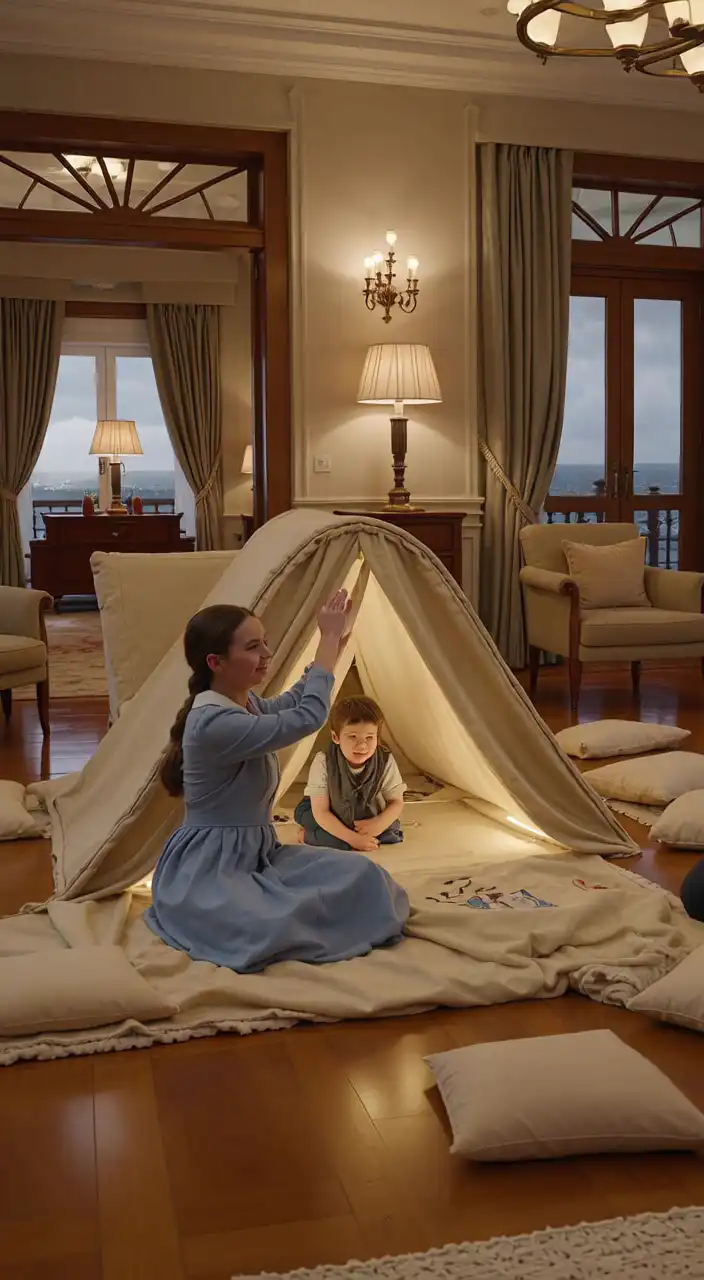
She spread one blanket from sofa to chair. Another over a side table. Cushions became walls. The careful room transformed into a low hidden world of fabric shadows and soft corners. She left the entrance open and sat outside it.
“No pressure,” she told Theo. “It’s just a fort. In case there are weather emergencies.”
Theo stood in the middle of the room, looking from her to the blanket cave. Rain tapped the windows. Thunder rolled far off. Usually that sound sent him inward. This time he hesitated, then dropped to his knees and crawled inside.
Rosa pressed a hand to her chest.
Ivy crawled in after him, not too close. “Report,” she whispered. “Is the dragon friendly?”
From inside the fort came no answer, but there was no crying either. Only stillness. Safe stillness.
Dalton came home early that evening and stopped cold at the living room door.
The rug was hidden under pillows. Blankets draped over imported furniture. Theo’s little socks stuck out from beneath a chair. Ivy was inside the fort humming under her breath.
Dalton’s voice cut through the room. “What is this?”
Theo flinched instantly.
Ivy emerged, lifting the blanket edge. “A fort.”
“I can see that.”
He looked from the disordered room to his son, whose body was already going rigid. “This is not acceptable.”
Ivy rose to her feet. “The room isn’t hurt.”
“That’s not the point.”
“What is the point?”
“The point is that this house runs a certain way.”
Theo was breathing faster now.
Ivy lowered her voice. “Mr. Mercer—”
“No forts in the formal living room. No dragging linens on the floor. No turning the place into a camp cabin.”
“It’s his home too.”
The words landed between them like a struck match.
Dalton’s face hardened. “You are here temporarily. Don’t confuse comfort with authority.”
Behind him, thunder sounded again. Theo scrambled deeper into the fort, then a muffled whimper came, the prelude to one of his shut-down spirals.
Ivy glanced toward the blanket opening. “He was doing well.”
“He needs structure.”
“He needs safety.”
“And you think this is safety?”
“I think he chose to go inside something soft during a storm instead of disappearing into panic.”
Dalton stepped closer, voice low and controlled. “You do not get to come into my house and decide the rules are optional.”
Ivy did not retreat. “Then make better rules.”
Silence cracked across the room.
Rosa vanished discreetly into the hall. Marlene, who had just arrived with a folder, took one look at Dalton’s expression and wisely backed out.
Dalton could feel anger rising, but underneath it was something uglier: fear. Fear that one hopeful week had made him careless. Fear that if he trusted this young woman and she failed like all the others, the fall would be worse. Fear that Brooke would have known how to bend and he only knew how to control.
He pointed toward the fort. “Take it down.”
Theo made a broken sound from inside.
Ivy looked at the little moving shape under the blanket, then back at Dalton. “Not while he’s in it.”
“That wasn’t a request.”
“No,” she said softly. “It was panic wearing a suit.”
He stared at her.
For a heartbeat he truly considered firing her on the spot.
Instead he said through clenched teeth, “My son is not going to spend his life hiding under furniture.”
Ivy’s expression changed. Less defiance. More understanding than he wanted from her.
“No,” she said. “He’s not. But right now he needs to learn that hiding with someone safe is different from being alone in fear.”
Dalton looked toward the fort opening. A tiny hand appeared, clutching the blanket edge. Then disappeared again.
He left the room before his son could see the helplessness on his face.
That night, after Theo was asleep, Dalton found Ivy on the covered terrace outside the kitchen, wrapped in a sweater against the cold salt wind.
“You overstepped,” he said.
She looked out at the black ocean. “Probably.”
“Then why do I feel like I’m the one who failed?”
“Because you love him.”
He leaned on the railing, jaw tight. “Love doesn’t seem to be helping much.”
Ivy was quiet for a moment. “Do you know what Theo does when he’s scared?”
“He shuts down.”
“He waits for the world to become too much. Then he goes away before it can hurt him.”
Dalton stared at the surf. “I know.”
“What if home keeps telling him to stay neat, stay quiet, stay managed? What if he thinks he has to do that too?”
“This house is not the problem.”
“No,” Ivy said gently. “Grief is the problem. Fear is the problem. But homes can either hold grief or polish over it.”
He turned toward her. “You speak like you knew my wife.”
“I didn’t. But I can tell she loved warmth.”
He looked back through the windows at the living room, now restored to order. Perfect again. Empty again.
“I forbade more forts,” he said finally.
Ivy gave a small nod. “I know.”
“And yet I’m asking—” He stopped, almost ashamed. “What do we do when the storm comes tomorrow?”
This time, when she smiled, there was no victory in it. Only hope.
“We build somewhere you can bear to see it,” she said.
The storm came the next night with full coastal force.
Wind slammed against the glass walls. Rain streaked across the windows in silver sheets. The ocean beyond the bluff churned dark and violent, and thunder rolled close enough to rattle frames on the hallway tables.
Theo had hated storms since Brooke died. Ivy suspected the body remembered what the mind could not fully name. The afternoon of his mother’s sudden collapse had ended with unexpected rain. Since then, thunder and fear had lived too near each other inside him.
By sunset he was already fragile.
He would not let Rosa change him into pajamas. He refused dinner except for a single cracker. He trailed Ivy from room to room with Brooke’s scarf in one hand and the other pressed against his mouth, eyes wide each time the wind boomed down the chimney.
Dalton had canceled his evening calls. That alone made the household uneasy. Usually work swallowed anything personal. Tonight he paced between the kitchen and the family room like a man waiting for a verdict.
Ivy found him by the fireplace while Theo sat on the rug nearby, not playing, simply listening to the storm.
“He’s building toward an episode,” she said quietly.
Dalton looked down at his son. “Tell me what to do.”
The words were rough, dragged from somewhere pride had long occupied.
Ivy studied him for a moment. “Can you follow directions exactly?”
His mouth almost twitched. “I run a public company.”
“That’s not what I asked.”
He let out a breath. “Yes.”
“Then first, lower your shoulders. You’re carrying the whole weather system in your neck.”
He actually obeyed. It startled both of them.
She crossed to the linen chest in the family room and pulled out two blankets, then looked at Dalton. “You said no forts in the formal living room. Fine. We’re not in there.”
He eyed the family room with its deep sectional sofa, broad stone fireplace, and more forgiving rug. “This room is less... ceremonial.”
“Excellent. Tonight we choose alive over ceremonial.”
Another crack of thunder split the air. Theo dropped to the floor and covered his ears.
Ivy crouched immediately, not touching him yet. “I know, sweet pea. Big sound.”
Dalton took a step forward.
“Stop,” Ivy whispered. “Don’t talk at him. Let him feel you settle first.”
She spread one blanket over the coffee table and anchored the corners with couch cushions, creating a low tent. She set another folded blanket inside and one small battery lantern beside it. Nothing elaborate. Just shelter.
Then she looked at Dalton. “Get on the floor.”
He stared. “Now?”
“Now.”
He lowered himself awkwardly in tailored slacks, knees cracking. Theo’s eyes flicked toward the movement.
Ivy spoke softly enough for only Dalton to hear. “He needs your nervous system to tell him the storm is survivable. Not your words. Your body.”
Dalton swallowed and nodded once.
“Sit near the fort opening,” she said. “Not blocking it.”
He shifted into place.
“What do I say?”
“For the moment? Nothing.”
Theo was crying now, still almost soundlessly, tears on his flushed cheeks. He crawled backward toward the hearth, trying to fold himself into the narrow corner.
Ivy mirrored him at a distance. “Blue room feeling in a family room,” she murmured. “That’s okay. We can make a smaller world.”
Theo’s gaze darted to the blanket tent.
Ivy looked at Dalton. “When he glances at it, just breathe slowly. Hand on your chest. Let him see.”
Dalton felt ridiculous. Then he saw his son watching him, really watching, and he placed his palm against his shirt and took one long visible breath.
In.
Out.
Again.
Theo’s sobbing breaths stayed ragged. But his eyes lingered.
“Good,” Ivy whispered. “Again.”
Another thunderclap sounded, sharp and immediate. Theo whimpered and reached blindly—not for Ivy this time, but toward the nearest steady thing.
Dalton’s entire body locked when his son’s small hand grabbed the fabric at his sleeve.
He looked at Ivy in panic.
“Don’t rush,” she whispered. “Stay soft.”
Dalton forced his voice down. “I’m here, Theo.”
The child did not look at him. He only held on.
Ivy gave the next instruction. “Copy me. Say what is true and simple.”
She faced Theo. “Loud storm. Safe house.”
Dalton repeated, more awkwardly, “Loud storm. Safe house.”
Theo’s breathing hitched.
Ivy continued, “Scary feeling. Daddy here.”
Dalton’s throat tightened, but he said it. “Scary feeling. Daddy here.”
Theo’s fingers clenched harder around his sleeve.
The room seemed to narrow to the three of them, the firelight, the storm, and the impossible fragility of this moment.
Ivy looked toward the fort. “Now invite. Don’t direct.”
Dalton stared at the blanket tent as though it were a boardroom proposal he feared mishandling. “Theo,” he said softly, “I made a little hideout with Ivy. If you want... we can go inside.”
No response.
Ivy leaned in just enough to catch Theo’s eyes. “Daddy’s coming too.”
That mattered. Dalton saw it.
Theo glanced from Ivy to his father to the blanket shelter. Then, trembling, he crawled one small step forward.
Dalton forgot to breathe.
“Stay with him,” Ivy murmured.
Theo moved again, still clutching the scarf in one fist and Dalton’s sleeve in the other. They reached the fort opening. Ivy went in first and sat cross-legged inside, making the small space feel ordinary rather than urgent. Theo paused at the threshold.
Dalton waited.
Another boom shook the windows.
Theo lunged into the fort.
Dalton followed on hands and knees, graceless and stunned. Inside, the lantern glowed gold against the blanket roof. It smelled faintly of detergent and cedar. Theo pressed into the space between Ivy and his father, breathing hard.
Ivy spoke softly. “Okay. The storm is outside. We are inside. Feel the rug under your feet.”
Theo’s eyes were fixed on the lantern.
Dalton copied her. “Feel the rug under your feet.”
“Blanket over our heads,” Ivy said.
Dalton repeated, “Blanket over our heads.”
“Daddy’s arm here if you want.”
Dalton placed his arm on the floor beside Theo without reaching.
Theo stared at it for several long seconds. Then, with a movement so careful it felt sacred, he leaned sideways until his little shoulder touched his father’s forearm.
Dalton shut his eyes.
Ivy looked away, giving him privacy inside his own miracle.
The storm went on. So did the breathing. In and out. Slow enough that Theo’s panic began to untangle. When his body softened, Ivy reached into her tote and produced a small finger puppet shaped like a seal.
“Emergency fort inspector,” she whispered.
Theo blinked at the seal.
The puppet sniffed the blanket wall. “Hmm. Structural integrity acceptable.”
To Dalton’s astonishment, a tiny huff of breath escaped Theo that was not a sob.
Ivy held the puppet toward Dalton. “Your turn.”
He stared. “I don’t know what to do with that.”
“Make it talk.”
“I run earnings calls.”
“Tonight you are a seal.”
A sound came from Theo then. Not a word. Not quite a laugh. But close enough to break something open in Dalton’s chest.
He took the puppet.
The little seal bobbed clumsily. “I object,” Dalton said in a deep ridiculous voice. “This fort has no snack policy.”
Theo’s eyes flicked to him.
Ivy widened hers dramatically. “No snack policy? Outrageous.”
Dalton tried again. “As chief seal attorney, I demand crackers.”
Theo’s mouth twitched.
The storm faded farther down the coast. Inside the fort, time changed. Dalton forgot his phone, his schedule, his usual instinct to measure progress. He only stayed present because Ivy kept guiding him with subtle signals: slower, pause, wait, don’t fill the silence, let Theo come.
So he did.
They watched the lantern. They listened to the rain soften. Ivy hummed once, then stopped when Theo seemed calm enough for quiet. Dalton kept his arm where it was. Theo kept leaning against it.
At some point the child picked up the seal puppet from his father’s hand and made it bump gently into Ivy’s knee.
Ivy gasped. “Inspector on site.”
Theo looked at her. Then at Dalton.
“Say there’s been a violation,” Ivy whispered to the puppet.
Theo’s lips parted. No sound came out.
Dalton felt the old ache rise—hope, followed by dread. But Ivy gave him a warning glance: don’t press.
So he only smiled at the puppet and said, “I think he’s considering legal action.”
Theo held the seal between them. Thunder rumbled very far away now, like memory.
Ivy tilted her head. “What’s my name, Inspector? Did you forget?”
Theo’s eyes fixed on her mouth.
Dalton could hear his own heartbeat.
Ivy touched her chest lightly. “Ivy.”
Theo swallowed.
And then, small and rusty and absolutely clear, he laughed.
A real laugh. Bright, startled, as if it surprised him too.
“Ih-vy,” he said.
The world stopped.
Dalton stared at his son, unable to move.
Theo looked right at Ivy and said it again, stronger this time because joy had found him before fear could shut the door.
“Ivy.”
The seal puppet dropped from his hand as he laughed once more.
Dalton made a broken sound in the back of his throat. He put both hands over his mouth, but it did nothing. Tears came with such force he had to bow his head in the cramped little fort his son had chosen to share with him.
Ivy’s own eyes filled, but she stayed steady for Theo. “Hi,” she whispered, smiling through tears. “That’s me. I’m Ivy.”
Theo turned toward his father then, still leaning against his arm, and for one impossible second there was no wall in his brown eyes at all. Just a three-year-old boy glowing from the inside out because he had said a name and been met with delight instead of pressure.
Dalton was crying openly now.
“Theo,” he whispered. “Buddy.”
Theo looked at him, and though he said nothing else, he did not turn away.
Outside, the storm moved down the coast and out to sea.
Inside the fort, under a blanket roof in the family room of a mansion built for appearances, a father finally learned how to kneel low enough to meet his son.
By morning, the story had already spread through the house, though no one dared retell it loudly, as if speaking too hard might scare the miracle away.
Rosa cried in the kitchen when Marlene whispered, “He laughed.” The chef pretended not to wipe his eyes after hearing, “He said her name.” Even the groundskeeper, Wade, removed his cap and stood quietly for a moment when Dalton, passing him on the terrace, said only, “Theo had a good night.”
But the person who mattered most had not merely heard it. He had lived inside it.
Dalton had not gone back to his office after the storm. He had slept on the floor beside Theo’s bed like a man keeping watch over treasure. When morning light entered the nursery, Theo woke, saw him there, and did not cry.
That alone was enough to remake a life.
At breakfast, Dalton came into the kitchen without his laptop. Without his phone in his hand. Marlene noticed immediately and said nothing.
Theo sat in his chair with a bowl of oatmeal. Ivy was slicing bananas. The room smelled of coffee and toasted bread and sea air. Ordinary things. Holy things.
Dalton pulled out the chair beside Theo and sat.
Ivy glanced at him. “No conference call?”
“I moved it.”
Her brows lifted slightly. “To when?”
“I delegated it.”
That earned him the first genuine grin she had ever given him.
Theo was watching them. Dalton noticed and kept his face soft.
Ivy slid the banana slices over. “Your turn, captain,” she told Theo.
Theo picked one up and dropped it into the oatmeal.
Dalton put a hand over his own chest in the same way Ivy had taught him the night before, then looked at his son. “Can Daddy help too?”
Theo did not answer. But he did not turn away. He pushed the spoon toward Dalton.
Marlene had to leave the room.
Later that afternoon, Ivy suggested they go outside because the storm had washed the sky clean and the garden paths glittered with sun. Theo usually resisted transitions to open spaces, but Ivy had begun creating tiny rituals around them. Green jacket. Left shoe first. Pause at the mudroom bench. Count to three. Open door together.
This time, Dalton asked, “May I come?”
Ivy looked at Theo. “What do you think?”
Theo held Brooke’s scarf for a second, then let it rest on the bench and reached for his father’s finger.
Dalton nearly lost his breath all over again.
They walked the estate grounds slowly, through beach grass bending in the wind and along the stone path skirting the bluff. Down in the lower garden, where hydrangeas bordered a broad stretch of lawn, Ivy started a silly game of stepping only on flat stones and pretending the grass was lava.
Theo hesitated at the edge.
“Your rules,” Ivy told him. “Fast feet or giant steps?”
Theo looked at Dalton.
Dalton crouched. “You decide, buddy.”
Theo lifted one foot and stomped dramatically onto the first stone. Ivy gasped. “A giant! We have a giant!”
Theo smiled.
Then he ran.
Not far. Not wildly. Just across the little row of stones into the sunlit grass, legs unsteady with excitement, dark hair lifting in the breeze. Ivy chased after him with exaggerated slowness. “Too fast! Much too fast for an old lady like me!”
“You are twenty-two,” Dalton said.
She glanced back. “Exactly. Ancient.”
Theo laughed again, the sound carrying over the garden.
Dalton stopped walking. For a second he could only watch. His son, who had spent so long folded into silence that joy felt like a rumor, was running through the garden under an open sky. Not cured. Not transformed into some different child. Still tender, still watchful, still likely to fear the next storm. But running. Laughing. Alive in the world again.
The force of it dropped him to a bench beside the path.
Ivy noticed first. She slowed, making the game into a circle so Theo could keep moving while she checked on Dalton with her eyes.
He pressed his fist to his mouth. Tears came anyway.
When Theo toddled back, flushed and bright-eyed, Dalton reached out uncertainly. “Can I have a turn?”
Theo swayed in place, considering. Then he leaned forward into Dalton’s chest.
Dalton folded around him with a sound halfway between a laugh and a sob.
“I’m sorry,” he whispered into his son’s hair. “I’m so sorry I didn’t know how.”
Theo patted his lapel with one small hand as if forgiving him was the easiest thing in the world.
That evening Dalton called Dr. Renata Bell, the child psychologist who had been overseeing Theo’s care.
“I’d like you to come by,” he said.
When Dr. Bell arrived the next day, she found not a frozen child in a structured observation room but Theo in the family room building a small blanket hideout with Dalton under Ivy’s supervision.
Dr. Bell removed her coat slowly. “Well,” she said.
Theo glanced at her, then back at the blanket.
Dalton stood. “He said Ivy’s name. He laughed.”
Dr. Bell looked from father to nanny to child. “That is significant.”
Ivy stayed seated on the floor. “He trusted first. The word came second.”
Dr. Bell nodded thoughtfully. “That tends to be how healing works.”
Dalton gave a short, almost embarrassed laugh. “You tried telling me that months ago.”
“I did,” she said. “You were busy trying to rescue him through optimization.”
He rubbed a hand over his face. “I know.”
Dr. Bell watched Theo crawl into the half-built fort and peek back out at his father. “And now?”
Dalton looked at his son for a long moment. “Now I think he needs less management and more of me.”
The words changed the room.
Ivy lowered her eyes, suddenly busy adjusting a blanket edge. But Dr. Bell saw the significance immediately.
“That,” she said quietly, “may be the most therapeutic development of all.”
After the doctor left, Dalton found Ivy on the terrace where the afternoon sun turned the ocean white at the horizon.
“I was wrong,” he said.
She leaned against the railing. “About the fort?”
“About almost everything.”
She smiled a little. “That’s a large umbrella statement.”
He let out a breath. “I thought if I controlled the environment enough, hired the best people, built the right systems, I could keep things from falling apart.”
“And when they did?”
“I worked harder.” He looked out at the sea. “I don’t know how to be a man who can’t fix the central thing.”
Ivy’s voice was gentle. “Maybe Theo never needed you to fix him.”
Dalton closed his eyes briefly. “He needed me to stay.”
“Yes.”
He nodded. “I’m making changes. No more red-eye flights unless absolutely necessary. Fewer board dinners at home. Mornings blocked off. Bedtime is mine.”
Ivy turned toward him fully then. “Are you sure?”
“No,” he said honestly. “But I’m doing it anyway.”
For the first time since Brooke died, the future did not feel like an empty hallway he had to walk alone.
Three weeks later, the Mercer house no longer sounded like a museum.
It sounded like a child lived there.
Not constantly. Not in some unreal flood of happiness. Theo still had difficult moments. Sudden noises could startle him into tears. Bedtime remained fragile on windy nights. Some mornings he clung to Brooke’s scarf before he could face the day. Healing had not erased grief. It had simply made room for other things beside it.
By then Dalton knew the rituals.
He knew how to crouch instead of loom. How to wait through silence without stuffing it full of anxious words. How to announce transitions simply: “Bath in five minutes.” “One more page, then sleep.” “Loud blender, safe kitchen.” He knew that when fear rose, his son did not need correction first. He needed company.
Most importantly, he knew how to come home before Theo was already asleep.
One evening, after dinner, Dalton found blankets folded neatly in a basket by the family room sofa. Ivy was helping Theo stack books nearby.
He picked up a blanket. “Inspection?” he asked.
Ivy tilted her head. “Only if the chief seal attorney is available.”
Theo looked up at his father and smiled, small but certain.
Dalton draped the blanket over the coffee table. “I believe I can be retained.”
Theo laughed and toddled over to help.
Ivy remained where she was for a moment, watching father and son build together. Not because Theo needed her to mediate every second anymore. But because she had helped create a rhythm they could keep.
Later, after Theo was asleep, Dalton walked Ivy to the front hall where her bag was waiting by the door.
“You know you don’t have to leave tonight,” he said. “The guest suite is ready if you want it. The roads are slick.”
“I know.”
He hesitated. “That’s not exactly what I mean.”
Ivy studied him, then smiled softly. “I figured.”
He slipped his hands into his pockets. “I hired you as a temporary solution.”
“And?”
“And I’d like to keep learning how to be his father while you keep reminding me when I’m acting like a CEO in a nursery.”
She laughed under her breath. “That happens more than you think.”
“I know.” He looked upstairs toward Theo’s room. “Stay. Not because he can’t survive without you. Because what you started here matters. And because I want us to do this right.”
Ivy’s expression gentled. “All right,” she said. “I’ll stay.”
The house settled differently after that.
Not perfect. Not finished. Whole in the way broken things become whole again: with seams, with memory, with tenderness where pain once ruled. Theo still carried grief in a three-year-old’s body, but now he also carried trust. Dalton still missed Brooke every day, but now he spoke of her to their son instead of hiding her behind photographs. And Ivy, young and warm and stubborn enough to challenge a billionaire in his own home, became part of the rhythm that turned survival into family.
On some nights, when storms pressed against the windows, three figures could be found in a blanket fort lit by a small lantern: a boy with brown eyes no longer empty, a father learning to stay, and the woman who had shown them both that safety begins close to the floor.
And when Theo laughed and said, “Ivy,” or reached for “Daddy,” the beach house above the sea no longer felt haunted by what had been lost.
It felt, at last, like home.
In the months that followed, Dalton reorganized more than his calendar. He reorganized his life around presence. Breakfast became sacred. Bedtime became his favorite hour. Work still mattered, but it no longer outranked the sound of his son’s voice.
Some healings arrive like thunder. Others begin under blankets, in borrowed calm, with one small word spoken at exactly the right moment.
For the Mercer family, wholeness started there. With a fort, a storm, and a father who finally learned to kneel.
Disclaimer: Mention of any brand or trademark is for identification only and does not imply partnership or endorsement