THE GARDEN WHERE HE RAN
On the morning of his late wife's birthday, Graham Voss stood in the breakfast room of the estate in Belle Haven, Connecticut, staring at a strawberry cake no one would eat.
It was small by mansion standards, something the chef had put together after noticing the date on the household calendar. Two neat layers, pale pink frosting, a few sugared petals on top. Graham had almost told him to take it away. Then he had changed his mind, because letting the day pass untouched had somehow felt worse.
The breakfast room overlooked the east gardens. Spring light spilled across the long table, illuminating crystal water glasses, untouched linen napkins, and the silver-framed photographs that had once made the room feel warm instead of ceremonial. In one, Maren stood barefoot in the grass, laughing over her shoulder, her honey-colored hair lifted by the wind. In another, she held their infant son against her chest, her cheek pressed to his black hair.
Graham picked up the frame and looked at it too long.
"You would have hated this room set up like a memorial," he said softly.
No answer came, of course. Only the hum of the refrigerator from the butler's pantry and the faint click of heels in the hallway as staff moved through their practiced morning.
A small, deliberate sound came from the doorway. Graham turned.
His son stood there in a cream knit sweater and tiny navy pants, one hand hanging limp at his side, the other holding the edge of the doorframe. At two years old, Oliver Voss was heartbreak in miniature. He had thick black hair that always fell into his brown eyes no matter how often someone brushed it back. His lashes were absurdly long. His face was soft, solemn, and so beautiful it still struck Graham in the chest every time he looked at him.
But Oliver was not looking at the cake. He was not looking at the photograph in Graham's hand. He was staring somewhere just past the table, expression blank, as if the world reached him only in fragments and none of them mattered enough to hold.
Graham forced a smile. "Hey, buddy."
Nothing.
He crouched, because every therapist and specialist had told him to get on the child's level. "Do you know what today is?"
Oliver blinked once.
"It's Mommy's birthday."
No response.
Graham swallowed. "She used to make fun of me because I never remembered to buy enough candles. She'd say I was rich enough to buy half Manhattan but somehow too incompetent to count to thirty."
Still nothing. Not even a flicker.
Mildred, the housekeeper, hovered just beyond the doorway with the uneasy posture of someone always waiting in case the child dissolved into distress. Since Maren's death in a car accident eighteen months earlier, the estate had become a museum of caution. Voices lowered. Doors closed gently. Toys arranged in untouched rows. Adults walking around a toddler as though one wrong move could shatter him.
Maybe they were right.
"Would you like to sit with me?" Graham asked.
Oliver did not come closer.
Graham set the photograph down and walked to him slowly, careful not to startle him. He lifted his son into his arms. Oliver was light. Too light, one pediatric specialist had once murmured, because children who disconnected from the world often disconnected from appetite too.
Graham carried him to the table and sat with him on his lap. "Look." He pointed to the picture of Maren. "Mommy."
Oliver's eyes passed over the frame without recognition. There was no reaching, no smile, no sound. The specialists called it developmental delay with severe social disengagement. He did not respond to emotional cues. He did not mirror expressions. He almost never smiled. He had spoken only a few words before the accident, and after it, even those vanished into silence.
Graham picked up a fork and cut a bite of cake. "One taste. For Mommy, okay?"
Oliver turned his face away.
Graham tried again, softer. "Please, Ollie."
The child didn't protest. He didn't cry. Somehow that would have been easier. He merely folded inward, gaze drifting away, body going slack and unreachable in Graham's arms.
The silence in the room deepened until it felt like another person at the table.
Graham set the fork down. His own appetite disappeared.
Mildred stepped forward carefully. "Mr. Voss, perhaps we should keep the morning routine as usual."
He almost snapped at her. Instead he nodded once. "Maybe."
He carried Oliver back upstairs.
The nursery suite had once been Maren's favorite part of the house. She had filled it with low shelves, soft rugs, baskets of wooden toys, books with torn paper tabs from being read too often. Now the toys sat untouched. The stuffed fox in the corner still wore the blue ribbon Maren had tied around its neck. Oliver often sat beside it for twenty minutes at a time, not really playing, not really resting, simply existing in a stillness that made adults whisper.
Graham knelt beside him on the floor near the window.
"Ollie."
No answer.
He held out a little cloth book Maren had used to make silly voices with. "Do you want the fox book? Or the truck one?"
Oliver did not reach.
Graham tried the shape sorter. The stacking rings. The soft yellow ball. Every object met the same blank drift of attention. It was like throwing pebbles into a well with no splash.
A memory rose with brutal clarity: Maren cross-legged on this same rug, their son six months old and squealing in delighted outrage while she booped his nose and called him "my serious little prince." She had always known how to pull him into the world. Even before the accident, before the specialists, before words like delay and intervention and adaptive program entered their lives, Graham had watched her and thought she carried a language he did not speak.
Now she was gone, and Graham had inherited not only a fortune built across three generations but a child he loved fiercely and could not reach.
There were therapists. Occupational specialists. A developmental pediatrician in New York. A neurologist in Boston. Customized sensory rooms, expensive consultations, imported equipment, weighted blankets, visual boards, speech cards, a parade of nannies with polished resumes and kind but frightened eyes. Some lasted a week. Some lasted a day. One cried in the driveway before she left.
His wealth could summon anyone. It could not buy one smile from his son.
Oliver shifted suddenly, a small tightening in his shoulders. Graham had learned to watch for it, though he never knew what came next. The child rubbed his fingers against the seam of the rug, then against his own wrist, then pressed both palms over his ears.
"It’s okay," Graham said quickly. "You're okay."
The words did nothing. Oliver's breathing shortened. His face remained blank, but his body was telling the truth his expression never did. Distress was building somewhere beneath the smooth surface.
Graham reached for him, too fast.
Oliver flinched.
That tiny recoil cut deeper than any accusation.
Graham drew back as if burned. "Sorry. Sorry, buddy."
Mildred appeared again in the open doorway. "Should I call Ms. Dorsey from therapy?"
Graham closed his eyes. "No."
When he opened them, he stared at his son and understood with humiliating clarity that he did not know what his child needed from him in that moment. Not comfort. Not words. Not touch. He was a father with every resource except the right instinct.
By afternoon, the cake was gone from the breakfast room, the candles still unlit in their box. Graham found himself in his study, the agency file open on his desk beside a brochure he had sworn he would not read again.
Rosewood Children's Residential Center.
A luxury euphemism for a live-in facility. Expert care. Structured support. Long-term developmental programming.
He had told himself he kept the brochure only because attorneys and doctors insisted he review every option. But his thumb had worn the paper soft at the edges.
Mildred knocked. "The childcare agency is on line two."
Graham stared at the phone. "What now?"
"They said they have one final candidate."
He almost laughed. "Final as in best?"
Mildred hesitated. "Final as in... they are out of ideas."
He let out a breath that felt like surrender. "Put them through."
The woman from the agency was polished and apologetic. "Mr. Voss, I want to be transparent. This young woman does not have the credentials your previous hires had."
"Then why are we speaking?"
"Because none of the credentialed candidates have worked. And because this one... has something unusual. She has years of hands-on childcare from raising younger siblings, eldercare experience, and every family we've placed her with says the same thing."
"What?"
"That children settle around her."
Graham leaned back and looked at the brochure on his desk. "How old is she?"
"Twenty-three."
Too young, he thought immediately. Too inexperienced. Too hopeful.
Or maybe hope was exactly what made people foolish enough to keep trying.
"When can she come?" he asked.
"Tomorrow morning."
Graham looked toward the nursery wing upstairs, toward the room where his son sat inside a silence no money could cross.
"Fine," he said. "Send her."
The next morning arrived wrapped in fog that drifted low over the estate grounds. The Voss mansion looked even larger in weather like that, its stone facade emerging from the mist like something old and private and impossible to soften.
Graham met the candidate in the west sitting room, mostly because it was formal enough to discourage sentiment. He had learned that hopeful people often said dramatic things in nurseries and playrooms. In a sitting room with carved mantels and a grandfather clock, they tended to remember reality.
When the butler opened the door and showed her in, Graham's first thought was that the agency had made a mistake.
She wasn't dressed like the other candidates. No structured blazer, no expensive tote full of binders and certification tabs. She wore a simple pale blue sweater, dark jeans, and sensible flats damp from the gravel drive. Her hair, chestnut and loosely pinned, had escaped in wisps around a face too open to hide what she felt. She was beautiful, yes, but not in a polished, intimidating way. There was warmth in her. Something almost old-fashioned. Something deeply steady.
"Mr. Voss?" she said.
Her voice was soft without being timid.
"Graham is fine."
She nodded. "I'm Tessa Rowan. Thank you for seeing me."
He gestured toward the chair across from him. "The agency says you have no formal training."
"Not the kind the others had."
"That isn't encouraging."
A quick smile touched her mouth. "No, sir, I suppose it isn't."
Sir. He almost corrected her, then let it go.
She sat without fidgeting. Most applicants looked around the room, taking in the paintings, the imported rugs, the quiet evidence of old money. Tessa didn't. She looked directly at him, attentive and calm.
"You understand my son has special needs."
"I understand he's two years old, he lost his mother, and everyone around him is afraid of doing the wrong thing." She folded her hands in her lap. "The agency also told me he has developmental delays and doesn't respond much."
Graham studied her. "That's an oversimplification of a complicated situation."
"I'm sure it is."
He waited for defensiveness. None came.
"Why do you want this job?" he asked.
She considered the question instead of delivering a practiced answer. "Because children know when adults are scared of them. And because grief can look like all kinds of things, especially when a child is too young to name it."
"You're assuming his behavior is grief."
"I'm assuming it's part of his world."
The answer annoyed him because it was neither naïve nor conventionally impressive. It simply sat there, difficult to argue with.
"What makes you think you can help him when specialists haven't?"
"I don't know that I can." She said it plainly. "But I know I won't try to perform progress at him."
He leaned back. "What does that mean?"
"It means I won't treat him like a project every minute. I won't chase eye contact because a chart says I should. I won't force play if he's telling me he can't do it. I pay attention first."
Graham rubbed a hand over his jaw. "And if paying attention gets us nowhere?"
"Then at least he'll have spent time with someone who wasn't asking him to become a different child before she could care for him."
The room went quiet.
From the hall came the faint sound of wheels on a service cart, then silence again. Tessa waited without trying to fill it. Graham hated how tired he felt all at once.
"You may meet him," he said finally. "I need to be clear, though. We have routines. There are therapists, meal protocols, sleep schedules—"
"I'll learn whatever you need me to learn."
He stood. "This way."
They walked upstairs through the long gallery lined with family portraits, then down the brighter hallway Maren had once insisted be painted a softer white because children should not grow up in a museum. At the nursery door, Graham paused.
"One more thing," he said. "Most people think they're different in the first hour."
Tessa met his eyes. "I'm not interested in being different, Mr. Voss. I'm interested in being useful."
He opened the door.
Oliver sat on the rug by the window exactly where Graham had left him twenty minutes earlier, his little body folded over a row of wooden blocks he had not stacked. Black hair fell over his forehead. His brown eyes were fixed on a patch of sunlight moving across the floorboards.
"Tessa," Graham said quietly, "this is Oliver."
She did not cross the room immediately. She did not call in a sing-song voice. She did not kneel and offer toys from a bag. Instead she took in the room, the child, the light, the carefully arranged order of things.
Then she did something no one else had done.
She sat down just inside the doorway.
Not near him. Not far. Simply on the floor, with her back against the wall and her hands resting loose in her lap.
Graham frowned. "What are you doing?"
"Meeting him where he is."
Oliver did not look at her.
Tessa tilted her head toward the sunlight on the rug. "That's a good patch," she said conversationally, as if speaking to an equal. "Warm, but not too bright."
No response.
She glanced at the blocks beside him. "I was never very good at towers. My little brother used to make them so tall and then cry when I sneezed near them."
Oliver's fingers moved once against the edge of a block.
Graham saw it and immediately told himself it meant nothing.
Tessa went on lightly, not demanding. "I think foxes are better than blocks anyway. Less pressure."
At that, Oliver's eyes shifted. Just a fraction. Not toward her face, but toward the stuffed fox in the corner.
Tessa noticed. Graham noticed her noticing. But she didn't pounce on it.
"Oh, there you are," she murmured, as if the child had spoken aloud.
Graham remained by the door, arms crossed. He had seen hopeful beginnings before. A therapist once declared after ten minutes that Oliver tolerated her proximity beautifully, then spent six sessions trying to turn tolerance into performance.
Tessa reached into her sweater pocket and drew out something small. Not candy. Not a toy. A smooth gray stone.
"I found this in my shoe after a walk yesterday," she said. "Which is rude of the stone, honestly."
She set it on the floor near herself. Then she left it there.
Minutes passed.
The house beyond the room remained hushed. Somewhere downstairs, a phone rang once and stopped. Tessa did not rush the silence. She sat in it like she trusted it.
Oliver's shoulders, often held in a subtle line of tension, eased a little.
When Graham finally stepped away to answer a call from his office, he did so with reluctant irritation, certain that nothing significant would happen in his absence.
Twenty minutes later, he returned and found the room unchanged at first glance. Oliver on the rug. Tessa on the floor. The blocks still scattered.
Then he saw the gray stone.
It was no longer beside Tessa.
It sat in front of Oliver's knee.
Graham looked from the stone to Tessa.
She kept her voice low. "He moved it."
"Did you see him do it?"
"Yes."
"Maybe he knocked it by accident."
"Maybe." Her eyes shone anyway. "Or maybe he was curious."
Oliver did not look at either of them. But one hand rested over the stone as if claiming it.
For no rational reason, Graham felt something dangerous stir in his chest.
Hope.
He shut it down immediately. Hope had embarrassed him before.
"It's a stone," he said.
Tessa nodded. "Yes."
But when she smiled at Oliver, it was the smile of someone who knew a closed door had opened by less than an inch, and who was wise enough not to shove it wider too soon.
Over the next ten days, Tessa did not try to conquer Oliver's silence.
She learned it.
That was the first thing that unsettled the household. Everyone else had arrived with plans. Tessa arrived with attention. She learned what happened before he withdrew, before he stiffened, before his hands rose to his ears. She learned that bright overhead lights in the late afternoon made his breathing change. That too many voices in the hallway before nap time pushed him toward distress. That hunger showed first in the way he rubbed his thumb against the seam of his pants. That fear came as stillness before it came as crying.
The first time she interrupted one of his meltdowns before it fully took him, Graham happened to be home early and saw it.
Oliver had been in the morning room while Mildred and a maid debated floral arrangements in tones they thought were discreet. A vacuum started in the adjacent hall. The chef called from the kitchen about a delivery. By the time Graham stepped in, Oliver was frozen in the middle of the rug, shoulders high, hands half-raised, face empty in that terrifying way that meant overwhelm was already happening under the skin.
"Gentlemen are here from Hartford on the vineyard acquisition," Graham said distractedly to no one in particular. Then he noticed the child. "Ollie?"
He moved toward him, panic already sharpening his steps.
"Wait," Tessa said.
She crossed the room quickly but not abruptly, dropped to the rug beside Oliver without touching him, and lowered her own breathing so visibly that Graham could see the rhythm of it.
"Too loud," she said softly. "I know."
Oliver did not respond.
Tessa turned her head toward the open doorway. "Mildred, could we have the vacuum off and the hall clear for five minutes, please?"
Mildred, startled by the authority in her gentle voice, obeyed at once.
The room quieted.
Tessa pressed one palm flat against the rug. "Feel this. Steady."
Oliver's eyes flickered downward.
"That's it," she whispered. "No rush. I'm right here."
She began tapping the floor in a slow pattern. Not a song. Not a command. A rhythm simple enough to hold onto.
Tap. Tap. Pause.
Tap. Tap. Pause.
After several seconds, Oliver's fingers twitched. Then, shakily, they pressed to the rug near her hand.
Graham stood motionless.
The child's breath lengthened by degrees. His shoulders lowered. The crisis passed not with drama but with a soft return.
Tessa looked up at Graham only when Oliver was calm. "He tells us before he falls apart. We just have to listen sooner."
Graham felt ashamed of how stunned he was. "How did you know?"
"I watched him all week."
That afternoon, she walked the grounds with Oliver in a stroller, not because he couldn't walk but because transitions exhausted him. She narrated small things to him without expectation.
"There's the fountain. Too cold for bare feet today."
"A robin is bossing everyone around."
"I think this cloud looks like mashed potatoes."
Sometimes she fell quiet and simply moved at his pace. Sometimes Oliver leaned his head to one side when she spoke, as if letting her voice settle somewhere in him. It was not dramatic. It was not visible progress to anyone demanding proof. But to Tessa, those shifts mattered.
By the second week, a pattern had formed. She was there for breakfast, not forcing bites but turning meals into calm rituals. She was there for transitions, kneeling before him and saying, "In one minute we're going upstairs," then waiting while he absorbed it. She was there when his body tightened, helping him come back before the world became too much.
She did ordinary things with reverence. Sweater sleeves rolled. Tiny hands washed under warm water. Shoes placed by the door. She talked to him the way people talk to children they believe are listening.
One morning, Graham found her in the laundry room of all places, sitting on the floor beside Oliver with a basket of clean socks.
"What is this?" he asked.
Tessa held up a tiny striped sock. "Advanced estate management."
Oliver touched the soft pile with both hands.
"We're matching socks," she said. "Very high stakes."
Graham almost said he had calls in five minutes and no time for nonsense. Instead he heard himself ask, "Why socks?"
"Because they don't ask anything of him." She paired two blue ones together. "And because ordinary things are safe."
Oliver's hand hovered over a red sock. Tessa placed another red one beside it. "There it is."
The child rested his fingers on the pair for a beat.
Graham stared.
Tessa didn't look triumphant. She looked matter-of-fact, as if trust grew exactly this way, one manageable moment at a time.
And yet not everyone in the house appreciated her methods. The therapists were polite but skeptical. The day nurse, who still came three mornings a week, privately called Tessa "the babysitter." Mildred worried that too much flexibility would undo professional strategies. Graham himself swung between gratitude and distrust, unable to decide whether Tessa was seeing something real or simply making him want to believe.
The pressure outside the estate made that uncertainty worse.
Three weeks after Tessa arrived, Graham sat in a conference room in Stamford with Dr. Neil Hargrove, Oliver's developmental specialist, and an attorney named Celia Brandt who handled family planning matters for the Voss estate.
Dr. Hargrove adjusted his glasses and spoke in his measured, polished way. "Mr. Voss, I understand the new caregiver has made the household feel more stable."
Graham heard the careful wording. Feel more stable.
"She's good with him," he said.
"Good emotionally, perhaps." Hargrove folded his hands. "But emotional comfort is not the same as intervention. Oliver is at a critical developmental stage. He needs structure, specialized support, and a team environment."
Celia slid the Rosewood packet across the table. "The boarding terminology is misleading, Graham. For a child his age, it would be a residential parent-participation program at first. Excellent outcomes. Full medical oversight."
Graham's jaw tightened. "You think I should send my two-year-old away."
"We think," Celia said carefully, "that refusing higher-level support because a young nanny has charmed the household may not be responsible."
The word charmed made him cold.
Dr. Hargrove continued, "Attachment to one caregiver can become a limitation if it delays proper programming."
Graham thought of Tessa on the floor, matching socks. Of Oliver's hand pressing to the rug beside hers. Tiny things. Fragile things. Not data anyone in that room would respect.
"What if we're seeing the beginnings of progress?" he asked.
"Then a formal setting would build on it," Hargrove replied. "If progress is real, it should generalize."
Should. The language of experts. Everything theoretical until a child was the one living inside it.
When Graham returned to the estate that evening, he found Tessa in the back garden with Oliver bundled in a light jacket. The grass had just been cut, and the whole place smelled green.
Oliver stood beside a stone bench while Tessa crouched near him, not touching, only waiting. He was focused on the lawn with strange intensity.
"What are you doing?" Graham asked.
Tessa glanced back. "He keeps looking at the grass. I think he wants to step on it."
"He's stepped on grass before."
"Not barefoot."
Graham frowned. "Absolutely not. It's damp."
Tessa rose slowly. "It is damp."
"He'll hate it."
"Maybe."
"Or maybe he'll get overwhelmed."
She held his gaze. "Then we'll stop."
Graham looked at his son. The child was pressing one foot against the inside of his shoe as though trying to escape it.
"No," Graham said. "Not today."
Tessa nodded once. She did not argue. But the disappointment that crossed her face was not for herself. It was for Oliver.
That night, Graham stood at the nursery doorway while Tessa settled the child into bed. Oliver never asked for stories, never reached for comfort, never resisted sleep in the way healthier children sometimes did. He simply drifted away from the day with the same remote quiet he brought into it.
Tessa tucked the blanket around him and murmured, "Good night, sweet pea."
Graham nearly smiled at the ridiculous nickname.
When she turned off the lamp and stepped into the hall, he was waiting.
"You think I hold him back," he said.
Tessa looked surprised. "No."
"You looked at me like I did."
She leaned against the wall, suddenly looking every bit her age and somehow older too. "I think you're scared to let him want things in case he can't handle the wanting."
The words landed hard because they were true.
"I am trying to protect him."
"I know." Her voice softened. "But protecting him and preparing him for loss have started to look the same in this house."
Graham's expression closed. "You don't know anything about loss."
Tessa went still.
He regretted it instantly.
After a moment she said quietly, "No. Not your loss. You're right."
He should have apologized. Instead he said, "Dr. Hargrove thinks we should move forward with Rosewood."
Her face changed. "A facility?"
"A residential program."
"For a two-year-old?"
"It's specialized care."
"It is separation," she said, more hurt than angry. "Right when he's finally beginning to trust."
"Trust isn't enough."
"No," she said. "But it's where everything begins."
He looked away first.
Within days, the possibility of Rosewood became real. Paperwork arrived. Tours were discussed. Celia called twice. Dr. Hargrove recommended a short evaluation stay. The estate seemed to sense the coming disruption. Staff lowered their voices even further. Mildred watched Tessa with pity now, as if she were already halfway gone.
And Oliver, though he had no words for any of it, began to fray.
He ate less. He woke crying one night, a rare and awful sound. He clung to the doorframe when Tessa tried to take him into the therapy room. His body, once slowly unwinding in her care, now stayed braced more often than not.
Everyone saw the setback and drew their own conclusion.
Dr. Hargrove said, "This confirms instability."
Celia said, "The timing proves he needs a formal setting."
Graham said nothing.
Tessa watched Oliver's hands tremble over breakfast and knew something in his world had shifted before anyone told him in words. Children always knew when the ground beneath them was about to move.
The week before the Rosewood evaluation, the estate held itself in a strained kind of order.
Folders accumulated in Graham's study. Calls ran long into the night. Schedules were revised as if logistics could make heartbreak cleaner. Tessa was told, politely and indirectly, to document routines for a possible transition. No one used the word goodbye, but it sat in every room anyway.
Oliver felt it all.
On Monday he refused breakfast and turned his face into Tessa's shoulder when she tried to move him to the high chair. On Tuesday he melted down at the sound of a suitcase being rolled across the upstairs hall, even though it belonged to a houseguest leaving the estate. On Wednesday he would not let Tessa out of sight during the morning, trailing behind her in short, hesitant steps from nursery to sunroom and back again, not touching her, just keeping her in view.
That alone was astonishing. Weeks earlier he had barely seemed to register absence. Now he noticed.
But stress made even good signs look fragile.
Graham saw the clinging and interpreted dependency. "This is exactly Dr. Hargrove's concern."
Tessa, standing in the nursery with Oliver leaning against her knee, fought to keep her voice even. "He isn't becoming damaged by attachment. He's showing it."
"He is deteriorating."
"He is frightened."
"Of what? He doesn't even understand what Rosewood is."
"No," she said. "But he understands tension. He understands your voice when it changes. He understands that everyone in this house is preparing for something."
Graham dragged a hand through his hair. "You keep speaking as if normal emotional logic applies here."
She stared at him. "It does."
The certainty in her voice made him defensive, because somewhere under all his fear he wanted to believe her.
"I built my whole life on facts," he said. "Evidence. Planning. Results."
"And how has that worked in your son's nursery?"
The question burned.
He turned away before saying something cruel. "I have a call."
He left her there with Oliver and the unbearable possibility that she was right.
That afternoon, rain darkened the grounds and trapped everyone indoors. Oliver's distress built slowly. By evening he was too quiet even for himself, staring at the windows while drops ran down the glass in silver trails. Tessa sat with him in the playroom, knees bent, one hand resting on the floor between them.
"You've had a hard day," she murmured. "I know."
His fingers twitched toward the window.
"You want outside."
A tiny shift in his breathing told her she had named it correctly.
"But it's raining hard." She glanced out. "Maybe tomorrow."
He pressed both palms to the glass.
Tessa understood then what had been drawing him all week. The grass. The damp earth. The sensory pull of it. A need he had almost reached for before Graham stopped him.
"Tomorrow," she promised again.
The next morning the storm had passed. The gardens shone under a washed blue sky, every leaf rinsed bright. The lawn beyond the terrace was lush and damp, not muddy enough to be dangerous but soft enough to yield underfoot.
Tessa found Graham in the study signing a stack of documents.
"We should go outside today," she said.
He didn't look up. "Not now."
"Before he unravels again."
"I have a driver coming at noon. Rosewood wants us there by one."
The words struck like a blow. "Today?"
"It's only an evaluation."
"He knows something is wrong already."
"He knows nothing."
Tessa stepped closer to the desk. "Then why is he watching every doorway? Why did he panic over a suitcase? Why hasn't he slept?"
Graham's pen stopped moving. "You're overstepping."
"And you're disappearing into paperwork because it's easier than standing in his fear."
He stood so suddenly the chair jolted back. "Do not tell me what is easy for me."
For a moment they were both breathing hard in the quiet study, Maren's wedding photo on the bookshelf behind him like a witness.
Then a cry split the hallway.
Not loud. Not prolonged. But wrong enough that they both moved instantly.
They reached the upstairs landing together. Mildred stood near the nursery door, pale. "He couldn't find Miss Rowan in the bathroom and—"
Tessa was already past her.
Oliver stood in the center of the nursery, body rigid, face drained, chest heaving. He wasn't screaming. He was beyond that stage, trapped in the terrible silent brink where overwhelm had stolen even the energy for noise. His gaze darted without landing. One hand struck repeatedly against his own thigh.
Tessa dropped to the floor several feet away. "I'm here."
He didn't seem to hear.
Graham took a step forward. "Oliver—"
Tessa held up a hand without looking at him. "Wait."
But this time, unlike the other times, Graham didn't retreat to the doorway.
He looked at his son and saw not an impossible child, not a puzzle for experts, not a file full of interventions and outcomes, but a terrified little boy who had lost his mother before he could understand death and was now being asked, in every way that mattered, to lose the one steady person he had found since.
Something inside Graham broke open.
He knelt on the rug opposite Tessa.
She looked up, startled.
"What do I do?" he asked, and there was no pride left in him.
Tessa's expression softened at once. She shifted slightly, making room for him in the moment instead of guarding it as her own.
"Stop trying to get him out of it," she said quietly. "Just join him where he is."
Oliver's hands were over his ears now, breath quick and ragged.
Tessa lowered her own shoulders, exaggerating the release. "Slow your body first."
Graham obeyed because there was nothing else to trust.
"Okay," he whispered.
"Put your hand on the floor," Tessa said. "Not on him. On the floor."
He did.
"It's steady," she told Oliver, but her eyes flicked briefly to Graham. Include him.
Graham swallowed. "It's steady, buddy."
Oliver's gaze flashed toward the sound of his father's voice, then away again.
Tessa began the same rhythm she had used weeks ago.
Tap. Tap. Pause.
She nodded once at Graham.
His first attempt was clumsy, too fast.
"Slower," she murmured.
He matched her.
Tap. Tap. Pause.
Tap. Tap. Pause.
For nearly a minute nothing changed. Then Oliver's breathing hitched, stalled, and began to lengthen. His head turned. Not to Tessa.
To Graham's hand on the rug.
Graham felt it like lightning under his skin.
"That's it," Tessa whispered. "He sees you."
Tears stung Graham's eyes so abruptly he had to blink them clear. He kept the rhythm going.
Tap. Tap. Pause.
Oliver crouched slowly, his knees bending until he was almost seated. One hand came down to the rug, then the other. He stared at Graham's fingers, at the broad hand that had always offered too much too fast, now still except for the careful tap of presence.
Graham's voice broke. "I'm here, Ollie."
The child stayed there, breathing. Looking.
Not smiling. Not speaking. But staying.
Tessa spoke gently into the fragile quiet. "He wants outside."
Graham looked at her.
"The grass," she said. "He has all week."
Common sense rose immediately. The evaluation. The schedule. The dampness. The expensive therapist's voice in his head listing reasons to proceed exactly as planned.
Then he looked at his son, small and trembling on the rug, and for the first time in months he chose the child in front of him over the system closing around him.
"Okay," he said.
Mildred made a startled sound from the doorway. "Mr. Voss, the car—"
"Cancel it."
"Sir?"
"Cancel Rosewood today."
Tessa's face went still with shock.
Graham stood carefully and looked at Oliver. "Want to go outside, buddy?"
No answer, but the child's eyes followed him.
That was enough.
Ten minutes later, the three of them stood on the rear terrace. The gardens spread wide beyond the stone steps, jeweled with the last of the morning moisture. Roses climbed the far wall. The trimmed hedges framed the lawn like a secret room.
Oliver stood between them in socks and a light sweater, staring at the grass.
Tessa crouched and tugged off one tiny sock. Then the other. "Cold toes, fair warning."
Graham hesitated. "Shouldn't he have shoes nearby?"
"We can bring them." She glanced up at him. "But if you want him to try, don't make it feel like a test."
He nodded.
Oliver flexed his bare toes against the warm stone of the terrace.
Tessa stepped down first, onto the lawn. She winced theatrically. "Ooh. That's a little squishy."
For the smallest fraction of a second, Oliver's mouth softened. Not a smile. The memory of one.
Graham's breath caught.
Tessa held out no hand. "Come see."
Oliver remained on the terrace edge, frozen by uncertainty.
Graham moved beside him. Instinct urged him to lift the child, place him, solve it. Instead he remembered Tessa's words.
Join him. Don't fix him.
He pulled off his own shoes.
Tessa looked up in surprise.
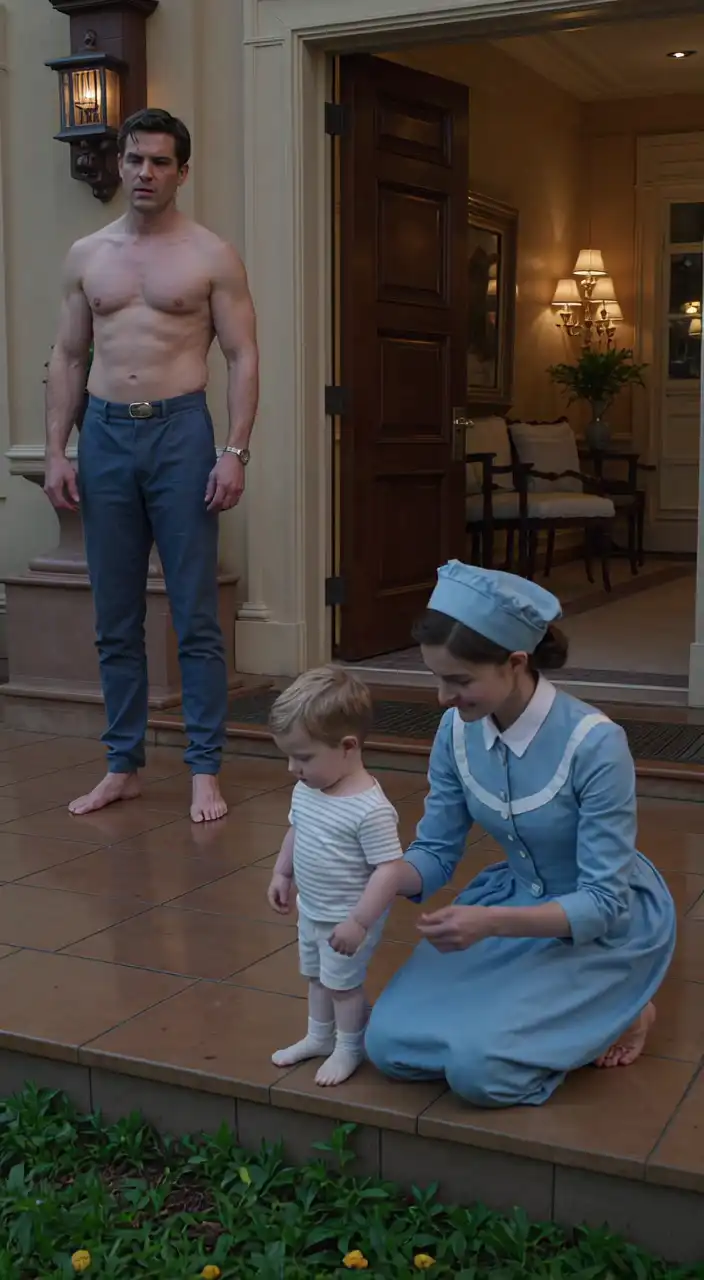
Then Graham peeled off his socks too and stepped onto the wet grass in expensive slacks and a rolled-up dress shirt, billionaire heir to a manufacturing empire standing barefoot on his own lawn like a man who had lost track of every rule that once organized his life.
"It's cold," he said to Oliver, giving the truth instead of persuasion. "And weird."
Oliver looked at his father's feet.
Graham wiggled his toes in the grass. "Very weird."
Tessa smiled slowly.
Oliver shifted one foot forward. Then back.
Graham didn't coax. "I'm right here."
That mattered. Tessa saw the difference immediately. No command. No pressure. Only an offer.
Oliver lowered one bare foot onto the grass.
He jerked in surprise at the sensation, fingers opening wide, body tightening.
Tessa dropped into a calmer crouch. "Yeah. It's different."
Graham kept his own face soft even as his heart hammered. "You can come back up if you want."
Oliver didn't.
Instead he brought the second foot down.
For a second he stood there, tiny and solemn on the wet lawn, brown eyes huge, feeling the world directly under him.
Then something happened none of them expected.
He took one step.
Toward Tessa.
Then another.
A wobbling toddler's pace, uneven and determined.
Tessa's breath hitched. She stayed where she was, hands at her sides, tears gathering but not moving.
"Gently," she whispered, though to whom she wasn't sure.
Oliver looked at her face as if recognizing it from a great distance. He took a third step, then a fourth, faster now because momentum had found him. His arms lifted for balance, sweater sleeves slipping back from his wrists.
Graham stared, unable to process what he was seeing.
Oliver had walked before, yes, in short practical movements indoors. But this was different. This was choice. Intention. Desire visible in motion.
He was going to Tessa.
Then halfway there, the child glanced back.
At his father.
Graham froze.
Tessa understood before he did. "Come with him," she said, voice shaking. "Don't stand outside it."
He stepped forward onto the lawn.
Oliver made a sound. Small, rough, almost forgotten from disuse.
"Dah."
Graham stopped breathing.
The child turned fully then, swaying on damp grass, and took two quick stumbling steps not just toward Tessa now, but between them, as if some instinct in him had finally made room for both.
Graham dropped to his knees in the wet lawn just as Oliver lurched the last step and collided against his chest. Tessa reached them at the same moment, one hand at Oliver's back to steady him, the other over her mouth.
For one suspended second they were all there together in the center of the garden.
Oliver pressed into Graham's shirt, fists clutching fabric.
"Dah," he said again, clearer this time.
Graham made a broken sound that might once have embarrassed him in front of anyone. He wrapped his arms around his son with exquisite care, as though holding something newly returned from the dead.
"I'm here," he whispered against Oliver's hair. "I'm here, I'm here."
Tessa knelt beside them in the grass, crying openly now.
Oliver lifted his head. His eyes went to her face. Then, with uncertain effort, one damp little hand reached across Graham's arm and touched her sleeve.
A claim.
Not one person. Not the other. Both.
Graham looked at Tessa through tears and disbelief. "I don't—"
"I know," she said, laughing and sobbing together. "I know."
From the terrace behind them came the unmistakable gasp of Mildred, who had apparently witnessed everything from the doorway, one hand pressed to her chest as if the scene had struck through years of careful restraint.
In the distance, somewhere beyond the hedges, a mockingbird burst into song.
The breakthrough might have remained one perfect private moment if Mildred had not done exactly what decades of impeccable household management had never prepared her to do.
She ran.
Not gracefully. Not with dignity. She ran across the terrace and into the wet lawn in house shoes, skirt hem lifted, tears already on her face.
"Did he—" she began, then stopped because Oliver was still in Graham's arms, still alert, still turned toward the two people beside him instead of away from them.
"He did," Tessa whispered.
Mildred knelt too, heedless of the grass staining her uniform. "Oh, baby boy."
Oliver looked at her. Really looked, not with full understanding but with awareness enough to register another person in the circle. It was enough to make the older woman break down completely.
By noon, the story had spread through the household despite every attempt to keep things calm. The chef cried in the kitchen. The groundskeeper removed his cap and said, "Well, I'll be." Even the skeptical day nurse arrived for her shift and stood speechless when Tessa described what had happened.
But the person who most needed to witness the change did not trust it at first.
Dr. Hargrove arrived that afternoon for a previously scheduled consultation. Graham had almost canceled him, then decided no. Let the expert see what numbers could not.
They met in the sunroom. Oliver was nearby on a low rug with Tessa, not isolated, not performing. Graham stood by the windows, changed now into dry clothes but still carrying grass stains on the cuffs of his rolled dress shirt like evidence.
Dr. Hargrove listened with professional reserve. "Children sometimes have spontaneous shifts."
"It wasn't spontaneous," Graham said sharply. "It was built."
Hargrove inclined his head. "Perhaps. But one event does not overturn the need for structured intervention."
Graham nearly laughed at the coldness of that, then caught himself because only a week earlier he might have said the same.
Tessa did not argue. She sat on the floor and rolled a small rubber ball toward Oliver, then waited while he touched it and rolled it back an inch. Tiny game. Tiny trust.
Dr. Hargrove watched.
Then Graham did something the old version of him never would have done in front of a specialist.
He stepped away from the windows, removed his shoes again, and sat on the rug.
Oliver noticed immediately.
Graham put one hand flat on the floor and tapped the slow rhythm.
Tap. Tap. Pause.
Oliver stared.
Tessa stayed silent.
Dr. Hargrove's expression sharpened.
Graham looked at his son, not demanding anything, simply offering the pattern they had shared that morning. "Steady," he said.
Oliver crawled two feet toward him.
The room went still.
He wasn't being prompted. No reward dangled in front of him. He moved because he wanted to join the person now speaking in a language he finally recognized.
When he reached Graham, he touched the man's hand and rested there.
Dr. Hargrove exhaled slowly. "How long has he been doing this?"
"He hasn't," Graham said. "That's the point."
The specialist looked at Tessa. "What exactly have you been working on?"
She answered simply. "Helping him feel safe enough to stay connected when he gets overwhelmed."
Hargrove watched Oliver lean, just slightly, against Graham's leg. "And the garden incident?"
Graham's throat tightened at the memory. "He chose us."
The doctor was silent for a long moment. When he spoke again, the certainty was gone from his tone.
"I would not recommend immediate residential placement," he said at last. "Not now."
Graham closed his eyes briefly.
Tessa looked down, relief passing over her face like sunlight.
Hargrove continued, more thoughtfully, "If attachment and co-regulation are unlocking responsiveness, then separation could be counterproductive. We may need to revise the plan."
Not a miracle. Not a cure. But a reversal of the direction that had been carrying Oliver away from home.
After the doctor left, Celia Brandt called to discuss the canceled evaluation. Graham took the call in his study with the door open this time, so he could still hear the faint sounds from the hall outside: Tessa's voice, Oliver's small movements, life.
"You understand this complicates long-term planning," Celia said.
"For the first time," Graham replied, "I'm planning around my son instead of around my fear."
There was a pause. "So Rosewood is off the table?"
"For now."
"Because of one emotional event?"
Graham looked through the open door. Tessa was kneeling in the hall, helping Oliver press stickers onto a sheet of paper. The child was not smiling, not transformed into a different boy overnight. But he was present. Watching. Choosing.
"No," Graham said quietly. "Because I finally saw him."
When he hung up, he remained in the doorway rather than retreating behind his desk. Tessa looked up.
"How bad was that?" she asked.
"Bad for my attorney. Better for my son."
A flicker of amusement warmed her face. "That's a promising trend."
He stepped into the hall. Oliver looked up too, then down again, but not before Graham caught the movement.
"I owe you an apology," he said to Tessa.
She rose slowly. "You don't have to—"
"I do." He glanced at his son, then back at her. "I treated you like sentiment when you were paying better attention than the rest of us put together. I almost sent him away because experts made me feel less helpless than love did."
Tessa's eyes softened. "You were trying to save him."
"I was trying to survive failing him."
The honesty of it seemed to loosen something in both of them.
From the floor, Oliver made a small frustrated sound over a sticker folded onto itself. Tessa crouched at once. Before she could help, Graham lowered himself beside them.
"Can I?" he asked.
Tessa sat back. "Yes. Slow."
He picked up the corner of the sticker carefully. "It got stuck, buddy. We'll fix it."
Oliver watched his fingers. Then, after a long second, he placed his own hand over Graham's wrist.
Not to stop him.
To stay with him.
Graham's face crumpled all over again.
Tessa looked away to give him the mercy of privacy, but her own eyes filled anyway.
That evening, after Oliver had fallen asleep, Graham found Tessa on the rear terrace with a blanket around her shoulders. The garden glowed silver under the outdoor lights. The patch of lawn where it had happened looked entirely ordinary.
"People will expect more now," she said without turning. "Because of today."
"I know."
"There may not be more tomorrow. Not in a way anyone can photograph."
He came to stand beside her. "Then we won't ask for tomorrow's proof tonight."
She looked at him then, surprised.
He gave a tired half smile. "I'm learning."
She laughed softly. "Very slowly."
"Painfully slowly."
The quiet between them was easy for the first time.
After a while Graham said, "He said 'Dah.'"
Tessa nodded, eyes bright. "He did."
"As if the word had been waiting somewhere."
"Maybe it was."
He looked out at the grass. "I keep thinking of all the times I stood over him trying to make something happen."
"And today you stood beside him."
He let that settle.
"Will you stay?" he asked.
Not forever. Not a proposal disguised as gratitude. Just the question that mattered in the shape it honestly had.
Tessa drew the blanket closer around herself and looked toward the nursery windows glowing warm on the second floor.
"Yes," she said. "As long as staying helps him."
Graham nodded. For now, that was enough. More than enough.
The days that followed did not become a fairy tale.
Oliver did not wake the next morning chattering in full sentences. He did not laugh his way through breakfast or suddenly transform into an easy child. Some afternoons he still folded into silence so deep it worried everyone. Some noises still startled him. Some transitions still ended in tears or rigid, breathless distress.
But the house was no longer arranged around despair.
Graham moved meetings out of the early morning so he could be there for breakfast. Not hovering over therapy goals, not checking progress like a report card. Just there. Sitting beside his son while Tessa passed a spoon into a tiny hand and said, "Take your time."
He learned the signs now. The thumb rubbing the seam. The eyes drifting before overwhelm. The difference between refusal and fear.
When Oliver tensed, Graham no longer rushed in with solutions. He got on the floor.
"It's steady," he would say.
And more often than before, Oliver stayed.
Tessa remained the center of many ordinary miracles. Bare feet on the grass became a ritual when weather allowed. She and Oliver stood in the garden after light rain, feeling cool blades between their toes. Sometimes he took only two steps. Sometimes six. Once he toddled all the way to the stone bench and patted it as if inviting the world to witness his decision.
Graham was there for that too.
Rosewood's brochures disappeared from the study. In their place came revised plans, gentler supports, and a home schedule built around connection rather than correction. Dr. Hargrove, to his credit, adapted. Mildred began leaving the terrace doors open on clear mornings because "master Oliver likes the garden air now." Even the staff's voices changed, no longer hushed with dread but softened by care.
The future remained uncertain. Progress still came in breaths, glances, one rough syllable at a time.
But one evening, as the sun lowered over the estate and gold light spilled across the lawn, Oliver stood between Tessa and his father with grass on his ankles and dirt on his heel. He looked at Tessa, then at Graham, then reached for both their hands.
Not because he was fixed.
Because he was finding his way.
And this time, neither of them let go.
In the weeks ahead, there would be hard days again. There would be specialists to question, new fears to face, and moments when healing seemed too slow to trust. But the Voss house no longer felt like a place waiting for another loss.
It felt like a place learning, at last, how to stay.
And somewhere beyond words, in the quiet language of wet grass, steady hands, and a father kneeling low enough to finally be seen, a little boy had already begun.
Disclaimer: Mention of any brand or trademark is for identification only and does not imply partnership or endorsement