THE GIRL IN THE GARDEN
The little girl was sitting under a grand piano in the west drawing room when the housekeeper found her.
It was nearly four in the afternoon, and the Langford estate in Bloomfield Hills, Michigan, was so quiet that every small sound seemed too loud. The tick of the antique clock in the front hall. The hum of the climate control behind the walls. The soft click of dress shoes crossing marble.
“Miss Tessa?” Mabel called gently, standing in the doorway with a folded cardigan over one arm. “Sweetheart, it’s time for your snack.”
No answer.
Mabel stepped farther into the room and looked past the white sofas, the untouched tea tray, the long windows overlooking the back gardens. Tessa Langford, two years old, brown-haired and green-eyed and heartbreakingly beautiful, sat on the rug beneath the piano bench with her knees pulled to her chest. She wasn’t crying. She rarely cried anymore. She just sat there, her small face blank, staring at the shadowed underside of the instrument as if it were safer than the rest of the world.
“Mabel?” another staff member whispered from the hall. “Did you find her?”
“Yes.”
“Mr. Langford is on his way home.”
That changed the room. It always did.
Mabel crouched carefully. “Tessa, your daddy will be here soon.”
Still nothing. Not even a blink that meant she understood.
At that moment, the front doors opened downstairs with the deep, expensive sound of polished wood and brass. Grayson Langford had arrived.
He came in carrying the weather with him—cold spring wind in his coat, city dust on his cuffs, the sharp pace of a man who ran half the skyline of Detroit and all the developments with his name on them. At thirty-nine, he had built a real estate empire from steel, glass, and ruthless timing. Office towers, luxury hotels, waterfront projects, whole districts reborn because he saw profit where others saw rust.
Yet the only threshold that made him hesitate was his own.
“How was she today?” he asked before he had even fully handed his coat to the valet.
Mabel appeared at the top of the stairs, her face careful in the way people’s faces became careful around grief. “She’s in the drawing room, sir.”
Grayson’s jaw tightened. “Did she eat lunch?”
“A little yogurt. Two bites of banana.”
“Did she go outside?”
“No, sir. Mr. Keene thought the air was too cold.”
Of course he did. Everyone in the house thought Tessa might shatter from one wrong temperature, one loud sound, one unexpected gust of wind.
Grayson climbed the stairs and crossed the wide hall lined with framed photographs. He passed one of his wife, Claire, barefoot in the estate garden, laughing over her shoulder with sunlight in her blond hair. Another of Claire holding baby Tessa against her chest, both of them wearing matching white sweaters. Another of the three of them together, taken before the illness hollowed the color from Claire’s face and before silence moved into the house like permanent fog.
He stopped in the doorway when he saw his daughter beneath the piano.
For a second his expression softened into naked pain.
“Tess,” he said quietly.
The child did not look up.
He loosened his tie and walked into the room, lowering himself to the floor with an awkwardness that came not from stiffness but from unfamiliarity. He was a man who could command a boardroom with one glance, negotiate hundred-million-dollar acquisitions without blinking, and order architects, attorneys, and city officials into motion. But when he sat before his own little girl, he looked like a man trying to remember a language he should have known by heart.
“Hey, sweetheart.” His voice turned gentler. “Daddy’s home.”
Nothing.
He reached under the piano slowly, not to touch her yet, just to let his hand rest on the rug between them. “I brought you something from downtown. A little music box. It plays that song your mom used to hum.”
At the word mom, Mabel looked away from the door.
Tessa remained still, eyes fixed somewhere beyond him.
Grayson swallowed. “Do you want to see it?”
He opened the velvet box. The tiny silver ballerina inside turned in a circle while thin notes drifted into the enormous room.
Tessa did not smile.
She had not laughed in more than a year. Not since the end of Claire’s illness. Not since hospital rooms and whispered calls and a mother growing weaker day by day became the landscape of her earliest memory.
She had been too young to understand cancer, but not too young to feel fear. Too young to name loss, but not too young to absorb it. She had watched people cry around her crib. She had watched her mother disappear in pieces. Since Claire died, Tessa did not babble the way other toddlers did. She did not bring toys to adults. She did not clap, squeal, tug sleeves, or run into waiting arms. She ate little, slept lightly, and spent long stretches sitting in corners, under tables, behind curtains, almost as if she was trying to take up less space in a world that had become unpredictable and cruel.
The pediatric specialist had called it emotional trauma with developmental withdrawal.
Grayson called it losing both of them at once.
He turned off the music box and set it beside him. “Tessa, look at me.”
Her green eyes shifted, briefly, toward the flash of silver in his hand. Then they slid away.
A tiny movement, barely anything. But in this house, they lived on barely anything.
“Good,” he whispered quickly, as if he could build a bridge out of that one glance. “That’s good, baby. That’s—”
She tucked herself farther into the shadows.
The effort left his face. He sat there a moment longer, one hand over his mouth.
From the doorway, Mabel said softly, “Sir, should I have Mrs. Bennett from the agency send another candidate tomorrow?”
He did not answer immediately.
There had been therapists. Child grief specialists. Sensory consultants. Private nurses. Two live-in nannies. One behavior coach flown in from Chicago. Another from Boston. One nanny quit after five days because “the child never responds.” Another cried and said she felt invisible. A third had followed every instruction in every binder and made no difference at all.
He had bought every resource money could summon, and still his daughter sat beneath a piano in a silent mansion, unreachable.
Finally he stood, too quickly, as if staying on the floor another second might break him open.
“Yes,” he said without looking back. “Send whoever she has.”
Then, after a pause, he added in a lower voice, “One more try.”
That night, after checking on Tessa asleep in her crib-sized bed beneath the mural Claire had painted herself, Grayson went to his study. He opened a drawer and took out a photograph he no longer kept in frames.
Claire in a hospital headscarf, smiling weakly, one hand on Tessa’s tiny foot.
“I’m failing her,” he said into the empty room.
The silence that answered was the same silence that lived in every hallway of the estate.
And for the first time in months, Grayson Langford wondered if one more try was hope—or surrender.
Three days later, Grayson did not go to the agency interview Mabel had arranged.
He meant to. He truly did. But a construction emergency at a riverfront site in Grand Rapids pulled him away before dawn, and by early afternoon he was driving himself back toward Bloomfield Hills with a headache burning behind his eyes and a voicemail from Mabel saying, “Sir, the candidate withdrew this morning. She accepted another placement.”
Another one gone before even stepping inside the house.
He almost laughed.
At a stoplight near a public park he rarely noticed, traffic stalled behind a school bus and a landscaping truck. Grayson drummed his fingers against the steering wheel, glanced toward the green space, and froze.
A group of children clustered near the edge of a flower garden where city volunteers had been planting early spring tulips. In the middle of them was a young woman in faded jeans, muddy sneakers, and a yellow rain jacket tied around her waist. Her dark blond hair had come loose from a braid. Dirt smudged one cheek. She was crouched low, speaking to a little boy who was crying over a broken pinwheel.
Grayson couldn’t hear the words through the glass, but he watched her take the pinwheel apart, hand the pieces to the boy one by one, and spin in a slow circle with her arms out. The crying child blinked. Then another child copied her. Then a third. In seconds she had all of them turning in place, laughing as the wind caught their jackets.
She didn’t command the moment. She joined it.
The light changed. Cars moved. Grayson did not.
A horn blared behind him.
He pulled over along the curb, got out of the car without giving himself time to think, and crossed the sidewalk toward the park.
The young woman was now kneeling in the grass beside a toddler girl who was pressing leaves into the dirt in a perfectly straight line. Instead of redirecting her, the woman quietly found more leaves and matched the girl’s pattern until the child looked at her in surprise.
Again, she joined.
When the little group dispersed toward a waiting van marked OAKRIDGE COMMUNITY EARLY LEARNING, Grayson approached.
“Excuse me.”
She looked up. Her eyes were clear blue, direct but not challenging. Young, maybe twenty-three or twenty-four. Beautiful in an open, unguarded way that had nothing to do with polish.
“Yes?”
“I’m Grayson Langford.”
Recognition flickered. In Michigan, his name often did that.
She stood, wiping dirt onto her jeans. “Okay.”
He almost smiled at the lack of awe. “I know this is unusual, but I need childcare. Full-time. Live-out or live-in. Excellent salary, benefits, anything reasonable.”
Her brows lifted. “That’s a very abrupt job interview.”
“I don’t have time for subtle.”
“Clearly.”
He should have been irritated. Instead, something in her calm steadied him.
“What’s your name?” he asked.
“Juniper Hale.”
The name was as unexpected as she was.
“My daughter is two,” he said. “She’s… withdrawn. After her mother died. We’ve had specialists and nannies, and none of them have been able to reach her.”
Juniper’s face changed then, all lightness gone. Not pity. Attention.
“How long ago did her mother die?”
“Fourteen months.”
“And your daughter saw the illness?”
“Yes.”
Juniper glanced back toward the garden beds. “Children understand more than adults think.”
“So I’ve been told.”
“By experts?”
He let out a breath that was almost a laugh. “Mostly.”
She folded her arms. “I’m not a specialist.”
“What are you?”
“Part-time aide at Oakridge. Early childhood education degree in progress. I grew up helping raise my younger brothers. I spend too much time outside. I don’t believe every child needs to be corrected into feeling safe.”
The wording hit him.
“I’ll pay triple whatever they pay you there.”
“That’s not a good reason to hire me.”
“It’s not the reason.”
Juniper studied him for a long second, then asked, “Why did you stop at the park?”
Because you moved toward children instead of trying to control them, he thought.
Because for ten seconds, I saw ease where my house has forgotten it exists.
Because I’m desperate.
He answered honestly. “You were listening with your whole body.”
Something softened in her expression.
“Tell me about your daughter,” she said.
An hour later, Juniper followed his car through the iron gates of the Langford estate.
She looked at the mansion, the sweeping drive, the stone fountain, and the formal hedges without visible reaction. Inside, while Mabel offered coffee in bone china cups, Juniper stood at the library window and watched the back gardens.
“You have enough grass here for a small national park,” she murmured.
Mabel stiffened slightly. No candidate had ever said such a thing aloud.
When Grayson took her upstairs, he warned, “She usually doesn’t respond. Don’t take it personally.”
Juniper stopped outside the nursery suite. “I won’t.”
Tessa sat by the window in a soft gray dress, one hand rubbing the edge of the curtain between finger and thumb. There were baskets of toys around her—wooden blocks, plush animals, musical instruments, picture books. Untouched. Her brown hair curled against her cheek. Her green eyes stared at the movement of branches outside.
Juniper did not call her name.
She did not swoop in with smiles or cooing voices or brightly offered toys.
Instead, she took off her shoes, crossed the room quietly, and sat on the floor three feet away, facing the same window.
For a full minute, she said nothing.
Grayson stood near the door, arms folded, waiting for discomfort to settle in. It didn’t.
Juniper noticed the rhythm of Tessa’s fingers against the curtain. Rub, pause. Rub-rub. Long pause.
Slowly, almost imperceptibly, Juniper echoed it against the hem of her own sweater. Rub, pause. Rub-rub. Long pause.
Tessa’s hand stopped.
Juniper stopped too.
Then Tessa began again.
Juniper matched her.
Mabel blinked from the hallway.
After a while Juniper said, still looking out the window instead of at the child, “That tree moves differently than the others. See that one? It’s bossy. It tells all the smaller branches what to do.”
No response.
“That cloud looks like a rabbit with bad manners.”
Silence.
Juniper tilted her head. “Or maybe a squirrel in a sweater. Hard to say.”
Tessa’s eyes shifted, not to Juniper’s face, but to her moving hand on the sweater hem.
A pause.
A tiny, deliberate pause.
Juniper’s mouth curved into the smallest smile. “Hi there,” she said softly, still not pushing. “I’m Juniper.”
From behind her, Grayson said quietly, “She won’t—”
Tessa looked at him then, startled by his voice. The moment broke. Her gaze dropped.
But Juniper just rose smoothly to her feet. “That’s enough for today.”
“That’s it?” Grayson asked.
“For a first hello? Yes.”
“You didn’t even try to make her play.”
“I did try,” Juniper said. “I tried not to make her defend herself.”
The answer followed him all the way downstairs.
As Juniper reached the front door, Mabel asked, “Will you be accepting the position, Miss Hale?”
Juniper glanced back toward the staircase. “If your daughter has a say, I think she already answered.”
Grayson frowned. “She didn’t do anything.”
Juniper slid on her muddy sneakers. “She stopped for me.”
After she left, he stood in the foyer replaying the scene upstairs.
Tessa had stopped.
It was so small it could have been nothing.
Yet in a house where nothing had changed for over a year, even a pause could feel like the first crack in ice.
Juniper started the following Monday.
By eight in the morning, she had already unsettled the entire household.
Mrs. Keene, the household manager, found her carrying Tessa into the breakfast room instead of insisting the tray be taken upstairs.
“The child eats better in a controlled setting,” Mrs. Keene said sharply.
Juniper settled Tessa on her hip and glanced at the long table flooded with morning light. “This is a controlled setting. It’s a room.”
“She doesn’t like change.”
“Or maybe she doesn’t like isolation.”
Mrs. Keene pursed her lips. “Mr. Langford prefers routine.”
Juniper looked down at Tessa, who had gone quiet and stiff at the tone in the room. “Then maybe Mr. Langford and I can talk about what routine has been doing for her.”
It was a bold thing to say on a first day inside one of the richest homes in the state.
But Grayson, who had come in just in time to hear it, did not correct her.
“Let her try,” he said.
That became the phrase that followed Juniper through the estate in those early weeks, half permission and half warning.
Let her try.
Juniper did not bombard Tessa with games. She did not produce flashcards or brightly colored lesson plans. She watched. She learned the child’s patterns the way some people learned a song by ear.
Tessa liked movement at a distance: curtains shifting, branches bending, fish circling in the indoor pond in the conservatory.
She rubbed fabric when nervous.
She paced the perimeter of rooms in small careful lines.
When overwhelmed, she went still before she went away.
So Juniper entered those rhythms instead of interrupting them.
When Tessa walked the edge of the nursery rug, Juniper walked it too, one quiet step behind, never touching.
When Tessa traced circles in condensation on a window, Juniper traced smaller circles below hers.
When Tessa pressed her forehead to the glass of the conservatory to watch rain gather on leaves, Juniper stood beside her and whispered, “That drop is winning. No, wait. The one on the left is dramatic but ambitious.”
Sometimes Tessa blinked. Sometimes she didn’t. Juniper kept going anyway.
At lunch one day, Mabel watched from the sideboard as Juniper sat on the kitchen floor with Tessa beside her, both of them tapping spoons against overturned mixing bowls.
“That is not a toy,” Mabel said.
Juniper tapped a slow pattern. “Today it is.”
Tessa tapped once.
Mabel froze.
Juniper did not make a fuss. She simply echoed the single tap and waited.
Tap. Tap-tap. Pause.
Tessa’s spoon moved again, soft as a raindrop.
For the first time, anticipation appeared in the child’s face—not joy yet, not even pleasure exactly, but the expectation of response.
That afternoon Grayson came home early and found them in the sunroom. Music drifted from Juniper’s phone, something old and warm with a swing beat. Juniper was not trying to make Tessa dance. She was swaying alone, absurdly, with exaggerated seriousness.
“This is official garden inspection music,” she told the child. “Extremely important. You can tell because my dancing is tragic.”
Tessa stood by a wicker chair, one hand on the cushion, watching.
Juniper bent her knees and spun clumsily, nearly losing balance on purpose. “Oh no. The inspector has fallen into scandal.”
A tiny shift touched Tessa’s mouth.
Grayson stopped in the doorway.
Was that—?
No. Not a smile. But the shape before one.
He did not speak. He was afraid to break it.
Juniper caught sight of him and lowered the volume. “Good timing. We’ve just learned that begonias are very judgmental.”
He stared at his daughter. “She’s standing longer.”
“Yes.”
“She usually sits.”
“She likes to watch movement.”
Grayson looked from Juniper to Tessa. “How are you doing this?”
Juniper tucked a strand of hair behind her ear. “I’m not dragging her into my world. I’m visiting hers.”
For a few days, hope moved through the mansion so carefully that no one dared name it.
Then the household pushed back.
It began with little things. Mrs. Keene insisted Tessa’s shoes were not suitable for the damp grass and brought her inside just as Juniper had gotten her to the terrace doors. The chef complained that floor picnics would ruin appetite training. A private speech consultant, brought in at great expense, sniffed at Juniper’s methods and declared, “Unstructured mirroring may reinforce withdrawal.”
Juniper listened to this with remarkable patience. Until Tessa heard the consultant’s clipped voice and retreated under a console table, folding into herself for the first time in days.
Juniper crouched beside her, not trying to pull her out.
“She was making progress,” Juniper said quietly.
The consultant folded her portfolio. “Progress requires measurable goals.”
“It also requires the child not feeling hunted.”
Later that night, Grayson called Juniper into his study.
The room smelled of cedar shelves and black coffee. City plans and property maps were spread across his desk, but he pushed them aside when she entered.
“Sit down,” he said.
“I’m okay standing.”
He looked tired. “Mrs. Keene says you’re disrupting the house.”
Juniper gave a short laugh. “The house was disrupted long before I arrived.”
“She means the routines.”
“I know what she means.”
He rubbed a hand over his jaw. “Dr. Pritchard reviewed your notes. She thinks your approach is too permissive.”
“Did Dr. Pritchard watch Tessa hide under a table because a stranger spoke about her as if she weren’t there?”
“She’s a respected specialist.”
“And your daughter is a grieving toddler, not a case file.”
The sharpness of it landed.
Grayson’s eyes cooled. “Be careful.”
“With what? Your pride? Your payroll?”
His chair scraped back. “With the fact that I am trying to help my child.”
Juniper’s expression changed at once, anger replaced by something sadder. “I know you are.”
“Then don’t talk to me like I don’t care.”
“I’m talking to you like a father who is surrounded by employees and experts who are more comfortable managing Tessa than knowing her.”
Silence stretched between them.
Finally Grayson said, lower, “You think I don’t know that?”
Juniper’s voice softened. “I think you’re scared that if this doesn’t work, nothing will.”
The truth of it made him look away.
“I have watched people fail her for fourteen months,” he said. “I watched Claire die while I kept promising both of them things I couldn’t control. Every person in this house is trying not to make it worse.”
“And in trying not to make it worse,” Juniper said gently, “they’ve made her world smaller and smaller.”
He sat back down heavily.
From the doorway, there was a small sound—the rustle of fabric.
Both of them turned.
Tessa stood in the hall in pale pajamas, one hand clutching the doorframe. Her eyes were fixed on Juniper, not frightened, just searching.
Juniper immediately lowered herself to the floor. “Hi, bug.”
Grayson had never heard her call Tessa that before.
Juniper patted the rug beside her. “You heard loud voices. I know.”
Tessa did not move closer, but she stayed.
Juniper tapped two fingers softly against her own knee in the little rhythm Tessa had taught her with the curtain. Rub, pause. Tap-tap. Pause.
Tessa’s breathing slowed.
Grayson watched the two of them from behind his desk and felt, not for the first time, that he was standing outside a door his daughter might one day let him through—if only he learned how to stop barging at it.
But the opposition in the house was no longer subtle.
The next morning, Mrs. Keene informed Juniper that outdoor time had been limited due to “health concerns.” The afternoon after that, the consultant scheduled extra sessions without asking. Mabel, torn between loyalty and hope, whispered apologies in the pantry. The staff had spent so long protecting Tessa from the world that Juniper’s insistence on letting her feel it—grass, wind, music, choice—looked reckless to them.
And then the rain came.
A soft spring rain at first, silver over the gardens.
Juniper stood at the terrace windows with Tessa in her arms, both of them watching water darken the stone paths.
“Listen,” Juniper whispered. “The sky is playing drums.”
Tessa leaned her head, the tiniest amount, against Juniper’s shoulder.
Mrs. Keene saw it and stiffened. “Absolutely not. She mustn’t go near that weather.”
Juniper did not argue then. But her gaze remained on the garden, thoughtful.
As if she already knew the place where healing was waiting.
And as if the rest of the house was going to make her fight for it.
The fight came two days later.
Saturday should have been easier because Grayson was home, but his presence often made the staff more formal and the atmosphere more strained. He spent the morning on conference calls in his study while voices echoed from his speakerphone about zoning, permits, acquisition timelines. Through the windows behind him he could see the estate gardens washed clean by overnight rain.
Every so often he found his eyes drifting from spreadsheets to the lawn.
At eleven, raised voices interrupted a call with his Chicago attorney.
He muted the line and stepped into the hall.
The argument was coming from the sunroom.
“I said no,” Mrs. Keene was insisting.
Juniper stood by the open French doors, Tessa on the floor beside her. Outside, a light rain had started again, gentle and warm enough for spring. The scent of wet earth blew through the room.
“She wants to go,” Juniper said.
“She is two years old. She has no idea what she wants.”
Juniper looked down at Tessa, who had one hand extended toward the rain-dark terrace stones. “I disagree.”
Mrs. Keene folded her arms. “Mr. Langford would never permit this.”
“Permit what?”
Both women turned.
Grayson stepped into the room, phone still in his hand.
Mrs. Keene moved at once to his side. “Miss Hale intends to take Tessa outside in the rain.”
Juniper didn’t flinch. “I intend to stand with her in it for two minutes if she chooses.”
“In the rain,” Mrs. Keene repeated, as if Juniper had suggested wildfire.
Grayson looked at his daughter. Tessa was not shut down. She was alert, fixed on the falling water with a concentration he hadn’t seen for anything else in months.
“She’ll get chilled,” he said automatically.
Juniper nodded once. “Maybe. Then we come in, dry off, and drink something warm.”
“This is not a campsite.”
“No,” Juniper said. “It’s a house where a child has spent more than a year being told not to touch life because life already hurt her once.”
The words landed in the wet air between them.
Grayson’s grip tightened on the phone. “That’s unfair.”
“Is it?”
Tessa made a small sound then—not a word, barely even a hum, but enough to turn all three adults toward her.
She was pressing her palm flat to the stone floor near the threshold, as if testing nearness.
Juniper crouched. “You want to feel it?”
Mrs. Keene stepped forward. “Miss Hale.”
Grayson closed his eyes for one beat. When he opened them, he said, “Two minutes.”
Mrs. Keene stared. “Sir—”
“Two minutes.”
Juniper’s expression didn’t turn triumphant. Only grateful.
She slipped off her cardigan, draped it over a chair, and took Tessa’s hand.
The child hesitated at the threshold.
Juniper did not pull.
“It’s okay,” she said softly. “The rain is just water with better entrance music.”
Tessa looked at the droplets striking the terrace.
Juniper stepped out first, lifting her own face to the sky, arms slightly spread. “Cold,” she announced. “Rude, actually.”
The absurdity of it hovered there.
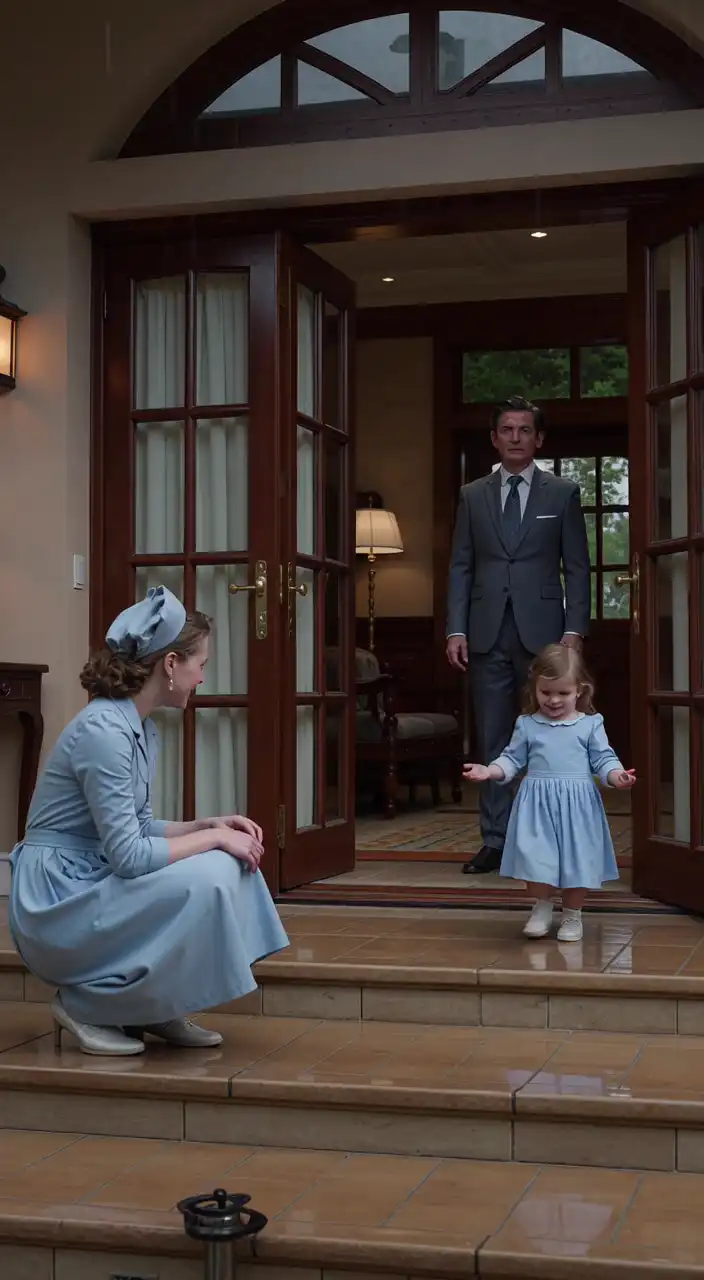
Then Tessa took one careful step onto the wet stone.
Grayson stopped breathing.
Another step.
The rain dotted her brown curls and darkened the shoulders of her little blue sweater. She did not recoil. She stood very still, staring at her hand as droplets gathered in her palm and rolled between her fingers.
Juniper knelt beside her, laughing softly at nothing and everything. “That one landed right on your thumb. Very dramatic.”
Tessa looked up at her.
Mrs. Keene whispered behind Grayson, “Bring her in.”
But he could not.
He was watching his daughter meet the weather as if it were the first honest thing the world had offered her in a very long time.
Juniper began to move, slowly at first, swaying with the rain and the rhythm of water on stone. “Do you hear it, bug? Tap on the leaves, tap on the roof, tap on the table. Whole band out here.”
She hummed a beat and stepped left, then right.
Tessa’s eyes tracked her.
Juniper twirled once, ridiculous and graceful at the same time. Her hair came loose fully now, sticking to her cheeks. “Official rain dance inspection,” she said. “Very important. No skill required.”
Still Tessa watched.
Then Juniper stamped lightly in a puddle.
Water splashed.
Tessa blinked.
Juniper did it again, widening her eyes in mock surprise. “Oh! The puddle objected.”
A tiny hand lifted.
One small shoe pressed down.
Splash.
It was so slight that anyone impatient would have missed it.
Juniper gasped as if witnessing a moon landing. “There she is.”
Grayson’s throat burned.
But the progress did not move in a straight line. Nothing did with Tessa.
That afternoon, after the rain play and hot towels and dry clothes, a specialist arrived unexpectedly for a scheduled weekend evaluation Mrs. Keene had neglected to cancel. Tessa was overtired. The consultant’s bright voice filled the nursery. Questions, prompts, toys placed too close, praise delivered too quickly.
Within minutes Tessa had folded back into silence so complete it felt like a door slamming.
Juniper stood by helplessly until finally she said, “That’s enough.”
The consultant snapped, “You are not qualified to determine that.”
“No,” Juniper said, “but I am qualified to see when she is drowning.”
Grayson, already strained and guilty from allowing the rain episode and then exposing Tessa to this, ended the session abruptly.
After the consultant left, the damage lingered. Tessa refused dinner. Refused the sunroom. Refused even the terrace window. She curled in her crib clutching a corner of blanket, eyes open and far away.
Juniper sat beside the bed until late evening.
When she finally came downstairs, she found Grayson in the kitchen, hands braced against the marble island, untouched whiskey nearby.
“She regressed,” he said without preamble.
“She got overwhelmed.”
“She was doing better.”
“She still is.”
He laughed once, bitterly. “You don’t know that.”
Juniper was quiet. “No. I don’t know. But I know healing isn’t obedience.”
He looked at her then, exhausted and raw. “Tomorrow I need to drive to Lansing for the day. There’s a state land meeting I can’t move. Mrs. Keene says your methods are causing instability. Maybe one structured day without all this…” He gestured vaguely, meaning music, rain, floor picnics, strange hope. “Maybe it would help reset things.”
Juniper went still. “You want me not to come.”
“For one day.”
“You think her shutting down means I pushed too far.”
“I think everyone in this house is one bad decision from making things worse.”
Including me, his face said.
Juniper took that in. The hurt was clear, but so was her discipline. “If that’s what you decide.”
He hated how formal she sounded suddenly.
“It’s one day,” he said.
She nodded. “Then I’ll see you Monday.”
Before leaving, Juniper went upstairs one last time. Grayson watched from the hall as she sat beside Tessa’s crib in the dim nursery.
“I’m not coming tomorrow, bug,” she whispered. “Just for one sleep and one wake-up. Then I’ll come back.”
Tessa did not move.
Juniper pressed her lips together and added, “You don’t have to do anything with that. I just wanted you to know.”
She stood, looked once toward the doorway where Grayson waited, and left.
The next day was awful.
By ten in the morning Tessa had refused breakfast. By eleven she was lying under the hallway console table, staring at the carved legs as if they were trees in some private forest. Mrs. Keene offered toys. Mabel sang softly. Grayson, home later than planned because he had turned his car around halfway to Lansing, tried to coax her into the library with the silver music box.
Nothing.
At noon she pushed his hand away.
At one, she cried—an exhausted, thin sound that tore through him because she cried so rarely now that it felt like hearing pain itself.
“What do you need?” he asked, kneeling on marble while staff hovered helplessly around him. “Tessa, sweetheart, tell me. Please.”
She crawled farther beneath the table.
Mabel wiped her eyes. “Sir…”
Grayson sat back on his heels. He had closed billion-dollar deals with steadier hands than the ones he held out to his daughter now.
He remembered Juniper saying, I tried not to make her defend herself.
So he dismissed the staff.
“Everyone out.”
Mrs. Keene hesitated. “Mr. Langford—”
“Out.”
When the hall emptied, he lay down on the floor three feet away from the table, suit jacket abandoned, cheek against cold marble.
For a while he said nothing.
Then he noticed Tessa’s fingers rubbing the hem of her blanket. Rub, pause. Rub-rub. Long pause.
The old rhythm.
Juniper’s rhythm.
Tentatively, he answered it with two fingers against the floor. Tap, pause. Tap-tap. Long pause.
Tessa’s hand stopped.
His heart slammed.
He tried again.
Tap, pause. Tap-tap. Long pause.
A small face turned toward him from the shadows.
He did not move closer.
“It’s okay,” he whispered. “I know. I know.”
Tessa stared.
Then, with enormous effort, as if dragging the sound up from somewhere buried under months of fear, she opened her mouth.
“Ju…”
Grayson went rigid.
Her brows pulled together in frustration. Tears filled her eyes.
“Ju…ni…”
He covered his mouth with his hand.
“Tessa?” he breathed.
Her voice came broken and hoarse from disuse, but it came.
“Junie.”
The nickname hit him like a blow.
Not Daddy.
Not Mabel.
Junie.
His daughter wanted Juniper.
For one stunned second, the whole mansion seemed to hold still around that single word.
Then Grayson was already reaching for his phone with shaking fingers.
Juniper answered on the second ring. “Hello?”
He couldn’t speak at first.
“Mr. Langford?”
“She asked for you.” His voice cracked. “She spoke. Juniper, she—she asked for you.”
Silence on the line. Then a sharp inhale. “I’m coming.”
When Juniper arrived twenty-two minutes later, hair windblown, sneakers wet from the drive, Grayson met her at the front door with tears on his face and no attempt to hide them.
“She’s in the hall,” he said.
Juniper touched his arm once—brief, human—and moved quickly through the house.
Tessa was no longer under the table. She had crawled halfway out and sat on the rug, eyes swollen, as if waiting had become unbearable.
“Hey, bug,” Juniper said softly from several feet away.
Tessa looked up.
What happened next would live in Grayson for the rest of his life.
His daughter pushed to her feet—not cautious, not slow, but urgent. Her little legs wobbled once, then steadied. She looked at Juniper with desperate certainty and ran.
Straight across the hall.
Straight into Juniper’s arms.
Juniper dropped to her knees just in time to catch her. Tessa collided with her chest and clung, both fists bunching the back of her shirt. A sound came from the child then, half sob and half relief.
Juniper held her tight, rain scent and shampoo and warmth. “I’m here,” she whispered. “I’m here. I came back.”
From the doorway, Grayson broke.
He turned away too late, shoulders shaking, one hand braced against the wall as years of pressure and guilt and helpless love gave out all at once.
Behind him, Juniper swayed gently with Tessa in her arms, following the child’s trembling breath until it slowed.
And in the hallway of a silent mansion, the first miracle did not sound like laughter.
It sounded like a name.
Mabel was the first person besides Grayson to witness the aftermath.
She came into the hall carrying a folded towel, saw Tessa clinging to Juniper’s shoulder, and stopped so abruptly that the towel slipped from her hands.
“Oh,” she whispered.
Juniper sat on the floor now with Tessa in her lap, one palm moving in slow circles over the child’s back. Grayson stood nearby, red-eyed and unsteady, as if he had been through an accident and survived.
“She said her name,” he told Mabel, and his voice broke all over again on the sentence. “She asked for her.”
Mabel put both hands over her mouth. Tears spilled immediately.
Mrs. Keene arrived next, summoned by the unusual noise in the corridor. She opened her lips, perhaps to scold, perhaps to manage, perhaps to explain, and then she saw Tessa lift her face from Juniper’s shoulder.
The child’s green eyes were wet and alive in a way no one in the house had seen for more than a year.
“Ju…nie,” Tessa whispered again, touching Juniper’s collar.
No one had a speech about protocols after that.
Mrs. Keene sat down on a nearby bench without a word.
Even Dr. Pritchard, updated by Grayson later that evening over a clipped phone call, fell silent long enough for him to hear the shift in her breathing.
“She initiated speech?” the doctor said at last.
“Yes.”
“And movement?”
“She ran to her.”
“That is… significant.”
Grayson stared through the study windows at the wet garden darkening under twilight. “She wasn’t trying to be significant. She wanted the person who made her feel safe.”
The house changed in small ways first.
No one interrupted when Juniper sat on the kitchen floor with Tessa for lunch the next day.
No one objected when music played in the sunroom.
And when a fresh light rain began at noon, Mrs. Keene herself set a basket of towels by the terrace doors without being asked.
The emotional change in Grayson was larger and harder. He had spent so long standing outside his daughter’s silence that seeing her burst through it for someone else should have hurt. In a meaner man, it might have. Instead it humbled him.
That evening he found Juniper in the conservatory while Tessa napped nearby in a stroller after an unusually active afternoon. Water tapped gently against the glass roof.
“Thank you,” he said.
Juniper looked up from the fern she had been absentmindedly touching. “You don’t have to thank me for caring about her.”
“I do.” He paused. “And I need to apologize.”
“For yesterday?”
“For thinking progress should look orderly. For letting the house overrule what you were seeing. For…” He exhaled. “For needing my daughter to heal in ways I could understand.”
Juniper was quiet for a moment. “You came down on the floor with her.”
He frowned. “What?”
“I heard from Mabel. You followed her rhythm instead of demanding she follow yours.” Juniper’s expression gentled. “That matters.”
He leaned against the conservatory doorframe, looking toward the sleeping child. “I almost sent her away from the one person she trusted.”
“But you brought me back.”
“Because she asked.”
Juniper smiled faintly. “Sometimes children tell the truth faster than adults.”
He laughed softly, the sound rusty from disuse.
Through the stroller mesh, Tessa stirred. Her eyes opened. Sleep-heavy, she searched the room and found them both.
Juniper crouched. “Hi, bug.”
Tessa reached one hand out, not frantic this time. Just certain.
Grayson moved before Juniper could, kneeling beside the stroller. “Can I?” he asked softly, though he wasn’t sure whether he was asking Juniper or his daughter.
Tessa looked at him.
For a heartbeat, the old fear returned. Then she placed her small hand over his fingers.
The gesture was simple. It nearly ruined him.
He bent his head, pressing his forehead lightly against the stroller handle while tears slipped free again. No power, no wealth, no polished control could survive that tenderness. He let himself cry in front of them both.
Juniper did not pretend not to notice.
Tessa did not pull away.
That night, Grayson canceled two out-of-state meetings and instructed his chief of staff to move all nonessential travel for the next month.
“You’re clearing your schedule?” his assistant asked in disbelief.
“I’m correcting it,” he replied.
Word spread quietly through the estate. The master of towers and land deals was coming home for breakfast. He was asking what songs Tessa liked. He was sitting on rugs. He was listening.
The breakthrough had not cured everything. Tessa still had long silent stretches. She still startled easily. She still disappeared into herself when strangers came too close. But now there was a path back. A voice, however fragile. A run across a hallway. A proof of trust.
And the family, such as it was, began reorganizing itself around that truth.
A week later, the gardens were bright with fresh growth.
Juniper stood barefoot in the grass, her shoes abandoned near the terrace. Music drifted softly from a portable speaker balanced on a stone bench. Not loud. Just enough for rhythm.
Tessa stood in front of her in yellow rain boots though the sky was clear, swaying in her own tiny uneven way.
“That’s excellent dancing,” Juniper declared solemnly.
Tessa blinked at her, then lifted both hands and turned in a wobbly little circle.
From the terrace, Grayson watched with coffee in one hand and his phone forgotten in the other. He no longer observed as if afraid to interfere with magic. Some mornings he joined them. Some mornings he simply stood close enough that Tessa could see him and choose.
Today she did.
She turned from Juniper, spotted her father, and held out one arm.
Not a word. Not yet.
But an invitation.
Grayson set the coffee down immediately and stepped onto the lawn. “Me too?”
Tessa’s arm remained lifted.
Juniper grinned. “Looks like you’ve been approved for garden inspection.”
He came to stand beside his daughter. After the briefest hesitation, he copied her sway. Left. Right. Awkward, dignified, terrible.
Juniper laughed. “Wow. Somehow that’s worse than mine.”
“I built half of downtown Royal Oak,” he said.
“And yet this defeated you.”
Tessa made a small sound then—not quite laughter, but close enough to light the whole morning.
Grayson looked down at her, startled into smiling so openly that he seemed younger.
Healing did not arrive all at once. The mansion did not transform into joy overnight. Claire was still gone. Some rooms still hurt. Some days Tessa still retreated from the world and had to be met there patiently, one rhythm at a time.
But she was no longer healing alone.
Neither was he.
Juniper did not promise forever, and Grayson did not ask for it. Not yet. The future remained open, tender, unfinished. But every day she came through the front door, and every day Tessa’s eyes searched for her less from fear and more from trust.
And in the long gardens behind the mansion, where rain still visited and music still drifted through damp spring air, a broken family began learning the shape of hope.
The estate was quieter than it used to be, but it was no longer empty. Silence had changed its meaning. It was no longer the silence of loss alone. Sometimes it was the silence before a child reached for a hand, before a father remembered to kneel, before music started and small boots crossed wet stone.
Grayson still kept Claire’s photograph in his study, but now when he spoke to it, his voice held something besides apology. Gratitude, maybe. Wonder. The humble kind of faith that comes after despair.
And out in the garden, where the grass remembered rain and a little girl in yellow boots learned how to move toward the people who stayed, healing kept going—slow, imperfect, and real.
Disclaimer: Mention of any brand or trademark is for identification only and does not imply partnership or endorsement