THE WHISPERS IN THE GARDEN
The dining room in the Hawthorne estate could seat twenty-two people.
Tonight, as on most nights, one place had been set.
A single white plate rested on linen so crisp it might have come from a hotel. Silver caught the glow of the chandelier. Crystal reflected the long windows overlooking the dark gardens of the estate outside Asheville, North Carolina. A chef waited in the kitchen. A housekeeper stood out of sight. Somewhere upstairs, a child monitor gave off a low, steady hush.
At the center of the room sat Rowan Hawthorne, thirty-eight years old, founder of a software empire that had made him a billionaire before he was thirty-five. Magazines called him visionary. Podcasts called him ruthless. Young entrepreneurs called him a legend.
None of those words meant anything in this room.
His untouched dinner cooled in front of him while family photographs lined the sideboard like witnesses. In one, his wife Claire was laughing on the terrace, her blond hair blown across her face as she held their infant son. In another, she stood in the gardens in a yellow sweater, one hand over her heart, smiling at Rowan as if she knew something beautiful he had not learned yet.
She had died without warning eighteen months ago.
No illness. No long goodbye. No explanation that made sense.
One day she had been alive, barefoot in the kitchen, holding a cup of coffee and teasing him for answering emails before sunrise.
The next day she was gone.
The official language had been clean and useless. Sudden unexplained death. Ongoing review. No one to blame. No one to argue with. No door to pound on. No answer.
A soft voice came from the doorway. “Mr. Hawthorne?”
Rowan looked up. “Yes, Denise?”
Denise, the longtime housekeeper, folded her hands over her apron. “Luca did not eat much. Again.”
Rowan swallowed. “How much is not much?”
“Three bites of applesauce. Half a cracker. Water, if I held the cup.”
He stared at the plate in front of him. “Was there another night terror?”
“At nap time. And after sunset. He cried until he lost his breath.”
Rowan pushed back his chair. “I’ll go up.”
“You should eat first,” Denise said carefully.
“I said I’ll go up.”
The housekeeper stepped aside.
His footsteps echoed through the mansion. The place had seven bedrooms, a home theater, a glass elevator, a temperature-controlled wine room, and a west wing Claire had once wanted to turn into an art studio for neighborhood children. It had everything money could install and nothing that mattered.
At Luca’s bedroom door, Rowan paused.
The room was dim, lit by a moon-shaped night-light on the wall. Toys sat in expensive order: wooden blocks, plush animals, sensory balls, a toy piano. Most remained untouched. Claire’s framed photograph stood on a low shelf because it was the only object Luca ever consistently looked at.
He was in his small adaptive wheelchair near the rug, though he should have been in bed. Two years old, dark brown hair falling in soft curls over his forehead, huge brown eyes made larger by fear, he stared at the photo of his mother with the terrible stillness of a child too young to understand death and somehow wounded by it anyway.
“Hey, buddy,” Rowan said quietly.
No response.
Rowan crossed the room and crouched in front of him. “It’s Daddy.”
Luca’s gaze flickered but did not settle on his face.
Rowan tried again. “Did you have a hard evening?”
Silence.
He had learned that silence could be louder than screaming. His son did scream sometimes—especially when waking from sleep, or when someone moved too quickly, or when a shadow stretched wrong across a wall, or when a door clicked shut. But this silence, this retreat, this drifting to a place Rowan could not enter, was worse.
Rowan reached out slowly. “Can I hold your hand?”
Luca flinched.
It was tiny, barely a movement at all, but Rowan felt it like a blow.
He lowered his hand. “Okay. Okay, I’m sorry.”
The monitor on the nursery shelf hummed. Somewhere downstairs, a grandfather clock ticked. Luca’s breathing was shallow and uneven, as if even air could not be trusted.
“You remember your mama?” Rowan asked before he could stop himself.
The child did not blink.
Rowan looked at the photograph too. Claire with her impossible sunlight smile. Claire who had known how to make bath time an adventure, mealtime a game, laundry a parade. Claire who could calm Luca by laying him against her chest and whispering nonsense secrets in his ear until he giggled.
Rowan had watched her do it a hundred times and apparently learned nothing.
“I don’t know how to do this without her,” he said to the room.
Luca’s fingers tightened around the soft blanket in his lap.
For months, doctors had called it emotional trauma layered over developmental fear responses. Night terrors. Hypervigilance. Severe anxiety around sleep, sound, transitions, and separation. His legs, weakened after a hospitalization following Claire’s death and then protected too much afterward, were no longer trusted by him. He could stand with support, the physical therapist insisted, but he had stopped trying. The wheelchair had begun as temporary help. It had become a refuge.
He barely ate. Rarely slept through the night. Startled at everything. Cried if strangers approached. Sometimes cried when familiar people approached too quickly. He did not run. He did not laugh. He did not call for his father. Most devastating of all, he did not reach.
Rowan sat on the floor because the chair suddenly felt too far away from his son and from the truth.
“Luca,” he said softly, “I closed a four-hundred-million-dollar acquisition this morning.”
Nothing.
“I bought a company in Seattle and signed off on a satellite office in Austin. I have three attorneys waiting for my answers and a board that thinks I’m brave and decisive.”
Still nothing.
“And I cannot get my son to eat dinner.”
His throat tightened.
When he finally stood, he crossed to the shelf and picked up a photo of the three of them at the beach. Luca had been a baby then, asleep against Claire’s shoulder. Rowan had one arm around them both, squinting into the sun. They looked like people who believed life would keep its promises.
He put the frame back before he dropped it.
Later that night, in his study, specialist reports covered the desk like accusations. Pediatric neurologist. Child psychologist. Trauma consultant. Feeding therapist. Sleep consultant. Physical therapist. He had flown in experts from Boston, Chicago, San Diego. He had turned one wing of the estate into a therapy center. He had hired nannies with elite references, night nurses, behavior coaches, a rotation of caregivers.
Some lasted a week. One lasted three days. Another resigned after Luca woke screaming and bit through his own lower lip in panic.
There was always one version of the same sentence.
I’m sorry, Mr. Hawthorne. I don’t think I’m the right fit.
He leaned back in his chair and covered his eyes.
On the desk, among the contracts and reports, lay a text from Claire’s cousin, Tessa Wren.
I’ve been thinking about Luca. If you need help, I’m coming anyway.
Rowan stared at the message for a long time.
Tessa was twenty-three. Warm, unpredictable, art-school energy in human form. Claire had adored her. Rowan had always found her vaguely alarming. She wore mismatched earrings, forgot her phone in refrigerators, and once convinced Claire to dye flower petals with food coloring just to “see what emotion looked like.”
She had no formal training for this.
Which, Rowan thought with a hollow laugh, meant she was no less successful than anyone else so far.
At nearly midnight, he typed back.
Come.
Tessa arrived three days later in a dented blue hatchback with a cracked bumper, two canvas bags, a box of children’s books, and a potted basil plant riding in the passenger seat.
Rowan watched from the front steps as she climbed out, pushed windblown auburn hair from her face, and waved like she was visiting family for a summer barbecue instead of walking into a house where grief hung in the hallways.
The estate spread around them in manicured perfection—stone fountain, sweeping driveway, clipped hedges, rose-lined paths toward the back gardens. Tessa looked at all of it for half a second and then at him.
“You look terrible,” she said.
He blinked. “Hello to you too.”
“I mean it with love.”
Denise, who had opened the door, went visibly still.
Tessa smiled at her. “You must be Denise. Claire talked about you all the time. She said you make the best peach cobbler in three states.”
Denise’s expression softened despite herself. “That is kind of her to say.”
“It’s true?”
Denise lifted her chin slightly. “Yes.”
“Perfect. I already trust you.”
Rowan exhaled through his nose. “You drove all night?”
“Most of it. I stopped for coffee and terrible gas station eggs in Knoxville.” She looked past him into the vast foyer. “This house is somehow even sadder than I imagined.”
He stiffened.
She caught it and lowered her voice. “Sorry. That was blunt.”
“It was accurate.”
For a moment they simply looked at each other—him in a pressed dress shirt after a morning of investor calls, her in jeans with paint on one knee and kindness she did not try to disguise.
“I’m not here to replace anyone,” Tessa said quietly.
“No one could.”
“I know.”
He led her inside. As they walked through the foyer, she touched the banister lightly, glanced at the family photos, and paused beneath the portrait Claire had hated because she said it made her look “like a woman waiting for a storm.”
Tessa smiled sadly at it. “That was her fake charity smile.”
Rowan almost smiled back. Almost.
In the sitting room he explained more than he had planned to. The night terrors. The food refusal. The fear. The wheelchair. The failed caregivers. The specialists who spoke in charts while his son shrank further into himself.
Tessa listened without interrupting, knees tucked beneath her on the sofa in a way that made Denise frown from the doorway.
When he finished, she asked, “What does Luca like?”
Rowan hesitated. “He used to like music.”
“Used to?”
“Before Claire died.”
“And now?”
“He looks at her picture. He accepts one blue blanket and one stuffed fox. He tolerates applesauce. He hates loud sounds, sudden movement, strangers, certain lights, and bedtime.”
“That’s not what I asked.”
He frowned. “What do you mean?”
“I mean what does he like? Not what scares him. What reaches him, even for one second?”
Rowan opened his mouth and then closed it.
She nodded gently. “Okay. Then we start there.”
When Tessa first entered Luca’s room, Rowan stayed in the hall with the door cracked open. He did not mean to spy. He told himself he was observing for safety.
Luca sat on the rug this time, his wheelchair nearby, his back against the side of the bed. Claire’s photo rested in front of him. His fox was tucked beneath one arm.
Tessa did not walk straight up to him.
She did not say his name in a bright voice. She did not kneel and wave a toy. She did not announce herself like a performer expecting applause.
She stepped inside, closed the door almost all the way, and sat on the floor near the far wall.
Not close. Not far. Just present.
For a minute she said nothing.
Then, very softly, “Hi, Luca. I’m Tessa. Your mama used to beat me at card games and then pretend she didn’t.”
No response.
“That was rude of her, honestly.”
Luca’s eyes stayed on the photograph.
Tessa leaned back on her hands. “I brought a basil plant. I don’t know if that matters to you, but it seemed wrong to come empty-handed.”
Silence.
“Also, I was told this room belongs to a serious gentleman with excellent hair.”
Luca shifted one finger against the fox.
From the hallway Rowan held his breath.
Tessa noticed, but she did not lunge toward the tiny sign of awareness. She simply looked around the room.
“This moon light is good,” she murmured. “Very classy. Better than my apartment. In my place, the bathroom light flickers like it’s haunted.”
Luca turned his head.
Just a little.
Not much. A glance, barely there. But it was toward her.
Tessa smiled as if she had been handed something sacred. “Yeah,” she whispered, “I don’t like that either.”
She drew one knee up and rested her cheek on it, making herself smaller. “You don’t have to do anything. I’m just going to sit here a while.”
Five more quiet minutes passed.
Then she began talking to the stuffed fox instead of to him.
“Sir,” she said to the toy in a fake whisper, “I can tell by your expression that this household has not been properly consulted. Is there a committee? Should I submit forms?”
A tiny pause.
“Excellent. I also prefer snacks over meetings.”
Luca’s eyes moved fully to her face for the first time.
Rowan felt his heartbeat jump so hard it hurt.
Still Tessa did not rush. “Blink once if you agree this fox seems wise.”
Luca stared.
“Fair enough,” she said. “You seem like a man who values silence.”
When she finally stood to leave, she moved slowly and said, “I’ll come back after lunch. If that’s a terrible idea, you can ignore me just as hard then too.”
At the door she stopped and looked back.
Luca was still watching her.
Downstairs, Rowan met her in the hall.
“Well?” he asked.
“Well what?”
“What do you think?”
“I think he’s still in there.”
Rowan’s voice sharpened. “Everyone says things like that. It doesn’t mean anything.”
She studied him for a moment. “No. It means you’re afraid to hope.”
He folded his arms. “I’m afraid of people making promises.”
“I didn’t make one.”
“What exactly is your plan?”
“For today?” she said. “Exist near him without demanding he perform healing on command.”
“That sounds unstructured.”
“That’s because it is.”
He almost dismissed her then and there. But before he could, Denise appeared with a tray of lunch for Luca.
“He won’t take the soup,” Denise said. “He is already upset.”
Tessa looked at the tray. Small bowl. Spoon. Crackers. Applesauce. Everything arranged with sterile care.
“Can I try?” she asked.
Denise hesitated. Rowan gave a single nod.
From the breakfast nook they watched on the camera feed. Tessa placed the tray on the rug instead of the table. She sat cross-legged beside it. Then she took one cracker, tapped it lightly against the bowl, and whispered to it with exaggerated seriousness.
“No,” she said to the cracker, “you may not dive without permission.”
Denise frowned. “What on earth is she doing?”
The camera showed Tessa holding the cracker close to her ear. “What’s that? You think the soup is too cold for dramatic swimming? Fair point.”
Luca looked at the tray.
Tessa whispered to the spoon next. “You’re right. We need a proper captain.”
She glanced at Luca but not directly. “I bet there’s someone in this room with leadership skills.”
Luca’s hand twitched.
Then, slowly, he reached toward the spoon.
Denise gasped.
He touched it. Pulled his hand back. Tessa waited.
A second later he touched it again and held on.
Tessa’s voice was barely audible through the speaker. “There he is.”
He did not eat much. One tiny bite. Then another from the applesauce after Tessa pretended the spoon had told her a secret and refused to share it until Luca supervised.
But he stayed. He did not cry. He did not turn his face away.
And when Tessa stood to leave at the end, Luca’s eyes followed her to the door.
She came back into the breakfast nook carrying the empty tray and grinning like she had found buried gold.
Rowan kept his expression hard out of habit. “Two bites.”
“Three and a half.”
“That isn’t a miracle.”
“No,” she said. “It’s a beginning.”
By the end of the first week, Tessa had done what five trained caregivers and a parade of experts had not.
She had made mealtime feel less like a test.
Every morning she asked Denise for plain yogurt, fruit cut into tiny stars, toast fingers, or oatmeal with cinnamon. She arranged them on low trays and carried them not to the formal nursery table but to wherever Luca felt safest—his room, the sunny alcove by the library windows, the terrace outside if the air was mild.
She never started with, “Take a bite.”
She started with ritual.
“Good morning, Captain Luca,” she would say, sitting on the floor beside him. “Today’s committee includes one banana, two strawberries, and a very suspicious spoon.”
Or, “Your fox says toast tastes better if we tell it one secret first.”
Sometimes she whispered nonsense into the toast. Sometimes she bent close to Luca and said, “I have a secret for the blueberries. Should we trust them with it?”
At first, he only watched.
Then he began waiting.
Not obviously. Not in a way anyone else would notice. But when she entered with the tray, his shoulders were less rigid. His eyes lifted sooner. His crying at the sight of food began to fade.
The biggest change was the whispering.
Claire had once used whispering with him when he was a baby, Rowan remembered. Little ridiculous things spoken into his curls until he squealed with laughter. Tessa brought it back, but gently, like returning a bird to a hand that had forgotten warmth.
“Don’t tell anybody,” she whispered one afternoon, holding a grape slice beside her mouth, “but I think Denise’s cookies are too good. They are a public danger.”
Luca stared at her mouth.
“Also,” she whispered to his stuffed fox, “your ears are listening ears. This seems private.”
Luca leaned forward.
It was so small Rowan thought at first he imagined it.
Then one day Tessa bent toward him and said, “I have a secret only brave boys can know.”
Luca tilted his head.
She cupped her hand beside her lips and whispered, “The mashed potatoes are wearing a cloud costume.”
A sound escaped him.
Not a word. Not even a real laugh.
Just a breathy little burst of air that rose and fell almost like a giggle.
Tessa froze for half a second, eyes shining, then continued as if the world had not shifted. “I know. Shocking.”
Later she found Rowan in his home office, where six screens glowed with market data and a venture capital meeting waited on mute.
“He almost laughed,” she said.
Rowan looked up sharply. “Almost?”
“That matters.”
He rubbed a hand over his jaw. “I’m trying not to treat every eyebrow movement like a breakthrough.”
“That’s fair,” she said. “But you also can’t treat every sign of life like it’s nothing because you’re scared it won’t last.”
He said nothing.
She leaned against the doorframe. “He trusts routine, but not rigid control. There’s a difference.”
“He needs structure.”
“He needs safety,” she corrected. “And sometimes people confuse those.”
At dinner she moved Luca’s tray to the kitchen while Denise was plating Rowan’s meal. The kitchen was warm, loud in a human way instead of a frightening one—pots cooling, faucet running, low conversation, the smell of rosemary chicken and bread.
Denise noticed immediately. “Miss Wren, he eats upstairs.”
“He doesn’t really eat upstairs,” Tessa replied lightly. “He survives upstairs.”
Denise’s mouth tightened. “This is not how things are done.”
Tessa set the tray near the wide butcher-block island and sat with Luca in his wheelchair beside her. “Maybe things need doing differently.”
“He’ll become dependent on novelty,” Denise said. “The therapists said consistency is essential.”
“This is consistency,” Tessa said. “I bring him at the same time. We sit together. No pressure. No audience.”
“I am hardly an audience.”
“You’re a worried person hovering over a two-year-old who already thinks the world is dangerous.”
Denise went red. “I have cared for this house for twelve years.”
“And I’m grateful,” Tessa said, softer now. “But right now, I’m asking for room.”
Denise looked to Rowan, who had entered in time to hear enough of it to feel immediately tired.
“Mr. Hawthorne,” she said, “the child belongs in his routine.”
Tessa met his eyes. “Tell me to take him back upstairs and I will. But look at him first.”
Rowan did.
Luca was not crying. He was watching steam rise from a bowl as if it were a shy animal. His hand rested on the tray, fingers open. His body did not have that locked, braced look it usually wore at meals.
Tessa picked up a spoonful of sweet potato and whispered to it, “Do not embarrass me in front of the gentleman.”
Luca blinked. Then opened his mouth.
Denise stared.
The bite went in. He swallowed.
Another bite followed several minutes later. Then one of chicken. Then half a cracker, accepted from Tessa’s fingertips as if this had always been possible.
“This won’t hold,” Rowan said, though his voice lacked force.
Tessa did not look at him. “Maybe not. Healing isn’t a straight line.”
That turned out to be true.
Two nights later Luca woke shrieking so violently that Rowan ran barefoot from his bedroom. By the time he reached the nursery hall, Luca was thrashing in bed, drenched in sweat, his small body rigid with terror. Denise hovered nearby. A night nurse from the temporary rotation stood helpless at the doorway.
“Luca, hey, hey, it’s Daddy,” Rowan said, gathering him too quickly.
The boy screamed harder, panic multiplying at the sudden lift.
Tessa appeared in an oversized T-shirt and socks, hair loose around her shoulders. “Put him down,” she said.
Rowan, exhausted and frightened, snapped, “Excuse me?”
“Put him down. He’s not awake enough to know what’s happening.”
The scream tore through the room again.
Rowan looked at his son’s face—eyes open but unseeing—and lowered him back to the mattress.
Tessa climbed onto the bed, not touching him at first. She matched his breathing with her own, slow and audible. “Luca,” she whispered, “I’m here. You’re in your moon room. Fox is here. Blanket is here. No rushing.”
He kicked once, hard.
She did not flinch. “I know. That was scary. You’re still here.”
Then she began whispering nonsense, a gentle stream of low words.
“The basil plant is asleep and dreaming dramatic plant dreams. Denise will make grumpy coffee in six hours. The moon is doing its job. Your blanket knows your hands. Your fox has heard all the secrets…”
Gradually the screaming broke into sobs. Then into hitching breaths.
Tessa reached for Rowan without looking away from Luca. “Sit on the other side.”
“What?”
“Sit down. Don’t talk yet. Just breathe where he can hear you.”
Rowan obeyed.
For nearly ten minutes they sat there, Tessa whispering, Rowan breathing slowly, while Luca trembled between them.
Finally his body softened. One hand groped blindly across the bedspread.
It landed on Rowan’s wrist.
He froze.
Luca did not look at him. But he did not pull away either.
Tessa’s eyes flicked up. “There,” she said quietly.
The next morning Rowan found her on the back terrace with coffee and a notebook.
“You ordered me in my own house,” he said.
She looked over the rim of her mug. “Did you want me to apologize?”
“No.”
“Good. I won’t.”
He sat across from her. The gardens stretched green and shining with early light. “Thank you,” he said after a moment.
She nodded once.
Then the conflict began in earnest.
Denise was not cruel. That would have been easier. She loved the house, had loved Claire, and believed deeply in order as a form of care. But to her, Tessa’s methods looked like erosion. Snack trays in the library. Finger paint on the terrace. Whispered “secret clubs” during meals. Bare feet on the grass. Luca out of his room more often. Less schedule posted on the nursery board, more instinct.
“It is becoming chaos,” Denise told Rowan three days later as they stood in the pantry. “She lets him hold food in his hands. She sits on the floor in the hallway. Yesterday she moved one of the antique side tables to make space for his chair.”
“Did she damage it?”
“That is not the point.”
“What is the point?”
“The house has standards. The child needs discipline, not improvisation.”
“He’s two, Denise.”
“He is also fragile.”
Rowan leaned against the shelf. “So what do you suggest? We return to the methods that weren’t working?”
Denise’s face pinched. “I suggest caution. She is emotional. Young. Attached already.”
“Attached,” Rowan repeated, and he did not know whether that frightened him or relieved him.
Matters worsened when Tessa brought washable paint into the sunroom and let Luca press his hands into it, then onto thick paper. Denise found green and blue smudges on the tray table and looked as if civilization had ended.
“This is a mansion, not a daycare center,” she said.
Tessa, kneeling beside Luca, replied, “Today it’s both.”
“He could ingest that.”
“It’s non-toxic.”
“He could become upset by the mess.”
“He’s not upset.”
“Because you encourage disorder.”
Tessa stood. “No. Because I’m trying to show him that not every unexpected thing is dangerous.”
Denise looked to Rowan again, who had walked in midway through the argument.
“Say something,” Tessa said.
He looked from the paint to Denise’s rigid posture to Luca, who had blue on one tiny hand and was staring at the marks on paper with unusual focus.
“I think,” Rowan said slowly, “the table can be cleaned.”
Denise’s disappointment landed like a weight in the room.
But that night she sent him a message requesting a formal review of household procedures, and Rowan realized this had become more than a disagreement. The old order of the house was fighting the possibility of a new one.
And somewhere in the middle of that quiet war was a little boy who had just begun, barely, to come back toward the world.
The week after the paint incident, the estate felt split down the middle.
On one side was Tessa’s soft rebellion—breakfast picnics on blankets, whispered “secret reports” to vegetables, songs hummed instead of played aloud, socks kicked off in the grass, and a kind of tenderness that ignored class, hierarchy, and all the expensive distance the mansion seemed built to preserve.
On the other side was resistance.
Denise now announced cleanup times with pointed precision. The chef grumbled when meal trays were “rearranged for games.” A part-time physical therapist warned Rowan that inconsistent expectations around mobility might “confuse the child’s adaptation goals.” Even Rowan’s executive assistant, calling from the city office, mentioned that a tabloid photographer had gotten a long-lens image of “the Hawthorne heir doing arts and crafts with some young woman on the terrace,” as if a child touching paint might affect stock prices.
Pressure pressed from every direction.
It did not help that Luca had a setback.
For two full days he refused almost all food again. He woke crying from naps. When Tessa tried to start their whispering routine, he turned his face away. On the third morning, when she rolled his wheelchair toward the breakfast alcove, he grabbed the armrest so tightly his knuckles whitened.
She stopped immediately. “Okay. Not there.”
Rowan, standing with his phone in hand and an emergency board call waiting, heard the flatness in her voice.
“What happened?” he asked after Luca had been calmed and settled back in his room.
She rubbed both palms over her face. “I don’t know. Maybe the house got too tense. Maybe he sensed all of us watching for progress. Maybe he had one bad dream too many.”
“Or maybe Denise is right.”
Tessa looked at him. “Do you believe that?”
“I believe we can’t afford to be sentimental.”
“And I believe he can feel when this house turns him into a project.”
Rowan’s jaw tightened. “Everyone in this house is trying to help him.”
“No,” she said. “Some people are trying to restore order. That’s not always the same thing.”
He almost argued. Instead he said, “The therapist wants to reassess his mobility plan next week.”
Her eyes narrowed. “Why?”
“Because he hasn’t attempted supported standing in months.”
“He hasn’t felt safe enough.”
“That may not be enough anymore.”
The words hung between them, colder than either meant.
That afternoon Tessa took Luca to the west sunroom where Claire had once wanted to make an art space. They sat by the windows with paper, finger paints, and no plan. Luca only watched. Tessa did not push.
“I’m mad at your dad,” she told the blue paint quietly.
Luca’s eyes shifted.
“He’s mad at me too,” she added. “Grown-ups are so exhausting.”
A tiny blink. A pause. Awareness.
She sighed dramatically. “I know. We should start a better club.”
He looked at her hand as she pressed one green fingerprint onto paper.
No smile. No reach. But he stayed.
That evening Rowan came home later than promised. He found Luca asleep at last and Tessa alone in the kitchen eating toast over the sink.
“You missed bath time,” she said without greeting.
“I had investors from San Francisco on video.”
“He cried for forty minutes before bed.”
He bristled. “Do you think I wanted that?”
“I think you always have a reason.”
He set his keys down harder than necessary. “And I think you forget this entire house is being held together by reasons.”
She turned. “No. It’s being held together by staff and money and silence. That’s different.”
His exhaustion flared into anger. “You’ve been here two weeks.”
“And in two weeks he’s looked at people more, eaten more, and cried less at meals than he has in months.”
“That doesn’t make you infallible.”
“I never said it did.”
They stared at each other across polished stone counters and unspoken grief.
Finally Rowan said, “Maybe this is too much.”
“For who?”
“For everyone.”
Tessa went very still. “If you want me to leave, say it clearly.”
He did not answer right away.
The silence was answer enough.
The next morning Denise informed Tessa, with subdued triumph, that a replacement caregiver from a premier agency could arrive by the weekend if needed.
Tessa did not react in front of her. But after Denise left, she sat in the nursery rocker and looked at the floor for a long time while Luca turned the ear of his stuffed fox between his fingers.
“Well,” she whispered, “that’s not ideal.”
Luca looked at her.
She smiled, but it shook at the edges. “Hey. No big feelings from you. That’s my department.”
He blinked.
She moved to the rug and sat beside him. “I might have to go away for a little while. Grown-up nonsense. You know how it is.”
He stared at her face with an intensity that made her chest ache.
“I’d tell your fox to be brave,” she said softly, “but I think he already is.”
At lunchtime she packed his tray with unusual care—applesauce, soft noodles, tiny chicken pieces, two slices of pear, and one cookie Denise would never have approved as part of a therapeutic meal. She carried it to the back garden because the weather was mild and the roses were opening.
The estate gardens rolled behind the mansion in terraces and curved stone paths, with clipped hedges, herb beds, and a circular patch of grass where Claire once planned summer lantern parties.
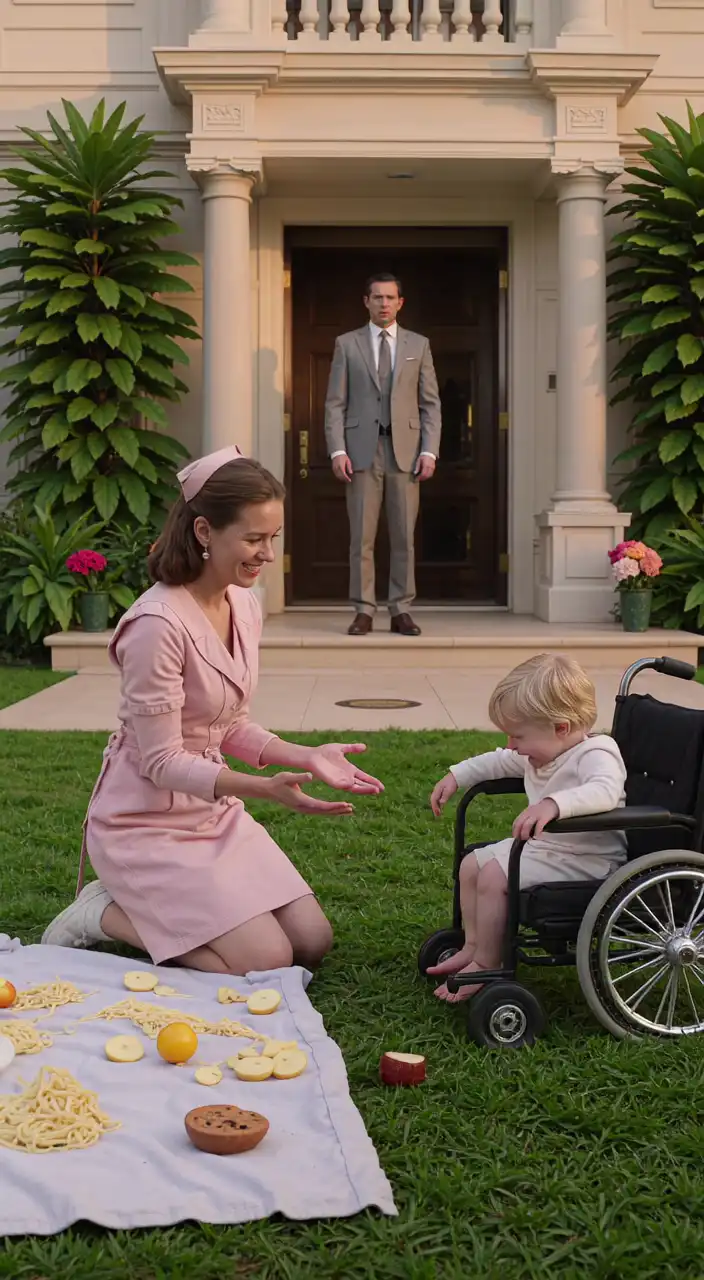
Tessa spread a blanket under the shade of a dogwood tree and parked Luca’s wheelchair beside it.
“Secret lunch,” she whispered. “Top level. Very exclusive.”
He watched the leaves move in the breeze.
She fed him in their usual rhythm. No pressure. One bite. Pause. Whisper. Another bite. At one point she bent close and said, “I have a terrible secret.”
His eyes fixed on her lips.
“I think your father loves you so much it makes him stupid.”
A sound escaped him. Softer than a laugh, but warmer than before.
She grinned. “Exactly.”
Then she made a mistake. Or maybe it was the thing that had to happen.
Her phone buzzed in her pocket. It was a text from Rowan: We need to talk this evening.
Tessa looked at the screen too long.
When she glanced up again, Luca was watching her with sudden tension, his body gone rigid.
“It’s okay,” she said quickly. “Just a phone.”
His breathing changed.
“No, sweetheart, I’m still here.”
She set the phone facedown. But the moment had shifted. He looked at the diaper bag by the blanket. Then at her canvas tote. Then at the path leading back to the house.
Tessa felt a quiet chill.
“Luca?”
His fingers gripped the side of his wheelchair.
“I’m not leaving right now.”
His breath hitched.
Inside the house, Denise was directing florists in the foyer for a charity dinner Rowan had forgotten to cancel. Staff moved in and out of the back hall. Voices floated through the open terrace doors. The atmosphere of transition, of preparation, of movement, seemed to gather around the child all at once.
Tessa knelt in front of him. “Hey. Eyes on me.”
His gaze darted past her.
“Luca, listen. I’m here.”
His lower lip trembled.
This was different from a night terror, different from his ordinary fear. This was focused. Immediate. Almost knowing.
She understood with a throb of sadness.
He thought she was going too.
“Sweetheart,” she whispered, “I know people leave. I know.”
The first cry was tiny.
Then another.
His hands opened and closed in panic. He pushed at the wheelchair tray. Tessa removed it quickly and dropped it aside.
“No, no, no pressure. I’m right here.”
He made a sound then—a raw, broken whimper that came from someplace deeper than tears.
“Tessa?” Rowan’s voice called from the terrace.
He had come home early after all.
He stepped onto the lawn just as Luca’s panic climbed. Tessa looked up sharply and held one hand out to stop him. “Don’t rush.”
Rowan froze at the edge of the blanket.
“What happened?”
“He thinks I’m leaving.”
Rowan stared. “How can you know that?”
“Because look at him.”
Luca’s eyes were fixed not on the food or the blanket or the trees, but on Tessa’s bag near the stone path. His whole body leaned toward her with a desperate tension Rowan had never seen.
Tessa moved close, lowering herself until she was at eye level. “I’m here,” she whispered. “I’m here, Luca. I’m right here.”
He cried harder.
His hands pushed against the armrests.
Then, all at once, he did something no one expected.
He tried to get out.
The movement was clumsy, desperate, unplanned. He shoved one hand against the side of the wheelchair, the other toward Tessa’s shoulder. His legs trembled beneath him as if they belonged to someone else. Tessa’s eyes widened.
“Rowan,” she breathed, “don’t scare him.”
“I’m not moving.”
Luca pushed again, crying now in hard little gasps. The chair shifted. Tessa dropped both hands near him but did not grab, giving him space and support at once.
“That’s it,” she whispered, voice shaking. “That’s it, baby. I’ve got you.”
He planted one foot on the blanket.
Then the other.
For one suspended second he stood.
Wobbling. Terrified. Beautiful.
A two-year-old boy who had hidden inside fear and wheels and silence stood upright in the middle of the garden because he believed the person he trusted was about to disappear.
Rowan made a sound like he had been struck.
Luca lunged.
He did not walk, not exactly, but he moved forward in a falling, reaching motion, one small leg dragging and then catching, both arms out.
Tessa caught him against her knees just as he collapsed into her.
And then it happened.
The breakthrough was not loud. It was hoarse, cracked, almost stolen from him.
“Teh…sa.”
Tessa went utterly still.
Rowan shook his head once as if refusing his own ears.
Luca clutched Tessa’s shirt in both fists and buried his wet face against her. “Teh-sa,” he said again, clearer this time, the name torn from fear and need and choice.
Tessa covered her mouth with one hand and cried.
Rowan took a step forward, then another, his disbelief breaking apart with each one. “No,” he whispered. “No, he—”
“He did,” Tessa sobbed.
Luca turned his face, not away from her but enough to look over her shoulder toward Rowan. His cheeks were blotched pink, his lashes wet, his brown eyes huge and trembling.
“Da,” he whispered.
Rowan fell to his knees on the grass.
For a second no one moved. Not the father. Not the cousin. Not the child. Wind moved through the dogwood branches overhead while the open terrace doors behind them framed the stillness of the house.
Then Rowan crawled the last distance because standing felt impossible.
“Luca,” he said, voice breaking. “Buddy. I’m here.”
The little boy reached one hand toward him without letting go of Tessa.
It was not a rejection.
It was an inclusion.
Rowan took that tiny hand so carefully it was like touching light.
“I’m here,” he said again, and now he was crying openly, billionaire, founder, impossible man brought to pieces by two syllables and a hand that finally reached back.
At the terrace doors Denise stood frozen, one hand over her mouth.
Nobody spoke for a long moment.
Then Tessa, through tears, gave a shaky laugh. “Well,” she whispered, pressing her face to Luca’s hair, “that was incredibly dramatic.”
Luca hiccuped against her shoulder.
And for the first time since Claire died, the garden did not feel like a place of memory.
It felt like a place where something new had begun.
Word traveled through the estate before anyone intended it to.
Not as gossip, exactly. More like shock moving through old walls.
The chef heard Denise crying in the laundry room and thought someone had died. The groundskeeper saw Rowan carry Luca inside not in the wheelchair but in his arms while Tessa walked beside them with grass on her knees and tears on her face. The physical therapist arrived for an afternoon session and found the household operating at a reverent hush.
In the nursery, Luca sat on Rowan’s lap wrapped in his blue blanket. His eyes were swollen from crying, but he was calm. Tessa sat on the rug nearby, not crowding him. Every few minutes he looked at her to make sure she was still there.
Every time he did, Rowan noticed.
The physical therapist, a practical woman named Maribel Kent, reviewed the account twice before asking, “He bore weight independently?”
“For a moment,” Tessa said.
“He initiated from emotional urgency,” Rowan added, still sounding stunned by his own words.
Maribel crouched carefully before Luca. “Can I see your feet, sweetheart?”
Luca tensed.
Tessa leaned in. “No tricks. She just wants to say hi to your superhero toes.”
Maribel glanced at her, then wisely played along. “Exactly. I have heard rumors about these toes.”
Luca’s gaze shifted between them.
When Maribel later stood in the hall with Rowan, her usually clinical tone had changed. “This matters,” she said. “Not because it’s a miracle cure. Because now we know motivation exists that’s stronger than avoidance. He moved toward attachment.”
“He said her name,” Rowan said, still dazed.
Maribel nodded. “Then his world is opening.”
Denise overheard from the linen closet and quietly shut the door to hide her tears.
That night Rowan did not go to his study after dinner. He did not take the call from Singapore. He did not open his laptop.
Instead he sat on the nursery floor while Tessa did their now-sacred meal ritual. Luca accepted bites between whispers. At one point Tessa leaned in and murmured something so absurd that Luca made that breathy almost-laugh again. Rowan laughed too, startled by the sound of himself.
Tessa looked over. “There. You do know how.”
“How to what?”
“Be here.”
After Luca finally fell asleep, Rowan found Tessa on the back stairs with two mugs of tea. She had changed into an old gray sweater of Claire’s that Denise must have taken from storage. It hung loose on her frame.
He stopped when he saw it. “I haven’t seen that in over a year.”
Tessa looked down. “Denise gave it to me. She said nights get cold out here.”
He let out a faint breath. “That’s practically an apology.”
“She also told me I load the dishwasher incorrectly.”
“That is definitely an apology.”
For the first time in many months, his smile came without effort.
Then it faded. “I thought I imagined it.”
“What?”
“His voice.”
“You didn’t.”
Rowan sat beside her on the step. “I heard him say your name and my mind rejected it. I have wanted so badly for some sign that I stopped trusting signs.”
Tessa wrapped both hands around her mug. “That’s what grief does. It teaches you not to believe in good things because they feel temporary.”
He looked out at the dark garden where the breakthrough had happened. “I was going to ask you to leave.”
She did not speak.
“I told myself it was because the house needed stability. Because people were talking. Because your methods were unprofessional. But the truth…” He swallowed. “The truth is that Luca needed you in a way he has never needed me, and I was ashamed of how much that hurt.”
Tessa turned to him fully. “He needs you too.”
“He said ‘Da’ like he was testing whether I still existed.”
“He said it because you did.”
He covered his eyes briefly. “I don’t deserve how patient you’ve been with me.”
“No,” she said. “Probably not.”
He laughed then, helpless and cracked open, and she smiled.
After a moment she added, “But deserving isn’t usually how family works.”
The next morning the change in the household was visible.
Denise placed breakfast trays on the low cart without comment and included two spoons “for committee business.” The chef made mini pancakes in the shape of stars. Maribel adjusted Luca’s therapy plan to include supported standing linked to relational cues instead of sterile prompts. Even the estate itself seemed less museum-like. A paper with blue handprints still hung in the sunroom. Nobody took it down.
The greatest change, though, was Rowan.
At lunch he came home from a downtown meeting instead of eating with clients. He loosened his tie, sat on the rug across from Luca and Tessa, and asked, “Is this seat available to board members?”
Tessa raised an eyebrow. “Only if you’re prepared for top-secret spoon negotiations.”
“I’ve handled hostile takeovers.”
“That won’t help.”
Luca looked between them. Then, slowly, he leaned toward Rowan.
It was a tiny lean. Barely a shift of weight.
But Rowan saw it and answered correctly this time. He did not rush forward, did not clap, did not flood the moment with need. He simply held out a cracker and said, “I heard there’s a wise fox running this meeting.”
Tessa hid her surprise behind her mug.
Luca took the cracker from his father’s hand.
Later, in the hallway, Rowan leaned against the wall and let out a shaky breath. “Did you see that?”
Tessa nodded. “I did.”
“He took it.”
“I know.”
Rowan looked at her with tears threatening again, and this time he did not apologize for them. “Thank you.”
She shook her head. “No. He did the brave part.”
That afternoon Denise approached Tessa in the kitchen while Luca napped.
“I was wrong,” Denise said abruptly.
Tessa glanced up from rinsing berries. “About the dishwasher?”
Denise sniffed. “About you.”
Tessa dried her hands. “You love him.”
“Of course I do.”
“And you loved Claire.”
A pause. “Very much.”
Denise’s eyes reddened. “The house was falling apart after she died. Order was the only thing I knew to preserve.”
Tessa’s voice gentled. “I know.”
“I thought you were making things worse.”
“But?”
Denise looked toward the nursery ceiling above them. “But he said your name.”
Tessa smiled through sudden tears. “Yeah.”
Denise straightened. “I would still prefer less paint on antique furniture.”
“That seems fair.”
By evening, the family dynamic had shifted in a way no specialist report could have predicted. Not because Luca had been magically cured, but because everyone now knew something undeniable: beneath the fear, he was choosing connection. He had stood for it. Spoken for it. Reached for it.
And Rowan, finally, was no longer standing outside his son’s world with folded arms and careful despair.
He was kneeling at the door, asking to be let in.
Two days later, Rowan canceled the agency caregiver without ever meeting her.
Then he asked Tessa to walk with him through the gardens at dusk while Luca slept and Denise stood watch with the monitor.
They followed the curved stone path to the dogwood tree where the grass still held the memory of that impossible afternoon.
“I owe you a direct answer,” Rowan said.
Tessa tucked her hands into the pockets of Claire’s sweater. “You do.”
He stopped beneath the tree. “Don’t leave.”
She looked at him quietly.
“I don’t mean for a week,” he said. “Or until I can hire someone better on paper. I mean stay. In the role Luca has already chosen for you. We can call it nanny if that makes the agencies comfortable. We can call it family if we’re being honest.”
Tessa’s eyes filled. “You’re sure?”
“No,” he said, and then gave a small, tired smile. “But I’m sure that certainty has done nothing useful for us so far.”
A soft laugh escaped her.
“He reaches for you,” Rowan continued. “And for the first time, he’s beginning to reach for me too. I won’t let pride interfere with that again.”
Tessa looked toward the mansion windows glowing warm against the evening. “If I stay, I do things my way when it comes to him.”
“I know.”
“Meals on the floor sometimes.”
“Fine.”
“Whispering to vegetables.”
He nodded. “If necessary.”
“Paint in the sunroom.”
He winced. “Washable.”
“Mostly.”
He offered his hand. “Stay, Tessa.”
She took it. “I’ll stay.”
The new emotional order did not arrive all at once, but it came.
Breakfast happened in sunlight instead of silence. Rowan learned how to wait on the rug without crowding. Denise started leaving small cookies “for confidential use only.” Maribel worked with Luca’s standing in playful bursts, always with one trusted person close. Night terrors still came, but less often, and now there were voices Luca knew how to follow back to safety.
Sometimes he whispered nothing at all and only listened.
Sometimes, when Tessa bent close and said, “Secret?” he answered with a breath that almost sounded like yes.
And some evenings, when Rowan came home before dark and sat beside his son under the dogwood tree, Luca would lay one hand on his father’s sleeve as if reminding them both that he was still there, still choosing them, one small brave moment at a time.
The mansion did not become less grand. The fortune did not vanish. The grief did not disappear.
But the house learned how to breathe again.
And in the garden where fear once forced a child to his feet, hope began to teach him how to stand.
Disclaimer: Mention of any brand or trademark is for identification only and does not imply partnership or endorsement