TIDES THAT SPOKE
Beau Mercer crossed the wide marble foyer of his beach house as if he were entering a museum built to preserve a life that no longer existed.
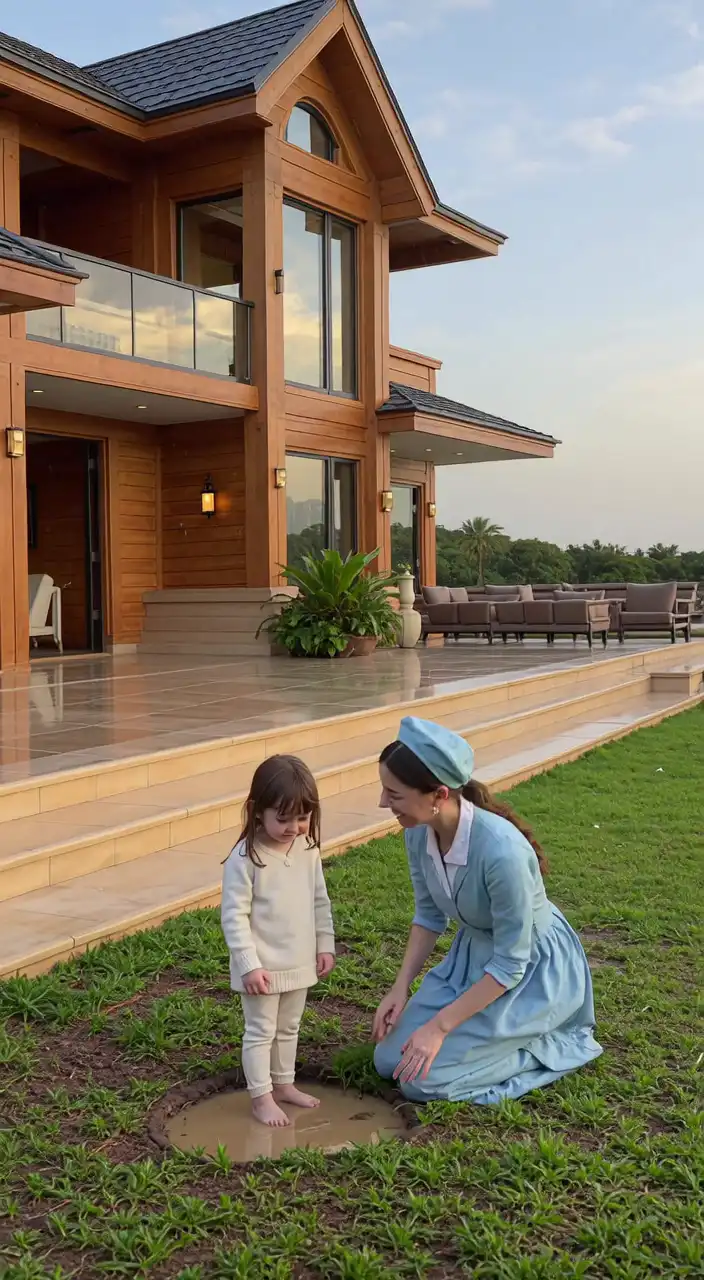
The house stood on a bluff outside Seabrook, Washington, all glass walls and weathered cedar, a masterpiece of coastal luxury that magazines had once called serene. At dusk, the ocean threw silver light through the windows and turned every polished surface into a memory. Beau hated dusk now. It was when the house remembered his wife most vividly.
A pale blue cardigan still hung on the back of a dining chair because no one had dared move it. A half-read novel remained on the table in the sunroom, a bookmark tucked neatly in the middle. In the kitchen, the copper kettle Amelia had insisted on buying sat on the stove, though Beau never used it. He had built towers downtown, bought city blocks, financed resorts from Oregon to Florida, but he could not move a cardigan.
His footsteps echoed down the hallway.
From the living room, his housekeeper, Darlene, rose from the couch too quickly. “Mr. Mercer.”
He loosened his tie. “Where is Wren?”
Darlene glanced toward the nursery wing. “In her room. Ms. Felton tried to get her to come downstairs for dinner.”
“Tried?”
Darlene hesitated. “She sat by the window the whole time. Didn’t touch the food.”
Beau closed his eyes for a second. “All right.”
He walked past framed photographs mounted along the hall. Amelia laughing barefoot on the sand. Amelia pregnant, one hand at the small of her back. Amelia in a hospital bed after Wren was born, exhausted and radiant, her blond hair flattened at the temples, smiling at the tiny bundle in her arms like she had been handed the moon.
She had survived childbirth. She had survived the difficult first year. Then, after what was supposed to be a routine surgery for a lingering complication, everything had gone wrong in one brutal night of alarms and signatures and bloodless hospital language. Beau had come home from that hospital with condolences, legal packets, and a child too young to understand why the world had suddenly gone cold.
He paused at Wren’s door, hand resting on the frame before he pushed it open.
The room was soft green and cream, full of expensive toys chosen by consultants, therapists, and assistants. None of them were where a child had actively left them. Plush animals sat in careful rows, untouched. A tiny wooden kitchen gleamed with no fingerprints. A shelf of books remained square and perfect.
Wren sat in the corner by the window, her knees tucked under her little body, curly brown hair haloed by fading light. At two years old, she was heartbreak in miniature. Her green eyes, Amelia’s exact eyes, stared not out at the sea but at the reflection of the room in the glass. Her small hand moved over the edge of a faded photograph she kept with her more often than any toy: Amelia holding her as a baby.
“Hey, sweetheart.” Beau forced warmth into his voice. “Daddy’s home.”
Nothing.
He crouched near her, careful not to block her line of sight because one therapist had once said changes in visual field could distress her.
“Did you have a good day?” he asked.
Silence.
He reached into his pocket and pulled out a tiny carved whale from a gift shop in Boston. “I got this for you. Look. It’s smooth, see?” He set it gently beside her.
Wren did not look at it. She did not look at him. Her fingers stayed on the photograph.
Behind him, the room hummed with ocean air through the vents and the low white noise machine someone had suggested for regulation. He hated how many someone had suggested things over the last year. Specialists. Early intervention experts. Development consultants. Speech therapists. Occupational therapists. Sleep coaches. Neurologists. Grief counselors, though Wren had never spoken enough to tell them what she felt.
“Wren.” His voice thinned despite himself. “Can you look at Daddy?”
For a second, her lashes flickered. Not toward him. Toward the sound of a gull outside. Then she resumed her stillness.
Beau sat on the rug anyway.
He had closed deals in rooms where governors waited for his answer. He had once bought out a rival company between breakfast and lunch. In his world, every problem had numbers, leverage, and deadlines. Here, in this room, with this tiny girl in a cream sweater and mismatched socks, he was powerless.
He looked around at the untouched toys, then at the photograph in Wren’s hand.
“She would know what to do,” he said quietly, not sure if he was speaking to his daughter or his dead wife.
At dinner, he sat alone at a twelve-seat table while waves hit the rocks below the terrace. Darlene set down grilled salmon and vegetables. Beau barely touched them.
“Ms. Felton is asking if you’d like to speak with her before she leaves,” Darlene said carefully.
He gave a bitter laugh. “Is she quitting too?”
Darlene lowered her eyes. “She says she doesn’t think she’s the right fit.”
“Of course she does.”
After Darlene stepped away, Beau looked toward the far end of the table where Amelia used to sit with one foot tucked beneath her, talking too much, laughing too loudly, making the giant house feel human. They had dreamed of this place together. A summer house that became a full-time home when grief made city life unbearable. A place where their daughter would run barefoot between terrace and sand.
Instead, the house was silent, and Wren did not run. She did not ask for juice, or point to birds, or tug on sleeves. She showed no interest in other children at the private toddler group Beau had paid a fortune to arrange. She turned away from adults, from music classes, from brightly colored sensory rooms. She seemed sealed behind glass, present but unreachable, as if the world had become too distant after losing the one person who had been her center.
Later that night, Beau stood outside Wren’s room again. She was asleep now, one hand still resting on the photo of Amelia. Moonlight touched her curls.
A framed family portrait stood on the dresser. Beau walked over and picked it up. He, younger and less hollow, had one arm around Amelia. She was holding Wren as a baby. All three of them looked toward the camera as if a future had been promised.
The first nanny had lasted six weeks. The second, twelve days. The third cried in the kitchen and said she had never felt so useless in her life. Therapists spoke about developmental delay, social disengagement, trauma overlays, and attachment disruption. They gave him charts. He wanted his daughter.
He looked at sleeping Wren and whispered, “I’m trying. God, I’m trying.”
The next morning his assistant emailed three more candidate files. Beau almost deleted them without reading. Almost.
Instead, he stared out at the gray ocean and made himself one more promise he wasn’t sure he could keep.
One more try.
Three days later, Beau was not looking for a nanny when he found one.
He had driven himself to a small public park on the edge of a neighboring coastal town after a disastrous virtual meeting left him unable to think. It was the first time in months he had stopped anywhere without security or schedule. He sat on a bench overlooking a patch of grass bordered by pines, watching children in rain boots zigzag around damp playground equipment under a sky the color of steel.
He noticed her because the children noticed her.
She couldn’t have been more than twenty-three or twenty-four, wearing an oversized yellow sweater, jeans rolled at the ankles, and sneakers splashed with mud. Her dark hair was tied in a loose braid that had half escaped. She was kneeling beside a little boy who had fallen near a puddle. Instead of fussing, she held out both hands like the puddle itself had made an interesting suggestion.
“Well,” she told him seriously, “that was a very dramatic landing.”
The boy sniffled.
“Do you think the puddle feels proud of itself?”
He blinked at her, confused enough to stop crying.
She leaned closer. “Should we show it we’re brave?”
The boy nodded. She stood and jumped into the puddle with both feet. Muddy water splashed her jeans. The boy laughed so hard he hiccuped.
Beau found himself watching longer than he intended.
A woman nearby called, “Nora! Mason says you’re cheating because your puddle was bigger.”
The young woman turned, grinning. “Life isn’t fair, Mason. Use this information wisely.”
The children swarmed her with the easy devotion children reserve for people who truly see them.
Beau waited until the woman she’d been helping—a tired-looking mother with twin toddlers—came over to thank her. He heard enough to understand that Nora wasn’t their nanny. She worked part-time at a community preschool and sometimes helped families in the neighborhood.
He would have walked away if she had been polished. If she had carried a portfolio, or approached him with professional brightness, or looked impressed when his driverless luxury SUV pulled into sight. Instead she looked at him the way she might look at anybody interrupting a park afternoon.
“Can I help you?” she asked.
Beau was absurdly aware of how strange this was. “Maybe. My name is Beau Mercer.”
Her expression didn’t change. “Okay.”
He almost smiled. Most people in the Pacific Northwest development world knew exactly who he was.
“I have a daughter,” he said. “She’s two. I’m looking for someone to care for her.”
Nora’s eyes sharpened, not with interest in him but in the child. “What kind of care?”
“She has developmental delays. She doesn’t engage much. With anyone.”
Nora tucked a loose strand of hair behind her ear. “Does she like being around people who ask things of her?”
“No.”
“Does she get left alone a lot because adults don’t know what else to do?”
The directness irritated him because it landed too close. “She has a full staff.”
“That wasn’t what I asked.”
Beau let out a slow breath. “Yes.”
Nora nodded once. “What’s her name?”
“Wren.”
“That’s pretty.”
He should have asked for a résumé first. A background packet. Training history. Recommendations. Instead he heard himself say, “Would you come meet her?”
The mothers at the park stared openly now. One of the toddlers was trying to put a pine cone in his mouth.
Nora folded her arms. “Do you often hire people on playground observation?”
“I don’t often do anything on playground observation.”
That finally made her laugh. “I can tell.”
They arranged for her to come that afternoon.
When Nora arrived at the beach house, she stood on the front terrace for an extra beat, taking in the cedar siding, the private path to the shore, the sweep of ocean beneath the cliffs. Beau expected surprise. Maybe admiration. She just said, “It’s beautiful. It must be loud when the storms come in.”
“It is.”
Darlene brought her inside. In the living room, Beau gestured toward the seating area. “Would you like coffee?”
“No, thank you.”
“You understand this is a serious position.”
“I figured that out when you offered me a job beside a sandbox.”
Beau sat across from her. “I haven’t offered anything yet.”
“Right.” Her expression remained calm. “Then ask what you need to ask.”
“Do you have formal nanny experience?”
“Some. More childcare than nannying. Preschool. Family support. A lot of babysitting since I was fourteen.”
“Young.”
“Yes.”
“Any specific training in developmental delay?”
“A few workshops. No advanced letters after my name, if that’s what you’re asking.”
He leaned back. “Then why should I trust you with my daughter?”
Nora looked toward the hallway leading to the nursery wing. “You shouldn’t. Not yet. You should let me meet her and decide if I’m someone who notices her, or someone who tries to fix her fast so I can feel useful.”
Something in that answer made him quiet.
He led her to Wren’s room. Wren sat on the rug near the bookshelf, turning a wooden ring over and over in her hands. She did not glance up when they entered.
“This is Wren,” Beau said softly. “Wren, this is Nora.”
No response.
Nora did not say hello in the bright singsong voice Beau had come to dread. She did not crouch too close. She did not present a toy like bait.
Instead, she stepped inside, took in the room, and sat on the floor six feet away.
Beau frowned. “That’s it?”
She looked up at him. “For now.”
Wren kept turning the ring.
Nora folded one leg beneath her and rested her hands loosely in her lap. “Hi, Wren,” she said in a normal voice, looking not directly at her but near her, as though joining the room rather than intruding on it. “I’m Nora. Your rug is very soft. I like the green.”
Beau stood by the door, impatient. Thirty seconds passed. Then a minute. Then three.
Nora glanced at the window. “I saw three crows outside when I came up the path. One of them was yelling at everybody. Maybe he had a lot on his schedule.”
Nothing.
Nora nodded as if this information had been adequately received. “You don’t have to answer me. I’m just here.”
Another minute slipped by.
Beau checked his watch, embarrassed by the absurdity of it. This was not strategy. It was sitting.
Then Wren’s hand stopped.
It was brief, barely a beat, but Beau saw it. Her fingers stilled on the wooden ring. Her face remained turned away, yet her body had gone alert, as if some small sensor deep inside her had registered a different kind of presence.
Nora did not move toward her. “I brought mud on my shoes,” she said conversationally. “Not into your room, though. Don’t worry. I think mud is nice outside and rude inside.”
Wren’s eyes shifted.
Not to Beau.
To Nora’s shoes.
It was only a glance, but it was a true one.
Beau straightened, hardly trusting himself. “She looks at people sometimes.”
Nora kept her gaze easy, her tone even. “I’m sure she does. She’s deciding what matters.”
A few seconds later, Wren resumed turning the ring. The moment was over.
Yet Nora smiled like someone who had heard the first faint crack in winter ice. “Nice to meet you, Wren.”
When they stepped back into the hallway, Beau said, “That could have meant nothing.”
“Maybe,” Nora said. “Or maybe she noticed that I didn’t demand anything from her.”
“You think sitting on the floor is a plan
Disclaimer: Mention of any brand or trademark is for identification only and does not imply partnership or endorsement