
THE SOUND SHE CAME BACK FOR
The resignation letter was printed on heavy cream paper, folded once, and placed with maddening neatness in the exact center of Beckett Wren’s desk.
He stared at it from across his office as if it were a legal threat instead of a single page written by a frightened woman who had lasted eight days in his house.
Outside the floor-to-ceiling windows, late afternoon light stretched over the grounds of Wren Hollow, the historic manor his grandfather had restored outside Ashmore, Virginia. The estate had once been described in magazines as timeless, elegant, and quietly majestic. Tonight it looked like what it had become in Beckett’s mind over the last three years: too large, too polished, and full of rooms where no one laughed anymore.
He loosened his tie with one hand and picked up the letter with the other.
Mr. Wren, I am sorry, but I cannot continue in this position. I do not believe I have the skills to care for your daughter properly. She does not respond to me, and I worry I am making things worse. I wish your family the best.
No accusation. No drama. Just surrender.
Beckett let the paper fall back onto the desk. On the wall behind him hung framed covers from financial magazines with his face on them. Youngest logistics billionaire in the region. Visionary CEO. Master negotiator. The man who had built Wren Continental into a company worth more than some countries’ annual budgets.
Yet he could not keep a nanny.
A soft knock came at the office door.
“Come in.”
Marlene, the house manager, stepped inside with the caution of someone entering a room where grief had become furniture. “Mr. Wren, dinner is ready.”
“I’m not hungry.”
She nodded. “Your daughter is in the blue sitting room.”
That was not unusual. Juniper had no favorite room in the ordinary sense, but she drifted toward places with filtered light and patterned carpets. She liked shadows more than toys. Silence more than voices.
Beckett stood, took the letter, then changed his mind and left it on the desk. “Did she eat?”
“Some applesauce. A cracker.”
“That’s all?”
Marlene hesitated. “Yes, sir.”
He walked through the hallways of the manor with the steady stride he used in boardrooms, but the house undid him every time. Portraits of long-dead relatives watched from paneled walls. A grandfather clock breathed out the seconds. The scent of lemon polish and old wood lived in the air. Everything had been preserved beautifully. Nothing had been saved.
The blue sitting room was dim except for the long gold streaks of evening sun. Juniper sat on the rug near the bay window, her tiny knees tucked under her. She was three years old, all soft curls and green eyes and delicate wrists, so beautiful that strangers often smiled before they realized she would not smile back.
Three porcelain dolls sat in a row beside her. She wasn’t playing with them. She was watching the curtains move in the air from the vent.
“Junie.”
No response.
Beckett crouched, the knees of his tailored slacks pulling tight. “Hey, sweetheart.”
Her gaze stayed on the curtain.
He reached into his pocket and took out his phone, not for the screen, but because the case held one of the few photos he still couldn’t bear to change: Sela in a hospital gown, exhausted and radiant, holding newborn Juniper against her chest. Sela had been alive in that picture for twelve more hours. Then complications had turned into hemorrhaging, and the room that was supposed to welcome a family had become a place where one life arrived and another was taken.
“Mom would have loved this hair,” he murmured, though the words were more for himself than for the child. “You know that? She had curls too.”
Juniper’s lashes flickered once. Then nothing.
He set the phone down and lifted one of the dolls. “Should she sit here? Or here?”
He moved the doll to the windowsill. “Too high?”
No answer.
He brought the doll down and made it walk along the rug. “Miss Eleanor is looking for tea.”
Silence.
“Junie.” His voice tightened despite himself. “Can you look at me, baby?”
She tipped her head, not toward him, but toward the far corner where a beam of light struck the floorboards. Her fingers rubbed the hem of her dress in repetitive little motions.
Beckett sat back on his heels.
He had learned not to raise his voice. He had learned not to say, Why won’t you answer me? He had learned not to cry in front of her when she passed through his arms like someone moving through fog.
Still, there were moments when helplessness came so hard it felt physical, like a fist in the center of his chest.
At dinner the long table was set for one. He ate alone beneath a chandelier while silver reflected candlelight and family photographs watched from the sideboard. One showed Sela laughing on the terrace, one hand on her pregnant belly. Another showed Beckett in a rumpled sweater, holding infant Juniper while looking terrified and proud and stunned by love.
He pushed his plate away untouched.
Later, after his calls with Singapore and Los Angeles, after signing three contracts and rejecting two acquisitions, after proving again to the world that he was a man capable of making impossible things happen, he went upstairs to the nursery suite Sela had designed.
Juniper was awake in her crib-bed, sitting in the dark with a stuffed rabbit in her lap.
He lowered himself beside the mattress. “Can’t sleep?”
Her green eyes moved to the rabbit’s ear.
He reached out slowly and stroked her curls once. She didn’t lean in. She didn’t pull away. She simply existed somewhere he could not reach.
The developmental specialists had called it a global delay with profound social disengagement. She had little interest in adults or other children. She rarely imitated. Rarely initiated. Rarely spoke. In truth, she had never really spoken at all. A sound here and there. A breath shaped almost like a word. But never a clear one. Never one directed at him.
At three years old, she lived in a private world that grief, genetics, and early loss seemed to have sealed shut.
“I’m trying,” he whispered.
Her expression didn’t change.
The first nanny had quit after two months. The second lasted eleven days. Then came therapists with binders, consultants with graphs, specialists with polished confidence and expensive plans. Some said more structure. Some said less. Some said intensive programming. Some said time. All of them left, and Juniper remained where she was: beautiful, silent, elsewhere.
Beckett kissed two fingers and touched them to her forehead because he was no longer sure what comfort looked like.
When he stood to leave, his eyes caught on the rocking chair in the corner. Sela used to sit there in the evenings while he answered emails, reading aloud from children’s books to the baby Juniper had been. He could still hear her voice if he stood still long enough.
He turned off the lamp and paused at the door.
Tomorrow he was supposed to meet yet another child development specialist from Richmond, a woman strongly recommended by the pediatric neurologist. Another expert. Another system. Another attempt.
And if that failed?
For the first time, Beckett let himself think the thought all the way through.
If that failed, maybe he was the one making things worse by trying.
He closed the door softly behind him and returned to his office, where the resignation letter still waited in the center of his desk like an answer he had not wanted.
The next morning began with spreadsheets, investor calls, and a breakfast he forgot to touch. By eleven, Beckett had canceled two meetings and moved the specialist consultation to the afternoon. He was standing in the entrance hall reviewing an email when the front doors opened before the butler could reach them.
“Don’t start with me, Edwin,” a woman’s voice called. “I know what the rules are, and I’m ignoring them.”
Beckett looked up.
His younger sister, Tamsin, swept into the manor carrying a large canvas tote and the kind of certainty that had irritated him since childhood. Behind her stood a young woman in a simple cream sweater, dark jeans, and sensible shoes. She was not dressed like the polished candidates agencies usually sent. Her chestnut hair was pulled into a loose braid, and her face was open, calm, and younger than he expected.
“Tamsin,” Beckett said. “What are you doing here?”
“Saving you from yourself.”
“Tamsin.”
She pointed at the woman beside her. “This is Elodie Pierce. She worked at the early childhood center where my friend’s son goes. She has training in child development, she’s worked with children with delays, and most importantly, she’s not afraid of silence.”
Elodie gave a small nod. “Mr. Wren.”
Beckett stared at his sister. “I already have a specialist coming.”
“Exactly,” Tamsin said. “Another specialist. Another chart. Another person who will talk about your daughter like she’s a project. You need someone who can actually be with her.”
“That is not how hiring works.”
“No,” Tamsin said. “But desperation does.”
He almost told her to leave. Then he noticed that Elodie had not rushed to defend herself, impress him, or list credentials. She simply stood there, hands folded around the strap of her tote, as if she had no need to force the moment.
“How old are you?” he asked.
“Twenty-three.”
“You know this isn’t ordinary childcare.”
“I know,” she said.
“What exactly did my sister tell you?”
“The truth,” Elodie replied. “Your daughter is three. Her mother died from childbirth complications. She has developmental delays and little social interest. She’s had several caregivers. Most people have tried to get responses out of her. You’re tired.”
Tamsin muttered, “See? Competent.”
Beckett ignored her. “And what makes you think you can do better?”
Elodie met his eyes without challenge. “I don’t think in those terms. I think children feel when everyone around them is measuring them. I don’t want to perform at her. I want to meet her.”
He folded his arms. “That sounds vague.”
“It probably does.”
“You don’t seem concerned.”
“I am concerned,” she said quietly. “Just not intimidated.”
That answer made him pause.
Tamsin, sensing movement in the wall, softened. “Beck, please. Just let her say hello to Juniper. If it goes nowhere, I’ll leave and never interfere in your staff decisions again.”
“That promise means nothing.”
“True. But let her try.”
After a long moment, he nodded once. “Ten minutes.”
The nursery suite was bright with late-morning light. Juniper sat by a shelf of untouched toys, lining up wooden blocks according to color. A nanny camera blinked from the corner. Marlene hovered near the doorway, prepared for the usual cycle: greeting, no response, rising adult discomfort, defeat.
Elodie stopped several feet away and took in the room. She did not speak immediately. She set her tote down, removed her shoes, and sat cross-legged on the carpet without asking Juniper to look at her.
Marlene looked startled.
Beckett stayed in the doorway with his arms folded. Tamsin stood beside him, unusually silent.
For nearly a minute, nothing happened.
Then Elodie said, in a voice no louder than the room itself, “Hi, Juniper. My name is Elodie.”
Juniper slid a yellow block beside a blue one. Her eyes did not lift.
Elodie nodded as though an introduction had been properly received. “I like this patch of sun. Good choice.”
Still nothing.
Most applicants filled silence with effort. They coaxed, praised, waved toys, made sing-song sounds, or looked nervously toward Beckett for rescue. Elodie did none of that. She simply sat there, hands resting on her knees, breathing evenly.
After another quiet stretch, she looked at the row of blocks. “You put the green one there.” A pause. “I won’t move it.”
Juniper’s fingers stopped for one second.
It was so small Beckett almost missed it.
Elodie did not smile too quickly. “I know people move things. I can leave them.”
Juniper placed another block down. Then she turned her head the slightest fraction toward the voice.
Not fully. Not even close. But enough.
Tamsin’s breath caught beside him.
Elodie reached into her tote and pulled out nothing flashy—just a wooden spoon. Then another. She laid them beside her without explanation. From the bag came a small metal measuring cup. Then a silicone spatula. Kitchen tools, clean and ordinary.
Beckett frowned. “What is that?”
Elodie answered without looking away from Juniper. “Options.”
Juniper looked.
It happened quickly, like a bird deciding whether a hand was safe enough to land on. Her green eyes shifted from the blocks to the metal cup. She stared at it, then at Elodie’s hand, then at the spoon.
No smile. No sound. But attention.
Elodie touched the spoon lightly against the measuring cup.
Ting.
She waited.
Again.
Ting.
Juniper blinked.
Elodie set the spoon down and said, “You don’t have to do anything.”
The child looked back at the spoon.
No one in the room moved.
Finally Juniper reached, not toward Elodie, but toward the measuring cup. Her fingers brushed the metal and lingered there.
Elodie’s voice stayed soft. “Yeah. That one’s cool.”
Beckett felt something dangerous flicker in his chest. Hope had become dangerous a long time ago.
Juniper withdrew her hand, then touched the cup again.
Tamsin whispered, “Did you see that?”
“I saw it,” Beckett said, though his voice sounded rougher than he intended.
Elodie didn’t ask for more. She didn’t say, Good job. She didn’t turn the moment into a test. She simply stayed on the floor as if Juniper’s curiosity was enough.
For ten minutes, that was all.
When Beckett stepped back into the hall, he told himself it meant nothing. A pause was not progress. A glance was not healing. A child looking at a spoon was not a miracle.
Yet when he checked the nursery camera feed from his phone twenty minutes later during a conference call, he saw Elodie still on the carpet, Juniper now sitting three feet closer than before.
And Elodie was smiling like she already knew how to wait for the rest.
By the third day, Elodie had learned the house’s rhythm and ignored most of it.
She ignored the formal schoolroom the previous consultant had prepared with flashcards and visual drills. She ignored the pressure to fill every hour. She ignored Marlene’s careful suggestions that “children in homes like this usually maintain more structure.”
Instead, she followed Juniper.
Not in a careless way. In an attentive way.
If Juniper stood by the east window watching the maple leaves move for fifteen minutes, Elodie stood nearby and watched too. If Juniper carried the same stuffed rabbit from room to room, Elodie made sure the rabbit always had a place to sit. If Juniper lined up silver teaspoons on the kitchen tile, Elodie sat on the floor a few feet away and lined up wooden clothespins without intruding into the pattern.
She rarely told Juniper what to do.
She narrated the world in spare, steady phrases. “The rain is louder today.” “Your sock came off.” “I’m opening the blue cup.” “I’ll be right here.”
At first, Beckett found it maddening. It looked like nothing. No program binder. No target list on a whiteboard. No visible campaign to bring his daughter back.
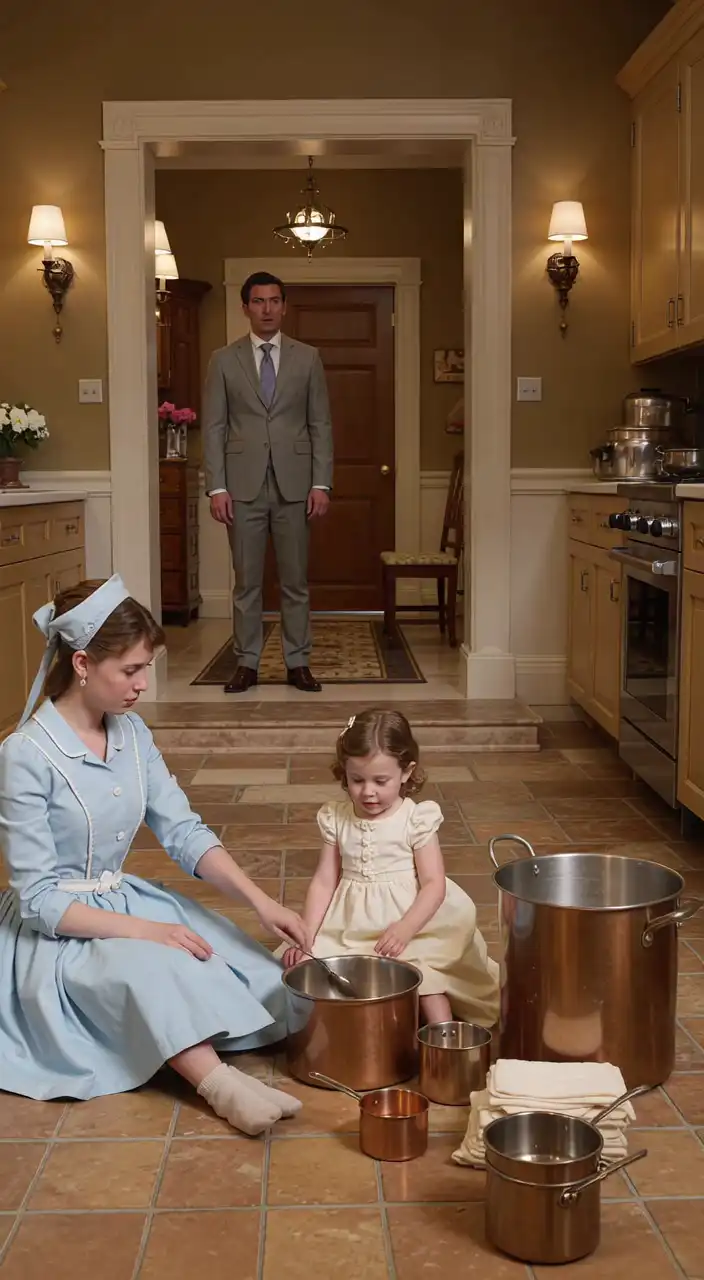
One evening he found Elodie seated on the pantry floor while Juniper sat across from her in the doorway. Between them were two stainless steel bowls, a whisk, a ladle, and a wooden spoon.
“Are you making lunch or a band?” Beckett asked.
Elodie looked up. “Neither. Listening.”
Juniper tapped the spoon against the bowl. Not hard. More of an experiment than a performance.
Dong.
Elodie tapped the whisk against her own bowl.
Shhhh-ding.
Juniper froze, listening.
Then she hit her bowl again.
Dong.
Elodie answered.
Shhhh-ding.
Back and forth they went, not exactly music, but not random either. A conversation without words.
Beckett leaned against the doorframe.
“Why kitchen tools?” he asked quietly.
Elodie spoke in the same low voice she always used around Juniper. “Because they don’t demand pretend play. They make immediate sense. Cause and effect. Sound and waiting. Turn and return.”
Juniper shifted closer to Elodie’s bowl.
“She likes predictability,” Elodie continued. “And she likes that I don’t crowd her. So I’m showing her that being with someone can feel as safe as being alone.”
Beckett looked at his daughter. Her face was serious, intent. But there was a softness at the corners of her mouth he had never seen during therapy sessions.
“She still doesn’t respond to me.”
Elodie glanced at him briefly. “You usually come in braced for heartbreak.”
The directness startled him. “Is that criticism?”
“It’s observation.”
Juniper tapped again. Elodie echoed it. Then Juniper did something new: she paused and looked at Elodie’s face to see whether the answer would come.
It did.
Shhhh-ding.
A small current moved through the room.
The first real change was not speech. It was anticipation.
Juniper began waiting for Elodie in little ways. Standing near the nursery door at nine in the morning. Turning her head toward footsteps in the hallway. Leaving one spoon untouched beside the bowl, as if saving it.
She still showed little interest in anyone else. Marlene remained background. The chef was tolerated. Beckett was accepted only in brief windows before she drifted away again. But with Elodie, there was a pattern now: stillness, notice, return.
A week later, Beckett came home early and found them in the back kitchen, where the old flagstone floor stayed cool even in June. Copper pots hung above the island. Sunlight cut through the room in warm slants.
Juniper sat in the center of a nest Elodie had made from folded dish towels. Around them lay wooden spoons, measuring cups, and two upside-down stockpots.
Elodie held one spoon out. “Your turn if you want it.”
Juniper took it.
She struck the pot once.
Boom.
Her eyes widened a fraction at the depth of the sound.
Elodie smiled. “Big one.”
Juniper hit it again. Then turned, almost involuntarily, toward the doorway where Beckett stood.
He took one careful step inside. “Hey, Junie.”
Her gaze landed on him for one beat. Two.
Then she looked away.
The hope that had risen in him sank just as fast.
Elodie spoke without pity. “Sit down.”
He looked at his trousers. “On the floor?”
“Yes.”
Marlene, passing in the hall, nearly walked into the doorframe at the sight of the billionaire owner of Wren Continental lowering himself onto cold flagstone beside a pot.
Juniper watched the movement. Her body tensed.
Elodie did not introduce him. Did not demand interaction. She simply handed Beckett a spoon and murmured, “Wait.”
So he waited.
Juniper tapped her pot.
Elodie answered on hers.
After a pause, Beckett lightly touched his spoon to the side of the pot beside him.
Tonk.
Juniper flinched.
He immediately set the spoon down. “Sorry.”
Elodie shook her head. “Too fast.”
He exhaled. “Of course it was.”
“You came in like you wanted the moment to become something.”
“I always want it to become something.”
“I know,” she said gently. “But she can feel that.”
Before he could answer, a brisk voice echoed from the hallway.
“Mr. Wren? Dr. Vale has arrived.”
Beckett closed his eyes for half a second. He had forgotten the appointment.
Dr. Corinne Vale entered with a tablet, sharp posture, and the polished urgency of expensive expertise. She took in the kitchen scene—pots on the floor, towels, wooden spoons, a nanny in socks—and did not bother hiding her disapproval.
“I see,” she said.
Elodie rose. “Hello.”
Dr. Vale offered a cool nod. “And you are?”
“Elodie Pierce.”
“The new nanny.” Her eyes returned to Juniper. “Mr. Wren, may we speak privately?”
They moved to the butler’s pantry just off the kitchen, though Juniper could still hear their voices if they rose. Elodie remained in the doorway rather than intruding.
Dr. Vale opened her tablet. “I reviewed the neurologist’s notes. Your daughter requires consistency, structured developmental intervention, and strict behavioral reinforcement. Social withdrawal at her age cannot be approached casually.”
Beckett rubbed a hand over his jaw. “What do you recommend?”
“A daily program. Timed tasks. Eye-contact shaping, prompted imitation, discrete language trials, corrected response patterns. We need measurable outputs.”
Elodie spoke from the doorway. “She shuts down when she’s pushed.”
Dr. Vale turned. “With respect, childcare staff often mistake avoidance for preference.”
“And experts often mistake compliance for connection,” Elodie replied.
A hard silence followed.
Beckett straightened. “Enough.”
But Dr. Vale was already committed. “Mr. Wren, if you want improvement, you cannot allow untrained improvisation to interfere with treatment. Pots and pans are not therapy.”
Elodie’s face remained calm. “No, but safety is. Trust is. A child who doesn’t seek people out won’t suddenly develop because we collect data faster.”
Dr. Vale’s mouth tightened. “I’ve seen this before. Households become emotionally attached to methods that feel compassionate but waste crucial developmental windows.”
The words hit Beckett where he was weakest. Waste. Window. Too late.
He looked back through the doorway. Juniper sat alone now, holding the spoon across her lap. The room had gone still.
Dr. Vale lowered her voice. “You have resources most families can only dream of. Use them. Start the full program. End the informal care model before your daughter loses more time.”
That evening, a printed proposal sat beside Beckett’s laptop: six hours a day of intensive intervention, strict routines, detailed goals, reduced unstructured contact.
Elodie found him in the library after Juniper had fallen asleep.
“You’re considering it,” she said.
He didn’t deny it. “What if you’re wrong?”
She stood across from the desk, hands at her sides. “Then she won’t be the first child I’ve failed to help. But if Dr. Vale is wrong, Juniper learns that every person who comes near her wants something from her.”
Beckett looked at the proposal. “I can’t gamble with my daughter.”
Elodie’s expression changed for the first time—not anger, but hurt. “Neither can I.”
“You’ve known her nine days.”
“And in nine days she’s started waiting for someone.”
He looked up.
Elodie swallowed. “Do you know how big that is for a child like her?”
He did not answer quickly enough.
The next morning the manor staff received a new schedule from Dr. Vale’s office.
Elodie read it in silence.
Juniper, standing beside her with a spoon in one hand, watched Elodie’s face as if she understood something had shifted in the air.
Dr. Vale’s program began on Monday.
The nursery suite was transformed within hours. Play areas were reorganized into stations. Visual prompts were laminated. Timers appeared. Data sheets clipped to boards. The formal schoolroom was reopened and stocked with matching cards, imitation toys, and reward tokens.
Beckett told himself this was action. This was responsibility. This was what a father did when emotion threatened judgment.
On the first morning, Juniper was brought to the little table by the window. Dr. Vale sat across from her with a bright plastic car.
“Look here,” she said crisply. “Juniper, touch car.”
No response.
“Touch car.”
Juniper’s fingers curled inward.
Elodie stood near the wall because Beckett had insisted she remain for continuity. Her presence was the only thing keeping Juniper from full distress, though even that seemed to fray under the pressure.
“Touch car,” Dr. Vale repeated, guiding the child’s hand.
Juniper’s body went rigid.
“Good,” Dr. Vale said, making a note. “Again.”
By noon, Juniper had stopped eating. By evening, she had retreated so deeply into herself that she would not even sit in the kitchen with the bowls and spoons.
On the second day, she cried without sound—tears sliding down her face while she turned toward the wall.
Beckett found Elodie in the west hall after dinner. “You can’t assume this means the program won’t work.”
“I can assume she’s telling us something.”
“She has delays. She resists novelty.”
“She resists being handled like a problem to solve.”
He lowered his voice. “You think this is easy for me?”
“No,” Elodie said. “I think you’re terrified. And terrified people love systems.”
The words stung because they were true.
“Dr. Vale says we have to stay consistent.”
Elodie looked past him toward the nursery. “If consistency means teaching her that connection feels like pressure, then what exactly are we preserving?”
By the third day, even Dr. Vale admitted Juniper’s engagement had dropped. “Regression is common before improvement,” she said.
But Beckett saw the difference with his own eyes. The child who had begun waiting in doorways was gone. The one who had once tapped a pot to hear Elodie answer now sat motionless, letting spoons slide from her hands.
Then came Friday.
June twenty-first.
The date had lived in Beckett’s body all week without his naming it. The anniversary of Sela’s death.
Three years.
Every year he took flowers to the cemetery in the morning and spent the rest of the day working until exhaustion blunted memory. He had never known what to do with the day inside the house. Juniper had been too young before, too unreachable after.
This year the manor seemed to know. Even the staff moved more quietly. The sky stayed overcast, pressing gray light against the leaded windows.
After breakfast, Dr. Vale arrived with a revised session plan. “We should not disrupt routine for emotional significance she likely does not understand.”
Elodie, standing by the fireplace with Juniper on the rug near her feet, said, “The house understands. He understands. Children feel anniversaries even when they can’t name them.”
Dr. Vale gave a dismissive exhale. “Sentimental projection helps no one.”
Beckett entered before the argument could sharpen. He had come from the cemetery still wearing his black coat. Damp soil clung to the edges of his shoes.
Juniper looked at him and then at the lilies in his hand.
For one second, Beckett saw his wife in that line of sight and nearly had to brace himself against the doorframe.
Dr. Vale approached him with her tablet. “Mr. Wren, given the atmosphere today, I recommend we keep sessions brief but maintain schedule.”
Elodie said nothing. She didn’t need to. Her silence had become its own language in the house.
Beckett looked from one woman to the other, then at his daughter standing small and solemn on the rug.
“No sessions this morning,” he said.
Dr. Vale stiffened. “That would be a mistake.”
“Then it will be my mistake.”
After she left in obvious displeasure, the house exhaled.
Juniper remained on the rug, one hand pressed against the seam of her dress. Elodie crouched several feet away, not touching her, not calling her name.
Beckett stood uselessly with the flowers.
“What do I do?” he asked, and the question was not directed at either of them alone.
Elodie looked up. “Stay.”
That was all.
So he stayed.
They moved to the old music room at the back of the manor, a room Sela had loved because the acoustics made even ordinary sounds seem warm. She used to play records there on Sunday mornings. Since her death, the room had remained mostly closed, piano polished, curtains half drawn, memory preserved like a museum.
Today Elodie opened the windows and let the summer air in.
Juniper stood just inside the doorway, uncertain.
Elodie went to the cabinet where old serving pieces were kept for parties. She took out a copper saucepan, a silver tray, two wooden spoons, and a small lidded tin from the kitchen.
Beckett watched. “What are you doing?”
“Making room for noise,” she said.
She set the saucepan on the rug and touched the spoon to the tin.
Tick.
Then to the tray.
Ting.
Then lightly to the saucepan.
Bloom.
Each sound floated differently in the room.
Juniper’s head lifted.
Elodie did not invite her. She simply made another sequence, slow and clear.
Tick. Ting. Bloom.
Beckett felt his chest tighten. Sela used to tap rhythms on countertops while she cooked. Not songs, exactly. Just little patterns she made without thinking.
Juniper took one step into the room.
Elodie set one spoon down beside the tray and retreated half a pace.
Juniper stared at it.
The gray afternoon deepened around them. Somewhere in the house, a clock chimed noon.
Beckett heard himself whisper, “She used to do that. Sela.”
Elodie looked at him. “Then do it with me.”
He hesitated. “I’ll ruin it.”
“Not if you listen.”
He lowered himself onto the rug opposite Elodie. His expensive coat bunched under him. He did not care.
Elodie tapped the tin.
Tick.
She nodded once at him.
Beckett tapped the tray.
Ting.
Elodie touched the saucepan.
Bloom.
They waited.
Juniper stepped closer. Her bare feet pressed into the Persian rug. Her curls fell across her cheek. She looked from one face to the other, then reached slowly for the abandoned spoon.
Beckett stopped breathing.
Her fingers closed around the handle.
She touched the tray.
A faint trembling ting.
Elodie smiled, but softly, as if smiles had weight and she dared not place too much on the moment. “There you are.”
Juniper looked at the spoon in her hand. Then, with grave concentration, she tapped the tin.
Tick.
Beckett answered on the tray.
Ting.
Elodie answered on the pan.
Bloom.
The pattern circled.
Soon it was no longer imitation. It was participation. Juniper made a sound and waited. Someone answered. She made another. The room held her and returned her to herself.
Beckett felt tears burning at the back of his eyes, but he kept still.
Then thunder cracked somewhere beyond the far fields.
The storm hit fast. A flash lit the windows white, followed by a sharp, close boom that shook the old panes. The silver tray rattled against the floor.
Juniper jerked violently. Her face drained. The spoon fell from her hand.
For months, maybe years, her response to sudden fear had been to fold inward and flee alone—under tables, behind curtains, into corners where no one could reach her without making things worse.
Beckett knew it. Elodie knew it.
The second thunderclap came harder.
Juniper gasped.
And then she ran.
Not away from them.
Toward Elodie.
She crossed the rug in a burst of movement and collided with Elodie’s chest, burying her face against the young woman’s sweater with a desperate sound that was almost a sob. Elodie wrapped both arms around her immediately, one hand covering the back of her curls, her body curved protectively around the tiny trembling frame.
“It’s okay,” Elodie murmured. “I’ve got you. It’s just thunder. I’ve got you.”
Beckett stared, unable to move.
Juniper clung tighter.
That alone would have been enough to undo him. Enough to split the world into before and after.
But then, muffled against Elodie’s shoulder, came a small, cracked voice, rough from disuse and fear and need.
“Eh... lo... dee.”
Silence swallowed the room.
Beckett felt the air leave his lungs.
Elodie went perfectly still. Her eyes flew to his over Juniper’s curls, wide with shock and tears. “Junie,” she whispered. “Did you—?”
Juniper pulled back just enough to look at her face. Her own face was wet and frightened, but awake in a way Beckett had never seen.
“El...odie,” she said again, clearer this time, as if the sound had been trapped for months and finally found the shape of escape.
Beckett broke.
He turned away, covered his mouth with his hand, and bent forward because the force of it was too much. A broken sound escaped him anyway. Three years of dread, guilt, helplessness, and starving love cracked open in one helpless sob.
Elodie held Juniper close and reached one hand toward him without letting go of the child.
“Beckett,” she whispered.
He looked up through tears.
Juniper turned at the sound of his name. Her green eyes found him. Not drifting. Not accidental. Found him.
He crawled across the rug slowly, every instinct in him fighting the urge to reach too fast.
“It’s okay, baby,” he said, voice shaking. “I’m right here.”
Juniper’s hand fisted in Elodie’s sweater, but she did not look away from him.
Another softer roll of thunder sounded.
She flinched, then pressed against Elodie once more.
Beckett stopped a foot away.
“You said her name,” he whispered, astonishment and grief braided together. “You said her name.”
Juniper stared at him. Her lips parted. No sound came.
Elodie stroked her back. “No pressure, sweetheart.”
Beckett nodded quickly, wiping his face. “Right. No pressure. I know.”
They sat like that on the rug, storm light flickering through the windows, the old house listening.
After a while Juniper loosened one hand from Elodie’s sweater and reached blindly outward until her fingers touched the sleeve of Beckett’s coat.
Just touched it.
But she left them there.
For Beckett, that touch felt as miraculous as any word.
Marlene was the first other person to witness the aftermath.
She entered the music room carrying fresh tea no one had asked for, paused on the threshold, and nearly dropped the tray.
Beckett sat on the rug in front of the window, coat discarded, tie loosened, eyes red. Elodie leaned against the sofa with Juniper in her lap. The child, who usually tolerated touch like weather, was asleep with one hand still tangled in Elodie’s sweater and the other resting on Beckett’s wrist.
No one spoke for a moment.
Marlene blinked rapidly. “Is she...?”
“Asleep,” Elodie whispered.
Beckett gave a short, unsteady laugh that turned into another brush with tears. “She ran to Elodie.”
Marlene looked from one face to the other. “Ran?”
“And she said her name,” Beckett said.
The house manager’s mouth opened. Closed. Opened again. “Spoke?”
Beckett nodded once, and the sight of his expression—stripped of control, lit with stunned devotion—seemed to undo Marlene more than the words themselves. She set the tea down blindly on a side table and pressed her hand to her chest.
“Oh, my goodness.”
By evening, Dr. Vale returned at Beckett’s request, clearly expecting a routine update and perhaps an apology for the disrupted schedule. Instead, she found the music room unchanged except for one detail: Juniper was awake and sitting on the rug beside Elodie, tapping a spoon lightly against the silver tray while Beckett answered on the copper pan.
Tick.
Bloom.
Tick.
Bloom.
Not every turn. Not perfect. But chosen.
Dr. Vale stood still. “What am I looking at?”
Beckett rose. His voice was calm now, but there was iron under it. “You’re looking at my daughter seeking connection.”
Dr. Vale’s gaze moved to Elodie. “You’re claiming a breakthrough because of one emotionally charged event?”
“No,” Beckett said before Elodie could answer. “I’m telling you I watched my child do in one minute what she has not done in three years of being evaluated, prompted, corrected, and managed.”
Dr. Vale drew in a measured breath. “Anecdotal responses can be misleading.”
Elodie said quietly, “So can data collected from a terrified child.”
Dr. Vale looked irritated, then uncertain, then simply defensive. “Meaningful progress still requires structure.”
Beckett nodded. “I’m sure it does. But not yours. Not like this.”
The specialist understood then. “You’re terminating services.”
“I am.”
She tightened her tablet case with both hands. “I hope this decision is not emotional.”
For the first time in a long while, Beckett did not mistake emotion for weakness.
“It is absolutely emotional,” he said. “I’m her father.”
After Dr. Vale left, the manor changed in ways that could be felt before they could be named.
The nursery suite was restored. The laminated prompts disappeared. The schoolroom door remained open, but no one forced Juniper into it. The kitchen regained its ordinary clutter, except now one lower cabinet held an unofficial instrument collection: wooden spoons, tins, measuring cups, lids, two small pans, a whisk, and a tray with a dent where Juniper liked to strike it.
Beckett changed too.
He stopped taking his first call before breakfast. He moved meetings. Canceled trips. Handed entire divisions of his company to capable executives he had spent years refusing to trust. The world did not collapse because he left the office at four. It kept turning while he sat on the floor in the music room learning how to wait.
One night, a week after the storm, he found Elodie covering Juniper with a blanket after she had fallen asleep on the nursery rug.
“She said it again today,” Elodie whispered.
Beckett’s heart jumped. “My name?”
Elodie smiled tiredly. “Not yet. Mine. But easier this time. And she made a ‘b’ sound when you came in.”
He leaned against the doorframe and closed his eyes briefly. “I don’t know how to thank you.”
Elodie looked down at the sleeping child. “You don’t owe me gratitude for loving her well.”
The words struck him with almost painful simplicity.
“She loves you,” he said.
Elodie’s expression softened. “She trusts me.”
“Same difference to a three-year-old.”
For a moment the air between them changed, not romantic exactly, but intimate with shared care and sleepless hope. Then Elodie glanced away first.
Two days later, Tamsin arrived with coffee and the triumphant restraint of a woman trying not to say I told you so.
“I’m not saying anything,” she announced.
“You’re saying it with your face,” Beckett replied.
Tamsin crouched beside Juniper in the music room while the child sat near Elodie’s knee. “Hello, Junie bug.”
Juniper did not respond, but she did not retreat either.
Tamsin looked up at her brother. “That’s new.”
He nodded.
Then something unexpected happened.
Elodie’s phone rang in the hall. She excused herself to take it, likely some routine matter. Juniper watched her leave. At first she simply stared at the doorway.
Then a housemaid accidentally dropped a stack of folded linens in the corridor. The sudden sound made Juniper startle.
Her eyes flashed to the empty doorway.
“Elodie!” Beckett called, but before the young woman could return, Juniper was already on her feet.
Not hiding.
Not freezing.
She ran into the hall after her.
“Elodie!” she cried in that same rough little voice, urgent and terrified of losing the person she trusted.
Every person in earshot stopped.
Elodie turned instantly and dropped to her knees. Juniper reached her, flung herself forward, and wrapped both arms around her neck.
“I’m here,” Elodie said, holding her tight. “I’m right here.”
Beckett stood a few feet away with one hand braced on the wall. He had thought he had used up his tears in the storm-lit music room. He had been wrong.
This time he did not turn away. He let everyone see him break down at the sight of his daughter fighting to keep her bond.
Marlene quietly wiped her eyes.
Tamsin covered her mouth.
Even Edwin, the grave butler, looked suspiciously stricken.
Juniper pulled back enough to pat Elodie’s cheeks with both hands, as if checking that she was truly there. Then she rested her forehead against hers.
The whole house seemed to understand that nothing would ever be the same again.
A week later, Elodie packed a small overnight bag.
It was not dramatic. She wasn’t leaving for good. Her mother in Danbury, Connecticut, had undergone a minor surgery, and Elodie needed to spend two days at home. She explained it gently at breakfast while Juniper sat in her high-backed chair, turning a spoon over in her fingers.
“I’ll come back on Sunday,” Elodie said. “Two sleeps.”
Beckett watched Juniper carefully. The child’s face gave little away at first, but her hand closed around the spoon so tightly her knuckles paled.
“We can make a calendar,” Beckett offered.
Elodie nodded. “And I’ll call.”
Juniper looked at her. Then at the little overnight bag by the door.
When Elodie stood to leave that afternoon, Juniper followed her into the entrance hall. The old marble floor reflected the light from the open doors. A car waited outside.
Elodie knelt. “I’m coming back, okay?”
Juniper’s mouth trembled.
Beckett held his breath.
The child lunged forward, arms around Elodie’s neck with surprising force. Then she pulled back just enough to say, in a voice cracked by effort but bright with meaning, “Stay.”
The word hit every person in the hall like a bell.
Elodie’s eyes filled at once. “Oh, sweetheart.”
Juniper pressed both palms to Elodie’s cheeks. “Stay.”
Beckett sank slowly to one knee beside them. “She means it,” he said, his own voice thick.
Elodie laughed through tears. “I know.”
She kissed Juniper’s curls and whispered, “I have to go for two sleeps. Then I’ll come back to you.”
Juniper considered this with fierce concentration, then touched two tiny fingers to Elodie’s hand as if making a contract.
The household after that was no longer a museum of loss.
It was still a historic manor with polished banisters, long corridors, and too many rooms. But now music came from the back kitchen in uneven joyful clangs. Beckett’s laptop stayed closed through dinner. Juniper waited by the window at four o’clock because that was when Elodie usually returned from errands, and Beckett often waited with her.
When Elodie came back on Sunday, Juniper did not hesitate. She ran.
Not from fear this time.
From love.
And Beckett, standing under the old carved archway of Wren Hollow, understood at last that healing had not arrived all at once in a miracle. It had been built in stillness, in listening, in answered sounds, in the courage to remain.
Some evenings he still walked past Sela’s photograph and felt the familiar ache of what had been taken. But now the ache lived beside something gentler. Juniper would sit between him and Elodie on the music room rug, one spoon in each hand, and strike out her small uneven rhythm against the shining world.
Someone always answered.
In the months that followed, Juniper’s words came slowly, then a little faster. Not on command. Not for charts. For people she trusted. Elodie remained in her life not because anyone declared it in some grand speech, but because Juniper had already chosen her with both arms and her first real word.
Beckett learned to be less of a rescuer and more of a father. He sat on floors. He listened before he spoke. He let silence be a bridge instead of a wound.
And in the old manor that had once held only echoes, there was now a new sound rising room by room: a child calling for the people she loved, and being answered every single time.
Disclaimer: Mention of any brand or trademark is for identification only and does not imply partnership or endorsement