THE LITTLE WORD THAT SAVED THE HOUSE
The nanny dropped her apron on the marble kitchen island and burst into tears.
"I am so sorry, Mr. Whitaker, I really am," she said, backing toward the service hallway as if the estate itself might swallow her whole. "I can't do this. She doesn't look at me, she won't eat for me, and when I tried to move her from the window she screamed until she made herself sick. I have children of my own. I've never seen anything like this."
Graham Whitaker stood in the center of his kitchen with his phone still in one hand, a London call blinking unanswered on the screen. Through the wall of glass beyond the breakfast room, the winter fields of his estate in Ashby, Virginia stretched pale and quiet under a low sky. Inside, the heat hummed softly, expensive and efficient, unable to warm the place.
His two-year-old daughter was crying upstairs.
The sound sliced through the house in ragged waves, then stopped all at once. Somehow the silence after was worse.
Graham closed his eyes. "You can leave if you need to."
The young woman nodded too fast, relieved and ashamed at once. "I just... I don't think she knows I'm there. Or maybe she does and hates me."
"She doesn't hate you," he said automatically, though he wasn't sure what his daughter felt anymore. Grief? Fear? Nothing at all? "Mrs. Pritchard will settle your pay."
"Thank you."
When she hurried away, the head housekeeper appeared in the doorway, her lined face carefully neutral.
"Should I call the agency?" she asked.
Graham laughed once, a sharp sound without humor. "What are we at now?"
Mrs. Pritchard hesitated. "If we count the temporary overnight help, seven."
"In three months."
"Yes, sir."
He loosened his tie, suddenly unable to breathe in his own kitchen. He was thirty-eight years old, one of the most aggressive investment bankers on Wall Street, a man financial magazines called brilliant and ruthless with equal admiration. He had negotiated mergers worth billions from a Gulfstream seat and closed deals before dawn from Tokyo to Manhattan. People waited outside conference rooms to shake his hand.
And none of that meant a thing in a house where his little girl sat in a nursery full of untouched toys and refused the world.
"I'll go up," he said.
He took the stairs two at a time, then slowed outside the nursery door. The room beyond looked as carefully designed as a magazine spread: pale yellow walls, white shelves, hand-painted stars on the ceiling, baskets of plush animals, a miniature teepee in the corner. It had been Lydia's dream to make it joyful. Lydia had chosen every detail while laughing over swatches and picture books, pressing Graham's hand to her belly when the baby kicked.
Now the joy had drained out of it.
Evelyn sat on the rug near the window, her tiny back to the room. Black curls rested against the collar of her cream sweater. Her blue eyes were fixed on the bare branches outside. One small hand held the corner of a faded silk scarf.
Lydia's scarf.
"Evy," Graham said gently.
No response.
He lowered himself to the floor, his knees protesting in his tailored slacks. "Hey, sweetheart."
Her shoulders stayed still.
He looked around the room. A tower of wooden blocks stood untouched. Finger paints remained sealed in a cabinet because the occupational therapist had once said structure mattered. Stuffed rabbits and cloth books lined shelves in obedient rows. Everything was ready for a child who never reached for any of it.
Graham swallowed. "I came home early."
That wasn't true. He had come home in the middle of the day because another nanny had quit.
He tried again. "Do you want to go for a walk?"
Nothing.
He reached slowly for the scarf. Evelyn's fingers tightened around it so hard her knuckles whitened.
"Okay," he whispered. "Okay, you keep it."
From the dresser, a silver-framed photograph faced the room. Lydia sat in a field of summer grass, laughing into the camera, holding six-month-old Evelyn on her lap. Both of them had those improbable blue eyes. Graham was behind them, leaning in, his face unguarded in a way it never was anymore.
Lydia had died when Evelyn was thirteen months old. A sudden heart attack. No warning worth the name. One minute she was standing in their Manhattan penthouse kitchen, teasing him for checking email during breakfast. The next minute she was on the floor. The ambulance had come. Doctors had spoken. Machines had existed. Then they had not mattered.
There had been no goodbye.
Sometimes Graham still woke convinced he had heard her voice in the next room.
"Evy." He set his palm on the rug between them, not touching her. "Daddy's here."
She didn't turn. She didn't lean in. She didn't protest. That was almost harder than if she had screamed.
At two years old, Evelyn had the solemn beauty of a painted child and the remoteness of someone far older. Specialists had called it developmental delay. They said she showed no interest in other children or adults, limited engagement, no meaningful speech, low social response. They advised consistency, repetition, measurable goals. They brought laminated charts into rooms where Lydia's absence hung like a torn curtain.
But charts could not explain the way Evelyn stared through people as if she had retreated to a place no one else could enter.
Graham sat there until his phone buzzed again.
He ignored it.
After a while he said, "Your mom would know what to do."
His voice broke on the last word.
That evening, the estate settled into its usual hush. The chef left dinner untouched under silver covers. A fire crackled in the study while Graham stood before the mantel, one hand braced against the stone. Family photographs crowded the shelf above: Lydia at thirty-two in a navy dress, Evelyn as a newborn in her mother's arms, Graham lifting both of them at a beach in Maine. Their happiness looked offensive in retrospect, too bright to trust.
Mrs. Pritchard entered quietly. "Sir?"
"Yes?"
"The agency said they can send someone tomorrow. They sounded... uncertain."
"Meaning?"
"Meaning they don't think she'll last."
Graham stared at Lydia's photograph. "Neither do I."
Mrs. Pritchard, who had been with the family since before Evelyn was born, took a breath. "Mr. Kent called earlier. He said his sister-in-law knows a young woman in Charlottesville. She used to nanny for their twins. He said she's between jobs and has a way with children."
Graham almost dismissed it. One more recommendation. One more hopeful stranger. One more woman stepping carefully into this graveyard of routines and failures.
Instead he said, "How old?"
"Twenty-three, I believe."
Too young, he thought. Too soft. Too hopeful.
"Set it up," he said anyway.
Because what else was left? Therapists came and went. Specialists billed fortunes and offered measured pity. Nannies lasted days, sometimes hours. Graham had begun reading brochures for residential developmental programs in the middle of the night, then hating himself by dawn.
His daughter was still in this house. Still breathing. Still his.
So he would try one more time.
Two days later, the rain came down in a steady silver curtain over the long drive to Briar Glen, the Whitaker estate. Graham had taken the morning off from New York calls and sat in the front parlor with his laptop open and his attention nowhere near the spreadsheet on the screen.
At eleven twenty, a dusty blue sedan rolled past the stone gate.
Mrs. Pritchard glanced through the window. "That must be her."
Graham stood. He had expected someone polished by an agency, someone in a blazer with a careful voice and a folder full of references. The woman who stepped from the sedan wore a thrift-store-looking green coat, rain boots, and her chestnut hair in a loose braid that had half fallen apart. She reached back into the car for a canvas tote, then shut the door with her hip and looked up at the mansion without any visible awe.
That alone made her different.
When she entered the foyer, she smiled first at Mrs. Pritchard, then at the groundsman crossing the hallway with muddy gloves in hand, then finally at Graham.
"Mr. Whitaker? I'm June Mercer. Sorry if I'm a little wet. The driveway is beautiful, but my windshield wipers were fighting for their lives."
Graham blinked.
She had warm brown eyes, a fresh face without calculated glamour, and a voice low and easy, as if she belonged wherever she happened to be. She was beautiful, yes, but not in the brittle, arranged way many people around wealth became. There was a steadiness to her that felt older than twenty-three.
"Thank you for coming," Graham said.
"Your friend Nolan's sister-in-law called me three times," June said. "By the third call, I figured I should probably at least listen."
That nearly made Mrs. Pritchard smile.
They moved into the morning room. Rain tapped at the windows. Graham asked the usual questions out of habit.
"You worked with twins?"
"Three-year-old boys," June said. "Wild, wonderful, sticky all the time."
"Do you have experience with developmental delays?"
"Some. Mostly with children who needed a different pace than the adults around them." She folded her hands in her lap. "I'm not a therapist, Mr. Whitaker."
He appreciated the honesty, though it made him tenser, not less. "Then why are you here?"
June held his gaze. "Because sometimes people hire experts and forget children are still people."
He looked at her for a long moment. Most applicants tried too hard to reassure him. They promised progress, structure, outcomes. This one sounded almost unimpressed by him, which in his world was rare enough to be suspicious.
"You understand the position could be difficult."
"I understand your daughter lost her mother," June said quietly. "And I understand everyone in this house is probably trying so hard to help that she never gets any peace."
Mrs. Pritchard looked down.
Graham's jaw tightened. "You haven't met her yet."
"No, sir. But I know what grief feels like when grown-ups build systems around it."
He leaned back. "And what exactly would you do differently?"
"At first?" June said. "Probably less."
Silence settled.
Then, from upstairs, a soft rhythmic thump sounded through the ceiling. Once. Twice. A pause. Twice again.
June turned her head slightly, listening.
"She does that when she's tired," Mrs. Pritchard said. "Taps her heel against the floor."
June nodded as if she had been given important information. Not tragic information. Not alarming information. Simply important.
Graham closed the laptop. "Come meet her."
Evelyn was in the playroom adjoining the nursery, sitting beside a low shelf with a line of wooden animals arranged from largest to smallest. A housemaid hovered near the door, uncertain whether to stay. Graham dismissed her with a glance.
"Ev," he said. "Someone's here to see you."
His daughter did not look up.
June stood in the doorway for a moment, taking in the room. Then, instead of approaching the child with a bright voice and a toy, she slipped off her coat, set down her tote, and sat cross-legged on the rug six feet away.
No greeting performance. No reaching. No, Can you say hi? No desperate smile.
Just presence.
Graham remained by the door, arms folded.
June studied the row of animals from her spot on the floor. "That horse looks bossy," she said mildly.
Evelyn's fingers paused on a wooden fox.
June waited.
After a minute she added, "I like foxes, though. They seem like they'd know secrets."
Nothing.
Another minute passed. Rain hissed against the windows.
June opened her tote and drew out not a device, chart, or educational toy, but a small notebook and a stubby box of crayons. She picked a gray one and began drawing on her own page, not offering it, not explaining.
Graham watched her make patient, unremarkable lines.
At last Evelyn turned her head an inch.
It was such a tiny motion any other person in the room might have missed it. But after months of searching for changes that never came, Graham saw it. He saw the little girl's eyes move from the fox to the stranger on the rug.
June did not pounce on the moment. She kept drawing.
"What are you making?" Graham asked before he could stop himself.
"A cloud," June said.
"It looks like a potato."
"Some clouds do."
Mrs. Pritchard made an offended noise on behalf of all clouds. June's mouth twitched.
Evelyn looked again.
This time her gaze stayed there three whole seconds.
June set down the crayon and, still looking at her notebook, said softly, "You don't have to talk to me. I'm good at quiet."
The room held still around those words.
Graham had heard therapists coax, instruct, narrate, encourage. He had heard people fill the silence because they could not bear what it suggested. He had never heard anyone offer his daughter permission.
After another minute, Evelyn reached for the wooden fox, lifted it, and set it down closer to June.
Not in June's lap. Not as a gift. Barely a shift at all.
But it was toward her.
June looked at the fox, then at Evelyn. "Thanks," she said. "Now I definitely think he knows secrets."
Evelyn's face did not change. Yet something in her body eased, some held breath or bracing tension Graham hadn't realized he was always seeing.
He told himself not to make too much of it.
Still, when June rose ten minutes later and asked if she could come back tomorrow, Graham heard himself answer, "Yes."
As she collected her coat, she said, "One more thing, Mr. Whitaker."
"What?"
"If I work here, I'd like everyone to stop testing her every five minutes."
He frowned. "Excuse me?"
"No making her wave, point, choose, identify, perform. Not unless it's necessary. She's not a quarterly report."
Mrs. Pritchard looked scandalized.
Graham should have ended the interview right there. Instead he almost laughed, because no one had spoken to him that way in years.
"You've been here forty minutes," he said.
June nodded. "And in forty minutes, I counted six times someone asked her to prove she was in the room."
He stared at her.
Then he said, "Come tomorrow at nine."
June smiled, not triumphant, just sure. "I'll bring better crayons."
When she left, the house felt oddly altered, though nothing visible had changed. Upstairs, Evelyn returned to her place by the shelf. But before she turned fully away, her eyes drifted once toward the door June had used.
A glance. A pause. A beginning so small it could have vanished if no one believed in it.
June did.
And, against his better judgment, Graham found that some buried part of him had started to.
June's first full day began without any miracle.
Evelyn did not run into her arms. She did not smile. She did not speak. At breakfast she sat in her high-backed chair and pushed banana slices into a neat line while the chef waited nearby with three alternative meals no one had asked for.
June slid into the seat beside her and poured herself water.
"Good morning, Evy," she said.
No answer.
June took a bite of toast. "I had a dream there was a sheep in my car. It was a very judgmental sheep."
Nothing.
"Honestly, rude."
Evelyn kept lining up banana slices.
Across the room, Mrs. Pritchard whispered to Graham, "Shouldn't she be trying more direct engagement?"
Graham, coffee in hand and one eye on the clock for his first call, said, "Let's see."
That became June's method. Let's see.
She sat nearby every day. On the nursery rug. On the terrace while Evelyn watched wind move through the grass. On the floor of the sunroom while light shifted across the hardwood. She did not crowd the child or narrate her every motion. She existed in Evelyn's orbit with a strange, restful faith.
If Evelyn stacked napkins, June stacked her own. If Evelyn stared out the window, June stared too.
Once, after fifteen minutes of total quiet in the library alcove, Graham passed the doorway and found June and Evelyn both sitting under the low shelf like two small animals in a den.
"What are you doing?" he asked.
June looked up. "Listening to the clock."
He almost said that was ridiculous. Then he noticed Evelyn's hand resting two inches from June's boot, not touching, but close by choice.
He left without another word.
Patient presence altered the rhythm of the house. June asked the staff not to hover. She moved some toys down from decorative shelves to the rug where they could actually be touched. She opened curtains that had stayed half-drawn for months because dim light was supposedly calming. She carried Evelyn outside onto the back terrace and let her watch chickens peck near the kitchen garden. She took off the child's shoes in the grass one warm afternoon and let her wiggle her toes in clover.
Mrs. Pritchard nearly fainted.
"Those are monogrammed socks," the older woman said.
June looked at the tiny feet in the dirt. "They'll survive."
"But the mud—"
"It's mud, not acid."
The groundskeeper, Alvin, hid a grin behind his hand.
For days, Evelyn remained mostly silent and distant. But subtle changes gathered like small lights. She no longer screamed when June entered the room. She began drifting closer during quiet play. She would sit on one end of the window seat while June sat on the other. She once placed a block in June's palm and took it back again, as if testing whether the exchange itself was safe.
At nap time, instead of resisting everyone, she allowed June to carry her.
"That's new," Mrs. Pritchard murmured.
Graham heard every update and believed none of them fully until he saw one for himself.
He came home from the city on a Friday evening earlier than usual. The house was quieter than normal, but not with its old dead hush. Sound floated from the breakfast room. A spoon tapping a bowl. A low female voice. The faint, wet laugh of summer though it was only late spring.
He stopped in the doorway.
June sat at the table with Evelyn in her lap and two bowls of melting vanilla ice cream between them. Not a plated dessert from the chef. Just simple scoops already collapsing around the edges. June had a streak of cream on her own nose.
"Emergency," she whispered to Evelyn. "Mine is escaping."
She pretended to chase a drip with her spoon and missed on purpose. It slid onto her hand.
"Oh no."
Evelyn watched, solemn and intent.
June leaned closer to the child's bowl. "Yours too. This is a very serious situation."
A drop of ice cream landed on Evelyn's chin.
The little girl blinked.
June did not swipe it away. "There you are," she said softly. "Now you look like a person who knows about dessert."
For one suspended second, Graham saw his daughter do something he had almost forgotten she could do.
Her mouth trembled upward.
Not a full smile. Not even close. But the beginning of one.
His chest clenched.
Then Evelyn lifted her hand and pressed two sticky fingers against June's cheek, leaving a pale smear there as if marking her.
June grinned. "I accept your terms."
Graham stepped back before they noticed him. He stood in the hall with one hand over his mouth like a man who had stumbled onto sacred ground.
But hope, once it entered Briar Glen, did not come alone. It brought fear with it.
The setback arrived three days later.
Mrs. Pritchard had been overseeing a linen delivery in the upstairs hall when a storage box from the city nursery was brought down by mistake. It was one of the many things still being sorted from the family's move out of Manhattan after Lydia's death. The carton split when the delivery man set it down. Tissue paper spilled across the hardwood. So did a framed watercolor, a baby blanket, and a bottle of Lydia's perfume, somehow unbroken.
The scent opened into the air all at once.
June was in the sitting room with Evelyn when it happened. She saw the child's whole body go still before the cry came. It wasn't the frustrated shriek the staff knew. It was a devastated sound, raw and terrified, as if something invisible had reached into her chest.
"Evy," June said, immediately dropping to her knees.
The little girl stumbled backward, eyes huge, hands over her ears. When June tried to come closer, Evelyn screamed harder and bolted down the hall toward her nursery. By the time June reached her, she was curled under the window seat, shaking, the faded silk scarf clutched to her face.
Graham got home to chaos.
Mrs. Pritchard met him at the door, pale. "She's been crying for an hour."
He ran upstairs. June was outside the nursery, seated on the floor by the open door, not entering, not leaving.
"What happened?" he demanded.
June stood. "A box was opened. There was a perfume bottle that belonged to Lydia."
His expression changed, the anger redirected inward. "Where is she?"
"Under the window seat. She won't let me touch her."
Graham moved to go in. June caught his sleeve.
"Slowly."
He jerked free. "She's my daughter."
"And she's terrified."
He stared at her, then strode into the room anyway. "Evelyn. Daddy's here."
The crying intensified.
He crouched by the window seat, heart hammering. "Sweetheart, come out. Please."
She pressed herself farther back into the shadow.
June stayed at the threshold. "Graham."
He looked up sharply. She had never used his first name before.
"Back up," she said quietly.
"She needs me."
"She needs less from you right now, not more."
The words hit like an insult because they were true.
He rose too fast. "You think sitting on the floor and eating ice cream makes you an expert?"
June flushed. "No. I think forcing her when she's drowning is making it worse."
"I hired you to help, and now she's worse than before."
Mrs. Pritchard, hovering behind them, took a small breath.
June's eyes filled, but her voice held. "Grief isn't a straight line. A setback doesn't erase what she's built."
"What she's built?" Graham snapped. "She still doesn't speak. She barely looks at people. And now one smell sends her into collapse."
June looked at him with something like pity, which only enraged him more.
"You want this fixed on your timeline," she said. "That's not love. That's panic."
His face went cold. "You don't get to tell me what love is in my house."
The room went quiet except for Evelyn's broken sobs.
June swallowed. "Then maybe I shouldn't be in it."
She grabbed her tote from the hall chair and walked down the corridor before anyone could stop her.
Graham stood in the nursery doorway, fury draining almost instantly into dread.
Inside the window seat shadow, Evelyn cried until she had no strength left, then went mute again.
And this time, when Graham whispered her name, she would not look at him at all.
The next morning Briar Glen felt as if a storm had passed through indoors.
No one mentioned June. The staff moved carefully. Graham took his calls from the study and said harsher things to junior associates than they deserved. Upstairs, Evelyn did not leave the nursery until nearly noon. When Mrs. Pritchard brought her lunch tray, the child turned her face to the wall.
By afternoon she was back by the window, holding Lydia's scarf and staring into distance with that terrible absence Graham had begun to believe was lifting.
He hated himself for what he had said. He hated June for being right. Most of all, he hated the sickening possibility that one argument had shattered the only bridge his daughter had shown toward another person.
At five, he found himself standing in the breakfast room where the melted ice cream had once made Evelyn almost smile. The chair June used was pushed in neatly. On the windowsill, one forgotten gray crayon lay by itself.
Mrs. Pritchard entered with a pot of tea she knew he would not drink. "Will you call her?"
Graham rubbed both hands over his face. "Why would she answer?"
"Because some young women still have more grace than older men deserve."
He looked at the housekeeper. "You're enjoying this."
"No, sir. But I have known grief to make people proud and stupid at the same time."
He gave a tired huff that might have been a laugh. "I was stupid."
"Yes."
He sat at the table. "Do you know what I keep thinking? That Lydia would be furious with me."
Mrs. Pritchard softened. "Mrs. Whitaker would tell you to apologize properly and stop making everything a battle to win."
That was exactly what Lydia would have said.
Upstairs, a dull thump began: heel against the floor. Twice. Pause. Twice again.
The sound cut through him.
He called June before he could talk himself out of it. It rang long enough that he assumed she would let it go to voicemail. Then she answered.
"Hello?"
He stood when he heard her voice, though there was no reason to. "June."
Silence.
"I was wrong," he said.
Another silence, this one listening.
"I spoke to you like..." He stopped, started over. "Like if I couldn't control the situation, I could at least control the room. That's not your fault. And it isn't helping Evelyn."
June exhaled slowly. He could hear traffic in the background, maybe a sidewalk, maybe a store parking lot.
"How is she?" she asked.
"Withdrawn. Won't eat much. Won't let anyone near her for long."
He heard the pain in her answer. "I figured."
He closed his eyes. "Can you come back?"
June did not reply immediately. "Only if you understand I'm not there to make your daughter perform recovery for everyone."
"I understand."
"And if something triggers her again, no one turns it into proof she's hopeless."
His throat tightened. "I understand that too."
One more pause.
"Then I'll come in the morning," she said.
When June returned, she did not make an entrance. She came through the side door in jeans and a navy sweater, braid over one shoulder, tote in hand. She nodded to Mrs. Pritchard, greeted Alvin by name, and went upstairs without asking permission.
Graham followed only as far as the nursery threshold.
June sat down on the floor where she had on her first day, six feet from the window seat.
"Hi, Evy," she said softly.
Nothing.
June set her tote beside her and leaned back against the wall. "I got in a fight with your dad."
Graham almost protested from the doorway, then thought better of it.
June continued, "He's very tall, so he probably thought that gave him an advantage. It didn't."
No reaction.
"I was mad too. Which is annoying because I prefer being right in a calm voice."
Still nothing.
She stayed there an hour. Then two. At one point she hummed under her breath. At another she drew quietly in her notebook, the same gray crayon moving in loops.
Evelyn did not approach.
But she stayed.
That became the pattern of the next two days. June returned, sat, waited, spoke little. Graham did something far harder than closing a billion-dollar deal: he did not interfere. He watched from hallways, from half-open doors, from the landing above, seeing in June's stillness a courage he had mistaken for passivity.
On the third afternoon, June asked him to help.
He was in the library pretending to work when she appeared at the door. "Do you have ten minutes?"
"For what?"
"To do exactly what I say and not improve it."
His mouth twitched despite himself. "That's an unusual request."
"Can you manage it?"
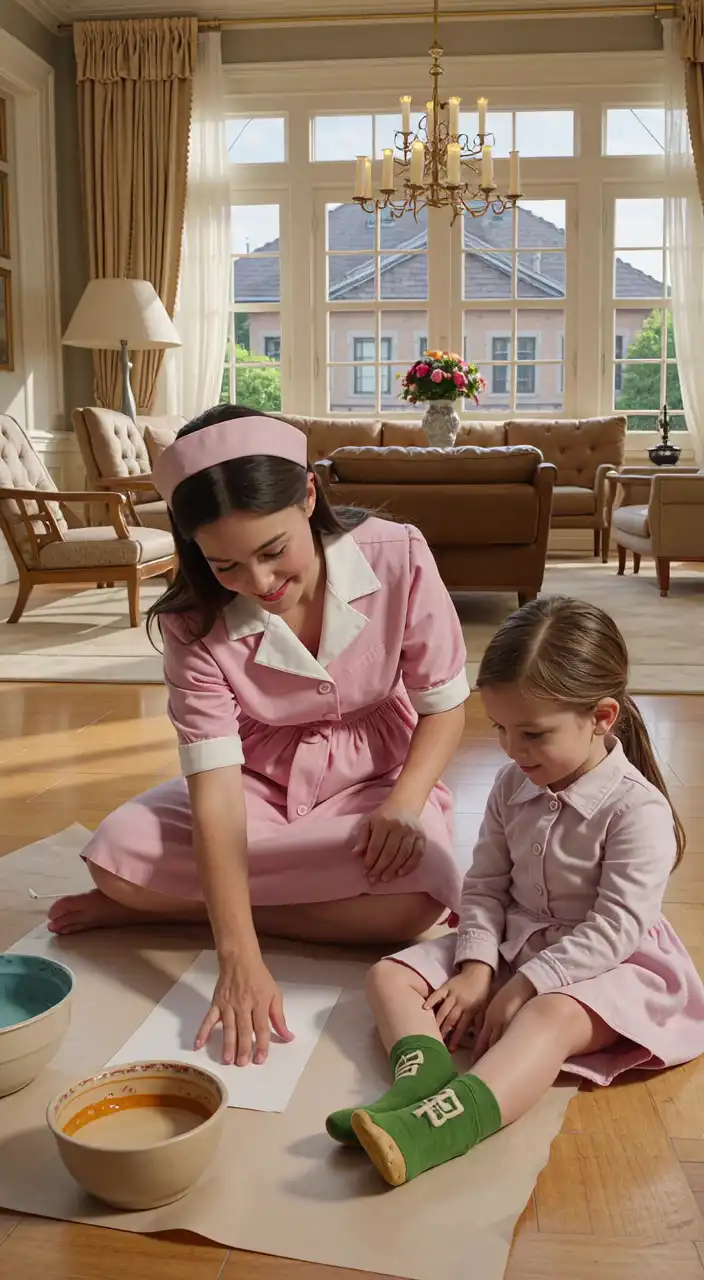
He followed her to the sunroom. Light poured through high windows onto long rugs and potted lemon trees. June had spread butcher paper across a low table. Bowls of washable paint sat nearby in blue, green, yellow, and white.
Graham stopped. "We're painting?"
"We're being available," June corrected.
Evelyn was on the rug near the window, watching.
June spoke in a low voice. "You sit here." She pointed to one side of the paper. "I sit there. No asking her to join us. No telling her what to do. If she comes close, we make space. That's it."
"And if she doesn't?"
"Then she watches two grown-ups make a harmless mess and survive it."
He loosened his cuffs and sat.
June dipped one finger in blue paint and dragged a line across the paper. "River."
Graham stared at the bowl. "I haven't finger-painted since prep school."
"Congratulations. Healing is humiliating."
He almost smiled. Across the room, Evelyn's eyes had shifted toward them.
Graham put one fingertip in green and made an awkward stripe. "Grass."
June nodded solemnly. "Excellent grass. Emotionally complex."
He snorted.
For the first time in days, Evelyn moved from the window.
She came only three steps closer, then sat down. June didn't acknowledge it. She added a yellow circle. "Sun."
Graham made a brown square that looked like a crooked suitcase. "House."
June glanced at it. "That house has tax problems."
A sound came from Evelyn. Not a word. Not quite a laugh. But softer than silence.
Graham's hand froze.
June kept her eyes on the paper as if nothing extraordinary had happened. "Maybe a tree would help."
He painted a tree trunk with all the concentration of a man disarming explosives.
Evelyn crawled another step nearer.
June set down her paint-covered hand and nudged the white bowl an inch toward the center. Then she waited.
The little girl stared at it for a long time. Finally, slowly, she reached out one small finger and touched the paint.
Graham held his breath.
Evelyn drew her finger back, studying the white on her skin. Then she pressed it onto the paper beside June's blue line, leaving one small mark.
June whispered, "There you are."
Graham looked at his daughter, his chest aching with the force of all the things he dared not say.
They painted that way for twenty minutes, if it could be called painting. June made clouds. Graham made another terrible tree. Evelyn added white dots, then blue smears, then one bold green slash across the page that cut through everything else like possibility.
When she shifted too fast and upset the bowl of yellow, paint spread over the paper and onto June's jeans.
Graham started automatically. "Careful—"
June laughed.
Not polite laughter. Genuine, bright, surprised laughter.
"Oh, that's ambitious," she said to the puddle.
Evelyn stared at her.
June touched the yellow paint on her jeans and dabbed it onto her own cheek like war paint. "Now I'm fancy."
For one suspended heartbeat, the room balanced on the edge of something unseen.
Then Evelyn stood, wobbly and determined, toddled the last step between them, and slapped her painty hand against the center of the page.
June grinned. "Yes."
Graham looked from June to Evelyn and understood with sudden, humiliating clarity what his daughter had been waiting for all along: not correction. Not management. Not anxious praise. Safety.
The next morning brought the true turning point.
June found Graham in the hall tying his tie before a video call. "I need one more thing from you today."
He gave her a wary look. "That phrase is becoming expensive."
"It costs less than therapy." She glanced toward the nursery. "Come to lunch. Stay in the doorway unless I ask you in."
"Why?"
"Because I think she's deciding something."
At noon he went.
June had set up lunch in the breakfast room instead of the nursery: grilled cheese cut into small squares, strawberries, and two cups of vanilla ice cream already softening. The weather had turned warm, and windows stood open to the scent of cut grass and distant horses.
Evelyn sat in her high chair, not tense exactly, but watchful.
June sat beside her with her own plate. "This sandwich is almost suspiciously good," she said. "I think the chef is showing off."
From the doorway, Graham saw the faintest flicker in Evelyn's eyes. Recognition. Memory.
June dipped a strawberry in a melting ribbon of ice cream. "That is probably illegal."
She ate it anyway. A drop ran down her wrist.
Evelyn watched, then looked toward the doorway.
At Graham.
His heart knocked hard once.
June followed the glance but didn't turn her head. "Sometimes," she said to no one in particular, "grown-ups say dumb things when they're scared."
Graham let out a breath.
June added, "Sometimes they apologize and mean it."
Evelyn looked between them again. Her small hands tightened on the tray.
Then, very slowly, she lifted one finger and pointed to the empty chair beside June.
June said nothing.
Graham moved only when June gave him the smallest nod.
He crossed the room and sat.
Evelyn stared at the melting ice cream. Then at June. Then at Graham.
Minutes passed. Long, strange, holy minutes in which no one rushed her.
June scooped a little vanilla onto her spoon. "Emergency dessert inspection?"
Evelyn's lips parted.
No sound came.
June waited.
The little girl's brow furrowed as if she were lifting something heavy from far away. She pointed, not at the bowl this time, but at June.
Her mouth worked again.
"Pl... ay."
The word was rough, breathy, almost hidden inside itself.
But it was a word.
Graham didn't move.
June went still as stone.
Evelyn pointed again at June, then slapped her palm lightly on the table, urgent now.
"Play."
Graham's vision blurred. He was suddenly aware of Mrs. Pritchard in the hallway behind him, one hand over her chest, and Alvin farther back with mud still on his boots from the garden, staring openly.
June's voice shook. "Yes, sweetheart. Yes, we can play."
Evelyn turned to Graham as if to include him in the verdict and hit the tray once with her spoon.
"Play."
It was not only a request. It was a bridge.
Between silence and sound. Between June and Graham. Between the broken rules of the old house and whatever came next.
Graham rose too fast, afraid if he stayed seated he might collapse. He took one step back into the doorway, one hand braced against the frame, tears falling before he could stop them.
From that distance, he watched his daughter say the word again while vanilla melted on her chin.
And in the bright ordinary light of the breakfast room, with windows open and paint still drying in the sunroom and the whole house holding its breath, the silence that had ruled Briar Glen finally broke.
For the rest of that day, the story moved through the estate faster than any market rumor Graham had ever managed.
Not because the staff were gossips, though some of them certainly were, but because everyone had lived under the same sorrow for so long that a single word felt like weather changing.
Mrs. Pritchard cried in the pantry while pretending to inventory tea. Alvin told the stable hand, "She said it clear as daylight." The chef produced celebratory shortbread no one had requested. Even the driver, who had only met Evelyn a handful of times, asked in a hushed voice, "Is it true?"
Graham answered the same way every time. "Yes. She said 'play.'"
But the real change was not the word alone. It was what came with it.
At dinner, Evelyn sat in her chair while June ate beside her and Graham sat across from them. When June rolled a pea in a tiny circle on the tray, Evelyn watched and then copied her. When Graham, after glancing at June for courage, rolled one too, Evelyn looked at him, considered, and nudged her pea toward the center as if allowing him into the game.
"Your turn," June said quietly.
Graham rolled his pea back. "I can do that."
June arched a brow. "Let's not get overconfident."
A tiny sound escaped Evelyn again. That not-quite laugh. More air than voice, but full of life.
Later that evening, Graham found June in the sunroom washing dried paint from the bowls.
"I don't know how to thank you," he said.
June kept scrubbing for a moment before answering. "By not turning today into a finish line."
He leaned against the sink. "I know."
"Do you?"
He nodded. "I do now."
She looked at him then, really looked, as if measuring whether the lesson would hold. "She may not say it again tomorrow."
"I know."
"She may say something else six weeks from now instead. Or not. She may move forward and backward and sideways."
He gave a weak smile. "You're telling an investment banker not to demand linear growth."
"I'm telling a father not to confuse progress with pressure."
He accepted that. "When she pointed to the chair..." He stopped, his voice catching unexpectedly. "It felt like she was forgiving me."
June's expression softened. "Maybe she was including you."
That was somehow even harder to bear.
The next week proved June right. Evelyn did not become a chatterbox. She did not transform into an uncomplicated child shaped for someone else's expectations. Some mornings she remained distant. Some afternoons she wanted only the window and Lydia's scarf and quiet. But now the house interpreted her differently.
Not as a failure. Not as a problem to solve before guests noticed.
As Evelyn.
When a speech therapist came for a scheduled review and began with brisk prompts from her flashcards, June gently intervened.
"Can we slow down?" she asked.
The therapist frowned. "Structure is important."
"So is dignity," June replied.
To Graham's own surprise, he backed June immediately. "We're changing the approach."
The woman looked taken aback. "Mr. Whitaker, if you stop targeting language output—"
"I didn't say we were stopping support," he said. "I said we're changing the approach."
He was still rich, still powerful, still used to being obeyed. But for the first time in a long while, he was using that power to protect something tender instead of dominate something uncertain.
That evening, as sunset turned the fields amber, he stood in the hall outside the nursery and watched from a distance.
June sat on the rug with a stack of board books. Evelyn leaned against her knee, one hand tangled in the loose knit of June's sweater. They were looking at pictures of animals. June touched the page.
"Bear," she said.
Evelyn pressed a finger to the page. No word.
June nodded as if the silence itself were meaningful. "Yes. Big bear."
A page later, she pointed to children on a playground. "What are they doing?"
Evelyn stared at the image. Then she turned, pointed not at the book but at June, and said, a little clearer this time, "Play."
June smiled, eyes suddenly shining. "Yes. They're playing."
From the doorway, unseen by them both, Graham pressed his fist to his mouth. He did not interrupt. He did not rush in and demand she repeat it. He simply stood there and let the moment be hers.
And his.
And Lydia's, somehow, in the gentlest way.
The family dynamic changed after that, not in one dramatic sweep but in a hundred small acts. Mrs. Pritchard stopped speaking about Evelyn in lowered tragic tones and began asking, "Would Miss Evy like her blue sweater or the yellow one?" The chef let the child stir pancake batter with June's help, accepting flour on the floor as the price of joy. Alvin built a little bench near the garden so June could sit with Evelyn and watch birds. Graham canceled two weekend trips in a row and startled his own executive assistant by saying, "No, reschedule it. I'm staying home."
At night he still missed Lydia with a pain that could flatten him. But now grief no longer felt like the only language left in the house.
There was another one growing.
Slowly. Imperfectly.
Alive.
By midsummer, Briar Glen no longer felt like a museum to a vanished life.
The silence had changed first. It was no longer heavy and watchful. It held rustling pages, June's soft running commentary, the clink of bowls in the kitchen, Evelyn's heel tapping less often and, sometimes, her breathy little words appearing like shy birds: "More." "Up." "Play."
No one treated each word like a circus trick.
That was the difference.
June stayed, but not as a miracle worker installed to repair the family. She stayed because she had become part of the emotional truth of the house. Graham remained her employer, yes. The estate records reflected salary adjustments, a better car allowance, a proper suite over the east wing. But inside the daily life of Briar Glen, titles mattered less than trust.
One Saturday morning, Graham found June and Evelyn on the terrace sharing a bowl of strawberries and melting vanilla ice cream before lunch because June believed some rules deserved to be weak. Evelyn had white on her cheek and sunlight in her black curls. She looked up when Graham approached and held out her spoon in solemn offering.
"For me?" he asked.
She nodded once.
June smiled. "High honor."
Graham accepted the spoonful. "Thank you, Evy."
The child leaned against his leg for one brief second before settling back beside June.
It was not a grand gesture. It was better. It was real.
In time, the whole household learned the same lesson: Evelyn was not broken waiting to be fixed. She was a little girl with grief, delay, beauty, preferences, fear, humor, and her own slow path into the world. Once they stopped demanding that she prove her worth through performance, she began to show them who she was.
And Graham, who could command markets and bend negotiations, finally learned to kneel on the rug, wait through silence, and count a glance as a gift.
In the early evenings, when the fields turned gold and the long windows reflected the sky, Briar Glen no longer looked like a monument to loss. It looked lived in. Healed, not perfectly, but honestly.
Somewhere inside, June's voice would drift down the hall. Evelyn would answer with a small word or a soft laugh. And Graham, hearing both, would set aside whatever work remained and go where his daughter was.
Because now he knew the house had been saved not by force, not by money, and not by certainty.
But by patience, by apology, and by one little word that opened the door.
Disclaimer: Mention of any brand or trademark is for identification only and does not imply partnership or endorsement