
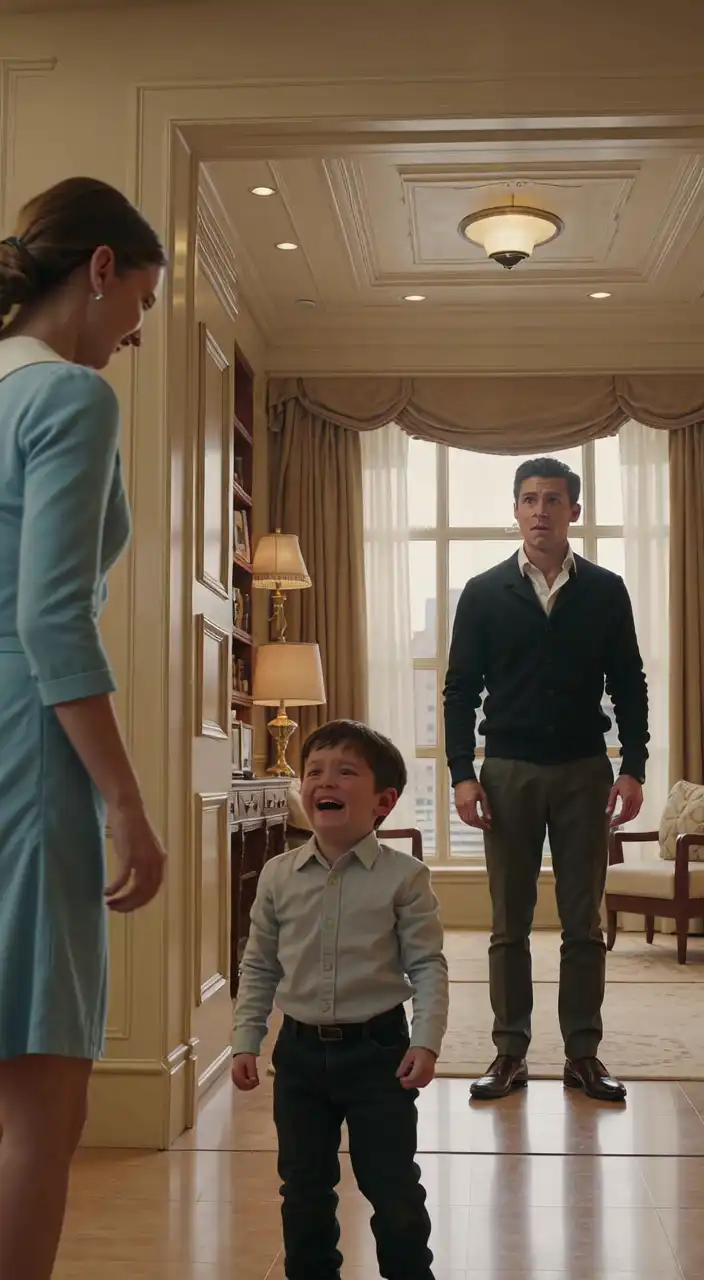
THE MORNING HE STOPPED CRYING
Graham Mercer had built his life on timing.
He knew when to enter a market, when to leave a negotiation hanging, when to lean back and let silence make people nervous. At forty-one, he was the billionaire founder and CEO of Mercer Urban Systems, a company that seemed to have a hand in every shimmering new skyline from Seattle to Miami. Timing had made him rich. Precision had made him feared.
But nothing in the glass-walled conference room on the fifty-second floor mattered when his phone buzzed just as the attorneys slid the final contract toward him.
The room went still.
“Mr. Mercer,” said the lead attorney, adjusting his gray tie, “if you sign here, the Denver acquisition closes before market opens tomorrow.”
Graham looked at the page, but his eyes were dragged toward his phone screen.
HOME.
He almost declined it. He almost let his chief of staff handle whatever domestic emergency had disrupted his day. But something cold moved down his spine.
“Give me a second,” he said.
He stepped away from the polished walnut table and answered. “This is Graham.”
His house manager, Colleen, sounded controlled in the way people did when they were trying not to sound alarmed. “Mr. Mercer, it’s Everett.”
Graham shut his eyes. “What happened?”
“He’s been crying for nearly an hour. Marta couldn’t calm him. Neither could Daniel. We tried his toys, his blanket, his music. He threw his cup and won’t let anyone near him now.”
Graham’s jaw tightened. “Did he fall?”
“No.”
“Did he hurt himself?”
“No, sir. But he’s worked himself into such a state, and…” Colleen hesitated. “I think he keeps looking toward Miss Avery’s painting.”
That hit harder than it should have. Harder than a panicked child. Harder than a ruined afternoon.
He turned his face toward the city outside the windows. Cars moved below like bright blood through steel veins. “I’ll be there in twenty minutes.”
“Sir, the contract—”
“I said I’ll be there.”
He hung up.
When Graham turned back, the room full of attorneys, executives, and advisers stared at him carefully, as if he were a storm front moving over their quarter. He had commanded rooms larger than this. He had shut down billion-dollar objections with a glance. Yet now he felt like a fraud in his own skin.
“Reschedule the signing,” he said.
His CFO blinked. “Graham, we’ve got three firms waiting on confirmation.”
“My son is more important than a signature.”
No one argued. No one ever did when he used that tone.
Still, in the elevator down to the private garage, he pressed his thumb and forefinger hard against his eyes. Everett. Two years old. Black hair always falling over one eyebrow. Impossible blue eyes that looked too large in his solemn face. Small enough to fit under one arm, if he’d let anyone pick him up.
His son had not walked a single step in his life.
Doctors had said all kinds of things in carefully sympathetic voices. Congenital weakness. Limited prognosis. Significant lower-body impairment. Prepare for lifelong mobility support. One neurologist, a famous specialist from Boston whom Graham had flown in on twenty-four hours’ notice, had been blunt enough to say, “You should adjust your expectations now. He may never walk.”
As if expectations had ever been the point.
The penthouse above downtown Spokane had once felt like a triumph—five thousand square feet of glass, stone, art, and light, with a wraparound terrace and a view of the river. After Lena died, it became a museum of unfinished moments.
Her sweater still hung in the back of the bedroom closet.
Her coffee mug remained on the highest kitchen shelf because no one had dared move it.
Her laugh lived in framed photographs and in the long, unbearable silence between staff footsteps.
She had died eighteen months earlier from a sudden heart attack in the middle of an ordinary morning. No warning. No goodbyes. One minute she had been kissing Everett’s forehead and telling Graham not to skip lunch; the next minute she was gone before the ambulance even reached the hospital.
Since then, the penthouse had become a place where everyone moved gently and no one knew what to say.
When Graham arrived home, the elevator opened straight into the foyer. The silence there was deceptive. It carried strain in it, the way a wire hums before snapping.
Colleen met him near the hall. “He’s in the sunroom.”
Graham shrugged off his coat as he walked fast. “Has he eaten?”
“Barely.”
“Any fever?”
“No.”
In the sunroom, afternoon light lay across the rug in soft gold strips. Everett sat in his small adaptive wheelchair, turned halfway toward the window, his tiny body rigid with exhaustion from crying. His cheeks were flushed and wet. One hand clutched the edge of the tray attached to his chair. On the low shelf beside him stood a framed watercolor Lena had painted of wildflowers.
Marta, the day nanny, hovered helplessly nearby.
The second Graham stepped into the room, Everett’s crying changed. It didn’t stop. It just softened into those breathless little gasps children make when they’ve worn themselves thin.
Graham crouched in front of him.
“Hey, buddy.”
Everett didn’t look at him.
Graham tried again. “Daddy’s here.”
Nothing.
He laid a hand very carefully on his son’s tray. “Do you want me to move you to the couch? We can sit together.”
Everett’s fingers tightened. His blue eyes stayed fixed somewhere over Graham’s shoulder, unfocused with grief too big for a two-year-old body.
Graham swallowed hard. “I know. I know.”
But he didn’t know. Not really.
He could buy the best pediatric specialists in the country, install custom ramps, therapy equipment, sensory furniture, imported flooring, adaptive seating. He could have private nurses on call and legal teams on standby and a jet fueled in under an hour. He could not figure out why his son cried like someone still missing a mother he could barely remember.
The therapist said children remembered feelings before facts.
Maybe Everett remembered warmth. Maybe he remembered Lena’s singing. Maybe he remembered the rhythm of her heartbeat against his ear.
Maybe he remembered being loved in a language Graham did not know how to speak.
That night, after Everett finally cried himself to sleep against Colleen’s shoulder because Graham couldn’t even manage that much, Graham stood alone in the dim nursery. Moonlight touched the mobile above the crib Everett no longer used and the shelf lined with untouched stuffed animals.
On the dresser sat a silver-framed photograph: Graham with one arm around Lena, Lena laughing into the camera, Everett in her lap at six months old, all round cheeks and sleepy eyes.
Graham picked up the frame.
“You were supposed to be better at this than me,” he said to the woman in the picture.
His own reflection looked back from the glass—expensive suit, hollow eyes, a man who could lead ten thousand employees but not reach one small boy.
By midnight he was in his study, looking through files from agencies, therapists, consultants, and private child-development programs. There were recommendations for a residential pediatric support center in Oregon. Gentle language. Beautiful brochures. Long-term enrichment. Specialized care.
A facility.
He stared at the folder until the words blurred.
He had already gone through six nannies in eight months. Some had been kind but frightened. Some had been too clinical. One had openly told Colleen the child needed “more than a household can provide.” Another had lasted three days before claiming she was unqualified. The therapists came and went. Progress reports remained politely bleak.
Graham pressed a hand over his mouth.
He was losing his wife in photographs and his son in slow motion.
At one in the morning, with a business trip to San Francisco in two days and no stable caregiver left, he called the emergency placement line for a private domestic staffing agency.
“I need someone,” he said.
The agent on the other end paused. “Mr. Mercer, we can send over available candidates, but with your son’s needs—”
“I don’t care if she’s perfect,” Graham said, his voice breaking in spite of him. “I just need someone who won’t leave.”
The next afternoon, Colleen lined up three last-minute candidates in the penthouse sitting room, each one more polished and less hopeful than the last.
The first was a former pediatric nurse who looked at Everett’s chart longer than she looked at Everett. The second had flawless references and spoke for fifteen straight minutes about schedules, developmental metrics, and boundaries. The third admitted, with professional regret, that she had another offer in Bellevue with “fewer medical complexities.”
By four o’clock, Graham’s patience had burned away.
“Is that all?” he asked the agency coordinator over speakerphone.
There was a crackle, then a nervous voice. “There is one more local candidate. She wasn’t on your preferred tier list.”
“Why not?”
“She’s young. Twenty-two. Limited formal high-net-worth household experience. More arts background than clinical. Her references are excellent, but not in the traditional sense.”
Graham gave a humorless laugh. “Traditional hasn’t worked well so far. Send her.”
An hour later, the elevator doors opened and out stepped a woman carrying a canvas tote bag with a painted sunflower on it.
She wore a soft blue sweater, worn jeans, and white sneakers that looked clean but not expensive. Her chestnut hair was pulled into a loose knot that had already half fallen out. She was undeniably beautiful, though not in the polished, curated way the others had been. Her face was open. Warm. Young enough that Graham’s first instinct was irritation.
“This is Miss Elodie Park,” said the coordinator quickly, as if bracing for rejection. “She has experience in early childhood support, adaptive recreation, and—”
“I can introduce myself,” the young woman said gently.
The coordinator fell silent.
Elodie set down her tote and offered her hand to Graham. “Hi. I’m Elodie.”
He shook it. “Graham Mercer.”
“I know,” she said, and then, before he could read insolence into it, added, “The agency brief was hard to miss.”
There was no simpering, no awe at the penthouse, no visible intimidation. She glanced around once, not with greed or curiosity, but as if taking the emotional temperature of the room.
“You’ve worked with children with disabilities?” Graham asked.
“Yes.”
“Wheelchair support?”
“Yes.”
“Grief?”
A flicker crossed her face. “Yes.”
Graham studied her. “You understand this is not a casual babysitting job.”
“I do.”
“You may be here twelve hours a day at times. My schedule changes. My son doesn’t respond well to strangers. He doesn’t like being touched when he’s upset. He wakes crying. He can refuse meals. He throws objects. He shuts down. And every person we’ve hired has left.”
Elodie did not look offended. “Then maybe what he needs is someone who doesn’t treat him like a problem to solve in one week.”
That landed.
Colleen made a tiny startled sound.
Graham crossed his arms. “And you’d be that person?”
“I’d like to meet him before either of us decide.”
It wasn’t the answer of someone trying to impress him. It was the answer of someone protecting the child first.
For reasons he couldn’t have explained, Graham said, “Fine.”
Everett was in the playroom off the family lounge, sitting in his wheelchair beside a low basket of wooden blocks he never touched. The room was full of beautiful, expensive things chosen by experts: textured mats, mobility toys, sensory lights, books with crisp pages, a tiny piano. Most of it sat unused.
Everett was turned toward the window, staring at the late sun on the glass.
“Everett,” Graham said softly, “someone’s here to meet you.”
No response.
Elodie did not step forward at once. She stood in the doorway for a long moment, taking him in. Graham watched her expression change—not pity, not alarm, but recognition.
Then she did something every previous caregiver had failed to do.
She left her shoes by the rug, crossed the room quietly, and sat on the floor several feet away from Everett without speaking to him.
Just sat.
Graham frowned. “Miss Park?”
She lifted one hand slightly, asking for a minute without looking at him.
Then she reached into her tote and took out a small wind-up music box, painted with fading stars. She didn’t hand it to Everett. She didn’t dangle it in his face. She wound it once and set it on the floor between them.
A thin, delicate melody filled the room.
Everett’s eyes shifted.
It was almost nothing. A tiny movement. Barely a turn of his head. But it was the first sign of curiosity Graham had seen from him all day.
Elodie smiled at the music box as if it were performing for both of them. “That’s old,” she said conversationally, not expecting an answer. “My grandma gave it to me when I was little. It sounds a little sad, doesn’t it? I like that. Sad songs are still songs.”
Everett blinked.
Graham stayed very still.
When the melody ended, Elodie didn’t wind it again right away. She leaned back on her hands and looked out the window too.
“Hi, Everett,” she said after a while. “I’m Elodie. I talk a lot, but you don’t have to.”
No pressure. No bright fake voice. No commands.
A minute passed. Then two.
Graham checked his watch, already prepared to call the whole thing off. Then Everett made a small sound in his throat—not a cry, not a word, just a soft questioning hum.
Elodie turned her head as if he had delivered a complete sentence. “Yeah,” she said. “I was thinking that too.”
Graham looked sharply at his son.
Everett’s hand, still resting on the tray, loosened.
Elodie wound the music box again. “We can just listen,” she murmured.
When Graham stepped away ten minutes later because his phone buzzed with a dozen messages from work, he did so with a strange tightness in his chest. He told himself it was nothing. A glance. A hum. Coincidence.
But as he reached the hall, he glanced back.
Everett was looking directly at Elodie.
And Elodie, still on the floor, gave him a little smile that seemed to say, I see you. Take your time.
Later that evening, while Colleen reviewed logistics in the kitchen, Graham asked, “You really think she can do this?”
Colleen, who had managed the Mercer home for seven years and rarely spoke beyond necessity, said quietly, “I think she’s the first one who walked into that room and didn’t act afraid.”
In the playroom, Elodie was saying softly, “Tomorrow I’ll bring something else. No surprises, okay? We’ll keep it simple.”
Everett did not answer.
But when she stood to leave, his eyes followed her to the door.
It was such a small thing.
Still, Elodie noticed. She rested one hand over her heart and whispered, “Got it.”
For the first time in months, hope entered the penthouse so quietly no one dared name it.
Elodie did not transform the house overnight.
That, more than anything, made Graham distrust the feeling growing in him.
There was no miracle by the end of the week. Everett did not suddenly talk, laugh, or become easy. He still woke crying some mornings. He still flinched when unfamiliar people reached for him. He still stared past people for long stretches, as if listening to a world no one else could hear.
But every day at nine fifteen, Elodie entered the playroom, sat in the same place on the same rug, and wound the same old music box.
Every day.
No matter whether Everett looked at her.
No matter whether he was restless or limp with grief.
No matter whether Graham was there watching with folded arms or buried in a call near the terrace doors.
She kept the routine so consistent it became a language.
At nine fifteen, the music started.
At nine sixteen, Elodie said, “Good morning, Everett. It’s me again.”
At nine seventeen, she laid three objects on the floor beside her—never too many. A scarf. A wooden spoon. A small bell. A red sock puppet. She named them in the same calm tone, then waited.
By the fourth day, Everett had begun turning his wheelchair slightly before the melody even started, as if his body expected her before his mind admitted it.
By the seventh, he watched the door at nine fourteen.
Elodie noticed, but she did not celebrate it loudly. She simply smiled and said, “You remembered. I did too.”
That was how trust began.
Not through techniques in binders. Not through charts taped to refrigerators. Through repetition so steady that a grieving two-year-old boy could rest against it.
She also broke rules.
The previous nannies had been given a thick household guide. Meals at exact times. Clothes selected and laid out by staff. Therapy blocks color-coded on the family calendar. Minimal noise. Minimal disorder. Controlled sensory input. No unnecessary overstimulation.
Elodie read the guide, thanked Colleen, and then started asking annoying questions.
“Why does he always eat in his chair facing the wall?”
“So he won’t be distracted,” said Marta.
“Why are all his toys on shelves he can’t reach?”
“To keep the room organized.”
“Why is everyone whispering around him?”
“So we don’t upset him.”
Elodie looked around at the immaculate playroom and said under her breath, “This place feels like a waiting room.”
The first major violation happened with music.
On a rainy Wednesday, while Graham was on a call about a hotel development in Phoenix, bass-heavy jazz drifted down the hall from the family lounge. Not loud enough to shake the walls, but loud enough to be deeply inappropriate by Mercer household standards.
He strode toward the sound and stopped in the doorway.
Elodie had pushed furniture aside.
She was in sock feet on the rug, swaying in exaggerated, ridiculous movements with a bright yellow scarf looped around her shoulders like a cape. Everett sat in his wheelchair facing her, his solemn blue eyes tracking every movement. She spun once, made the scarf fly, then gasped theatrically as if the scarf had attacked her.
“Oh no,” she told him. “It’s winning. I’m losing the dance battle.”
Everett blinked.
Elodie leaned sideways, arms windmilling, almost falling. “This is tragic.”
“Miss Park,” Graham said sharply.
She looked over, breathing hard but smiling. “Hi.”
“What is this?”
“A dance emergency.”
“I can see that.”
She straightened. “He was having a difficult morning. The rain was making him tense. So I changed the energy.”
“With jazz?”
“With silliness.”
“This is not in his care plan.”
“Neither is staring at walls.”
The words landed between them.
Graham’s expression cooled. “You do understand my son has medical and developmental limitations.”
“Yes,” Elodie said, just as coolly. “I also understand he’s two. Not a project. Not a porcelain figure in a display case.”
Everett made a tiny noise, and both adults looked at him at once.
Elodie immediately lowered herself back to his level. “Sorry. Grown-up thunder.”
She picked up the yellow scarf and set it across his lap. “Your turn to judge my performance. Be honest.”
Everett touched the edge of the fabric with two fingers.
It was the first time Graham had seen him reach for something offered in play rather than necessity.
That evening, Graham found Elodie in the kitchen pouring tea.
“You’re overstepping,” he said.
She turned. “Am I?”
“You’re changing routines without approval.”
“I’m creating routines he can actually feel.”
“He needs structure.”
“I’m giving him structure.”
“He needs expert care.”
Her face softened, and somehow that was worse. “Graham, with respect, he has expert care. He’s drowning in expert care.”
He bristled at the use of his first name but was too tired to correct her. “You’ve been here nine days.”
“And in nine days he’s started anticipating one part of his day instead of fearing all of it.”
Graham stared at the dark window over the sink, seeing their reflections. “You think I haven’t tried?”
“I think you’ve tried everything money can arrange.”
That should have offended him. Instead it pierced him.
Elodie set her mug down. “Do you know what he does at nine fourteen?”
Graham said nothing.
“He looks at the door. He waits for me.”
The simple sentence hollowed him out.
Then came the disruption that threatened everything.
On Friday, Graham returned from a late meeting to find a thick envelope on the kitchen island. Colleen had left it with his dinner. It was from the pediatric mobility institute in Portland—the residential program his attorney friend had recommended months earlier.
He opened it standing under pendant lights while the penthouse hummed with quiet evening sounds.
Inside were acceptance materials.
A room had been reserved for Everett beginning in three weeks.
Attached was a letter from Dr. Neil Babcock, one of Everett’s specialists: Given the family’s difficulty securing consistent in-home support and the child’s plateau in emotional adaptation, I strongly advise consideration of structured residential intervention.
Graham read the page twice.
Residential intervention.
A beautiful phrase for sending his son away.
He barely slept. By morning the idea had become a decision made under pressure, then an accusation, then a wound. He told himself it was practical. Everett would have therapists, nurses, adaptive equipment, specialists all in one place. Professionals. Stability.
Not a revolving door of women who left and a father too absent to replace them with love.
He told Colleen to keep the packet private for now.
He failed to tell Elodie.
She found out anyway.
On Monday, while searching the study for crayons she’d ordered for a floor-art activity, she saw the institute folder open on Graham’s desk. Everett’s name was visible on the acceptance forms.
That evening she waited for him in the family lounge.
“You’re sending him away?” she asked.
Graham loosened his tie. “It’s under consideration.”
“That’s not what the paperwork looked like.”
He was too exhausted for gentleness. “You went through my desk?”
“I found what concerns your son.”
“My son,” he snapped, “is exactly why I’m making hard decisions.”
Elodie’s face went pale. “He finally started trusting someone.”
“And what happens when you leave too?”
“I haven’t left.”
“Not yet.”
The words hung there, ugly and true to his fear.
Elodie swallowed. “So this is it? The minute something fragile begins, you hand him to a facility because it’s tidier than staying in the room long enough to learn him?”
“You don’t know what it’s like.”
“No,” she said, and now her voice shook, “but I know what it feels like to be treated as if your grief would be more convenient somewhere else.”
Graham stared at her.
For a second he saw not the nanny but a young woman with old pain in her eyes.
Still, anger won. “This is not your decision.”
“No,” she said quietly. “But he deserves someone to fight for him.”
Before he could answer, Everett let out a cry from the hallway where Colleen had paused with his chair just out of sight.
He had heard enough.
And for the first time since Elodie arrived, the routine that had been carefully built seemed in danger of breaking.
The next two days felt wrong in the penthouse.
Not loud wrong. Quiet wrong.
Elodie still came to work. She still sat on the rug at nine fifteen and wound the music box. She still spoke softly to Everett, still offered the yellow scarf, the bell, the puppet, the simple patient presence that had become his anchor.
But something in her brightness had dimmed.
And Everett knew.
Children always knew.
He grew clingy in the only ways he could. His eyes searched for her constantly. When Colleen wheeled him into the breakfast area and Elodie was not yet there, his breathing sped up. If she stepped into another room, his head turned after her until she returned. If Graham entered while she was with Everett, the child’s body went tense, as if expecting another rupture he could not stop.
Graham noticed all of it, which made him harsher with himself and, unfairly, with everyone else.
He postponed the institute confirmation call twice.
He buried himself in work and failed at hiding it. The penthouse office doors stayed closed. Conference calls bled into dinner. Legal pads piled beside untouched coffee. On one wall, a giant screen displayed maps and projections; on his desk sat a framed photo of Lena kissing Everett’s temple.
On Wednesday afternoon, he overheard music again.
This time it was softer. A slow piano piece.
He stood in the hall and watched without entering.
Elodie sat on the rug with Everett beside her, his wheelchair angled close enough that one small hand rested against her shoulder. She was moving a scarf through the air in time with the melody, not dancing wildly now, just letting it float and dip.
“Up,” she whispered. “Down. Around we go.”
Everett watched every motion.
Then Elodie put the scarf in his hand. “Your turn.”
His fingers closed around it clumsily. He lifted it a few inches. It fell.
Elodie gasped as if he had performed magic. “Did you see that? Incredible.”
A tiny almost-smile flickered at the corner of his mouth and disappeared.
Graham had to grip the doorframe.
A week earlier, he would have missed that expression entirely.
He stepped inside before he could think better of it.
Elodie looked up. Her face shuttered politely. “We were just finishing.”
Graham nodded, awkward in his own home. “I… saw.”
Everett looked from one adult to the other. His shoulders tightened.
The atmosphere changed at once.
Elodie must have sensed it because she said gently, “Want to stay, Graham?”
He almost said no. Instead, maybe because of the child watching, maybe because Lena would have demanded more courage from him than boardrooms ever had, he took off his shoes and sat stiffly on the far edge of the rug.
Everett stared.
Graham felt absurdly large and clumsy there. “What do I do?”
Elodie hesitated, then answered, “Nothing dramatic. Just don’t ask anything from him for a minute.”
“I can manage that.”
“Can you?”
He gave her a look. She nearly smiled despite herself.
She handed him the yellow scarf. “When the music changes, lift it slowly. Let him follow it if he wants.”
So he did.
The scarf rose and fell. Everett’s eyes tracked it. Elodie stayed quiet. Graham stayed quieter than he had in years. For three full minutes, no one rushed the child. No one praised too early. No one turned his attention into an achievement report.
Just music. Breath. Presence.
When the song ended, Everett made a soft frustrated sound.
Graham looked at Elodie. “What does that mean?”
“It means he wanted more.”
The words stunned him.
Wanted more.
Not endured. Not tolerated. Wanted.
Pressure built from there, because wanting more made the threat of separation unbearable.
The institute called again on Thursday morning. Graham finally answered.
“Mr. Mercer,” said the coordinator pleasantly, “we do need to confirm placement by Friday if you intend to proceed.”
He looked through the glass wall of his study at the family lounge, where Elodie sat beside Everett reading the same picture book for what must have been the fortieth time. Everett’s hand rested on the page.
“Can I call you back?” Graham asked.
“Of course. But we cannot hold the space indefinitely.”
After the call, he walked straight into the lounge.
“We need to talk,” he said.
Elodie closed the book.
Colleen quietly wheeled Everett toward the nursery for his nap, but not before he twisted to keep Elodie in sight. The look in his face nearly undid Graham before the conversation even started.
In the kitchen, Elodie folded her arms. “Have you decided?”
“No.”
“But you’re close.”
He exhaled. “I don’t know what the right choice is.”
“That’s the first honest thing you’ve said about it.”
His temper flashed. “Do not mistake honesty for weakness.”
“I don’t,” she said. “I think you’re terrified.”
He laughed once without humor. “You have no idea.”
“Then tell me.”
He looked at her for a long moment. No employee had ever asked him for his truth like that. No one in months had asked it without fearing him.
Finally he said, “If I keep him here and fail him, that’s on me. If I send him somewhere better equipped, maybe he has a chance.”
Elodie’s eyes filled, but she did not cry. “And if he thinks everyone he trusts disappears?”
“He’s two. He won’t think it like that.”
“He already does.”
The sentence landed with brutal force.
Graham shook his head. “You can’t know that.”
“He panics when people leave the room too fast. He watches doors before they open. He calms when routines come back. That’s not random.”
He turned away, both hands braced on the counter. “You think I don’t see his fear? I live with it.”
“No,” she said softly. “You work around it.”
He wheeled back toward her, wounded and angry. “You don’t get to judge me.”
“I’m not judging you for grieving,” she said. “I’m begging you not to confuse your guilt with what he needs.”
It was the cruelest accurate thing anyone had said to him since Lena died.
He could not bear it.
“You’re done for today,” he said.
Elodie stared at him. “What?”
“Go home.”
“Graham—”
“Go.”
For the first time since she had entered the penthouse, she looked at him not with patience or challenge but with disappointment. Deep, quiet disappointment.
She picked up her tote bag. “Tell him goodbye for me if you decide to make it permanent somewhere else.”
Then she left.
The door of the private elevator slid shut with a whisper.
A few seconds later, from down the hall, Everett began to cry.
Not the tired cry of overstimulation. Not the angry cry of frustration. This was sharper, panicked, immediate.
Graham strode toward the nursery. Colleen was trying to soothe him, but Everett was twisting in his chair, looking toward the foyer, making breathless sounds of distress.
“She heard us leave the kitchen,” Colleen said helplessly. “He expected her to come back.”
Graham crouched. “Everett. Hey. She’ll be back tomorrow.”
Everett looked at him then—a direct, bright, desperate look—and slapped one small hand against his own chest, then reached toward the foyer.
Again. Hand to chest. Reach.
Graham froze.
Colleen whispered, “He’s asking.”
Everett made the sound again, urgent this time. “Eh! Eh!”
“You want Elodie?” Graham asked, his voice breaking.
The child’s whole body leaned forward.
Graham stared.
In all the months of specialists and assessments, no one had ever seen Everett communicate a desire so clearly.
He stood so fast his chair scraped the floor. “Call the elevator desk. Find out if she’s still downstairs.”
Colleen already had her phone out. “She’s waiting for a rideshare in the front circle.”
“Keep him here.”
Graham took the private elevator down himself, tie undone, heart hammering in his throat.
He found Elodie under the awning outside the building, tote over one shoulder, Spokane rain misting silver beyond the driveway lights.
She looked startled when he came toward her.
“Come back upstairs,” he said.
Her expression hardened. “So you can fire me properly?”
“No.”
She searched his face. “Then why?”
“Because he asked for you.”
The anger left her eyes in an instant. “What?”
“He—” Graham stopped, still unable to believe it. “He pointed to himself. Then to the door. He was reaching for you.”
Elodie put a hand over her mouth.
“Please,” Graham said, and it was the first real plea he had made to anyone in years. “Come back.”
She did.
Upstairs, Everett was still crying when the elevator opened. But the second Elodie entered the nursery doorway, he stopped long enough to suck in a wet breath.
“I know,” she whispered, hurrying to him. “I know. I came back.”
She knelt beside his chair. Everett grabbed a fistful of her sweater and would not let go.
Graham stood in the doorway, feeling like an intruder in the most important moment of his own life.
Elodie pressed her forehead lightly to Everett’s hand. “You called me back, huh?”
Everett gave a trembling little exhale.
Then he turned his face toward Graham.
For one suspended heartbeat, father and son looked at each other over Elodie’s bent shoulder.
Everett took one hand off her sweater.
Slowly, uncertainly, he reached toward his father too.
Not away from Elodie. Toward both of them.
The child who had spent so long locked behind grief had bridged the space himself.
Graham crossed the room as if approaching something sacred. He knelt on the other side of the wheelchair. “Hi, buddy.”
Everett’s hand landed against Graham’s wrist.
Elodie looked up, tears bright in her eyes. “He’s doing it.”
Graham could barely speak. “I know.”
He stayed there. Not for a minute. Not for a token moment before a call. He stayed while Everett’s breathing steadied. He stayed while Elodie sang under her breath. He stayed while tiny fingers held them both in one fragile circle.
That night no one mentioned the institute.
The breakthrough came the next morning.
Sunlight spread pale gold across the nursery curtains. Usually Everett woke with a thin, frightened cry that rippled through the baby monitor before dawn. Usually someone hurried in braced for tears.
But at six twenty-three, when Colleen checked the monitor, she frowned and turned up the volume.
No crying.
Only a soft rustle. Then a sound none of them had heard from Everett upon waking since Lena died.
A little breathy laugh.
Colleen knocked on Graham’s bedroom door so hard he thought something was wrong.
He opened it in alarm. “What happened?”
“Come.”
He followed her barefoot down the hall. Elodie, who had arrived early after barely sleeping, was already at the nursery door.
Inside, Everett was awake in his adaptive toddler bed, black hair a wild halo on the pillow, blue eyes bright in the morning light.
And he was smiling.
Not a reflex. Not gas. Not a passing twitch. A real smile, warm and unmistakable, directed at the doorway where Elodie stood and where Graham had just appeared behind her.
Elodie covered her mouth.
Graham stopped breathing.
“Good morning,” she whispered.
Everett made a delighted little sound and kicked his legs weakly under the blanket, the upper half of his body wiggling with clear happiness. When Elodie approached, he smiled wider. When Graham came into view beside her, the smile remained.
For a man who had spent a year measuring loss in silence, that smile was more astonishing than any victory his career had ever given him.
He sank into the rocking chair because his knees no longer seemed reliable.
“He woke up smiling,” Colleen whispered from the door, crying openly now.
Elodie went to Everett and stroked his hair. “Hi, sunshine.”
Everett laughed again—small, rusty, almost surprised by himself.
Graham pressed both hands over his face.
He was too stunned even for tears at first.
By eight o’clock, the entire emotional weather of the penthouse had changed.
Marta cried in the kitchen. Daniel, the chauffeur who normally kept to the background, stood in the hall grinning helplessly when Colleen told him. Even Chef Reuben emerged from breakfast prep long enough to peer in from the doorway and murmur, “Well, I’ll be.”
But the most important witness was not staff.
It was Graham.
He did not observe from a distance this time. He sat on the nursery floor while Elodie helped Everett into his wheelchair. He held out a tiny blue sweater and asked, “This one?” as if seeking permission from his son. He carried the breakfast tray himself to the low table by the window.
Everett kept looking between them, eyes bright with expectation instead of dread.
At one point Elodie picked up the old music box and set it on the tray. “Want your song?”
Everett slapped the tray once in excitement.
Graham stared. “That means yes?”
Elodie smiled at him. “You’re learning.”
He let out a disbelieving breath. “Apparently.”
The morning unfolded with delicate wonder. Everett still needed help. He still could not stand, still relied on his chair, still had limits no smile could erase. But something inside him had shifted. He was reaching. Anticipating. Participating. The emotional door had cracked open.
And once Graham saw it, he could not unsee all the ways he had been standing outside it.
At ten, his phone lit up with the Portland institute calling again.
He looked at the screen, then at Everett, who was watching Elodie make the yellow scarf “sneeze” dramatically over the back of the couch.
Graham answered. “This is Graham Mercer.”
“Mr. Mercer, we’re calling for placement confirmation.”
Graham’s voice came out steady. “We won’t be needing the space.”
A pause. “Would you like us to keep his file active in case—”
“No.” He looked straight at his son. “I’m keeping my son at home.”
When he hung up, Elodie had gone still.
“You heard that?” he asked.
“I heard enough.”
Graham stood there with the phone still in his hand, feeling suddenly awkward. “I was wrong.”
Elodie looked down at Everett, who was trying to catch the floating scarf with both hands. “About the facility?”
“About more than that.”
She met his eyes.
“I thought protecting him meant outsourcing what I couldn’t do,” Graham said quietly. “Maybe some of that was fear dressed up as logic.”
Elodie said nothing for a moment. Then, very softly, “What changed your mind?”
He looked at his son’s face, open with joy in a way he had thought might never happen again.
“He asked us not to let go.”
That afternoon, Graham canceled a three-day trip to San Francisco and moved two board meetings to video. His assistant nearly swallowed her tongue.
“Sir, the investors—”
“Will survive,” Graham said. “Block my calendar after five for the foreseeable future.”
“After five every day?”
“Did I stutter?”
He began participating in routines with a humility that would have been funny if it weren’t so moving. Elodie showed him how to wait before speaking, how to sit at Everett’s level, how to announce transitions gently instead of sweeping into rooms already distracted. He learned which sounds soothed Everett, which fabrics he liked touching, how the music box meant safety now because it always came with Elodie’s calm voice.
That evening, while the city glittered below the penthouse windows, Graham found himself in the playroom for the nine-fifteen routine delayed to sunset just because Everett seemed happiest then.
Elodie wound the music box.
Graham sat beside the chair.
Everett looked at them both and gave another small, shining smile.
Graham laughed under his breath in pure disbelief. “I still can’t believe this.”
Elodie glanced at him. “Believe what?”
“That he can look happy waking up. That he can…” He swallowed. “That he’s still in there.”
Elodie’s expression softened. “He was always in there.”
The words struck him with pain and gratitude all at once.
Later, after Everett was asleep, Graham stood on the terrace with the city wind cold against his sleeves. Elodie stepped out with two mugs of tea and handed him one.
“For the record,” she said, leaning on the railing, “you were impossible yesterday.”
He almost smiled. “Only yesterday?”
She gave him a sideways look. “Do you want honesty or comfort?”
“Honesty, apparently. It’s become expensive but useful.”
Below them, Spokane moved in ribbons of light.
“I’m sorry,” he said after a minute. “For ordering you out. For assuming leaving was inevitable. For treating your care like a temporary interruption instead of the reason my son smiled this morning.”
Elodie looked down into her tea. “I’m sorry too. I was angry, and I pushed hard.”
“You were right.”
“That doesn’t always make it easy.”
“No,” he said. “It doesn’t.”
They stood in silence for a moment, not empty this time but full.
Then Graham asked, “When you said you understood grief… what did you mean?”
Elodie took a breath. “My mom died when I was thirteen. Different situation. But after that, people kept deciding what was best for me without asking what hurt. I hated being managed more than I hated being sad.”
Graham turned toward her. “That’s why you saw him.”
“Maybe.”
He looked through the glass doors into the warm light of the playroom, where a yellow scarf still lay draped over the arm of a child-sized chair. “Thank you,” he said simply.
Elodie nodded once. “He did the hard part. He let us in.”
Inside, down the hall, Everett slept without crying through the first hour of night.
That alone felt like a revolution.
Three days later, Graham asked Elodie to join him in the study.
The room that had once held institute brochures and late-night defeat now held a new schedule on the desk—one with blocks marked FAMILY BREAKFAST, THERAPY WITH DAD PRESENT, MUSIC TIME, TERRACE AIR, and NO CALLS.
Elodie stood just inside the door, wary enough to make him hate what his previous behavior had earned.
“If this is about adjusting hours—” she began.
“It’s about asking you to stay.”
She blinked. “Stay?”
He came around the desk, not as a CEO making an offer, but as a father trying not to get this wrong. “Formally. Permanently, if you want it. With any resources you need. Better pay, of course. Full authority in his daily care alongside me. No facility. No revolving door. I want you here, Elodie.”
She looked startled into stillness.
In the hall, as if the timing had been scripted by a kinder universe, Everett let out a happy shout. Both of them turned instinctively toward the sound.
Graham smiled despite himself. “I think that was his vote.”
Elodie laughed softly, the sound warm and relieved. “You’re sure?”
“No,” he said honestly. “I’m sure of almost nothing these days. But I am sure my son trusts you. And I am sure I don’t want to build this new life without the person who helped him find his way back to us.”
Her eyes filled. “Then yes. I’ll stay.”
When they entered the family lounge together, Everett was waiting in his wheelchair with the yellow scarf over his lap and Colleen nearby pretending not to watch. Graham knelt beside him.
“Good news, buddy,” he said. “Elodie’s staying.”
Everett looked at Elodie, then at Graham, and smiled in that small luminous way that made every adult in the room feel humbled.
The penthouse did not become perfect after that.
There were still hard mornings. Still therapies. Still grief that arrived unexpectedly when Lena’s favorite song played in a store or when Everett reached for a mother he could not name. His legs did not heal because love appeared. His wheelchair remained part of his life. The future stayed uncertain in all the ordinary human ways.
But the silence changed.
Now it held music.
Now it held Graham on the floor in rolled-up sleeves, badly waving a yellow scarf while Everett watched in delight.
Now it held Elodie’s steady voice at nine fifteen and a little boy waiting for it at nine fourteen.
And in that bright penthouse above the city, where loss had once echoed louder than anything else, healing finally learned the way home.
Graham still kept Lena’s mug on the top shelf.
But now, when morning light touched it, it no longer looked like proof of what had ended.
It looked like part of the love that had stayed.
Disclaimer: Mention of any brand or trademark is for identification only and does not imply partnership or endorsement