THE HILL WHERE HE LAUGHED
The boardroom at Halston Ridge Capital overlooked three floors of glass, steel, and the gray spring sky of Duluth, Minnesota. Twelve people sat around a polished black table discussing a land acquisition worth more than most small towns would see in a lifetime. Screens glowed. Attorneys waited on speakerphone. Someone from Chicago was talking about tax advantages. Someone else was talking about timing.
At the head of the table, Garrett Vale stared at a presentation he could have delivered in his sleep.
"Mr. Vale?" his chief financial officer prompted carefully. "If we close before the end of the quarter, we're positioned to—"
"Do it," Garrett said.
A few people exchanged glances. Usually he wanted every clause read twice.
The attorney's voice crackled from the center speaker. "We still need your final approval on the easement language."
Garrett rubbed a hand over his jaw. He had shaved at six, flown in from Denver at eight, taken two investor calls in the car, and still felt like he had not woken up in nearly three years.
"Then fix the language," he said. "I don't care what it costs."
The room fell quiet.
Garrett knew what they saw: a man in a hand-tailored charcoal suit, forty years old, heir to an old investment empire, owner of a sprawling country estate outside Ashford, Vermont, a man with enough money to solve almost any problem by noon. He had inherited board seats before he inherited his father's patience. He had inherited properties, foundations, expectations, and a last name people said with deference.
What he had not inherited was any idea how to help his son.
His phone buzzed once against the table. He never allowed interruptions in meetings, but his eyes went to the screen immediately.
MARGOT - ESTATE MANAGER
A cold pressure tightened behind his ribs.
He picked up the phone. "Excuse me."
He stepped out into the hallway lined with abstract paintings and answered on the second ring. "What happened?"
Margot's voice was calm in the trained way of someone trying not to make things worse. "It's not an emergency, sir. Nolan had another episode after breakfast."
Garrett closed his eyes.
"He threw the blue plate when Mrs. Caffrey moved his spoon," Margot continued. "Then he became distressed when Eli started the vacuum in the downstairs hall. He's settled now in the nursery."
"Did he hit his head?"
"No."
"Did he eat?"
"A little applesauce. Not much else."
Garrett leaned his forehead against the cool glass wall. Through it, he could see the board waiting for him, all spreadsheets and patience. "Did he let anyone near him?"
"Only after the therapist left."
The therapist. Another one. Another expert with charts and soft tones and a look in her eyes that said she had already decided his son was unreachable.
"I'll be home tonight," Garrett said.
There was the slightest hesitation. "Of course, sir."
He knew what that pause meant. Tonight. Like every night. He would return after Nolan was exhausted from crying or hiding or staring silently out the nursery window. He would stand in the doorway like a visitor in his own home. He would try, and his son would not look at him.
Garrett ended the call and stayed where he was another moment, his reflection faint in the glass. Expensive suit. Perfect tie. Tired eyes. A man who could close a multimillion dollar deal in under ten minutes and still freeze outside a two-year-old's bedroom.
When he returned to the boardroom, the attorney asked, "Should we proceed?"
Garrett sat down, glanced once at the photo tucked into the leather folio beside him, and felt the old wound split open all over again.
It was a picture taken on the estate grounds in late summer. Celia was laughing, sunlight in her pale hair, her hand on Garrett's shoulder. In her arms was baby Nolan, round-cheeked and solemn, his curly brown hair already impossible to tame. Celia had looked tired in those last months, but beautiful too. He had thought tired was survivable. He had thought sadness was a season. He had thought there would be time.
There had not been time.
His wife had died when Nolan was six months old, swallowed by postpartum depression that none of his money, none of his doctors, none of his certainty had managed to stop. She left behind a note too fractured to comfort anyone and a silence so large it moved into the walls of the estate and never left.
"Mr. Vale?" the CFO said again.
Garrett slid the photo back into place. "Proceed."
But all through the meeting, while numbers and signatures marched forward, all he could picture was his son with the blue plate, the wrong spoon, the sound of a vacuum, the whole world becoming unbearable because one tiny thing had shifted.
Nolan was two years old and beautiful in a way that hurt to look at too long. Curly brown hair that refused every brush. Wide brown eyes fringed with absurdly dark lashes. Soft little hands that clutched at the hem of his shirts. A cupid mouth that almost never smiled.
Doctors had called it autism spectrum disorder. Severe sensory distress. Communication delays. Rigid routines. Public meltdowns. Garrett had learned the vocabulary because he had no choice, but the words never captured the reality of it. The reality was a child who could scream until he was trembling because sunlight hit the car seat buckle too sharply. A child who would not answer to his own name half the time. A child who loved spinning the wheels of a wooden truck but would not let another person join him. A child whose grief and fear seemed trapped somewhere unreachable, as if his mother's absence had become a shape inside him.
No one took Nolan into town anymore. Once, shortly after his second birthday, Garrett had insisted on trying. A simple trip for ice cream in Ashford. Fresh air. A normal memory.
Nolan had lasted six minutes.
The bell over the shop door, the voices, the cold glass case glowing with colors, a toddler near the window laughing too loudly. Nolan had gone stiff in Garrett's arms, then wild. He had arched backward, shrieked until every head turned, knocked a napkin dispenser to the floor. Garrett had carried him out while strangers looked on with pity or annoyance, neither of which he could bear.
After that, the staff quietly arranged life around avoidance. Meals in the nursery. Walks only on the far grounds. Curtains half-drawn. Voices low. No surprises. No noise. Protect the boy from the world. Protect the world from the boy.
It wasn't cruelty. It was fear wearing a careful face.
That evening, long after the contracts were signed and the congratulatory hands shaken, Garrett drove through the iron gates of Vale House as twilight settled over the Vermont hills. The estate spread across acres of rolling land, stone terraces, horse paddocks no one used anymore, and a mansion so elegant it felt almost insulting.
Inside, it was quiet enough to hear the grandfather clock in the front hall.
Garrett climbed the stairs and paused outside Nolan's room. He could hear no crying. No movement. Just the hush of the baby monitor and the low hum of filtered air.
When he stepped in, the lamp by the rocking chair cast a warm pool over the nursery. Mrs. Caffrey, the senior housekeeper, stood folding tiny sweaters. Nolan sat on the floor by the window in pale blue pajamas, staring at the slow turn of the ceiling fan. Three toys lay beside him untouched.
"Dada's home," Garrett said softly.
Nolan did not turn.
Garrett crouched, careful, as if approaching a frightened animal. "Hey, buddy."
No answer.
He picked up a cloth rabbit from the rug. Celia had bought it before Nolan was born. "Remember this? Your mama loved this rabbit. She said he looked worried."
Still nothing.
Mrs. Caffrey lowered her eyes. Garrett hated when the staff looked at him that way, with sympathy sharpened by relief that his grief was not theirs.
He tried again. "Nolan, can you look at me?"
The little boy's fingers fluttered once near his ear, then settled. His eyes stayed on the fan.
Garrett swallowed hard. "I missed you today."
No response.
On the wall above the dresser hung a framed photo of Celia kissing Nolan's forehead. Garrett looked at it too long. Some nights he imagined taking it down because maybe seeing his mother's face and never hearing her voice was another wound. Other nights he thought if he removed it, he would be erasing her all over again.
"Sir," Mrs. Caffrey said gently, "he had a difficult day."
Garrett laughed once without humor. "He always has a difficult day."
She did not answer.
He sat on the rug anyway for ten full minutes, his suit wrinkling, his knees aching, speaking softly into the silence. About the drive home. About the rain expected tomorrow. About nothing at all. Nolan never looked at him.
At last Garrett rose. The room smelled faintly of lavender lotion and clean cotton and sadness.
Downstairs, in the study Celia had once filled with music, he stood before the shelves lined with specialists' reports, therapy plans, and recommendations. Applied behavioral analysis. Speech intervention. Sensory integration. Parenting consultations. Private clinicians flown in from Boston and New York. Nannies with glowing résumés and excellent references. None of them had stayed. None of them had changed the look in his son's eyes.
Margot knocked once and entered with a slim folder. "There is one more temporary placement available through the agency in Montpelier," she said. "Though technically she was sent to another household first. Their needs changed unexpectedly."
Garrett took the folder without opening it. "How young?"
"Twenty-two."
He nearly handed it back. "No."
Margot kept her voice even. "Sir, the other candidates withdrew after hearing about Nolan's needs."
Of course they had.
Garrett looked toward the dark window, where the reflection of the study lamps floated over the night outside. In the glass, he could almost imagine Celia standing there, asking him what exactly he planned to do besides fail more expensively.
"One more try," he said, though it sounded more like surrender than hope.
Rain came down in a fine silver mist the next morning, soft over the pastures and stone walls of the estate. The air smelled of wet earth and lilacs, and Vale House stood on the rise above the grounds like it had been waiting a hundred years for someone to breathe in it properly again.
Garrett was halfway through a call with a European investor when he saw the unfamiliar hatchback pull around the circular drive. It looked comically ordinary beside the black SUVs.
Through the front window, he watched a young woman get out carrying one duffel bag, a canvas tote, and no visible awe at the size of the place. She wore jeans, rain boots, and a green sweater under a yellow raincoat. Her dark blond hair was in a loose braid that had come half undone in the damp. She tilted her face up toward the house for one brief second, as if measuring it, then bent to retrieve a small stuffed fox that had fallen from her tote.
Margot opened the door before she reached it.
Garrett ended his call and met them in the entrance hall.
"Mr. Vale," Margot said, "this is Tessa Rowan."
The young woman shifted her bags to one hand and offered the other. "Good morning."
Her handshake was warm, firm, and entirely unafraid.
Garrett glanced at the file in Margot's hand. "The agency said you were assigned elsewhere."
"I was," Tessa said. "A family in Barre needed overnight help for twins after their mother had surgery. She recovered faster than expected."
"Have you worked with autistic children before?"
"A few." She looked him in the eye. "Enough to know each child is different."
That answer irritated him because it sounded sincere instead of strategic.
He motioned toward the sitting room. "Let's talk."
Tessa followed him in, setting her bags neatly by the door. She did not stare at the oil portraits or the marble fireplace or the grand piano no one played. She sat where indicated, folded her hands, and waited.
Garrett remained standing.
"The position may only be temporary," he said. "My son is two. He has autism, sensory issues, severe distress with changes, limited speech, and difficulty with transitions. He has a history of public meltdowns, and he does not respond well to strangers."
Tessa nodded.
"He may ignore you entirely."
"That's all right."
"He may scream if you enter the room."
"That's all right too."
"The staff is structured. Schedules are followed precisely. His environment must remain controlled."
At that, something flickered over her expression. Not disagreement exactly. Interest.
Garrett noticed. "Is that a problem?"
She was quiet a moment before saying, "A predictable environment can help. But sometimes adults become so afraid of upsetting a child that they stop seeing the child. I don't love that part."
Margot shifted almost imperceptibly in the doorway.
Garrett folded his arms. "You say that after hearing one paragraph."
"I say it because I've seen it."
His first instinct was to end the interview there. He had not asked for opinions. But there was no smugness in her, no performance. Just calm.
"What made the agency send you to us?"
Tessa smiled faintly. "Honestly? Probably because nobody else wanted the assignment."
To his annoyance, he almost smiled back.
Mrs. Caffrey appeared in the hall carrying a tray toward the nursery staircase. On the tray sat a blue plate with toast cut into perfect squares, a white cup, and one small banana. Tessa's eyes followed it.
"May I ask something?" she said.
"Go ahead."
"Who chooses the blue plate?"
Garrett blinked. "My son. Or rather, he only accepts that one."
"And if someone gives him the wrong one?"
"He melts down."
Tessa nodded again, like she was collecting weather patterns. "Then today I won't try to change the plate."
"That would be wise."
"But I might ask whether the toast can be arranged in a line instead of a square."
Mrs. Caffrey looked scandalized. Garrett exhaled through his nose. "Why?"
"To see if he notices me noticing him."
Silence stretched a beat.
"You're not a therapist," Garrett said.
"No. I'm a caregiver."
There was no arrogance in it. Just certainty.
Against all judgment, Garrett said, "You can meet him."
Nolan's nursery sat at the end of the upper hall with windows over the east lawn. The room had once been bright, Celia's choice: cloud wallpaper, bookshelves painted white, a rug patterned with stars. Over time, many colors had been muted or removed because they caused distress. The room now felt softer, dimmer, arranged around avoidance.
Tessa paused at the doorway while Mrs. Caffrey set the tray down and stepped back.
Nolan sat on the floor by a low shelf, his little body turned toward a stack of wooden rings. His curls were sleep-creased on one side. He wore gray knit overalls and no socks. He did not look up.
Mrs. Caffrey whispered, "He doesn't like people coming in all at once."
Tessa nodded. "Then maybe fewer people should."
Mrs. Caffrey stiffened.
Garrett watched as Tessa removed her raincoat, folded it quietly over the chair, took off her shoes, and walked into the room in her stocking feet. Not toward Nolan. Not with a bright voice or false cheer. She simply crossed to the rug and sat on the floor several feet away, knees bent, hands in her lap.
No one spoke.
A minute passed.
Nolan turned one ring over and over in his hands.
Another minute.
Tessa looked around the room as if she had all day. At last she said softly, not to him exactly but near him, "That fan sounds different from the one downstairs."
Nolan's fingers paused.
Garrett straightened slightly.
Tessa did not move closer. "Downstairs has a click every four turns. This one hums."
Nolan still did not look at her, but he resumed touching the ring more slowly.
Tessa glanced toward the tray. "I see toast. Important question. Are we lining up the squares or making a toast train?"
Mrs. Caffrey gave Garrett a wounded look, as if asking whether this was truly happening.
Nolan's head tilted one fraction.
It was so small Garrett might have imagined it.
Tessa reached for a square of toast without touching the tray at first, as if giving Nolan time to object. When he didn't, she set one piece down on the rug in front of her. Then another behind it. Then another.
In a whisper meant entirely for the child, she said, "Choo choo."
The room held still.
Nolan's gaze shifted.
Not to Garrett. Not to Mrs. Caffrey.
To the toast train.
Garrett felt something tight and painful move in his chest.
Tessa did not smile too broadly or announce success. She only added the last piece, then sat back as if trains made of toast were the most ordinary thing in the world.
After a long moment, Nolan reached toward the line, took the front piece, and held it in his fist.
Tessa said quietly, "Conductor approves."
Then, for the first time, Nolan looked at her. Just a glance. Quick and wary and gone again.
But it was a look.
Garrett almost spoke and didn't. Some instinct told him that words would break whatever fragile thread had just been tied.
Tessa looked up at him then, her expression gentle but unsurprised, like she had found the exact door she had expected to find.
"It's all right," she murmured. "We don't have to rush him."
Garrett nodded once, unable to trust his voice.
Later, when he was leaving for the office in the converted carriage house across the estate, he passed the nursery again. Through the slightly open door he heard Tessa say, "One square for you, one square for me. Fair is fair."
No answer came, but there was no crying either.
As Garrett stood there unseen, Nolan made a soft sound in the back of his throat and slid one untouched square of toast across the rug toward her.
Tessa accepted it like a gift.
The beginning of something new was so small it could have been missed by anyone not starving for it.
Garrett, already a man made of hunger, felt it all the same.
By the fourth morning, Tessa had built a world inside Nolan's day without announcing any of it.
She did not call them interventions. She did not chart them on clipboards. She simply made tiny rituals that belonged to the two of them, little islands of sameness with room enough for surprise.
At breakfast, she tapped twice on the tray before setting down the blue plate. Tap tap. Then she waited. On the second day, Nolan's fingers had fluttered. On the third, he tapped once on the high-chair arm in response. On the fourth, he watched for her hand before glancing at the plate.
After his bath, she wrapped him in a warm towel and said, "Baby burrito, coming through," every single time. By the end of the week, Nolan leaned into the towel instead of fighting it.
Before nap, she opened the curtains exactly three inches and asked, "Should we let the clouds in a little?" Nolan had begun looking toward the window when she said it.
When she put his cup beside him, she always spun it a tiny quarter turn so the handle faced left. It turned out he preferred it that way but had never known how to tell anyone.
The rituals were so ordinary that Garrett almost dismissed them when Margot reported them. Then he began noticing the difference they made. Nolan was not transformed. He still startled easily. He still had long periods of silence. He still recoiled from unexpected touch and could dissolve into screams when the wrong noise cut across his world. But around Tessa, there was less panic. More anticipation. As if some part of him had begun trusting the shape of the day.
One afternoon Garrett stood in the upstairs hall and watched through the cracked nursery door while Tessa helped Nolan into a sweater.
"Left hand mystery tunnel," she said softly, guiding the sleeve. "Did it disappear? Oh no."
Nolan's mouth twitched.
"There it is," she whispered when his hand emerged. "Found you."
No one else in the house spoke to him like that. Not because they were unkind, but because they were all trying so hard to be correct. Efficient. therapeutic. Careful. Tessa was careful too, but she was not frightened of delight.
She also kept doing things the household did not approve of.
Mrs. Caffrey complained first. Garrett found her waiting in the study after lunch with the expression of a woman who had held her tongue for as long as decency allowed.
"Sir, I must say I am concerned."
Garrett set aside the financial report in front of him. "About?"
"Miss Rowan had him in the mudroom this morning."
"So?"
"In the mudroom. On the floor."
He blinked. "Mrs. Caffrey, he's two. Floors happen."
She lowered her voice. "She let him play with the dog's water bowl."
Garrett sat back. "She what?"
"She put towels down and sat with him while he dipped measuring cups into it. Like a common nursery game."
For a brief absurd moment, he pictured generations of Vale ancestors rising from their portraits in outrage.
"Did he have a meltdown?" Garrett asked.
"No."
"Did he laugh?"
Mrs. Caffrey looked offended by the possibility. "Not exactly."
That evening he asked Tessa about it while they stood on the terrace outside the kitchen. Rain clouds were building low over the hills. The chef's herb garden glistened in the fading light.
"You used the dog's bowl."
Tessa looked unrepentant. "I cleaned it first."
"That isn't really the point."
"The point is he was fascinated by the water movement and tolerated ten minutes of shared play."
Garrett crossed his arms. "The household thinks you're being too loose."
"The household thinks he's made of spun glass."
"He is vulnerable."
"Yes," she said. "But vulnerable isn't the same as breakable."
Something about her tone unsettled him because it struck too close to his own guilt.
"You've been here six days," he said. "My staff has cared for him since he was born."
"And they're trying," she said gently. "But everyone in this house reacts to his distress by shrinking his world. Less noise, fewer people, fewer changes, fewer places. I understand why. It keeps disaster away."
"Public meltdowns are not small disasters."
"I know." Her voice softened. "But if every hard thing means retreat, then home becomes the only place he exists. Even here, everyone tiptoes. He feels that."
Garrett looked away toward the wet fields. "You think I don't know what this house feels like?"
Tessa was quiet. "I think you know exactly."
For a moment neither spoke.
Then she said, "Tomorrow, if the weather breaks, I want to take him to the west hill."
Garrett turned sharply. "Absolutely not."
"It's on the estate."
"That doesn't matter. It's uneven ground."
"So we'll go slowly."
"He hates wind."
"Sometimes. Sometimes he likes pressure and movement."
Garrett gave a short laugh. "You say that like he's predictable."
"No," she said. "I say that like I'm paying attention."
He hated that he respected her for it.
The first real change came the next morning, not on the hill but in the breakfast room alcove where Nolan now sometimes ate if the curtains were partly open and only one adult besides Tessa was present.
Garrett had made himself stay home for the first hour of the day, claiming calls could wait. He sat at the far end of the table with coffee growing cold in his hand while Tessa crouched beside Nolan's little chair.
"Tap tap," she said, fingers against the tray.
Nolan looked at her hand.
She set down the blue plate. Toast in a line today. Banana sliced into coins. Cup handle left.
Garrett said carefully, "Good morning, Nolan."
Nolan's shoulders tightened.
Tessa didn't intervene. She just rested one hand on the table, not touching him, and said lightly, "Your dad used the serious voice. Should we forgive him?"
Garrett almost protested, but then something astonishing happened.
Nolan glanced at him.
Not through him. At him.
Only for a second, but it was a clear, direct look, his brown eyes alert and uncertain.
Garrett set down his coffee too quickly. "Hi, buddy."
Nolan looked back at the banana.
The moment passed. But it had happened.
Garrett's chest felt hollowed out by hope.
"I saw that," he said after Nolan had been carried off for his nap.
Tessa nodded. "Yes."
"What did it mean?"
"It meant he knew you were there."
"He's always known I'm there."
She considered him. "Maybe. But today he let you in for a second."
The words stayed with Garrett all afternoon.
Then the conflict sharpened.
Margot requested a formal conversation. She arrived in the study with Mrs. Caffrey and Eli, the groundskeeper who also handled much of the estate's maintenance indoors. Garrett knew before anyone spoke that this had become a household matter, not merely a staff complaint.
Margot clasped her hands. "Sir, we are worried that Miss Rowan is creating instability."
Garrett's expression cooled. "Explain."
Mrs. Caffrey stepped forward. "She changes his routines without approval."
"She adds to them," Garrett corrected.
"Yesterday she let him sit on the kitchen floor beside the warm dishwasher because he liked the humming."
"Today she carried him onto the back lawn during a drizzle."
Eli cleared his throat. "And she said the west hill might be good for him. Sir, that slope is slick after rain."
Garrett leaned back. "So this is about the hill."
"It's about boundaries," Margot said. "The child needs consistency. Specialists have said so repeatedly."
"Specialists also said my son should be making more eye contact by now," Garrett said coldly. "Forgive me if I don't consider them infallible."
Margot hesitated, then pressed on. "With respect, sir, Miss Rowan encourages behavior we have spent years trying to prevent."
Such as joy, Garrett almost said.
Instead he asked, "Has Nolan been worse since she arrived?"
No one answered immediately.
Mrs. Caffrey chose honesty. "No. But that may only mean he is becoming dependent on her."
The remark landed harder than she intended.
Garrett looked toward the window. Dependency. Another word sharpened by fear. Another reminder that every improvement in his son seemed to arrive attached to the possibility of future loss.
"If she leaves," Margot continued carefully, "the consequences could be severe."
Garrett said nothing.
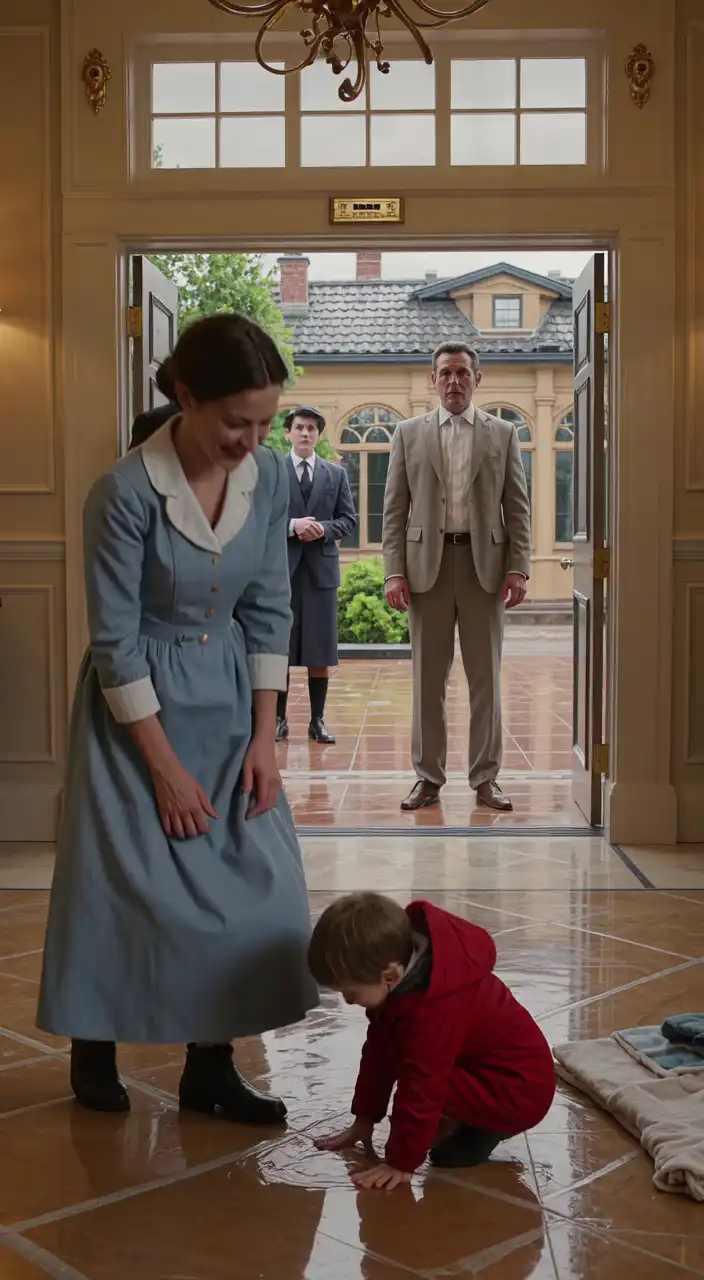
That evening, he found Tessa in the mudroom zipping Nolan into a tiny red rain jacket. The boy swayed on his feet, eyes fixed on the puddles beyond the open door.
"You're taking him outside," Garrett said.
Tessa glanced up. "Only to the courtyard. It's raining lightly."
"I heard."
Nolan made a small urgent sound.
Tessa rested a hand near his shoulder. "We're waiting one minute, honey."
Garrett watched his son bouncing once on his toes. Anticipating. Wanting. He was not used to seeing want in Nolan unless it was fear.
"The staff thinks you're making him dependent," Garrett said.
Tessa's hands stilled on the zipper. "Children are supposed to depend on people."
"Not like this."
"Like what? Trusting someone to help him feel safe?"
Garrett's voice roughened. "You don't know what it costs when people leave."
At that, Tessa looked at him fully, and the room seemed to narrow around the truth neither had spoken plainly before.
"No," she said softly. "I don't know what it cost your wife to die. And I don't know what it cost you to stay standing afterward. But I do know this child cannot heal from loss by being protected from attachment."
Rain ticked steadily on the windows.
Nolan reached toward the open door again, making that same small sound.
Tessa turned back to him. "Okay, okay. We go together."
She took his hand.
Garrett should have stopped them. Instead he followed to the threshold and stood watching as Tessa led Nolan into the drizzle of the inner courtyard, where rain darkened the flagstones and gathered in bright shallow pools.
Nolan froze at the first drop on his cheek.
Tessa lifted her face to the sky and said, "Oh. Wet sky."
Then, to Garrett's astonishment, she stepped directly into a puddle with both feet.
Splash.
Nolan blinked.
She did it again. Splash.
The little boy stared, entirely arrested.
Tessa crouched and touched the puddle with one finger. "Rain says hello."
After a long moment, Nolan took one step forward. Then another. The toe of his rain boot entered the water.
His body tensed, waiting for disaster.
None came.
He looked at Tessa.
She smiled, quiet and warm. "That's it."
When he shifted his weight and made the smallest ripple, she nodded like he had done something magnificent.
From behind Garrett, Mrs. Caffrey said under her breath, "He'll catch cold."
Garrett did not answer.
He kept watching the child in the rain and the young woman beside him who seemed to understand that healing might begin not with fixing what was wrong, but with making room for one small brave step inside what was possible.
The hill became a battle long before Nolan ever touched it.
For three days, rain swept across the estate in soft bands, turning the lower meadow silver and the west slope slick with spring grass. Tessa did not push. She stayed with Nolan's rituals, their little private anchors: tap tap at breakfast, baby burrito after bath, clouds in a little before nap. The courtyard rain play had become its own ceremony now. If mist touched the windows, Nolan would drift toward the mudroom and look for his red jacket.
But household resistance thickened around them.
Mrs. Caffrey began resetting things after Tessa arranged them. If Tessa left two measuring cups by the water station she had made in the mudroom, they disappeared by evening. If she let Nolan carry his own spoon from breakfast to sink, someone rushed to take it before he reached the kitchen.
"He's not a baby ornament," Tessa said once, more sharply than Garrett had ever heard from her.
Mrs. Caffrey drew herself up. "And he's not a science experiment."
Margot, trying to keep peace, shifted Nolan's schedule back toward old patterns whenever Tessa was off duty. The result was confusion. One morning, the blue plate arrived with the toast in a square instead of a train. Nolan shrieked so suddenly that the footman carrying flowers in the hall nearly dropped the vase.
"See?" Mrs. Caffrey said afterward, pale with vindication. "Change upsets him."
Tessa, kneeling on the floor with Nolan pressed against her legs and crying into his fists, answered without looking up, "Random change upsets him. Shared rhythm helps him."
Garrett heard that from the doorway and did not intervene. He was beginning to understand that the conflict in his house was not between order and disorder. It was between control and relationship.
Still, even he wavered.
On Friday morning, Dr. Byron Kessler, Nolan's developmental specialist from Burlington, arrived for a scheduled review. He was a neat man in his fifties with rimless glasses and the professional caution of someone who had long ago learned to speak in probabilities.
Nolan did not cooperate.
He would not stack the blocks as requested. He would not point to the picture cards. He lay under the small table in the nursery while Dr. Kessler sat on the rug with his clipboard and suggested, after forty minutes, that perhaps the child was over-stimulated by recent caregiving changes.
"Consistency is critical," he told Garrett in the study afterward. "In my experience, emotional reliance on a single caregiver can become counterproductive, particularly if the caregiver is using intuitive rather than evidence-based methods."
Garrett stared at the man. "Evidence-based methods have gotten us where, exactly?"
Kessler cleared his throat. "Progress in these cases is rarely linear."
"I know that phrase."
The doctor chose his next words carefully. "I understand Miss Rowan has encouraged broader sensory exposure. Rain, open grounds, less structured transitions."
"On the estate. Supervised."
"Even so, I would caution against confusing novelty with improvement."
The old despair crept back in then, slick and poisonous. Garrett had built entire industries on pattern recognition. But with Nolan he could not tell hope from wishful thinking until it had already cut him.
That afternoon he found Tessa on the covered back porch, sitting with Nolan in her lap while they listened to rain on the roof. She had one of Celia's old scarves draped lightly over both their shoulders like a tent. Nolan held the edge between two fingers.
"Kessler thinks you're over-stimulating him," Garrett said.
Tessa looked up. "Do you?"
"I don't know."
She accepted that more kindly than he deserved. "Fair answer."
"He thinks dependence on you could be a problem."
Nolan shifted and pressed his head under her chin. Garrett watched it happen with a pang so sharp he almost looked away.
Tessa's voice stayed low. "I won't stay if staying harms him."
The words hit him harder than the doctor's warnings.
"And if leaving harms him?" Garrett asked.
She did not answer immediately. Rain drummed softly around them.
"Then we don't disappear abruptly," she said at last. "We make bridges."
Garrett looked at his son, tucked into the hollow of her body with unusual ease. "He never did that with anyone else."
Tessa's thumb moved slowly over Nolan's sleeve. "He's tired of being scared."
The pressure built the following week because the calendar brought with it a day no one in the house liked to name aloud.
Celia's birthday.
Before her death, it had been a ridiculous holiday of too many flowers and one carefully chosen gift and breakfast in bed she never managed to finish because she would rather come downstairs and steal fruit from the kitchen. After her death, the date became a thing Garrett survived privately. He usually left the estate early, worked too much, visited the cemetery at dusk, and returned after everyone was asleep.
This year, Tessa found out because Nolan's nursery still had a small ceramic star on the shelf with Celia's handwriting on the bottom: For my birthday boy's first bedtime story.
She turned it over in her hands and asked quietly, "When is her birthday?"
Garrett, standing in the doorway, answered before he could decide not to. "Wednesday."
Tessa looked at him. "What do you do that day?"
"Nothing."
A pause. "That doesn't sound true."
His jaw tightened. "I work."
"I meant with Nolan."
Garrett gave a humorless smile. "He doesn't understand birthdays."
"Maybe not the way we do."
He should have shut the conversation down. Instead he heard himself say, "The last birthday of hers we had together, she spent most of the afternoon in bed. I thought she was exhausted from the baby." He swallowed. "I brought home a cake she didn't touch."
Tessa said nothing. Her silence was never empty; it made room.
"I keep wondering what I missed," he said. "Everyone says not to do that. As if saying it enough changes the fact that I missed something fatal."
Nolan sat between them on the rug, turning the ceramic star over and over in his small hands.
Tessa's voice was very gentle. "Maybe Wednesday shouldn't be nothing."
He looked at her sharply. "I am not having a birthday party for a dead woman in front of my son."
"No. But maybe we can make space for her without making the whole house hold its breath."
Against all instinct, he let her plan.
Wednesday dawned bright after days of rain. The whole estate smelled washed clean. Sunlight lay over the meadow, and the west hill shone in fresh green folds beyond the orchard fence.
At breakfast, Tessa added one new element to Nolan's ritual: a single yellow flower beside the blue plate.
Nolan frowned at it.
"For Mama," she said simply.
He touched one petal, then looked away.
Garrett, standing near the window with coffee in hand, felt his throat close.
The day moved strangely. Softer than he expected. Tessa did not force conversation about Celia. She just threaded small remembrances into the ordinary. A song Celia had loved hummed during bath time. The ceramic star brought to the window ledge. The yellow flower moved to Nolan's nap table, then to the mudroom bench.
By late afternoon, clouds had drifted back in, high and white. The air over the estate was cool and moving. Nolan woke restless from nap, rubbing his face, his body prickly with the kind of discomfort that often tipped into tears. Mrs. Caffrey suggested dimming the room and keeping him inside.
Tessa crouched in front of Nolan and asked, "Do you want your jacket?"
At once his eyes shifted toward the hall.
Garrett, who had stayed home all day without admitting to himself why, said, "The ground will still be wet."
Tessa looked up. "Yes."
"The hill is dangerous."
"It's also exactly the right kind of movement for some children."
Mrs. Caffrey, standing behind them, gasped softly. "Surely not today."
Today. Because Celia's birthday made everyone superstitious with grief.
Nolan made a strained sound, halfway between a whine and a plea. His hands flapped once at his sides.
Tessa said quietly, "He's asking."
Garrett stared at his son. At the curls damp from sleep. At the brown eyes already starting to flood with distress because the adults around him were turning tense again. Celia had once accused Garrett, laughing, of treating every uncertainty like a board vote. He almost heard her voice then.
For once, choose with your heart first.
"Take him," Garrett said.
The west hill rose beyond the orchard, a long grassy slope ending in a broad lower meadow bordered by birches. In summer it was where picnics had once happened. In winter, where local children from neighboring farms came to sled by invitation from a version of the Vale family that had known how to be generous without being watched.
Now it belonged mostly to wind.
Tessa carried Nolan the first part of the way, his red jacket bright against her sweater. Garrett followed several paces behind. Farther back came Margot and, despite repeated instructions, Mrs. Caffrey, muttering prayers about damp clothes and common sense.
At the top, the world opened. The estate spread behind them in stone and slate. Ahead, the meadow rolled away under the lowering sun. The grass was wet enough to shine.
Nolan clung to Tessa at first, face tucked against her neck. The breeze lifted his curls. She didn't set him down immediately. She stood still and let him look.
"Listen," she whispered. "Just wind. Just birds. Just us."
Garrett stayed back, hands in his coat pockets so no one would see them shake.
After a minute, Tessa lowered Nolan to the ground. His boots sank slightly into the soft turf. He wobbled, then steadied. His eyes were huge.
Tessa crouched. "You don't have to do anything."
She sat down on the hill herself.
Mrs. Caffrey made a horrified sound.
Tessa looked at Nolan with mock solemnity. "I may slide. This is serious."
Then she pushed off gently and scooted three feet down the wet grass, not graceful at all. Her braid came loose. She laughed under her breath and looked up.
Nolan stared.
Tessa climbed back up, sat again, and this time tipped onto her side, rolling halfway down before stopping in a tangle of limbs and green-stained jeans.
She raised one hand dramatically. "I have been defeated by the mountain."
A sound came from Nolan.
Not crying. Not distress.
A short surprised breath.
Garrett's heart slammed.
Tessa did not react too strongly. She simply sat up and patted the grass beside her. "Your turn if you want. Or you can supervise."
Nolan took one step. Then another. His boots slipped slightly, and he flinched.
Garrett moved instinctively forward, but Tessa lifted a hand without looking at him. Not stopping him exactly. Asking for trust.
Nolan crouched awkwardly. Sat. The wet grass touched the back of his legs and he jerked.
"It's okay," Tessa said. "The hill is cold. I know."
She rolled once more, slower this time, showing him. Then she sat at the bottom and opened her arms only a little, not demanding.
Wind moved over the field. A bird called from the birches. Somewhere far off, a horse in the neighboring property snorted.
At the top of the hill, Nolan placed both palms on the ground.
And pushed.
He slid six inches, startled himself, and stopped.
Tessa grinned. "Yes."
He did it again. A little farther. Grass darkened the knees of his pants.
Then, with a small desperate courage that seemed almost too tender to witness, Nolan let his body tip.
He rolled.
Once. Twice. Halfway down the slope in a crooked tumble of red jacket and curls and chubby toddler limbs.
Garrett's breath caught so hard it hurt.
At the bottom, Nolan lay still one terrifying second. Tessa remained seated a foot away, letting him gather himself.
Then he lifted his head.
Looked straight at her.
And smiled.
It was not a polite smile or a reflex. It broke over his whole little face like sun through cloud, transforming him so completely that Garrett almost did not recognize his own child. Brown eyes bright, mouth open, cheeks lifted. Beautiful. Alive. There.
Tessa's own face changed with it, wonder and tenderness at once. "There you are," she whispered.
Nolan made a sound then, high and bubbling.
A laugh.
Small, breathy, undeniable.
Garrett did not realize he had stepped forward until he was at the edge of the slope, one hand pressed over his mouth.
Below, Nolan pushed himself clumsily upright and looked toward Tessa again as if to make sure she had seen. As if smiling required witness.
She laughed softly with him. "Again?"
He bounced once in place.
Again.
This time she climbed beside him, but before they rolled she looked up toward Garrett. Not calling him. Inviting him.
For one second fear rooted him where he stood. Fear of doing it wrong. Fear of breaking the spell. Fear of wanting too much.
Then Tessa said, gentle but clear, "He wants to share it."
Garrett went.
He sat awkwardly on the wet hill in his expensive coat, shoes sinking in the grass, and felt ridiculous. Nolan stared at him, smile gone now, uncertainty back.
Tessa touched the ground between them. "Daddy sits too."
Garrett looked at his son. "Can I?"
Nolan's fingers twitched at his sides.
Tessa said, "We'll do one together."
So Garrett copied her. He planted one hand behind Nolan, not touching until the child leaned by accident into his sleeve. That tiny contact nearly undid him.
"Ready?" Tessa asked.
Garrett gave a strangled nod.
They tipped.
The world turned into wet grass, cold air, and the stunned absurdity of a billionaire heir rolling downhill because a young nanny had decided grief should not own every inch of his son's life.
They landed in a heap.
For a beat there was silence.
Then Nolan laughed again. Louder.
Garrett looked at him, really looked, and tears blurred the whole field. His son was looking back, eyes fixed on his face, as if searching it for the right response.
Garrett let himself smile through the tears. "Yeah," he whispered. "Yeah, buddy."
Above them, unnoticed by most, the first light rain had begun again, silvering the grass and darkening Tessa's hair. She lifted her face to it and laughed too.
On Celia's birthday, under a wet Vermont sky, their son laughed on the hill.
And something in the whole broken house shifted.
Mrs. Caffrey cried first.
Garrett had always thought of her as indestructible in the way of women who keep large houses running and private grief tucked into starched collars. But when Nolan laughed the second time, then reached with both hands for the grass as if demanding another roll, she covered her mouth and turned away, shoulders shaking.
Margot stood very still beside her, eyes wide.
"It's the first time," she whispered.
Garrett barely heard her. He was at the bottom of the hill now, kneeling in wet grass while Nolan, flushed and bright-eyed, leaned against his leg only long enough to push himself upright again. The contact lasted less than two seconds, but Garrett felt it like a blessing.
Tessa stayed close without crowding him. "Slow," she murmured. "Let him lead."
Nolan toddled two steps uphill, slipped, and sat down hard. Garrett tensed, ready for tears.
Instead Nolan looked at Tessa.
She put both hands on her own knees and said, "Big feelings. You okay?"
He blinked. His mouth trembled once.
Garrett held himself still. Every instinct screamed to grab him.
Tessa glanced at Garrett, then back at Nolan. "Try again or all done."
Nolan slapped one palm against the grass.
Again, somehow.
So Garrett stood and climbed with him, one pace behind. Not carrying him. Not fixing it. Just near.
At the top, Nolan turned in a clumsy circle and then, to Garrett's astonishment, reached one hand out into the air between them.
It took him a second to understand.
Garrett offered his hand like a man handling something sacred. Nolan's damp little fingers touched his.
Only for balance. Only for the start.
But it was his son's choice.
They rolled together a second time, Garrett less graceful than before, Nolan laughing in startled bursts each time they bumped. At the bottom, rain dotted their coats and hair. Tessa stood over them smiling through tears she did not seem embarrassed to have.
From farther up the hill, Margot called, "He's soaked!"
No one moved to stop them.
The witness changed everything because it was no longer one young caregiver making impossible claims. The whole household had seen Nolan not merely comply, not merely tolerate, but feel joy. They had seen him recover from a slip without collapsing. They had seen him seek connection in the middle of excitement rather than retreat from it.
For years, this estate had organized itself around preventing breakdown. Suddenly it had proof that life could hold more than avoidance.
Back inside, wrapped in towels in the mudroom while rain tapped the windows, Nolan sat on the bench between Tessa and Garrett eating apple slices. His cheeks were still pink. Every so often, as if replaying the hill inside his body, he gave a breathy little exhale that almost became another laugh.
Mrs. Caffrey knelt to remove his muddy boots with hands that were much softer than usual. "Well," she said, voice thick, "you did make a dreadful mess."
Nolan looked at her.
And because Tessa had changed the room by changing the rules, Mrs. Caffrey did something no one would have expected from her a week earlier. She smiled back and added, "A magnificent one."
Margot went to call Dr. Kessler before Garrett could stop her. Ordinarily that would have annoyed him. This time he was glad. Let the experts hear it.
When the doctor answered on speaker, Margot said with unusual excitement, "He laughed, Doctor. On the hill. And he initiated contact with Mr. Vale."
There was a brief silence. "I see," Kessler said. "Well. That is encouraging."
Encouraging. Garrett nearly laughed himself.
He looked through the mudroom doorway where Tessa was helping Nolan push one sleeve off his wet jacket. She had no triumphant expression, no I told you so. Only that same quiet attention, as if breakthroughs were made of ordinary moments someone had chosen to honor.
Later that night, after Nolan had gone to sleep exhausted and peaceful, Garrett stood outside the nursery and watched through the cracked door. Tessa sat in the rocking chair humming under her breath. Nolan was already down, one hand curled around the ear of the cloth rabbit.
Garrett did not go in. He stayed in the hall, in shadow, deeply moved in a way too private for interruption.
When Tessa stepped out and pulled the door softly closed behind her, she found him there.
"You saw him smile at me when I walked in tonight," she said.
Garrett nodded. "I did."
DM03-B. The first smile when she entered the room had come quietly, not on the hill but now, at bedtime, after the day's joy had settled into memory. Nolan had looked up from his blanket, seen Tessa in the doorway, and smiled before she said a word. As if her presence itself had become part of safety. Part of home.
Garrett leaned against the wall and let out a long breath. "I almost missed my son's first real laugh because I was afraid of wet grass."
Tessa's mouth curved. "You didn't miss it."
"No. I just missed a lot before that."
They walked downstairs in the dim pool of the hall sconces. The house felt different tonight, less like a museum to sorrow and more like somewhere people might actually live.
In the kitchen, Garrett poured two cups of tea because he suddenly could not bear the formality of offering whiskey. Tessa accepted hers with both hands.
"I owe you an apology," he said.
"For what?"
"For thinking money and expertise and control were the same thing as care."
Tessa shook her head. "You were trying to survive."
"I was hiding in competence." He stared into his cup. "Business, schedules, specialists, rules. All things I know how to manage. But my son..." He swallowed. "Every time he looked through me, it felt like I was losing both of them."
Tessa's voice softened. "He's been looking for you too."
Garrett laughed faintly, painful and amazed. "On a hill, apparently."
"Sometimes that's where people are easiest to find."
He looked up then, truly seeing her not just as the answer to a crisis but as the person who had walked into his grieving house and refused to treat his child like a problem to be contained.
"What changes now?" he asked.
"That depends on you," she said.
He waited.
"You don't need to become me. You need your own rituals with him. Your own rhythm. Something that belongs to father and son."
Garrett thought of breakfast trays and quarter-turned cups, of rain jackets and hills. "What if I do it wrong?"
"You will sometimes."
He huffed a laugh.
"And then you'll repair it," she said. "That's parenting."
The word landed not as accusation, but invitation.
The next morning, Garrett did something no one at Vale House had seen him do in years. He canceled his first two meetings. He sat at Nolan's breakfast table before the plate arrived.
When Tessa brought it in, she paused.
Garrett lifted two fingers and tapped the tray. "Tap tap."
Nolan looked up.
Tessa said nothing at all. She simply placed the blue plate down and stepped back.
Garrett added, trying to keep his hand steady, "Good morning, buddy."
Nolan's eyes moved from the plate to Garrett's face.
And stayed there one full heartbeat longer than ever before.
Healing did not arrive all at once after the hill. Nolan still had difficult days. Sudden sounds still hurt him. Town was still too much. Some mornings began in tears because the clouds looked wrong or a sock seam felt unbearable or grief in a two-year-old body had no language except refusal.
But the rhythm of the house changed.
Garrett changed first.
He moved his earliest calls later whenever he could. He learned the breakfast ritual exactly as Nolan liked it, then slowly made one of his own: after tap tap and plate placement, he would roll a banana coin down the tray and say, "Incoming." The first time Nolan stopped it with one small hand, Garrett felt absurdly triumphant.
At bath time on the nights he was home, he became the official bubble inspector. Before nap on weekends, he was the one who opened the curtains three inches and asked, "Should we let the clouds in a little?" Sometimes Nolan still ignored him. Sometimes he looked. Sometimes, if Garrett had the courage to wait instead of forcing, Nolan answered with a tiny shift of his body that was enough.
Tessa stayed, but not as a miracle worker perched outside the family. She stayed as guide, witness, and steady heart. She taught Garrett how to watch before reacting. How to lower his own voice when Nolan spiraled. How to offer choice without surrendering structure. How to sit on the floor and be unimportant enough that a child might decide to come closer on his own.
The household changed too. Mrs. Caffrey stopped snatching spoons from Nolan's hand. Margot began asking Tessa before reorganizing his schedule. Eli built a safer path to the west hill and added a low rail near the muddier turn, pretending it was ordinary maintenance.
On drizzling afternoons, the mudroom no longer felt like a forbidden zone. It became a place for towels, puddle boots, measuring cups, and the possibility of delight.
By summer, Garrett and Nolan had a Saturday ritual that belonged only to them. They walked, slowly, to the hill after breakfast. Some days Nolan rolled. Some days he only sat in the grass and watched the wind move through it. Garrett learned not to call the quiet days failures.
One morning, as Tessa watched from the orchard path, Nolan reached for Garrett's hand before the slope even began.
Garrett looked back at her, stunned in the sweet familiar way he still was whenever his son chose connection.
Tessa smiled and raised a hand, not claiming the moment.
It belonged to them now.
In the months that followed, Vale House was still touched by loss. Celia's absence did not vanish. Her photos remained. Her songs still drifted through certain rooms. Her birthday would always ache. But the ache no longer swallowed every other feeling.
There was room now for wet grass, rain on the courtyard stones, toast trains, and laughter carried downhill on the wind.
And in the life Garrett had nearly mistaken for something broken beyond repair, there was finally a way forward that looked less like management and more like love.
The estate did not become noisy overnight. It became gentler first. Then warmer. Then, slowly, alive again.
On a late summer evening, Garrett stood at the nursery door and watched Nolan look up as Tessa entered with the bedtime rabbit. His son smiled, then turned and patted the space beside him for Garrett too.
It was a small invitation. The kind easy to miss if you were rushing.
Garrett no longer was.
He crossed the room, sat on the rug, and when Nolan leaned against his knee, he stayed very still, letting the moment be exactly what it was: not a miracle, not an ending, but the beginning of a father finally learning how to be found.
Disclaimer: Mention of any brand or trademark is for identification only and does not imply partnership or endorsement