THE HOUSE BY THE GRAY WATER
At two thirteen in the morning, the study at the edge of the beach house glowed with the cold light of three monitors and one forgotten desk lamp.
Graham Mercer, founder of a software empire worth more than most countries' annual budgets, sat behind a desk made of dark walnut and cried with both hands over his face.
Outside the floor-to-ceiling windows, the Atlantic rolled against the private stretch of sand below his estate in Cape May, New Jersey. Wind pushed at the glass. Somewhere farther down the hall, the grandfather clock ticked with cruel steadiness, as if time had not split in half the night his wife died.
On his desk lay a tablet full of quarterly numbers, a contract draft for an acquisition in Seattle, and a framed photograph of a smiling woman with honey-blond hair holding a baby girl on her hip. Lydia Mercer had been laughing in that picture, head tipped back, sunlight all over her face. The child in her arms had been too young to remember that day.
Now Wren was two years old.
And Graham did not know how to reach her.
He lowered his hands and sucked in a shaking breath. His reflection in the black window looked like a stranger—thirty-eight, expensive shirt wrinkled, tie gone, eyes bloodshot, jaw rough with stubble. A billionaire who could build platforms, buy companies, and command rooms full of men twice his age. A father who stood outside his daughter’s nursery some nights too afraid to go in.
The study door opened quietly.
“Mr. Mercer?”
It was Eileen, the night housekeeper, still in her navy sweater, her gray hair pinned back. She looked worried before she even finished the sentence. “Wren is awake again.”
He stood so fast his chair rolled backward.
“Was she crying?”
Eileen hesitated. “No, sir. Just... awake.”
That was somehow worse.
He followed her down the long upstairs hallway. The house was beautiful in a way magazines loved—white oak floors, broad windows, clean lines, pale stone, expensive art. Lydia had filled it with warmth anyway. Bowls of shells from morning walks. Books left open. A watercolor she had painted in the breakfast nook. Since the fire in their city townhouse two years earlier, after the hospital and surgeries and the move to the coast for “peace,” the new house had stayed spotless and hollow.
Wren’s bedroom door was open. Soft light from a whale-shaped night lamp spilled across the rug.
His daughter sat in the middle of her crib-sized daybed, not crying, not reaching, not making a sound. Her brown curls rested against her cheeks. Her green eyes—Lydia’s eyes—were open and fixed on the framed photograph on the dresser. The same picture, enlarged. Lydia in a white sundress, holding Wren as an infant.
“Hey, birdie,” Graham said softly.
Nothing.
He went closer, lowering himself beside the bed. “Wren. Daddy’s here.”
Her gaze did not move.
At two years old, she should have been running barefoot through the house, tugging cabinet doors open, scattering blocks, demanding cookies before dinner, climbing into his lap with sticky hands. Instead, Wren had not walked in over a year.
There was no spinal injury the doctors could point to. No fracture left untreated. No disease they had named with certainty. After the fire that killed Lydia, Wren had recovered physically from smoke inhalation and a minor burn on her calf. For a while, she had toddled clumsily again. Then one day she simply stopped.
She would sit. Be carried. Sometimes stand if supported under her arms for a few seconds, trembling with panic before dropping down again. Therapy after therapy had come and gone. Specialists from Philadelphia, Manhattan, and Boston had offered possibilities with long names and guarded tones. Trauma response. Functional neurological disruption. Developmental regression after catastrophic loss.
And still she did not walk.
Graham held out a stuffed rabbit Lydia had bought before Wren was born. “Do you want Clover?”
Wren blinked once.
He tried again. “Should I read to you? The one with the moon? You used to like that one.”
No answer. No reaching. No little smile. Just those wide, solemn eyes on her mother’s photograph.
He swallowed hard and sat on the floor, his back against the bed. “I don’t know what to do,” he whispered, though whether he spoke to his daughter, his dead wife, or the dark itself, he could not have said.
Eileen quietly withdrew and closed the door most of the way.
For a long time, the room held only the sound of the ocean and the faint hum of the monitor in the corner. Graham looked around at untouched toys—a wooden train, stacking rings, a basket of soft books. Even the bright wheelchair custom-made for toddlers sat near the wall like an accusation. Its seafoam cushion matched the curtains Lydia would have chosen. They had spent a fortune making everything beautiful and gentle.
None of it mattered.
“Wren,” he said after a while, forcing brightness into a voice that had no strength left, “look at me for one second. Just one.”
At last her eyes shifted.
For an instant hope kicked painfully in his chest.
Then she looked past him, toward the doorway, where nobody stood.
The hope collapsed just as fast.
He turned toward the dresser. Next to Lydia’s photograph sat a ceramic shell dish still holding her rings from the night of the fire. Graham had never moved them. He never could.
“Your mommy loved this room,” he said, because talking was better than silence and silence in this house had become unbearable. “She would’ve made fun of me for picking the wrong curtains. She would’ve said no toddler needs imported rugs.”
His laugh broke in the middle.
Wren’s expression did not change, but one small hand lifted and touched the blanket in front of her. A nervous, repetitive motion. Thumb against fabric. Press, release. Press, release.
The therapists called it self-soothing.
Graham called it another way his child had learned to live somewhere he could not follow.
By dawn he was back in the study with a legal pad full of names, crossed-out schedules, and failed plans. Live-in nurse. New pediatric neurologist. Rehabilitation center in Baltimore. Another therapist. Another specialist. Another person to enter his daughter’s room and leave shaking their head.
His executive assistant, Marisol Dean, had been gently pushing him for weeks to stop managing his home like a crisis project and actually hire someone who could stay. He had dismissed every candidate. Too rigid. Too cheerful. Too frightened. Too clinical. Too eager to impress him. Most lasted three days. One left before lunch after Wren threw herself backward in terror during transfer practice.
Graham stared at the list until the words blurred.
“I can’t do this alone,” he said into the empty study.
It was the first honest thing he had said in months.
By eight thirty the beach house was awake. The chef was in the kitchen. Groundskeepers moved beyond the dune grass. A delivery truck backed up near the service drive. And Graham, who had built his company by never surrendering control, sent one short text to Marisol.
I’m done choosing. If you trust someone, bring her.
Two minutes later she replied.
Interview at noon. Please don’t cancel this one.
He almost did.
Then he looked at the nursery monitor on his phone. Wren sat by the window in her little chair, sunlight on her brown hair, staring out at the gray water beyond the glass.
And he thought, with a shame so deep it hollowed him out, that he had not only lost his wife in the fire.
He was losing his daughter too.
At eleven fifty-eight, Graham stood in the formal sitting room feeling ridiculous for agreeing to this.
The room looked staged for a luxury magazine spread: cream sofas no one used, driftwood art Lydia had loved, a marble fireplace, glass doors opening onto a terrace with a view of the ocean. Through those doors, he could see the low green rise of dunes under a pale spring sky.
Marisol entered first, tablet tucked to her chest, practical as always. “Please try not to glare at her.”
“I’m not glaring.”
“You are a little.”
“I built a global company with six thousand employees. I can conduct a normal interview.”
Marisol raised an eyebrow. “That’s exactly the sort of thing a man says before terrifying a twenty-two-year-old.”
He exhaled. “How old is she?”
“Twenty-three.”
“Wonderful.”
“She came highly recommended.”
“By whom?”
“The agency director. And by the family in Montclair she worked for during college. Their son had cerebral palsy.” Marisol paused. “She requested no special treatment because of your status.”
“That’s unusual.”
“She also asked whether your daughter likes bubbles, songs, and warm washcloths.”
Graham frowned. “What kind of interview question is that?”
“One that was not about salary.”
Before he could answer, the front door opened in the foyer.
The woman who stepped in did not look like any nanny he had previously interviewed.
She wore a simple yellow blouse with rolled sleeves, jeans, white sneakers, and her chestnut hair in a loose braid that had half come undone in the wind. She carried one canvas tote and no visible anxiety. She was undeniably beautiful, but not polished in the way women around men like Graham often were. She looked sunlit, alive, unarranged.
“Mr. Mercer?” she said, walking into the room and extending her hand without hesitation. “I’m June Halpern. Thank you for seeing me.”
Her voice was warm and clear.
He shook her hand. “Please sit.”
She sat, but not stiffly. She glanced once toward the terrace doors, toward the sound of waves, then back at him.
Marisol remained standing near the fireplace, probably to prevent him from ruining this.
Graham folded his hands. “You understand my daughter has complex needs.”
“I do.”
“Most candidates say that, then they realize what it actually means.”
June nodded. “Maybe. But I usually prefer finding out who a child is before deciding what they mean.”
He looked at her more closely. “That sounds nice. It’s also vague.”
“It means I read her file,” June said. “It also means your daughter is not a file.”
Marisol made a quiet sound that might have been approval.
Graham leaned back. “You’re direct.”
“I find children do better when the adults around them stop performing.”
That should have irritated him. Instead, to his own surprise, it almost made him laugh.
“You know nothing about this house,” he said.
She looked around once, not impressed by the carved mantle or the ocean beyond the glass. “I know it’s very clean. I know everyone inside it is probably trying hard. I know trying hard can make a child feel managed instead of loved.”
Marisol coughed into her hand to hide a smile.
“You’ve met my daughter for exactly zero minutes,” Graham said.
“Yes. Which is why I’d like to meet her before I tell you what I think I can do.”
“And if she ignores you?”
June shrugged lightly. “Then I’ll say hello to the room she’s in and let her decide whether I’m interesting.”
He should have ended the interview. He should have asked for references, credentials, a ten-step care plan. Instead, after a beat, he said, “Follow me.”
Wren was in the sunroom play area overlooking the beach. A housekeeper had arranged toys in neat rows on the woven rug. Wren sat in her wheelchair by the windows, a tiny figure in a pale blue dress, hands in her lap. Her brown hair curled at the nape of her neck. Her green eyes were fixed on the line where sea met sky.
“She doesn’t respond well to strangers,” Graham said quietly.
June did not answer immediately. She entered the room, but instead of approaching Wren head-on, she set down her tote near the wall and sat cross-legged on the floor several feet away. Not too close. Not too far. At the child’s level.
“Hi, Wren,” she said, looking not at the girl’s face but at the patch of sunlight near her wheels. “I’m June. Your window is showing off.”
Nothing.
June tilted her head toward the ocean. “That water looks grumpy today. I think it wanted to be blue and woke up gray instead.”
Graham stood in the doorway with his arms folded. Marisol stood just behind him.
Wren did not look at June.
June reached into her canvas tote and pulled out a small tin. She opened it. No flashy toy. No electronic gadget. Just a folded stack of brightly colored washcloths.
Graham almost asked why she had brought laundry supplies.
Instead June spread one cloth on the rug and smoothed it with unnecessary seriousness. “This one,” she informed the room, “is obviously a strawberry. This one is pretending not to be a blueberry, but I know better. And this yellow one is a very dramatic banana.”
She folded the banana into a crooked shape and set it upright.
Still Wren did not turn.
June kept going as if she had all day. “I brought these because sometimes baths are boring, and boring is a terrible way to meet water.”
At the word baths, one of Wren’s fingers twitched.
Graham noticed.
June noticed too, though she did not show triumph. She merely reached for another cloth and made a tiny fish with it. “This fish has gossip,” she said in a confidential tone. “I can already tell.”
Very slowly, Wren’s eyes shifted from the ocean to the rug.
The movement lasted less than a second.
Then she looked away again.
It was so small anyone else might have missed it.
Graham felt himself dismissing it automatically, the way he had learned to dismiss every almost, every maybe, every not-quite.
But June smiled as though a door had opened.
“Nice to meet you too,” she said softly.
He frowned. “She didn’t do anything.”
June looked up at him, calm and certain. “She noticed me.”
“That isn’t the same.”
“For today,” June said, turning back to Wren, “it is.”
A minute later she lifted the yellow washcloth banana and made it bow toward the wheelchair. “Your Majesty,” she told Wren, “I regret to inform you that the fish is being rude.”
Wren’s lashes fluttered.
Not a smile. Not a laugh.
But she stayed looking.
June did not rush toward her. Did not praise her. Did not announce progress. She just sat there on the rug in a patch of afternoon light and let the silence be something gentle instead of heavy.
When Graham finally stepped back into the hall, Marisol looked at him.
“Well?” she asked.
He kept his voice neutral. “One afternoon trial.”
Marisol’s expression said she knew that was more than he had intended to offer.
Inside the sunroom, June’s voice drifted out softly. “You don’t have to talk to me, Wren. I’m actually excellent at waiting.”
When Graham glanced back through the doorway, he saw his daughter looking not at the ocean, not at her mother’s memory, but at a ridiculous washcloth fish in a stranger’s hand.
It was barely anything.
And somehow it felt like the first crack in a wall.
June did not begin by trying to make Wren walk.
That alone made her different from everyone else.
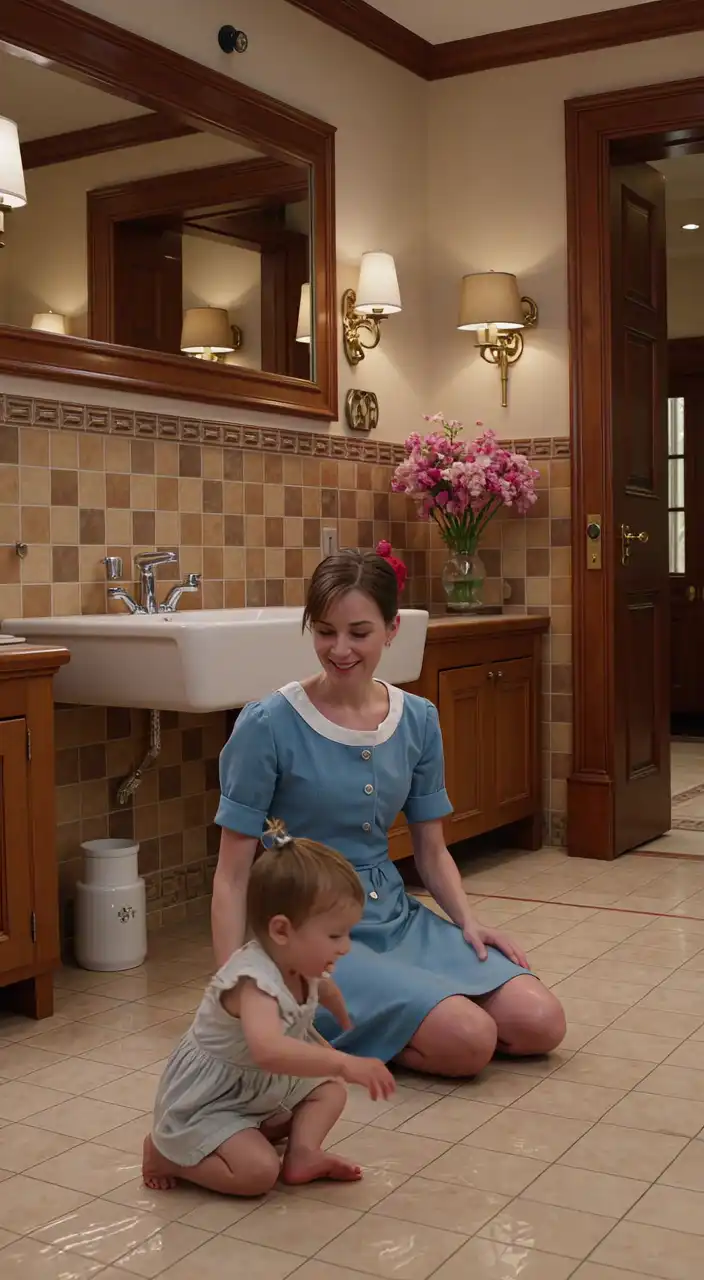
The first morning she arrived for a full day, Graham found her in the nursery bathroom sitting on the bath mat in rolled-up jeans, sleeves wet to the elbow, while Wren sat in the shallow tub splashing one hand against the water.
The nanny all the others had become had always hovered, corrected, restrained. “Careful.” “Don’t slip.” “Sit still.” “No, not like that.”
June was saying, “I think this washcloth whale is a liar. He says your toes are secretly sea stars.”
Wren’s eyes were fixed on the foamy beard June had made on the whale’s face. A bubble clung to the child’s wrist. She watched it with solemn concentration.
“You’ll soak the floor,” Graham said from the doorway.
June glanced over her shoulder. “Yes.”
“That’s all you have to say?”
“It’s a bathroom.”
He looked down. Water had escaped the tub and spread over the tile in cheerful little rivers. Wren slapped the surface again and stared at the splash pattern as if it were
Disclaimer: Mention of any brand or trademark is for identification only and does not imply partnership or endorsement