THE GIRL WHO RAN THROUGH THE GARDEN
In the east wing of the estate, where the morning sun fell softly through gauzy white curtains, a little girl sat in the middle of a pale blue nursery and stared at the wall as if it held a secret no one else could see.
Her name was Willa Mercer, and she was two years old.
She had brown curls that fell against her cheeks in loose, uneven rings and wide green eyes that should have been bright with mischief. Instead, they were distant, fixed on nothing. Around her lay a world built for joy: a dollhouse hand-painted in Charleston colors, a row of stuffed rabbits and bears, a shelf of books with thick pages and cheerful animals, wooden blocks, plush rugs, tiny shoes lined in a perfect row. None of it had been touched that morning.
A silver mobile turned slowly above her crib, though she no longer slept there. It played a lullaby that had once calmed her. Now she did not even blink.
Outside the nursery door, footsteps paused.
“Has she eaten?” a man asked quietly.
“Only two spoonfuls of yogurt, sir,” answered the housekeeper. “She pushed the rest away.”
“What about the apple slices?”
“She lined them up on the tray and then stared at them.”
The man closed his eyes for a moment before stepping inside.
Gavin Mercer was thirty-eight, self-made, and worth more money than most people could imagine. He had built a software empire before he was thirty-five, had investors calling from Singapore and London before dawn, and had recently bought a cybersecurity firm in Seattle with what the business media described as casual confidence. His estate outside Ashford, Vermont, stretched over rolling green hills, a private lake, old stone walls, and gardens planned by designers who charged more for a week than some families earned in a year.
None of that helped him now.
He loosened the tie at his throat and crouched in front of his daughter.
“Hey, bug,” he said, making his voice warm, playful, gentle. “Daddy’s here.”
Willa did not turn.
He picked up a stuffed fox from beside her and made it hop awkwardly across the rug. “Mr. Fox says good morning. He says he’s starving and would like to know if you have any cookies hidden in here.”
Nothing.
Gavin swallowed. “Or crackers. He’ll settle for crackers.”
Her small fingers remained wrapped around a satin ribbon, faded from too much handling. It was tied to a little cloth heart, the only object she seemed to keep near her every day. It had once been attached to a robe belonging to her mother.
Her mother.
The room still held traces of Serena Mercer in ways that pierced him when he least expected it. The lavender sachet in the dresser drawer. The framed photo on the bookshelf of Serena laughing in the garden, eight months pregnant, one hand over her belly. A knitted blanket draped over the rocking chair, half-finished because she had always said she would complete it after the baby arrived.
She never did.
A sudden heart attack, the doctors had said. Rare. Catastrophic. Fast.
No warning. No goodbye.
Willa had been so young when Serena died that people had assumed she would not remember. But grief did not always need language. Sometimes it settled in the body like winter.
Gavin sat on the rug in his thousand-dollar suit, the knees pressing into the soft fibers. “Willa,” he said more softly, “look at me, sweetheart.”
No response.
He reached out carefully, brushing a curl back from her forehead. She flinched.
The movement was small. It hit him like a blow.
“I’m not going to hurt you,” he whispered.
At the door, Mrs. Delaney looked down quickly, pretending she had not seen. She had worked for the Mercers for six years and had loved Serena in the quiet, loyal way staff sometimes loved the people who treated them kindly. Since Serena’s death, she had watched the house become a museum of unfinished grief.
Gavin tried again. “Do you want to go outside? The ducks are at the pond. We can throw bread. Or…” He glanced around desperately. “Or we can read that bunny book. You used to like the bunny book.”
Used to.
Before the funeral. Before the endless parade of strangers speaking in soft voices. Before the specialists and therapists and caregivers who came with charts, plans, and polished concern. Before Willa withdrew farther and farther away until even her cries became rare.
He rose at last and crossed the room to the bookshelf. A framed family photo stood there, taken on the terrace the previous summer. Serena sat in a white dress, glowing in the late afternoon sun, Willa on her lap and Gavin beside them. In the picture, Willa’s hand was on Serena’s cheek. Gavin remembered that exact moment. Serena had laughed and said, “Look at her. She already thinks she owns us both.”
He picked up the frame.
“You did,” he murmured to the photo. “You really did.”
When he turned back, Willa was still sitting in the same spot, the ribbon looped around her fingers, her tiny body rigid and self-contained, as if she had drawn a circle around herself no one else could enter.
The doctor called it emotional trauma. Severe withdrawal. Complicated grief responses compounded by developmental vulnerability. He had heard so many careful phrases over the past year that they had begun to feel like furniture in his head.
What he saw was simpler and more painful.
His daughter was disappearing while he stood in the room with his hands empty.
He left the nursery a few minutes later because he had a conference call with investors in San Francisco, because there was always a call, always a deal, always an emergency in some glowing screen waiting for him downstairs. In the hallway, he stopped at the portrait Serena’s mother had commissioned after the wedding. Serena in ivory silk, smiling with that open, fearless warmth that had once made Gavin feel as though life itself had chosen him.
His sister’s voice startled him from behind.
“You’re doing it again,” said Lena Mercer.
He turned. Lena, three years younger, practical in jeans and boots, had driven up from Montpelier before breakfast. Unlike Gavin, she had inherited none of their father’s reserve. She loved directly, argued loudly, and saw through him in seconds.
“Doing what?”
“Walking around this house like money is going to solve grief.”
His jaw tightened. “I’m not in the mood.”
“No, you’re exhausted. There’s a difference.”
He rubbed a hand over his face. “She won’t look at me, Lena.”
Her expression softened. “I know.”
“I’ve hired specialists from Boston. New York. I brought in a child trauma consultant from Chicago. I rebuilt a wing of this house into therapy rooms I don’t even understand. I’ve had six nannies in eight months.” His voice dropped. “And she still sits there like the world ended.”
Lena stepped closer. “Maybe because for her, it did.”
He looked away.
There was a long silence before she said, “I know someone.”
He almost laughed. “Please don’t.”
“I’m serious. Her name is Ivy Rowan. She’s twenty-three. She helped with a little boy in my neighbor’s family after a bad accident. Not as some miracle worker. She just… knows how to be with children without making them feel watched.”
“I need someone qualified.”
“She is qualified.”
“I need someone who understands trauma.”
“She does.”
“I need someone who won’t quit after three days.”
Lena folded her arms. “Then stop hiring people who are dazzled by the paycheck and terrified of silence.”
That landed because it was true.
Gavin stared back toward the nursery. “What if this is just another failure?”
Lena answered gently, “Then it’s one more. But if you give up now, Willa will feel that too.”
He closed his eyes.
Somewhere upstairs, the house was quiet again. Too quiet for a child. Too quiet for a home.
At last he said, “Fine. Have her come tomorrow.”
Ivy Rowan arrived the next afternoon in a dusty green hatchback that looked almost embarrassed to be driving past the iron gates of Mercer Hollow Estate.
The security guard called ahead. Gavin was in his study, half listening to a presentation through his wireless earbuds, when he glanced at the front drive camera and saw a young woman stepping out of the car with a canvas duffel slung over one shoulder. She wore worn brown boots, jeans, and a cream sweater with a tiny tear near one cuff. Her dark blond hair was twisted into a loose braid that had already half escaped. She looked up at the house without awe, without nervousness, almost as if she were studying a mountain she planned to climb.
Lena stood beside her, talking with animated hands.
Gavin ended the call mid-sentence and went downstairs.
The front doors opened before he reached them. Lena came in first.
“Don’t glare,” she said under her breath. “At least pretend you have manners.”
“I always have manners.”
“You have expensive silence. That’s not the same thing.”
Then Ivy stepped inside.
She was young, younger than he expected, with clear gray-blue eyes and the kind of face people noticed because it was open rather than polished. Pretty, yes, but not in a fragile way. There was color in her cheeks from the wind, and when she smiled, it seemed effortless.
“Mr. Mercer,” she said, offering her hand. “I’m Ivy Rowan. Thank you for meeting with me.”
Her grip was firm. “You drove up from where?”
“Bennington.”
“That’s two hours.”
“A little over.”
He looked at Lena. “You couldn’t find anyone closer?”
Ivy’s mouth twitched. “I can leave if distance is the main issue.”
Lena sighed. “You see? This is why your employees are afraid of you.”
“I’m not afraid of him,” Ivy said.
Gavin actually looked at her then. Most people in his house measured every word around him. Ivy stood in his marble foyer with dirt on her boots and no trace of performance.
“Have you worked with children with trauma before?” he asked.
“Yes.”
“With nonverbal episodes? Withdrawal?”
“Yes.”
“With a child this young?”
“Yes.”
He gestured toward the sitting room. “Tell me how you’d approach this.”
Ivy did not sit until he did. “I’d start by not treating your daughter like a problem to solve. I’d learn her rhythms first. What she reaches for. What she avoids. What she repeats. What makes her body tense. What helps her soften.”
“We’ve done observation.”
“I’m sure you have.” Her tone stayed respectful. “But observation and presence aren’t always the same thing.”
Lena hid a smile behind her coffee cup.
Gavin leaned back. “And what exactly qualifies you to say that?”
“I grew up helping raise my younger twin brothers after my mom got sick. I studied early childhood development for two years. Then I worked with families privately. Some needed schedules. Some needed structure. Some needed someone willing to sit on the floor for an hour and say nothing because the child wasn’t ready for words yet.”
He watched her carefully. “You speak as if you already know my daughter.”
“No,” Ivy said. “I’m speaking as if I know children can feel when adults enter a room expecting failure.”
That silenced him.
A moment later Mrs. Delaney appeared at the doorway. “Sir? Willa is awake from her nap.”
Gavin looked at Ivy. “You can meet her.”
The nursery felt even quieter with a stranger in it. Willa sat beside the low window seat, satin ribbon looped around her fingers, the cloth heart pressed against her palm. She did not look up when the door opened.
“This is Willa,” Gavin said, his voice unconsciously formal.
Ivy did not answer right away. She stood in the doorway for a few seconds, taking in the untouched toys, the photo frames, the weighted quiet. Then, instead of approaching Willa or calling her name brightly the way others had, she crossed the room slowly and sat down on the rug several feet away.
Not too close.
Not too far.
She folded her legs beneath her and looked at a wooden stacking toy near her knee.
“Hi, Willa,” she said softly. “I’m Ivy.”
No response.
Gavin waited for the usual next steps: coaxing, toy shaking, exaggerated cheer. But Ivy did none of that. She noticed the ribbon in Willa’s hand and the cloth heart attached to it.
“That’s important,” she said, not asking to touch it. “I can tell.”
Willa’s fingers tightened around it.
Ivy glanced around until she saw a basket near the rocking chair. In it were several soft items the staff had stopped offering because Willa never played with them: a plush moon, a knit lamb, and a small faded square of floral fabric.
Ivy picked up the fabric square and looked at it. “This one feels like it’s been loved.”
Mrs. Delaney, from the doorway, whispered, “It came from her mother’s robe.”
Ivy nodded almost imperceptibly. Then she laid the fabric square on her own knee and, after a minute, gently tied one corner around her finger so that it dangled there like Willa’s ribbon.
No one had thought to imitate Willa’s attachment object before.
Gavin saw Willa’s eyes shift.
Just once.
Just for a second.
But she looked.
Ivy pretended not to notice. “Mine doesn’t look as nice as yours,” she said to the room. “You definitely have the better one.”
Willa’s gaze stayed there a heartbeat longer than usual.
The nursery air seemed to change, not with magic, not with a miracle, but with the faintest crack in a sealed window.
Gavin looked at Lena. Lena looked back as if to say, Do not ruin this.
Ivy picked up a small wooden ring from the floor and slid it over her wrist. “I’m going to sit here a while, Willa. You don’t have to do anything.”
Minutes passed.
The old house settled around them. Somewhere downstairs, a phone rang and was answered quickly. A breeze touched the curtains. Ivy remained still, relaxed, patient in a way that did not feel trained so much as sincere.
At last Willa turned her head a little more.
Her green eyes rested on Ivy’s hand.
On the tied fabric.
On the fact that this new person had entered her room and, instead of trying to pull her outward, had stepped one careful foot into her world.
Gavin almost spoke.
Ivy lifted one finger without looking at him, a silent request for quiet.
He obeyed.
Then Willa did something so small no report would ever capture its force. She let the cloth heart in her own hand fall forward so it was visible.
An offering? A warning? A comparison?
Whatever it was, Ivy smiled as if she had been handed something precious.
“That’s beautiful,” she said. “Thank you for showing me.”
Willa did not speak.
But she did not turn away.
Later, in the hallway, Gavin said, “That was barely anything.”
Ivy looked up at him, calm and certain. “To you, maybe.”
“And to you?”
“The first hello.”
Over the next week, Ivy built her days around the object no one had understood.
The ribbon and cloth heart were not a random comfort item. They were a bridge.
Willa carried them everywhere: to breakfast, to the nursery, to the little stroller on the terrace, even to bath time until Mrs. Delaney carefully hung them nearby. When stressed, Willa rubbed the fabric between her fingers with absolute concentration. When the house grew noisy, she pressed it against her lips. When someone tried to remove it, she folded inward as if the world had sharpened.
So Ivy never took it away.
Instead, she entered through it.
She made a game of finding “soft things” around the nursery and placing them in a circle on the rug: a velvet bunny ear, a cotton washcloth, the edge of a blanket, a silk ribbon from an old gift box. She tied matching scraps around her own wrist and around the handle of a toy wagon. She narrated without demand.
“This one is cool.”
“This one is bumpy.”
“This one feels like clouds.”
Willa did not speak, but her gaze tracked every movement.
One morning Ivy sat by the window while Willa stood silently beside the bookshelf.
“I think your ribbon knows this room better than I do,” Ivy said. “Maybe it can give me a tour.”
Willa remained still.
Ivy waited.
After a long minute, Willa shuffled two tiny steps toward the rocking chair and touched the unfinished knitted blanket draped across it.
Ivy’s breath caught, but she kept her voice light. “Oh. We’re visiting this one.”
Willa touched the blanket again, then retreated.
It was the first time she had intentionally led anyone anywhere.
At lunch, Ivy ignored the expensive high chair setup the staff preferred and sat cross-legged on the kitchen floor with Willa’s tray beside her. Mrs. Delaney looked scandalized.
“Miss Rowan,” she said carefully, “she’s fed in the breakfast room.”
“She can be,” Ivy replied, “but today she’s here with me.”
“That’s not how—”
“It’s okay,” came Gavin’s voice from the doorway.
He had been watching more than he admitted. Every night he reviewed company earnings and every evening he found himself asking the staff not about deliveries or schedules but about whether Willa had looked at Ivy, followed Ivy, sat near Ivy.
It infuriated him, the way hope could rise from such tiny evidence. It also kept him alive.
Ivy offered Willa a strawberry slice. “This one’s wearing a fancy hat.”
Willa stared at it.
“A very fancy hat,” Ivy repeated. “Probably thinks highly of itself.”
A pause.
Then Willa took the strawberry and placed it on her tray beside three blueberries lined in a row.
“Excellent,” Ivy said. “You’ve humbled it.”
Gavin almost smiled.
Trust began not in grand moments but in repetitions. Ivy entered Willa’s world exactly where it existed: through objects, textures, patterns, and silence. When Willa lined up leaves gathered from the terrace, Ivy lined up leaves too. When Willa ran her thumb across the seam of a pillow for five straight minutes, Ivy found another seam and mirrored the motion. When Willa froze at sudden sounds, Ivy did not tell her there was nothing to fear. She lowered herself nearby and breathed slowly until Willa’s shoulders eased.
“You don’t have to come out all at once,” Ivy would murmur. “I’ll meet you where you are.”
By the second week, change appeared in forms subtle enough that only people paying close attention would understand them.
Willa began waiting at the nursery window near the hour Ivy usually arrived each morning.
She let Ivy brush her curls with only brief tension.
She accepted a cookie directly from Ivy’s hand.
Once, while sitting on the terrace wrapped in a light sweater against the Vermont breeze, she leaned her shoulder against Ivy’s knee for three full seconds before moving away.
Ivy said nothing about it.
That night, Gavin stood in the nursery after Willa had fallen asleep in her toddler bed. The cloth heart lay beneath her hand. Her face looked younger in sleep, softer, less guarded.
Lena, who had stayed for dinner, leaned in the doorway. “You see it now.”
He kept his eyes on his daughter. “I see… less absence.”
“That’s something.”
He nodded. “It terrifies me.”
“Why?”
“What if this disappears too?”
Lena’s face gentled. “Then you survive it and keep going. That’s what parenting is, Gav. It’s loving someone enough to keep your heart breakable.”
But not everyone in Mercer Hollow welcomed the changes.
Three days later, Gavin’s mother arrived unannounced.
Elaine Mercer had the regal bearing of women who had spent decades being obeyed in charity boards, private clubs, and foundation meetings. Her silver hair was perfectly styled, her pearl earrings discreetly expensive, her concern sharpened by judgment. She had adored Serena in a reserved way and had never forgiven grief for making her son look permanently untidy inside.
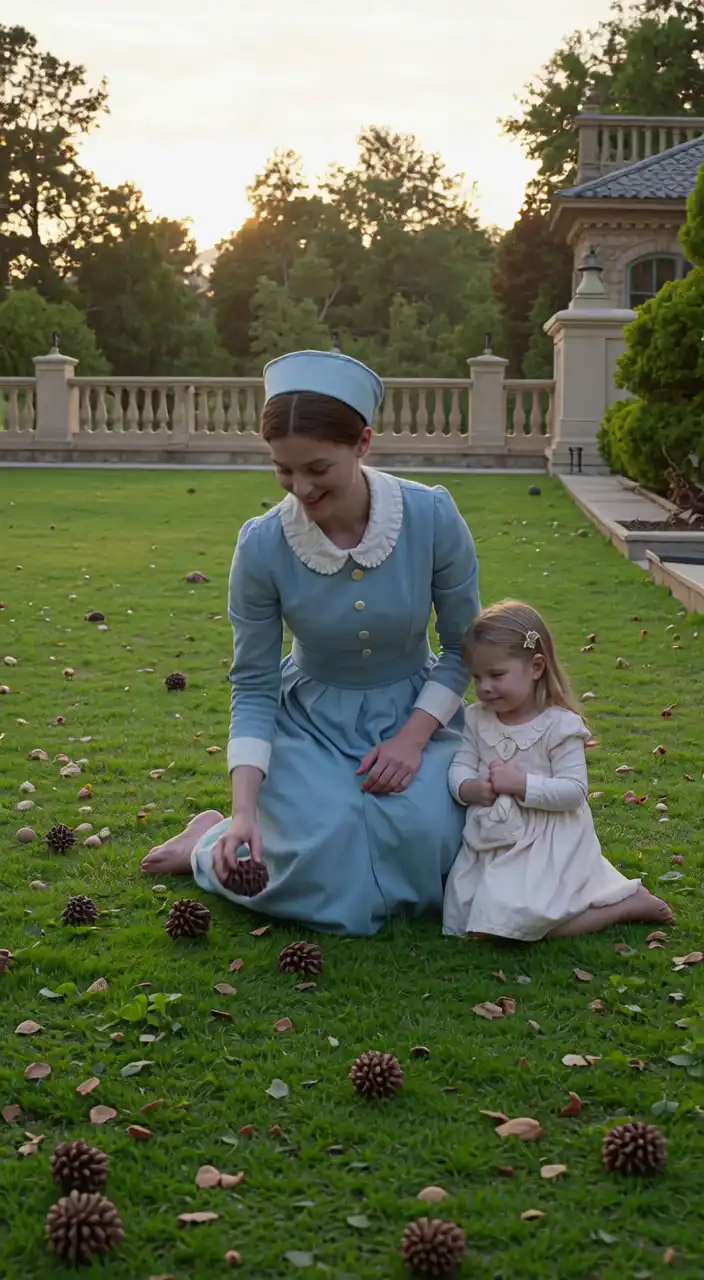
She found Ivy and Willa on the back lawn under a maple tree. Ivy had spread a blanket on the grass. Willa sat barefoot at its edge, touching clover blossoms while Ivy made a tiny procession of pinecones.
Elaine stopped dead. “Why is she outside without shoes?”
Ivy looked up. “Because she wanted to feel the grass.”
“That is not an answer.”
Willa flinched at the sharper voice and drew her ribbon tight.
Elaine turned toward the patio where Gavin had just stepped out with his phone in hand. “Gavin, what exactly is going on here?”
He frowned. “Mother.”
“I leave this house for two weeks and return to find my granddaughter sitting on the ground like a farm child.”
“It’s clean grass,” Ivy said evenly.
Elaine gave her a cold glance. “And you are speaking out of turn.”
Ivy stood. “With respect, ma’am, Willa was calm until now.”
“That child needs consistency, therapy, and proper care. Not improvisation.”
Gavin’s jaw tightened. “Ivy has been helping.”
“Helping?” Elaine repeated. “By undoing structure? By taking her into the garden barefoot? By feeding her on kitchen floors? Serena would never have approved of this chaos.”
The words landed like stones.
Willa made a soft sound in her throat and began to rock slightly.
Ivy dropped back to the blanket immediately, lowering her voice. “Hey, Willa. I’m here. Look, the pinecone train is waiting.”
Elaine stared. “Good Lord.”
Gavin said, too sharply, “That’s enough.”
But the damage had been done. Willa’s breathing turned shallow. She clutched the cloth heart and turned away from all of them, her little body curving inward.
Elaine looked offended, as if grief itself had slighted her.
Later, inside the study, the argument was worse.
“She is crossing boundaries,” Elaine said. “Staff are whispering. The child is becoming attached in an unhealthy way.”
“Attached?” Gavin repeated. “To a person who comforts her? Yes. That’s generally how attachment works.”
Elaine ignored the edge in his voice. “You are vulnerable right now, and that young woman knows exactly how to position herself in a house like this.”
Lena, who had stayed after hearing the raised voices, snapped, “Oh, for heaven’s sake. Not everyone is running a social strategy, Elaine.”
“I am trying to protect this family.”
“From what?” Lena shot back. “A nanny who sits in the grass?”
Elaine turned to Gavin. “I want her supervised. Closely. And I do not want Willa encouraged to depend on someone temporary.”
At that, silence fell.
Temporary.
The word seemed to move through the room like a draft.
Because that was the truth beneath all of it. No matter how gentle Ivy was, no matter how much Willa softened around her, she was still an employee. Someone who could leave. Someone who might leave.
Gavin looked toward the window, out across the back gardens where Willa had just begun to notice butterflies.
“I don’t know what I’m doing,” he admitted quietly.
Elaine’s expression softened a little. “Then do not hand your daughter’s heart to a stranger.”
That night he canceled his last meeting and stood outside the nursery longer than usual. Inside, Ivy sat in the rocking chair reading in a low voice while Willa lay awake in bed, staring at the ceiling but listening.
When Ivy emerged, Gavin said, “My mother thinks you’re overstepping.”
Ivy nodded as if she had expected that. “Probably.”
“That doesn’t concern you?”
“It concerns me if it affects Willa.”
He studied her. “You really think these methods are worth the disruption?”
“I think children like your daughter don’t heal because adults maintain appearances.” She met his gaze steadily. “They heal when they feel safe enough to want connection again.”
“And if attachment to you makes it worse later?”
Her eyes flickered, the first sign of hurt he had seen. “Then we handle that honestly. But withholding care because goodbye might happen is still a kind of abandonment.”
He had no answer to that.
Neither of them noticed Willa standing in the half-open nursery doorway, ribbon in hand, listening with solemn green eyes.
The pressure in the house changed after Elaine’s visit.
No one openly challenged Ivy in front of Gavin, but the undercurrents were obvious. Mrs. Delaney remained kind yet more formal. The chef asked whether “garden snacks” were really appropriate. A senior house manager quietly returned the nursery furniture Ivy had shifted to create more floor space. When Ivy took Willa outdoors, one of the groundskeepers seemed suddenly assigned nearby every time, as if observation itself might restore order.
Willa felt all of it.
Children always did.
Her small gains became less steady. She still waited by the window for Ivy in the mornings, but she startled more easily. Twice she refused lunch. Once she cried soundlessly when Ivy left the room for only a minute. Her body, which had begun to trust, now seemed braced for something it could not name.
On Thursday afternoon, Gavin found Ivy on the terrace after a difficult morning.
“She had a rough session with the speech therapist,” Ivy said.
“She threw the flash cards.”
“She was overwhelmed.”
He exhaled. “My mother called again. She wants me to bring in a new child psychiatrist from Manhattan.”
Ivy’s mouth tightened. “Do you want to?”
“I want my daughter better.”
“That’s not the same question.”
He looked past her through the French doors where Willa sat on the floor, rubbing the cloth heart against her cheek.
“Do you know what the worst part is?” he asked. “I can build systems. I can fix companies. I can walk into chaos and create order in twenty-four hours. But with her…” His voice failed for a moment. “I walk into a room and everything in me wants to reach for her, and I don’t know how without making it worse.”
Ivy was quiet before she said, “Then stop reaching for a result.”
He frowned. “What does that mean?”
“It means sit with her without asking her to prove she loves you back. Let her feel you there.”
He gave a short humorless laugh. “You make that sound simple.”
“It isn’t. It’s just human.”
That evening brought another clash.
Elaine stayed for dinner and watched with thinly veiled disapproval as Willa sat not in the formal dining room but in a high-backed chair in the breakfast nook off the kitchen, where Ivy had found she tolerated meals better. Gavin had agreed to it because Willa actually ate there.
During dessert, Elaine set down her spoon. “This cannot continue.”
Lena rolled her eyes. “Oh, good. We haven’t fought in almost six hours.”
“I am not fighting,” Elaine said. “I am stating what everyone else is too afraid to say. The child is becoming overdependent. She follows that girl with her eyes every second.”
“Because Ivy is kind,” Lena replied.
“Because Ivy has inserted herself into a vulnerable space.”
Gavin put down his napkin. “Mother.”
“No. You need to hear this.” Elaine looked directly at him. “What happens when she leaves? What happens when she decides this remote estate is too lonely, or a better offer comes, or she wants a life? Willa will be shattered again.”
Ivy, who had been wiping strawberry from Willa’s hand, went still.
Elaine continued, “You cannot permit a revolving door of emotional substitutes.”
The word substitute made something flash across Gavin’s face.
Ivy rose. “I think I should take Willa upstairs.”
But Elaine was not finished. “Perhaps you should. And perhaps tomorrow you should not come back until we decide what role, if any, is appropriate here.”
Silence crashed into the room.
Willa looked from one face to another, sensing the fracture if not the language. Her fingers tightened around the ribbon. Her lower lip trembled but no sound came.
Lena stood so fast her chair scraped. “That is enough.”
Gavin remained frozen for one terrible second. His instinct to control the room warred with his fear that Elaine might be right, that a deeper attachment would only create a larger wound.
Ivy’s expression changed.
Not angry. Not dramatic.
Just hurt enough to become still.
“I understand,” she said softly. “I’ll pack a few things tonight and leave in the morning if that’s what you decide.”
Willa made a tiny breathy noise.
Ivy bent down immediately. “Hey. It’s okay.”
But Willa had already begun to fold into herself, gaze dropping, shoulders curling inward like shutters closing.
That night the house barely slept.
Gavin sat in his study staring at a spreadsheet he could not read. On the desk beside him stood a photo of Serena holding newborn Willa in the hospital, her face pale but radiant. He picked it up.
“I’m trying,” he said to the silence. “I’m trying, and I don’t know if I’m making everything worse.”
At one in the morning, he went upstairs and stopped outside the guest room where Ivy was staying. A small lamp still glowed beneath the door. He almost knocked. He did not.
At six thirty the next morning, mist hung over the gardens and the hills beyond the estate. The grounds were silver with dew. Birds moved in the hedges. Somewhere a fountain trickled in the courtyard.
Ivy came downstairs carrying her canvas duffel.
Mrs. Delaney met her in the foyer, eyes red-rimmed. “Miss Rowan… I’m sorry.”
Ivy gave her a sad smile. “It’s all right.”
“No, it isn’t.”
From the staircase landing, Lena appeared in an oversized cardigan. “Tell me you’re not actually leaving before he’s even made up his mind.”
Ivy adjusted the duffel strap. “Your mother made it clear.”
“She’s not his wife, his boss, or God.”
A humorless little laugh escaped Ivy. “No. But I won’t stay where my presence is hurting Willa.”
At that moment Gavin came out of the study, unshaven, tie undone, looking as if the night had worn grooves into him.
“Ivy.”
She turned.
He crossed the foyer, words clearly difficult. “I didn’t ask you to leave.”
“You didn’t ask me to stay either.”
He stopped.
Lena muttered, “Finally, someone says it.”
Gavin ignored her. “I needed time.”
Ivy’s voice was gentle, but there was steel under it now. “Children like Willa feel uncertainty faster than adults admit. Last night she understood enough. If I stay, it has to be with clarity.”
He looked toward the staircase instinctively, as if Willa might somehow appear there and answer for him.
Instead Mrs. Delaney whispered, “Sir… she’s not in her room.”
All of them turned.
“What do you mean not in her room?” Gavin said sharply.
“She was there when I checked ten minutes ago.”
The next seconds broke into motion.
Lena ran toward the east wing. Gavin took the back stairs two at a time. A footman searched the library. Another checked the music room. Mrs. Delaney’s voice shook as she called Willa’s name in the playroom, then in the upstairs sitting area.
Ivy stood in the foyer for one stunned second and then noticed the terrace door standing barely open.
“She likes the morning light,” she said.
They all rushed outside.
The gardens behind Mercer Hollow rolled in terraces of clipped hedges, rose beds, gravel paths, and a long lawn that stretched toward a wildflower border Serena had planted herself. Beyond that stood the old orchard and a stand of maples beginning to leaf out fully in the late spring warmth.
At first there was no sign of Willa.
Then Lena pointed. “There.”
Near the far end of the lawn, beside the butterfly garden Serena had once loved, a tiny figure in a pale yellow sweater stood unsteadily among the flowers.
Willa.
Barefoot.
Her brown curls lifted in the breeze. In one hand she held the cloth heart.
In the other, nothing.
She was farther from the house than she had ever gone alone.
“Don’t run at her,” Ivy said quickly. “You’ll scare her.”
Gavin’s heart was pounding so hard it hurt. “Willa!”
The child turned at the sound of his voice. For one awful moment it seemed she might bolt in the wrong direction toward the stone edging.
Ivy stepped forward slowly, setting down her duffel in the grass.
“Hi, Willa,” she called softly. “I’m here.”
Willa stared at her.
A monarch butterfly drifted low between them, bright orange against the morning mist.
And then the truth of the morning revealed itself.
This was a goodbye moment. Willa knew it in the only way a two-year-old could know such things: by the movement of suitcases, by adult tension, by the threat in the air. She had gone to the place where she and Ivy had watched butterflies together, the place where the world had once felt gentle.
Ivy took another slow step. “You found our garden.”
Willa’s mouth opened. No word came.
Gavin could not breathe.
Elaine had come out onto the terrace behind them in her robe, one hand pressed to her chest, stunned into silence.
Ivy crouched slightly, arms open but not demanding. “You can stay there if you want. I just wanted to say goodbye kindly.”
The word goodbye moved over the lawn like a cold wind.
Willa made a broken little sound.
It was not a cry exactly. It was worse, because it seemed pulled from someplace deeper, a place buried for months.
Ivy’s own eyes filled, but she kept her voice steady. “You are safe, Willa.”
The butterfly lifted and drifted toward Ivy.
Willa looked at it, then at Ivy’s open arms, then back toward the house where all the adults stood tense and waiting.
Something changed in her face.
Fear met want.
Want won.
With sudden, shocking determination, Willa lurched forward.
One step.
Then another.
Then, because toddlers do not run gracefully but with desperate faith, she broke into a stumbling run across the grass straight toward Ivy.
“Willa!” Gavin gasped.
Ivy dropped fully to her knees just in time to catch her.
Willa collided with her chest, both little hands clutching at Ivy’s sweater, the cloth heart trapped between them. For a second the whole world seemed to stop there in the wet morning garden, in the child’s fierce grip, in the way her body shook with effort and need.
Then Willa buried her face against Ivy’s shoulder and made the clearest sound Gavin had heard from her in nearly a year.
“No.”
Just one word.
Hoarse. Small. Trembling.
But unmistakable.
Ivy broke.
A sob escaped her as she wrapped her arms around the little girl. “Okay,” she whispered. “Okay, sweetheart. I’m here. I’m here.”
Behind them, Gavin stood rooted to the lawn as tears hit him without warning, hot and relentless. He covered his mouth with one hand, but it did nothing. Months of helplessness, guilt, exhaustion, and guarded hope split wide open inside him.
His daughter had run.
Toward someone.
For someone.
Because she wanted connection badly enough to chase it.
Lena was crying openly. Mrs. Delaney had both hands clasped to her apron. Even Elaine, on the terrace, looked shaken to the core.
Willa clung harder. Ivy rocked her gently, forehead against her hair.
“You came to get me,” Ivy whispered. “You brave, brave girl.”
Gavin took a step forward, then stopped, uncertain.
Ivy looked up through tears. “Come here,” she said softly.
He moved as if waking from a dream and sank to the grass beside them. Close enough to touch. Not close enough to crowd.
Willa’s face remained hidden against Ivy, but she did not recoil from his presence.
Gavin’s voice shattered. “Hi, bug.”
A tiny hand emerged from Ivy’s sweater and, blindly, found his sleeve.
He bowed over that hand as if it were a miracle.
“I’m here too,” he whispered. “I’m here.”
No one spoke for a long time.
Butterflies moved among the flowers Serena had planted. The mist lifted. Morning widened over the estate. And on the wet grass of a garden built by a woman gone too soon, her daughter chose the living with all the strength her small body had.
The story of what happened in the garden spread through Mercer Hollow before breakfast was cleared.
Not because the staff gossiped cruelly, but because something impossible had become real in front of too many witnesses to deny. The withdrawn little girl who barely reacted, who had lived for months behind distant green eyes, had left the house on her own, crossed the lawn, and run into Ivy Rowan’s arms with a word that changed everything.
By ten o’clock the house no longer felt like a mausoleum.
It was still quiet, but not with the same dead quiet. This was the hush that follows a storm when everyone steps outside and realizes the trees are still standing.
Willa spent the morning in the sunroom with Ivy on the floor beside her. She stayed close, occasionally pressing her knee against Ivy’s leg as if verifying she remained there. Every few minutes she looked up and then back down to her ribbon, recalibrating reality. Ivy did not overtalk the moment or treat it like a performance to be repeated. She simply stayed.
Gavin stood in the doorway for a while before entering.
“Can I sit?” he asked.
Ivy glanced at Willa. “Ask her.”
He swallowed and lowered himself onto the rug a few feet away. “Willa? Can Daddy sit with you?”
Willa’s fingers paused on the cloth heart. She did not look at him, but she did not turn away.
Ivy smiled faintly. “I think that’s a yes.”
He let out a shaky breath. “I’m not sure I deserve one.”
“You don’t earn children,” Ivy said quietly. “You show up.”
Across the room, the family therapist who had arrived for a scheduled session looked almost disoriented. Dr. Maren Holt had spent months documenting Willa’s detachment, her minimal responsiveness, her trauma indicators. Now she watched the child lean against Ivy’s side while keeping one hand stretched toward Gavin’s pant leg.
“This is significant,” she said at last.
Lena, sitting in a window chair, gave a half laugh through tears. “That might be the understatement of the year.”
Dr. Holt knelt carefully. “Mr. Mercer, what happened this morning suggests attachment desire, symbolic association, and voluntary motor initiative under emotional activation.”
Gavin blinked at her. “In English?”
“It means,” Ivy said gently, “she wanted someone enough to move.”
The therapist nodded. “And she chose connection under stress rather than deeper withdrawal. That matters.”
Elaine entered then, slower than usual, all her certainty washed pale. She stood near the threshold for several moments before speaking.
“I owe you an apology,” she said to Ivy.
The room went still.
Ivy looked up. “You don’t owe me anything.”
“Yes,” Elaine said, her voice thinner than Gavin had ever heard it. “I do. I thought I was protecting her. Perhaps I was protecting myself from another loss I could not manage.”
No one interrupted.
Elaine looked at Willa, and when she spoke again, her composure broke just a little. “I have not seen her reach for anyone since Serena died.”
Gavin turned away sharply, emotion threatening again.
Elaine faced him. “And I was wrong, Gavin. Terribly wrong.”
He held her gaze for a long moment, then nodded once. It was not full forgiveness, not yet, but it was a beginning.
Later, after lunch, Gavin found Ivy in the back garden while Willa napped. The butterfly bed shivered in the breeze. Ivy stood with her hands in her sweater pockets, looking out over the lawn where the morning had unfolded.
“I should thank you,” he said.
She shook her head. “Thank Willa. She did the brave part.”
He stepped closer. “You stayed when this family made it difficult.”
“I almost didn’t.”
“I know.”
He looked down at the grass. “When I saw her run to you…” His voice caught. “I thought I’d be jealous. Or ashamed. Instead I was just—” He broke off, pressing his hand hard over his eyes. “God, I was so relieved.”
The tears came again, less violently than before but no less honestly. Gavin Mercer, who negotiated with boards and governments without blinking, stood in his own garden and cried because his daughter had chosen life in a visible way.
Ivy moved nearer but did not touch him until he nodded once. Then she rested a hand lightly on his arm.
“You didn’t lose her,” she said.
“I thought I had.”
“No. She was waiting for safety.”
He let out a raw breath. “And I didn’t know how to give it.”
“You’re learning.”
He laughed once, bitter and soft. “At thirty-eight. Billionaire founder. Public genius. Private idiot.”
Ivy smiled. “Private grieving father.”
That landed differently. Kinder.
He looked at her. “Stay.”
It was a simple word, but nothing in him had ever asked so plainly.
Ivy’s expression changed. “Are you sure?”
“Yes.”
“No half-decisions? No revisiting this after the next argument with your mother?”
He shook his head. “Stay in whatever role Willa needs. Stay as long as she needs an anchor here. We’ll make it formal, permanent, whatever support you require. But stay.”
Ivy glanced toward the house where Willa slept under a window Serena had once painted with stars. “I’ll stay.”
When Willa woke, they went back outside together.
This time Gavin joined them correctly.
Not trying to lead. Not trying to force delight. He sat on the grass while Ivy and Willa watched two yellow butterflies stagger over the lavender. After a while Ivy handed him a soft fallen blossom.
“Your turn,” she murmured.
He looked at Willa and copied what Ivy had done for days. He placed the blossom beside Willa’s ribbon and said, quietly, “This one’s wearing a fancy hat.”
Willa looked at the flower.
Then, to Gavin’s astonishment, the corner of her mouth lifted.
Not a full smile. Barely even that.
But real.
His breath left him in a whisper. “Hi there.”
Willa shifted closer, enough that her little shoulder touched his knee while still leaning into Ivy.
It was not a replacement. Not a competition. It was the beginning of a new shape, one that made room for grief and healing at the same time.
That evening the house changed in visible ways. The formal nursery schedule was loosened. The therapist revised Willa’s treatment plan to center relational safety. Mrs. Delaney brought snacks to the sunroom without being asked. The chef sent out a plate of butterfly-shaped cookies no one pretended were for the adults.
And Elaine, before returning to her suite, paused beside Ivy in the hall.
“Serena loved that garden,” she said quietly.
“I know.”
Elaine glanced toward Willa’s room. “Thank you for taking her there.”
Ivy answered with equal softness. “She took herself.”
Ivy moved from the guest room to a sunny set of rooms near the nursery the following week, not as a temporary employee waiting for the next family, but as a permanent part of Mercer Hollow’s inner life.
The paperwork called her Willa’s private developmental caregiver. Lena called her “the only person in this house with common sense.” Mrs. Delaney began leaving fresh tea outside her door in the evenings. Even the staff who had once watched her with suspicion relaxed when they saw how the child’s days now unfolded: calmer mornings, easier meals, fewer frozen silences, more moments of watchful curiosity.
And every afternoon, when weather allowed, Ivy took Willa to the garden.
Sometimes they chased butterflies. Sometimes they only sat in the grass and watched the sky move between the branches. Sometimes Gavin joined them after ending his calls early, his suit jacket discarded, shoes in his hand as he crossed the lawn like a man relearning his own life.
He changed more than his schedule.
He stopped taking evening meetings three nights a week. He learned how to sit on the nursery floor and let long quiet minutes pass without panicking. He learned Willa’s signs: the tightness around her eyes before she shut down, the way she rubbed the ribbon faster when overwhelmed, the tiny shifts that meant yes, no, enough, maybe. Under Ivy’s gentle guidance, father and daughter began building a language made of patience, repetition, and presence.
One afternoon, under a sky washed gold by sunset, Willa toddled through the butterfly bed with Ivy just ahead of her and Gavin close behind. She laughed then—soft and startled, as if the sound had surprised even her.
Gavin stopped walking.
Ivy turned and smiled.
“There she is,” she whispered.
The new emotional order of the house did not erase Serena. Her photos remained on the shelves. Her blanket stayed on the rocking chair. Her garden bloomed brighter than ever. But the estate no longer felt trapped in the moment she died. Love had shifted, stretched, made room for the living without betraying the dead.
Willa still had hard days. Healing was not a straight line, and everyone in the house learned to respect that. But now, when she retreated, she came back faster. Now she reached. Now she waited at windows. Now she knew that when morning came, someone would meet her exactly where she was.
And Ivy stayed.
In time, the memory of that misty morning in the garden became part of Mercer Hollow’s foundation, spoken of softly and held with reverence. It was the day a little girl crossed the distance between herself and the world. It was the day a father saw hope with his own eyes. It was the day grief loosened its grip just enough for love to move again.
On spring evenings, the three of them could often be found near the wildflower border Serena had planted: a child with green eyes and a ribbon in her hand, a young woman kneeling in the grass beside her, and a father learning that sometimes the truest way to protect what you love is simply to stay close enough to witness it bloom.
And when butterflies rose above the lavender, Willa always looked up first.
Disclaimer: Mention of any brand or trademark is for identification only and does not imply partnership or endorsement