THE BOY WHO WHISPERED MORE
The boardroom on the fifty-second floor of Halbrecht Global overlooked most of Cedar Hollow, North Carolina. Glass walls framed a blue spring sky, and a polished black table reflected the faces of twelve executives waiting for their CEO to finish reading the final terms of a three-hundred-million-dollar acquisition.
Graham Halbrecht stared at page seven without seeing a word.
"Sir?" his attorney prompted softly. "If you approve the revised language, we can close before noon."
Graham looked up. Every eye in the room moved toward him at once. Men and women who had negotiated with heads of state, competitors, and regulators still held their breath when Graham Halbrecht fell silent. At forty-one, he had built a logistics empire that touched ports, rail lines, software systems, and freight corridors across the country. Magazines called him ruthless. Television hosts called him visionary. Shareholders called him indispensable.
None of those words mattered at eight-thirty-two on a Wednesday morning, when all he could think about was whether his three-year-old son had eaten breakfast.
"Push the indemnity cap to eight percent," Graham said automatically.
The chief financial officer blinked. "We already did."
"Then why are we still talking?"
No one answered. The attorney cleared his throat. "Because we need your signature."
Graham picked up his fountain pen, then stopped. His phone, face down beside his legal pad, buzzed once. The vibration was small, nearly silent. But his pulse jumped hard enough to make his grip tighten.
He turned the phone over.
ESTATE MANAGER.
A cold knot formed under his ribs.
"Take five," he said, standing so abruptly his chair rolled backward.
"Mr. Halbrecht, the buyers are on video from Seattle," someone protested.
"They can wait."
He walked out before anyone could say more. The hallway outside the boardroom smelled faintly of coffee and lemon polish. He answered the call on the second ring.
"Marisol?"
The estate manager's voice was composed in the practiced way of people who worked around grief and money. "I'm sorry to interrupt your meeting, Mr. Halbrecht. There isn't an emergency, exactly."
His hand braced against the wall. "Then why are you calling me during a closing?"
There was a pause. "Milo's morning therapist says he became distressed during stretching. He cried for twenty minutes. He wouldn't settle for anyone."
Graham closed his eyes.
"Did he fall? Did something happen?"
"No, sir. He was safe. But he kept turning his head toward the hallway." Another pause. Softer this time. "It seemed like he was waiting for someone."
The words hit him with cruel precision.
"For me?" Graham asked, though he already knew the answer and feared it.
"I can't say for certain."
He thanked her, ended the call, and stood alone in the corridor with the skyline spread beyond the windows. His reflection in the glass looked like a man held together by expensive wool, long hours, and stubbornness. But behind the image was another life, the one he could never repair.
His wife, Eliza, had died twenty-two months earlier.
A rare disease had taken her slowly and mercilessly, piece by piece, while specialists flew in from Boston, Houston, San Diego, anywhere with a new treatment or a fragile maybe. Graham had bought time in every form money could purchase. Private care. experimental trials. round-the-clock nurses. consultations on secure video calls at three in the morning. None of it had saved her.
She had been the warm center of their house, the soft laugh in every hallway, the one who could make even Graham's brutal schedule bend around dinner, birthdays, bedtime songs. She had also been the one person who knew instinctively how to reach their son.
After her death, the mansion on Briar Gate Estate became too large for sound. The staff moved carefully. Doors shut quietly. Footsteps softened on rugs. Meals appeared and disappeared. The fountains ran in the courtyard. The gardeners trimmed the hedges. The chef made Graham's coffee exactly the way he liked it.
And upstairs, in the nursery redesigned into a therapy room and bedroom suite, little Milo Halbrecht lived in a body that did not obey him.
Milo was three years old, with curly brown hair that fell over his forehead in loose, shining rings and huge brown eyes that seemed too deep and watchful for a child so young. Cerebral palsy stiffened his limbs and limited his movement. Some mornings his hands stayed fisted tight against his chest. Some days his legs trembled with effort when therapists tried to guide them. He could not run, could not climb, could not throw himself recklessly into the world the way other boys his age did. Even sitting upright without support could exhaust him.
And after Eliza died, something else seemed to close inside him too.
He rarely made a sound.
Not because he had no voice. Doctors said he could vocalize. They said language might come slowly. They said grief, frustration, and pain could all deepen silence. Graham had heard every clinical explanation available, each one cleaner and less devastating than the truth he felt every night.
His son did not know how to live in a world without his mother, and Graham did not know how to guide him through it.
When Graham went home after midnight, he often stood in Milo's doorway and watched him sleep in the dim light of the monitor. Tiny chest rising. Curl of lashes against round cheeks. One hand twisted in the blanket. The sight of him was so sweet it hurt. The sight of him was a wound.
During the day, Graham tried. He crouched beside therapy mats and held bright wooden blocks in front of Milo's face.
"Look, buddy. Red or blue? Want the blue one?"
Milo's eyes tracked the window instead.
At dinner, Graham lifted a spoon of puree and said, "One bite for Dad."
Milo swallowed if fed, but never reached.
In the playroom, surrounded by imported toys chosen by child development specialists, Graham sat on the floor in a thousand-dollar suit and attempted a smile.
"You know, your mom used to beat me at every game. Every one. We should team up against her memory, huh?"
Milo stared past him at Eliza's photograph on the bookshelf.
That photograph was always there. Eliza in a cream sweater, laughing into wind, one hand on the stroller handle, the other touching baby Milo's socked foot. The frame had become a compass point in the child's world. Sometimes he would turn toward it and go still, as if listening to something no one else could hear.
Graham went back into the boardroom ten minutes later, signed the papers, shook hands, listened to congratulations, and felt none of it.
By the time he returned to Briar Gate that evening, the sunset was burning orange behind the iron gates and the long gravel drive. The mansion rose pale and elegant beyond the gardens, all columns and stone terraces and dark windows catching the last light. It looked like security from a distance. Inside, it felt like absence.
He found Milo in the therapy room, propped with cushions near the low window seat. Marisol stood nearby. A physical therapist packed resistance bands into a canvas bag.
"He had a hard morning," she said gently. "But we got through part of the session."
Graham nodded. "Thanks."
When they were alone, he knelt beside his son.
"Hey, pal."
Milo's lashes flickered once. Nothing more.
Graham touched the small curl at his temple. "I had meetings all day. I'm sorry."
No response.
"Do you want to see the garden lights?"
Milo's gaze remained fixed on the dimming sky.
Graham swallowed. "Do you want me to read to you?"
Silence.
In the hall outside, house staff moved quietly toward dinner service. Somewhere downstairs, dishes clinked. The sounds only deepened the emptiness between father and son.
That night, after Milo was asleep, Graham sat alone in his study with old photo albums spread open across his desk. Eliza in a hospital scarf, smiling anyway. Eliza holding Milo skin-to-skin when he was born early. Eliza barefoot in the estate gardens, kneeling in the grass so Milo could feel clover on his palm.
Graham pressed a hand over his mouth.
He had hired pediatric neurologists, occupational therapists, speech specialists, mobility consultants, and six nannies in nineteen months. Some had been kind. Some had been polished. Some had been experts in special needs care. None had stayed long. Milo's care demands were constant, his silence unnerving, the house too formal, the grief too thick.
That afternoon, another candidate had declined before even visiting.
Too complex, the agency had said.
Graham stared at Eliza's picture until the room blurred.
"I don't know what to do anymore," he whispered into the silence.
The next morning, he told Marisol, "Send me whoever is left."
Even as he said it, it felt less like a decision and more like the last thing a drowning man says before letting go.
Two days later, rain washed the estate in silver. The gardens shone wet and dark beneath a low sky, and the front drive reflected the mansion's white stone like a mirror.
Marisol met Graham in the foyer at nine sharp. "The agency only had one person willing to come on short notice."
"That's encouraging," Graham said dryly.
She hesitated. "She doesn't have the kind of resume you usually request."
"At this point, Marisol, I don't care if she arrives on a bicycle and studied childcare from library books. Can she lift thirty pounds safely, follow medication schedules, and stay calm under pressure?"
"So she claims."
The front doors opened before either of them could say more.
A young woman stepped inside carrying a faded green duffel bag and an umbrella dripping onto the marble. She looked about twenty-three. Her blond hair was braided loosely over one shoulder, already escaping in soft strands from the rain. She wore jeans, brown boots, and a navy sweater with the sleeves pushed to her elbows. Her face held no expensive polish, no calculated poise. She looked fresh from weather and real life.
She also did not look intimidated.
"I'm Wren Calloway," she said, closing the umbrella. "Sorry. The driver said the side road floods easy."
Marisol blinked at the puddle on the floor.
Graham's first thought was that the agency had lost its mind.
His second was that Wren had the steady eyes of someone who did not pretend.
"Mr. Halbrecht," he said.
She shook his hand without fuss. "I know who you are."
"Most people say that with either awe or resentment."
Wren gave a small smile. "Mostly the internet says it for me."
Marisol made a faint sound that might have been alarm.
Graham gestured toward the sitting room. "Let's talk."
She followed, leaving damp boot prints on the marble. In the sitting room, she sat when invited but perched on the edge of nothing. She set her duffel at her feet and folded her hands.
Graham opened the thin agency file. Summer camp assistant. Two years in adaptive recreation at a nonprofit center in Boise Ridge, Montana. Seasonal aide on therapeutic trail programs for children with mobility limitations. No elite household experience. No private estate references. No mention of luxury service standards.
"You're aware my son has cerebral palsy," Graham said.
"Yes."
"He requires assistance with most physical tasks."
"Yes."
"He has limited speech."
Wren nodded. "I read that too."
"He doesn't warm up to strangers."
"That part I assumed."
Graham studied her. "And yet you took the job."
"I took the interview."
"No one else did."
Her expression softened, not with pity exactly, but with understanding. "Children know when adults come in acting scared of them."
"He isn't frightening."
"I didn't say he was." She glanced toward the windows where rain slid down the glass. "I said adults get scared. Of doing it wrong. Of silence. Of pain they can't fix."
Something in his chest tightened.
"What makes you think you're different?"
Wren thought about it. "I don't need him to perform for me."
Marisol, standing discreetly near the door, finally spoke. "Miss Calloway, this is a highly structured household. There are schedules, therapy blocks, dietary protocols, sanitation procedures—"
Wren turned politely. "Good. Kids need consistency."
"They also need boundaries."
"Of course."
Graham leaned back. "And can you follow them?"
"I can follow the ones that help him."
The room went still.
For reasons Graham could not immediately explain, he did not end the interview there.
Instead he said, "You'll meet him now."
Milo's room faced the eastern gardens. The rain made the world outside soft and green. Inside, every toy had its place. Books lined low shelves. Adaptive seating stood beside the window. Therapy wedges and cushions occupied one corner. It was a beautiful room designed by experts and arranged by adults. It felt more like a clinic than a childhood.
Milo sat in a supportive chair near the glass, a knitted blanket over his legs. His curly brown hair needed trimming. His gaze rested on the blurred movement of rain on leaves.
"This is my son," Graham said quietly.
Wren did not move toward him right away. "Hi, Milo."
No response.
Most candidates filled silence with bright, nervous chatter. Wren simply took in the room, then lowered her duffel by the door, removed her boots, and crossed the rug in socks. Without asking for a chair, she sat on the floor about six feet away.
Graham frowned.
Wren folded one leg under her and looked out the window too. "Rain sounds different when you're close to glass," she said conversationally. "On a porch roof it's loud. On leaves it's whispery."
Milo did not turn.
She waited.
After a full minute, Graham said, "He usually needs encouragement to engage."
Wren lifted a hand slightly, not shushing him, but asking for quiet.
She stayed where she was. "I used to work with a girl who hated everybody talking at her when she was tired. So we watched clouds and judged them. Mean cloud. Sad cloud. Potato cloud."
A tiny shift crossed Milo's eyes.
It was so small Graham almost missed it.
Wren saw it. She did not pounce.
"That one out there?" she went on, studying the wet garden beyond the window. "Looks like a turtle who forgot where he parked."
Milo's fingers twitched against the blanket.
Graham stared.
Wren slowly widened her eyes into an exaggerated turtle face, lower lip tucked, neck stretched comically forward. It was absurd. Not elegant. Not therapeutic in any polished sense. Just silly.
For the first time since Graham had entered, Milo's gaze moved from the rain to her face.
The contact lasted maybe two seconds.
Then it broke.
But Graham felt it as sharply as a struck bell.
Wren let out a soft, thoughtful hum, as if nothing monumental had happened. "You don't have to like me today," she told Milo. "I'm just saying if that cloud starts driving, it should not be allowed on a highway."
Marisol looked startled enough to intervene, but Graham lifted one hand to stop her.
Another minute passed. Then Wren tipped her own head to one side and made a cross-eyed expression at the window, as though inspecting invisible cloud traffic regulations.
Milo blinked.
Not a full smile. Not even close.
But there was a pause in the stillness that had ruled him.
Wren rose only when Marisol reminded her about the rest of the house tour.
At the door, Graham glanced back. Milo was still looking toward the patch of rug where she had sat.
In the hall, Graham kept his voice even. "He looks at many things."
"He looked at me back," Wren said.
"It was a reflex."
"Maybe." She slid her boots on. "Maybe not."
He should have dismissed her certainty as arrogance. Instead it unsettled him because it sounded too calm to be either hopeful fantasy or a sales pitch.
By lunch, the paperwork was signed for a one-week trial.
That afternoon, while Graham took a call in his study, he happened to pass the monitor screen connected to Milo's room. He paused.
Wren was on the floor again, sitting with her back against the window seat. She wasn't holding flashcards or demonstrating motor prompts. She was making ridiculous faces: puffed cheeks, fish lips, bug eyes, an exaggerated gasp as if invisible squirrels had committed a felony.
Milo's expression remained solemn.
But every few moments, his eyes flicked to her mouth.
At one point his body stilled in a different way—not shut down, but attentive.
Wren smiled, small and private, like someone who had heard a door unlock somewhere very far inside a house.
Graham walked away before anyone saw him watching.
That evening, Wren handed him a short care log. Feeding okay. Stretching tolerated. One episode of frustration during transfer, settled with humming and slow breathing. Good visual tracking during quiet play.
"That's all?" he asked.
"That's plenty for day one."
"You sound certain."
"I am."
He almost argued. Instead he glanced toward the hallway leading to Milo's suite.
For the first time in months, certainty did not sound like cruelty.
It sounded like the beginning of something he was afraid to believe.
By the fourth day, Wren had learned the rhythms of Milo's distress.
It often began with the smallest signs: the tightening of his jaw, a flutter in his breath, fingers curling inward until his knuckles paled. If a transfer from chair to mat went badly, or if a muscle spasm caught him by surprise, frustration rushed through his little body faster than words ever could. The old pattern in the house had been immediate correction. Reposition him. distract him. talk louder. offer a toy. call for help.
Wren did almost none of that.
When Milo's eyes went wide and wet and his breath turned jagged, she lowered herself to his level and waited for permission the way one might wait at the edge of a frightened animal's reach. Not pitying. Not dramatic. Present.
"I'm here," she would say softly.
If he turned his face away, she did not chase it.
If he made that strained, angry sound from deep in his chest, she matched the rhythm of his breathing with a low hum, not touching him until the tension in his shoulders eased just enough. Sometimes she tapped a slow beat against the floorboards beside him. Sometimes she rocked very slightly where he could see it, offering calm without imposing it.
One afternoon, during a difficult stretch session, Milo's legs stiffened painfully and he started to cry. The physical therapist reached for a toy with flashing lights.
Wren touched her arm. "Wait."
She knelt near Milo and made no attempt to cheer him up. She simply breathed in a deep slow count, then out again with a gentle humming note. Once. Twice.
Milo's sobs hitched.
"That's it," Wren whispered. "You don't have to be brave right this second. Just be with me."
He stared at her mouth.
She hummed again, the same tone.
After a few moments, his breathing began—barely—to match the pattern.
The therapist stared. "I've never seen him settle that fast."
Wren kept her eyes on Milo. "He's not fighting us. He's scared."
When he accepted it, she offered two fingers into his palm. Sometimes he ignored them. Sometimes his fist unclenched just enough to hook around them. On those days, victory looked like almost nothing at all. A softer breath. A quieter cry. The slight release of a locked shoulder.
But in that house, almost nothing became everything.
Trust began there, not in miracles, but in the repeated experience of not being forced.
Then came the silly faces.
Wren discovered that if she waited until Milo was calm—not tired, not overwhelmed, just quietly alert—and then crossed her eyes or inflated one cheek like a lopsided toad, his focus sharpened in a way no flashcard ever had. She turned it into a private ritual. Never loud. Never frantic. Just the two of them, measuring the world in ridiculous expressions.
"Your turn," she would say, though she knew he could not fully imitate her.
Sometimes his lips trembled at one corner.
Sometimes his eyes brightened and held.
Sometimes a tiny puff of air escaped him that might have been the shape of a laugh if his muscles had obeyed more easily.
She celebrated each attempt as if he had delivered a speech.
"That was excellent grumpy-fish face," she told him one morning. "Terrible manners. Ten out of ten."
At bath time, she narrated the steam on the mirror like weather reports.
At snack time, she let him feel the cool smooth skin of a pear before it was pureed.
When the weather cleared, she opened the French doors to the covered terrace so he could hear birds close-up. She described clouds, ladybugs, the fountain spray, the smell of wet rosemary from the garden beds.
She treated him not like a list of deficits, but like a boy.
And Milo, in tiny ways, began to anticipate her.
His eyes went to the door before her shift started.
His body relaxed faster in her arms during transfers.
He tolerated stretches longer if she hummed first.
Once, when she widened her eyes and gasped theatrically at a robin outside the window, he made a breathy sound so sudden and startling that both women nearby froze.
Marisol put a hand to her chest. "Was that—"
"A sound," Wren said quietly, smiling at Milo. "A very opinionated one."
The first real change was not speech, or even a smile.
It was expectation.
One afternoon Graham came home early enough to pass Milo's room before dinner. The door was cracked. He heard Wren inside.
"No, absolutely not," she was saying in mock seriousness. "Those eyebrows are illegal. If you raise them any higher, I'll have to call the eyebrow police."
Graham looked in.
Milo lay supported on a floor cushion while Wren lay on her stomach opposite him, chin in her hands. She lifted one eyebrow high, then the other, then both, making her face a ludicrous puppet show of alarm. Milo watched with intense concentration. And when she pretended to faint from the scandal of his expression, his eyes lit with unmistakable anticipation before she even moved.
He knew the game.
Graham felt the realization physically.
Wren noticed him and sat up. "You're home early."
Milo's gaze shifted toward Graham, then back to her.
A month ago that would not have hurt. Now it did.
"Continue," Graham said.
Wren smiled at Milo again. "Your dad looks concerned. Should we demonstrate advanced eyebrow crimes?"
Graham's mouth almost twitched.
But hope did not enter Briar Gate without resistance.
The first conflict came from Graham himself, though he did not think of it that way. He thought of it as maintaining order.
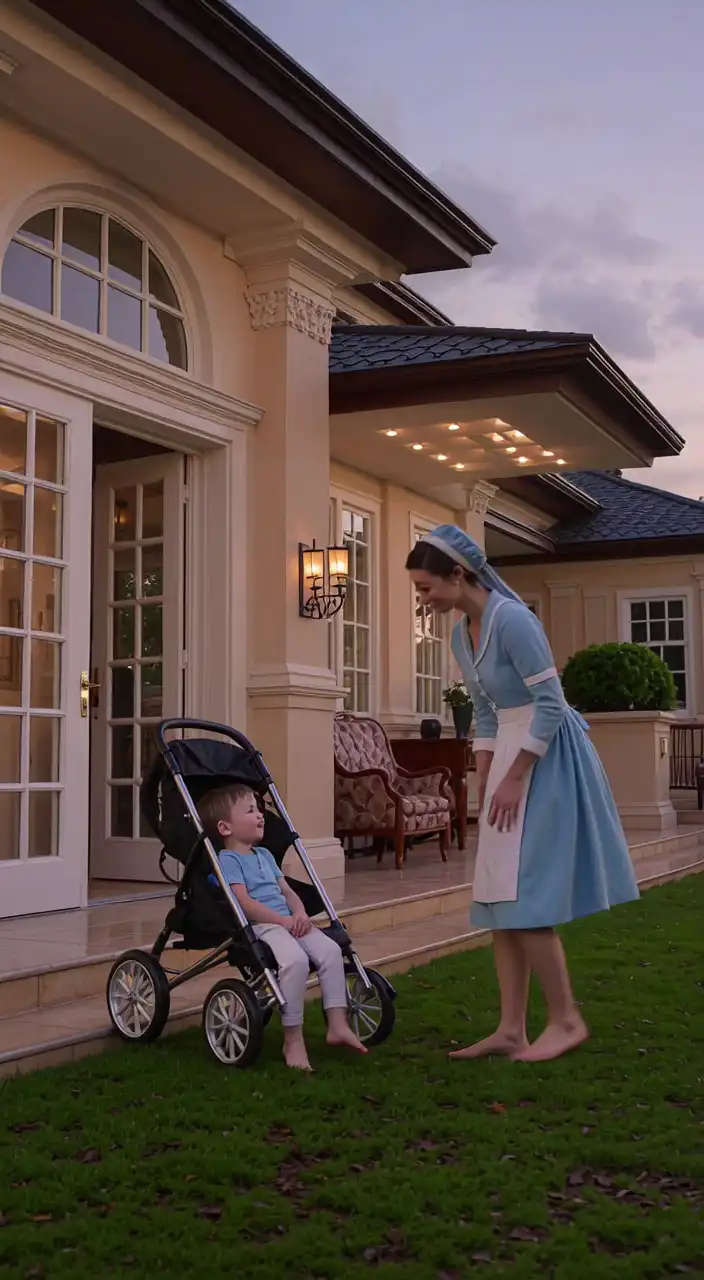
He found Wren on the side lawn late one morning with Milo bundled in a soft jacket, supported in an adaptive stroller while his bare feet rested against a folded fleece blanket. She had parked him beside the herb garden where the grass grew thick near the stone path. Her own boots were off. She stood barefoot in the damp lawn, face turned up to the sun, then bent and brushed her toes through the grass.
"See?" she told Milo. "Cold first. Then soft."
Graham stopped short on the terrace. "What is this?"
Wren looked up. "Sensory time."
"He isn't supposed to be out on wet ground."
"He's not on the ground."
"He doesn't belong barefoot outside."
"He isn't barefoot outside. I'm barefoot outside." She crouched near Milo. "I'm demonstrating that the earth has not declared war."
Graham descended the steps, irritation sharpening his tone. "There are protocols for hygiene, temperature, and safety on this estate."
"He's wearing socks," Wren said evenly.
"That isn't the point."
"What is the point?"
The staff gardener nearby suddenly found the rose bushes fascinating.
Graham lowered his voice. "The point is that I hired you to care for my son, not experiment with him."
At once, Milo's shoulders tensed.
Wren noticed before Graham did. She softened her face and spoke to the child, not the father. "You're okay. Big voices, little problem."
Then she stood. "He likes the air. He calms outside."
"I've built therapy rooms, hired specialists, converted half this house for his needs."
"I know."
"And yet you take him to the lawn like that's somehow better than everything else?"
"No." Her voice remained maddeningly calm. "I take him where he can feel the world without being tested by it."
Graham folded his arms. "No barefoot games. No grass experiments. No dirt. No bringing outdoor habits inside the house. I want structure."
Wren held his gaze. "Sometimes structure can become a cage."
His expression hardened. "I don't need philosophy from a trial nanny."
"And Milo doesn't need every hour to feel like work."
Silence dropped between them.
Marisol appeared in the terrace doorway, alarm written all over her face.
Graham took a breath that did nothing to cool him. "From now on, activities remain inside approved areas unless I personally authorize them."
Wren's jaw tightened. "Understood."
He turned and walked back toward the house, furious without fully knowing at whom.
Behind him, he heard Wren murmur, "Sorry, honey."
That night he replayed the exchange and told himself he had done the right thing. Estates functioned on order. Children with complex needs required consistency. Wren was too casual, too instinctive, too comfortable improvising. He could not let the entire house begin revolving around whatever felt meaningful in the moment.
Still, over the next week, the air in Milo's room changed.
Wren obeyed the rules. She kept activities indoors. She stayed on rugs, mats, and approved furniture. She used bowls of lavender water instead of garden air, fabric scarves instead of leaves, recorded bird sounds instead of the terrace.
Milo complied with care.
But he lost that flicker of anticipation.
His distress episodes lengthened.
He stared at the French doors.
When Wren made silly faces, he still watched, but something in his focus seemed dimmer, as though he were waiting for the rest of a sentence that never came.
Graham noticed. Of course he noticed.
He also refused to admit what it meant.
One evening, he entered during a hard moment. Milo had stiffened during an evening transfer and was crying in those breathless, furious bursts that always made Graham feel as if the walls were closing in. Wren knelt in front of him, humming softly, hands resting on her own knees while she waited for him to accept touch.
Graham stepped forward. "Just pick him up."
Wren didn't look away from Milo. "Not yet."
"He's upset."
"I know."
"So comfort him."
"I am."
Graham heard the steel in her voice then, the refusal beneath the gentleness, and it struck his pride like a slap.
"I am his father," he said.
Wren finally looked up. "Then help me by getting lower and quieter."
For a second he simply stood there, stunned that anyone in his own house had spoken to him that way.
Then Milo made a ragged choking sound, and all of Graham's outrage drained into fear.
Wren turned back at once. "Easy, sweetheart. Easy."
Graham sank, awkward in his suit, to one knee beside them.
"What do I do?" he asked.
Her answer came softly. "Nothing fast."
Milo cried on. Graham's hands trembled uselessly.
For the first time, he wondered whether all his rules were not protecting his son at all, but protecting himself from the terror of not being able to control any of this.
And that question, once born, refused to leave.
Pressure built quietly after that.
Graham did not revoke his estate rules, but he stopped enforcing them with the same certainty. He found himself pausing outside doorways, listening. Watching. Learning against his own will that Wren's methods were not random rebellion but an entire language of response he had never understood.
Still, tension remained between them.
At breakfast one morning in the small family dining room, Wren reviewed Milo's overnight stiffness and suggested a schedule adjustment.
"He settles better after sensory breaks," she said. "If his mid-morning session moves fifteen minutes later, we can avoid starting right when his legs are at their tightest."
Graham stirred untouched coffee. "The therapist already has a schedule."
"The schedule isn't sacred."
"The people I pay very well made it for a reason."
Wren set down her spoon. "And your son is still a person, not a calendar."
Marisol looked down at the tablecloth.
Graham gave a humorless smile. "You enjoy challenging authority."
"No," Wren said. "I enjoy noticing him."
Milo, in his supportive high chair nearby, watched the rise and fall of their voices with solemn brown eyes.
Later that day, Graham saw Wren sitting on the nursery rug with a shallow tray beside her. In it were smooth stones, a sprig of mint, and warm washcloths. All approved, all indoor, all clean. She dabbed Milo's feet with the cloth, then touched the mint leaf to the back of her own hand before holding it where he could smell.
"Outside without outside," she murmured. "Not my best work, but we're surviving."
Milo looked at the tray, then at the closed French doors.
Wren followed his gaze and sighed.
Something twisted in Graham's chest.
That evening, he stood in the doorway after she had put Milo down for a nap. "You think I made a mistake."
She straightened the blanket. "I think you're scared."
His face hardened. "Of dirt?"
"Of hope."
The bluntness stole his next reply.
She met his eyes. "If you let yourself believe something small helps him, and then it stops helping, you'll feel like you failed him again."
He looked away first.
"You don't know anything about what I feel."
"I know grief when it fills a room."
For a moment the only sound was the monitor's faint static.
Then Graham said, "His mother used to take him into the gardens."
Wren waited.
"He was younger. Before..." He swallowed. "Before she got too sick. She would lay a blanket under the sycamore tree and hold clover against his fingers. She said he liked wind."
Wren's expression softened. "Maybe he still does."
He left without answering.
The true test came three days later, when a private residential pediatric facility in Asheville sent over updated information at Graham's earlier request. It had been a desperate late-night inquiry, made after months of exhaustion. The place offered intensive therapy, medical oversight, communication programs, mobility training. It was, on paper, everything a loving father should consider.
Marisol placed the packet on his desk after lunch.
"Would you like me to schedule a call?" she asked carefully.
Graham stared at the glossy brochure. Children in bright rooms. Specialized equipment. smiling staff. Measured promises.
"Not yet."
But by dinner the idea had become a stone in his mind. If he could not be present enough, skilled enough, soft enough—wasn't it selfish to keep Milo home? Wasn't it worse to let a child linger in silence because his father could not build the right world around him?
That night, he asked Wren to stay after her shift.
They stood in the library. Rain tapped the windows again, gentler this time.
"I may have found a place," he said.
Wren's eyes sharpened. "What kind of place?"
"A residential program. Highly regarded. Advanced care."
Her face changed instantly. "You want to send a three-year-old away from home?"
"I want him to have every advantage."
"He needs attachment, Graham, not institutional excellence."
"He needs more than a father who misses half his therapies and a nanny who breaks rules."
Her voice went quiet. "And if you send him away, what exactly do you think he'll hear? That his grief was too much? That his body was too hard? That home is where people leave?"
"Don't," he said sharply. "You don't get to judge me."
"Then don't ask me to pretend this is mercy."
He looked at the packet in his hand as if it might justify itself. "I'm considering all options."
Wren's throat moved. "When?"
"Next week, possibly. They want an initial assessment."
The silence that followed felt like a fracture spreading.
Wren nodded once. "Understood."
When she went to say goodnight to Milo, Graham stayed in the hall outside and did not mean to listen. But he heard her all the same.
She sat by the bed and whispered, "Hey, meadow boy. I might not be here much longer."
No answer.
"I know. I don't like it either." Her voice wavered only a little. "You deserved more time."
Graham stepped away then, guilt rising so suddenly it felt like nausea.
The next day, Milo was wrong from the moment he woke.
His body stayed tense through breakfast. He refused almost all puree. During therapy he cried with a raw desperation that left him shaking. Wren calmed him twice, then lost him again at lunch. By afternoon even her silly faces brought no brightening at all.
"He knows something changed," she told Graham in the hall.
"He's three."
"He's grieving, not stupid."
At four o'clock, Graham announced that the facility's intake coordinator would call the next morning. Marisol heard. So did the chef. Households always knew before they were told officially.
Wren packed her bag in silence.
"You're leaving early?" Graham asked, though he could see she was trying to keep her composure.
"My shift is over."
"Milo's still awake."
She nodded toward the monitor on the side table in the sitting room, where Milo lay propped in his adaptive seat in the playroom, looking exhausted and watchful. "Then tell him goodnight."
Wren walked to the door, then stopped. "You keep thinking the worst thing is that he can't do enough. But the worst thing is that everyone keeps deciding things about his life while he has no way to protest."
She left before he could answer.
The house felt immediately colder.
At dusk, Graham wheeled Milo himself into the playroom. The sky beyond the French doors was washed lavender after rain. The child had cried himself almost empty and now only stared at nothing.
Graham crouched beside him.
"I know today was hard."
No response.
"I'm trying to do what's best for you."
Milo's lashes trembled.
Graham looked toward the hallway where Wren usually appeared at this hour with a blanket or a ridiculous face or a hum low in her throat. The emptiness there accused him.
He tried again. "You'd have doctors, therapists, everything you need."
Milo turned his head away.
Graham's voice roughened. "What if I'm not enough here?"
The question came out before he meant it to.
Milo's small body gave a sudden jerk. Not spasm. Effort.
He strained awkwardly toward the playroom door.
Graham frowned. "What is it?"
Again, that effort. Head turned. Eyes fixed on the empty doorway. Breath catching.
"You want..." Graham followed the stare, and understanding slid in slow and terrible. "You want Wren."
Milo made a frustrated sound deep in his throat, almost angry.
Graham stood at once. "Marisol."
She appeared within seconds.
"Call Miss Calloway," he said. "Ask her to come back."
Marisol disappeared with rare haste.
Graham remained just outside the playroom afterward, unable to settle, one hand on the doorframe. He did not go in again. He watched from the hall as evening gathered.
Twenty minutes later, the front door opened and closed hard enough to echo.
Wren came in breathless, hair loosened by wind, sweater half-zipped over a T-shirt, boots unlaced as if she'd put them on while running.
"What happened?"
Graham stepped aside. "He kept looking for you."
She was already moving.
In the playroom, she dropped to the rug in front of Milo exactly as she always did, as if no argument had ever passed between the adults in this house.
"Hey," she whispered. "Hey, meadow boy. I'm here."
Milo's whole face changed—not into a smile, not yet, but into fierce relief.
Wren placed one hand over her own chest and took an exaggerated slow breath. "Can you find me? In... and out..."
His breathing stuttered, then chased hers.
She hummed the note he knew.
Again.
Again.
Graham stood in the hallway, unseen by either of them, his chest so tight it hurt.
After a minute, Wren tipped her head and made one tiny ridiculous face: crossed eyes, puffed cheeks, eyebrows lifted like astonishment. Normally it would have been playful. Now it was almost tender, an offering of familiarity.
Milo stared at her mouth.
"Do you want me to do it again?" she asked softly.
His lips trembled.
Wren leaned closer. "More silly? More?"
The room seemed to hold its breath.
Milo's throat worked. Nothing came.
Wren did not hurry him. "That's okay," she murmured. "You can tell me with your eyes."
She made the face again, worse this time. A scandalized owl. A puffed-up fish. A dramatic gasp that ended in a crooked grin.
And then Milo did something Graham had never seen him do with such deliberate force.
He pushed against the arm support of his chair, strained toward her, and formed his mouth around sound.
"Mm..."
Wren froze.
Graham's hand clamped on the doorframe.
Milo's eyes shone with frustration, urgency, will. He looked straight at Wren and fought his body as though dragging the word through mud.
"M-more."
It was barely above a whisper.
Not clear as bells. Not easy. A breath-worn, fragile little sound.
But it was a word.
Wren's face crumpled. Tears filled her eyes instantly. "Yes," she breathed. "Yes, baby. More."
She did the face again, laughing through her tears now, and Milo's mouth opened in what was not quite laughter but was nearer to joy than Graham had seen since Eliza was alive.
Graham could not move.
He stayed in the hallway, one step from the threshold, watching his son ask for something he wanted.
Not endure. Not comply.
Want.
And in that moment, every rule, every defense, every polished certainty in Graham Halbrecht's life shattered quietly at his feet.
Wren did not realize at first that Graham had heard.
She stayed on the rug with Milo, repeating the game gently, never demanding another word, only offering the safety of the moment back to him again and again.
"That one counted," she told him, wiping at her cheeks with the back of her hand. "You don't owe me ten more."
Milo's eyes remained fixed on her face. His breath came easier now. Once, his lips parted as if trying to shape the sound again, but Wren only smiled.
"It's okay. We can keep it." She touched her chest. "I heard you."
From the hallway, Graham watched with his own vision blurred. He had negotiated billion-dollar contracts without flinching, signed layoffs, fought lawsuits, spoken on stages before thousands. Yet one whispered word from a three-year-old boy had reduced him to silence.
Marisol arrived behind him carrying the cordless phone, then stopped dead when she saw his expression.
"Mr. Halbrecht?"
He lifted one shaking hand to quiet her.
Inside the room, Wren finally looked up and saw him.
For a heartbeat, no one moved.
"You heard?" she asked.
Graham nodded, unable to trust his voice.
Wren swallowed hard. "He said more."
"I know."
He stepped into the room slowly, as if approaching a sacred thing he did not deserve to disturb. Milo turned toward him, still flushed from effort. Graham knelt beside the chair.
"Buddy," he whispered.
Milo looked between them.
Graham had imagined this moment before in a hundred forms. A first word in a therapy clinic. A technician nodding with professional satisfaction. A doctor recording a milestone. He had never imagined it would happen because his son was fighting not to lose someone who made him feel safe.
The truth humbled him.
"I almost sent you away," Graham said, more to himself than the child.
Wren's face softened, but she did not rescue him from the admission.
Graham looked at her then. Really looked. At the exhaustion under her eyes from racing back to the estate. At the dampness of rain still caught in the edges of her braid. At the patience she had poured into this house without ever being promised she would be trusted.
"I'm sorry," he said.
Wren blinked. "For what part?"
A broken laugh escaped him. "Pick one."
Milo made a small urgent sound.
Both adults turned at once.
Wren leaned near him. "You want something?"
Milo stared at her. His mouth worked again with visible concentration. Air. effort. Frustration.
Graham held perfectly still.
Wren whispered, "It's okay."
Milo pushed through it.
"Wen."
Not perfect. But unmistakable.
Wren covered her mouth.
Graham bowed his head for one stunned second, then looked back up to see his son's eyes fixed with fierce intent on the young woman beside him.
The meaning was plain even before another word came. Stay. Here. You.
Marisol began to cry quietly by the door.
The call from the facility's intake coordinator rang out from the cordless phone in her hand. The sound sliced through the room.
Graham stood and took the phone.
"Mr. Halbrecht," Marisol whispered, offering it.
He looked at the display, then pressed decline.
A second later he powered the phone off completely.
Wren let out a breath that sounded almost like disbelief.
Graham turned back to Milo. "No one is sending you anywhere tonight."
Milo's body seemed to loosen by a degree. Not much. Enough.
The emotional consequence of that moment spread through the house faster than any formal announcement.
The next morning, the physical therapist arrived and found Graham on the nursery floor in rolled shirtsleeves while Wren coached him through a transfer.
"Slower," Wren said. "Let him anticipate you."
"I am going slower."
"You are going rich-man impatient slower."
Graham shot her a look.
She smiled. "Try again."
The therapist stood in the doorway, astonished, as Milo settled with less resistance than usual.
At breakfast, Graham canceled two afternoon meetings. By lunch, he had rescheduled a recurring investor call that always cut through Milo's evening routine. By evening, he requested the full therapy team revise plans around Milo's responses instead of expecting Milo to bend around the adults.
No one at Briar Gate had ever seen the master of the estate rearrange his empire for anything less than a crisis.
This was one.
And yet it felt like healing.
Later that day, Graham found Eliza's old photo album and brought it to the playroom. He sat on the rug beside Wren and Milo.
"Your mom liked this tree," he said, showing Milo a picture from the gardens. "She called it the listening tree because the leaves rattled even when the air looked still."
Wren glanced at him, surprised and quietly pleased.
Milo looked from the photograph to the window.
Graham took a breath. "Would you like to see it?"
The child did not answer with words. But his eyes sharpened the way they did before something mattered.
Wren smiled. "That looks like a yes to me."
Graham met her gaze. "Then let's stop acting like the outdoors is a felony."
That afternoon, for the first time since his angry decree, the French doors opened wide.
Marisol supervised blankets, sanitizer, cushions, and enough approved supplies to satisfy any lingering concern. The chef sent out chilled pear puree. The groundskeeper trimmed the path. The whole estate seemed to exhale.
Under the sycamore tree at the far edge of the garden, where Eliza had once spread blankets, Wren helped settle Milo on layered quilts. Graham lowered himself awkwardly beside them. Wind moved through the branches overhead with a silver whisper.
Wren slipped off her shoes and wiggled her toes in the grass. "See? Still no war."
Graham, after a pause, removed his own shoes.
The grass was cool.
Milo watched both of them with solemn fascination.
Wren made a scandalized face at the sensation. "Oh no. The lawn is touching me."
A tiny sound escaped Milo—half breath, half laugh.
Graham felt it like sunrise.
He looked down at his son, then up through the tree branches Eliza had loved, and for the first time in a very long while, grief and hope occupied the same space without destroying each other.
Two days later, Graham called the agency and converted Wren's trial week into a permanent position.
Not because she had produced a miracle on demand. Not because one whispered word erased the hard road ahead. Milo still had cerebral palsy. He still needed therapy, adaptive care, patience, and more progress than any family could predict. But he had also made his will known in the clearest way he could.
He wanted Wren.
When Graham told her in the sunlit breakfast room, she blinked at him over a mug of coffee.
"Permanent?" she asked.
"If you'll stay."
She glanced toward Milo, who sat by the window in his chair, watching the garden with alert brown eyes.
Then back at Graham. "Only if staying means we keep listening to him."
"It does."
"And no banning grass like it's contraband?"
A faint smile touched his mouth. "I may even issue an official pardon to mud."
Wren laughed softly. "Bold of you."
What changed in the household was not dramatic to outsiders. The fountains still ran. Meetings still happened. The mansion still stood polished and grand on its sweeping grounds in Cedar Hollow.
But now the French doors opened most afternoons.
Now Graham got on the floor without being asked quite so often.
Now therapy schedules bent around Milo's regulation instead of bulldozing through it.
Now silly face contests existed alongside mobility exercises, and both were treated as meaningful.
Most of all, the house no longer moved as if sorrow might shatter it.
It moved like a place learning to live again.
On a mild evening a week later, Graham stood back on the terrace while Wren sat with Milo on a blanket under the sycamore. She crossed her eyes outrageously, and Milo's whole face brightened in anticipation. Then, with immense effort and a seriousness that made the moment even sweeter, he whispered the word he had fought so hard to claim.
"More."
Wren laughed, and Graham closed his eyes briefly, overcome.
When he opened them again, he did not step in right away. He stayed where he was, watching from a small distance, deeply moved by the sight of his son reaching toward joy instead of away from pain.
It was not the end of grief.
It was the beginning of a new language for loving through it.
And when Milo turned, found his father on the terrace, and held his gaze there for one long, quiet moment, Graham understood that he was being invited in too.
So he went.
The wind moved gently through the sycamore leaves, carrying the scent of grass and rosemary across the lawn. Wren shifted to make room on the blanket, and Graham sat down beside them without a word.
Milo looked from one face to the other, his brown eyes warm with effort and recognition. Then he lifted his gaze to Wren and tried again, the sound small but determined.
"Wen."
No one in the garden pretended that such a fragile word was small. It was a bridge. It was a promise. It was a child fighting, in the best way he knew, to keep the person who had found him.
And beneath the fading gold of evening, with grief still present and love finally learning how to breathe around it, the broken family at Briar Gate became something gentler, stronger, and new.
Disclaimer: Mention of any brand or trademark is for identification only and does not imply partnership or endorsement