
THE HOUSE THAT WAITED FOR LAUGHTER
At the far end of the second floor, beyond the glass hallway that looked out over the gray Atlantic, there was a nursery painted in soft shades of sky and sand. The shelves held wooden boats, plush whales, board books with bitten corners, and a train set that curved in a perfect little circle on the rug. Nothing was broken. Nothing was messy. Nothing looked loved.
Three-year-old Owen Mercer sat beside the window in a small white chair, his feet not quite touching the floor.
His curly brown hair fell over his forehead. His blue eyes were open, fixed on the ocean beyond the dunes, but they did not seem to be seeing the waves. A stuffed fox lay beside him, one arm twisted under his leg. Sunlight pooled around him. The room was warm. Beautiful. Silent.
“Would you like your blocks, sweetheart?” the housekeeper, Mrs. Della Crain, asked from the doorway.
Owen did not turn.
She tried again, gentler. “We could build a castle. Or a boat. Your daddy bought a new set yesterday.”
Nothing.
From downstairs came the muffled sound of a phone call, a man’s voice sharp and efficient, numbers and timelines and names spoken with the pressure of money behind them. Grant Mercer could move markets from the dining room table. He could have three screens open, two attorneys waiting, and a private driver downstairs in under ten minutes. He was one of the most successful investment bankers on the East Coast, a man financial magazines called relentless and brilliant and unshakable.
But when he climbed the stairs and paused at the nursery door, he looked like a man who had misplaced his life.
Mrs. Crain turned toward him with quiet relief. “He hasn’t moved much this morning.”
Grant nodded once. “I’ll try.”
She slipped out, shutting the door softly behind her.
For a moment Grant just stood there, one hand still on the knob. He had taken off his suit jacket, but he still wore his tie, loosened at the collar. His phone buzzed in his pocket. He ignored it.
“Owen.”
The child did not react.
Grant crossed the room and lowered himself carefully to one knee. This was still awkward for him, as though his body knew conference rooms and airports better than floors and rugs. He reached for the stuffed fox and held it up.
“Look who I found,” he said. “Mr. Fletcher has been looking for you all morning.”
No answer.
Grant made the fox bob and stumble. “I think he says he misses his best friend.”
Owen blinked once. His gaze remained on the window.
Grant swallowed. “Buddy.”
When there was still nothing, he sat on the rug in front of his son and set the toy between them. He had read articles during flights. He had spoken to specialists in New York, Boston, Philadelphia. He knew to keep his voice calm. He knew not to ask too many questions. He knew grief in children could look like withdrawal, freezing, disconnection. He knew words for all of it.
None of them told him how to reach his own child.
“Do you remember the beach?” Grant asked quietly. “Mama used to take you down there. She’d roll up your little pants and let you chase the foam.”
Nothing in Owen’s face changed.
The room seemed to tighten around him. On the dresser stood a silver-framed photo taken four summers earlier in Tybee Island, Georgia, before the storm, before the funeral, before this house became a monument. In it, Kelsey Mercer was laughing into the wind, one hand on Grant’s arm, the other resting over baby Owen’s back. Her blond hair had blown across her cheek. Her smile had been alive in a way photographs almost never held.
Grant looked at it too long.
The day Kelsey died, she had been visiting a coastal shelter fundraising site after a hurricane warning had changed direction and escalated faster than predicted. She had gone because she believed money should move toward people before speeches did. A flash flood had taken the road under her SUV. The rescue teams found the vehicle the next morning.
Owen had been too young to understand death. But after she was gone, the light seemed to leave him anyway.
He did not laugh. He did not run to anyone. He did not throw tantrums like other toddlers. He did not demand stories or cookies or one more song. He ate when fed, slept when exhaustion overtook him, and spent long stretches simply sitting, as if all the joy in him had folded inward and gone still.
The specialists called it severe emotional trauma.
Grant called it losing them both.
He leaned forward. “Hey,” he whispered. “I’m right here.”
Owen’s lashes flickered. His small fingers tightened for one second around the arm of the chair, then loosened again.
Grant tried one more time. He held out his hand. “Come with me downstairs. Chef made blueberry pancakes. The good kind. With the tiny berries you used to steal off my plate.”
No movement.
The silence pressed on his chest until breathing felt deliberate.
Finally, Grant rose and crossed to the dresser. He picked up the photo of Kelsey and traced the edge of the frame with his thumb.
“What do I do?” he asked the woman who could not answer.
Behind him, the room remained unchanged.
That afternoon, the child therapist came for what had become a ritual of gentle failure. Dr. Elise Rowan sat on the floor with toys spread around her, her expression kind and tired. Owen sat where he always sat. Grant watched from the corner, arms folded, every muscle in him rigid.
“Owen,” Dr. Rowan said, rolling a small blue car slowly across the rug. “The car is going to the beach.”
No response.
“It’s a windy day,” she continued. “Maybe the car needs a friend.”
Silence.
After thirty minutes she gathered the toys back into the basket with quiet professionalism. In the hall outside the nursery, she lowered her voice.
“He’s not getting worse,” she said.
Grant gave a short, humorless laugh. “That’s the standard now?”
“It matters,” she replied. “He’s three. There is still room, so much room, for healing.”
“But not with me.”
Dr. Rowan looked at him steadily. “With consistency. With safety. With patience. And yes, with you, if you can learn to be still enough for him.”
Grant rubbed a hand over his face. “I buy out companies before lunch, Doctor. I can negotiate with boardrooms full of men trying to gut each other alive. My son won’t even look at me.”
“That doesn’t mean he doesn’t feel you.”
Grant stared through the glass wall toward the ocean. “We’ve had six nannies in eight months. Two specialists in residence. Sleep consultants. Play therapists. Music therapists. One woman from California who billed more per hour than senior counsel at my firm. Nothing.”
Dr. Rowan’s voice softened. “He doesn’t need to be fixed on a schedule.”
Grant said nothing.
That night, after Owen finally slept, Grant sat alone in the study off the main hallway. The beach house in Seabrook Island, South Carolina, was all polished wood, giant windows, and expensive restraint. Every room had been designed for beauty. None of them felt like home anymore.
A stack of résumés lay on his desk. Another agency. Another list of women with infant credentials, early childhood coursework, and references polished to shine. He should have called one by now. Instead he stared at a photo on his phone of Owen at one year old, mouth open in a laugh Kelsey had captured from the backyard.
He could not remember the last time he had heard that sound.
Mrs. Crain knocked once and entered. “Sir?”
Grant looked up.
“There’s a young woman downstairs asking for you,” she said. “She says she used to babysit for Mrs. Mercer. Before.”
Grant frowned. “Before?”
“Yes, sir. Her name is Sadie Holloway.”
Something old and nearly forgotten stirred in his memory. Kelsey on the terrace one summer evening, smiling as a college girl with a braid blew soap bubbles for toddler Owen. A bright laugh. Bare feet. Grass stains on knees. Sunburned shoulders.
Grant sat straighter.
“Send her in,” he said.
And though he didn’t know it yet, the stillness in the house had just met its first challenge.
Sadie Holloway did not look like the women the agencies sent.
She stood in the front parlor with a canvas duffel at her feet, a faded denim jacket over a green sweater, and wind-reddened cheeks as if she had come in from the shore instead of a car. She was young, no older than twenty-three, with clear brown eyes and chestnut hair pulled into a loose braid that had half come undone. She looked more like someone who hiked state parks for fun than someone who belonged in a multimillion-dollar beach estate.
Grant recognized her slowly.
“Kelsey hired you one summer,” he said.
Sadie nodded. “Two summers, actually. I was in college at the time. I came afternoons when she had foundation meetings or charity dinners.” Her smile faded gently. “I heard about what happened. I should have reached out sooner. I was in Colorado working with an outdoor education camp for kids.”
Grant gestured for her to sit, but she remained standing. “How did you know we needed help?”
“I saw Mrs. Crain at the grocery store in town,” Sadie said. “She told me Owen wasn’t doing well.” She hesitated. “I loved that little boy before he could even walk. I thought maybe... if he remembered something familiar...”
Grant almost stopped her there. Familiar had failed him in every form. Familiar toys. Familiar rooms. Familiar songs Kelsey used to sing. The result had been the same terrible blankness.
“You should know this won’t be simple,” he said. “He’s not a normal child right now.”
Sadie’s expression changed at once. Not offended. Not timid. Just firm.
“He is a normal child,” she said. “He’s a hurt child.”
The answer was so immediate that Grant actually blinked.
She went on quietly, “There’s a difference.”
Grant leaned back. “You understand he doesn’t speak much. Hardly at all. He doesn’t play. He doesn’t connect. He barely sleeps through the night. He wakes screaming sometimes, but even then it’s like he’s somewhere we can’t follow.”
“I understand.”
“You say that now.”
“I do.” She met his eyes. “And if I can’t help, I’ll tell you honestly. But if I stay, I need room to do it my way.”
That should have irritated him. In any other room, from any other employee, it would have. Instead he heard Kelsey in it—that same refusal to bow before polished rules if the rules were useless.
“What exactly is your way?” he asked.
Sadie shrugged one shoulder. “I pay attention. I don’t crowd. I don’t perform concern at kids. I don’t treat silence like defiance. And I go outside whenever possible.”
“This is not summer camp.”
“No,” she said softly. “It’s grief.”
The room fell quiet.
Mrs. Crain appeared in the doorway with tea no one had asked for, then discreetly vanished. Grant looked toward the staircase.
“You can meet him,” he said at last. “No promises.”
Sadie didn’t answer with reassurance. She simply picked up her duffel, set it aside, and followed him upstairs.
Owen was in the same chair by the nursery window, his small profile outlined by evening light. He wore a navy sweater and soft gray pants. His fox was in his lap now, though Grant had not seen him pick it up.
Sadie paused in the doorway.
Grant watched her carefully, expecting the same pattern he had seen a dozen times: bright voice, over-eager smile, toy offering, escalating effort, subtle panic.
Instead she crouched down and whispered, “Hi, Owen.”
No reaction.
She did not move closer right away. She set herself on the floor a few feet away, cross-legged, as if she had all the time in the world. Then she looked out the window too.
For a full minute, she said nothing.
Grant frowned. “He won’t answer.”
Sadie raised one finger without looking at him, asking silently for patience.
Another minute passed. Owen’s gaze remained on the ocean. Sadie drew a slow breath and spoke toward the glass, not toward him.
“The tide’s low,” she murmured. “If we went down now, we’d probably find those tiny ghost crabs hiding by the reeds.”
Nothing.
“And I bet the sand is cold,” she added. “Cold enough to make your toes curl.”
Grant folded his arms. This felt absurd.
Sadie reached into the pocket of her jacket and pulled out a smooth shell, pale pink and white. She placed it on the rug between herself and Owen.
“I found this on the path by the dunes,” she said. “It looks like a cloud that forgot how to fly.”
At that, Owen’s eyes shifted.
Not to her. Not to Grant.
To the shell.
The movement was so slight Grant almost thought he imagined it.
Sadie didn’t react visibly. “You don’t have to touch it,” she told him. “I just thought it looked lonely.”
Owen’s fingers tightened around the stuffed fox.
Sadie leaned back on her hands and tilted her face toward the fading light. “Your mama used to sit on this floor and tell me you could hear the ocean before you could say the word for it.”
Grant’s breath caught.
Owen blinked. Then, slowly, he looked at Sadie.
It lasted no more than two seconds.
But it happened.
Grant straightened. “Did you—”
Sadie still did not look at him. “Hi there,” she said to Owen, voice warm and low. “I remember your curls. You used to pull my shoelaces apart and laugh like you’d invented mischief.”
Owen looked back toward the window.
Yet something in the room had shifted, a thread drawn through cloth.
Sadie stayed on the floor another twenty minutes. She did not ask him to play. She did not test him with flash cards or cheerful songs. She spoke now and then in simple observations.
“The clouds are moving fast.”
“That fox has seen some things.”
“I think your chair is the best seat in the whole house.”
Eventually, she went quiet again.
When they stepped into the hall, Grant pulled the door nearly shut behind them.
“That was your strategy?” he asked under his breath.
“Yes.”
“You sat there.”
“Yes.”
“You put a shell on the rug.”
Sadie looked up at him, and there was a hint of amusement in her tired face. “He looked at it.”
“He looks at objects.”
“He looked at me too.”
Grant was silent.
She softened. “You saw it.”
He hated how much hope hurt. “One glance doesn’t mean anything.”
“Maybe not,” she said. “But it means one glance.”
Mrs. Crain came up the hallway carrying folded towels. “Dinner is at seven,” she said, then noticed Grant’s expression. “Is everything all right?”
Grant glanced back through the nursery door. Owen had not moved from the chair, but the shell remained on the rug within his line of sight.
“Yes,” Sadie answered for him. “I think so.”
That night, just before nine, Grant checked the nursery monitor from his study. Owen was in bed, awake and still. On impulse, Grant rewound the live feed from twenty minutes earlier.
He watched Sadie during bedtime.
She had sat on the floor beside the crib-turned-toddler bed, not forcing eye contact, not filling the room with chatter. At one point she had hummed under her breath while folding the blanket edge over Owen’s legs. His hand had emerged from under the blanket and rested for a moment on the fabric near her wrist.
Small. Brief. Easy to miss.
Grant replayed it three times.
Downstairs, his phone rang with London on the line and a deal worth more than the house he sat in. He let it ring out once before answering.
But even as he shifted back into the language of markets and leverage, part of him stayed fixed on a nursery upstairs, on a shell on a rug, on a young woman who had walked into the silence and not tried to conquer it.
And for the first time in many months, the silence had answered in the tiniest possible way.
Sadie started the next morning before sunrise.
Mrs. Crain found her in the kitchen in wool socks, making oatmeal with cinnamon and sliced bananas while speaking quietly with the chef about whether there were any strawberries left. She carried the bowl upstairs herself instead of having a staff tray delivered.
“Morning, Owen,” she said when she entered.
He was awake in bed, staring at the corner of the ceiling.
“No pressure,” she added, setting the tray aside. “I’m just going to open the curtains a little. The ocean looks dramatic today.”
She moved slowly. Curtains. Light. Sweater. Socks. She narrated the world without demanding he join it. When she touched his shoulder to help him sit, he flinched once—sharp, involuntary. Instead of insisting, she withdrew her hand at once.
“Okay,” she said softly. “You tell me when.”
A minute later, he leaned slightly toward her.
That was enough.
By the third day she had learned his night terrors came just after two in the morning. No one knew what he dreamed. He never woke fully, only thrashed and whimpered with a broken, strangled fear that made the sound of a child’s distress worse because he seemed trapped inside it.
The first night Sadie heard it, she ran into his room before Mrs. Crain or Grant. Owen was kicking against the sheets, tears slipping from the corners of his eyes though he still looked asleep.
“It’s okay, honey,” she said, kneeling by the bed. “I’m here.”
He arched away from her touch.
So she changed tactics.
She sat on the floor, close enough to be found, far enough not to overwhelm him, and began breathing audibly. Slow in. Slow out.
“That’s it,” she whispered. “You don’t have to wake up all the way. Just listen. In... and out...”
The sound in his throat eased by degrees.
When Grant appeared in the doorway in rumpled pajama pants and an old T-shirt, she lifted a hand without turning. Wait.
He froze, watching.
Sadie kept breathing. “The waves are coming in,” she murmured. “And the waves are going out. Nothing stays scary forever.”
Owen’s fists unclenched.
Ten minutes later he rolled toward the edge of the bed and let one hand dangle down until his fingers brushed Sadie’s shoulder. She stayed exactly where she was until his breathing deepened.
In the hall, Grant spoke in a whisper rough with disbelief. “How did you do that?”
Sadie rubbed sleep from one eye. “I didn’t do magic. I didn’t ask him to stop being afraid. I just didn’t leave him alone in it.”
From then on, she became the one he reached for in the dark, though reach was still too strong a word. It was more that his body stopped fighting when she was there. She learned the signs: the slight tightening around his mouth before a shutdown, the distant look that meant memory had taken him somewhere he couldn’t name, the way his hand searched the blanket edge when he needed something steady.
She met each one without hurry.
During the day she took him outside, despite the household’s polished hesitation.
Not to the main beach crowded with umbrellas and tourists. To the private dune path behind the estate, where sea grass bent under the wind and the sand stayed cool in the morning.
“Shoes off,” she told him the first time.
Mrs. Crain looked alarmed. “Miss Holloway, Mr. Mercer usually prefers—”
“He can put them back on if he hates it.”
Grant, checking emails on the terrace before heading to Charleston for meetings, barely looked up. “Do whatever keeps him calm.”
So Sadie sat on the bottom step and took off her own shoes first. “See? Barefoot club.”
Owen stood there in silence, watching.
She did not remove his shoes for him. She wiggled her toes in the sand and made a face. “Cold. Rude, actually.”
Owen blinked.
Then he sat down and let her ease off one sneaker. Then the other.
That morning he walked beside her to the edge of the dune path, one hand twisted into the hem of her sweater. He did not smile. He did not speak. But he walked.
“Good morning, sea oats,” Sadie announced to the grass.
“Good morning, tiny angry sand crab,” she added when one skittered across the path.
At the driftwood fence she paused. Ahead stood a broad live oak bent by years of salt wind, its low limbs spreading sideways in a shape that looked almost made for climbing.
Sadie touched the bark. “My favorite tree in the world so far.”
Owen stared at it.
“You’re thinking,” she told him.
He placed one palm on the trunk.
By the end of the week, they had a ritual. Breakfast. Quiet play. Barefoot walk. Touch the tree. Sit under it if the wind was loud. On difficult days, when some invisible memory seized him and his whole body went distant, Sadie sat with her back against the trunk and let him sit tucked against her side until the storm in him passed.
She never asked, “What’s wrong?”
She only said, “I know. I know.”
And somehow, the boy who responded to almost nothing began waiting for those walks.
The first real change was so modest the staff barely noticed.
Owen started turning his head when Sadie entered a room.
Then he started carrying the shell she had first brought him, not in his hand, but tucked in the pocket of his cardigan like a private anchor.
One afternoon she held out a red bucket near the shoreline and said, “Can you help me collect three smooth stones?”
He looked at the bucket. At her. At the ground.
Then he bent, picked up one flat gray stone, and placed it inside.
The click it made against the plastic was tiny.
Sadie smiled as if he had handed her the moon.
“Thank you,” she said.
From the terrace above, Grant lowered his coffee cup and stared.
Maybe that was why what happened two days later cut so hard.
He had come home early from Charleston after a bruising meeting with overseas investors. His head already throbbed. An attorney had spent forty minutes warning him that stepping back from the firm, even temporarily, would signal instability. A second call from New York informed him a competitor was circling one of his biggest accounts. By the time he walked through the beach house, he was operating on strain, not thought.
Mrs. Crain met him in the foyer. “Mr. Mercer, don’t be alarmed, but—”
He was already alarmed.
“Where’s Owen?”
“Outside with Miss Holloway.”
Grant crossed the terrace fast.
Past the dune fence, under the live oak, he saw them.
Sadie was halfway up the broad lower branch, one arm braced, the other reaching down. Owen, his tiny body awkward but determined, had one sneakered foot on a notch in the trunk and both hands on the bark. His face was pale with concentration. Sadie’s voice drifted down.
“I’ve got you. One knee here. That’s it. Strong boy.”
Grant’s heart slammed against his ribs.
“What the hell are you doing?” he shouted.
Sadie’s head snapped up.
Owen jerked at the sound, lost balance, and began to cry—not loudly, but with a sudden burst of terrified panic that ripped through Grant like glass.
In three strides he was at the tree. He lifted Owen down too quickly, clutching him hard against his chest.
“Are you out of your mind?” Grant barked at Sadie. “He could have fallen.”
Sadie jumped from the branch. “He was two feet off the ground.”
“He is three years old.”
“Yes, and he wanted to try.”
“He doesn’t know what’s safe!”
“He knows more than you think.”
Grant stared at her in disbelief. Owen was trembling in his arms, cheeks wet, body rigid with the aftershock of being startled.
“You do not take my son climbing trees,” Grant said, each word clipped. “You do not put him in danger because you think rules are optional.”
Sadie looked at Owen first, not him. “I would never put him in danger.”
“You already did.”
Mrs. Crain had come outside and stopped a distance away, stricken.
Grant shifted Owen higher against his shoulder. “Pack your things.”
The words fell into the salt air like a blade.
Sadie went very still. “Grant—”
“I said pack your things.”
Owen made a broken sound against Grant’s neck, then pushed weakly backward, as if trying to see around him.
Grant was too furious, too frightened, too full of every failure of the past year to understand the motion.
Sadie swallowed. “He trusted himself for the first time.”
Grant’s face hardened. “You’re done here.”
She looked at Owen for one long second. Then she nodded once.
“All right,” she said quietly. “But when he wakes tonight scared, don’t tell him I disappeared.”
Grant said nothing.
He carried Owen inside, the child’s tears damp against his collar, his own pulse still wild with the image of tiny hands on rough bark. Fear had arrived first; anger followed close behind. By the time he reached the nursery, fear had convinced him it was wisdom.
Owen cried harder when Sadie did not come for bedtime.
And for the first time in weeks, the house returned to silence that felt like loss.
That evening unraveled with brutal speed.
Without Sadie, bedtime became a map no one could read. Mrs. Crain tried the usual bath, lotion, quiet lamp, soft blanket. Owen did not resist with noise. That would have been easier. He simply seemed to fold in on himself until every attempt to guide him met a limp, absent refusal.
Grant sent the staff away and tried himself.
He sat on the rug with the stuffed fox. “Buddy, look. Mr. Fletcher’s back.”
No response.
He brought in the shell from the window ledge where Sadie had left it after washing off the sand. “Remember this?”
Owen stared at nothing.
Grant carried him to bed. Owen’s body was rigid, not sleeping, not fighting, just enduring. At nine-thirty, Grant was still in the nursery chair, tie off, sleeves rolled, reading the same page of a board book over and over because he could not think what else to do.
“And the little boat sailed home,” he read hoarsely.
Owen’s eyes remained open.
At ten, Grant called Dr. Rowan.
“She shouldn’t have done that,” he said before the doctor could finish saying hello.
“I assume this is about Sadie,” Dr. Rowan replied.
“She had him in a tree.”
“A low branch?”
“That’s not the point.”
“No,” Dr. Rowan said calmly. “The point is whether he was afraid before you shouted.”
Grant went silent.
Dr. Rowan continued, “Did he initiate the climbing?”
“Yes, but he’s three.”
“And traumatized children regain trust through mastery as much as safety. Sometimes more.”
Grant pressed his fingers to his eyes. “Are you telling me I overreacted?”
“I’m telling you fear makes parents confuse control with protection.”
The words landed hard because they were true enough to hurt.
At midnight, Owen finally slept from exhaustion. At 2:07 a.m., the night terror hit.
Grant woke to the sound over the monitor and ran.
Owen was twisted in the sheets, small body seized by panic. Grant knelt by the bed at once. “Owen. Owen, it’s Daddy.”
The child’s hands flailed. His breath came in rapid little gasps.
Grant reached for him and made it worse. Owen recoiled so violently that he nearly rolled from the mattress.
“No, no, no—” Grant heard himself say, voice breaking.
He remembered what Sadie had done. He backed away. Sat on the floor. Breathed. “In and out,” he tried, feeling foolish and desperate at once. “Come on, buddy. Waves in. Waves out.”
But he was too tense, too frightened. The rhythm never settled. Owen’s sobbing remained thin and trapped, not fully awake, not comforted.
Grant looked at the door.
Pride lasted another forty seconds.
Then he stood, crossed the hall, and called Mrs. Crain. “Do you have Sadie’s number?”
Mrs. Crain, in her robe and slippers, did not hide her relief. “Yes, sir.”
Grant took the phone with shaking fingers and stepped onto the dark terrace facing the ocean. The house behind him glowed in pale squares. The wind smelled of salt and rain.
Sadie answered on the third ring, thick with sleep. “Hello?”
He almost couldn’t get the words out. “It’s Grant.”
Silence sharpened her awake. “What happened?”
“He’s having a terror. I can’t...” He swallowed. “I can’t reach him.”
She did not make him ask twice. “I’m coming.”
The drive from her rental cottage in town took twenty-three minutes. They felt like an hour.
When she arrived, hair pulled into a hasty knot, sweater over pajama shorts and rain boots, she came in without ceremony. Grant met her at the foyer.
“I’m sorry,” he said immediately, the words blunt and inadequate.
She nodded once. “Later.”
Upstairs, the nursery lamp cast a dim amber circle. Owen was still crying, weaker now, exhausted and frightened into a kind of despair that was harder to witness than screaming.
Sadie went to the bed and stopped.
“Hey, honey,” she whispered. “I came back.”
Grant stood at the doorway, every muscle locked.
She did not touch Owen right away. She crouched low so her face came level with the mattress and began the same steady breathing, quieter than before, as if she knew his fear was frayed from overuse.
“I know,” she murmured. “That was a hard, hard night.”
Owen’s body shuddered.
“You can be mad,” she told him. “You can be scared. I’m still here.”
Something in Grant cracked open at those words. She had returned after he fired her, after his accusation, after his arrogance. And the first thing she offered the child was permission.
She sat on the floor and hummed, not a lullaby Grant recognized at first, just a soft melody with a walking rhythm to it. Then he remembered hearing Kelsey sing it once on the beach when Owen was a baby. A folk song about moonlight on water.
Owen’s crying eased into hiccuping breaths.
Sadie looked over her shoulder at Grant. “Sit,” she mouthed.
He obeyed, lowering himself to the floor on the other side of the bed.
She kept humming. After a moment she whispered, “Not tense. He feels it.”
Grant forced his shoulders down.
“Good,” she said barely aloud. “Now breathe with me.”
So he did.
Waves in. Waves out.
For a while, the only sounds were the ocean beyond the glass and the fading storm in the child. Then Owen shifted, his hand searching over the blanket. It found empty air. Sadie moved closer, but before she reached him, his fingers brushed the edge of Grant’s sleeve.
Grant froze.
Owen did not pull away.
Sadie’s eyes lifted to his, urging him to stay calm, stay soft, don’t make a moment carry too much weight.
Grant turned his hand carefully, palm up on the mattress.
Owen’s fingers settled into it.
It was the first time his son had reached for him in nearly a year.
Grant bit the inside of his cheek so hard he tasted blood.
The terror passed. Owen’s breathing deepened. Sadie remained where she was, one elbow on the mattress, eyes half-closed with fatigue. At last she whispered, “There you go. Good job, baby.”
Grant looked at her across the bed. “I was wrong.”
She gave a tiny shrug. “You were scared.”
“I fired you.”
“Yes.”
“You still came.”
Her expression softened. “He called me.”
Grant glanced at their joined hands. “He didn’t say anything.”
“He didn’t have to.”
Morning came thin and rainy. Sadie had stayed through dawn because Owen woke twice more and each time quieted only when he saw her silhouette in the chair. Grant made coffee for both of them in the kitchen, an act so unfamiliar that the chef pretended not to notice.
They sat at the long table while the house was still asleep.
“I thought if I controlled enough,” Grant said, staring into his mug, “I could keep what was left from breaking.”
Sadie wrapped both hands around her coffee. “That’s what people do when they survive something they couldn’t stop.”
He looked up.
She continued, “But Owen doesn’t need a perfectly managed life. He needs a safe one. Those are not always the same.”
Grant let out a slow breath. “I don’t know how to do this.”
“No,” she said kindly. “You know how to outrun pain. Parenting him is going to ask you not to.”
He laughed once, without humor. “You’re twenty-three. How are you the wisest person in this house?”
“I worked with kids who had hard stories,” she said. “And your wife taught me some things.”
At Kelsey’s mention, his face changed.
Sadie smiled faintly. “She used to say, ‘If a child is quiet, listen harder.’”
Grant looked toward the stairs. “Stay.”
The word hung there, not as an order this time, but as a request stripped bare.
Sadie considered him. “Only if you mean as part of his healing, not as a replacement for your absence.”
He flinched, then nodded. “Fair.”
That day should have been a fresh start. Instead it failed almost at once.
The rain trapped Owen indoors. The dark sky made him restless. He wouldn’t touch breakfast. He would not leave the nursery. Every attempt at comfort slid off him. By afternoon even Sadie looked worn. She sat on the floor near his chair and said nothing, but Grant could see worry in the set of her shoulders.
At five, she stood.
“I’m going to step out for an hour,” she told Grant quietly in the hall. “He needs the room to miss me a little.”
Grant frowned. “That sounds like a theory.”
“It is.”
“And if it doesn’t work?”
She looked tired enough to tell the truth. “Then today was just a bad day.”
He almost asked her not to leave. Instead he nodded.
The bad day deepened after she went.
At sunset the rain stopped, leaving the house washed in a strange silver light. Owen stood by the nursery window with the shell in his hand. Grant watched from the doorway, helpless.
Down the drive, a pair of headlights appeared.
Sadie came back carrying something under her arm and another thing dangling from one hand. She did not rush upstairs. She crossed the terrace, disappeared briefly by the side entrance, then came around to the dunes visible from the nursery window.
“What is she doing?” Grant muttered.
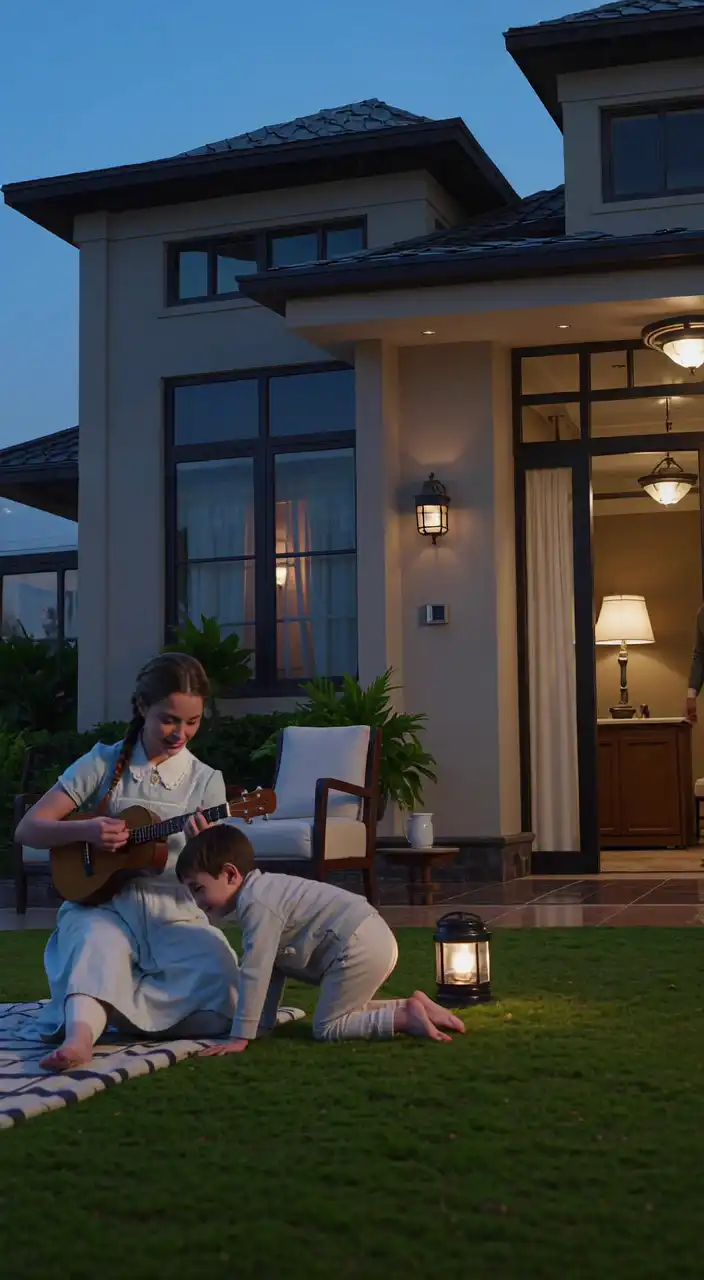
She sat down right there on the wet grass where Owen could see her through the glass. She spread out a thick quilt. From the bag she drew a small battery lantern and set it glowing beside her. Under her arm had been an old ukulele.
Then she looked up at the window and gave a single exaggerated wave.
Owen did not wave back.
Sadie strummed one chord. Then another. Then she began singing in a light, unpolished voice—the same moon-on-water song from the night terror, only brighter now, almost playful.
Grant stayed where he was, hidden by the doorframe.
Outside, Sadie sang to the evening. “Moon on the water, come and find me...”
Owen’s hand tightened around the shell.
She sang the second line and paused deliberately at the end, leaving space.
The room held its breath.
From the doorway, Grant saw the impossible happen in pieces.
First, Owen turned fully toward the window.
Then he took one step. Then another.
His mouth parted.
Softly, rusty with disuse, almost more breath than sound, he filled in the final word of the line.
“...gently.”
Grant did not move.
He thought perhaps he had imagined it.
Sadie’s shoulders stiffened outside, but she did not whirl around or react too big. She simply played the chord again and sang the line once more.
“Moon on the water, come and find me...”
Owen pressed one palm to the glass. This time, clearer, trembling, he sang the word with her.
“Gently.”
Grant’s vision blurred.
Sadie looked up very slowly then, toward the window, as if she had all the patience in the world. “That’s right, honey.”
Owen made a sound that was not quite the old laugh, not yet, but was no longer emptiness either. He rushed from the nursery before Grant could stop him, small feet pounding down the hall, down the stairs, through the open terrace doors where Mrs. Crain gasped from the kitchen threshold.
Grant followed to the edge of the terrace and stopped.
In the damp evening yard, Owen crossed the grass with both hands lifted for balance, his shell clutched in one fist, his curls blown by the wind. Sadie set the ukulele down and opened her arms.
He went to her.
Not wild. Not dramatic. But undeniable.
She gathered him onto the quilt, and with his cheek against her shoulder, he whispered one more time, as if testing the shape of trust in his own mouth.
“Gently.”
On the terrace, unseen, Grant stood very still while the ocean moved beyond them and the house that had forgotten sound listened to a child finding his way back.
Grant did not go down to them right away.
He remained on the terrace steps, one hand gripping the railing, watching from a distance because stepping into the moment felt almost sacrilegious. Below him, the battery lantern cast a warm gold circle on the wet grass. Sadie sat cross-legged on the quilt, Owen in her lap, the ukulele across her knees.
She sang the verse again, softer now, and this time Owen did not sing every word. He only joined at the end, offering “gently” like a fragile gift. Each attempt was quiet and breathy, but it was unmistakably voice.
Mrs. Crain had come to stand beside Grant. Her hand flew to her mouth.
“Oh my Lord,” she whispered. Tears pooled instantly in her eyes. “Did you hear him?”
Grant nodded, unable to speak.
Chef Nolan emerged from the kitchen wiping his hands on a towel, saw where they were all looking, and stopped dead. Even the groundskeeper, Reggie, coming around from the side garage, slowed and removed his cap as if entering church.
No one interrupted.
The miracle, if that was what this was, did not look flashy. It looked like a tired young woman in rain boots and a small boy wrapped in a blanket under an unsettled sky. It looked like trust given back after being broken. It looked like a song.
After a while, Sadie glanced up and finally saw
Disclaimer: Mention of any brand or trademark is for identification only and does not imply partnership or endorsement