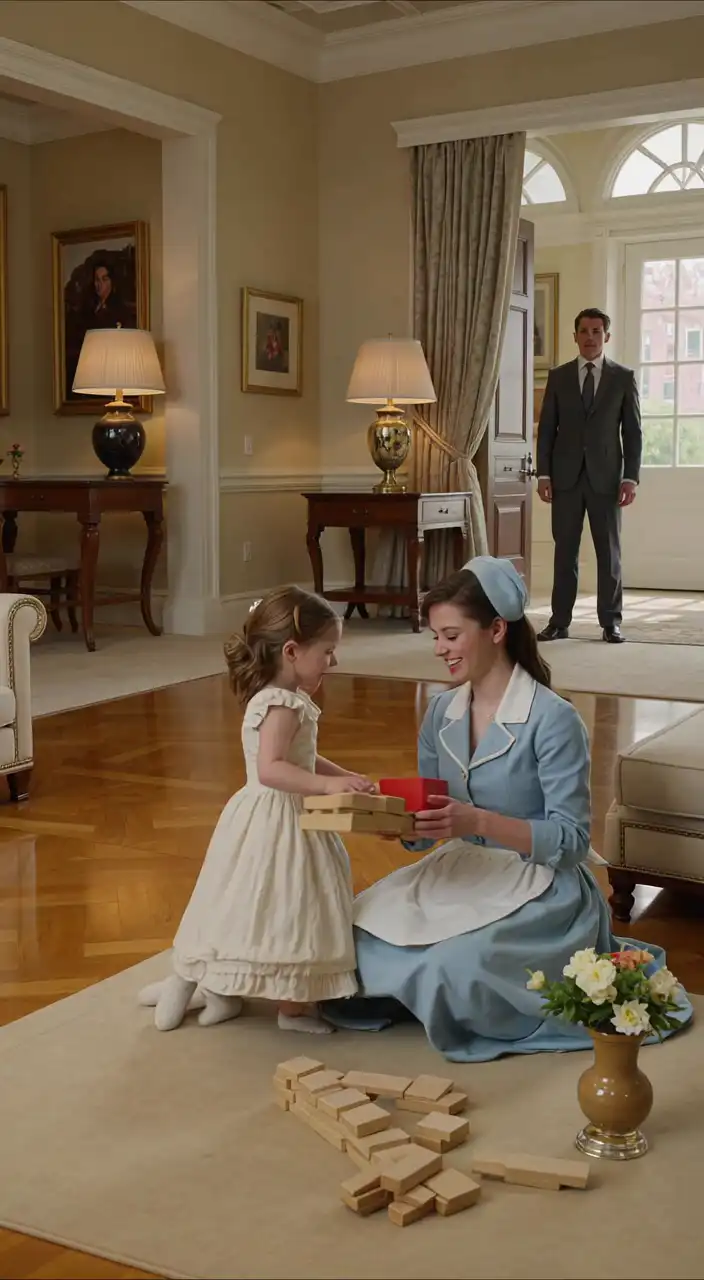
THE HOUSE THAT LEARNED TO SPEAK
The little girl was sitting under a long walnut console table in the west hallway when the housekeeper found her.
Not crying. Not sleeping. Not playing.
Just sitting there with her knees tucked to her chest, her small blue eyes fixed on the strip of afternoon light stretching across the polished floor.
"Miss Elodie?" the housekeeper said softly. "Honey, would you like your snack in the sunroom?"
No answer.
The child had curly brown hair that had slipped loose from its ribbon and fallen across one cheek. She was beautiful in the helpless, aching way some children were beautiful, all softness and solemn eyes and tiny hands folded too tightly together. At three years old, Elodie Mercer looked like a child who should have been laughing in gardens and smearing jam on her face. Instead, she moved through the thirty-thousand-square-foot estate like a quiet ghost.
From the doorway, the butler lowered his voice. "Still nothing?"
The housekeeper shook her head. "She hasn't said a word all day."
"Mr. Mercer is on his way home."
At that, the housekeeper looked down the hall as if the billionaire owner of the estate might appear simply because he had been named.
Blaine Mercer did not come home early. He ran a global logistics empire from a glass tower in Minneapolis and half his life from the back seats of black SUVs, private jets, and conference rooms where every minute was measured in money. His company moved freight across oceans and rails and highways. He could redirect shipments in six countries with one call. He could buy vineyards, hotels, and entire blocks of downtown property without blinking.
But no one in the house had ever seen him successfully persuade his daughter to come out from under a table.
The chef stood at the far end of the hall, wiping his hands on a towel. "Should we call her therapist again?"
"We called this morning," the housekeeper said. "She said not to force interaction."
"That is all anyone ever says," the butler muttered.
At five forty-three, the front doors opened.
Blaine walked in with his suit jacket over one arm, phone still in his hand, his expression sharpened by a day of decisions worth more than most people would earn in ten lifetimes. He was forty, broad-shouldered, controlled, and handsome in the severe way grief sometimes made a man handsome. The silver at his temples had appeared after the flood.
"Where is she?" he asked before anyone could greet him.
The housekeeper hesitated. "West hallway."
His jaw tightened.
He walked toward the hall, his expensive shoes making almost no sound on the runner. When he saw Elodie beneath the console table, he stopped.
For a moment he simply looked at her.
There had been a time when his wife, Maren, would have known exactly what to do. She would have crouched, smiled, and turned a hallway into a cave, a castle, or a train station. She would have spoken in that warm, playful voice that made life seem less sharp around the edges. But Maren had been taken two years earlier, when a flash flood tore through a mountain town during a charity retreat she was attending. Since then, every room had kept her absence like a second kind of furniture.
Blaine loosened his tie and crouched a few feet away.
"Hey, Bug."
Elodie blinked but did not move.
He tried again, gentler. "You hiding from everybody?"
Silence.
He set his phone facedown on the floor as if that were a meaningful sacrifice. "I missed dinner last night. I know. I'm sorry. But I'm home now."
Her gaze shifted, not to him, but to the shadow of a branch swaying against the wall through the tall window.
The housekeeper quietly withdrew. The butler did too. They all knew this ritual.
Blaine reached into his pocket and pulled out a tiny plush fox he had bought at an airport in Denver three days earlier. "Look what I found. He has ridiculous ears. I thought maybe you'd want him."
He placed it near the edge of the table. Elodie stared at it. Then, with one small movement, she turned her face away.
The rejection was so slight that anyone else might have missed it.
Blaine did not miss it.
His throat worked once. He sat back on his heels and looked down the hall toward the family portrait hanging above the staircase. In it, Maren stood between him and a baby Elodie, laughing at something outside the frame. The photographer had caught motion, not perfection. Maren's hair was windblown. Blaine was looking at her instead of the camera. Baby Elodie was reaching outward as if she trusted the whole world to catch her.
The world had not.
Elodie had spoken once, long ago, to her mother. Just a handful of soft words. Then the flood came. Since then, according to every specialist, every developmental pediatrician, every expensive therapist flown in from Chicago or Seattle, she had selective mutism shaped by trauma and attachment rupture. She could understand language. She could hear perfectly. She could likely speak. But with everyone except, once in a while, her father in the middle of the night, she stayed silent.
Even with him, the words had almost vanished.
He had heard "Da" twice in six months.
That was all.
"Elodie," he said quietly, "can you look at me?"
Her lashes trembled. Nothing more.
"Please."
At that, she crawled farther back into the dim space under the table until her shoulder touched the wall.
Blaine shut his eyes.
It wasn't that she hated him. Every specialist had told him that too. She was overwhelmed. Grieving. Frozen. Protecting herself. The terms changed. The result did not.
No words. No laughter. No little arms thrown around his neck.
Only silence in a house too large to contain it.
He rose after a long minute and carried her upstairs himself. She did not fight him, but she did not lean into him either. She was light in his arms. Too light. Her head rested near his shoulder without trust, simply because gravity put it there.
In her bedroom, where untouched dolls sat on white shelves and a canopy hung above a bed she often refused to sleep in, he set her down beside the window seat.
He pointed toward a framed photo of Maren on the nightstand. "Mom would tell me I'm doing this wrong."
The words escaped him before he could stop them.
Elodie looked at the photograph.
That was the one thing she always looked at.
Blaine followed her gaze and felt his chest go hollow. "Yeah," he whispered. "I know. I miss her too."
He sat beside her in the deepening evening.
"Do you know what I did today?" he asked. "I had six people in one room arguing over a shipping route through Savannah. Six adults. All talking over each other. I got them to stop in under thirty seconds."
No response.
"I can negotiate with governments, kiddo." His laugh broke halfway through. "I can buy half a state if I want to. But I can't figure out how to get my own daughter to tell me if she's hungry."
She lifted one small hand and pressed it against the glass.
Outside, the estate rolled over acres of green in western Virginia, all horse pastures, formal gardens, and old trees. The butterfly garden Maren had planted near the south terrace was in bloom.
Blaine saw it and looked away.
He had tried everything. Speech therapists. Trauma specialists. Child psychologists. Sensory consultants. Three nannies in two months. Rotating activities, reward systems, structured play, unstructured play, music, stories, travel, home programs. One nanny left after four days. One after two weeks. One cried in the kitchen and admitted she couldn't bear the child's silence.
He had money, influence, staff, resources, attorneys, consultants, private physicians, and every possible recommendation from people who said they understood children.
Still, every night came down to this: a father and daughter sitting in a room full of beautiful things neither one knew how to use.
After Elodie fell asleep against the window cushion, Blaine walked downstairs to his study. The room was lined with first editions, dark wood, and awards no longer meant anything to him. He opened a drawer and took out a folder from the placement agency his household manager had sent over that morning. There had been an emergency staffing mix-up at another estate nearby. One of the temporary caregivers was available immediately.
He almost tossed the folder aside.
Instead, he stared at the name on top of the page.
Tessa Rowan. Age twenty-three.
One more try, he thought.
Or maybe the last one.
Tessa Rowan arrived the next morning in a borrowed compact car with a cracked back taillight and a canvas tote bag slung over one shoulder.
That alone should have told Blaine Mercer she did not belong in his world.
The placement coordinator, flustered and apologetic, had explained the strange circumstances twice over speakerphone. Tessa had been hired as a short-term mother's helper for a neighboring estate while their usual caregiver recovered from surgery. But on her first day there, she had spent more time instinctively caring for a distressed toddler visiting with relatives than doing the polished household support she had technically been assigned. The neighboring client had complained she was "too informal." The coordinator, desperate because no one wanted the Mercer position anymore, had asked if Blaine would at least meet her.
He almost hadn't.
Now he stood in the front entry, coffee untouched in his hand, while Tessa stepped onto the black-and-white marble and looked around with no visible awe.
She was young, maybe twenty-three as the file said, with clear hazel eyes, sun-browned skin, and chestnut hair braided over one shoulder. She wore a pale blue sweater, jeans too practical for the estate, and sneakers instead of polished loafers. Beautiful was too simple a word for her. She had the kind of face children trusted before adults did.
"Mr. Mercer?" she said.
"Yes."
She offered her hand. "I'm Tessa Rowan. Thank you for seeing me."
Her voice was warm, unhurried, and entirely without fear. Blaine noticed that immediately. Most candidates either fawned over his status or stiffened under it. Tessa did neither.
"You understand the position?" he asked.
"I understand your daughter is three, that she lost her mother very young, and that she doesn't speak to most people."
"Most people" was kinder than accurate.
Tessa tilted her head slightly. "The coordinator also said several caregivers have quit."
Blaine didn't bother softening it. "They have."
"And you're still interviewing?"
His mouth tightened. "Clearly."
For the first time, a smile touched her face. Not mocking. Just honest. "Good. That means you haven't given up on her."
The bluntness caught him off guard.
Mrs. Pritchard, the household manager, appeared with a tablet in hand. "Mr. Mercer, shall I show Miss Rowan the staff quarters and schedule?"
Tessa glanced toward the staircase instead. "May I meet Elodie first?"
Blaine set down his coffee. "You haven't heard the schedule."
"I can hear it after. If I'm not right for her, the rest won't matter."
Mrs. Pritchard looked faintly scandalized. Blaine almost said no on instinct.
Instead, he heard himself say, "She's in the conservatory."
The conservatory was one of Maren's favorite rooms, all glass walls, pale stone, and giant ferns that reached toward the vaulted ceiling. Morning light poured across the tiled floor. Elodie sat on a small rug by the window with a line of wooden animals arranged in a perfect crescent around her knees.
She did not look up when they entered.
"She likes patterns," Blaine said quietly. "If someone disturbs them, she starts over."
Tessa nodded but did not respond to him. She walked into the room slowly, then stopped several feet away from the rug.
"Hi, Elodie," she said softly.
No answer.
Most adults would have tried harder right away. Introduced toys. Asked questions. Knelt too close. Tessa did none of that.
Instead, she lowered herself to the floor with an easy, ungraceful movement and sat cross-legged just outside the arc of the animals.
Blaine frowned. "Miss Rowan—"
She raised a finger slightly without looking at him. Not shushing him. Asking for a moment.
Then she looked at the rug, not at Elodie.
"Oh," she murmured, as if to herself. "I think this fox is trying to cut in line."
Elodie's hand paused over a wooden deer.
Tessa leaned closer to the fox figurine but did not touch it. "He has the face of a line-cutter. I know the type."
Silence.
"The rabbit seems offended," Tessa added. "Understandably."
Blaine stood motionless near the doorway. Mrs. Pritchard had gone still too.
Elodie did not speak, but her eyes shifted. They moved from the deer to the fox, then to Tessa's face.
It was the first direct glance she had given a stranger in days.
Tessa saw it and pretended not to make much of it. "You don't have to tell me if I'm right," she said. "I can wait. I have a lot of practice waiting."
She reached into her tote and pulled out something small: a cloth butterfly finger puppet, faded from use. Instead of offering it, she slipped it over one finger and let it flutter once in the air before making it land awkwardly on her own knee.
"Oh no," she whispered. "Emergency landing."
Elodie's mouth did not smile, but her gaze stayed fixed.
Blaine folded his arms. "This is usually the point where she turns away."
Tessa looked up at him then. "Maybe she doesn't want to turn away today."
There was no challenge in her voice. Just possibility.
She turned back to Elodie. "Would you like me to move farther away?"
Elodie blinked.
"I can." Tessa scooted back an inch. "See? Very cooperative."
Another pause.
Then, so small Blaine almost thought he'd imagined it, Elodie's fingers closed around the wooden fox and nudged it one place farther up the line, correcting the offense Tessa had invented.
Tessa put a hand dramatically over her heart. "Thank goodness. Order has been restored."
Elodie looked at her again.
Blaine felt something shift in the air, too fragile to name.
Mrs. Pritchard whispered, "She noticed her."
"I see that," Blaine said.
For twenty more minutes, Tessa stayed on the floor. She didn't ask Elodie to perform. She didn't insist on eye contact. She simply commented quietly on the procession of wooden animals as if she had been invited into an important meeting and meant to behave.
When Elodie rose at last and padded toward the window bench, Tessa did not follow. She remained where she was and said, "Thanks for letting me sit with your committee."
At the doorway, Blaine asked, "What exactly was that?"
Tessa stood and brushed off her jeans. "Nothing exact. She was leading. I was joining."
"Most professionals say she needs structured prompting."
"Maybe later." Tessa's gaze drifted back to the little girl by the window. "Right now she needs someone who isn't afraid of silence."
Blaine studied her.
"You're very certain for someone with no experience in this house."
She met his eyes. "I'm not certain at all. I just know children can feel when every adult enters the room expecting them to fail."
That stayed with him longer than he wanted it to.
As Tessa headed with Mrs. Pritchard toward the back hall, she glanced over her shoulder. Elodie was still at the window.
"Bye, Elodie," she said lightly. "I'll probably see you again unless your wooden fox files a complaint."
The little girl did not wave.
But she turned around to watch Tessa leave.
That tiny movement was so brief that Blaine might have dismissed it any other day.
Tessa didn't.
Her smile was small and private, as if she had just heard the first note of a song no one else recognized yet.
By the third day, Tessa had broken at least nine household rules.
She ate lunch in the nursery instead of the staff dining room. She carried Elodie on her hip out to the herb garden without first having a full sensory transition prepared. She sat on the floor of the library in her socks. She let the child choose books by color instead of educational category. She talked to her constantly without demanding replies. She moved through the estate as though it were a home instead of a museum.
Mrs. Pritchard disapproved of nearly all of it.
Blaine told himself he did too.
And yet each morning, when he left for the city or locked himself in his home office for investor calls, he found himself checking the cameras less, not more.
Trust began in silliness.
Tessa discovered quickly that Elodie did not like being told what game to play, but she watched everything. If a doll was made to speak for her, she withdrew. If an adult asked too many direct questions, she froze. But if a world was opened and left unfinished, she edged toward it.
So Tessa stopped trying to lead and started making invitations.
In the breakfast nook she arranged orange slices, blueberries, and crackers into a crooked train on Elodie's plate.
"Oh no," Tessa whispered. "This train is headed for Pancake Mountain, and I don't think the conductor has any idea what she's doing."
Elodie stared.
Tessa bit into a cracker. "Disaster. Total disaster."
The next morning Elodie moved a blueberry to the front of the line.
Tessa gasped. "A volunteer engineer."
Another day, in the playroom, Tessa placed a blanket over two chairs and crawled under it herself. "This is not a fort," she declared. "This is a turtle cafe. Very exclusive. No grown-ups allowed except me because I forgot to leave."
From the doorway, Blaine watched Elodie stand still for almost a minute, then carry a stuffed rabbit to the opening and push it inside.
Tessa nodded solemnly. "Reservation for one?"
Elodie climbed in after it.
There was no miracle. No sudden speech. No dramatic leap into Tessa's arms.
But there were changes, subtle and precious enough to alter the atmosphere of the house.
Elodie began waiting near the playroom at the time Tessa usually arrived each morning. She brought certain toys to whichever room Tessa was in, not handing them over, simply setting them nearby as if acknowledging a shared project. She did not speak, but her face softened. Her shoulders lowered. Once, when startled by a vacuum in the hall, she reached for Tessa's sleeve instead of shrinking into a corner.
That evening, when Blaine returned from Richmond after a series of meetings, he found Tessa and Elodie in the south garden.
The butterfly garden.
He stopped on the terrace steps.
Maren had planted coneflowers, milkweed, salvia, black-eyed Susans, and lavender in curved beds around a stone path. For months after her death, Blaine had avoided the place. The gardeners maintained it because it had been on the plans, because no one had the heart to tear it out, because memory itself sometimes became landscaping.
Now Tessa crouched in the grass, pointing toward a yellow swallowtail drifting over the purple blooms.
"I think that one is late for an important butterfly meeting," she murmured.
Elodie stood beside her in a sunhat, one tiny hand clutched around the hem of Tessa's sweater. She followed the butterfly with complete attention.
"Should we follow from a respectful distance?" Tessa asked.
Elodie took three quick steps after it.
Then four.
Then she was moving through the path, not running wild, not in a meltdown, not shut down, but engaged. Tessa followed at her pace, never grabbing, never commanding.
Blaine felt his breath catch.
Mrs. Pritchard, who had come out behind him, said in a low voice, "She's been doing that all afternoon. Watching for butterflies."
"How long?"
"Forty minutes."
Forty minutes of interest. Forty minutes of light in the child's face. That was not small.
Still, progress brought its own terror. Blaine had learned enough over the last two years to know hope could become cruelty if held too carelessly.
At dinner, he asked Tessa, "What exactly are you trying to do with the garden?"
Tessa looked up from where she was cutting Elodie's food into tiny pieces. "Trying? Nothing dramatic. She likes movement she doesn't have to answer. Butterflies don't ask anything of her."
"And the imaginary games?"
"They give her control." Tessa slid the plate toward Elodie. "She leads, I follow. If she wants the rabbit to be a librarian and the spoon to be a canoe, then that's what they are."
Blaine leaned back. "You're making it sound simple."
"It isn't simple. It's respectful."
He didn't answer that.
The first real sign that Elodie was changing happened the next morning.
Blaine was on a call in his home office when he heard a sound through the cracked door. Not a word. A laugh.
Just one.
Light, surprised, unmistakably childish.
His heart slammed so hard he ended the call midsentence and stepped into the hall.
The sound came from the upstairs landing. Tessa was lying flat on the carpet pretending to be a stranded sea lion. Elodie stood over her with a toy tea towel draped around her shoulders like a cape.
Tessa groaned dramatically. "I fear I have washed ashore in the kingdom of blankets."
Elodie made the laugh again, softer this time, and pressed the tea towel onto Tessa's head.
Blaine gripped the banister.
Tessa looked up and saw him. She didn't make a big show of the moment. She just smiled and said, "Good morning, Mr. Mercer."
Elodie turned. The instant she saw her father, the laughter vanished. Her body went still.
Blaine's joy curdled into the familiar ache. "Morning."
He wanted to come closer. He wanted to ask what had been funny, to kneel and join them, to claim some place in this fragile world opening around his daughter.
Instead he did what he always did when he didn't know how to bridge the gap.
He retreated behind practicality.
"Mrs. Pritchard told me you've changed Elodie's schedule."
Tessa sat up slowly. "I adjusted it."
"You removed two of her therapist-directed table sessions."
"They were happening when she was already exhausted."
"Those sessions were designed by experts."
Tessa rose to her feet, calm but not timid. "And she spent most of them shut down."
"That doesn't mean they aren't necessary."
"No," Tessa said. "It means the timing wasn't working."
Blaine glanced at Elodie, who was watching them with wide eyes. His voice sharpened anyway. "You are not her clinician."
"And you're not in the room with her all day."
The words landed harder than she intended. Blaine's expression turned cold.
Mrs. Pritchard, appearing with disastrous timing, said, "Sir, Dr. Leland is on line two. She wanted an update on the child's compliance."
Tessa's jaw tightened at the word.
Blaine said, "Take Elodie to the playroom."
Tessa looked from him to the little girl. "Come on, sweet pea. Let's let the grown-ups use too many complicated words."
She held out a hand.
Elodie hesitated, then took it.
Blaine watched them go with an emotion too tangled to sort: anger, yes, but also the unwelcome knowledge that Tessa had not entirely been wrong.
The conflict came two days later, sudden and cruel in the way setbacks often are.
That afternoon, a summer storm rolled across the estate fast and violent, shaking the windows and darkening the garden. Thunder cracked over the hills while Blaine was in a video conference with investors in Singapore. Downstairs, one of the newer staff members accidentally moved a framed photograph from the nursery dresser while dusting. It was a photo of Maren holding baby Elodie wrapped in a yellow blanket.
When Tessa brought Elodie in from the covered terrace and the child saw the empty spot on the dresser, something in her collapsed.
She began searching frantically, her breath turning ragged.
"Elodie, hey, I'm here," Tessa said, dropping to the floor beside her. "We're okay. We can find it."
But the storm, the missing photo, the disruption of the room, all of it was too much. Elodie cried without sound, a terrible open-mouthed grief that seemed to tear through her tiny body. She shoved Tessa's hands away. She kicked at the rug. She clawed at the door.
The staff panicked. Mrs. Pritchard sent someone for the therapist's emergency instructions. Another maid brought noise-reducing headphones no one could get near her enough to use.
Tessa found the photo on the changing table and came back slowly. "I have it. See? I have Mama."
Elodie looked at the frame, then at Tessa.
And recoiled.
Not just from the moment. From Tessa herself.
"Okay," Tessa whispered, though the words hurt. "Okay, you don't want me close."
She set the photo down within reach and backed away.
When Blaine rushed in at last, tie undone, face pale with alarm, Elodie was crouched in the corner with the picture clutched to her chest, and every time Tessa moved an inch, the little girl turned her face away.
"What happened?" he demanded.
Mrs. Pritchard answered first. "There was thunder. And the photograph was moved. She became distressed."
Blaine looked at Tessa. "And now?"
Tessa swallowed. "Now she doesn't want me near her."
As if to prove it, Elodie buried her face against the frame and refused to look at Tessa at all.
The progress of the last week seemed to vanish in one brutal hour.
That night Elodie would not let Tessa help with bath time, bedtime, or stories. She accepted only Blaine, and even with him she remained rigid and tear-streaked, holding her mother's photo until sleep took her.
In the hall outside the nursery, Blaine faced Tessa.
"This is what I was afraid of," he said quietly.
Tessa looked exhausted, heartsick, and younger than she had before. "I know."
"She was finally opening up."
"I know."
He ran a hand through his hair. "If she associates you with the panic—"
"I know," Tessa said again, this time with a crack in her voice.
For the first time since she'd arrived, she seemed uncertain.
And in that uncertainty, the whole house held its breath.
The next two days were worse than the first months had been, not because Elodie returned fully to silence, but because she returned to it with memory.
She knew what connection had felt like now.
That was what made the loss sharper.
If Tessa entered a room, Elodie turned her head. If Tessa sat on the floor near her, Elodie gathered her toys and moved away. At meals, she refused anything Tessa placed in front of her until someone else touched the plate. In the garden, she would not step onto the butterfly path at all.
Mrs. Pritchard began speaking in practical tones about "maintaining consistency through personnel transition."
Blaine hated how relieved part of him felt to hear it. Relief meant control. Control meant fewer chances to hope and be humiliated by hope's collapse.
On the third morning after the storm, Tessa found Blaine in the study before dawn. He was already dressed for the day, staring at a spreadsheet on his laptop without seeing it.
He did not ask her to sit.
"I'm going to be direct," he said.
She nodded. "Okay."
"I can't put Elodie through a revolving door of attachment."
Tessa's fingers tightened around the mug of tea she carried but hadn't drunk. "You think I should leave."
"I think she may have connected the panic to you."
"Maybe she did."
"You don't disagree?"
Tessa looked down for a moment, then back at him. "Children in grief don't separate events the way adults do. The storm, the missing photo, the fear, me being there while it happened. It's all tangled."
Blaine exhaled sharply. "So what am I supposed to do? Keep waiting while she withdraws again?"
"No." Tessa stepped closer. "You're supposed to help untangle it."
He stared at her.
She continued carefully, "You love her, but when things get emotional, you go formal. You start sounding like one of the experts."
His eyes flashed. "Excuse me?"
"You ask what happened instead of saying that was scary. You manage instead of join."
"That is an unfair oversimplification."
"Maybe." Her voice softened. "But not entirely wrong."
Blaine looked away toward the dark windows. Rain still clung to the glass from the earlier storm. Across the lawn, the butterfly garden glimmered wet in the first gray hint of morning.
"What would you have me do?" he asked at last.
"Be with her without trying to fix her. And with me..." Tessa hesitated. "Give me one chance to apologize to her."
He frowned. "Apologize? For what?"
"For being part of a moment that scared her. Even if I didn't cause it." Tessa swallowed. "Children deserve apologies too."
The idea sounded absurdly simple. Possibly naive. Entirely outside every expensive protocol he had paid for.
And yet he could not shake the memory of Elodie laughing on the carpet while Tessa played stranded sea lion.
"When?" he asked.
Tessa let out a careful breath. "Today. But only if she chooses to stay."
The setup for that second chance came by accident and memory.
That afternoon would have been Maren's thirty-sixth birthday.
No one had planned to mark it. Blaine had buried the date beneath meetings and signatures and logistics because he did not know how to survive anniversaries except by pretending they were ordinary days. But the kitchen calendar, still carrying one of Maren's old handwritten notes in faded ink from years before, betrayed it.
Pick flowers from the south garden for the table. M.
Tessa saw the note while making Elodie's lunch.
She didn't announce it. She simply asked Mrs. Pritchard, "Did Mrs. Mercer like birthdays?"
The older woman paused. "She liked making everyone else forget they disliked them."
Tessa smiled sadly. "That sounds right."
Blaine came home early without admitting to himself why. He found a small vase of wild-looking garden flowers in the dining room, nothing formal, just color: lavender stems, yellow daisies, and white cosmos from the cutting beds.
"Who did this?" he asked.
Tessa, kneeling in the family room beside a basket of blocks, looked up. "I thought the house should know."
He said nothing.
Elodie sat by the fireplace with her mother's photo in her lap. It had become her anchor since the storm. When she saw Blaine, she looked at him, then at the flowers, then back at the picture.
Blaine's chest tightened so sharply he almost left the room.
Tessa did not rescue him.
Instead she said very quietly, "Maybe today isn't a day to pretend."
He stood frozen. "You knew."
"I saw the calendar."
He wanted to tell her she had crossed a line. That staff did not involve themselves in private grief. That this family did not hold impromptu memorials in the middle of the week because the nanny found a note.
But Elodie was looking at him. Really looking.
So he crossed the room and sat on the rug.
For a few moments no one spoke.
Then Blaine said to his daughter, voice rough, "Today is your mom's birthday."
Elodie curled her fingers around the frame.
"She loved this room because the light made everything look softer in the afternoons. She loved that garden because butterflies never seemed to care how rich people were." He gave a broken laugh. "She said they had better priorities."
Tessa stayed back, letting father and daughter have the center.
Blaine looked at the picture in Elodie's lap. "I don't talk about her enough, do I?"
Elodie blinked.
He answered himself. "No. I don't."
He drew in a shaky breath. "I thought if I kept moving, if I kept the house running and work stable and all the right people around you, it would somehow protect you. But I think maybe..." He stopped and pressed a hand over his eyes. "Maybe it only made everything quieter."
Tessa said gently, "Quiet isn't always peace."
He lowered his hand and looked at her. For once, there was no resistance in him. Only tired truth. "I don't know how to do this."
"I know," she said. "That's different from not caring."
Then she looked at Elodie.
She didn't move closer. She spoke from where she was, level and calm.
"Elodie, I need to tell you something. The other day was scary. The thunder was loud, and your mama's picture wasn't where it should have been. I was there, and I know that felt bad. I'm sorry."
The room went utterly still.
Blaine watched his daughter.
Elodie's lashes fluttered. Her fingers loosened slightly on the frame.
Tessa continued, "I should have slowed down and helped your room feel safe again before trying to help you. That was my mistake."
Blaine had never heard an adult apologize to a child that way. Not simplified, not patronizing, not dramatic. Just honest.
"You don't have to forgive me right now," Tessa said. "You don't have to do anything. I just wanted you to know I understand why you were upset."
Elodie stared at her.
A minute passed. Maybe two.
Then Tessa reached into the block basket and pulled out a green block and a yellow one. She set them on the rug beside her and said, very lightly, "I'm building a birthday bridge for butterflies. It will probably be structurally unsound."
Nothing.
She added a blue block. "Terrible engineering. Very irresponsible."
Blaine almost smiled despite himself.
Tessa did not look at Elodie while she built. She simply kept speaking as if continuing a game that had only paused.
"This side is the flower market. This side is cloud town. Butterflies may pass if they promise not to complain."
A tiny sound came from Elodie. Not a word. Not a laugh. More like the breath before one.
She slid off Blaine's lap and stood.
Neither adult moved.
Elodie took one step toward Tessa.
Then another.
At the third, she stopped and clutched the photo to her chest again.
Tessa kept her eyes on the blocks. "We may need a safety inspector. This bridge has no standards at all."
Elodie knelt several feet away.
Blaine could hear his own heartbeat.
The little girl stretched one hand toward the loose pile of blocks between them and picked up a red one. She held it for a long moment, gaze flicking between the half-built bridge and Tessa's face.
Then she set the red block carefully on top of the yellow one.
Tessa inhaled, but barely. "Oh," she whispered. "An expert has arrived."
Elodie did not look away.
Tessa added another block to the far side. "Would the expert like a blue one or a square one?"
No response.
But Elodie tapped the square.
"You have excellent taste," Tessa said.
Blaine sat motionless, terrified that even a shift of breath might shatter the scene.
Together, they built in silence. Tessa left spaces; Elodie filled some of them. Tessa made a butterfly out of two clothespins and a napkin from the side table. Elodie watched, then reached for it.
The cloth butterfly landed crookedly on the bridge.
Tessa smiled. "I think she's late for the party."
Elodie looked at the butterfly. Then at Tessa.
Then something miraculous and heartbreakingly small happened.
Her mouth curved.
Not wide. Not bright. But undeniably a smile.
Blaine made a broken sound in the back of his throat.
Tessa glanced at him once, her eyes shining, then back to Elodie. She did not rush the moment.
"Happy birthday, Mama," she said softly, including the child without forcing her.
Elodie pressed her lips together, as if feeling words move somewhere inside but still not trusting them.
Then the cloth butterfly tipped off the bridge and landed on Tessa's knee.
Tessa gasped dramatically. "Direct collision. I have been chosen."
Elodie let out one sudden peal of laughter.
Blaine's hand flew to his mouth.
The laugh rang through the family room, startling in its clarity, as if the house itself had forgotten children could sound like that.
Tessa laughed too. "Was that on purpose?"
Elodie rocked forward on her knees.
And then, with all the effort of lifting something heavy from deep underwater, she said it.
"Tessa."
Just one word.
Soft. Breathy. Perfect.
The room stopped.
Tessa froze, tears flooding her eyes so quickly she couldn't hide them. "Hi," she whispered.
Elodie looked startled by her own voice. She touched her throat, then the butterfly, then Tessa's sweater sleeve.
"Tessa," she said again, stronger this time, and smiled as if she had found a hidden door.
Blaine broke.
He folded over where he sat on the rug, both hands over his face, shoulders shaking with silent sobs he had apparently been storing for two years. Not because she had spoken a miracle cure into the room. Not because one name meant every wound was healed.
But because she had reached toward someone.
Because the silence had cracked.
Because in speaking Tessa's name, Elodie had shown them all that she was still there.
He felt Tessa's gaze on him only briefly. She didn't intrude on his grief. She turned fully to Elodie, pressing a hand to her own chest.
"You said my name," she whispered.
Elodie leaned forward, touched Tessa's cheek with one tiny hand, and laughed again.
Outside, beyond the windows, a butterfly drifted past the garden in the late gold light, and for the first time since the flood, the house no longer felt
Disclaimer: Mention of any brand or trademark is for identification only and does not imply partnership or endorsement