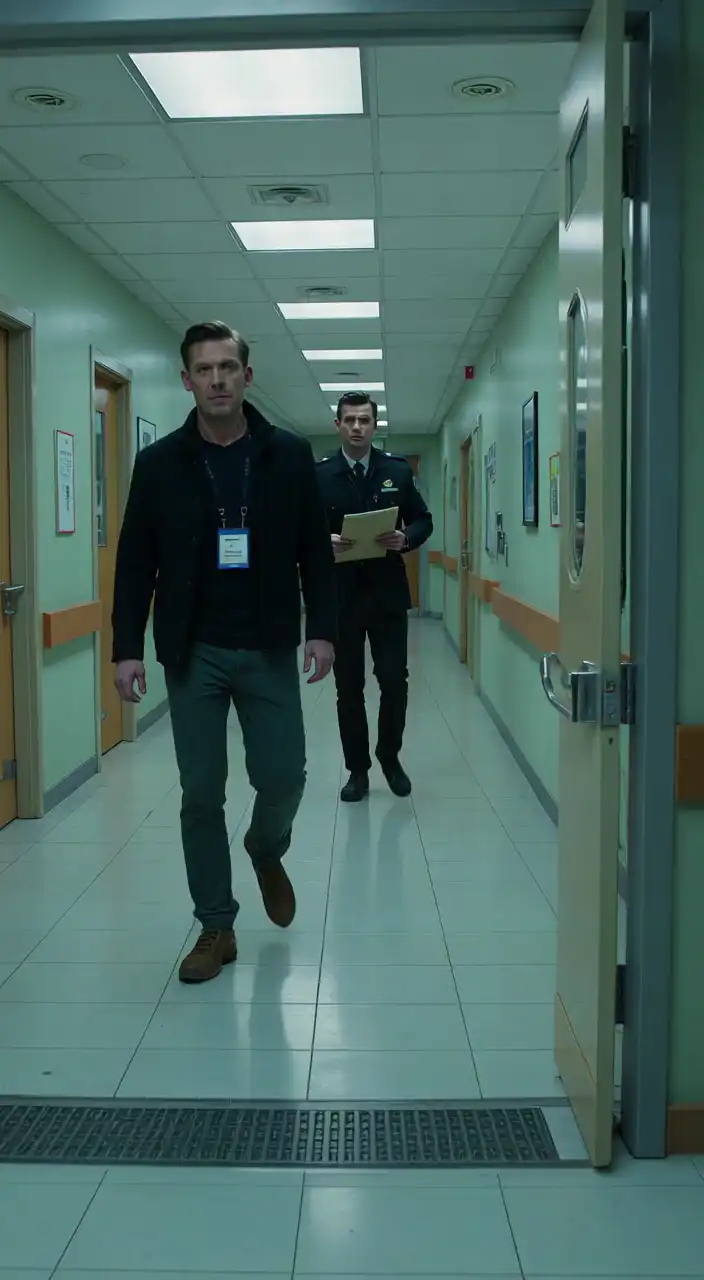
Liam did not repeat himself.
He crossed the last few feet in three fast strides, put his body between Charles and the woman, and dropped his clipboard onto the nearest chair hard enough to make everyone in the hallway jump. "Now," he said.
Something changed in the air when he said it. Not louder. Clearer. People who had been pretending not to notice suddenly looked up from their phones. The nurse at triage was already moving toward us with a rolling pulse monitor, one hand raised toward the doorway behind her as if she were flagging backup. Sebastian tried to push himself up from the tile and failed.
Charles lifted both hands, smooth and offended. "Security does not override consent."
"Medical abuse alerts do," Liam said.
The woman with Sebastian flinched so hard at that phrase that she nearly stepped backward over the chair leg. She was younger than I had first thought, maybe mid-twenties, with a grocery store apron still peeking out under her jacket. She kept looking at Charles before answering anyone, and that look told me more than her words had. Not partner. Not equal. Employee. Frightened employee.
The nurse knelt beside Sebastian. "Hey, baby, look at me. I'm Marisol. Can you tell me your name?"
His eyes tracked to her, slow and glassy. "Seb..." he whispered.
"Good. Sebastian, I'm going to touch your wrist, okay?"
Charles cut in before the boy could nod. "This has not been authorized. The family account-"
Liam turned his head just enough to pin him with a look. "You are obstructing emergency evaluation in front of witnesses and cameras. Choose your next sentence carefully."
That landed. Charles's jaw flexed. He stepped back one pace, but not far enough to stop looming.
Marisol clipped the pulse monitor on Sebastian's finger. The amber light stopped flashing and went red. Her face changed immediately. She didn't panic, which somehow made it more frightening. "I need a wheelchair. Now. And peds response."
A second nurse appeared from inside triage pushing a wheelchair with one foot while pulling gloves on with her hands. Marisol leaned closer to the boy and sniffed lightly near his mouth, then his sleeve. Her eyes flicked to the yellow stain. "What did he take?"
"He didn't take anything," the woman said too quickly. "He had cough medicine earlier. He spilled some in the car."
Sebastian made a tiny sound in his throat. Not agreement. Protest.
Marisol heard it too. "Sebastian? Did you get medicine?"
His lashes fluttered. He looked past her, straight at the woman, and his shoulders pulled inward like he was bracing for impact. Then he whispered, "I said no."
The whole hallway went still.
The yellow bottle cap was still in my hand. Liam saw me looking at it and held out his palm without taking his eyes off Charles. I gave it to him. He turned it over once, saw the sticky residue on the inside rim, then slipped it into a clear evidence bag from his blazer pocket. The fact that he carried evidence bags told me this wasn't his first hallway like this.
Charles recovered first. "Children refuse antibiotics all the time. This is becoming theatrical."
Marisol ignored him completely. "Sebastian, sweetheart, can you sit up for me?" He tried, and his arms trembled so badly that she abandoned the attempt and nodded to the other nurse. "We move him together on three."
The woman reached forward then, finally seeming to remember she had arrived with him. "Please be careful," she said, and for the first time the words sounded real.
Marisol looked up. "Are you his mother?"
The woman hesitated. There it was again. A beat too long.
"No," she said. "I watch him after school."
Charles snapped, "His family retained this facility through our executive wellness program. His grandmother is aware of his condition and has directed no inpatient actions without her authorization."
Liam's head turned slowly. "You are an administrator. Why are you speaking for a child's guardian in a medical emergency?"
Charles's mouth tightened. "Because his grandmother pays this hospital six figures a year."
There it was. Not medicine. Status.
Marisol and the second nurse got Sebastian into the wheelchair. His head lolled once against the side, and Marisol slapped the call button clipped to the chair handle. Somewhere behind the triage doors a louder alarm answered.
The woman made a move as if to follow, but Liam blocked her with one forearm. "Not yet. I need your name."
She looked trapped. Charles looked furious.
"Rina," she said at last. "Rina Soto."
"Rina," Liam said, gentler now, "did you give that child medication today?"
Her eyes filled so fast it looked painful. "I... I gave him what she told me to give him."
"Who is she?"
Rina's lips trembled. She shook her head once, not refusing exactly, more like she was trying not to drown.
Charles stepped forward again. "This conversation stops. Any questions go through legal."
Liam picked up his clipboard. "No. They go through the abuse alert protocol that you just triggered."
He tapped his earpiece. "Lock pediatric exit corridor B. Notify charge nurse and on-call social worker. Child hold for medical endangerment review. And I need hallway camera footage from the last twenty minutes."
That last sentence changed Charles more than anything else had. His face lost color. He had not expected the cameras to matter.
Rina saw it too. She looked from him to Liam like somebody spotting the first crack in a locked door. "I didn't want to bring him here," she blurted. "He said if I took him to County I'd lose my job. He said this hospital would handle it quietly."
Liam wrote one line on the clipboard. "Who said that?"
She pointed without looking. "Him."
Charles let out a thin breath through his nose. "You are making accusations while under emotional distress."
Rina's voice sharpened with desperation. "He called me three times on the drive. He told me to say Sebastian was faking because if they tested him, his grandmother would blame me."
That got Marisol, who had paused at the threshold long enough to hear it. "Tested for what?" she asked.
Rina covered her mouth with both hands.
Inside triage, Sebastian gagged.
Marisol wheeled him through the doorway at once. "Move."
Liam turned to me. "Did you hear the obstruction statement?"
"All of it," I said.
"Will you stay?"
"Yes."
He nodded once. "Good."
Then he faced Charles and Rina again. "Nobody leaves."
The next ten minutes felt both frantic and slow in the way emergency time always does. Nurses crossed the hallway carrying supplies. A respiratory tech came at a near run. The red alarm inside kept sounding in short bursts before flattening into a steadier tone. Through the narrow gap before the triage doors swung closed, I caught one glimpse of Sebastian on the bed: his stained sleeve cut away, adhesive leads on his chest, his small face gray under the fluorescent lights.
Rina started crying without sound. Charles did not look at the doors. He was staring at Liam's clipboard, calculating.
That was when a thin electronic voice broke from somewhere low to the ground.
"Please state the nature of your emergency."
Everyone looked down.
A phone was lying under the plastic chairs, face lit, speaker on. Somewhere in the struggle, someone's 911 call had connected and stayed open.
The dispatcher repeated, "If you can hear me, I need to know if the child is breathing."
Liam bent and picked up the phone. The cracked lock screen showed a little cartoon soccer ball and, across the top, one missed call after another from a contact labeled Mrs. W.
Rina made a strangled sound. "That's his."
Liam put the phone to his ear. "This is Liam Alvarez, security supervisor at St. Catherine's. We have a pediatric medical emergency and a possible delayed-care incident already on site. Keep the line open."
The dispatcher's tone shifted instantly, crisp and alert. "Copy. EMS can still respond for external transfer if needed. Did anyone report ingestion?"
Liam looked at Rina.
She whispered, "I don't know what it was. It was in a spoon first. Then she changed bottles."
"She?" Liam asked.
Rina shut her eyes.
Charles finally moved with purpose. Not toward the child. Toward the phone. "This is inappropriate. Turn that off."
Liam stepped back before he could reach it. "You really should stop walking into your own evidence."
Inside triage, a doctor called for stat labs and tox screening. And when Charles heard the word tox, he did something that told all of us the truth was worse than delay.
He spun toward the staff-only hall.
Liam was faster.
He caught Charles by the arm before he made three steps, twisted him just enough to stop the run, and said in a voice so controlled it sounded cold, "If you try to leave this floor before law enforcement clears you, I will put you on the wall."
Charles stopped struggling. But his eyes had gone to the staff hall, to a frosted glass office door with ADMINISTRATION printed across it.
And suddenly the yellow stain on Sebastian's sleeve was not the only thing in that hallway that looked like proof.
Liam did not let go of Charles until two more security officers arrived and took position on either side of him. Charles kept his face arranged into offended professionalism, but the muscle in his cheek would not stop jumping. He looked at the administration office once, quickly, then away, and that glance landed on Liam like a physical object.
"Open that office," Liam said to one of the officers.
Charles spoke immediately. "That room contains privileged records."
"It contains something you thought you could reach before pediatrics drew blood," Liam replied.
One officer headed for the office door. The other stayed with Charles. Rina backed herself into a chair and sat as if her knees had quit. I stayed where I was, half because Liam had asked, half because moving felt like stepping out of a current I now needed to follow through.
The office was locked.
"Key?" the officer asked.
Charles said nothing.
Liam held out his hand to the officer at Charles's side. "His badge."
Charles's composure cracked for the first time. "You do not have authority to seize my credentials."
Liam's eyes stayed flat. "You are being detained in a patient safety investigation tied to an active emergency. Badge."
The officer unclipped it from Charles's lanyard while Charles hissed, "This will destroy this hospital."
"No," Liam said. "What happened to that child might."
The badge opened the office with a soft click. We all heard it because the hallway had gone almost silent except for triage sounds and the low voice of the 911 dispatcher still on speaker from Sebastian's phone, waiting in case the on-site team needed outside transport.
The officer stepped into the office and stopped. "Supervisor?"
Liam left Charles with the second officer and went inside. I could not see much from where I stood, just a compact desk, a wall monitor, and a small stainless cabinet under the counter. Then Liam looked back toward the hallway.
"Rina," he said. "Come here."
She stared at him in horror. "I can't."
"You can," he said, not unkindly. "Tell me if you've seen this before."
Rina rose like someone underwater and walked into the office. A second later she made a sound that was half sob, half gasp.
"I told him not to keep them here."
Liam came out holding a pharmacy sample bag in one gloved hand. It contained two amber bottles with peeled labels and one oral syringe stained yellow at the tip. In his other hand was a clipboard page with times and initials. Even from a distance, I could see one line repeated beside several dates: S - drowsy after dose.
Charles closed his eyes for one second.
That was the first real proof of intent.
Liam looked at him. "You want to tell me why an administrator has unlabeled medication in a locked office next to pediatric triage?"
Charles opened his eyes and went right past denial into contempt. "Because if poor people panic every time a child gets sleepy after treatment, this building drowns in accusations."
Rina pressed both hands to her mouth. "It wasn't treatment."
He rounded on her. "You are a nanny. Do not invent expertise."
That word landed wrong. Nanny. Not sitter. Not family friend. Something more entangled with money and hierarchy than anyone had been saying out loud.
Liam heard it too. "So whose child is this, exactly?"
Charles looked away.
Rina answered because somebody had to. "His grandmother's daughter cleans houses for the Whitmores on weekends. Sebastian goes with her sometimes. Mrs. Whitmore started paying me to watch him after school when his mom got extra shifts. She said she was helping." Rina swallowed. "Then she started sending medicine with instructions when he was 'too wild' or 'too talkative' or 'needed to sleep through visitors.'"
The name on the missed calls flashed in my mind. Mrs. W.
Liam held up Sebastian's phone. "Whitmore?"
Rina nodded.
"Why would a wealthy donor's family be dosing someone else's child?"
Rina started crying again, but this time words came with it. "Because he saw something."
Charles snapped, "Enough."
Liam's whole posture changed. "What did he see?"
Rina looked at Charles as if she expected him to strike her just for breathing. He didn't move, but fear answered for him.
"At the pool house last month," she said. "Mrs. Whitmore's grandson pushed another little boy into the deep end and laughed when he couldn't get out. Sebastian screamed and ran for the gardener. The cameras caught all of it. Mrs. Whitmore said if the police were called, the whole family would be ruined. After that she kept saying Sebastian was imaginative, unstable, dramatic. Then she started sending medicine when he had to be around guests."
A nurse passing by slowed, heard enough to freeze, then hurried toward triage with that information burning visibly on her face.
Liam's expression hardened. "And today?"
Rina stared at the sample bag. "Today he was supposed to go to his school counselor because he told me he was going to tell her why he hates going there. Mrs. Whitmore called Charles. Charles told me to bring him here if he got too sick but to say he was faking, because if Child Protective Services heard him first, there would be reports and questions." She wiped her face roughly. "He threw up in the car. I wanted to stop at the fire station, but Charles said no. He said St. Catherine's could keep it off record until the grandmother arrived."
That phrase hung there: off record.
From triage came a burst of quick footsteps. Marisol pushed through the doors, mask hanging at her neck, eyes sharp. "Doctor wants to know if the ingested medication could be promethazine or hydroxyzine. He has CNS depression and inconsistent history."
Rina shook her head helplessly. "I only saw yellow liquid."
Liam lifted the bag. "Found this in admin office. Send pharmacy and tox photos now."
Marisol took out her phone, snapped images, then pointed to the log sheet. "Can I take that?"
"Not yet," Liam said. "I need chain of custody."
At the words chain of custody, Charles gave a small humorless laugh. "You think you're building a criminal case out of a donor accommodation."
Marisol stared at him as if he had spoken in another language. "A seven-year-old is sedated and unstable because adults wanted him quiet. Call it whatever helps you sleep."
She went back inside.
That should have shut Charles up. Instead it made him reckless.
"You all want a villain because it's simpler than admitting his mother medicates him too," he said. "Ask for the school reports. Ask why he disrupts class. Ask why neighbors complain. You are romanticizing poverty and weaponizing compliance."
It was the kind of ugly argument that often works because it contains just enough truth about strain to blur deliberate harm. Rina almost folded under it. I saw her shoulders cave. Liam saw it too.
"Did his mother know?" he asked quietly.
Rina stared at the floor. "She knew about cough syrup sometimes. She did not know about this office. She did not know Charles changed bottles. She thought Mrs. Whitmore was giving vitamins, sleep support, things to help with behavior."
That was the contradiction. Not innocence. Groomed dependence.
Liam wrote quickly on his clipboard, then spoke into his earpiece. "I need local police for suspected child endangerment, evidence preservation, and witness separation. Also contact hospital legal and mandated reporter on call. And get me registration on Sebastian's guardian and mother immediately."
Charles smiled then, thin and cold. "Good luck. Mrs. Whitmore sits on the foundation board."
Liam didn't blink. "Then she can explain herself to detectives in a nicer room than this hallway."
The triage doors opened again. A physician I hadn't seen before came out fast, young but all business, with purple gloves and Sebastian's yellow-stained sleeve in a specimen bag. "Which one of you handled the clothing?" he asked.
"I did not touch the shirt, only the cap," Liam said.
The doctor nodded. "Good. We have significant sedation. Vitals are unstable but responsive. We are moving him to pediatric observation with airway support on standby. And one more thing." He held up the bagged sleeve. "This stain doesn't smell like over-the-counter cough medicine. It smells compounded."
Charles looked at the floor.
The doctor saw it. "Who works with compounding pharmacy access here?"
No one answered.
Then, from the open administration office, a printer suddenly woke up and spit out a single page none of us had asked for.
The officer nearest it grabbed it before it hit the floor.
He looked at Liam. "You need to see this."
Liam took the page. At the top was a billing header from St. Catherine's executive wellness program. Beneath it: Behavioral support consult, private pediatric accommodation, donor courtesy, no chart release without admin review.
And at the bottom, in neat typed initials and one handwritten note, was the phrase that changed the room again.
If child becomes verbal, dose before transport.
Rina broke.
She doubled over, sobbing so hard she couldn't breathe, repeating, "I didn't know, I didn't know."
Charles's status finally peeled off him all at once. He wasn't a polished administrator anymore. He was a man in a nice shirt standing next to a poisoned paperwork trail.
Liam handed the page to the arriving police officer just as the elevator doors opened at the far end.
A woman in pearl earrings and a cream coat stepped out with a lawyer behind her.
And before anyone introduced her, the missed-call name glowing on Sebastian's phone told us exactly who she was.
Mrs. Whitmore did not hurry. That was the first thing about her that made my skin crawl. Her grandson could have been the one inside, a donor could have collapsed in the lobby, a board member could have arrived to find a fire, and she still would have moved at that same measured pace, like time itself had learned to wait for her.
She took in the scene in one sweep: police officer, security, Rina crying, Charles cornered, administration office open, me still standing there because I had become part of the witness chain whether I wanted to or not. Then her gaze landed on Sebastian's phone in Liam's hand and sharpened.
"I've been calling for fifteen minutes," she said. "Where is the child?"
Not Sebastian. The child.
"In active treatment," Liam said.
She looked at Charles. "What happened to discretion?"
The lawyer beside her, a man with silver hair and a blue pocket square, touched her elbow. "Let's not characterize anything before we understand-"
She shook him off without taking her eyes from Liam. "I understand that a domestic employee overreacted, my administrator lost control of a hallway, and security is making a spectacle out of a family matter."
Rina looked up through tears. "He couldn't hold his head up."
Mrs. Whitmore's expression barely shifted. "And now he is in a hospital, which solves that."
Liam held his clipboard at his side. "No. The question is why he was delayed, dosed, and brought through a private route under instructions not to chart freely."
The lawyer's posture changed at once. "What instructions?"
That interested me. He had not known everything.
Mrs. Whitmore answered for him. "Administrative shorthand. Children become impossible in stressful environments."
"Some children tell the truth in stressful environments," Liam said.
Her eyes met his fully for the first time. "You are overstepping."
The police officer beside him, Officer Dana Reece according to her tag, stepped in. "Ma'am, from this point on you can either answer identification questions or wait while we sort out witness status and probable charges. But no one is leaving."
Mrs. Whitmore finally looked bothered. Not frightened. Offended. "Charges? Against whom?"
Officer Reece held out her notebook. "Let's start with your full name."
The lawyer moved closer. "Mrs. Whitmore will provide identification, but she is not answering substantive questions until-"
The triage doors pushed open before he finished. A different nurse came out carrying a clipboard and one small navy sneaker in a clear bag. "Who brought the patient in?"
Rina raised a trembling hand.
The nurse crossed to her. "We found this tucked inside his hoodie pocket." She held up the bag. Inside the sneaker was a folded piece of paper wrapped in tissue. "He kept grabbing at his pocket even while sedated. The doctor wants to know if it's relevant."
Rina stared at it like she had never seen it. Liam took the bag carefully, opened the sneaker under Officer Reece's eye, and slid out the folded paper.
It was a child's drawing first, done in green and black marker. A square blue pool. A stick boy in water. Another boy on the edge with a red shirt and a wide curved smile. In the corner, in cramped printing, were the words: Owen pushed Malik. I told but nobody did.
Below the drawing, on the back side, was another paper torn from a notepad. A grownup hand had written a date and time and one sentence: Guidance with Ms. Patel 3:15. Tell her if they try to stop you.
Rina covered her face. "I put that note in there this morning."
Mrs. Whitmore's voice sharpened for the first time. "You did what?"
The lawyer turned to her, startled. There it was again: not everyone had the same map of the secret.
Rina straightened with visible effort. "Because he was scared of your house. Because every time he said your grandson almost killed that boy, you called him confused. Because you told his mother he had behavior issues and needed calm medicine, and she believed you because rich people always sound certain." Her voice shook, then steadied. "And because today he said he was tired of being sleepy when adults lied."
No one spoke for one beat.
Then Officer Reece took the drawing from Liam, looked at it, and asked the lawyer, "Who is Owen?"
Mrs. Whitmore answered too quickly. "My grandson. This is absurd. Children invent stories after roughhousing."
Charles closed his eyes again. If he'd stayed silent, he might have looked merely loyal. Instead he muttered, almost under his breath, "The footage was deleted."
Liam heard him. So did I. So did Officer Reece.
"What footage?" Reece asked.
Charles seemed to realize too late that he had spoken aloud. "Nothing."
"The pool footage?" Liam said. "From the incident Rina described?"
Mrs. Whitmore turned on Charles, and the temperature between them changed instantly. "You told me that was handled."
So she did know.
The lawyer took one involuntary step backward.
Officer Reece's pen stopped moving. "Handled how?"
Nobody answered.
From inside peds, a monitor alarm blipped twice, urgent but controlled. Marisol appeared in the doorway and beckoned Liam. "Doctor needs the timeline now. Child is rousing and agitated. He keeps asking for his mom and saying don't let the nice shoes take me."
Charles looked down at his spotless shoes.
That planted detail came back like a knife. Sebastian had been watching all along.
Liam didn't miss it. He handed his clipboard to Officer Reece, then to me he said, "Stay available. You've heard enough to matter." To Reece he added, "Separate them. Especially him." He pointed to Charles. "And don't let anybody touch that office system."
Mrs. Whitmore drew herself up. "You cannot prioritize a sedated child's babbling over documented family authority."
Marisol faced her squarely. "Lady, if you are the reason he was sedated, then your authority is exactly the problem."
Liam went inside triage with the sample bag, the timeline, and the sneaker note. The doors shut behind him.
The hallway split into pressure lines. Officer Reece moved Charles toward the wall and called for another unit. The lawyer asked for a private conference and was denied. Rina sat gripping the edge of her chair with white knuckles as if staying upright had become a task all by itself. Mrs. Whitmore remained standing, composed through force, but one hand kept smoothing her coat sleeve over and over, the only leak in her control.
Five minutes later a woman in dark scrubs and a cardigan hurried off the elevator carrying a tote bag and a county ID. She introduced herself as Denise Harper, hospital social worker, then crossed directly to Rina.
"Where is his mother?" she asked.
"Cleaning houses in North Hills," Rina said. "Her phone was off because one client doesn't allow calls while she's inside."
Denise nodded once, already dialing. "Then we get another number."
Rina gave it. Denise stepped aside and called. It went to voicemail. She tried again. Then a third time.
No answer.
Mrs. Whitmore spoke toward no one in particular. "If his mother is unavailable, I can facilitate decision-making. I've supported that family for years."
Denise looked at her county ID, then back up at the pearls and coat and clipped certainty. "If what I'm hearing is true, you're not facilitating anything."
The lawyer cut in. "Let's not leap to allegations based on a distressed employee and a child with possible preexisting behavioral-"
Officer Reece held up the printed admin page. "Do your clients usually type instructions that say dose before transport?"
The lawyer went silent. He turned to Mrs. Whitmore with the expression of a man discovering the floor under him had not been disclosed.
Mrs. Whitmore did not apologize, retreat, or even soften. "He becomes hysterical. Sedation can be humane."
Denise said, "Without parental informed consent? To stop a disclosure?"
Mrs. Whitmore's chin lifted. "To stop chaos."
That word settled over all of us. Chaos. What powerful people call the truth when it reaches the wrong ears.
Inside the peds area, another alarm sounded, this one longer. Marisol came out again, faster this time. "Where is his mother? He woke up enough to fight the mask off and then nearly passed back out. He needs a familiar voice."
Rina lurched to her feet. "I'll go."
Denise blocked her gently. "Wait. The doctor needs guardian context first."
Rina looked destroyed. "He trusts me."
Before anyone could answer, Denise's phone finally connected.
A woman's tired voice came through on speaker by accident. "This is Tasha. I'm working."
Denise identified herself quickly. "Ms. Freeman, your son Sebastian is at St. Catherine's in pediatric emergency care. He is stable enough to treat, but we need you here now."
The line went dead silent. Then Tasha said, "What happened?"
Denise glanced toward all of us and chose the careful truth. "There are concerns about medication exposure and delayed care."
A crash sounded on Tasha's end, like a dropped bucket or chair. "Who gave him medication?"
No one in the hallway answered because she wasn't really asking us. She was asking the universe how it had managed to find one more way to be cruel.
"I'm on my way," she said, voice breaking. "Don't let them move him."
That last line turned every eye toward Mrs. Whitmore and Charles.
Denise said, "We won't."
Tasha hung up.
For the first time all evening, Mrs. Whitmore looked uncertain. Not because of guilt. Because the mother was coming before control had been restored.
Officer Reece's radio crackled. Another unit was downstairs. She glanced at the administration office, then at Charles. "I need digital forensics on that terminal and any deleted security footage tied to Whitmore property addresses or executive account notes."
Charles gave a short laugh full of exhaustion. "You won't get private residential footage through hospital channels."
Rina looked at him. "Maybe not. But she made me pick up Owen from swimming lessons the day after the pool. He left his tablet in my car."
Charles stared.
Rina swallowed. "I still have it."
That was the next reversal, and it hit the room harder than the printed instruction had.
Mrs. Whitmore took one fast step toward her. "You stole from my family?"
Rina did not back down this time. "No. I kept the only thing your grandson ever forgot to lock."
Officer Reece moved at once. "Where is it?"
"In my locker at Mercado's Grocery on Fulton." Rina's breath came shallow but firm now. "There are videos. He recorded everything. Pool tricks. Cruel stuff. And one video of Mrs. Whitmore telling Charles on speaker that 'sleep is cleaner than bruises.' I didn't understand then what she meant."
The lawyer actually swore under his breath.
Mrs. Whitmore's face became something else entirely. Not polished, not maternal, not philanthropic. Just furious. "You stupid girl."
Rina flinched, but held on. "I know."
Officer Reece called for a second officer to accompany a retrieval. Denise moved Rina away from the wall and into a chair closer to her, protective by placement alone.
The triage doors opened once more, and Liam came back out carrying Sebastian's phone and a small clear specimen cup with yellow residue swabbed from the sleeve. His expression told us the stakes had climbed again.
"He aspirated during vomiting," Liam said. "They're stabilizing him, but transfer to PICU is on the table if he doesn't maintain his airway. We need exact timing of every dose."
Rina looked sick. "There were two today. One before school in juice. One in the car from the bottle."
"Who handed you the bottle?" he asked.
She pointed at Charles.
Charles said, "You can't prove contents."
Liam lifted Sebastian's phone. "Maybe not from your mouth. But from his."
He tapped the screen, unlocked not by passcode but by emergency access, and held it toward Officer Reece. The 911 call log was open. Below it sat a voice memo app still recording, battery low, started at 2:58 p.m.
Sebastian had turned it on before the car ride.
The file was thirty-seven minutes long.
And in the first visible waveform spike, before the child started crying, there was enough sound to know adults had forgotten he could leave a witness in his own pocket.
Denise asked the question all of us were thinking. "Did he do that on purpose?"
Liam looked toward the closed triage doors where Sebastian was fighting to stay conscious in a room full of strangers. "I think he was trying to make sure somebody believed him."
Officer Reece held out her hand for the phone.
Mrs. Whitmore lunged.
Not far. Not violently. But enough.
Enough for the lawyer to gasp, enough for Officer Reece to seize her wrist, enough for every last pretense in that hallway to finally die.
"You are done touching this case," Reece said.
And then, over the muffled alarms from pediatrics, we heard Sebastian's weak voice from inside call out one word that froze Rina where she sat and made Denise run for the door.
"Mom?"
The next half hour stripped away all the remaining excuses.
Officer Reece listened to the beginning of Sebastian's voice memo with Liam and Denise beside her while another officer stood guard over Charles and Mrs. Whitmore. I couldn't hear every word from where I was, but the parts I did catch were enough to turn my stomach.
A car door. Sebastian's breathing too fast. Rina saying, "Please drink a little water."
Then Charles's voice, calm and annoyed: "Not water. The dose first, or he starts talking when we hit triage."
A small voice saying, "I don't want it."
Rina, crying already: "I'm sorry, baby. Just a little."
Charles again: "Tell him if he cooperates, he goes home."
Then gagging. Coughing. Rina panicking. Charles telling her to keep driving and use the side entrance. At one point Sebastian whispered, slurring, "Ms. Patel said tell if they stop me," and Charles answered, "Ms. Patel won't hear a thing if you take a nap."
Liam closed his eyes for one second when that line played. Denise put one hand flat against the wall.
Officer Reece stopped the recording and looked at her partner. "I want felony child endangerment, obstruction, conspiracy, and evidence tampering on hold pending supervisor review. And call the district detective now."
The lawyer spoke carefully, as if each word might explode. "My client is not speaking."
"Good instinct," Reece said.
Mrs. Whitmore did not stay silent. "This is absurdly inflated. There was no malicious intent."
Liam looked at her. "A child recorded himself being drugged to stop him from talking."
She turned that old-money steadiness back on him. "You have one recording from one frightened child under the influence of whatever else he may have been given in that household."
Denise's voice cut across hers. "He was given enough by your side of this hallway."
The elevator chimed again. This time the woman who came running off it did not move like she expected doors to open for her. She moved like she would break through them if they didn't.
Tasha Freeman still wore a cleaning polo and latex gloves stuffed into one back pocket. Her hairnet hung half torn around her neck, and there was bleach on one sneaker. She saw Rina first, then Charles, then Mrs. Whitmore, and all the confusion in her face vanished into one terrible understanding.
"Where is my son?"
Denise went straight to her. "With the doctor. He's being treated. He's asking for you."
Tasha started toward triage, but Officer Reece touched her arm lightly. "Before you go in, I need to ask one urgent question. Did you authorize anyone to sedate Sebastian today?"
Tasha's head snapped around. "What?"
"Today, or any other day, for behavior control, transport, visits, or school."
"No!" The word echoed. "Who said that? What did they give him?"
Rina stood up crying. "Tasha, I'm sorry."
Tasha stared at her. "Sorry for what?"
Rina looked like she might collapse, but she forced it out. "The yellow medicine. Mrs. Whitmore said it helped him sleep. Charles changed bottles. I should've told you sooner. I thought it was vitamins at first, then calming syrup, then..." She broke. "Today he said he was going to tell his counselor everything, and they got scared."
Tasha turned slowly to Mrs. Whitmore. "You put something in my child?"
Mrs. Whitmore actually looked offended by the framing. "I tried to help a difficult situation. You were overwhelmed. He was volatile after the pool event and prone to fixation."
Tasha crossed the distance between them in two steps before Officer Reece intercepted her. Tasha wasn't trying to be elegant or strategic. She was a mother whose body had reached the end of civilized language.
"You told me he was having adjustment problems," Tasha choked out. "You told me those packets were for focus. You told me private schools use supplements all the time. You looked me in my face."
Mrs. Whitmore said, "And you accepted resources."
The cruelty of that landed so hard the hallway went silent again.
Tasha made a sound I have never heard from another human being. Not a scream. A split. Denise wrapped both arms around her from the side and held on while Tasha shook.
"You let him think nobody would believe him," Tasha said through tears. "He's seven."
From inside pediatrics, Marisol opened the door and saw Tasha. Relief flashed across her face. "Mom?"
Tasha turned immediately.
"Come now," Marisol said. "He's waking up and fighting us."
Tasha ran in.
The doors swung shut behind her, and for the first time the hallway belonged mostly to the adults who had done this. That mattered. When the child was no longer present to absorb everyone's performance, the masks slipped faster.
Liam went to the administration office terminal with hospital IT now arriving behind him. "Image the drive before anyone logs in," he told them. "And pull access history from his badge for the last thirty days."
Charles finally spoke in a different tone, worn through and mean. "You're acting like this institution survives on virtue. It survives on donors. Accommodation happens every day. Quiet charts. courtesy holds. selective notes. Everyone likes ethics until payroll is due."
That confession by philosophy might have been his worst mistake.
Liam didn't even look up. "And today a kid almost stopped breathing in your hallway."
Charles's mouth hardened. "He was never supposed to get that much."
There it was.
Officer Reece stepped forward. "Say that again."
He realized too late. "I mean-"
"I heard it," I said, before fear could talk me out of it.
"So did I," Denise added.
Charles shut his mouth.
IT called from the office. "Supervisor, we have a local print cache and deleted file queue. There are repeated admin notes under donor courtesy tags. Some reference sedation consults with no corresponding patient chart."
The lawyer went pale. "Charles, if there are uncharted medication events, you need independent counsel."
Mrs. Whitmore looked at him with disgust. "Do not collapse on me now."
He turned to her. "Collapse? Ma'am, if this is what it appears to be, you have used a hospital administrator to facilitate undocumented pediatric dosing tied to witness suppression."
She answered the way people do when they've lived too long without consequence. "Then we manage perception."
Officer Reece actually laughed once, without humor. "No, ma'am. We manage custody."
She signaled her partner. "Detain both."
The handcuffs didn't go on dramatically. No shouting, no scrambling. Just metal closing around wrists that had always expected doors, not restraints. Charles looked stunned by the indignity. Mrs. Whitmore looked stunned by reality itself.
Rina covered her face and cried harder, maybe from guilt, maybe from relief that she was no longer the most powerless person in the room.
Liam wasn't watching the cuffs. He was watching the office monitor. "Hold up," he said.
On the recovered file list, one title stood out: Owen_Pool_Final.mov.
The room tightened around it.
Officer Reece moved to his shoulder. "Can you open it?"
IT nodded. "Recovered partial."
They played it without sound at first. A bright backyard pool. Summer sunlight. A cluster of children. One boy in a red shirt shoving another into the deep end while adults off camera laughed at something else. Then a smaller child, Sebastian, running into frame, jumping up and waving both arms toward the patio.
The video froze where file damage began.
Even silent, it said enough.
Then IT restored the audio buffer.
Water splashing. A child coughing. Sebastian screaming, "He can't swim! He can't swim!" A woman saying sharply, "Turn that off." Another voice, unmistakably Mrs. Whitmore's, low and furious: "Get Sebastian away from the camera."
Rina sat down hard.
Officer Reece looked from the screen to the cuffed grandmother. "We're done debating witness credibility."
Liam asked, "Can you export that to law enforcement custody now?"
"Already copying."
Then Marisol came out again, breathless but smiling for the first time all night.
"He knows his mom," she said.
Every body in that hallway reacted. Tasha's sob from inside broke into a laugh. Rina folded forward in relief. Even I felt my knees weaken.
Marisol looked at Denise. "Doctor says airway is holding for now. He may avoid PICU if he stays responsive. Tox is running. We still need history."
Denise nodded and went in to support Tasha.
Officer Reece asked Marisol, "Can the child talk?"
"A little," Marisol said. "Enough to answer simple questions. Not enough for a full interview. And not with this crowd."
Reece nodded. "No one from that side goes near him."
Mrs. Whitmore lifted her cuffed hands slightly. "I would never harm that child."
Marisol looked directly at the yellow-stained specimen bag still on the counter near the door. "You already did."
That should have been the ending of the night. It wasn't. There was one more obstacle, and it hit from the place that always complicates clean justice: fear mixed with dependency.
Denise came back out ten minutes later with Tasha behind her. Tasha's eyes were swollen, but she had made herself steady. She looked at the handcuffs on Mrs. Whitmore and Charles, looked at the officers, looked at Liam, and then said something that shocked all of us.
"I don't want to press charges."
The hallway went dead silent.
Officer Reece spoke carefully. "Ms. Freeman, in a case involving a child and suspected poisoning, the state may proceed regardless."
Tasha shook her head, frantic now. "You don't understand. If I do this, I lose my work. Half my houses are from her neighborhood. She'll say I stole. She'll say I lied. She'll bury me. I just need my son safe."
Mrs. Whitmore said softly, almost kindly, "Tasha, think carefully. Sebastian needs stability. Public chaos helps no one."
Liam took one step toward them, rage controlled into precision. "Do not speak to her."
But the damage was done. Tasha was spiraling back into the net that had held her this long. Not because she forgave them. Because survival had taught her what powerful retaliation looks like before it happens.
Denise faced her. "Listen to me. Your son turned on a recording because he was afraid adults would erase him. If you pull back now, he will learn that he was right."
Tasha broke again. "I know. I know. But I can't feed him on courage."
Rina stood. Her voice shook, but she kept going. "You can use mine too."
Everyone looked at her.
"I have the tablet. I have texts from Charles. I have the note from Ms. Patel because I wrote it. I'll tell them everything. If Mercado's fires me, they fire me. If Mrs. Whitmore ruins me, then let her do it in daylight."
Mrs. Whitmore stared at her like she was something filthy that had started speaking.
Then the lawyer, who had been quiet for too long, made his own choice. "Officer, I will not facilitate any further communication from my client to witnesses. And for the record, I advised neither undocumented sedation nor evidence suppression." He turned to Tasha. "Ma'am, if there are labor repercussions or retaliatory claims, that creates additional exposure for them, not you."
It wasn't compassion exactly, but it was useful truth.
Liam added, "Hospital administration is already in this. Once the recording, print order, and recovered footage are logged, no one gets to turn this into your word against theirs."
Tasha looked from one face to another, still terrified, still calculating rent and groceries and bus fare in the middle of her child's medical crisis. Then from inside the room came Sebastian's small hoarse voice, carrying through the half-open door.
"Mom? Don't go."
That settled it.
Tasha wiped her face and stood straighter. "I'm not going."
Officer Reece nodded once. "Okay. Then neither are they."
After that, the machinery moved, but it moved through people, not around them. A detective arrived and took the phone. Another officer left with Rina to retrieve the tablet from her grocery locker. Hospital legal came up white-faced and deferential once they saw Liam's evidence chain and the cuffs. The charge nurse initiated formal mandated reporting in front of Denise and Tasha, line by line, not hidden in some back office. Marisol brought Tasha water and then, later, a blanket because mothers in shock go cold.
I stayed long enough to give my statement, describe the bottle cap, repeat Charles's obstruction, and sign where I was told. No one rushed it. That mattered too. The details that predators rely on disappearing were being preserved by tired people doing their jobs correctly.
Near midnight, Liam found me by the vending machines.
"He's going upstairs," he said. "Observation, not PICU."
I let out a breath I didn't know I had been holding for hours.
"The tox screen?" I asked.
"Strong sedating antihistamine, likely mixed concentration. Not fatal by itself at the doses they suspect, but dangerous enough with repeat exposure and aspiration risk. Especially in a kid his size."
"Will they prove the repeats?"
He looked tired for the first time. "The sleeve, the cap, the office stash, the printed instruction, the recording, the pool file, the tablet if it matches, the school counselor note, and whatever's in pharmacy access logs?" He nodded. "Yeah. I think they can prove plenty."
I thought about Sebastian pressing record in his pocket. About the yellow stain. About his eyes following the nice shoes.
Liam leaned against the wall for one second, then straightened. "He did the hardest part before any adult did."
The ending came in pieces over the next weeks, but none of it felt abstract because each piece had a face attached.
Rina's tablet retrieval brought back exactly what she said it would: videos of Owen's cruelty, selfies, deleted clips saved to cloud backup, and one short audio file of Mrs. Whitmore saying, "Sleep is cleaner than bruises, Charles. Handle it before his mother starts performing poverty for sympathy." That sentence spread through every room it needed to spread through.
Ms. Patel, the school counselor, confirmed that Sebastian had asked for a private talk and seemed frightened someone would stop him from getting there. She became one of the mandated reporter anchors in the case. Mercado's Grocery did not fire Rina. The manager, once he learned why police needed her locker, drove her to the county office himself to give a second statement.
St. Catherine's suspended Charles before dawn and terminated him before the week ended. Hospital administration issued a careful statement first, then a less careful one when the executive courtesy program records started surfacing. They tried to call it a rogue employee problem. Liam's incident report and IT's recovered files made that version harder to hold. An internal review widened. A pharmacy consultant was interviewed. So were two board members who suddenly remembered hearing too often about "donor sensitivities."
Mrs. Whitmore was not led into court in pearls and grace. She came in with more lawyers than sympathy and discovered neither buys back a recording of a child begging not to be dosed. The pool incident reopened separate questions involving the other boy, Malik, whose family had been quietly pressured not to complain after "an unfortunate summer accident." Once one truth came up, others came with it.
And Sebastian?
The first time I saw him again was six weeks later, in daylight, in a pediatric follow-up clinic where no one blocked the doorway. Tasha had asked Liam to tell me when they came because she said I had knelt on the floor when other people stayed standing, and Sebastian remembered that. He was smaller than I expected after everything, but louder too. Color had come back into his face. He still wore an oversized hoodie, but the sleeve was clean and rolled neatly at the wrist.
He had a hospital bracelet in his pocket. Not because he needed it. Because he wanted to keep it.
"Proof," he told me solemnly when I asked.
Of what?
"That they had to listen."
Tasha laughed then, tired and proud at once. The sound of it felt like a room opening.
He was in counseling. Tasha had found a legal aid group through the social worker. Emergency housing support bridged the first month after she lost several clients who did not want "drama." Then other clients came, the kind who had heard enough to know exactly who they were hiring and why. Rina helped with after-school pickups now, but under Tasha's rules, Tasha's medicine cabinet, Tasha's eyes.
Before I left the clinic, Sebastian tugged my sleeve. "They got the nice shoes?"
I smiled. "Yeah, buddy. They did."
He nodded like a foreman confirming work had been completed.
Then he pulled a folded paper from his pocket and handed it to his mother. Tasha opened it, and for one terrible second I thought another secret had found us. But it was just a new drawing.
This one showed a hallway with bright lights, a small boy on the floor, a nurse kneeling, a man in dark clothes standing in front of a door, and a phone with lines coming out of it like it was shouting. Above them all, in careful block letters, he had written: They heard me.
That was the real rescue. Not only that his breathing held, or the toxins were identified, or the powerful people were finally named. It was that the lesson they had tried to force into him failed.
They tried to teach him that help can be seen but not reached, that status decides who gets believed, that medicine can be used to erase a child's voice before adults have to hear it.
Instead, in a fluorescent hallway with a yellow stain on his sleeve and a monitor alarming before anyone signed consent, enough people chose to act like his life mattered more than somebody else's money.
And once that happened in the open, blocked care became exposed care, and exposed care became something harder to bury than any donor account, nicer shoe, or locked office could manage.
Disclaimer: Mention of any brand or trademark is for identification only and does not imply partnership or endorsement