
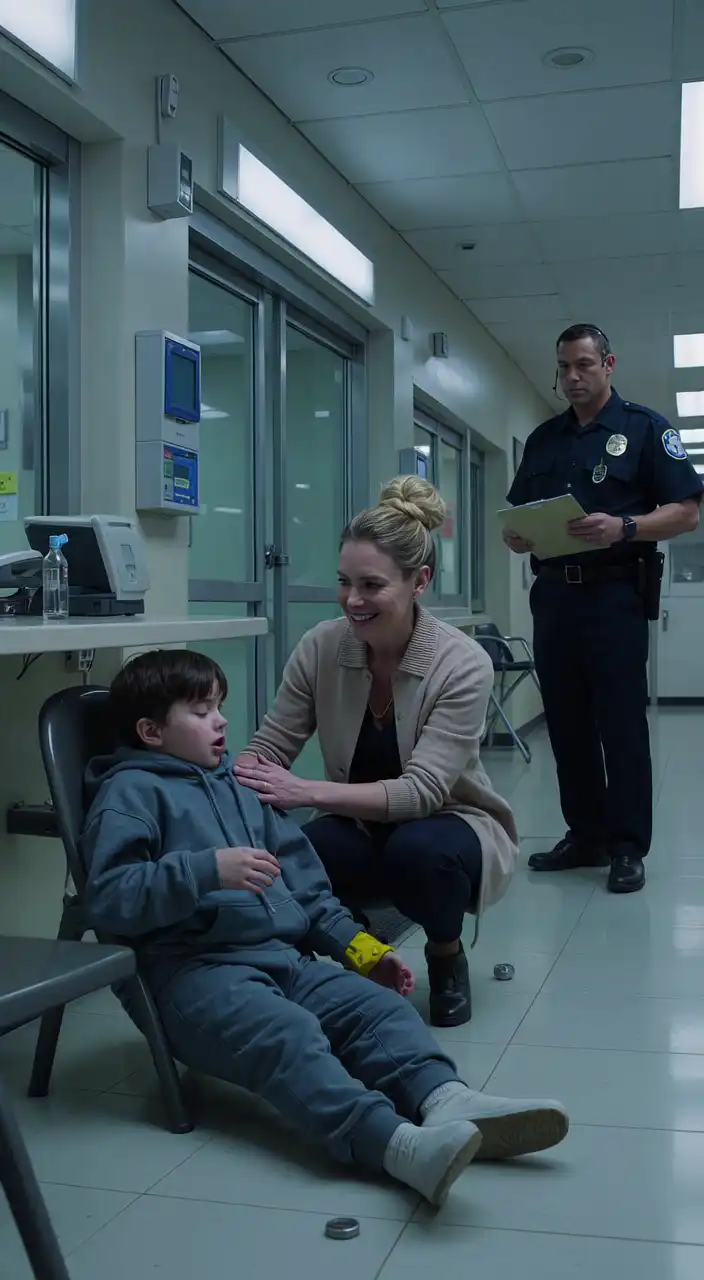
Emily's fingers locked harder around Daniel's arm for one terrible second, like her body moved before her face could catch up.
"That is ridiculous," she snapped, and the calm smile vanished so completely it was almost more frightening than if she had shouted from the beginning. "You don't get to accuse me of anything because a kid spilled something somewhere."
Daniel made a small sound in his throat and folded forward, one hand pressing against his stomach. The movement looked involuntary, like he was trying not to be sick on the floor. The nurse at triage stopped pretending this was a disagreement in a hallway. She pushed through the sliding doors and crouched beside him.
"Hey, sweetheart, look at me," she said. "Daniel, can you tell me what hurts?"
Emily cut in immediately. "His name is not on your list because we were leaving. He gets dramatic."
Marcus shifted between Emily and the hallway exit without touching her. He was not a large man, but the way he planted his shoes made the corridor feel suddenly narrower. "No one is leaving," he said. "Nurse Patel, I need clinical eyes now."
The nurse had already noticed Daniel's pulse in his throat and the tremor running through his wrists. "I need a wheelchair," she called over her shoulder. "And page peds triage, possible ingestion."
Emily laughed once, high and brittle. "Possible ingestion? He had syrup from home three hours ago. That's all. You're scaring him for no reason."
Daniel whispered, "Not home."
Nobody would have heard it if the hallway had not gone so quiet after Marcus's question. Nurse Patel leaned closer. "Not home? Daniel, where?"
His eyes darted to Emily and then down to the tile. Shame moved over his face in a way that no child should know that well. "The room," he said.
Emily stooped as if to gather him up. "He's confused. He has a speech delay when he's tired."
Marcus put one arm out, not touching her, just creating a barrier. "Ma'am, step back."
She straightened, and for the first time I saw something underneath the cardigan-and-handbag neatness. Not wildness. Calculation. She was scanning doors, badges, who looked convinced, who looked uncertain, where the weakest point in the line of adults might be.
A technician arrived with a wheelchair. Daniel tried to stand and failed. His knees gave under him, and Nurse Patel caught him under the shoulders while the tech guided the chair into place. As they lifted him, his sleeve dragged across the floor and that yellow stain flashed brighter under the lights. The bottle cap near the baseboard rocked from the motion. Marcus stooped, picked it up with a folded tissue from his pocket, and looked at the inside threads.
His face changed almost imperceptibly.
"What?" Nurse Patel asked without looking up.
He kept his eyes on Emily. "This cap is from hospital stock."
Emily said, "Lots of caps look alike."
"Not with color-coded pediatric dosing labels," Marcus replied.
Daniel gagged, thin and dry. Nurse Patel made the decision everyone else had been circling around. "We're done here. He's coming in now."
The triage doors opened. Emily moved fast, stepping into the wheelchair's path. "You cannot take him without me present."
Nurse Patel rose just enough to face her. "If you are his guardian, then you can come once registration and security clear this. But you do not get to delay assessment."
Emily turned to Marcus with sudden outrage that might have worked on a less prepared person. "You are security. Stay in your lane. Call administration if you have concerns. This child has behavioral episodes and sensory issues. He throws up medicine and smears it on himself. I brought him in because I'm responsible, and now you want to make me look abusive because we're Black and he's adopted."
That landed. People in the hallway shifted. One older man across from me frowned at Marcus like he was deciding whether this was overreach. Emily saw it and pressed harder.
"Ask his school. Ask his doctor. Ask anybody. He lies when he's overwhelmed."
Daniel's head jerked up at that word. Lies. His eyes went wide, and then he looked at Nurse Patel with the kind of last-ditch courage people use when they think this is the only opening they will get.
"He said don't tell," Daniel breathed.
Nurse Patel's voice lowered. "Who said that, honey?"
Emily's answer came first. "His cousin. About candy. This is exactly what I mean."
But Daniel's gaze had already slipped past her, toward the open triage doorway, toward help so close he could smell antiseptic and hear monitor beeps. "The man," he whispered. "Yellow medicine. Said sleep."
That was enough.
Nurse Patel pushed the wheelchair through the doors. The tech moved with her. Emily lunged after them, and Marcus caught her forearm, firm and clean. "Stop."
She yanked against him. "That is my son."
"Then act like his safety matters," Marcus said.
Her face went blank for half a second, as if she had to discard one script and pull out another. When she spoke again, tears came instantly. It was skilled, startling, and almost convincing. "Please. He has trauma. If strangers take him away he'll panic. Let me go with him."
Marcus didn't release her. "Registration can verify. Until then, you stay here."
The sliding doors shut between Daniel and Emily, and Daniel disappeared into triage with his head lolling against the wheelchair back. For one second Emily stopped fighting and just stared at the closed doors. It was not grief on her face. It was fear.
Not fear for a sick child.
Fear of losing control of the story.
Marcus spoke into his radio. "Code consult for suspected pediatric medication event outside triage. Also notify charge nurse that caregiver conflict and possible concealment are involved."
At the desk, another staff member opened a charting window and asked Emily for identification. She handed over a wallet card so quickly it looked rehearsed too. Foster authorization, I thought at first when I saw the shape of it. But the clerk's eyebrows pulled together.
"This temporary placement letter expired two months ago," she said.
Emily reached for it at once. "It's being renewed."
"Do you have current guardianship paperwork?"
"It's in the car."
Marcus watched her. "What car?"
"Mine."
"License plate?"
She hesitated just long enough for everyone to notice.
A second nurse came through the doors. "Patel needs social work and toxicology informed. Child presents with lethargy, tremor, pinpoint pupils fluctuating, possible mixed ingestion. She also wants to know whether security recovered the source container."
Marcus held up the cap in the tissue.
The nurse's jaw tightened. "Bring that to peds. Now."
Emily took a step back. "This is insane."
Then she did what people do when argument fails and truth is too close. She pivoted toward the exit.
Marcus had already anticipated it. "Door lockdown on north corridor," he said into his radio.
The automatic doors at the end of the hall clicked before Emily got three steps. She stopped, stared at them, and then turned with a fury so naked it stripped the friendly caregiver mask off completely.
"You have no right," she said.
A woman behind the desk answered quietly, "We do when a child may have been poisoned in our hallway."
Emily's head whipped toward her. "Poisoned? You hear one confused sentence from a difficult child and decide his caregiver did it?"
The clerk didn't flinch. "No. We heard the sentence, saw the symptoms, found hospital-stock medication debris, and saw you try to remove him from assessment."
For the first time, Emily looked uncertain about which lie would still work. She crossed her arms so tightly her knuckles blanched. "You people don't understand him," she muttered. "He ruins everything when he gets attached to attention."
The sentence hung there, ugly and telling.
Marcus studied her for a beat. "Who is 'he' attached to?"
Emily realized too late what she had said. "No one."
Marcus spoke into his radio again, lower now. "Add possible prior coercion. I want surveillance from pediatrics med room, corridor B, and north lobby for the last thirty minutes."
I should have looked away then. My mother squeezed my wrist, silently asking if we should keep out of it. But Daniel's little voice saying "Not home" had gotten under my skin. I stood and walked to the baseboard where the cap had been. Near the leg of the plastic chair, almost invisible against the grout line, was a tiny foil seal with a sticky yellow smear on it.
I picked it up by one corner. "There was this too."
Marcus turned. His expression shifted from controlled anger to quick approval. He took a specimen bag from the desk drawer and let me drop the foil in. Printed across the torn silver edge in tiny blue letters were three words: For clinical use.
Emily saw it and went white.
That was the first moment I knew this wasn't just about her giving Daniel something from home to make him sleepy for a difficult day. Hospital stock. Missing medication. An expired placement letter. A child too afraid to speak unless the doors to safety were physically open.
And somewhere inside those triage rooms, Daniel was finally separated from the person who had been controlling every word around him. Which meant, for the first time that day, someone might ask him the right question and have enough time to hear the answer.
The problem was that once Emily understood the hallway was no longer hers to manage, she stopped trying to sound reasonable.
She smiled at Marcus again, slower this time, and said, "If you pull that video, you'd better pull all of it. Especially from this morning. You'll see I was trying to return something your nurses left where a child could reach it."
It was the first plausible explanation she had offered.
It was also the first one that made Marcus's eyes narrow instead of relax.
Because if she had only found an abandoned medication bottle and tried to return it, she would have said that in the first ten seconds, not after a lockdown.
And because "this morning" meant she had been in pediatrics before anyone here knew Daniel was sick.
Marcus handed the bagged foil to the nurse and said, "Then let's see what you were doing in pediatrics before triage even opened."
Inside the sealed doors, an alarm started beeping faster, and everyone in the hallway turned toward the sound.
Emily did too.
And for the first time since Daniel hit the floor, she looked genuinely afraid that he might die before she could finish her lie.
Nurse Patel came back through the triage doors ten minutes later with two things on her face at once: the focus of someone moving too fast to waste language, and the anger of someone who had just learned this was worse than it looked.
"Security room," she told Marcus. "Now. Child tested positive on rapid screen for sedating antihistamine and a second agent we haven't confirmed. Blood sugar unstable. We need to know dose, timing, and whether this happened once or repeatedly."
Emily gave a dry, disbelieving laugh. "Repeatedly? You're writing a movie."
Patel didn't even glance at her. "He also has old bruising in healing stages on the upper arm consistent with restraint, and he begged the resident not to let her come in the room."
That made the older man across the hall, the one who had doubted Marcus, lower his eyes.
Patel turned to the registration clerk. "Did she produce legal guardianship?"
"Expired temporary placement letter only."
Emily snapped, "You don't know what you're talking about. The agency has been slow for months."
Patel's gaze finally landed on her, sharp and level. "Then you'll have no problem waiting while we verify every piece of this."
Marcus motioned toward the side corridor. "Walk with me."
"I am not under arrest."
"No," he said. "You're under observation in a hospital with a medically compromised child and a missing medication issue. Keep walking."
Something in his tone must have told her the performance window was closing. She adjusted the cardigan, lifted her chin, and followed him, not because she wanted to but because she suddenly understood everyone in the hallway had watched enough.
My mother whispered, "We should sit down."
But I had already been seen, already handed over evidence, and Patel glanced at me. "Were you here when the child spoke?"
"Yes."
"Stay nearby, please. Social worker may need your statement."
So we sat. And from the plastic chairs outside triage, the whole story began to open by inches.
The first contradiction came from the chart.
A resident emerged with a tablet and asked the clerk, "What last name is the caregiver using?"
The clerk told him.
He frowned. "That's not the name in our system from last month."
Patel looked up. "He was here last month?"
The resident nodded. "Brief ED visit for vomiting and drowsiness. Left before full workup. Chart note says caregiver declined labs after patient 'suddenly improved.'"
Marcus stopped walking Emily and turned back. "Same caregiver?"
The resident scanned. "Description matches."
Emily's voice sharpened. "That was food poisoning. He was fine."
Patel asked, "And why didn't you tell us he had a prior unexplained lethargy episode?"
"Because it was not relevant."
Patel stared at her for a beat too long. "To a child with probable ingestion, recurrent unexplained sedation is absolutely relevant."
Emily folded her arms again, but this time it looked less like composure and more like armor with cracks in it. "I don't have to be interrogated by every person with a badge."
"No," Marcus said. "Just by the right ones."
A woman in navy slacks and a county badge approached from the elevator bank carrying a thin laptop and a paper cup gone cold in her hand. She introduced herself as Lena Alvarez, hospital social worker and mandated reporter. Her expression was gentle when she asked for Daniel. It changed when she heard "expired placement letter."
"I need the placement agency name now," she told Emily.
Emily gave it.
Lena typed, waited, called someone on speaker, and asked for the on-call supervisor. We all heard the hold music. We all heard the click when someone answered. Lena kept the questions plain.
"Is Emily Carter currently the authorized foster placement for Daniel Brooks, date of birth-"
She stopped. Looked up. Checked the expired letter again.
Then she asked a second question, slower.
"Can you confirm whether the child in your placement file is Daniel Brooks or Darren Brooks?"
Emily moved.
Not bolting for the exit this time. Not dramatic. Just one smooth step toward Lena, hand out like she wanted the paper.
Marcus intercepted her instantly.
On speaker, the agency supervisor said, "Authorized placement ended nine weeks ago. Child was supposed to be transferred after a complaint."
Lena's voice dropped. "Transferred where?"
"Emergency kinship review was pending. We lost contact after caregiver reported the child had gone to stay with an aunt in Georgia."
Every adult in that hallway froze on a different beat.
Emily said, "That's a clerical error."
The agency supervisor kept talking, unaware of the silence she had created. "There is also a note that the child uses the nickname Daniel though legal first name is Darren. Why? Is he with you? We've had a welfare locate request open."
Lena closed her eyes for one second, then opened them hard. "Yes," she said. "He's here. He's medically unstable, and the former caregiver is present."
The supervisor exhaled so loudly the speaker crackled. "Do not let her leave."
Emily jerked against Marcus. "Former? You people don't know anything. They dump kids and then act heroic."
Lena ended the call and looked at her with a new kind of pity, the kind that does not soften consequences. "You reported him out of state instead of surrendering placement. That is not a clerical error."
Emily's lips thinned. "You don't know what he is like."
Nobody answered that, which made it heavier than an argument.
Patel's pager buzzed. She read it and swore under her breath. "His oxygen dipped during emesis. We need exact substances. Now."
Lena faced Emily. "What did he take?"
"Nothing."
Patel stepped forward. "That answer could kill him."
Emily looked toward the triage doors. Her face did something strange then, a flicker of conflict so quick it might have been missed if everyone had not been staring. It was not remorse exactly. It was calculation colliding with consequence.
"He steals medicine," she said at last. "He goes through bags. He sneaks into cabinets."
Marcus said, "Into hospital cabinets?"
Her mouth closed.
Patel took the opening. "So you are admitting he was near medication before triage."
"I am saying he is sneaky."
Lena asked, "Why didn't you say that immediately?"
"Because no one was listening."
But that was wrong, and everyone knew it. We had all heard her call him dramatic, manipulative, attention-seeking. Not sneaky. Not possibly poisoned. Not in danger.
Patel said, "If he accessed medication by accident, giving timeline and quantity helps us save him. If you know what he took and you keep withholding it, that is intentional endangerment."
The word intentional landed like a thrown object.
Emily's eyes flashed. "He was supposed to sleep."
Silence.
A nurse passing with supplies stopped midstep.
Patel's voice went flat. "What did you give him?"
Emily looked at the floor. "Just enough to calm him down."
"What was 'enough'?"
"He gets worked up in hospitals."
"What did you give him?"
She said nothing.
Marcus's radio crackled. "Supervisor, security review confirms subject entered pediatrics sub-wait hall at 8:11, remained near med cart staging area forty-three seconds. Camera angle partial."
Emily laughed again, but now it was thin and desperate. "Forty-three seconds proves nothing."
Marcus keyed back. "Send clip to consult room."
Patel breathed out once through her nose. "Good."
Lena turned to me then, unexpectedly. "Did the child say anything else before triage?"
I repeated it exactly: "I didn't take cough medicine. Not home. The room. The man. Yellow medicine. Said sleep."
Lena's eyes sharpened at one phrase. "The man."
Patel heard it too. "There's another adult."
Emily said too fast, "He watches videos. He repeats nonsense."
Marcus asked, "Who is the man, Emily?"
"No one."
But this time the lie came with a visible tell. Her right thumb rubbed the side seam of her cardigan pocket over and over, as if checking for something still there.
Marcus noticed. "Empty your pockets."
She recoiled. "Absolutely not."
"You can do it here, or law enforcement can do it when they arrive."
"Law enforcement? Over Benadryl?" she said, trying to make it absurd. "You're calling cops because a foster kid had a fit in public."
Lena's face hardened. "We are calling because a missing child under expired placement arrived sedated, underfed, frightened, and medically unstable with evidence of concealed dosing and false reporting."
Emily glanced at the locked corridor doors again.
That was when the second pressure point hit.
A pediatric resident pushed through the doors with a paper strip from the bedside monitor and addressed Patel directly, but loud enough for all of us to hear: "Heart rhythm's irregular during the sleepy periods, and tox wants to know if clonidine access is possible. Pupils and pressure keep swinging."
Patel's head snapped toward Emily. "Clonidine? Was he given blood pressure medication?"
Emily went pale under the fluorescent lights.
The yellow stain on Daniel's sleeve mattered even more now. Not just syrup. Not just sedation. Mixed dosing, maybe multiple drugs, maybe not the first time.
And when Emily finally spoke, it was not to answer the doctor. It was to whisper, almost to herself, "He was not supposed to say anything about the room."
Lena heard that.
So did Marcus.
And whatever room she meant, it was suddenly more important than the medication itself.
Marcus touched his earpiece. "Add local PD and request immediate welfare check address from agency records. We may have another involved adult and a scene containing evidence."
Emily lunged toward him with a speed that startled even him. "No."
He caught her wrists before she reached the radio. For the first time, real panic blew the polish off her voice.
"You cannot go there," she said. "You cannot let them in there before I call him."
Patel stared at her. "Call who?"
Emily clamped her mouth shut.
Too late.
Because now there was a child behind the triage doors fighting the effects of something that could stop his breathing, and there was a room somewhere with another adult, maybe more drugs, maybe proof of where Daniel had really been kept for the last nine weeks.
And Emily had just made it clear that whatever was in that room scared her more than the hospital did.
Marcus led Emily into the small consult room off the corridor with Lena beside him and another security officer at the door. Because I was only a witness, my part should have been over. But Patel came back once more to ask me to write down exactly where I had been sitting and what I heard. I did, hands shaking more than I expected. My mother signed as witness that I had been there.
Through the consult room's narrow glass strip, I could see Emily perched on the edge of a vinyl chair, composed again by force. She had crossed her ankles, folded her hands, rebuilt the mask. Lena sat opposite with a legal pad. Marcus stood by the wall-mounted screen waiting for security video.
Inside triage, the beeping started and stopped in patterns I could not read. Every time doors opened, I caught antiseptic, worried voices, and once the sight of Daniel's small sneaker hanging off a bed rail as staff moved around him.
Patel came out to update Lena but ended up talking where all of us could hear. "We're treating presumptively for mixed ingestion. He responded partially to glucose, then dropped again. He vomited and aspirated a little, but not enough to intubate yet. Tox says the yellow residue may be compounded liquid or crushed medication in syrup. We need history."
Lena nodded. "She's still not giving it."
Patel looked through the glass at Emily. "Then maybe the video will."
The wall screen flickered on.
It showed the pediatrics sub-wait hall from a corner angle. Time stamp: 8:11 a.m. People drifted in and out. A med cart sat near a locked alcove because a nurse was restocking under visual line, not expecting someone to step close between tasks. Emily appeared from the left holding Daniel's hand. He was upright then but already sluggish, hood up, dragging his feet.
She looked around once. Not panicked. Not hurried. Practiced.
She parked Daniel by a chair, told him something too quiet for the video mic, and moved toward the cart. The nurse assigned to it was helping a family twenty feet away. Emily's shoulder blocked the exact moment of contact, but when she stepped back her hand went into her cardigan pocket.
Daniel did not move. He watched her.
Then came the detail that changed the room.
She crouched in front of him and lifted something to his mouth. He turned away. She pinched his chin. He swallowed.
Marcus paused the screen.
The silence after that felt physical.
Emily said, "It's medicine. I told you he was already sick."
Patel answered immediately. "Then why take it from an unsecured hospital cart instead of telling triage what he already had?"
"It was not from the cart."
Marcus resumed the clip. Emily wiped Daniel's mouth with his own sleeve. Yellow smeared across the cuff. Then she stood, scanned the hall, and guided him toward the main triage corridor, where the public confrontation had happened minutes later.
Patel pointed. "Pause. Back two seconds."
Marcus did.
At the bottom right of the frame, near Daniel's shoe, something small bounced once and rolled out of sight. The cap.
Patel looked at Emily. "You dosed him in the hall."
Emily stared at the frozen image and then shook her head, as if refusal could reverse the pixels. "You cannot prove what was in the spoon."
Marcus leaned over the console. "Enhance to the prior minute."
The technician scrubbed back. Another angle synced from farther down the hall. It showed Emily reaching into her pocket before the cart interaction. Not after. Pulling out a travel syringe or small spoon. Then taking something from the cart area. Maybe not the main drug. Maybe a mixing liquid. Maybe a second medication. The sequence was still incomplete, but it destroyed the claim that this was all accidental access by Daniel.
Lena said quietly, "Who told you how much to give him?"
Emily's eyes cut to her. "No one."
Lena had been waiting for that. "The child said, 'The man. Said sleep.'"
Emily looked away.
Patel's phone rang. She answered, listened, and her face tightened. "He just had another pressure drop. Tox wants to treat for clonidine exposure while we wait. They need weight history because he is under baseline for age."
Lena's pencil stopped. "Underweight too?"
Patel covered the phone. "By a lot."
Marcus swore softly.
Lena turned back to Emily, and this time there was no softness left. "How long has he been sedated on and off?"
"I don't know what you're talking about."
"You kept him after your placement ended. You reported him with an aunt out of state. You brought him into a hospital with hospital-stock medication debris on his clothes. We have video of you forcing a dose into his mouth. You can spend the next ten minutes protecting yourself, or you can help doctors keep him alive."
Emily's lips trembled. Not from guilt. From strain. Like a structure holding too much pressure. "You don't know what he does at night," she whispered.
Lena held still. "Tell me."
"He cries. He opens doors. He wanders. He tells stories. He makes people look at me like I'm the problem."
Marcus said, "So you drugged him?"
Emily snapped, "I made him sleep."
The room went silent again.
It was a confession, but not a complete one.
Patel asked the crucial question. "With what?"
Emily's eyes filled, but she still tried to choose a version of the truth that would spare her the worst. "Mostly syrup. Sometimes the little white pill if he fought."
"What white pill?"
She said nothing.
"What man?" Lena pressed.
Emily rubbed her pocket seam again, harder. Marcus noticed and nodded to the female officer by the door. "Pocket contents."
Emily jerked back. "No."
The officer stepped forward. "Stand up, ma'am."
After a moment that stretched too long, Emily stood and turned out her pockets with theatrical disgust. Lip balm. Keys. Crumpled receipt. A folded sticky note. No pill.
But Marcus picked up the receipt first.
It was from a discount pharmacy, timestamped two nights earlier. Along with milk, bread, and detergent, there were two items circled in pen: children's syrup and a pill splitter.
Patel took a sharp breath. "Clonidine is often tiny white tablets."
Emily shook her head too quickly.
Lena opened the folded sticky note. Three lines were written in block letters:
1 tsp if crying 1.5 if running around half tab if still awake
No names. No drug names. Just instructions.
The phrase at the bottom was worse than the numbers.
Keep him quiet.
Patel reached for it like it might burn through paper. "Who wrote this?"
Emily closed her eyes.
"The man?" Lena asked.
No answer.
Marcus took a photo and sent it to evidence intake. "Address from agency?" he asked Lena.
She already had it open. "Apartment on Grant. Same one listed during placement."
Marcus radioed dispatch for a welfare check upgrade to full response. "Possible evidence of child medicating, possible second suspect on site."
Then came a small but important reversal.
A nurse from pediatrics hurried in carrying a clear plastic bag. "Found this in the hoodie pocket when we changed him." Inside was a friendship bracelet made of cheap blue string and letter beads. It read DANNY in crooked white cubes. Tied to it with a rubber band was a metal key stamped 2B.
Lena frowned. "Does he have another clothing bag?"
"No. Just this."
Patel stared at the key. "Two-B. Apartment?"
Marcus looked at the agency address on Lena's screen. "Unit 1A."
So why was a child wearing a key to 2B hidden in his hoodie pocket?
Lena's answer came slowly. "Because he was keeping something."
Patel understood first. "Or someone."
The bracelet was grimy, stretched, clearly handmade by a child. A planted little thing everyone might have dismissed if Daniel had arrived clean, fed, and safe. But the way it had been hidden in his pocket turned it into intention. Protection. A secret.
Lena said, "When he's stable enough, ask him what 2B is."
Patel nodded. "If he's stable enough."
The words landed hard.
Emily looked at the bracelet and for the first time seemed honestly shaken. "He still had that?"
Lena's head lifted. "You knew about it."
Emily pressed her lips together.
Patel took the bag and left at almost a run.
An hour earlier, this had looked like a difficult caregiver minimizing a dramatic child in a busy hallway. Now it was a medically unstable missing foster child, probable repeated sedation, a possible second offender, and a hidden key that suggested Daniel had been protecting evidence or access to somewhere else in the building.
The key changed the emotional center too. Daniel had not only been surviving. He had been planning.
Marcus got another radio update from responding officers. "Grant address. Building manager reports Unit 1A appears occupied. Male seen leaving and returning irregularly. Officers on approach."
Emily made a strangled sound. "No, no, no."
Marcus looked at her. "Who's in 2B?"
She said nothing.
Lena leaned forward. "Emily, if there is another child there, this is your last chance to say it before officers open doors blind."
Emily's face cracked then, not open but unstable. "It's not like that."
Lena did not blink. "Then tell me what it's like."
Emily swallowed. "He said he was helping."
"Who?"
She whispered a name so low we barely heard it. "Terrence."
Patel came back before anyone could build the next question. Her expression was grim, but there was a thread of hope in it now too.
"He's awake enough to answer one or two direct questions," she said. "Not many. We need concise."
Lena rose. "I'll go."
Patel pointed at me. "No more witnesses. Just me, social work, and resident."
Emily stood up from the chair so abruptly it scraped. "I need to see him."
"No," Patel said.
"He needs me."
Patel's voice sharpened. "He asked us not to let you in."
Emily froze as if slapped.
Lena went through the doors with Patel. Marcus stayed, watching Emily with that same contained fury. I kept seeing the bracelet in the bag. DANNY. Child letters, maybe made by another child, maybe by Daniel himself. The hidden key against his ribs. A secret small enough to carry even when an adult controls your meals and your sleep.
It took only six minutes for Lena to return, but the hallway felt suspended while she was gone.
When she came back, she was carrying the bracelet bag and her face had changed.
"He said 2B is 'Miss Pearl's door,'" she told Marcus. "He said when Emily and Terrence got mad, he listened there because Miss Pearl hit the ceiling with a broom if she heard crying. He said she 'went away in the ambulance' three days ago."
Marcus straightened. "Elderly neighbor?"
Lena nodded. "He says Miss Pearl gave him crackers through the chain lock and told him to keep the extra key if he ever needed to hide in her bathroom. He says after she left, Terrence started using her apartment because no one checked it."
A chill moved through the whole corridor.
"Using it for what?" Marcus asked.
Lena looked at Emily.
Emily looked at the floor.
"Daniel said, 'the bottles,'" Lena answered. "And he said Terrence told Emily the hospital stuff was stronger."
That was the larger reversal beginning to show itself. Miss Pearl had not just been a kind neighbor. Her empty apartment, or access to it, may have become part of whatever Terrence and Emily were doing. Storage. Hiding place. Maybe where Daniel had been kept when agency checks were avoided.
Marcus was already speaking into the radio. "Update responding officers. Add adjacent Unit 2B if accessible. Elderly resident transported out three days ago; possible unlawful entry and evidence storage."
Emily finally whispered, "He said he was only borrowing it."
Marcus stared at her. "Borrowing a hospitalized elderly neighbor's apartment?"
She began to cry again, but the sound was different now, frayed and real. "You don't understand. Terrence said if I lost Daniel, I'd lose everything. He said the agency would blacklist me. He said nobody wanted a problem kid with night terrors and bathroom accidents and stealing food. He said we just needed him quiet until the review passed."
Lena spoke carefully. "And when the placement ended?"
Emily twisted the receipt in her hand until it tore. "Terrence said we could keep him off record a few weeks. Then he said longer. Then he said if Daniel slept through visits and school calls, people would stop asking."
"School?" Marcus said. "He hasn't been attending?"
"No," Emily whispered.
That explained the underweight, the fear, the recurrent drowsiness. It made every prior minimized incident heavier.
But it still did not explain the hospital stock medication.
Patel asked it bluntly. "Why take anything from pediatrics today?"
Emily shook her head. "I ran out of syrup."
It was so simple and so ugly that for a moment nobody spoke.
She kept going because once the truth starts breaking loose, it often comes in pieces. "He got loud in the car. He said he was going to tell. I thought if he slept through triage, I could say he was just tired and bring him back later. Terrence said hospital medicine worked faster."
Lena said, "Terrence works here?"
Emily's eyes flew up.
There it was.
Not a doctor. Not a nurse. Maybe housekeeping, transport, vendor, maintenance. But someone with enough access or enough confidence to use the hospital as a supply point.
Marcus keyed his radio. "Freeze all employee exits pending ID on male suspect Terrence, possible inside access to pediatric meds. Check visitor logs and service badges connected to Grant address."
The story had become bigger than one hallway, bigger than one caregiver lie. Yet Daniel was still behind the doors, still fighting the dose already inside him.
And then the final turn of this movement hit.
Marcus's radio crackled with a voice from patrol at Grant Apartments. "Supervisor, Unit 1A clear of occupants. Strong chemical and medication odor present. Unit 2B door ajar. We have evidence of recent occupancy by a child. Also... stand by... we have a male subject attempting rear stair exit."
Emily covered her face.
Marcus said, "Hold him."
The radio answered with shouting in the background, feet on stairs, an officer yelling, "Stop, hospital police!"
Then a second voice, breathless and urgent: "Subject is resisting. We also found multiple pharmacy bottles, hospital packaging, and what looks like discharge paperwork from an elderly female resident."
Miss Pearl's apartment. The bottles. The hidden key. All of it paying off at once.
Marcus looked at Emily. "Terrence doesn't get to hide behind you anymore."
But before anyone could take satisfaction from that, Patel's pager sounded again. She read the screen and her jaw clenched.
"What?" Lena asked.
Patel looked up. "Daniel just told the resident one more thing before he drifted again."
She held the bracelet bag tighter.
"He said Terrence wasn't the only person Emily made him call 'Dad.'"
Lena went still. Marcus did too, hand halfway to his radio as if the news had changed the shape of the room beneath him.
"Say that again," he said.
Patel's face had gone pale with controlled anger. "Daniel said there were other men. He said sometimes they came when he was told to stay in the bathroom or the closet. He said if he made noise, Emily said he would go somewhere worse."
Emily made a sound from behind her hands, not a denial, not exactly. More like the air leaving someone who had been outrun by the truth.
Lena spoke first. "Is he conscious enough for forensic questions?"
"Not for a full interview," Patel said. "He's drifting. Tox treatment is running. Pressure is still unstable, but he's more responsive than he was. We have to be careful not to push him."
Marcus keyed his radio anyway. "Notify responding officers at Grant that this may involve broader exploitation and multiple adult contacts. Preserve everything. Full scene tech response."
My mother put a hand over her mouth. I felt sick and cold at the same time. Up until then I had been watching a rescue in motion, terrible but still somehow containable. That one sentence ripped the walls outward. Daniel was not just a child drugged to keep him quiet. He might have been hidden, circulated, threatened, and taught to swallow fear in silence.
Emily dropped her hands and looked up at Lena. Her mascara had finally started to break at the edges. "I didn't let them touch him," she said quickly. "I didn't. I kept him away when I could."
Lena's stare was like stone. "When you could?"
Emily shook her head harder. "Terrence knew people. They came around. I said no. I said he was too much trouble. I said he cried."
The sentence was monstrous enough that she seemed not to understand how it sounded until she heard it hanging there.
Marcus said, very flatly, "You are trying to bargain with your own cruelty."
Patel cut in before Emily could spin another version. "Whatever happened or did not happen in that apartment, the immediate issue is that he may have had repeated chemical restraint. We also found old needleless oral syringes in the hoodie pocket lining. More than one."
Lena frowned. "He kept them?"
"No," Patel said. "They were tucked up inside the seam like someone shoved them there in a hurry. Maybe he hid them. Maybe someone forgot. But the resident thinks the fabric smells layered. Different medicines over time."
Emily closed her eyes.
Marcus heard the silence for what it was. "Repeatedly," he said.
Patel nodded once. "Repeatedly."
Another conflict point hit right then, hard and fast. A man in a suit with an administration badge came down the corridor with a risk management officer beside him. Their faces had that institutional expression that tries to look calm while calculating damage.
"Supervisor Ramos," the administrator said to Marcus, "I need a summary before this area turns into a scene."
"It already is a scene," Marcus said.
The man glanced at me, my mother, the older patient across the hall, the locked doors, the consult room still open. "We need to control information."
Patel bristled immediately. "Control the medication chain, maybe. Not the people who delayed a child's death by noticing what your system missed."
The risk management officer lifted both palms. "No one is minimizing care. But if there is an employee angle and missing stock involved, we need coordinated reporting."
Marcus stepped closer to them. "Good. Coordinate with law enforcement, CPS, and pharmacy audit. Because if anyone's first instinct here is containment over evidence, you're already behind."
The administrator's jaw flexed. "No one said that."
"You walked in here saying information control before you asked whether the boy was alive," Patel said.
That landed. He looked toward triage at once, chastened or at least aware of how bad he sounded. "How is the patient?"
"Not dead," Patel said. "Because he got through the door in time."
Lena used the opening. "I need every prior visit under all recorded names, including Darren Brooks and Daniel Brooks, and any aliases tied to this caregiver. I also want badge access logs for pediatrics med rooms and sub-wait areas for the past ninety days."
The administrator nodded too slowly for her liking. "We'll need formal requests."
"No," Marcus said. "You'll need urgency."
His radio went off again before the argument could spread. Patrol. "Male subject detained behind Grant Apartments. ID on person reads Terrence Halbrook, contracted environmental services at St. Agnes Regional. Repeat, subject has hospital contractor badge."
Patel shut her eyes for one second in fury.
Marcus answered, "Copy. Secure badge, phone, keys, and clothing. Is 2B clear?"
A pause. Then: "Negative. We have signs of recent occupancy and a locked interior closet. Forcing entry now with supervisor approval."
Emily made a broken movement toward the sound of the radio. "No, no, no, don't break that door, he'll get mad, he said not to-"
She stopped because she had just said too much again.
Lena turned slowly. "Who will get mad, Emily? Terrence is already in custody."
Emily stared at the floor.
The radio crackled with wood splintering, an officer coughing, another saying, "Open. Open. We have... hold on."
Every person in the hallway leaned toward that sound.
Then the officer came back, voice changed.
"We found storage tubs with pediatric medication packaging, used dosing syringes, school papers in the child's name, and multiple prepaid phones. Also camera equipment. Requesting detectives now."
Nobody spoke.
Then the officer added, "There is also a wall calendar with dates marked M and R, and initials we don't recognize."
Patel's face hardened further. "Camera equipment."
Lena was already typing. "This just escalated to criminal trafficking review."
Emily shook her head violently. "No. No. He filmed the apartment, not the boy. It was for money, for online sales, furniture, stupid resale videos. You don't know."
Marcus said, "Then detectives will sort out what the cameras were for."
She looked at him with sudden, naked desperation. "If they think I knew all of it, they'll bury me."
Lena's voice was ice. "You brought a sedated missing child into a hospital and tried to stop him from speaking. Start worrying about the child you buried."
That should have ended her, emotionally. Instead it triggered the reversal none of us expected. Emily began to cry for real. Not performative tears. Jagged, uneven sobs that made her shoulders shake.
"I tried to send him back," she whispered. "I called the agency twice. They didn't call back. Terrence said if I turned him in after the paperwork lapsed, they'd charge me. He said no one would care because Daniel was already flagged difficult. He said the medicine was temporary. He said everybody does something to make foster kids manageable."
No one answered, maybe because the statement was too revolting, maybe because in some smaller way everyone knew that the system around a child like Daniel often made that lie easier to sell. Not true. Never true. But easier for a desperate, selfish adult to believe.
Lena crouched just enough to be eye level with her, and that made her voice hit harder, not softer. "Listen carefully. There are things here that may involve Terrence beyond you. There may be other victims, other children, other crimes. If there is anything you know that gets us to names, locations, phones, passwords, routine contacts, or where Daniel was taken, this is the only useful thing you can do now."
Emily swallowed and wiped her nose with the back of her hand like the careful image no longer mattered. "He had a storage unit."
Marcus responded immediately. "Location."
"I don't know the exact number. Red doors. Near the freeway. He called it 'the office.' He kept old phones there and tote bins."
"Name of facility."
She hesitated.
Marcus leaned in. "Now."
"Sunwest Mini Storage," she whispered.
He radioed it through at once.
Patel's pager chirped again, but this time when she read it something in her face loosened, just barely. "His pressure is responding. He's still not safe, but he's stabilizing."
The whole corridor exhaled.
It did not feel like victory. More like a ledge after a fall.
Lena stood. "Can he hear me again yet?"
"Maybe for a minute," Patel said. "Why?"
"Because if he gave us that key and that name, he's been trying to help. I want him to know someone listened."
Patel nodded and disappeared back through the doors.
The administrator, quiet until now, cleared his throat. "Contractor badge access means this is going to involve media if it leaks."
Marcus rounded on him. "If it leaks? A child almost died on your hallway floor because a contractor with med access and a caregiver thought they could outtalk triage."
The risk officer touched the administrator's sleeve, silently telling him to stop talking. Smartest thing anyone in a suit had done so far.
Fifteen minutes later uniformed city police replaced the second security officer at the consult room. They read Emily her rights. She asked for a lawyer halfway through and then, in another emotional whiplash, begged not to be taken before she saw whether Daniel lived.
One of the officers said, "You don't get to make that decision."
She looked at Lena instead. "Please. Just tell me if he wakes up."
Lena did not promise anything.
As Emily was led past the plastic chairs, she glanced at me. Maybe because I had picked up the foil. Maybe because I had heard Daniel when she thought nobody would. Her expression was not hatred. It was almost accusation mixed with disbelief, as if she still could not understand how a whole structure of lies had come apart because strangers chose to pay attention.
After she was gone, the hallway became quieter in a different way. The danger from her body was removed, but what she had brought with her remained. Statements. evidence bags. logs. camera footage. a child inside a treatment room with too many adults now trying to undo what should never have been allowed.
Marcus came over to where my mother and I sat. "Thank you for staying."
I nodded, suddenly exhausted.
He looked at me directly. "You may have saved that boy's life."
I started to say I had not done much, but he shook his head once. "People look away from hallway things all day. You didn't."
That was when the emotional reversal hit me personally. Until then I had been riding fear and adrenaline. Now my hands began to shake badly enough that my mother wrapped both of hers around them. The reality that Daniel could have been wheeled back out, could have been taken away, could have died with everyone thinking he was dramatic, landed all at once.
A detective arrived next, then another. They took statements from Marcus, Patel, the registration clerk, the older man who had doubted and then witnessed, me, my mother. The story became formal. Times. quotes. positions in the hall. Which hand held the shoulder. Which word Daniel used first. They asked whether Emily had touched the cap after it fell. Whether I had seen anyone else near the chair. Whether there had been mention of a pediatrician. Every little hallway detail that had felt chaotic was now being pinned into a chain.
The clue movement became almost visible in real time. The cap and foil went to hospital police evidence. The sticky note was photographed and sealed. The pharmacy receipt was matched against home purchases and store video request forms. Security exported the med-cart footage, then a second clip from the north lobby showing Emily arrive with Daniel barely able to walk. Badge logs began to flag Terrence's entries into restricted sub-wait areas during hours he had no cleaning assignment there. The agency emailed case notes showing missed home checks and a neighbor complaint they had never fully closed. Grant Apartments yielded the hidden tote bins, the cameras, the phones, and Miss Pearl's missing key ring.
Then came another hook, another awful turn.
One detective stepped out of a call and asked Marcus, "Did anyone mention an elderly neighbor named Pearl?"
Lena answered yes.
The detective grimaced. "Her ambulance transport records show possible medication confusion before admission. If Terrence had access to her unit and prescriptions, this may tie into more than one victim."
Patel heard it and muttered, "He was testing supply lines on the vulnerable."
Lena's face tightened. "And Daniel was easiest to silence."
The detective nodded. "For now, yes. But we may be looking at theft from hospital stock, theft from a medically fragile elder, unlawful confinement, child endangerment, and whatever the electronics reveal."
Patel crossed her arms hard over her scrubs. "Please let one of the reveals be the exact dose history. I want to know how often he was put under."
Almost on cue, the resident came through with lab updates. "Confirmatory panel is leaning sedating antihistamine plus clonidine. Possibly more, but those are the big ones. He also has mild liver stress markers. Could be repeated exposures, poor nutrition, or both."
Lena closed her eyes briefly. "Repeated."
"Likely," the resident said.
It had been hours by then. The triage line had long since closed and reopened under new staff. Hallway traffic changed. Day became evening against the far glass doors. But the center of gravity stayed where Daniel had first slid to the tile, where all the institutional seconds had almost been wasted.
Near sunset, Patel finally returned with a different expression. Not relaxed. Not happy. But carrying the first real piece of rescue consequence that felt clean.
"He's asleep naturally now," she said. "Monitored. Breathing on his own. The worst instability passed."
My mother let out a breath so deep it seemed to empty the day from her.
Lena asked, "Did he say anything else?"
Patel nodded. "A little. Enough to matter."
We all waited.
"He told us Miss Pearl called him 'Baby Detective' because he remembered where things were hidden. He said he took the 2B key when Terrence started bringing bottles there because he thought if he kept the key, Terrence couldn't lock him inside."
Marcus looked away for a second, jaw working.
Patel kept going. "He also said he put one bottle cap under the chair on purpose when Emily dragged him through the hall. He thought if it fell out where nurses could see it, somebody would know."
That hit harder than almost anything else.
Not just surviving. Signaling.
Not just a scared child. A scared child making evidence move.
The older man across from us covered his face with both hands. "Jesus."
Patel nodded once. "Yes."
Lena's eyes had gone bright. "Can I see him?"
"For one minute," Patel said. Then she looked at me. "You too, if you want. Briefly. Since he asked if the chair person stayed."
I did not understand at first. "The chair person?"
"He remembered you were near the chairs," Patel said. "He asked if the person who heard him got in trouble."
That broke something in me a little.
So I went in.
Daniel looked smaller in the bed than he had on the floor. Monitors traced his heart and oxygen in quiet green lines now, less frantic than before. The oversized hoodie was gone. He had a hospital gown and warm blankets and a pulse ox on one finger. Without Emily looming over him, he looked impossibly young.
His eyes opened when Patel said his name softly. They were heavy but aware.
"Hey," I said, because nothing more polished would come.
He studied my face, then whispered, "You told."
"Yeah," I said. "I told."
He gave the faintest nod, as if that confirmed an experiment he had hoped would work. His voice was papery. "I dropped the cap."
"I know."
"And the key. Not where she sees."
Lena stepped closer, careful to stay gentle. "We found it. You did good."
His mouth trembled, and I thought he might cry, but he only asked, "Miss Pearl okay?"
Lena answered with the truth available. "She's in the hospital too. People are checking on her."
He accepted that, or maybe was too tired to do anything else. "Terrence said nobody listens if you're bad," he whispered.
Patel touched the blanket near his hand, not touching him unless invited. "He lied."
Daniel looked at all of us then, one by one, as if still testing the room for danger. What he found must have been enough, because some rigid part of his face finally loosened.
"I told the yellow," he murmured.
It took me a second to understand.
The yellow stain. The yellow proof.
"You did," I said. "And it worked."
His eyes drifted shut after that.
We left him to sleep.
Outside, consequences kept unfolding. Detectives confirmed the storage unit had been rented under Terrence's cousin's name and contained more hospital consumables, old foster paperwork, children's clothing in mixed sizes, and digital media pending warrant review. The agency supervisor arrived in person looking wrecked and defensive at once, followed by county child protection intake, who had to begin the formal process of emergency custody, trauma placement search, and internal review. Administration started a parallel audit and suddenly everyone who had once moved slowly discovered urgency.
There was pressure from every direction now. Police wanted statements. The county wanted timeline reconstruction. Hospital leadership wanted to know how a contractor touched anything near pediatrics. Pharmacy wanted to know which lot numbers were unaccounted for. The foster agency wanted to know why an expired placement had turned into nine missing weeks. Every authority that had once existed in fragments was now converging on the same fluorescent hallway.
And because truth is rarely neat, one more emotional reversal arrived before the night ended.
Lena came out of a call with Miss Pearl's niece. "Pearl had reported hearing crying through the vent more than once," she told Marcus. "She complained to the building manager that a little boy was being kept alone. She was dismissed as confused after her own health scare."
Marcus shut his eyes briefly.
Lena continued. "Before she was hospitalized, she slipped Daniel that bracelet key bundle through the chain and told him if he ever got to a hospital, he should make them look at his sleeves because medicine leaves colors."
Patel pressed her hand to her chest. "She taught him the clue."
The whole day folded differently around that. Daniel had not invented the signal alone. An old woman next door, written off as unreliable, had given him a method. A child and an elder, both vulnerable, had been trying in their own ways to move evidence through adults who did not listen fast enough.
By the time my mother and I were finally allowed to leave, the patch of tile where Daniel had collapsed had been cleaned. But I could still see it in my head. The cold floor. The doors opening and shutting. The moment care had been close enough to see but not yet close enough to touch.
Marcus walked us toward the exit. His earpiece was still active, his phone still buzzing with updates. "Detectives may call tomorrow," he said. "Are you okay to talk again if needed?"
"Yes," I said.
He nodded. "The child will have protection on his room tonight. No visitors without county authorization."
"What happens now?" my mother asked.
Lena, who had joined us with a stack of files against her chest, answered that one. "Now the rescue part gets hard."
She did not mean medicine, though medicine was still part of it. She meant the after. The interviews. The trauma exam if Daniel was stable enough. The placement scramble. The evidence review. The possibility of discovering there were other children or other nights or worse uses for those cameras. The systems that would suddenly race because exposure forces movement, even when quiet need did not.
But she also meant something else.
"He was believed tonight," she said. "That changes the road from here."
As we stepped through the main doors into the dark parking lot, my phone buzzed with a local news alert about a contractor detained after a pediatric medication incident at St. Agnes. No names yet. No details. Just the beginning of public exposure, the first outer ring of consequence.
Inside, under those fluorescent lights, Daniel was no longer on the floor. The yellow stain had become a record. The cap had become evidence. The key had become a map. The hallway had become a crime scene and a rescue line at the same time.
And somewhere in a locked evidence bag sat a cheap blue bracelet that proved a little boy had been trying, all along, to leave a trail adults could not ignore.
Disclaimer: Mention of any brand or trademark is for identification only and does not imply partnership or endorsement