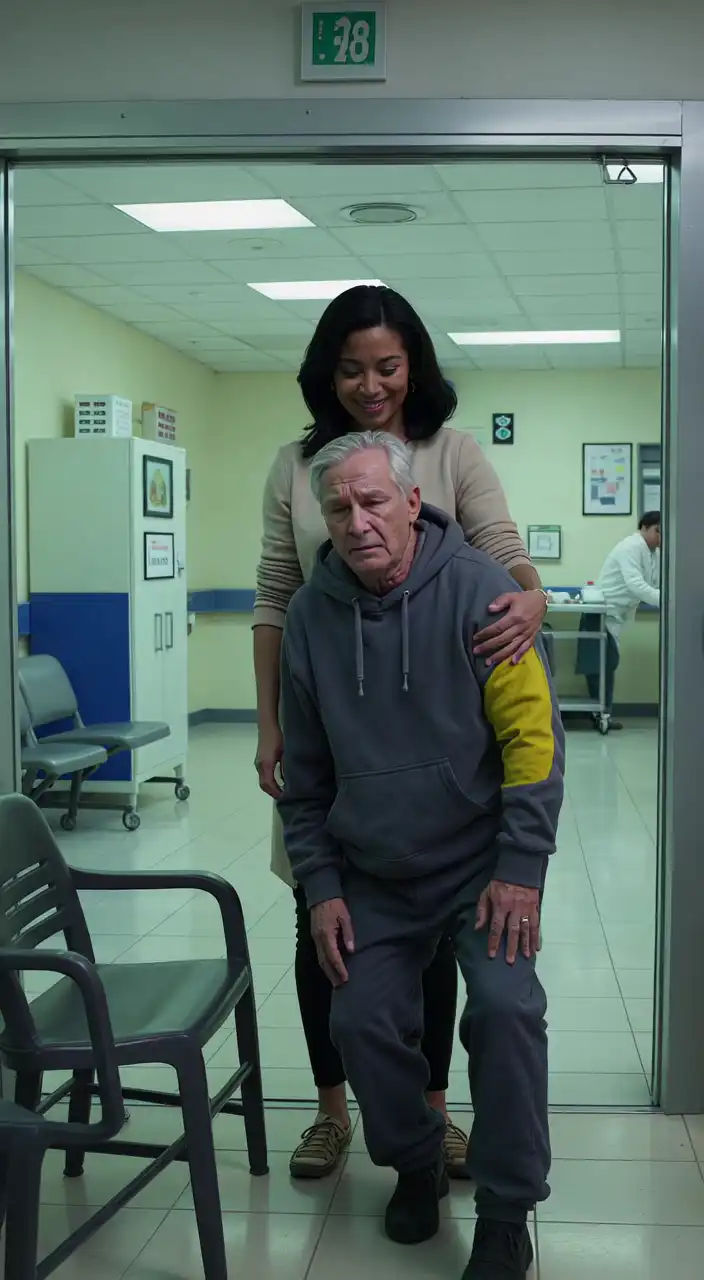
Sandra's hand tightened around Leon's upper arm so fast he winced before anyone else moved.
"I said we're leaving," she snapped, and the sweet, patient tone she had worn at the chairs dropped right off her face. She turned her body toward the exit, trying to haul him upright, but Leon's knees folded under him. He gave a small sound that did not even reach a cry, just a breath forced through fear.
Abigail moved first. She stepped between Sandra and the hallway doors with one arm spread across the opening and the other already reaching for Leon's wrist. "Ma'am, let go of him."
A nurse from the far station hurried over at the sound of the alarm, and a security officer rounded the corner at nearly the same time. The monitor's amber light kept flashing from a portable unit someone had rolled toward the hall, but the sound had done its job already. It broke the weird silence that had let Sandra control the scene.
Sandra straightened as if insult itself were a shield. "This is insane. I brought him here because he was dizzy. Now you're acting like I poisoned him."
Abigail did not answer that. She had two fingers on Leon's pulse and her eyes on his face. "Leon, can you hear me?"
He nodded once, barely.
"Did you take any medicine today?"
Sandra answered before he could open his mouth. "Children's cough syrup. One dose. Hours ago."
Leon flinched at her voice. Abigail saw it. So did the security officer. The nurse knelt on the other side of Leon, opened an oxygen package, and asked softly, "Buddy, can you tell me if your tummy hurts?"
Leon whispered, "No."
Sandra threw up a hand. "See? He doesn't even have symptoms. He's exhausted. He stayed up all night."
Abigail looked at the yellow stain again, then at the bottle cap near the wall. She spoke without taking her eyes off Leon. "Pick that up, bag it, and call peds toxicology."
Sandra's head snapped around. "You are not taking my things."
The security officer said, "Nobody is touching your purse, ma'am. But the item on the floor stays here."
Leon swayed. Abigail caught his chin gently when his head dipped. "Leon, did you throw up?"
He shook his head.
"Did someone give you medicine from a spoon? A cup? A syringe?"
His eyes flicked toward Sandra so quickly it might have been missed by anyone less practiced. Abigail did not miss it. Neither did the nurse, who shifted a little closer, placing her own body between Sandra and the child without making a show of it.
Sandra folded her arms. "This is exactly why poor people don't come to hospitals. One stain and suddenly you're calling security."
Abigail finally looked up at her. Her voice stayed even, but something in it hardened. "I am calling for immediate evaluation because this child is weak, tremoring, pale, and unable to stand. I am also concerned because his presentation does not match the history you're giving."
The words landed harder than shouting would have.
The nurse slid a pulse ox onto Leon's finger. He watched it with frightened concentration, as if he needed to understand what the machine would tell these adults. Numbers flickered. The nurse's mouth tightened.
"We need him inside now."
Sandra stepped forward again. "No. I said no. I am his guardian."
Abigail rose in one smooth motion. She was not tall, but in the narrow hall, in that white coat with the trauma badge clipped at her chest, she somehow filled the space. "If a child is at risk, emergency care does not wait on performative refusal."
Sandra blinked, hearing the word performative. That got through where medical terms might not.
"Watch how you speak to me," she said.
"Then answer one question clearly," Abigail replied. "What exact medicine did he take?"
Sandra hesitated. It was tiny, less than a second, but everything in the hallway sharpened around it. Then she said, "Dextromethorphan. Generic. Lemon flavor."
The nurse holding the pulse ox glanced at the sleeve stain and then at Abigail. The stain was not lemon colored anymore once you looked at it as medicine. It was bright, artificial yellow, thick along the cuff like liquid had spilled and dried in layers. Not one dose. Not from one clean spoon.
Abigail asked, "How much?"
"One capful."
"Then why is there a loose bottle cap on the floor in a hospital hallway if he was dosed at home hours ago?"
Sandra opened her mouth and shut it.
The security officer shifted his stance, subtle but ready. Another nurse arrived with a wheelchair and an emesis bag. The hallway that had belonged to Sandra's voice thirty seconds ago now belonged to procedure.
Leon lifted one trembling hand from the floor. On his wrist was a paper band from a free clinic, bent and damp, almost hidden by his sleeve. Abigail saw it when he tried to scratch at the pulse ox.
"What clinic is that from?" she asked.
Sandra answered too quickly. "Old. He plays with trash. He puts anything on."
But Leon whispered, "Yesterday."
Abigail crouched again. "Yesterday you were seen at a clinic?"
His lips parted. He looked at Sandra, then at Abigail, and said nothing. The silence said enough.
Abigail nodded to the nurse. "Take him to bay three."
Sandra lunged toward the wheelchair before they could settle him into it. "You are not taking him anywhere without me."
The security officer stepped in front of her. "Ma'am, you can come with us if you stay calm."
"I am calm."
She was not. Panic had started leaking through the clean edges of her cardigan and neat bag and polished speech. She reached into that bag with one hand, maybe for a phone, maybe for papers, and every person around her stiffened.
"Take your hand out slowly," the officer said.
She froze, then yanked out a folded discharge sheet and waved it. "He was already seen. They said viral illness. You're kidnapping him because you want to bill me for tests."
Abigail held out her hand. "Let me see that."
Sandra did not want to give it over, but now there were too many eyes on her. She shoved it at the doctor. The paper was crumpled and damp at the edge, as if it had been jammed into the bag in a hurry. Abigail scanned it, and the tiny change in her face told the nurse everything.
"This is not a discharge paper," Abigail said quietly. "This is a recommendation for immediate transfer if symptoms continue or worsen."
Sandra laughed too loudly. "Same thing."
"No," Abigail said. "Not even close."
Leon made a choking sound. His head rolled toward the nurse's shoulder. That ended the argument. They lifted him into the wheelchair, and for the first time he did not seem embarrassed about being carried. He looked relieved.
As they moved toward triage, he grabbed at Abigail's sleeve with surprising urgency. She bent close to hear him.
"Don't let her give me any more," he whispered.
Abigail's eyes closed for the space of one breath.
Then she straightened and said, loud enough for the whole hallway, "Get poison control on speaker. And do not let that woman out of my sight."
Inside bay three, the air changed from public noise to clinical urgency. Curtains snapped partly closed. A tech brought leads. Another nurse cut away the stained cuff with trauma shears because Abigail wanted the fabric preserved and Leon needed clear access to his arm.
Leon watched the scissors with a dazed, almost guilty expression. "I'm sorry," he murmured.
The nurse nearest him, a Puerto Rican woman with tired eyes and a warm voice badge that read M. Rivera, paused in the middle of peeling back the hoodie. "For what, baby?"
He swallowed. "Messing it up."
Her face tightened, not at him but for him. "You didn't mess anything up."
Sandra tried to push through the curtain gap. Security blocked her shoulder with a flat palm and kept her outside the immediate bedside area while registration called for a supervisor. She started protesting to anyone who would listen.
"He's dramatic. His mother left him with me because she couldn't handle him. I am the one doing everything."
The sentence floated through the curtain, and Leon's eyes opened wider. There it was, not just fear of punishment but fear of being unwanted. Abigail heard it too. She asked gently, "Who is Sandra to you, Leon?"
He stared at the sheet.
"Auntie," he whispered after a long pause.
The nurse clipping leads onto his chest asked, "Lives with you?"
He nodded.
"Where's your mom?"
Another pause. "Working."
Sandra banged the side rail outside. "You need my consent. He lies when he's tired."
Abigail did not look at the curtain. "In this room, he gets to answer for himself."
The first set of vitals came through. Heart rate elevated. Blood pressure lower than Abigail liked. Pupils odd, not dramatic but not right. The tremor in his hands worsened when he tried to reach for the blanket.
The yellow stain smelled faintly sweet and medicinal when Rivera sealed the cut sleeve into an evidence bag. She held it closer and frowned. "This isn't standard cough syrup."
Abigail nodded. "I know."
Poison control answered on speaker, and Abigail gave a fast, precise summary: pediatric male, estimated age seven or eight, weakness, tremor, altered behavior, possible repeated ingestion, bright yellow residue on clothing, unknown product, caregiver giving inconsistent history, clinic transfer recommendation ignored.
The toxicologist on the line asked three rapid questions, then said, "Consider antihistamine combination product or sedating cold prep in excess. Check glucose, EKG, tox screen if your protocol allows, liver panel, and get exact bottle if possible. Repeated dosing matters more than the single reported amount."
Repeated dosing. Sandra had said one capful, hours ago. The stain and the cap were already telling another story.
Rivera checked Leon's finger stick glucose. "Low normal."
Abigail bent down so he did not have to look up at a wall of adults. "Leon, I need your help. Did Sandra give you medicine more than one time today?"
His lower lip trembled. He was old enough to know what telling meant and young enough to think it would still be his fault.
"If I say it," he whispered, "she gets mad."
Abigail kept her voice calm. "If you don't say it, I still help you. But the truth helps me help your body."
He watched the amber reflection from a monitor light blinking on the bedrail. Something about that small regular pulse seemed to anchor him.
"Three times," he said.
Outside the curtain, Sandra shouted, "He's confused!"
Nobody in the room acted like they heard her. That may have been the kindest thing they could do. Leon's eyes filled with tears he tried hard not to let fall.
"Maybe four," he corrected himself. "One in the morning. One before school. One after school. One in the car because I wouldn't stop sleeping."
Rivera looked up sharply. "Wouldn't stop sleeping?"
Leon nodded, crying now without sound. "She kept saying wake up. Then she got scared."
Abigail's expression did not change, but something colder entered it. She asked, "Why was she trying to keep you asleep before that? Were you sick?"
He swallowed again. "I wasn't supposed to tell."
"Tell what?"
He looked toward the curtain. Rivera reached over and gently lowered the bed's side speaker volume where Sandra's voice was bleeding through from the hall.
Leon whispered, "I told my teacher my juice tasted nasty."
That sentence stopped every adult in the bay.
Abigail did not jump on it. She knew better. Frightened children shut down when adults turn their truth into a spectacle. She just asked, "When did you tell your teacher that?"
"Yesterday."
"And then you went to the clinic yesterday too?"
He nodded.
"Did they give you that wristband there?" She touched the bent paper band lightly.
"Yes."
"Did Sandra stay with you in the room?"
Another nod.
Rivera muttered under her breath, not for Leon to hear, "Jesus."
The EKG machine arrived. They shifted him carefully. He gagged once, then clamped his mouth shut in terror, as if vomiting would get him in trouble. Rivera was already there with the bag and a cool hand behind his neck.
"It's okay. Let it happen if it happens."
He did not vomit, but a thin line of yellowish saliva touched the edge of his lip. Rivera caught it with gauze, bagged that too on instinct. A small gesture. A planted thing that mattered because she was paying attention.
Abigail stepped outside the curtain then, not because the room was less urgent but because the next move needed force. Sandra was arguing with the registration supervisor about insurance cards now, like coverage was the real emergency.
"He is being evaluated for a potentially toxic ingestion," Abigail said. "He is staying."
Sandra crossed her arms so tightly the cardigan pulled at the buttons. "You're making a story out of a stressed little boy and a bottle of medicine."
Abigail held up the clinic paper. "This note says he was advised to go to the emergency department if symptoms persisted. Why didn't you bring him yesterday?"
"He got better."
"He can barely sit up."
"He overdoes it when strangers fuss over him."
Abigail let a beat pass. "Then why did he say, 'Don't let her give me any more'?"
The color changed in Sandra's face. Not much. Just enough.
"I don't know what you've coached him to say."
Abigail said, "Children in distress do not usually improvise dosage timelines, school disclosures, and fear responses this consistent."
Sandra took one step backward.
That was when another voice entered the hall. Firm, older, and already angry.
"Where is Leon?"
Everyone turned. A woman in a fast-food visor, apron still on over jeans, stood at the end of the corridor with a phone in her hand and terror on her face. Her name tag said Tasha.
Sandra whispered, "Damn it."
The security officer looked between them. "Ma'am, who are you?"
"Tasha Williams. I'm his mother." She pointed at Sandra without looking away from the curtain. "And if my sister told anybody I said not to bring him in, she's lying."
The story did not get simpler. It got bigger.
Tasha rushed to the curtain, and Sandra moved to intercept her. For one ugly second the two women stood almost chest to chest, years of family damage rising right there in a hospital hallway.
"You had no right to come here like this," Sandra hissed.
Tasha's voice broke. "My son's teacher called me because he could barely hold his pencil. They said he was in the emergency room and you were trying to take him home."
Sandra shot back, "Because I have been raising him while you work doubles and disappear."
Tasha flinched as if slapped, and Abigail saw immediately what role each woman had been playing in this family's survival: one overburdened mother who trusted the wrong help, one sister who had turned that dependence into power.
"Enough," Abigail said. "If you're his mother, I need to verify and I need a history. Right now."
Tasha nodded frantically. "Anything. Please. Is he breathing okay?"
That question, simple and direct, told Abigail more than the shouting had.
Inside the bay, Leon heard his mother's voice and tried to lift his head.
"Mom?"
Rivera squeezed his hand. "She's here, baby."
He started crying then, openly, with the exhaustion of a child who had spent too long being careful. And outside, Sandra looked less like a guardian than a cornered witness.
The first labs had not even come back yet, and already the rescue was becoming something else: not just getting Leon through a doorway, but untangling why the person closest to him had worked so hard to keep him from one.
Tasha was verified and brought to the bedside within minutes. The second she saw Leon under the thin hospital blanket, leads on his chest, pulse ox glowing red on his finger, her own body seemed to fold inward with guilt.
"Oh, baby." She touched his forehead with both hands, then stopped as if afraid she had no right. "I am so sorry. Mama's here."
Leon reached for her without opening his eyes all the way. That single movement did more than any ID card could. Tasha sat on the bed edge until Rivera gently guided her to the chair so the lines would not pull free.
Sandra demanded to be let in too. Security kept her outside with the supervisor and, at Abigail's request, a social worker who had just been paged down from pediatrics. Sandra switched tactics instantly.
"I have been the stable one," she said to the social worker. "My sister is never home. She leaves him with me all the time. Now that doctors are involved, suddenly she wants to act like mother of the year."
The social worker, Denise, did not rise to the bait. She had a legal pad in one hand and the watchful stillness of someone used to walking into lies mid-sentence. "You can tell me your timeline. Start with when Leon first seemed ill."
Inside, Tasha was giving Abigail a different timeline, halting and ashamed. "He had a cold two weeks ago. Just cough and runny nose. Sandra was helping with pickups because my manager changed shifts. She said he got clingy in the mornings, didn't want school, complained his stomach felt weird. I thought maybe he was anxious because I've been gone more."
"Did you tell her to medicate him?" Abigail asked.
"I said Tylenol if he had a fever. That's it."
"What about cough syrup?"
Tasha's brows drew together. "I bought one bottle last week, but it was almost full when I left for work yesterday." She looked at the cut-off cuff in the evidence bag on the counter. "What is that stain?"
"We don't know yet," Abigail said. "But it matters."
Leon stirred. Tasha lowered her voice and brushed his hair back. "Baby, did Aunt Sandra give you medicine every day?"
He kept his gaze on the blanket. "She said I'd stop making trouble if I just slept."
The room went still around that sentence.
Tasha made a sound from somewhere deep in her chest, not quite a sob and not quite anger. "What trouble?"
Leon swallowed. "Talking."
Abigail stepped in before his mother could ask too much at once. "Talking about what, Leon?"
He was quiet for so long Rivera adjusted his blanket twice. Then he whispered, "She said if I tell, Mama loses me."
Tasha covered her mouth.
Children did not invent that exact fear from nowhere. Denise had come inside just in time to hear it. She did not interrupt, but Abigail saw her write something down.
The EKG printed. Nothing catastrophic, but enough irregularity with his symptoms to support toxic ingestion concern rather than simple fatigue. Labs were still pending when the poison center called back asking whether the hospital could locate the bottle. Sandra claimed it was discarded at home. That would have been convenient if anyone believed her.
Rivera set a small specimen cup on the tray and carefully dropped in the gauze with the yellow saliva. "For the lab if they want residue."
Abigail gave her a quick look of appreciation. Good nurses noticed the things that turned suspicion into proof.
Denise asked Tasha, "Has Sandra ever tried to keep Leon from medical care before?"
Tasha looked miserable. "Not exactly. But she always says I'm dramatic. If he wheezed, she'd say he was milking it. If he threw up, she'd say school lunch upset him. Last month he came home asleep in the middle of the afternoon, and she joked he'd make a great house cat."
Leon did not smile. Neither did anybody else.
Abigail asked, "Why was the clinic involved yesterday?"
Tasha frowned. "What clinic?"
Rivera lifted Leon's paper wristband carefully. The print was faded but readable enough. Eastside Family Walk-In.
Tasha stared at it. "I didn't take him there."
Leon whispered, "Aunt Sandra said not to tell you because you'd get mad she missed work."
That was reversal number one, though nobody named it that way. Sandra had not avoided care entirely. She had taken him somewhere once symptoms became too visible, perhaps to get reassurance, perhaps to create paperwork, perhaps because she thought she could control the story in a faster, less scrutinizing place. But the clinic had not discharged him cleanly. The paper in Sandra's bag had been a warning, not protection.
Denise asked, "Do you know where the bottle is at home?"
Tasha nodded slowly. "Maybe. Top kitchen cabinet maybe. Sandra uses my apartment during the day with him. She says he listens better there."
Abigail looked at Denise. "We may need law enforcement if this rises to intentional dosing."
Denise answered, "I'm already paging the on-call child protective investigator and hospital police."
Tasha turned white. "Police?"
Abigail kept it careful. "Right now my focus is Leon. But if someone repeatedly gave him medication to sedate him, or anything else, that's not a parenting disagreement. That's harm."
Tasha bent over and pressed her forehead to Leon's hand. "I should have seen it."
Leon, half-drugged and weak as he was, patted her once with his free fingers. "You were working."
That almost undid Rivera.
Outside, Sandra had changed again. The louder version of her was gone. Now she was crying. Controlled tears, carefully visible. "I was trying to help. You all have no idea what he is like. He screams. He lies. He wets the bed. My sister begged me."
Denise stayed with her in the hall long enough to gather the details, then returned to Abigail with a look that said more than words. "She keeps saying she only wanted him to rest. She also says she bought a grape syrup, but the cap found in the hall is from a yellow-labeled sleep aid combination product, not a standard cough medicine."
"How do you know?" Abigail asked.
"The security officer took a picture before bagging it. Branding is visible."
Another planted detail paid off. The cap nobody almost noticed in the hall had just cracked Sandra's "one capful of cough medicine" story open.
A phlebotomist came in for bloodwork, and Leon recoiled at the needle with the pure terror of a child who had already had too much done to him without control. Tasha held his shoulders and whispered, "Look at me. Squeeze Mama's hand. Don't look at the poke."
He managed. He did not scream. When it was over, Rivera gave him a dinosaur sticker from a drawer. He stared at it like a precious object, then stuck it crookedly onto the blanket near the amber light of the monitor. Another tiny anchor.
The teacher called next.
Not directly to the room at first. Security patched the call to Denise because the front desk said a school was asking whether a student was safe. Denise took it in the corridor, listened, and then covered the phone.
"The teacher says Leon told her yesterday and again this morning that his juice tasted 'sleepy.' He said Aunt Sandra got mad when he spit it out."
Tasha's face collapsed.
Abigail asked, "Did the teacher report it yesterday?"
"She says she sent him to the school nurse, who called the emergency contact on file because Tasha was unreachable at work. Sandra picked him up and said she'd take him to urgent care."
Which she had. Just enough to look responsible. Not enough to keep him safe.
The labs started populating. Not definitive on their own, but compatible with an overdose picture from a combination over-the-counter medication, and dehydration from reduced intake besides. Poison control recommended continued observation, fluids, repeat neuro checks, and preserving all possible evidence. Abigail ordered pediatric admission.
When Sandra heard "admission," she lost what remained of her composure. She shoved past the social worker, got one step into the bay, and pointed at Tasha.
"This is your fault. If you had raised him right, I would never have to do everything for you."
Tasha stood so fast her chair tipped backward. "Everything? You drugged my child so he would sleep!"
Sandra shouted back, "I gave him what mothers give every day!"
Abigail cut between them. "No. Mothers do not repeatedly medicate a child into collapse because his honesty inconveniences them."
The sentence hit Sandra harder than security's hands on her elbows when they turned her toward the hall.
As they escorted her away, Leon started shaking again. Not from her touch this time. From hearing the fight, from the drop in stimulation, from fear catching up to his body. Rivera raised the head of the bed, checked his airway, and talked him through slow breaths.
"You're safe right now. Stay with me. Count the sticker points if you want."
He blinked at the dinosaur sticker. "One, two, three..."
His voice steadied on seven.
The first child protective investigator arrived while he was counting. Her name was Marisol Vega, and she came in with a county ID, a soft blazer, and eyes that knew how to hold both tenderness and consequence. She did not rush to interview him. She watched how he reacted to each adult. She watched who he reached for. She asked Tasha only what mattered immediately: was there any safe person besides Sandra who could stay overnight, and who had access to the apartment.
"My neighbor Ms. Collins has a key for emergencies," Tasha said. "Why?"
Marisol looked at Denise, then at Abigail. "Because if that bottle is there, we need it before it disappears."
Tasha understood all at once. "Sandra has my spare key."
No one had to say the rest. Sandra might not still have her phone, but if she had any ally, any boyfriend, any cousin willing to "help clean up," the evidence could vanish.
Marisol was already moving. "Hospital police can request a welfare assist and preserve the scene until detectives decide next steps."
Tasha gripped the bedrail. "Please go. Please."
Abigail could not leave the hospital. But for the first time since Leon hit the floor in the hallway, the rescue had widened beyond one room. The yellow stain, the bent clinic wristband, the bottle cap, the teacher's phone call, the phrase "sleepy juice" - each small thing was becoming a path out of denial.
Still, the answer was not complete. Sandra had given too much medicine. That seemed almost certain now. But why had she needed him quiet so badly? Because he was difficult? Because she was overwhelmed? Or because he had seen or said something she could not risk?
Leon drifted half asleep while the adults organized around him. As Rivera adjusted the IV rate, he murmured something too low to catch. She bent close.
"What was that, baby?"
His eyes stayed shut. "The blue cup."
Rivera looked at Abigail.
"What blue cup?" Abigail asked.
But Leon had already slipped under again, and the room had gained a new question.
Marisol was out the door within minutes, hospital police at her side. Denise went to keep Sandra occupied with forms and rights notices. Tasha called her manager through tears and said the words no low-wage worker can afford to say: "I am not coming back tonight."
Abigail stayed by Leon's bed long enough to watch his heart rate ease under fluids and distance from Sandra's voice. But the phrase he had murmured stayed with her.
The blue cup.
Not random. Not with a child this guarded.
And if there was another container involved, then whatever had happened at home was more deliberate than even the hall scene suggested.
By the time the county investigator reached Tasha's apartment, rain had started. Not a storm, just a thin cold drizzle that turned parking lot sodium lights into smeared halos. Marisol hated nights like that because everything looked blurred, and blurred scenes invited later arguments. She rode up with Officer Kemp in the elevator, listening to Tasha on speaker describe the layout.
"Kitchen straight ahead. Leon's room left. Sandra usually keeps her tote by the table if she's there."
"Any pets?" Kemp asked.
"No."
"Any weapons you know of?"
"No."
The apartment door was locked. Tasha had given permission to enter, and Ms. Collins from next door came out in slippers clutching the spare key with both hands. She was in her sixties, silver braids wrapped in a scarf, worry plain on her face.
"I knew something wasn't right," she said before the door was even open. "That baby was too sleepy lately."
Marisol turned to her. "What did you notice?"
"Coming home from school and not even asking for cartoons. Head hanging. Once I saw him standing by the mailbox, and Sandra snapped at him because he dropped his backpack. He looked drugged, excuse me for saying it."
Marisol did not correct her. Sometimes neighbors named the truth before family could bear it.
The apartment smelled faintly of lemon cleaner, stale fryer grease from Tasha's work uniform, and something sweeter underneath. Artificial. Medicinal. It was stronger near the kitchen.
Kemp started body cam documentation. Marisol moved with her notebook open, careful not to touch more than necessary. On the counter sat a blue plastic cup with a cartoon astronaut on the side. Half an inch of cloudy yellow liquid clung to the bottom.
The blue cup.
"Photograph that before anyone moves it," Marisol said.
Beside the sink was a spoon with yellow residue drying along the bowl. In the trash, visible on top, were two empty blister packs of pediatric sleep and cold medicine. Not prescription. Over-the-counter. But the dosage windows on the package would matter. Repeated enough times, over enough days, even ordinary medication became a weapon.
Kemp exhaled slowly. "Well."
Marisol crouched to look into the trash without touching it. There was also a crumpled clinic pamphlet and what looked like school paperwork. She noted it all. On the top cabinet shelf, exactly where Tasha had predicted, stood the original cough syrup bottle, almost untouched. Sandra had not been using what she'd admitted to. She had created a fake answer close enough to sound normal.
Ms. Collins, standing in the doorway, put a hand to her chest. "Lord have mercy."
Marisol glanced toward Leon's bedroom. "I need a look in there too."
The room was small but loved. Faded superhero sheets. Crayons in a jar. A spelling list taped to the wall. On the dresser sat a framed school photo and a stack of library books. One of them had a paper sticking out. Marisol almost ignored it, then saw the writing on the exposed edge: Parent note.
She slid it free with gloved fingers. It was from Leon's teacher.
Leon seemed unusually drowsy during reading and lunch this week. Please let me know if medication changes or sleep issues are affecting school. We want to support him.
The note had never been signed by Tasha. Across the bottom, in hurried handwriting, was: He stays up playing games. We are handling it. - S.
Sandra had intercepted even that.
Kemp called in for detective consultation and a warrant extension if needed. Given the mother's consent and visible child welfare concern, they could preserve immediate evidence, but the case was already thickening. Marisol photographed the note, the cup, the packages, the spoon, and the cup's yellow ring near the lip where a child had likely sipped and pulled away.
On the coffee table, under a stack of mail, she found another planted detail from the hospital: a clinic receipt dated yesterday, Eastside Family Walk-In. The reason line read lethargy, unsteady gait. Tasha had truly never seen it. Sandra had likely hidden it before she got home from work.
The clinic itself answered their after-hours line slower than Marisol liked, but once she identified herself, the on-call nurse pulled the chart. "He was seen for excessive sleepiness. Provider documented concern for possible accidental ingestion versus oversedation and advised ER evaluation. Caregiver declined ambulance."
"Did the child say anything to staff?" Marisol asked.
The nurse paused. "He said, 'I don't like the yellow one.' Provider noted caregiver interrupted him repeatedly."
That fit too neatly.
In the hospital, Leon woke harder the second time. Not clearer, just more frightened. He tried to pull off the pulse ox and whispered, "I don't want the yellow one. Please don't make me."
Tasha was asleep crooked in the chair, one hand still on the blanket, until the motion jerked her awake. "No one's giving you anything, baby. You're okay."
Abigail had come back for a repeat check before handing off to the inpatient pediatrician. She leaned over the rail. "Leon, can you tell me what the yellow one is?"
His eyes searched the room as if Sandra might step from behind a curtain. When he saw only Tasha, Rivera, and Abigail, some tiny part of him unclenched.
"In the blue cup," he said.
Rivera and Abigail exchanged a look. The county team had not called yet, but they no longer needed to wonder whether the cup mattered.
"Did she mix it with juice?" Abigail asked.
He nodded.
"What did it taste like?"
"Bitter. She said if I spit it out she'd tell Mama I hit her."
There it was again: not just sedation, but coercion. A child being trained into silence.
Tasha covered her eyes with her palm. "I left him there every day."
Rivera put a hand on her shoulder. "You left him with family. That's not the same as choosing this."
It mattered that someone said it aloud.
The pediatrician taking over, Dr. Shah, listened to the full story with increasing concern. He ordered overnight telemetry and an additional tox consult in the morning. Leon's body was stabilizing, but repeated dosing over days raised questions: how long, how much, and whether other substances had been mixed in.
At 1:13 a.m., Marisol called the unit. Abigail was still there finishing a note and took it.
"We found the blue cup," Marisol said. "And more. Unused cough syrup. Empty sleep-aid blister packs. Teacher note intercepted. Clinic receipt hidden. It looks worse than simple bad judgment."
Abigail turned slightly so Tasha could not hear every word before they were ready. "Any sign of why Sandra was so intent on keeping him sedated?"
"Maybe. Neighbor says he was more awake in the mornings and after weekends with his mother. More lethargic on school days. Teacher documented drowsiness all week. If he was too sleepy to talk, that may have been the goal."
"To hide what?"
"Still working on that," Marisol said. "But there was one more thing. On the fridge was a handwritten schedule for Tasha's shifts. Under it, in a different pen, a reminder: 'Renew check Friday.' You know what kind of check?"
Abigail thought of Sandra calling Leon dramatic, difficult, too much trouble. Thought of Tasha working doubles. Thought of a woman who had turned caregiving into leverage.
"No," she said carefully.
Marisol answered, "We're checking whether Sandra has been receiving kinship assistance or other benefits tied to supervising him while Tasha works. If school starts asking questions or Tasha moves him elsewhere, that money could stop."
A motive, but maybe not the whole motive. Money explained some lies. It did not fully explain a child saying he would make Mama lose him if he talked.
Dr. Shah came in with fresh orders as Abigail ended the call. Tasha saw the change in her face immediately.
"What did they find?"
Abigail sat beside her instead of standing over her. "Enough to know you were right to come. Enough that he is safer here than at home tonight. We are going to keep helping him."
Tasha nodded, but she was not fooled by gentle phrasing. "And my sister?"
"That part is moving too."
Leon was drifting again, but not as deeply. The fluids were helping. His color had a little more life in it. He reached under the blanket and pulled out something he had been clutching since earlier. A bracelet made from blue and white plastic beads, stretched thin, handmade by a child.
Tasha stared. "Where did you get that?"
He swallowed. "Nia made it."
"Nia who?"
"My friend."
The name meant nothing to Abigail, but it changed Tasha's face. "Sandra's boyfriend has a little girl named Nia."
Leon closed his fist around the bracelet. "She said keep it if I get scared."
Abigail felt the story tilt.
Children gave each other comfort items all the time. But the bracelet, the fear, the sleepiness at specific times, the phrase about losing his mother - a second child in Sandra's orbit suddenly mattered.
Abigail asked, "Does Nia stay with Sandra too?"
Tasha's answer came out slow. "Sometimes. Off and on. Her dad drops her there."
"Has she ever seemed sick?"
Tasha stared at the bracelet, remembering. "Quiet. Too quiet."
A new pressure point entered the room. This was no longer only about Leon surviving what had happened. It might also be about whether Sandra had done some version of it before, or to someone else.
Marisol was called back immediately. She asked for the boyfriend's name, the little girl's age, and any address they knew. The county's after-hours machinery widened again.
Leon, exhausted but lucid enough for one more truth, whispered, "Nia said not to drink if it smells like flowers."
Rivera felt the hair rise on her arms. Yellow medicine. Bitter in juice. Smells like flowers.
Not just too much cough medicine, then. Maybe mixed. Maybe substituted. Maybe something in the apartment cleaner bottle, maybe liquid sleep aid, maybe an antihistamine syrup. Still uncertain. Still dangerous.
And before the night was over, Sandra requested a lawyer.
By dawn the rain had stopped, but the pressure had not. Leon's labs showed improvement with fluids and time, enough to ease the immediate terror, but toxicology remained cautious. Some over-the-counter combinations did not leave clean signatures quickly, especially after vomiting, delay, and small repeated doses instead of one large dramatic ingestion. That ambiguity frustrated Tasha and protected Sandra, at least for the moment.
"What if they say they can't prove it?" Tasha asked Marisol when the investigator returned in person just after sunrise.
Marisol did not offer fake comfort. "Then we prove what we can. Pattern. Access. Contradictions. Witnesses. Physical evidence. The fact that he improved away from her and worsened under her care matters."
Tasha looked toward Leon's room where he was finally sleeping naturally, no chemical haze flattening his face. "Will they let her come near him?"
"Not today," Marisol said.
Sandra had spent the night in an interview room with hospital police and then a city detective. She had not been arrested yet. She had lawyered up after first trying to paint herself as a martyr and then as a misunderstood substitute parent. Her attorney's early line, delivered over speaker to the detective, was exactly what Abigail expected: no malicious intent, common household medication, stressed caregiver, no definitive tox result.
Abigail hated when realism favored the dangerous.
Still, the case kept moving because Sandra had lied too many times in too many directions. She had claimed one dose at home, yet the cap in the hallway matched a different product. She had claimed the clinic cleared Leon, yet the note instructed ER transfer. She had claimed Tasha was informed, yet the mother had no idea about the clinic, the note from school, or the hidden receipt. She had claimed standard cough medicine, yet the apartment held nearly full cough syrup and empty sleep-aid packs. In family harm cases, the lies themselves often became the bridge to action when chemistry lagged behind.
Leon woke midmorning asking for water and then for cereal. Rivera nearly smiled with relief when he made a face at the bland applesauce on his tray. Children close to danger and children climbing out of danger did not look the same. He still trembled a little when startled, but the blank heaviness had lifted.
Abigail returned on her break specifically to see that change. Leon noticed her badge and said, with shy seriousness, "You were the one in the hall."
"I was."
"You told her not to move me."
"I did."
He considered that like it meant more than simple words. "Thank you."
Tasha started crying again. This time it was quieter.
Denise used that calmer window to ask whether Leon could speak with a child forensic interviewer later, not about every detail, not yet, but enough to preserve his statements gently if needed. Tasha agreed. Leon said yes only after Abigail promised he would not have to be alone with anyone who felt like Sandra.
Then came the second reversal.
The school nurse arrived in person during her lunch break carrying a zip bag with paperwork the teacher had found in Leon's backpack that morning after the class was dismissed. She had been told to drop it at the hospital for the social worker. Denise opened it carefully.
Inside was a folded behavior chart signed in Sandra's name. Across multiple days, boxes marked sleepy, noncompliant, disruptive, bathroom accident. At first glance it looked like evidence against Leon. Then Denise turned it over and found a second page attached: a draft request for school evaluation services, not for learning or speech, but for behavioral placement consideration due to "chronic dysregulation and unsafe outbursts." The sections describing symptoms were exaggerated to the point of fiction.
Sandra had not just been silencing him at home. She had been building a paper trail to depict him as unstable.
Tasha stared at the forms. "Why would she do this?"
Marisol answered from the doorway, having arrived just in time to hear. "Because a documented 'difficult child' makes adults ignore sedation, bruises, fear, missed schoolwork, almost anything. And if she wanted more control over where he spent his days, or sympathy, or financial leverage, this would help."
The motive deepened. The blocked rescue in the hallway had not been a one-off panic. It had been the moment a larger system of control nearly failed in public.
Leon saw the papers and immediately curled inward. "I wasn't bad," he whispered.
"No," Tasha said fiercely, moving to him at once. "You were sleepy because she made you sleepy."
He looked at her like he wanted to believe it but had lived too long inside the opposite script.
Abigail took the bracelet from the tray where he had set it and handed it back to him. "People who are afraid often tell the truth in pieces. You did that. It helped."
He rubbed the blue beads with his thumb. "Nia said grown-ups don't listen till kids fall down."
Nobody in the room had a good answer for that.
By afternoon detectives had located Sandra's boyfriend and confirmed Nia existed, six years old, with no open medical case. But when they asked whether Nia had ever seemed excessively sleepy after visits, the father went silent long enough to matter. He agreed to bring the child for evaluation. The circle widened again.
Sandra, confronted with the school forms and clinic records, changed her story for the third time. Now she said Leon was "impossible" in the mornings and that she had maybe mixed up dosing because she was tired. No intent. No concealment. Just a helper overwhelmed by a child and an absent mother.
That lie might have worked if not for one particular planted detail: the intercepted parent note. Sandra had written that they were "handling it" before the hospital, before the clinic transfer, before any plausible accidental confusion. She had been managing perception as much as medication.
Marisol laid the note and the behavior chart side by side for the detective. "This is image control."
The detective nodded. "And maybe fraud if benefit paperwork turns up."
Abigail almost wished it were only fraud. Fraud was easier for institutions to understand than the slow emotional poison of making a child doubt his own body.
Leon was medically cleared for a regular pediatric floor by evening but not for discharge. That distinction mattered. He no longer looked like he might slide off the chair and disappear into the tile. Yet he was still at a threshold: not just alive, but waiting to see whether the adults around him could build a safe world fast enough.
When transport came to roll him upstairs, he panicked at the movement of the bed. "She's coming?"
"No," Rivera said. "Different room, same safety."
He nodded but clutched the rail until his knuckles showed.
At the elevator, Abigail walked alongside for a few yards. Her shift should have ended hours earlier, but some cases made clocks feel indecent.
Tasha said, "I don't know how to thank you."
"Get some sleep when someone can sit with him," Abigail said. "Then tell the truth every time they ask. Even the parts that make you feel guilty. Especially those."
Tasha nodded.
Leon touched the crooked dinosaur sticker still stuck near the rail, then looked at Abigail. "Can I keep it?"
"It's yours."
When the elevator doors closed, Abigail finally let herself feel the anger in full. Not hot and wild. Focused. Clean. The kind that kept you charting carefully and speaking up when a family story did not fit a child's face.
Upstairs, the final obstacle arrived in a form nobody wanted: discharge planning pressure.
Not from medicine. From life.
Tasha's phone kept lighting up with missed calls from work, then from her landlord, then from Sandra's number through unknown apps after her direct phone access was restricted. A text came from a cousin saying, Family says you are exaggerating and trying to send Sandra to jail over cold medicine. Call me.
That was the last barrier, movement five's hardest edge: not whether Leon would be believed by trained staff, but whether his mother could hold that belief when family guilt, money, housing, and loyalty all came crashing down.
Tasha sat by his bed reading those messages with the same stunned face she'd worn in the hallway. "If I lose this job, I lose the apartment."
Marisol did not soften the truth. "If you send him back into Sandra's care because everyone pressures you, you may lose him another way."
Tasha closed her eyes. "I know."
Leon was awake enough now to watch her. Children always knew when economics entered the room, even when nobody named it. He held the bracelet and asked, "Are we going home?"
Tasha looked at him, then at Marisol, then at Denise. "Not there," she said.
The plan that formed over the next hours was not easy, and that made it real. Ms. Collins could keep Tasha's apartment key and refuse entry to Sandra. The county could seek a temporary protective order restricting Sandra's contact while investigation continued. Tasha's manager, reached by Denise and unexpectedly human when told it involved a hospitalized child, agreed to three unpaid days instead of immediate termination. A church pantry coordinator Ms. Collins knew offered grocery support. None of it was neat. All of it mattered.
Then Sandra made one last move.
She had managed to get a message to Tasha through their mother. The voicemail came in while Tasha was in the family consult room with Marisol and Denise. Sandra was crying, raw now, less polished than before.
"I never wanted him dead. I just needed him to sleep. You don't understand what he's like when he talks. He says things. He repeats things. He told people about Marcus yelling, about me leaving Nia there, about the checks. He was going to ruin everything. I was fixing it. Please, Tasha. Don't do this."
Tasha put the phone down with shaking hands.
Marisol hit save on the recording.
There it was. The hidden secret. Leon had not only complained that his juice tasted wrong. He had become dangerous to Sandra because he noticed and repeated adult truths: the boyfriend Marcus, little Nia being left there, money tied to caregiving, maybe benefits claimed under false supervision. Leon's honesty had threatened the system Sandra was using to prop up her own life. So she had not merely quieted a difficult child. She had chemically dimmed a witness.
When Tasha reentered the room, she did not look confused anymore. Devastated, yes. But clear.
Leon saw her face and drew back a little. "Am I in trouble?"
She went straight to him, knelt by the bed, and took both his hands. "No. Listen to me. You told the truth. None of this is because you were bad. None of it."
He searched her face like a child checking whether the world had finally settled into one version.
"Even about the nasty juice?"
"Especially about that."
He started crying again, but not with the panicked tension from before. This was release. Slow, exhausted, shaking release. Tasha gathered him carefully around the IV and leads and let him cry into her shoulder.
Marisol stepped into the hall to call the detective with the voicemail. Denise made copies. Abigail, though no longer on duty, received the update by secure message from Dr. Shah and allowed herself the first real breath since the corridor.
By the next morning, Sandra was formally barred from contact pending investigation. Detectives had enough for probable cause discussions on child endangerment and evidence tampering, even if toxicology remained partly circumstantial. Nia was evaluated and found not acutely harmed, but her father admitted Sandra had given "nighttime stuff" sometimes to help her settle. That case would move separately.
Leon stayed one more day for observation. His tremor resolved. His appetite came back in bursts. He asked for pancakes and then only ate the strawberries. He insisted on keeping the blue-beaded bracelet and the dinosaur sticker. Rivera, off shift but passing through, brought him a fresh coloring book. Abigail stopped by once more in street clothes and plain scrubs beneath a jacket. Without the white coat, she looked less like command and more like what she also was: a woman who had chosen not to let one child be walked back out of danger.
He recognized her anyway.
"You saw the stain," he said.
"I did."
"And the cap."
"I did."
He nodded solemnly, as if confirming the rules of a world he could maybe trust now. Small things mattered if the right grown-up looked.
Tasha signed temporary safety paperwork with hands that still shook but did not stop. Ms. Collins picked them up at discharge because the county wanted another adult present at the apartment return. Officer Kemp met them there while the locks were changed. The blue cup was gone into evidence, the spoon too, the hidden papers all copied. The kitchen looked ordinary again, and that was the cruelest part. Harm so often hid inside ordinary objects.
Leon stood in the doorway holding his mother's hand and did not want to enter.
Tasha knelt. "We don't have to stay here long. We can pack what matters and sleep at Ms. Collins's tonight if you want."
He nodded.
"What do you want first?"
He thought, then said, "My library books."
So they began there. Not with speeches. With a stack of books, a backpack, the superhero sheets, the spelling list, the framed school photo, and the bracelet safe on his wrist. Ms. Collins made spaghetti next door and did not ask for details until Leon was in the other room drawing. Then she listened and cried and said the practical holy things neighbors say: "I can do school drop-off for a while. I have court shoes if you need some. We will make this work."
Weeks later, when the case had moved into hearings and interviews and family fractures no post could hold, the part Leon remembered most clearly was still the hallway. The tile cold under his legs. Sandra saying he was faking. The doctor crouching down and looking at his face before she looked at the adult story.
At his follow-up visit, his color was good and his voice easier. He showed Abigail the bracelet and told her Nia had another one now because her dad let her choose beads. He said school felt "less sleepy." He said his teacher let him keep water on his desk all day. He said his mother still had to work too much, but Ms. Collins came over in the mornings, and nobody put anything in the blue cup because they had thrown the blue cup away.
Abigail smiled at that. "Good."
Then Leon asked the question children ask when they need the moral center restored in plain language.
"Did I almost disappear?"
Abigail answered him honestly, in the only way that fit. "You almost got ignored. That's not the same thing. And then you didn't."
He nodded like he understood more than a child should.
Blocked care had become exposed care. A yellow stain, a bottle cap, a bent clinic wristband, a teacher's worry, a child's terrified whisper, a handmade bracelet from another scared little girl - none of it looked powerful alone. Together, they pulled him over the threshold Sandra had tried to keep closed.
And in the fluorescent hallway where urgent care had been close enough to see but not yet reachable, one doctor had heard a false story, looked at the wrong-colored stain on a little boy's sleeve, and refused to let him be carried back into silence.
Disclaimer: Mention of any brand or trademark is for identification only and does not imply partnership or endorsement