
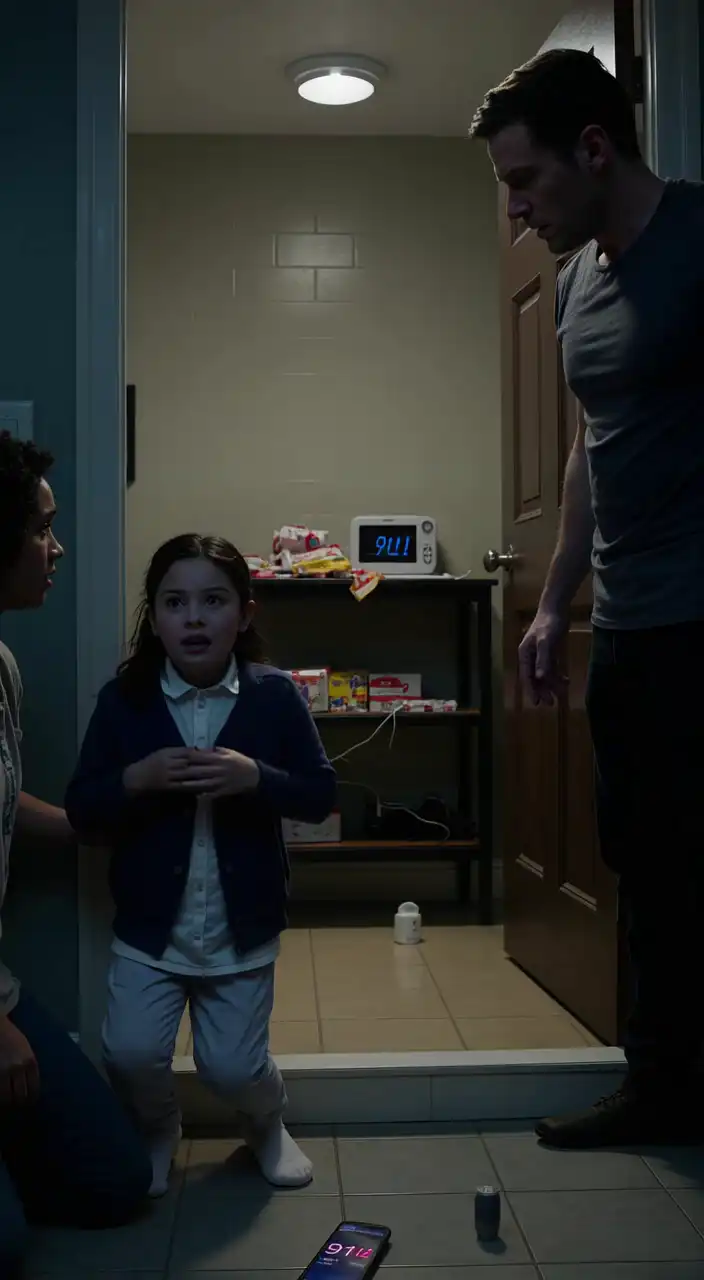
"Ma'am, if you can hear me, do not unlock anything for him. Officers and EMS are at your door now."
The pounding came again, harder this time, a flat official rhythm that shook the cheap wood and rattled the chain. Sophia jerked at the sound, tried to suck in air, and could not. Layla moved without thinking. She shoved Victor with both hands, not because she thought she was stronger, but because Sophia had made that same terrible scraping sound again and there was no room left for fear.
Victor staggered half a step, cursed, and reached for her arm. Layla twisted away and threw herself across the threshold, fumbling the chain loose with trembling fingers. The phone was still on the tile behind her, dispatch still connected, Valerie's voice small and steady, repeating, "Open the door. Leave the line open."
The second the chain slipped free, the door pushed inward against Victor's shoulder. A paramedic in navy blue caught it with one hand and scanned the floor in one fast motion. He saw Sophia first. Most adults in a panic talk too much. He did not. He dropped to his knees, opened a bag, and said, "She's in distress. Where's the inhaler?"
Layla pointed down the hallway.
Victor started talking over her immediately. "She gets anxious. It is not an attack. Her mother always overreacts."
A police officer behind the paramedic lifted a hand at Victor. "Sir, step back."
The other paramedic, a woman with a braid tucked under her cap, was already moving down the hall. She scooped up the inhaler from the baseboard, glanced at it, and swore under her breath. "This is empty."
Layla stared at her. "No. I bought a new one two weeks ago."
Sophia's eyes found Layla's face, huge and wet and terrified. She was old enough to be embarrassed by struggle, old enough to recognize when adults were choosing not to help, and the look on her face carried both. The male paramedic fitted an oxygen mask over her mouth and nose while the woman tore open another package from the kit.
"Listen to me, sweetheart," he said. "I'm giving you medication now. You focus on pushing air out. That's all."
Victor kept talking. "Her doctor said she uses it for no reason. She panics. She lies to her mother."
The officer turned his head, just enough. "Sir, I said step back."
That should have been the end of it, but Victor's fear made him reckless. He took one step forward and reached for the bag the female paramedic had set down. The officer caught his wrist and pinned it to the wall so quickly Layla almost missed it.
"Do not touch medical equipment," the officer said.
For one suspended second the apartment went quiet except for the hiss of oxygen and Sophia's weak wheeze under it. Then the female paramedic held up the empty inhaler canister between two fingers.
"It was reassembled," she said. "This was opened."
Victor stopped talking.
Layla felt that land inside her like a second emergency. She knew what a finished inhaler looked like. She knew what a used one felt like in the hand. She had taken Sophia to refill prescriptions herself before Victor started insisting he would "manage the house better" if he handled all the medicine. But the canister had weight when she last saw it. She remembered because Sophia had shaken it in the kitchen and said, "Hear that? We have enough."
The paramedic's eyes went to Layla, then to the scattered wrappers, then up toward the shelf where the baby monitor blinked red over the room.
"Is there recording in this unit?" she asked.
Layla followed her gaze. The monitor had been there since Sophia's baby brother died before term years ago, one of those sad objects nobody put away because grief turned furniture into memorial. Victor had repurposed it later as a room monitor "for safety," he said, so he could hear when Sophia coughed at night. Layla had hated that explanation even before she had language for why.
"Yes," she whispered. "Sometimes it records clips."
The officer heard that. So did Victor.
"It doesn't matter," Victor snapped. "That's private property."
Sophia's body jerked under the first treatment, a cough cracking free at last, thin but real. The sound made Layla want to cry from relief, but the paramedic was still serious.
"We need to transport now," he said. "She is improving, but not enough."
Victor's answer came too fast. "No hospital. She hates hospitals."
Sophia, with the mask on, lifted one shaking hand and clawed toward Layla's sleeve. It was not graceful. It was desperate. The officer saw it too.
"Sir," he said, and now his tone had changed. "You do not make that decision."
Victor looked from the officer to the paramedics to the open door and understood, maybe for the first time, that authority had crossed the threshold. He changed tactics immediately. His voice softened. "My wife is confused. English is difficult for her when she's upset. We can drive her ourselves."
Layla stared at him in disbelief. Her English was fine. He knew that. He only used that lie in front of schools, clinics, and billing offices, whenever controlling the conversation mattered more than dignity.
The female paramedic said, "Mom, do you consent to transport?"
"Yes," Layla said, and this time her own voice came out steady. "Yes. Please take her."
Victor opened his mouth again, but the officer cut him off. "Do you have any other children in the home?"
Layla flinched at the old grief of the monitor and at the shape of the question. "No. Just Sophia."
The officer nodded once, eyes still scanning. He had already noticed too much for this to stay a simple breathing call: the empty inhaler, the wrappers, the phone on the floor with the active dispatch line, the man trying to cancel treatment. He asked dispatch for a supervisor over his shoulder and stepped closer to Victor.
The stretcher would not fit easily through the cluttered hall, so they half carried, half guided Sophia into a stair chair. Every movement scared her because movement stole breath, and every time her chest seized Layla saw the same panic flash through her eyes: What if they stop helping because he says to?
"They're not leaving you," Layla whispered, touching her forehead. "I'm coming."
At the doorway, the female paramedic paused by the shelf, reached up, and lifted the small parent unit of the baby monitor. The red light still blinked.
"Officer," she said, "I want this documented."
Victor lunged again, and this time two things happened at once. The officer shoved him back, and the monitor slipped from the paramedic's hand just enough to light up its tiny screen. A saved clip icon glowed in one corner, and for a second, everyone could hear a burst of earlier audio through the speaker:
A child's rough wheeze. Layla saying, "Please, give it to her." Victor's voice, low and hard: "If she goes to the hospital, they'll start asking questions."
No one in the doorway moved.
The officer looked at Victor like the room had just changed shape around him. The paramedic clicked the monitor off and handed it to another officer who had just arrived. He slid it into an evidence bag without a word.
Then the elevator at the end of the hall opened with a ding too ordinary for the moment, and Sophia's head lolled against the stair chair while the oxygen hissed on, and Layla realized the rescue had begun but whatever Victor had been hiding had only just started to surface.
The ambulance doors closed on sirens and cold air and the sharp smell of plastic tubing. Layla sat on the bench seat with one hand on Sophia's ankle under the blanket because it was the only part of her daughter not crowded by straps, wires, and the paramedic's moving hands. The nebulizer treatment clouded the space around Sophia's face. Her breathing was still fast, still shallow, but the scraping edge had eased into a tight wet wheeze.
"Keep talking to her," the male paramedic said, checking the monitor clipped near her shoulder. "Simple voice. Let her orient to you."
Layla bent low. "You hear me, habibti? Keep looking at me."
Sophia's eyelids fluttered. "Am I... in trouble?"
The question almost broke Layla.
"No," she said. "You are sick. That's all. They are helping you."
The female paramedic was entering details into a tablet, but she looked up at that. Something in her face softened, then sharpened again into professional focus. "Has this happened before?"
Layla hesitated. Victor had trained hesitation into the walls of their home. Every sentence had to be measured there. Every truth had a consequence.
"She has asthma," Layla said carefully. "She had attacks before. But recently..." She looked at Sophia, then back at the paramedic. "Recently her medicine empties too fast. And sometimes he says she already took it when she did not."
The paramedics exchanged a glance. Not dramatic. Not theatrical. The kind of glance people use when a pattern is settling into place.
"What do you mean by 'he'?" the female paramedic asked.
"My husband."
"Has he ever prevented her from being seen?"
Layla thought of a clinic two months earlier where Victor answered every question directed at Sophia. She thought of an urgent care visit he canceled after telling the receptionist the child was "perfectly fine now." She thought of a pharmacy bag missing from the cabinet and Victor insisting insurance had denied the refill, only for Layla to find the copay charge on a bank app days later.
"Yes," she said.
The male paramedic nodded once. "Hospital social worker is going to meet you. That doesn't mean you're in trouble. It means we need to keep her safe and understand what's going on."
Safe. The word was so simple it almost felt unreal.
When they rolled into the emergency bay, the lights were brutal and immediate. A nurse was waiting before the doors opened, and behind her a physician in green scrubs reached straight for the report. Everything became motion and short sentences. Sophias's name, age, known asthma, acute respiratory distress, oxygen saturation, possible withheld medication, active law enforcement scene. Layla walked beside the stretcher until a nurse stopped her long enough to clip a visitor band around her wrist.
The pediatric room was small and bright, decorated with a faded mural of ocean fish that only made the plastic rails look more cruel. Sophia was moved onto the bed. Respiratory therapy arrived with another machine. A nurse placed stickers on her chest, wrapped a cuff around her arm, and threaded an IV with practiced tenderness while explaining every step directly to Sophia, not to Victor, not around her, not through anyone else.
That alone felt foreign.
A doctor in her forties with tired eyes and a firm voice came in, introduced herself as Dr. Chen, and crouched until she was level with Sophia. "I know breathing feels scary right now. We are not guessing. We are going to treat the asthma and figure out why it got this bad."
She then turned to Layla. "I need a very direct answer. Was rescue medication available when this started?"
Layla nodded, then shook her head because the truth had become complicated. "The inhaler was there. But it was empty. It should not have been empty."
Dr. Chen held out her hand. The female paramedic, who had come up from the ambulance to finish the report, passed her the inhaler in a sealed belongings bag. Dr. Chen turned it over, inspected the mouthpiece, tested the canister, then looked at the cap. "This was opened and reseated. Not by a child."
Layla gripped the side rail.
Dr. Chen noticed the reaction and lowered her voice. "I am a mandated reporter. So are the nurses here. I need to ask if there has been interference with medication, doctor visits, or emergency calls before tonight."
Before Layla could answer, the door opened and Victor walked in.
He should not have been able to enter so quickly, but hospitals were full of cracks for confident men in clean shirts. He carried himself like a wronged father even though he was not Sophia's father by blood. He had found time to compose his face on the drive or in the squad interaction downstairs. He gave Layla one look that promised consequences, then turned on charm for the room.
"I came as soon as they let me up," he said. "My daughter has panic attacks. My wife overreacted and now everyone is confused."
Sophia's eyes, half open under treatment, widened with raw terror. That was more convincing than any accusation.
Dr. Chen straightened. "Sir, step outside."
Victor smiled a brittle smile. "I think I should stay for my family's care."
"I wasn't asking."
The nurse had already moved closer to the bed, one quiet body between Victor and the child. Security appeared in the doorway a beat later, as if hospitals had learned the script long before this family walked in. Victor's jaw tightened, but he lifted his hands slightly and backed out.
He did not look defeated. He looked calculating.
The moment the door shut, Dr. Chen said, "Tell me everything he controls."
Layla did not realize how much there was until she began listing it. Insurance cards. Prescription pickups. The family phone plan. School attendance calls. Banking passwords. The locked drawer with medicine. The explanations he gave so quickly no one else seemed to notice Sophia was not allowed to answer for herself. The insistence that any breathing trouble was drama. The way he said hospitals "make paperwork problems." The way he always seemed most afraid of people asking routine questions.
By the time she finished, a social worker named Amanda was in the room taking notes by hand, not on a loud keyboard. She asked simple questions in a tone that did not flatten everything into policy. Was Sophia safe going home with Victor? No. Did Victor have legal guardianship? Layla blinked. "We are married. He signs forms sometimes."
Amanda asked again, more precisely. "Has he adopted her? Is he on her birth certificate? Does he have any custody order?"
Layla stared.
No.
The answer created its own silence.
That was the first incomplete explanation: Victor had acted like a legal authority for years, and many people had accepted it because he sounded certain. But certainty was not paperwork.
Amanda's pen paused. "Then that changes who can authorize what."
Layla thought of every receptionist who had deferred to him. Every refill he had picked up. Every school call he had intercepted. How much of his control depended on other people never asking one more question.
A respiratory therapist came in with a printout from triage. "One more thing," she said to Dr. Chen. "Mom mentioned repeated early inhaler depletion. Pharmacy reconciliation shows three rescue inhalers filled in six weeks."
Dr. Chen frowned. "For one child?"
"Yes."
Sophia, still weak but more awake now, whispered through the mask, "He tests them."
Everyone in the room turned toward her.
"What do you mean?" Amanda asked gently.
Sophia swallowed. Speaking cost effort. "He sprays them in the sink. He says if I can watch them empty, maybe I'll learn not to waste doctors."
The room went still in a new way. Not surprised. Horrified.
Amanda knelt by the bed. "Has he said why he doesn't want you at the hospital?"
Sophia's fingers tightened around the blanket. "He says if doctors look too close, they'll ask about my brother."
Layla felt all the blood leave her face.
Her son. The baby who never came home. The monitor on the shelf. Victor's refusal to throw anything away from that time. The rules about who could mention him and when. The old ache that had never fit neatly inside grief.
Dr. Chen looked at Amanda. Amanda looked at Dr. Chen. Neither of them rushed to fill the silence with soft nonsense.
"What happened to your brother?" Amanda asked carefully.
Layla answered before Sophia could. "He was stillborn."
But even as she said it, memory pried open something she had kept sealed because the pain was too large to carry and survival needed smaller truths. Victor had been alone with the records when the hospital mailed them. Victor had handled the discharge papers. Victor had always told the story quickly, firmly, with details that shut down questions.
Sophia whispered, "He says that. But I heard him fighting with Nana on the phone. She said she knew the baby cried."
The fish mural on the wall swam in Layla's blurred vision.
Dr. Chen put a hand on the bed rail. "Tonight we are treating Sophia. That is first. But this conversation means she is not leaving here without a safety plan."
Outside the door, there was raised male speech and the clipped tone of security answering it. Victor was not gone. He was rearranging himself for another attempt.
Amanda stood. "I need to contact child protective services and law enforcement assigned to the scene. Not because Sophia did anything wrong. Because what I'm hearing may be medical neglect, coercive control, and possible evidence concealment. I also need to verify who has legal authority over your daughter."
Victor had lived for years in the space between fear and paperwork. Now the paperwork was beginning to talk back.
Before Amanda reached the door, a nurse from triage stepped in holding a clear bag with Sophia's belongings. School cardigan. Blanket. Crumpled sock. A small zip pouch from the apartment floor that no one remembered packing.
"I found this tucked in the blanket," the nurse said. "Is it hers?"
Layla took it automatically and unzipped it. Inside was Sophia's backup spacer tube, one folded pharmacy receipt, and a tiny silver key on a blue elastic bracelet.
Sophia saw the bracelet and whispered, "Drawer key."
Layla stared at the key in her palm, then at the receipt folded beneath it. The receipt was from the pharmacy two days earlier. Paid. Pickup complete.
Victor had told them the refill was denied.
Amanda took a slow breath. "Do not give that to anyone else. That matters."
And in the hallway beyond the door, Victor's voice rose just enough for Layla to hear him say, "You don't understand. If she talks, everything gets twisted."
For the first time, Layla believed him about one thing.
If Sophia kept talking, everything Victor had built might actually collapse.
Amanda closed the room door behind her and made three calls in under four minutes. She did not dramatize what she was doing. She named facts, asked for confirmations, and used the kind of calm language that carried more force than panic ever could. Child in respiratory distress. Alleged interference with medication. 911 call partially recorded. Non-parent spouse presenting as decision-maker. Possible ongoing coercive control. Need for immediate safe discharge planning.
Layla sat at Sophia's bedside holding the blue bracelet key so tightly it cut an imprint into her palm. The little silver key was absurdly small for the amount of fear around it. A key to a locked drawer. A planted truth. A habit of control worn on a child's wrist because Victor never imagined anyone would look at a bracelet and see access.
Sophia dozed in bursts now that the medication had opened her lungs enough for sleep to catch up with her. Each time she drifted off, her hand slid toward Layla until their fingers touched. Dr. Chen had ordered another hour of observation and blood work to rule out infection or a deeper trigger. The monitors beeped in their own detached rhythm. Every noise in the hospital sounded like proof that systems existed outside Victor's reach, and still Layla could not stop glancing at the door.
A woman in uniform knocked and stepped inside. Not a patrol officer. County deputy, older than the others, hair pulled back, face composed in a way that said she had learned when to move slowly around frightened people. She introduced herself as Deputy Elena Ruiz and asked if Layla wanted an interpreter. Layla said no. Victor had hidden behind that assumption long enough.
"I was given the initial scene report," Deputy Ruiz said. "I also heard a portion of the 911 callback and the monitor clip the responding officer secured. I need to ask some questions, but we can stop if your daughter needs you."
Layla nodded.
Ruiz's questions were methodical. Who controlled medication storage? Victor. Who normally spoke to schools and doctors? Victor, unless he was absent. Had Victor ever physically blocked a call before tonight? Yes. Had he ever told Layla not to mention certain medical events? Yes. Had there been prior unexplained illness, missed appointments, denied pharmacy access, or restricted transportation? Yes, yes, yes, and yes.
Then Ruiz asked a question Layla had not prepared for.
"Did Victor benefit in any direct way from keeping Sophia medically dependent but publicly minimized? Money, housing, custody leverage, immigration leverage, insurance, anything like that?"
Layla opened her mouth and closed it again. Benefit was such a cold word for a life. But the answer came anyway.
"Our lease is in his name," she said. "Insurance through his work. He tells me if I make trouble, I lose all of it."
Ruiz wrote that down. "And the prior infant death your daughter mentioned. Did Victor control those records too?"
"Yes."
Ruiz's face did not change, but something in the room did. This was no longer only an ambulance call that had exposed a controlling husband. A new possibility had entered: that the fear driving him was older and darker than one ER visit.
Amanda returned with a slim folder and a tablet. "I have school emergency contact records," she said. "Sophia's school lists Victor as 'father' and primary medical contact. Layla is secondary. There is no court order, no adoption filing, and no guardianship attached."
Ruiz took the folder. "So he inserted himself institutionally."
Amanda nodded. "And the school nurse documented several instances where Sophia reported not having her inhaler. There were voicemail notes from him saying she 'uses asthma to avoid class.'"
Layla shut her eyes.
The planted details were aligning cruelly: the empty inhaler, the pharmacy receipt, the bracelet key, the school nurse notes, the monitor recording. None of them alone told the whole story. Together they formed a shape Victor could not talk his way out of.
A knock came at the door again. Security entered first, followed by a hospital administrator in a navy blazer and Victor behind her, somehow still trying to stay within the frame of respectable concern. He held his shoulders down and his face arranged into grievance.
"Mr. Alvarez is requesting clarification regarding visitation restrictions," the administrator said carefully. "Given the child welfare concerns, we're limiting non-essential access until law enforcement completes interviews."
Victor looked at Layla and smiled with no warmth at all. "You are making a terrible mistake."
Ruiz stepped between them. "Sir, you'll speak to me, not them."
He ignored her and addressed Amanda instead. "My wife has been unstable since losing our son. She imagines control where there is structure. Our daughter manipulates her. The recording proves nothing without context."
Sophia's eyes flew open. Even exhausted and wired to monitors, she recoiled at the sound of his voice.
Dr. Chen, who had reentered silently at some point, saw that recoil and did not miss what it meant. "That's enough," she said. "He's done."
Victor's expression cracked for the first time. Not into sorrow. Into anger.
"You people hear one desperate child wheezing and suddenly you think you're heroes. Ask her how many times she lies. Ask my wife why medicine goes missing when she forgets doses."
Ruiz did ask something then, but not what he expected. "Where is the medication storage drawer key, sir?"
His eyes flicked, involuntarily, toward Layla's hand.
It was tiny. That movement. Easy to miss. But everyone in the room saw it.
Ruiz said, "Thank you."
Victor realized too late what he had done. "You searched my house without consent?"
"No," Ruiz said. "A child arrived with her own property."
Layla opened her hand and showed the bracelet.
For the first time since the door had opened at the apartment, Victor seemed genuinely startled. He had not known Sophia kept a copy.
Sophia swallowed hard and whispered, "I took it after he said I didn't deserve air unless I asked right."
The nurse nearest the bed covered her mouth briefly with two fingers and turned away to compose herself.
Victor tried one more pivot. "That is fantasy. She is medicated. She's confused."
Ruiz stepped forward. "Sir, whether it's fantasy or not is exactly what we're investigating. Right now, you are not to approach this child, her mother, or her treatment team."
He laughed once, harsh and disbelieving. "Because of a toy monitor and a little key?"
Amanda answered before Ruiz could. "Because every time someone gave you room to explain, you used it to override a sick child."
The administrator signaled security. Victor's jaw clenched. He knew leaving looked bad. Refusing would look worse. He pointed at Layla with a shaking finger.
"If you go along with this, they will take everything."
Layla surprised herself by answering quietly. "You already tried."
Security escorted him out. He did not struggle, but he kept looking back, not at Sophia. At the folder in Ruiz's hand. At the people writing things down. At the administrative machinery he had spent years avoiding.
As soon as he was gone, Sophia began crying soundlessly under the oxygen mask, tears sliding into her hairline. Layla pressed her forehead to Sophia's hand.
"You kept the key," she whispered.
Sophia nodded once. "In case you ever believed me."
The sentence landed harder than any accusation in the room.
Later, when Sophia had been moved from emergency treatment to a monitored pediatric bed, Ruiz and Amanda left temporarily to coordinate scene access. Dr. Chen updated Layla on the medical side: Sophia likely had a severe exacerbation worsened by delayed treatment, possible viral trigger, but the dangerous part tonight had been time lost without a functioning rescue inhaler. The empty inhaler was not just suspicious; it was causally important. Minutes mattered in asthma. Obstruction mattered. This had not been a family disagreement. It had been a threshold event.
A few minutes after midnight, Amanda returned with another complication.
"Victor's mother is downstairs," she said. "She says she has information about the baby."
Layla's whole body went cold.
"I don't want drama around Sophia," Amanda added quickly. "I can send her away. But based on what your daughter said, this may matter."
Layla thought of all the years Victor had sealed that loss inside his version of events. Thought of the monitor still on the shelf because he controlled even grief. Thought of his exact words on the recording: If she goes to the hospital, they'll start asking questions.
Not bills. Not inconvenience. Questions.
"Bring her," Layla said.
Victor's mother, Teresa, entered with the slow careful walk of someone who expected not to be welcomed. She was small, plainly dressed, and carrying a worn leather purse with both hands as if it might steady her. She looked first at Sophia in the bed and immediately began to cry.
"I did not know he got this bad," she said. "I knew he controlled. I did not know he was taking her medicine."
Layla had no softness left for the woman yet. "You knew enough to fight with him on the phone."
Teresa nodded, accepting that. "Yes."
Ruiz, back now, remained at the side of the room with a notebook. Amanda stayed seated near the door. No one let this become a private family confession that could later be denied.
Teresa opened her purse and removed a manila envelope. "When your baby died, Victor came to my house after the hospital. He was frantic. He said there had been questions about timing, about when you came in, about whether he waited too long because he didn't want the police around from an old warrant issue. He made me promise not to tell you."
Layla could not breathe for a second, which felt obscene in a room built around Sophia's struggle for air.
"He said the baby was gone already," Layla whispered.
Teresa looked at her with naked shame. "I don't know if that was true. I know only that the nurse called me once, by mistake or mercy, and said if anyone asked, the chart showed late presentation after reduced fetal movement. I saved what she mailed later because I did not trust my son."
She slid the envelope to Ruiz.
Inside were photocopied discharge summaries, a note card with a nurse's first name and unit number, and one certified letter from the hospital's risk office acknowledging a request for records Victor had submitted without Layla's signature. Not proof of criminal guilt. But enough contradiction to blow open the sealed story.
Amanda looked from the documents to Layla. "This may explain his terror of hospitals. He may have been avoiding scrutiny ever since."
That was the reversal. Victor had always acted like hospitals were dangerous because they overreacted. In truth, they were dangerous to him because they noticed patterns, timestamps, missing signatures, mismatched stories. He had not merely hated exposure. He had been building his life around avoiding it.
Sophia stirred and whispered, "Is Nana mad at him?"
Teresa moved closer, careful not to crowd the bed. "I am mad that I stayed quiet too long."
The old woman reached toward the blanket, stopped, then let Sophia choose. Sophia lifted two fingers. Teresa took them and wept harder.
Ruiz cleared her throat gently. "I have enough for an emergency protective action tonight. That addresses contact and discharge safety. The older infant matter will require review and records requests. But for now, Mr. Alvarez is not taking this child home."
The words should have brought immediate peace. Instead they brought the next obstacle.
Amanda checked her tablet and sighed. "Layla, the apartment lease and utilities are in Victor's name alone. If he is barred from contact, we need to assume he may retaliate by shutting off access or claiming you trespassed."
The room's hard practical reality crashed back in. Rescue was not just oxygen and authority. It was where to sleep after the man who controlled the front door lost power at the hospital bedside.
"I have nowhere else," Layla said.
Teresa straightened unexpectedly. "You have my guest room."
Layla turned to her.
"I know you do not trust me," Teresa said. "You should not, not yet. But I can offer a lock, a clean bed, and witnesses. And I kept copies because one day I knew he would hurt someone with his need to control truth."
Ruiz nodded. "That may be the safest immediate placement if child welfare approves and if Layla consents."
Sophia's fingers, still linked with Teresa's, tightened slightly. Small gesture. Large consequence.
But before any plan could settle, Amanda's phone buzzed. She looked at the screen and swore under her breath.
"What?" Ruiz asked.
"He called the school district emergency hotline on his way out," Amanda said. "He reported Layla as mentally unstable and claimed she abducted Sophia during a domestic dispute. He is trying to create a counterrecord before morning."
Ruiz was already standing. "Of course he is."
Movement three had its desperate lie: if he could not keep control at the apartment or the bedside, he would build paperwork smoke elsewhere.
Amanda looked at Layla. "I need you ready for this. He will not stop at one false report."
Layla looked down at the bracelet key, the pharmacy receipt, her daughter's tired face, the envelope from Teresa, the badge on Ruiz's vest. For years, Victor's power had come from being the first voice institutions heard. Tonight, for the first time, he was late.
Still, he was not finished.
By dawn, there were three separate versions of Layla in official systems, and Victor had authored all of them.
Amanda laid the printouts on the family consultation table one by one. One was the school hotline note claiming "maternal mental instability and unauthorized removal of medically fragile child." One was a message left with the apartment complex's after-hours line alleging police misconduct and "property theft." The third was the ugliest: Victor had called the hospital main line pretending to be a relative and suggested Layla might attempt to flee with Sophia to avoid "an investigation into medication abuse."
Ruiz read each without visible reaction, then set them in a neat stack. "He's manufacturing confusion."
"He always does that," Layla said, exhaustion flattening her voice. "He makes so many versions that everyone gets tired before truth catches up."
Ruiz looked at her. "Then we don't get tired first."
Sophia was sleeping more steadily now, on room air between intermittent treatments, her breathing still tight but no longer terrifying. Dr. Chen had downgraded the immediate crisis from critical to guarded. The danger had moved. Not away. Just sideways. It lived now in signatures, discharge plans, and who would get believed at eight in the morning when schools, offices, and managers answered phones.
Amanda asked if Layla had any personal identification, passport, independent bank card, or spare phone. Layla had a state ID in her purse and an old debit card Victor said was "inactive." No passport. No independent phone. No car keys; Victor kept both sets.
"Okay," Amanda said. "We're not solving all of life before breakfast. We are solving today."
That directness helped.
Teresa left briefly and returned with coffee, a change of clothes for Layla from a discount store across the street, and a folder of old mail she had driven home to retrieve. Inside were two things Victor never knew she had saved: copies of pharmacy pickup texts that had still gone to a family plan number years earlier, and a holiday voicemail from Victor to Teresa during Layla's pregnancy with the baby.
Amanda almost set the voicemail aside until Teresa said, "Listen to the part after he thinks I hung up."
Ruiz played it on speaker low.
First came the performance voice Victor used with outsiders: cheerful, brisk, discussing dinner plans. Then a pause, a scrape, and his real voice muttering to someone else in the room, "If she keeps saying the baby isn't moving, we'll be at the hospital all night. She can wait."
No direct confession. No dramatic admission. Just the ordinary contempt of a man deciding delay for another person's body.
Layla gripped the chair so hard her knuckles whitened. That one sentence crossed time. It stitched Sophia's blocked inhaler to the older loss she had never been allowed to examine honestly. Delay was his method. Minimizing was his method. Making need sound manipulative was his method.
Ruiz said quietly, "Save that file in three places."
Amanda already had.
At 7:12 a.m., a caseworker from child protective services named Brianna arrived. She was younger than Layla expected and carried no false softness. She reviewed the timeline, interviewed Sophia separately with a child life specialist present, and returned with a face that confirmed the child had said enough.
"She describes repeated denial of medication, control of school communication, and threats that she would be blamed if doctors got involved," Brianna said. "She also said she hid the bracelet key after he emptied an inhaler in front of her last month."
Dr. Chen, listening nearby, closed her eyes briefly.
Brianna continued, "Based on current information, my recommendation is discharge to mother with a temporary no-contact restriction on Mr. Alvarez pending emergency hearing. We also need safe housing verified before release."
Teresa offered her home again. This time Brianna asked practical questions: separate room? locks? other residents? firearms? transportation to follow-up appointments? Teresa answered each. Alone. Locking bedroom doors. No firearms. Reliable car. Fifteen minutes from the hospital.
The plan might have settled there if Victor had not made one more move.
A hospital security supervisor entered and pulled Ruiz aside. Ruiz listened, then came back with a grim expression. "He returned to the apartment before patrol could secure full reentry. Neighbor reports he was removing boxes through the back stairwell."
Amanda's eyes sharpened. "Medication? Documents?"
"Unknown."
Layla stood up so fast the chair scraped. "He is clearing things."
Ruiz nodded. "Probably. Which means if there is evidence in that locked drawer or anywhere else, time matters."
"You have the key," Amanda said.
Layla looked at the bracelet in her hand.
The room shifted around a choice. Stay beside Sophia while others search. Or go with law enforcement and identify what mattered before Victor's disappearing act erased it. Neither option felt survivable.
Sophia, hearing enough to understand, pushed herself upright slightly. "Mama."
Layla went to her.
"You go," Sophia whispered. "Take the nurse note. The one from school."
Amanda blinked. "What nurse note?"
Sophia pointed weakly toward her cardigan hanging on the chair. "Pocket."
Inside the cardigan, folded into quarters so many times the paper edges had softened, was a handwritten note from the school nurse. Layla had never seen it. It read: Soph, if you don't have your inhaler again tomorrow, come straight to me. I don't care what anyone said at home. - Ms. Jensen
On the back, in a child's handwriting, Sophia had written and crossed out the words He says if I tell they will split us up.
Amanda held the note like it was both fragile and explosive. "This goes with us."
That small planted detail, ignored at the apartment because it was just a cardigan over pajamas, now joined the record. It proved an outside adult had noticed before tonight. It showed fear and coaching. It made Victor's pattern harder to reduce to one dramatic misunderstanding.
Layla kissed Sophia's forehead. "I will come back."
"You always say that," Sophia murmured, not accusing, only tired.
Layla nearly collapsed under the weight of it. Always say. Not always do.
"I know," she whispered. "This time I do."
Ruiz, Amanda, and Layla went together to the apartment with another officer. The morning hallway looked vulgar in its normalcy: neighbor's doormat, delivery flyer, somebody's cooking smell. Last night had transformed the threshold into a scene; daylight pretended otherwise.
The front door stood ajar.
Inside, the apartment had been hurriedly disturbed. Not ransacked for outsiders. Selected for someone who knew exactly what to pull first. The kitchen drawer where Victor kept medication was open and empty. Bathroom cabinet shelves were bare in rectangular shapes where bottles had stood. The folder where Layla thought insurance cards were kept was gone.
But panic creates sloppiness, and Victor had not been alone in the apartment long enough to be careful with everything.
Ruiz filmed as they moved room to room. "Do not touch until I say."
In Sophia's room, the baby monitor camera was missing from the shelf, wires dangling. The parent unit was already in evidence, but Victor had returned for the source. Too late.
"That matters," Ruiz said.
In the kitchen trash, under coffee grounds and paper towels, Amanda found blister packs with dates, torn prescription inserts, and one inhaler box with the pharmacy label still attached. Filled two days ago. Patient: Sophia N. Dispense quantity: 1. Not the one from the hospital bag. Another one.
"Where is the canister?" Amanda asked.
Layla looked around wildly. Victor would not discard a full canister where police could find it. He would pocket it or flush it. Unless interrupted.
Then she remembered the way he moved through the apartment: pressed shirt, one phone, one pill bottle, keys always left in the ceramic bowl by the door except when he was hiding something. She went to the bowl. Empty.
"Check the back stairwell route," Ruiz told the officer.
While he went, Layla used the bracelet key on the small wooden drawer in the kitchen island that Victor always kept locked. It opened with a tiny click far too soft for what it concealed.
Inside were not valuables. They were instruments of management.
Prescription bottles with other people's names scratched off. Two nearly empty inhaler canisters and one full one. Sophia's insurance card. A stack of school absence notices. Layla's old passport application, never mailed. A spare phone. And beneath all of that, in a manila sleeve, copied hospital records from the pregnancy with the baby.
Amanda exhaled hard through her nose. "Document everything."
Ruiz photographed before touching. The copied records were incomplete, but one page jumped immediately: nursing notation advising immediate evaluation after reports of decreased fetal movement earlier in the day, followed by a late-night arrival time hours later than the call. Another page referenced "partner reluctant to remain for additional questioning regarding timeline."
Layla sat down on the kitchen floor because her legs gave out.
The officer returned from the back stairs holding a black trash bag and Victor's spare key ring. "Found behind the dumpster enclosure. Looks like he staged a drop and planned to come back."
Inside the bag were the missing camera unit for the baby monitor, household mail, and several pharmacy bags. One contained a new inhaler still sealed. Not empty. Not lost. Hidden.
Ruiz looked at Layla. "This is enough for an arrest request."
Layla should have felt triumph. What she felt was nausea. The sealed inhaler in a bag by the dumpster reduced everything to one unbearable truth: Sophia's air had been available. Victor had simply chosen not to let her have it.
Then the apartment manager appeared at the open door, red-faced and flustered. "I was told there was an unlawful entry. Mr. Alvarez said his wife has episodes."
Ruiz turned, badge forward. "Active law enforcement investigation. Do not touch anything."
The manager took in the uniforms, the evidence markers, the open drawer, and recalculated instantly. "I... of course."
Amanda stepped in before he could retreat into convenience. "Who signed the lease?"
"Mr. Alvarez."
"Who submitted occupancy records?"
He hesitated. "He did."
"Did you ever meet the child or mother during signing?"
"Not really."
Of course not. One voice had represented the household everywhere.
Ruiz asked for access logs from the building cameras. The manager nodded too quickly. "Yes, yes, we have hallway and back exit footage."
Another planted detail the story had promised from the start: domestic recording exposure. Not just the baby monitor. Now there would be building footage of Victor removing bags after the hospital barred him.
By noon, Victor had not yet been located, which made every hour feel split between progress and threat. Sophia was stable enough for discharge planning but not discharged. Teresa's house had passed immediate approval. The protective paperwork was moving. Yet Victor was still out there with a talent for appearing first in bureaucracies and family systems alike.
When Layla returned to the hospital, Sophia was awake and waiting. Children know from adult faces whether the world has changed.
Layla sat and took both her hands. "They found the inhaler."
Sophia stared. "The full one?"
"Yes."
For a second, Sophia looked neither relieved nor angry, only tired in a way no child should be. "I knew it."
That was the emotional threshold of movement four. Proof did not heal on contact. Sometimes it only validated how long the child had been alone with truth.
Brianna came in soon after with temporary orders printed and clipped. "He is barred from contact pending hearing. School will be notified. Hospital records are locked down. We also flagged the pharmacy and pediatric office that only Layla may authorize pickup and communication."
Simple administrative sentences. Lifesaving all the same.
Then Teresa, still seated quietly by the window, said the thing no one wanted to be true.
"He will come to my house first."
Everyone looked at her.
"He always comes where he thinks pity still lives," she said. "And if he cannot talk to Layla, he will try to talk to Sophia through guilt."
Ruiz, who had stayed longer than her shift should have required, nodded. "Then we prepare for that, not after."
The rescue was nearing completion, but movement five needed its final obstacle. Victor had lost the apartment, the hospital room, and the first versions of the story. What remained to him was proximity, manipulation, and one last chance to force Layla into private negotiation before the court or police locked his reach down for good.
Late that evening, after Sophia was officially discharged and settled into Teresa's guest room with fresh sheets and a borrowed stuffed dog from some closet of old grandchildren, Layla finally let her body feel the previous night's terror. The house was modest and overly warm. There were framed school photos of Victor and his siblings on one wall and a crucifix above the kitchen doorway. Everything smelled faintly of onions and laundry soap. Teresa kept apologizing with her eyes instead of her mouth.
Sophia had her nebulizer setup on the bedside table, medications counted and lined up where everyone could see them. Amanda had insisted on that visible routine. No more locked drawers. No more mystery. A baby monitor sat on a dresser too, but unplugged, and Teresa asked before moving it to the closet.
That small permission almost made Layla cry.
At 9:17 p.m., Teresa's landline rang.
All four adults in the house froze. Teresa still had a landline because she trusted wires more than apps. Ruiz had arranged for patrol drive-bys, but not round-the-clock presence. Layla moved toward the phone; Teresa lifted a hand and answered on speaker.
Silence for one beat. Then Victor.
"Mom. Tell them to stop this."
Sophia, from the hall, inhaled sharply. Layla turned and saw her standing there, pale and wrapped in a blanket, listening.
Teresa's jaw set. "You should not be calling."
"You brought strangers into family business."
Ruiz, who had stayed just long enough to review safety steps and was now by the front window, motioned for quiet and started recording on her department phone. She had anticipated this.
Victor continued, voice low and urgent. "If Layla signs one statement saying she panicked and overread the attack, this all calms down. I can fix the lease. I can keep the school out of it."
There it was again. Delay, minimization, private correction. Rescue undone in exchange for restored control.
Layla stepped close enough for her voice to carry. "You hid her medicine."
A pause. Then the dangerous softness. "I was trying to teach her not to abuse it."
Sophia made a small sound in the hallway like a breath turning into pain.
Ruiz held up one finger: keep him talking.
Layla said, "And the baby?"
Nothing for two seconds. Then Victor snapped, losing the performance for the first time anyone but family had heard. "The baby was dead before we got there. If you had not made every discomfort into an emergency, none of this would have happened."
Teresa closed her eyes.
It was not a confession clean enough for television. Real monsters rarely provide those. But it was enough to reveal the core: his need to make need itself the crime.
Ruiz spoke then, official and unmistakable. "Victor Alvarez, this call is being documented. You have been instructed not to contact these parties."
The line went dead.
Everyone in the kitchen remained still. Sophia was shaking now, not from asthma, from aftermath. Layla reached her just as the child folded into her arms.
"I heard him," Sophia whispered. "You heard him too."
"Yes," Layla said into her hair. "Not just us anymore."
That was the threshold. The vulnerable person had come as close as possible to being swallowed again by the old pattern, and the pattern had failed in front of witnesses.
The arrest came at 11:06 p.m.
Ruiz's supervisor called first, then Ruiz herself: Victor had been picked up near his friend's auto shop after trying to retrieve a duffel from a storage unit he rented under the friend's name. Inside were more family documents, older prescription records, and the apartment monitor camera base. Enough to support tampering and interference counts while broader investigations continued.
Sophia was asleep by then, finally breathing with a loose even rhythm that let Layla sit at the bedside and listen without counting seconds between breaths. Teresa slept in a chair outside the room because guilt had made rest impossible. The house, for the first time in years, held no locked medicine.
Morning light came thin and honest through Teresa's curtains. Amanda visited before noon with paperwork, appointment cards, and a quiet kind of triumph. Brianna had arranged school support through the nurse and counselor. The pediatric office had flagged all future prescriptions for direct pickup by Layla or delivery to Teresa's address. Legal aid had been contacted regarding protective orders, lease issues, and identity correction across school and medical records.
None of it felt cinematic. It felt like scaffolding after a collapse.
The longer ending unfolded over weeks because rescue in real life keeps proving itself.
Sophia returned to school with a new inhaler in her backpack, another in the nurse's office, and no adult authorized to speak over her except the mother who had finally learned the cost of waiting for permission. Ms. Jensen, the school nurse, cried when she saw the note had mattered. Dr. Chen followed up personally after the worst of the crisis passed and told Sophia, in plain terms, that needing help fast was not drama and never would be.
Layla met with lawyers and investigators. The older infant records did not yield one neat prosecutable answer; life is crueler than fiction that way. But they did reveal a timeline Victor had lied about repeatedly, signatures filed without proper authorization, and a pattern of interference with care extending across years. That mattered. Not because it restored the lost child. Because it prevented the next silence from being dismissed as family confusion.
Teresa became, slowly, something more complicated and useful than an apology. She testified to what she knew, shared what she had saved, and let her house become a bridge rather than a bargain. Trust did not bloom overnight. It was built in visible acts: rides to appointments, open drawers, bills shown plainly on the table, no whispered phone calls behind closed doors.
The baby monitor recording was entered into the protective hearing along with the 911 line, the building footage, the pharmacy receipt, the hidden full inhaler, and the school nurse note from the cardigan pocket. None alone was perfect. Together they formed the moral shape of the case: blocked care at the exact moment care was needed, wrapped in lies about overreaction and instability, exposed because a mother opened a door in time and a dispatcher refused to let the line disappear.
At the emergency hearing, Victor wore another pressed shirt and tried another version of concern. But now every version met timestamps, clips, labels, and other adults who had heard the same pattern. When his attorney suggested the family had merely experienced a misunderstanding under stress, the judge held up the photograph of the sealed inhaler recovered from the dumpster bag and asked one question:
"If the child's distress was exaggerated, why was functioning rescue medication hidden outside the home on the same night emergency services were blocked?"
There was no good answer. Only the silence of a man who had finally run out of first access.
Afterward, in the parking lot, Layla sat in Teresa's car with both hands on the steering wheel though the engine was off and she was not yet ready to drive. Sophia was in the back seat, sleepy from the adrenaline crash, tracing circles on the window fog. Amanda had already gone. Ruiz had nodded once from across the lot and left them to their own air.
"Mama?" Sophia said.
Layla turned.
"Are we still the kind of family people ask questions about?"
Layla thought of how badly Victor had feared that. As if being questioned were worse than being left alone without help.
"Yes," she said honestly. "But now the questions help us."
Sophia considered that, then nodded. "Okay."
At home - not the apartment, not yet some perfect permanent place, but Teresa's guest room with the unplugged monitor in the closet and medicine on the nightstand where nobody needed a key - Layla tucked the blanket around her daughter and watched her fall asleep with the inhaler within reach.
Before turning off the lamp, Sophia touched the blue bracelet still looped around the little silver key.
"You can throw it away," Layla whispered.
Sophia looked at it, then at her mother. "Not yet."
Layla understood. Some objects stop being instruments of fear and become evidence that fear ended.
So the bracelet stayed a while longer on the nightstand beside the inhaler, the two small things that had come to mean opposite worlds: one life controlled, one life reachable. And when Sophia breathed in through the dark, the sound was no longer a plea waiting for permission. It was just breath, finally unblocked.
Disclaimer: Mention of any brand or trademark is for identification only and does not imply partnership or endorsement