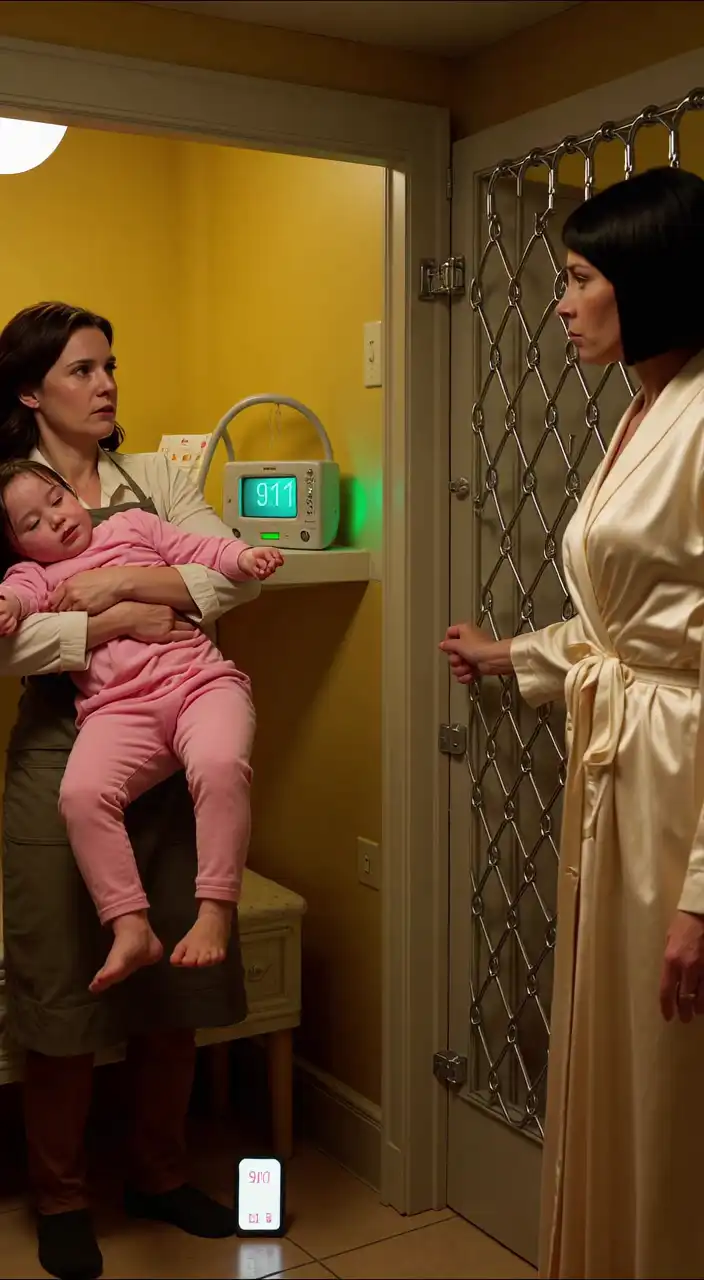
Elena's fingers dug deeper into my wrist the second that voice came through the door.
"Say she is sleeping," she whispered, fast and furious. "Say you panicked."
Lina gave a dry little cough against my shoulder. It sounded too weak to belong to a child who had spent the whole afternoon burning up. I tried to pull away, but Elena shifted in front of the deadbolt and the chain, using her body like another lock.
The knock came again, harder. "Ma'am, this is EMS. We got an open line and child distress in the background. Open the door."
I had not felt hope for hours. It should have made me stronger. Instead it made my legs shake. If Elena had only blocked me with words, maybe I would have shoved past her already. But when you spend two years living in someone else's apartment after your husband dies, listening to every reminder that you owe them rent, gratitude, and silence, you learn to hesitate at exactly the worst moments.
Elena heard that hesitation and pounced on it.
"You want them here?" she said under her breath. "You want them asking why your daughter keeps getting sick? Why there are medicine wrappers all over that room? They will not blame me, Rosa. They will blame the mother."
Her words landed because they aimed at the oldest wound she knew. Since Sami died in a scaffolding accident, every bad thing that happened in my life seemed to come with paperwork I didn't understand and authority figures I was scared of disappointing. I worked double shifts at a bakery. I slept in the small room off the kitchen. I accepted Elena's "help" because Sami's father had sold their house years before, and this apartment was all she had left to rule. Elena liked to say she had rescued me. Some nights I almost believed it.
But Lina's skin was so hot through the blanket that it snapped me back.
The paramedic outside tried the handle. The chain caught. "We can hear people inside," he said, louder now. "Child sounds lethargic. Open the door immediately."
I twisted my arm hard enough to break Elena's grip. Pain shot up to my elbow, but she lost her balance for one second. I used my shoulder to hit the door, chain and all, and shouted, "My daughter needs help!"
That was enough.
A man's voice, older and steady, answered from the other side. "Step back from the door, Mom. We are coming in."
The chain strained. Elena reached for me again, but this time Lina slid in my arms and let out a strange, tiny moan. It frightened Elena more than my shouting had. She stepped back on instinct, and that gave me room to pull the chain loose.
The door opened so fast it banged into the wall.
The paramedic in front was older, broad-shouldered, carrying an orange bag. His gray hair was damp at the temples from the summer heat, and his face went immediately to Lina, not to Elena, not to the apartment, not to me. That alone almost made me cry. Behind him stood a younger EMT and a patrol deputy keeping the hallway clear.
"I've got her," the older paramedic said softly. "I'm Michael. Let's look at her right now."
He reached for Lina with practiced calm. I transferred her into his arms, my own shaking so badly I was afraid I'd drop her. Michael laid her across his forearm and touched her cheek, neck, and forehead in quick sequence. He looked at her eyes, pressed a finger to her gums, then nodded once to his partner.
"She's dehydrated. Temp's high. Let's get vitals. How long has she been this lethargic?"
"Since before noon," I said, my voice cracking. "Fever since last night. She stopped drinking. She threw up this morning. I wanted urgent care, then the ER, and-"
"And she overreacted," Elena cut in. Her voice had changed completely. Calm. Almost offended. "The child had a mild fever. I told her to wait for Tylenol to work. She likes drama. She called 911 before even trying to cool her down."
Michael didn't look up from the pulse oximeter he was clipping onto Lina's tiny finger. "Who ended the first call?"
Nobody answered.
The younger EMT, a woman with dark braids tucked under her cap, glanced toward the glowing phone on the tile. Its cracked screen still showed the emergency call interface, red timer frozen. She bent to pick it up.
"I think the line stayed open long enough to dispatch," she said.
Elena folded her arms. "Exactly. A misunderstanding."
Lina stirred and whimpered, "Mama."
I stepped closer, and Michael shifted so she could see me. "I'm here, habibti," I whispered. "I'm here."
Her eyes fluttered, unfocused. She tried to lick her lips and couldn't.
"Heart rate's racing," the younger EMT said. "O2 okay for now. Skin's dry. She needs transport."
"Agreed," Michael said. Then he looked at me. "Did she get any medication? Be specific."
I opened my mouth, but Elena answered first.
"Children's fever reducer. One proper dose."
Michael's eyes moved past her shoulder toward the nursery. Toward the dresser. Toward the torn wrappers.
"What kind?" he asked.
Elena hesitated a fraction too long. "The normal one."
That was the first moment I saw him register her as a problem instead of background noise.
He handed Lina back to me for one second while his partner pulled out a rectal thermometer and pediatric supplies. Then he stood and took one step into the nursery doorway.
From where I stood, I could see what he saw: two different brands of fever medicine wrappers, one crushed juice pouch, a dosing syringe in the wrong cap, and the baby monitor camera on the shelf with its green light still blinking.
Michael turned to me. "Mom, did you give any meds?"
"I gave one dose at six this morning before work," I said. "I wrote the time on the fridge note. Then Elena texted me at noon saying Lina was napping and the fever had broken. When I got home early, Lina was limp and hotter than before."
Elena laughed once, too sharp. "Because she never knows what she gave. She's exhausted all the time."
Michael ignored that. "You wrote the time down?"
"Yes."
"Show me."
My hands were full of blanket and child, but the younger EMT took Lina again and motioned me toward the refrigerator. There, under a magnet shaped like a pomegranate, was the bakery receipt where I'd scribbled: 6:05 AM - acetaminophen 5 mL - fever 101.8 - drank half cup water.
Michael read it, then looked back at the nursery. "And these wrappers are acetaminophen and ibuprofen. More than one dose worth."
Elena's face hardened. "So? That's how fever works. You alternate. Any grandmother knows that."
The younger EMT asked, "How much did you give and what times?"
Elena's lips pressed thin. "I don't remember exactly."
The deputy at the doorway, who had remained quiet until then, shifted his stance. "Ma'am, we need clear answers."
Elena flared at him. "For a fever? In my own apartment?"
Lina suddenly retched, a tiny dry heave with almost nothing in it. Michael took her back immediately, and his calm voice sharpened. "Enough. She needs transport now."
He moved toward the stretcher in the hallway. I followed so closely I nearly stepped on his heels. Elena grabbed the doorframe and said, "Her mother isn't thinking clearly. The child can rest here."
Michael stopped and turned, all the softness still there but with steel under it now.
"No," he said. "This child is going to the hospital."
Elena looked at me then, not at him. There was hatred in that look, but something else too. Panic. "If they test her," she said again, louder this time, "they will ask why she keeps needing doctors every month."
I froze.
Every month.
Michael caught it. "What does that mean?"
Elena realized too late that she had said too much. "Nothing. I mean she always runs fevers. That's all."
But I was already thinking of the last six months. Lina's stomach virus that lasted too long. The cough that came after Elena's "herbal tea." The unexplained rash. The mornings after Elena babysat when Lina clung to me and wouldn't eat. I had blamed daycare germs, cheap apartment mold, my bad luck, my own constant work schedule. Because if I let myself suspect more, I would have had to admit I had left my child in danger.
Michael studied my face, and I think he saw the realization moving through me.
"What else has happened?" he asked quietly.
I swallowed hard. "I... I don't know. She gets sick when I'm at work sometimes. Elena always says she already handled it. She says not to waste money on doctors."
The younger EMT met Michael's eyes. Something unspoken passed between them. Then she said, "Let's bring the monitor unit too."
I blinked. "What?"
"The baby monitor," she said. "If it's recording audio, the hospital and law enforcement may need it."
Elena moved faster than I had seen her move in years. She lunged toward the nursery shelf.
The deputy caught her by the forearm before she got there. Not rough, but final. "Don't touch it."
"It records over itself," Elena snapped. "It's old junk. It doesn't matter."
Michael's gaze settled on the blinking green light. "Then you won't mind if we take a look."
For the first time since the ambulance arrived, Elena looked truly afraid.
The younger EMT reached up, unplugged the parent unit from the charger, and handed it to the deputy. The screen flickered with a grainy image of the nursery and the edge of the hallway outside. On the speaker, faint but unmistakable, a child's weak crying crackled between static.
Michael's radio crackled on his shoulder. He ignored it and spoke directly to me. "Rosa, ride in with us. Bring your phone and whatever papers belong to your daughter. We move now."
I nodded and turned toward the kitchen table where Lina's clinic folder usually sat. Elena made one last play.
"She has no insurance card with her," she said. "You won't get far. Let me sort this out."
That was another old trick. Make the next step sound impossible so I would stop moving.
But before I could even answer, the deputy said, "Hospital first. Sorting later."
I found the folder under a stack of unopened mail. Lina's Medicaid card was there. So was something else I had never seen before: a folded urgent care discharge sheet from three weeks earlier with Lina's name on it and a note in red pen at the bottom.
Return immediately if caregiver reports repeated vomiting after medication.
My heart seemed to drop through the floor.
I turned back toward Elena with the paper in my hand, and she did not deny it. She only stared at the sheet and then at the monitor in the deputy's grip, calculating what the room could still hide.
Michael was already crossing the threshold with my daughter in his arms when he looked back at me and said, "Mom, if there is anything you haven't been told, the hospital is where it starts coming out."
In the hallway, under the flashing wash of ambulance lights, I followed him out carrying the discharge paper, while behind me Elena finally raised her voice and shouted the one thing that made every piece of the day slide into a worse shape:
"She was never supposed to call 911."
The stretcher wheels hit the elevator gap with a hard metallic jolt, and Lina's eyes rolled half-open as if even that tiny bump hurt.
I climbed into the ambulance beside her, clutching the discharge paper so tightly it softened with sweat. Michael snapped the stretcher locks in place and hooked up another line while his partner, whose name tag read Tasha, started a small fluid bolus through an IV in Lina's hand. My daughter was so limp she barely protested. That scared me more than any scream could have.
"Talk to her," Tasha said. "Keep your voice in her ear."
So I did. I told Lina about the yellow cup she liked. About the little bread animals I sometimes brought home from the bakery. About the stray cat downstairs she called Socks even though it had no white fur at all. My voice shook through all of it.
Michael sat on the bench seat opposite me and opened Lina's clinic folder. He slid the discharge paper out with two fingers and read it under the ambulance light.
"When was this visit?" he asked.
I leaned forward. "Three weeks ago? I didn't know it existed until just now."
He turned the page toward me. The intake line listed arrival time, temperature, and the name of the adult who had brought Lina in.
Not me.
Elena Nassar.
A dizziness I had nothing to do with exhaustion washed over me. Elena had taken Lina to urgent care without telling me. Not because she wanted medical help, but because something had gone wrong badly enough that she had needed a doctor for cover. Then she hid the paperwork and told me Lina had a stomach bug from daycare.
Michael saw my face and kept his tone even. "We will give this to the ER team. We also need a list of every illness you remember, even if it seemed minor."
"I work mornings," I said. The words spilled out before I could organize them. "Elena watches Lina until daycare opens or if Lina is sick and can't go. She always says not to lose pay. She says mothers like me cannot be picky. Every time Lina got worse, Elena acted annoyed at me for worrying. She'd say, 'You make her weak by staring at her.'"
Tasha was flushing the IV line when she said, "Did the child improve in the hospital or once you had her away from home?"
I looked at her. "Usually yes. I thought that was normal."
She and Michael exchanged a glance. Not dramatic. Just professional, and somehow that made it worse.
"I don't want to jump ahead," Michael said, "but repeated unexplained illness that improves away from one caregiver is something the hospital takes seriously."
My mouth went dry. "Are you saying she hurt her?"
"I'm saying tell the truth exactly as you know it," he said. "Do not soften it because someone is family."
The monitor above Lina showed her heart rate still too high, but slowly settling as fluids dripped in. Tasha checked her pupils and asked me what Lina had eaten today.
"Toast this morning. Maybe some applesauce. Elena said she gave her tea."
"What kind of tea?"
"I don't know. She says family remedies. Mint, anise, things like that." I looked down at the discharge paper again. "Last month there was a cough that came out of nowhere after one of those teas."
Michael nodded toward my phone. "Do you have texts from Elena today?"
I unlocked the cracked screen with trembling fingers. There they were:
12:07 PM - Fever gone. She's sleeping. 1:34 PM - Don't come home early. She needs quiet. 3:02 PM - I already gave medicine. Stop acting dramatic.
And beneath those, one older thread from weeks ago I had barely registered then: She threw up but she's fine now. Do not waste your money on ER bills.
Michael asked if he could take photos of the messages for the receiving team. I said yes.
The ambulance hit a pothole and Lina whimpered. I put my hand over her leg, just above the blanket. Her skin felt both hot and papery. Tasha hung a second small bag and said, "ER's ready for us. They know it's a possible overdose situation, but that's precaution until labs say more."
Overdose. The word rang in my skull.
By the time we reached Mercy General, the fear in me had split into two separate things. One was immediate: keep Lina breathing, drinking, waking, safe. The other was slower and colder: if Elena had been hiding medical visits and dosing her without telling me, how long had this been happening under my own roof?
Hospital doors opened before the ambulance had fully stopped. A nurse met us at the bay, and Lina disappeared into a brightly lit room full of hands, monitors, pediatric supplies, and questions fired with the speed of people who do not have time for shame. I was told to answer what I could and move aside when I couldn't.
A pediatric resident asked me about fevers, vomiting, and urine output. A nurse asked about medications in the home. Another asked who had custody. Tasha handed over the discharge paper and relayed the interrupted 911 call, the obstruction at the apartment, and the baby monitor recording. Michael gave a calm, exact account without a trace of drama. Hearing the facts in that steady voice made them sound even more serious.
Then a woman in navy scrubs stepped into the room and introduced herself as Dr. Patel, the pediatric attending. She checked Lina herself, listened to the report, and then looked directly at me.
"We are going to stabilize her and run blood work, electrolytes, and medication levels," she said. "Your daughter is dehydrated and very febrile. We also need to understand whether she received incorrect doses or something she should not have had."
I nodded too fast. "Do whatever you need."
"We will." Her expression softened a fraction. "And because there was a blocked emergency call and concern about concealed care, our social worker and a child protection team clinician will also speak with you. That does not mean we think you caused this. It means we are treating the situation seriously."
I nearly collapsed with relief at that single sentence. Someone in authority had finally said out loud that serious did not automatically mean guilty mother.
They moved me to a chair near the wall while they worked. Through the blur of motion, I saw one planted detail from home follow us like a witness: the baby monitor parent unit, now sealed in a clear evidence bag on the counter beside Lina's chart.
A social worker named Denise arrived first. She had reading glasses on a chain and a voice so gentle it almost undid me. She didn't ask if I loved my daughter. She asked who controlled the apartment lease, who handled mail, whether anyone kept my ID or Lina's documents from me, whether I had free access to transportation, and if Elena had ever threatened to report me as unstable or unfit.
Every answer opened something ugly I had taught myself not to name.
"She holds the apartment over me," I said. "She says if I move out, I will drown in bills. She says if I argue, she can tell people I leave Lina with anyone. She tells me what doctors cost even when Medicaid covers it. She says immigrants who make noise lose everything."
Denise wrote nothing for a moment. She just looked at me. "Has she isolated you from other help?"
"My sister is in another state. I stopped talking to friends from work because Elena said they were bad influences. If Lina got sick, Elena would tell me not to tell daycare or they would judge me."
Denise finally wrote, then nodded. "You are not the first person whose dependence was used against her."
A child abuse pediatrician arrived next, a careful man named Dr. Levin who did not speak like television detectives. He asked for a timeline. Exact dates if possible. What Lina had eaten before each unexplained illness. Whether Elena had certain habits in the kitchen. Whether there were medications, supplements, or sweet-smelling syrups in the apartment.
That question pulled up a memory I had shoved aside because it felt too petty to matter. "She keeps a little amber bottle near her tea things," I said. "No label. She says it's a sleep tincture from her cousin."
"Has Lina ever seemed unusually sleepy after tea or juice from Elena?" he asked.
I thought of afternoons when Lina would nap too hard, too long. Thought of once finding a sticky medicine stain on the collar of Lina's pajama top that smelled vaguely minty and bitter. Elena had laughed and called it spilled herbal tea. I had rinsed it in the sink and gone to work.
"Yes," I whispered. "Sometimes."
Dr. Levin wrote that down immediately. "Any chance there are other recordings in the home? Indoor cameras, voicemail, texted photos?"
"Maybe the hallway camera," I said. "Elena thinks it doesn't catch the apartment door clearly."
Denise looked up. "Building camera?"
I nodded.
She left the room within seconds to start that request.
When Michael reappeared at the doorway with a deputy beside him, I had a strange burst of gratitude so intense it embarrassed me. He wasn't family. He didn't owe me anything. But he had arrived when the world was still trying to tell me I was exaggerating.
"The deputy wants a statement when you're able," Michael said. "No rush. Your daughter first."
I stood up too quickly. "Did she... did Elena say anything else?"
The deputy, whose badge read Warren, answered. "She changed her story twice before we left. First she said there was no real call. Then she said you were hysterical. Then she said the child gets 'episodes' and doctors always overreact. We have her on body cam trying to stop EMS from taking the monitor."
The monitor. The green blinking eye. The hidden witness in the safest room of the apartment.
Dr. Patel returned just then with the first lab concerns. "Lina's acetaminophen level is elevated higher than expected from a single proper dose this morning," she said carefully. "Not at the worst threshold, but high enough that we need to treat and monitor. We are also seeing significant dehydration."
The room narrowed around those words.
Elevated higher than expected.
Not proof of everything. But proof of enough.
I put my hands over my face and breathed through my fingers because if I didn't, I was going to scream. All those times Elena had rolled her eyes at my worry. All those times she had made me feel stupid for wanting a doctor. The medicine wrappers. The hidden urgent care paper. The repeated illnesses. The command not to "ruin the family" if they tested Lina.
Dr. Patel crouched slightly to keep her face level with mine. "We caught this in time. Stay with that."
In time.
I nodded, but a second later another nurse came in carrying a small plastic belongings bag. "This came with the patient blanket," she said. Inside were the torn wrappers from the dresser that Tasha must have scooped up before leaving. One was acetaminophen. One was ibuprofen. And one, folded under them, was from an over-the-counter nighttime cold syrup not meant for a child Lina's age without guidance.
I stared at it. "She didn't even have a cough today."
Nobody in the room spoke for a beat.
Then Dr. Levin said quietly, "That contradiction matters."
For the first time, I understood that whatever Elena had been doing was not just neglect. It had shape. It had pattern. And somewhere between the baby monitor audio, the hidden urgent care visit, the wrappers, the texts, and the hospital labs, that pattern was starting to hold.
But pattern alone would not keep Elena from fighting.
Denise returned with fresh urgency in her step. "Building management says the hallway camera does face the unit entrance after all," she said. "They can preserve footage tonight, but they need law enforcement request paperwork immediately before it rolls over at midnight."
Deputy Warren swore under his breath and turned for the door.
At the same moment, Dr. Patel's monitor alarm chirped, and three nurses moved toward Lina at once.
Her heart rate had spiked again.
The room shifted instantly back to the first truth. Evidence could wait one more minute. Rescue could not.
Dr. Patel looked at me and said, "Mom, step back. We need space."
And as I backed toward the wall, clutching the bag of medicine wrappers, I saw Lina's small hand twitch toward me while the baby monitor sat sealed on the counter beside her bed, holding whatever my daughter had not been old enough to say for herself.
The next hour taught me that fear can have layers.
There was the sharp fear each time a monitor beeped faster than it should. There was the heavy fear of waiting for lab numbers and trying to understand whether "elevated but treatable" meant my child was safe or barely safe. And under both of those, there was a different fear taking shape as more adults with clipped badges and calm questions moved through the room: if Elena sensed that the story was turning against her, what would she do next?
Lina's heart rate settled after more fluids and fever management. Dr. Patel said the spike was likely from dehydration and stress, not a fresh collapse. I clung to that. Tasha had long since cleared to another call, Michael too, but before he left the ER he stepped in one last time.
"You're doing fine," he said.
I almost laughed at the absurdity of those words in that room. "I don't feel fine."
"I didn't say you felt fine," he said. "I said you're doing fine. There's a difference."
Then he nodded toward the evidence bag holding the baby monitor. "A lot of cases don't start with something that clear."
"What if it isn't enough?" I asked.
He paused. "People who block care count on confusion. Every honest detail you give makes confusion harder."
After he left, Denise helped me list dates. We built the last six months on scrap paper from memory: the stomach bug in February, the rash in March, urgent care in April that I knew about, hidden urgent care in May that I didn't, the cough in June, and now this. Each incident had one thing in common. Elena had been alone with Lina right before it got worse.
Once I said that out loud, I couldn't unsay it.
Deputy Warren came back with a detective from the county's special victims and child abuse unit, a woman named Sergeant Morales. She was compact, direct, and somehow less frightening than I expected because she didn't waste time on theater.
"We have the building manager preserving the hallway footage," she said. "We also have EMS body cam and the open 911 audio request in progress. I want the baby monitor examined before anybody powers it down incorrectly. Does it save locally or only transmit?"
"I don't know," I said. "It was a gift from a coworker when Lina was born."
Morales held up a hand. "That's okay. Tech can determine it. I also need to know if anyone else had motive to keep the child sick or keep you dependent."
I stared at her, startled by how bluntly she had named the thing I had only begun to feel.
Denise answered before I could. "Rosa's housing and childcare both run through the stepmother."
Morales nodded once, as if that fit too neatly. "Control. Financial leverage. Access to the child. Prior concealed treatment. That is enough for us to push tonight."
The phrase push tonight should have reassured me, but instead it raised the pressure. Because if they were moving quickly, Elena would feel it too.
At 10:14 p.m., my phone lit up with her name.
I almost dropped it.
Denise, Morales, and I all looked at the screen together. Elena Calling.
"Do not answer without us discussing it," Morales said.
The call went to voicemail. Then another came. Then three texts in a row.
Where is Lina? You are making a mistake. If you talk too much, they will take her from you.
The old panic came roaring back so fast it made my scalp prickle. This was Elena's voice in purest form. Not concern. Threat shaped like concern.
Morales held out her hand. "May I photograph those?"
I nodded.
Another text appeared before she could even finish: Delete our messages. You do not understand what they will do.
Morales looked up sharply. "Good. She's worried about records."
The word good sounded strange attached to a threat, but I understood what she meant. Elena was showing her hand.
Dr. Levin returned with a nurse and asked if I remembered anything about the hidden urgent care visit. I didn't, beyond the paper itself. He said they were requesting records now, and if the staff had documented concerns then, it would matter. The nighttime syrup wrapper mattered too, not because one wrapper proved poisoning, but because it contradicted Elena's story about "proper fever medicine" and broadened what had to be tested.
An hour later, just when fatigue was making everything fuzzy, a new problem hit.
Mercy General's registration clerk found a notation in Lina's chart from the hidden urgent care visit. The listed emergency contact had been changed that day.
From me to Elena.
No one said anything dramatic. No one gasped. But Denise's face changed, and Sergeant Morales asked for the exact timestamp immediately.
"It means she wasn't just hiding visits," Denise said once the clerk stepped away. "She was positioning herself to be contacted first."
I felt sick.
I remembered a week in early spring when Elena had insisted she was "organizing paperwork like a real adult" while I showered before work. I had thanked her. I had thanked her.
Morales spoke into her phone, requesting the records and asking whether any authorization signature was on file. Then she muted the line and said to me, "This is one of those details that looks bureaucratic until you ask what it was for. If a child worsens and the primary contact is the controlling caregiver, the real parent can be delayed."
The room seemed colder.
That was the reversal taking shape in front of me: I had thought Elena blocked care because she despised expense, inconvenience, attention. Maybe those were part of it. But changing the emergency contact suggested something colder and more deliberate. She didn't just want fewer doctors. She wanted to stand between me and any doctor who might notice a pattern.
A nurse came in to say Lina was more responsive. I rushed to her bedside. Her eyes opened this time and actually found me.
"Mama?" she whispered.
"I'm here."
She looked confused, then frightened in the way children do when they wake somewhere bright and unfamiliar. I stroked her hair and kept my voice low. "You're at the hospital. They're helping your body feel better."
She swallowed with effort. "Grandma said don't tell."
Everything in me went still.
She was not old enough to invent the exact wrong sentence.
Denise heard it. So did the nurse. Neither interrupted. They let me answer first.
"You don't have to keep secrets from doctors," I said carefully, because every adult in the room had suddenly become very quiet. "Not ever."
Lina's eyes drifted half shut. "Bitter juice," she murmured. "I said no."
The nurse stepped away without a word and came back with Dr. Levin almost immediately.
He did not interrogate her. He spoke gently, asked only a few age-appropriate questions, and stopped the moment she looked tired. But the essentials were there. Elena had given her something "bitter" in a little cup after I left for work. Elena had said it would make her "rest." Elena had also told her not to tell me because "Mama worries too much."
I thought I might stop breathing.
No dramatic accusations followed. Just more careful documentation. More chain-of-custody language around the wrappers and monitor. More testing requested. More people moving with that quiet urgency that means a line has been crossed.
At 12:03 a.m., Sergeant Morales got the first written summary from the preserved hallway footage. No audio, but clear video of me kneeling with Lina in the doorway, phone on the floor, Elena blocking the frame with her body, and then the paramedics entering after visible resistance. Enough to support obstruction. Enough to match the 911 open line and body cam.
Morales exhaled slowly. "That helps."
"What about the baby monitor?" I asked.
"Tech is pulling what it stored locally now. If it captured what EMS heard through the doorway, that's stronger."
As if summoned by the question, a hospital security officer entered with a county technician carrying the monitor unit in an antistatic bag. They needed to verify one thing with me: had I ever intentionally activated recording mode?
"I don't think so," I said. "I only used it to hear her nap."
The technician nodded. "Some units cache rolling audio when motion or crying triggers the parent unit. We got several clips from tonight."
My knees went weak.
Morales asked, "Can we listen?"
"With witness present and documented chain, yes."
They used a small speaker in a conference room down the hall, away from Lina's bedside. Denise stayed with me. The technician played the first file. Static. A soft child whimper. My own voice in the distance saying, "Stay with Mommy." Then Elena, clear as if she were in the room with us:
"Stop crying. She will be home soon and I am not calling anyone for every little fever."
Another clip. A drawer opening. Wrappers crackling. Lina crying harder. Elena's voice lower, irritated: "Drink it. I said drink it." Then coughing. Then silence too long to be comfortable.
The last clip was the one from just before EMS arrived.
I heard myself saying, "The monitor is recording."
And Elena answering, "If they test her, you will ruin this family."
No one in the room moved for a moment after that.
Morales finally said, "That's enough for exigent action."
I didn't know the legal phrase, but I understood the meaning.
Then came the next reversal, smaller but somehow even more personal. The technician replayed the beginning of the second clip because Dr. Levin thought he heard something under the wrapper noise.
A television in the background? No.
A cabinet door.
Specifically, the little cabinet above the stove where Elena kept her tea tins and the unlabeled amber bottle.
Dr. Levin looked at Morales. Morales looked at me.
"If deputies are still at the apartment," she said, already reaching for her phone, "we may have probable cause to secure the medication area before it disappears."
For the first time all night, I felt something besides fear.
I felt Elena's certainty slipping.
But she was not done yet.
While Morales stepped into the hall to call it in, Denise's phone buzzed from the social work station. She answered, listened, and her face changed.
"What is it?" I asked.
She covered the receiver. "Your stepmother just arrived downstairs."
My entire body went cold.
"Can she come up?" I said.
"Not unless you permit it, and I strongly advise against that."
The receiver crackled. Denise listened another second, then looked at Morales in the hallway. "Security says she's demanding to see the child and claiming the mother is unstable and may flee."
There it was. The move Elena had been building toward. If she couldn't stop care, she would try to undermine me as the caregiver.
Morales came back in as Denise relayed it. She didn't even look surprised. "Good. Let her talk to security where she's recorded."
I stared at her. "Good again?"
Morales gave a thin, humorless smile. "People who think they can control a room often overperform when they lose it."
Downstairs, behind hospital security glass, Elena was starting her next lie. And if she said the right wrong thing in front of the right camera, it might finally show everyone what I had been too afraid to say first.
Security did not let Elena onto the pediatric floor, but they did something almost better. They kept her in the family consult room off the lobby under camera coverage because she insisted on "speaking to whoever was in charge." Morales asked if I wanted to hear from the adjacent office while security and the deputy handled the initial contact.
I didn't want to. I went anyway.
There is a point in some nights when dread becomes a kind of clean endurance. I had crossed into it.
Through the small monitor on the wall, I saw Elena sitting ramrod straight in the same expensive robe, though now she had thrown a cardigan over it to look more respectable. Respectable was important to her. Respectable women did not poison children, in her mind. Respectable women used words like concern and discipline and family reputation until everyone else doubted what they had seen.
A hospital security supervisor sat across from her. Deputy Warren stood by the door. Morales watched from our side of the glass with a notebook in hand.
Elena began exactly where I expected. "My stepdaughter is overtired and emotional. She overmedicates the child because she cannot cope. I tried to stop a scene."
Morales did not write yet. She waited.
The supervisor asked, "Then why did EMS report you physically obstructed a medical response?"
"I was trying to keep strangers from frightening the girl."
"And the interrupted 911 call?"
"An accident."
"The hidden urgent care visit in your name?"
That one hit her. I saw it in the tiny shift of her jaw.
"I took the child as a favor because Rosa was at work."
"Why wasn't the mother informed?"
"I told her. She forgets things."
Elena had spent years learning how to answer with just enough insult to sound plausible. If you didn't know her, some of it almost worked. But pressure makes pattern visible. Every question that narrowed toward evidence made her angrier.
Then the supervisor said, "We also have concerns about statements captured on a nursery monitor."
Elena's whole body stilled.
"What statements?" she asked.
Morales made her first note.
The supervisor didn't answer directly. "Did you at any point tell the mother not to seek testing?"
"It depends what she says I said."
There it was: not denial, but repositioning.
Morales leaned toward me. "Hear that? She's already trying to negotiate the wording, not the truth."
I kept my eyes on the screen. Elena looked composed, but there was a shine of sweat at her hairline now.
Deputy Warren asked, "Do you keep any medications or tinctures in the apartment outside their original containers?"
"No."
"Any unlabeled bottles?"
"No."
"Any over-the-counter nighttime syrups given to the child today?"
"Absolutely not."
Morales wrote continuously now.
Because while Elena was talking downstairs, a second deputy at the apartment had just called in what they found while securing the scene pending a warrant. In the cabinet above the stove, beside tea tins, sat the unlabeled amber bottle I had mentioned. In the trash under coffee grounds were two more nighttime syrup wrappers matching the one bagged from Lina's room. And behind a stack of paper napkins was a pharmacy bottle with the label peeled off but enough adhesive residue left to suggest it had once been prescription.
Not final proof. But enough contradictions to keep the night moving.
Elena made the mistake Morales had predicted. She started improvising beyond the facts.
"Rosa cannot manage stress," she said. "Sometimes she leaves Lina drowsy herself and forgets what she gave. I have covered for her because I didn't want the child taken."
I heard myself make a strangled sound in the dark room behind the glass.
Denise put a hand near my elbow, not touching me, just present.
The security supervisor asked, "You covered for unsafe medication practices by not calling emergency services?"
Elena blinked. "I was handling it within the family."
The sentence hung there like a confession translated into her own moral language.
Morales stepped out then. Not dramatic. Just done listening passively.
When she entered the consult room, Elena's posture changed instantly from regal to defensive. She recognized authority she couldn't bully with social status.
"Mrs. Nassar," Morales said, sitting across from her, "I need to clarify several inconsistencies. You stated no unlabeled medications are in the apartment. A deputy reports one in the kitchen cabinet. You stated no nighttime cold syrup was given. We have wrappers suggesting otherwise. You stated this was an overreaction to fever. We have lab concerns inconsistent with a single proper dose."
Elena's mouth opened, then closed.
"Also," Morales continued, "we have evidence that you altered emergency contact information during a prior medical visit and did not inform the child's mother."
Elena tried a new angle. Tears. I had seen them before, always dry-eyed at the start, summoned for effect. "I am the only one who has held this family together since my husband remarried that girl. I took them in when no one else would. Rosa is weak. She lets that child run wild. I had to be strict."
Strict.
A child lying upstairs with elevated medication levels and dehydration, and Elena still wanted the scene to be about discipline.
Morales did not move an inch. "Being strict is not the issue. Blocking emergency care is. Concealing prior care is. Administering unknown substances is."
"I gave tea."
"Then you can explain the monitor audio describing bitter liquid and your instruction not to tell the mother."
That hit like a slap. Elena's face emptied.
For three full seconds, she had no script.
Then she said the most revealing thing of the night.
"If Rosa leaves with that child, she will never bring her back."
Not if the child gets hurt. Not if the mother is unstable. Bring her back.
Back to Elena.
Morales turned her head slightly, and even from the next room I could see the significance land. This was not just about family pride or annoyance. It was possession. Control. If Lina became my reason to move out, Elena lost her hold over both of us.
I suddenly remembered something tiny and awful from months earlier. Elena fastening a little plastic hospital bracelet from a routine clinic visit around her own wrist for a joke, saying, "See? Even the nurses know I am the one who handles things." At the time I had rolled my eyes and kept packing the diaper bag. Now that memory came back sharp as glass.
Another planted detail. Another piece repaid too late.
Morales asked one final question. "Did you tell the mother, quote, 'She was never supposed to call 911'?"
Elena looked toward the camera in the corner of the room as if it might rescue her. "People say things when they're upset."
Morales stood. "That's not an answer."
As she moved to the door, Elena's composure shattered for the first time. "You don't understand how hard it is to manage people like her," she snapped. "If I didn't intervene, they'd be in clinics every week. That child cries over everything. She needs quiet, sleep, discipline. Rosa fills her head with panic."
There it was. The motive stripped of manners. Elena had decided that Lina's body was hers to regulate and my fear was the real problem.
Morales left the room. The deputy stayed with Elena.
In the hallway, Morales spoke low and fast to Warren. I caught only fragments: child endangerment, obstruction, warrant, temporary protective orders, hospital hold. Denise exhaled beside me for what felt like the first time in an hour.
Back upstairs, another pressure point was waiting.
Dr. Patel met us near Lina's room with updated labs and a serious face. "She's responding, but slowly. We need overnight admission and continued monitoring. The acetaminophen level is still concerning enough that we're treating to protect her liver."
Overnight admission. My relief at not taking her back to that apartment fought with terror at hearing the word liver attached to my child.
"Will she be okay?" I asked.
Dr. Patel answered the way good doctors do when they refuse to make false promises. "I believe she has an excellent chance because she is here now. But the next several hours matter."
The next several hours.
As if that wasn't enough, registration had another complication. Because Elena had changed the emergency contact during the hidden urgent care visit, some linked records listed her as preferred caretaker in a secondary field. Hospital administration could fix it, but not instantly. Until then, every system printout risked carrying Elena's name into decisions where it did not belong.
I felt nauseated with rage. Even now, through forms and databases, she was still between me and my child.
Denise and a unit clerk began clearing it line by line. Insurance contact, guardian field, authorized pickup, emergency contact, release of information. Bureaucracy turned into battlefield. Every checkbox was a piece of oxygen.
At 2:17 a.m., while I sat at Lina's bedside stroking her hand, my phone buzzed from an unknown number.
I almost ignored it. Then a voicemail alert arrived immediately after.
It was building management from the apartment complex. They had reviewed more hallway footage because law enforcement requested a wider window. The manager said there was another clip from earlier that evening, before I came home.
My stomach dropped.
On that clip, according to the manager, Elena could be seen carrying Lina out into the hallway wrapped in a blanket, pacing with her for several minutes, looking toward the elevator, then taking her back inside just before I arrived.
"She almost took her somewhere," Denise said when I played the message for her.
"Or staged concern," Morales said. "Or considered getting help and changed course. We need the video."
But another possibility was already forming in my mind, darker than the others. Elena might have been testing whether Lina looked sick enough to force a hospital trip she could control, then retreated when she saw neighbors nearby. Or she might have planned to move evidence. Or to present herself as the savior if things worsened.
None of those options comforted me.
The mini-hook of the night moved again when Dr. Levin returned with preliminary information from the hidden urgent care visit. The note from three weeks ago documented vomiting, unusual drowsiness, and a caregiver history that "medications may have been repeated accidentally by family member." No toxicology was run because symptoms improved quickly, and the child was discharged with strict return precautions.
The caregiver who gave that history was Elena.
So she had already used the accidental repeat-dose explanation once before.
This wasn't panic. It was a script.
And if a script was repeating, then somewhere in all the paperwork and recordings, there might be a pattern stronger than any one night's crisis.
The night nurse dimmed the room so Lina could rest. Machines glowed soft green and blue. The sealed baby monitor sat in the evidence cabinet outside. The pomegranate magnet, the wrappers, the amber bottle, the changed emergency contact, the hallway footage, the open 911 line - small things, ordinary things, all turning into one story.
Lina woke near dawn and asked for water.
Dr. Patel allowed a few careful sips. I held the cup while she drank like someone climbing back from very far away. Then she leaned against me and fell asleep again, breathing easier.
I should have felt the worst had passed.
Instead I looked at the rising gray light beyond the hospital window and understood Movement Five of the night was beginning. Elena had lost the apartment door, lost the first lie, lost the consult room. Her next move would not be to persuade.
It would be to separate me from Lina by any official path she could still reach.
And twenty minutes later, Sergeant Morales walked in with that exact warning.
"Rosa," she said, "your stepmother has retained a lawyer she knows from her mosque committee, and he's already calling hospital administration claiming you are medically neglectful and unstable from grief."
The room went cold again.
"Can she do that?" I asked.
Morales looked at sleeping Lina, then back at me. "She can try. Which means the next few hours are not only about your daughter's body anymore. They are about making sure nobody mistakes the rescuer for the risk."
Morning made everything feel more official and more dangerous.
Overnight fear runs on adrenaline. Morning fear gets clipboards.
By seven o'clock, Mercy General's pediatric floor was full of shift changes, case reviews, and the kind of neutral shoes worn by people who make decisions around children. Denise came in with coffee I could barely taste. Dr. Patel came with better numbers. Lina's fever was beginning to respond. Her labs still needed watching, but the treatment had started working. Every improvement felt precious and fragile.
Then Denise sat down and said, "We need to prepare for a family safety conference."
The phrase sounded harmless. It wasn't.
Hospital social work, child protection, administration, and law enforcement wanted a joint plan before discharge. That was good. But Elena's lawyer had forced herself into the edges of the process by alleging I was exhausted, inconsistent with medication logs, and possibly responsible for duplicate dosing. He could not override the investigation, but he could muddy it. Mud was Elena's natural habitat.
"I wrote the dose time," I said, immediately defensive.
"We know," Denise said. "The note helps you. So do the texts, the monitor audio, the obstruction, the hidden records. But institutional systems still ask whether any caregiver could have contributed. We answer with facts, not fear."
Facts, not fear.
I repeated it under my breath as if it were a prayer.
Sergeant Morales brought new updates. Deputies had executed the initial warrant with follow-up authorization from a judge. The apartment search recovered the unlabeled amber bottle, the partial prescription bottle with the removed label, additional fever reducers, and a notebook from Elena's bedside table.
"What kind of notebook?" I asked.
"A household expense book," Morales said. "But some entries mention your work shifts and Lina's illnesses."
My skin crawled.
She opened a photo on her tablet. Lines in neat Arabic and English mix. Dates. "Rosa early shift." "Lina cough again." "No daycare today." "Clinic closed Sunday." "R too dramatic after work."
Elena had been logging my schedule against my daughter's symptoms like a manager tracking inventory.
Morales showed me another image. A page corner folded over. In English this time: If child is admitted, contact first. Mother cries and confuses facts.
Denise inhaled sharply. "She was planning narrative control."
The major reversal that had been growing all night locked fully into place then. I had spent years thinking Elena wanted gratitude and obedience. What she wanted was dependence. Keeping Lina intermittently sick kept me financially unstable, emotionally off balance, and too ashamed of "another doctor visit" to push back. Changing emergency contacts and hiding records wasn't cleanup. It was infrastructure.
I wanted to vomit.
Instead I asked the only thing that mattered. "Can she get near us?"
Morales shook her head. "Not if I can help it. We are pursuing charges for obstruction and child endangerment. Depending on toxicology and consult findings, more may follow."
I sat with that. Charges. Real words. Not just family conflict.
Then the hospital conference began.
We met in a small room with a laminated tree on the wall. Dr. Patel, Dr. Levin, Denise, a nursing supervisor, hospital legal liaison, Sergeant Morales, Deputy Warren, and a CPS intake worker named Marisol joined by speakerphone because the case had crossed the threshold for mandated review. I was terrified of CPS even hearing the letters, but Marisol started by saying something I needed badly.
"The purpose today is immediate child safety planning," she said. "We are not here assuming the reporting parent is the perpetrator. We are here because care was blocked and a child may have been medically harmed."
I nearly cried with relief again.
They walked through everything methodically. My written dose note at 6:05 a.m. The noon text falsely saying the fever had broken. The "don't come home early" message. The open 911 call. EMS witnessing obstruction. Lina's elevated acetaminophen level and dehydration. The nighttime syrup wrapper. The hidden urgent care visit. The changed emergency contact. The baby monitor audio. The hallway footage. Lina's own statement about "bitter juice" and "Grandma said don't tell."
It was overwhelming to hear my life converted into bullet points, but there was power in it too. Facts, not fear. Facts could stand in rooms where my voice used to shake.
The hospital legal liaison then raised the obstacle I had feared. "The stepmother's attorney alleges the mother is overworked, sleeps little, and may unintentionally double-dose medication herself."
Before panic could take me, Dr. Levin answered.
"The current evidence does not support that as the primary explanation," he said. "The timeline of messages, the hidden care records, the recorded statements, and the child's disclosures point strongly toward concerning conduct by the stepmother. We should not conflate poverty and fatigue with intentional or reckless administration by the reporting parent without evidence."
It was one of the most protective sentences anyone had ever spoken about me.
Even so, practical questions remained. Where would Lina go after discharge? Could I safely return to the apartment? Did I have another adult support? Could the hospital hold discharge until a protective arrangement was in place?
I had almost nothing. A sister in Dearborn I hadn't seen in a year. Two close coworkers. Eight hundred dollars in savings. No car. No lease in my name.
When I said this, shame tried to rise again. Denise cut it off cleanly.
"Resource scarcity is not a moral failing," she said. "It is a safety planning fact."
Marisol on speakerphone asked if I would accept emergency shelter placement or family reunification support with a relative. I said yes to anything that kept Elena away from Lina.
Then my phone buzzed with a name I hadn't seen in months: Huda from the bakery.
I stared at it.
Denise nodded. "Answer if you want."
I did. Huda spoke fast, breathless. "Rosa? I just saw two police officers at your building at dawn and got scared. Are you okay? The manager said something happened with Lina."
I had forgotten how quickly news travels in apartment hallways and workplace gossip threads. I also remembered that Huda once offered me her spare room after Sami died, and Elena had told me accepting would make me look irresponsible.
"Huda," I said, and my voice broke. "I need help."
She didn't ask for a performance. She asked where to come.
By ten a.m., Huda and our supervisor, Mr. Klein, were both at the hospital lobby with proof of my employment, copies of my posted work schedule, and a stack of messages showing every time I'd asked to leave early for Lina and every time Elena had texted saying it was "handled." I had not asked them to bring that much. They simply did.
Another planted detail repaid itself there: my wrinkled work shirt from the night before, still in the belongings bag. Mr. Klein pointed at it and said to the hospital liaison, "She came straight from the bakery any time that kid needed anything. Everyone knows that."
Institutional pressure shifted. I could feel it. Not because outsiders should define motherhood, but because systems trust corroboration. Elena had counted on me being isolated. She had been wrong.
Then came the next jolt.
The tox screen from the unlabeled amber bottle was not fully back, but preliminary testing suggested a sedating antihistamine mixed into a homemade liquid. Not illegal by itself. Not definitive on its own. But entirely consistent with a "bitter juice" used to make a child sleep.
Dr. Levin stayed careful with language. "We cannot yet tie concentration and dose to this event with certainty. But in context, it is deeply concerning."
In context. Two of the strongest words in medicine and investigation.
At noon, hospital security informed Morales that Elena's lawyer was requesting a supervised statement from his client claiming she had administered "traditional sleep tea" because the child was overtired and the mother habitually panicked at normal fevers. Morales rolled her eyes for the first time.
"She's still trying to rename sedation as culture," she said.
The final obstacle took shape all at once after lunch.
Hospital administration could place a no-information hold and bar Elena from visiting. Law enforcement could pursue charges. CPS could safety-plan against contact. But none of that changed one immediate problem: once Lina was medically stable, I needed a legal, physical place to take her that Elena could not reach easily. Huda's spare room might work informally, but Elena knew the bakery, knew Huda's last name, knew too much.
I looked at sleeping Lina and felt the threshold again. Rescue is not complete when the ambulance arrives. Rescue is complete when the danger cannot simply resume in a new room.
Denise solved part of it. Through a domestic violence advocacy partner, she found a confidential family shelter with medical transport support. I almost said no out of pride alone. Then I remembered Elena at the apartment door, hand on the chain, telling me no ambulance was coming. Pride had nearly buried us once already.
"Yes," I said.
Marisol arranged an emergency protective action that barred unsupervised contact by Elena pending investigation. Morales moved on the arrest paperwork. Huda agreed to store my work things and help me retrieve nonessential belongings later under police escort.
All of that should have been enough.
Then Lina woke in the middle of the afternoon and asked a question that nearly broke me.
"Are we in trouble?"
Children hear more than adults think. She had heard stern voices, seen strangers, sensed the charged air.
I climbed into the chair beside her and pressed my forehead to her hand. "No, habibti. You are not in trouble. You were very sick, and grown-ups are making sure nobody stops your help again."
She looked at me solemnly. "Grandma said doctors make Mommy cry."
I swallowed hard. "Mommy can cry and still do the right thing."
She considered that in the grave way only a three-year-old can. Then she asked for the yellow cup. The one from the ambulance story. The nurse found a cup almost the same shade, and Lina drank a little more water from it.
That ordinary moment felt larger than any legal document.
Late afternoon brought the final piece from the baby monitor extraction. A timestamped clip from earlier than we realized - midafternoon, before I got home - captured Elena on the phone with an unknown woman saying, "She is too sleepy to fight me now. Rosa will think it is the fever. I just need tonight quiet."
The room went silent after Morales played it.
Not maybe. Not confusion. Not accidental overmedication.
Intent.
Morales closed the file and said, "That changes the charging conversation."
Everything after that moved with the inexorable steadiness of a locked mechanism finally turning the right way. Elena was arrested before evening. Her lawyer stopped calling the hospital. The emergency contact fields were corrected. The hallway footage and monitor clips were duplicated. The hidden urgent care records were subpoenaed in full. The notebook, wrappers, bottle, and texts went into evidence. A temporary order barred Elena from contacting me or Lina directly.
Only then did my body let itself feel what it had been postponing. I shook so hard Denise had to bring another blanket.
By the second night, Lina's numbers improved enough that Dr. Patel spoke about discharge in twenty-four to forty-eight hours if she kept drinking and her liver labs continued the right direction. I thanked her so many times she finally squeezed my shoulder and said, "Take the win."
So I tried.
The ending, when it came, was not loud. It was made of doors opening the right way.
Forty hours after the ambulance, I carried Lina out of Mercy General wearing borrowed clothes from Huda and holding a plastic bag of discharge instructions I actually trusted. No one blocked the elevator. No one snatched my phone. No one spoke over me when I asked questions about dosing, hydration, follow-up labs, or warning signs. Denise walked us to a plain van from the confidential shelter program. Huda followed behind in her own car with my work bag and the stuffed rabbit Lina slept with at daycare.
Before we left, Michael found us in the lobby by chance while clearing another run from the ED. He stopped short when he saw Lina awake in my arms, cheeks cooler, eyes clear enough to track him.
"Hey there," he said to her.
She tucked her face into my shoulder, shy now that she was no longer drifting in and out.
I looked at him and thought of the apartment threshold, the open line, the orange bag, the question he asked before anyone else dared to name the truth: Who stopped the mother from calling for help?
"Thank you," I said.
He nodded once. "You answered the door."
It was such a simple thing to say, but he meant more than the chain lock. He meant I had opened the night to outsiders when family secrecy demanded silence.
At the shelter, a caseworker named Nina gave us a room with two narrow beds, a lamp, a dresser, and a locked cabinet for medications. The locked cabinet made me cry harder than the hospital had. Safety can look very plain when you've lacked it too long.
The next week was a long braid of healing and exposure. Lina had follow-up labs and improved steadily. She wanted applesauce, then crackers, then finally one of my bread animals from the bakery. Her strength came back in small visible steps: sitting up alone, asking for cartoons, complaining about the bland electrolyte popsicles. Every complaint sounded like music.
The investigation widened. The pharmacy bottle's peeled label was eventually reconstructed enough to identify a sedating prescription medication that should never have been given to Lina. The notebook showed repeated references to "quiet days" when my shifts were longest. The hidden urgent care clinician remembered Elena minimizing symptoms while watching the door more than the child. Combined with the monitor clips and hallway footage, the pattern was impossible to dismiss as misunderstanding.
There was no instant courtroom finale. Real life moved through interviews, charging decisions, protective orders, and careful documentation. But each step was dramatized by choices, not paper alone. I had to decide whether to press forward when Elena's relatives started sending messages through cousins saying she was old, stressed, misunderstood. I had to listen to Lina's forensic interviewer explain that the process would be gentle but necessary. I had to tell my sister the truth after a year of pretending I was "managing." Hard things did not stop being hard because the right people finally believed me.
One afternoon, about two weeks later, Marisol called with final safety recommendations. The shelter program had helped me apply for transitional housing. Huda had arranged a short-term carpool for my early bakery shifts. Mr. Klein held my position. Denise connected me to a trauma counselor who said something that stayed with me: coercive control often teaches victims to distrust their own urgency.
That explained the deepest bruise. Not why Elena did what she did. Why I had doubted myself so many times while living with it.
Three planted details remained with me like witnesses turned blessings. The cracked phone screen, now repaired through a victim assistance fund, still held the saved texts that had helped expose the lies. The pomegranate magnet from the apartment - retrieved later during a supervised belongings pickup - now held Lina's real medication chart on the shelter mini-fridge, doses written clearly in my own hand where no one else could edit them. And the baby monitor, released eventually after forensic duplication, stayed in a sealed box I could not yet open, but its blinking green light had already done what I once thought impossible: it had made the private fear in one nursery become an outside rescue signal.
Months later, when the first hearing came, I did not need drama from the courtroom. Elena looked smaller than she had in the apartment doorway, stripped of her robe, her home field, her certainty that no one could see her. The prosecutor played only one short clip from the monitor for a pretrial issue. Her own voice filled the room: "If they test her, you will ruin this family."
No one had to explain what family meant to her.
Outside the courthouse, I did not feel victorious. I felt cleanly sad, the way people feel when a truth finally costs exactly what it was always going to cost. A family built on silence had broken. But the child at its center was alive, and she no longer had to be the price of keeping adults comfortable.
That night, Lina fell asleep in our new apartment - a tiny one-bedroom obtained through transitional housing - with a cool forehead and a stuffed rabbit under her chin. The room was not fancy. The paint was cheap. The radiator clanked. But every inch of it belonged to a future where no one could block the door and call sickness disobedience.
Before I turned out the light, Lina mumbled, half asleep, "Mama?"
"Yes?"
"Doctors helped."
I sat on the edge of the bed and kissed her hair. "Yes, they did."
Then she said the sentence I had needed all along, in the soft voice of a child who finally trusted the world to tell the truth back to her.
"You helped too."
I stayed there a long time after she slept, listening not for danger but for breathing. Normal, steady, ordinary breathing. The kind no one should have to fight a family to protect.
Disclaimer: Mention of any brand or trademark is for identification only and does not imply partnership or endorsement