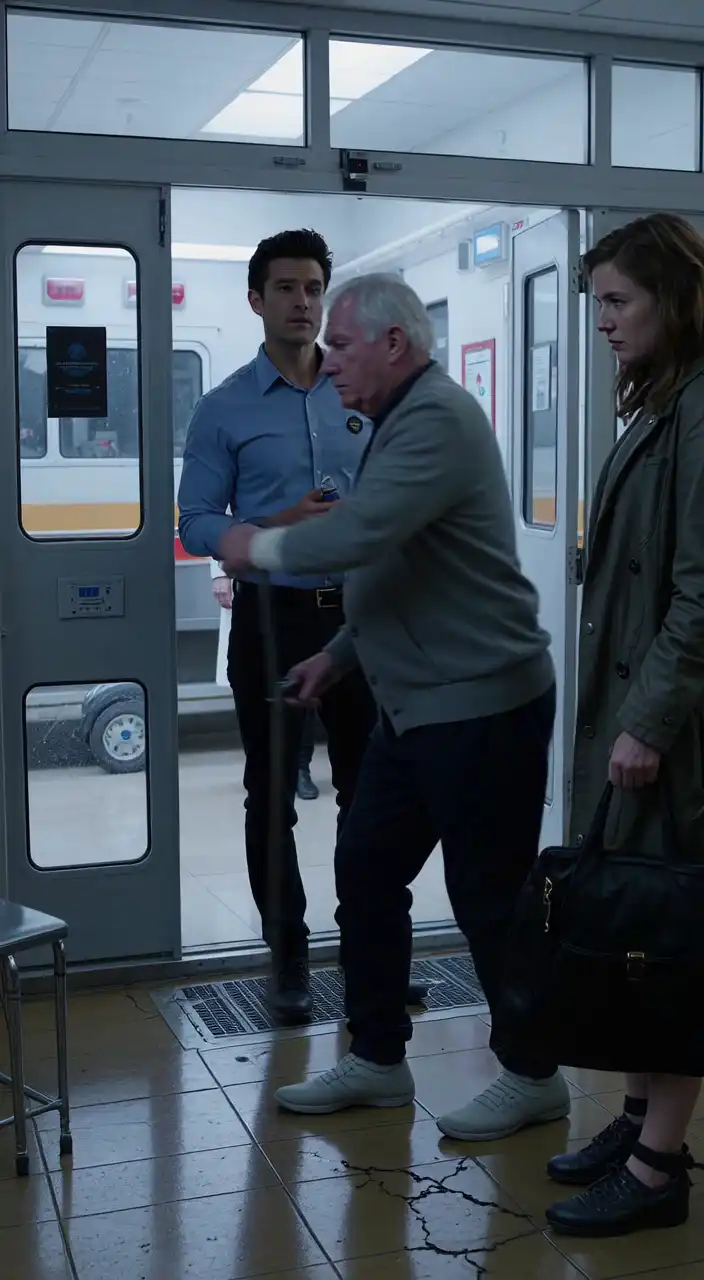
Nathan's fingers closed on empty air because Dr. Mercer stepped between them so fast her badge slapped against her coat.
"Sir, back away from the patient," she said.
"He is not your patient anymore," Nathan shot back. "He was discharged thirty minutes ago. We're leaving."
Dad swayed against the wall. His face had gone the color of old paper, but under the fever flush there was something worse than pain on it. It was fear. Not fear of surgery, not fear of hospitals. Fear of saying the wrong thing while Nathan was still close enough to touch him.
I moved to Dad's other side and caught his elbow. His skin felt hot through the damp cardigan. "Dad, sit down."
"I'm all right," he whispered, and then his knees dipped.
Dr. Mercer took his wrist, two fingers at his pulse, eyes narrowing. "No, you're not." She turned her head without taking her hand off him. "Wheelchair. Monitor. Now."
An orderly who had been pushing linens abandoned the cart and ran back inside. Security came from the desk at the same time, one young guy in a yellow jacket and an older woman with a radio already in her hand. Nathan opened his mouth for another speech, but the older guard held up a palm.
"Sir, step away."
"This is my husband."
The word hit me hard because I had spent two years pretending that meant something decent. Nathan had been with my father after Mom died. He had organized pills, driven to appointments, talked to insurance reps, and made everyone think he was the one keeping the whole family from drowning. And maybe for a while he had. That was the worst part. It made every ugly thing easy to excuse until the pattern became a trap.
Dad sank into the wheelchair when it arrived, more from collapse than agreement. Dr. Mercer touched the edge of the bandage where the stain had soaked through. Not bright blood. Rusty brown with a yellow halo. My stomach tightened.
"When did this dressing last get changed?" she asked.
Nathan answered first. "This morning. Home nurse looked at it."
"No home nurse was ordered," Dad said suddenly.
His voice was quiet, but every person around us heard it. Nathan stared at him as if he had broken a private contract.
Dr. Mercer's eyes flicked up. "Mr. Bennett, did someone tell you not to come back?"
Dad swallowed. His hand groped toward the pocket of his cardigan, then stopped when he realized the pocket was empty. "My papers..."
Nathan cut in. "He loses things. He's been confused all day."
"I have his overnight bag," I said. "But not the discharge papers."
Because they were in Nathan's coat. I knew it before I saw the fold line under the fabric. White corner, half hidden near his ribs.
The older security guard saw me looking. So did Dr. Mercer. She didn't make a scene about it. She just said, "Bring him inside. Bay four. Full vitals, blood cultures, CBC, lactate, wound check. And page surgery."
Nathan gave a short laugh meant to sound superior. "This is exactly what I'm talking about. More testing because the hospital wants another bill."
Dr. Mercer finally looked at him. "Then you'll have no problem waiting right here while I determine whether this man has a post-op infection or sepsis."
The word sepsis changed the air. Even Dad lifted his head. Nathan's face tightened for one second before he recovered.
"He's had a low-grade fever," he said. "That's normal."
Dad whispered, "It was 103.4."
Dr. Mercer didn't react outwardly, but she moved faster. "Inside. Now."
As the orderly pushed Dad through the sliding doors, his cane still lying where it had fallen, I bent to grab the cracked phone off the wet floor. The screen was spidered across one corner, but still alive. Emergency call ended. 00:19.
Nineteen seconds.
Just enough time for Dad to connect, maybe say one word, maybe not even that. Just enough time for someone else to hit end.
Nathan saw me pocket it. "That is my phone."
Dad turned his head from the wheelchair. He looked at the phone, then at Nathan, and for the first time all evening his voice came out clear. "No. That's mine."
Nathan took one step toward me. The younger guard moved in front of him at once.
"Sir."
The rain pounded harder against the ambulance bay doors. Beyond the glass, headlights smeared in the storm, and over the intercom someone announced weather advisories, flood warnings, road closures west of town. The storm was getting worse. I remember that because even in the middle of everything, my mind clung to one ugly thought: if Nathan had gotten Dad into the car, and if that road had closed, no one would have seen what was happening until it was much later.
Inside bay four, they cut Dad's cardigan sleeve and peeled the dressing back. I stood near his shoulder while a nurse clipped on the pulse ox, blood pressure cuff, and cardiac leads. Dad shivered so hard the leads kept lifting. Dr. Mercer looked at the incision and her mouth flattened.
"How long has it been draining like this?"
Dad didn't answer.
Nathan, from the doorway now held back by security, said, "It's staining from the antiseptic. They said that could happen."
Dr. Mercer ignored him. "Mr. Bennett. Look at me."
Dad did.
"You are safe in here. I need the truth if you want me to help you."
His eyes filled. He hated crying in front of people. I had seen him sit through Mom's funeral with his jaw locked so tight the muscle jumped. But now tears just spilled, hot and helpless, and he looked away from me as if he was apologizing.
"He said if I came back," Dad whispered, "they'd put me in a home."
The nurse drawing blood paused for one heartbeat, then kept going.
Dr. Mercer said, "Who said that?"
Dad swallowed. "Nathan."
Nathan exploded. "Because he refuses to follow instructions. Because he panics. Because every time he feels one ache he wants an ambulance."
I stepped toward the doorway before I realized I was moving. "You took his papers."
He snapped back at me, "I kept them because he cannot manage them."
But Dr. Mercer was no longer listening to either of us. She was looking at the monitor, at Dad's pulse rate, at the tremors in his hands, at the wound that smelled wrong now that the dressing was open. Not dramatic. Not confusion. Infection, maybe more.
She straightened. "Get broad-spectrum antibiotics started after cultures. Fluids. Stat." Then to security: "He is not to leave with that patient, and he is not to interfere."
Nathan's whole posture changed. The authority in his face curdled into calculation. "You don't understand. He mixes meds. He took too many pills and made himself sick."
That should have sounded useful. Instead it landed badly because Dad's pill bottle was still in Nathan's hand.
Dr. Mercer noticed it too. "What medication is that?"
Nathan hesitated one beat too long. "Pain medication."
"Whose name is on the bottle?"
He didn't answer.
The older security guard stepped closer. "Sir, hand it over."
He gripped it tighter.
I didn't know then that the pill bottle would matter almost as much as the phone. I only knew Dad had started shaking harder at the sight of it.
Dr. Mercer saw that too. "Give the medication to the nurse."
Nathan looked at Dad, not at any of us. It was a sharp, private look, the kind that says remember what happens when you cross me. Dad shut his eyes.
Then Nathan smiled, small and strained. "Fine." He set the bottle on the counter.
The nurse picked it up and read the label. Her brows rose. "This is not his oxycodone."
Dr. Mercer held out her hand. The nurse passed the bottle over.
Dad opened his eyes again, confused. "What is it?"
Dr. Mercer read the label, then looked at Nathan for a very long second. "Zolpidem. Ten milligrams."
A sleep medication.
Not pain pills.
Nathan said, too quickly, "He couldn't rest."
Dad whispered, "You said they changed it."
No one in the room spoke for a moment. Then Dr. Mercer handed the bottle to the nurse and said, very evenly, "Document that. And call pharmacy to verify discharge meds."
The first real crack in Nathan's control had opened. He knew it. I knew it. Dad knew it too, because I felt his hand searching blindly over the blanket until I took it.
The storm thudded at the windows. Somewhere down the hall a trauma pager went off. In our bay, the nurse spiked the antibiotics while Dr. Mercer leaned in close to Dad and asked one more question that made the room go colder than the rain outside.
"Mr. Bennett, did anyone keep you from calling for help after you got home last night?"
Dad's lips parted.
Nathan said, "Don't answer that without me."
And Dr. Mercer turned to security and said, "Get him out of this doorway. Right now."
They moved on Nathan together, but as they did, his coat swung open and a folded packet of papers slid halfway out of his inside pocket. Dad saw it before I did.
"My discharge instructions," he said.
Nathan grabbed for the papers.
So did I.
The older guard caught his wrist first.
The packet fell to the floor between us, already blotched by rain from the bay.
I picked it up, opened to the first page, and saw the line Dr. Mercer had expected all along: Return immediately for fever over 100.4, shaking, increased drainage, or confusion.
And someone had drawn a hard black line through it with a pen.
Nathan had not only hidden the papers. He had tried to erase the warning.
The security guard read enough over my shoulder to understand why Dr. Mercer had called this what it was.
Nathan stopped fighting then. Not because he was sorry. Because he was thinking ahead.
When he looked at Dad again, there was no anger left in his face at all.
Only fear.
The lab tech had barely wheeled away Dad's blood samples when surgery called back and asked for wound photos. Dr. Mercer took them herself, then ordered a CT because she did not like how tender Dad's abdomen was above the incision. The fever alone was enough to keep him, but the tremor and the drainage and the way he kept drifting in and out between sharp moments made everyone move with urgency that no one bothered to hide.
Nathan was not allowed back into the bay. Security kept him in a small family consult room near the nurse's station where he could be seen through a glass panel. Every few minutes he stood, paced, sat, and started talking at whoever walked by. Insurance. Overreaction. Husband's rights. Confusion after anesthesia. Every word louder than the last.
Dad flinched each time Nathan's voice rose, even through walls.
I leaned over him while the IV fluids ran. "He can't come in here."
Dad nodded, but his breathing stayed shallow.
Dr. Mercer came back after checking on another patient and lowered the bed rail so she could get closer without towering over him. "I need to ask about the last twenty-four hours. Not because I'm trying to create trouble. Because your symptoms and that medication don't fit the discharge plan."
Dad stared at the blanket. "I don't want..." He swallowed. "I don't want him arrested if I'm wrong."
That sentence told me more about their life than anything else. Not because he was protecting Nathan. Because he had been trained to doubt his own evidence even while he was sick.
Dr. Mercer's voice softened. "Then just tell me what happened."
He took a long breath that shuddered halfway through. "They discharged me yesterday afternoon. Laura drove us home because Nathan said parking was bad." He glanced at me apologetically; I had gone back to work after drop-off, assuming someone would call if there was a problem. "At home I was hurting more than I thought I should. He said take the pills and sleep. They looked different."
"The zolpidem," Dr. Mercer said.
Dad nodded. "I asked why they were blue. He said the hospital changed suppliers." His fingers tightened around the blanket. "I slept and slept. Every time I woke up he said it wasn't time for the antibiotic."
That made Dr. Mercer lift her head. "What antibiotic?"
Dad looked confused. "The one on the paper."
I handed her the discharge instructions. She scanned the page. There it was, halfway down under medications and wound care: cephalexin prescription sent to outpatient pharmacy because of higher infection risk after the revision procedure.
"Did you ever receive this?" she asked him.
Dad blinked. "He said the pharmacy was closed because of the storm."
The nurse, who had been documenting in the corner, muttered under her breath, "Pharmacy was open till nine."
Dr. Mercer asked, "Did you see the bottle yourself?"
Dad slowly shook his head.
So there it was: hidden instructions, substituted pills, no antibiotic picked up, a man too sedated to notice his fever rising. Plausible incompetence if each piece stood alone. Something uglier when they lined up.
Still, Dr. Mercer did not jump straight to the ugliest conclusion. That was one thing I learned from her over the next hours. Good doctors do not make accusations first. They build a safe path to truth while keeping the patient alive.
She asked, "When did you try to call 911?"
Dad shut his eyes. "This morning. I woke up soaked. Shaking. He was in the kitchen. I called from the floor because I couldn't stand yet."
"Did you speak to the dispatcher?"
"I don't know. I heard a woman say 911 what's your emergency. Then he took the phone."
The cracked screen in my pocket suddenly felt hot.
"What did he say?" Dr. Mercer asked.
Dad's mouth worked. "He told them it was an accidental call. Then he told me if I embarrassed him again, he was done helping me."
The nurse looked away. She had probably heard versions of this before. So had Dr. Mercer. But for me it split open the whole fake history Nathan had sold us. Helpful man. Organized man. Stressed caregiver. Not a saint, maybe too controlling, but basically trying. That was the lie all of us had been resting on because the alternative was unbearable.
Dr. Mercer asked one more practical question. "How did you get back here?"
"Fever got worse. I couldn't keep water down. Laura came by after work because I sounded strange." Dad looked at me then, shame and gratitude tangled together. "Nathan said I just needed air. He wouldn't let her call from the house. Said we'd drive over and prove I was fine."
That lined up with the ambulance bay scene. He had brought Dad back to the one place where appearances could still be managed if he kept him moving.
I said, "He was trying to get him into the car before anyone saw the bandage."
Dad gave the faintest nod.
A transporter arrived for CT. As they rolled Dad out, Dr. Mercer touched my arm. "Stay with him if you can. I'll handle the rest."
"The rest" turned out to include more than labs and imaging. A social worker appeared first, a woman named Denise with a legal pad and a steady face. Then a charge nurse. Then a hospital security supervisor. Dr. Mercer had already documented concern for possible caregiver interference and medication substitution. Those words sounded clinical. They also opened doors fast.
Nathan was still in the consult room. Through the glass I could see him gesturing, trying to turn his outrage into authority. When the social worker entered, he switched instantly to injured spouse.
"This family is punishing me for taking care of him," he said loudly enough for all of us to hear. "He forgets his meds. He falls asleep on the toilet. He thinks every ache is an emergency. I am the only one who stays."
Denise sat across from him and said, "Then you'll want us to understand the medication discrepancy."
His jaw moved once. "What discrepancy?"
"The sleeping pills in place of his pain meds."
"I gave him what was in the discharge bag."
"There were no sleeping pills in his discharge bag."
Nathan spread his hands, frustrated and almost convincing. "Then the hospital made a mistake."
That was the plausible explanation movement Dr. Mercer had expected, I realize now. Not a confession. Never that. A version of events where every harmful act was a misunderstanding, every missing paper an accident, every delayed call reasonable caution.
And for a few minutes, it almost held.
Because Dad was post-op. Because older patients do get confused. Because caregivers do become overwhelmed. Because hospitals do make errors. Because abuse hides best inside what already looks ordinary.
The reversal came from a small planted detail no one had expected to matter so soon: the pharmacy text on Dad's phone.
While CT was delayed by a trauma case, I sat beside him in the hallway alcove and asked if he knew his passcode. His hands trembled too hard to type, so he told me. The cracked screen unlocked on the second try. Recent calls showed the interrupted 911 attempt, then nothing. But messages included one from Greenway Pharmacy the previous evening: Charles, your prescription is ready for pickup. Hours extended due to storm watch until 9 PM.
I showed it to Dr. Mercer when she came by for transport update.
She read it, then exhaled slowly. "That helps."
"No, it proves it," I said.
"It proves one lie," she corrected gently. "That's enough for right now."
CT finally took Dad in. I waited outside with the phone and the folded discharge papers in a plastic belongings bag. Through the glass doors at the end of the corridor, the storm had turned the parking lot into a gray sheet. Security radios crackled about a possible road closure on the county route Nathan would have taken if he had gotten Dad into the car.
Again that thought: if he had succeeded, if they had been alone on that road, if the fever climbed and the sedative kept Dad half asleep...
I couldn't finish the picture.
When Dad came back from CT, he was more lucid for a little while, maybe from fluids, maybe from the fact that someone finally believed him. Denise asked if he wanted Nathan listed as his emergency contact.
Dad stared at the ceiling for so long I thought he had not heard. Then he said, "No."
The word was soft. It shook me more than a shout.
"Do you want him to have medical information?" she asked.
"No."
"Do you want him in your room?"
"No."
I reached for his hand. He squeezed back, weak but certain.
That should have ended one layer of Nathan's control. It didn't. Because control doesn't vanish when a victim says no. It just changes tactics.
The CT results came in while Denise was still there. Dr. Mercer reviewed them, face unreadable at first, then asked the nurse to page surgery stat and call for a bed upstairs.
I stood too fast. "What is it?"
"Fluid collection near the incision," she said. "Possibly infected. They may need to take him back to the OR."
Dad heard every word. His eyes widened with naked terror.
"I just got out," he whispered.
Dr. Mercer put a hand on the rail. "I know. But this is why you came back. You did the right thing."
From the consult room down the hall, Nathan started pounding on the glass. He had seen the bed request go through on the monitor at the desk. He knew admission meant losing the easy story that this was all overreaction.
"I need to speak to my husband!" he yelled. "You can't keep me from him!"
The security supervisor moved toward him, but Nathan was already switching again, desperation now showing through the polished surface.
Dad heard that voice and began to shake harder than before.
Then his blood pressure dropped.
The monitor alarmed sharp and fast. Nurses converged. Dr. Mercer was back at bedside in seconds, ordering another bolus, repeat lactate, more blood pressure cycling. Dad's fingers went cold in mine.
There it was: the contradiction turning physical. He was not simply anxious. He was getting sicker while Nathan argued in circles down the hall.
As they worked, Denise leaned close to me and said, low enough that only I could hear, "Has he ever isolated your father from other people before?"
I thought of all the small excuses I had accepted. Dad too tired for church. Dad napping when I dropped by. Dad's bank statements "already handled." Dad's old fishing buddy turned away because "he needs rest." My throat closed.
"Yes," I said.
She wrote one line, then looked toward the consult room. "Then this may get bigger before it gets better."
She was right. Because the next thing Nathan did was not shout.
He asked for a lawyer.
Surgery residents arrived within fifteen minutes, rain on their shoulders and urgency in their eyes. One of them, Dr. Patel, examined the incision again and then reviewed the CT with Dr. Mercer at the workstation while I tried to keep Dad focused on my voice. He was fading in and out, answering one question, missing the next. The nurse hung a second bag of fluids. A tech brought a portable bladder scan because he had barely urinated since arriving, another sign no one liked.
I heard enough of the surgical conversation to catch phrases: probable deep incisional infection, concern for abscess, return to OR if pressure doesn't stabilize. Every phrase landed like a weight.
Dr. Patel came to the bed and crouched so Dad could see his face. "Mr. Bennett, we may need to take you back upstairs tonight to wash out the wound and make sure the infection isn't spreading. I know that's not what you wanted to hear."
Dad's eyes fluttered open. "Will I wake up?"
The room went still for a beat. Honest fear always does that.
Dr. Patel said, "That is the plan. And your chances are much better because you're here now."
Dad looked at me. "Don't let him sign anything."
The sentence was thin, but it sliced through everything.
Dr. Patel glanced at Denise, who was still in the room taking notes. "He won't," she said before anyone else could. "Patient is alert enough to state preferences. We've documented that he does not authorize spouse access."
That should have settled the immediate issue. Instead, it triggered the next lie.
Nathan somehow got hold of someone by phone from the consult room, because within twenty minutes a man in a damp sport coat showed up claiming to be "family counsel." Whether he was a real lawyer or just a friend who knew how to speak loudly in hallways, I still don't know. He marched to the nurse's station and demanded to know why Nathan was being "detained" and why a spouse had been "cut out of medical decision-making."
The security supervisor did not rise to it. "Sir, this is a hospital, not a courtroom. The patient has stated his wishes."
"While under sedation and coercion from his daughter and staff."
I stepped forward before Denise touched my sleeve to stop me. "He was sedated at home, not here."
The man turned his smile on me. "Then perhaps you'll save that for later."
There it was again, the strategy of people like Nathan: make everything sound procedural, disputed, too messy to act on quickly. If he could turn Dad's danger into a family disagreement, he might still regain access before surgery.
What blocked him was not emotion. It was documentation.
Dr. Mercer had already uploaded photos of the wound, notes on the fever and blood pressure, the medication discrepancy, and Dad's direct statements. The nurse had scanned the zolpidem bottle. I had provided the phone with the interrupted 911 call and the pharmacy text. Denise had charted Dad's refusal of spousal access while fully oriented to person, place, and why he was in the ER. A web was forming around Nathan, thread by thread.
The sport-coat man kept pushing anyway. "Then my client wants his own property returned. Phone, papers, medications."
Dad heard him from the bed and used a strength I did not know he still had to raise his head. "No," he said.
It came out ragged, but everyone heard.
The man's smile slipped. "Charles, you're upset. Let's not make this harder."
Dad's whole face changed then. Not stronger exactly. Clearer.
"You made it harder."
He sank back, exhausted from six words. But those six words broke another piece of Nathan's story in public. This was not a confused elder parroting his daughter. This was a man naming what had happened.
The sport-coat man asked to speak with Nathan privately. Security allowed it in the consult room with the door open. Denise stayed near enough to hear if voices rose. I couldn't make out every word, but I caught enough.
"No police yet?" "...doctor documented concern..." "...if you keep pushing you'll make it worse..." "...he needs me..." "...not if the chart says what I think it says..."
When the man came out, his confidence had cooled. He asked for Nathan's coat. The supervisor refused until its contents were inventoried because the discharge papers had been concealed in it. That became another fight.
Inside the coat pocket, besides the folded papers, security found Dad's wallet, his reading glasses, and a small key ring with two keys Nathan claimed were his. Dad, eyes half closed, said one was the lockbox key from the den at home.
I remembered the lockbox. Mom used to keep passports there. After she died, Nathan said it was easier if he handled "important documents."
Denise looked at me. "Do you have access to the house?"
"Yes."
"Anyone there now?"
"No."
She nodded once, thinking.
That was the pressure point ending the third movement before the next escalation: the hidden control was not only this night, not only a bottle and some papers. There might be documents, meds, money, maybe more at the house. But we couldn't chase that yet because Dad's blood pressure dipped again and surgery stopped being a possibility and became a need.
Dr. Patel came back with consent forms. "We're taking him up."
Nathan must have understood the same thing at the same moment, because he burst from the consult room before security could intercept him and crossed half the hall.
"He can't consent like this!"
Dad flinched so violently the pulse ox alarmed.
Dr. Mercer stepped into Nathan's path. "You need to stop."
"I'm his husband."
"And he has said no."
Nathan looked past her to Dad and switched one last time from outrage to wounded devotion. His voice went soft, almost intimate, carrying farther because of it. "Charlie, tell them. Tell them I take care of you. Tell them she's turning you against me."
For one terrible second, I thought Dad might fold. Years of conditioning can rush back under stress faster than truth can hold.
Instead he lifted his trembling hand and pointed, not at me, not at the doctors.
At the zolpidem bottle sitting bagged on the counter.
"You gave me that," he said.
No one moved.
Then he pointed toward his belongings bag where the discharge papers showed through clear plastic.
"And you hid those."
The older security guard took Nathan by the arm. He resisted only long enough to hiss, "You ungrateful old man."
Every person in earshot heard that too.
Dr. Mercer did not raise her voice. She didn't need to. "Remove him from the treatment area. If he returns without authorization, call police."
Nathan twisted toward Dad as they pulled him back. "You won't manage one day without me."
Dad shut his eyes. The words landed, but not the way Nathan intended. I felt it in the sudden grip of his hand on mine. Not dependence. Decision.
"I guess we'll find out," he whispered.
They rolled him toward the elevator for surgery. I walked beside the stretcher until the red line on the floor where family had to stop. Dr. Patel promised someone would update me. Denise promised she was not leaving. Dr. Mercer squeezed my shoulder once and went back to the ER because another crisis was already arriving through the doors.
Hospitals don't pause for one family's catastrophe.
In the waiting area, the storm deepened. County route 16 closed from flooding. The radio at the desk confirmed it. The road Nathan had wanted to take home was now underwater in two sections.
I sat with Dad's phone, his wallet, and that little lockbox key in a plastic cup on my lap and understood how close this had come.
Not abstractly. Mile by mile.
If Dr. Mercer had been thirty seconds later. If the phone screen had gone dark. If Dad had not flinched from Nathan's hand. If the road had closed after they left.
Denise sat beside me and said, "When he's stable, we need to talk about home safety, finances, and whether there are other medications or records being controlled."
I looked at the key. "There are."
She nodded. "Then tonight is not the whole story."
It wasn't. Because while Dad was in surgery, the county dispatcher called back about the interrupted 911 attempt.
And the recording proved Dad had managed to speak one word before Nathan took the phone.
"Help."
The dispatcher had a crisp voice and the kind of professional calm that made bad news feel even colder. She called the ER desk asking to speak with the physician or social worker connected to Charles Bennett's case. Denise took it on speaker with security present while I sat close enough to hear every word.
"We had an interrupted emergency call from this number at 7:12 a.m.," the dispatcher said. "Open line for nineteen seconds. Male caller, weak voice, one audible word: 'Help.' Then a second male voice said accidental dial and disconnected."
Denise asked if the audio could be preserved.
"It already is," the dispatcher said. "Because the call flagged for a welfare concern after the disconnect. Deputies were unable to complete a follow-up due to storm diversion and address confirmation issues."
The guilt hit me before she finished. Deputies had tried. Somewhere in the morning chaos, with roads flooding and my own workday swallowing me, a chance had existed and slid by.
Denise did not let me drown in that. She asked for report numbers, callback information, and whether a deputy could come to the hospital once roads allowed. Then she hung up and wrote carefully for a full minute.
"That changes things," she said.
I thought of Nathan in the consult room, then maybe in the lobby, maybe still spinning stories. "How much?"
"Enough that if your father wants to make a statement later, there is corroboration."
Not proof of every motive. Not a solved crime. But a hard point in reality that Nathan could not charm away.
Dad was in surgery almost three hours. I watched rain drag itself down the waiting room windows and listened to coded announcements I could not parse. Nurses changed shifts around me. A volunteer offered stale coffee. The sport-coat man disappeared at some point. Nathan, I learned, had been escorted fully off the treatment floor and was arguing by phone from the main entrance until security warned him again. Then he left the building before police arrived for an unrelated incident.
That should have relieved me. Instead it made me uneasy. Men like Nathan often become more dangerous when control slips.
At 1:14 a.m., Dr. Patel came out still wearing OR cap lines across his forehead. "We cleaned out infected fluid and reopened part of the incision to drain it. It was a deeper infection than we wanted, but we got him through. He's headed to step-down, not ICU."
I stood so quickly my knees shook. "Is he okay?"
"He's not okay yet," he said honestly. "But he's better than he would have been by morning."
Those words stayed with me.
He explained drains, cultures, antibiotics, another day or more of close monitoring. I nodded at pieces and lost others. The important facts were simple: he was alive, he was still ours, and he would wake up somewhere Nathan could not reach.
Before I could go upstairs, Denise asked me to step into a consult room.
Not the one Nathan had used. Another, smaller room with a tissue box and a laminated patient rights poster.
"I know you want to see him," she said. "This will only take a few minutes. We need a plan before dawn."
The plan was bigger than I had let myself imagine. Temporary visitor restrictions. A note to registration not to disclose room number. A request for police standby if Nathan returned. Questions about where Dad would go after discharge if home was unsafe. Questions about whether there was a power of attorney, joint accounts, controlled medications, prior threats, isolation from friends.
Each question pulled another memory loose.
Nathan answering Dad's phone and saying he was napping. Dad missing his own grandson's school concert because "it was too crowded." A bank notice Dad said he never saw. Prescription bottles lined up on the kitchen shelf, labels turned away. Mom's old lockbox moved from the closet to Nathan's den cabinet.
Denise listened without drama and wrote it all down.
"Do you think he would want to go back to that house?" she asked.
I said no immediately, then paused. "I don't know if he'll feel able to say no tomorrow."
"Then we make it easier for him to say it."
That, more than anything, was what rescue looked like in the hours after the obvious crisis. Not one brave declaration. Systems built around a tired person's weakest moment so he did not have to fight alone.
When I finally reached Dad's room upstairs, he was pale, groggy, and threaded with more tubing than before. But his fever had already edged down. His hand found mine the way it had in the ER.
"Did he leave?" he whispered.
"Yes."
"Did they believe you?"
The question nearly wrecked me.
"Yes, Dad. They did."
He closed his eyes, relief passing over his face so plainly it looked like pain. "I thought if I said anything and they sent me home..." He didn't finish.
I brushed his hair back. "You're not going home with him."
He opened his eyes again, trying to focus. "The lockbox."
"I know."
"Second shelf in den. Blue folder." He swallowed. "And Mom's bracelet."
I stared. "Mom's bracelet?"
He gave the faintest nod. "He took it. Said he was protecting valuables."
That was the first time I understood the lockbox wasn't only paperwork. It was leverage, memory, ownership. The bracelet mattered because Mom had promised it to my daughter one day. Nathan knew exactly what kinds of things anchor a person to family, and he kept them where he controlled access.
"Rest," I said.
But he caught my wrist. "He'll say I need him."
The words were slurred by anesthesia and exhaustion. The truth inside them was perfectly sharp.
"Let him say it," I told him. "This time we're going to check."
By morning, cultures had started to show bacterial growth. The official infection gave Dr. Mercer's instincts a lab result to stand beside. Dad was weak but clearer. A deputy came to the hospital once a detour route reopened and took a preliminary statement in the presence of Denise and a patient advocate. They did not press Dad past what he could manage. They asked simple, concrete questions: Did you try to call? Did someone end the call? Were discharge papers hidden? Were medications changed? Did anyone stop you from seeking care?
To each, Dad said yes.
Nathan called the unit five times before breakfast. Because registration had flagged the chart, staff gave him nothing. By the third call he was crying. By the fourth he was threatening complaints. By the fifth he said Dad suffered from memory loss and a manipulative daughter was exploiting him. The charge nurse documented every word.
Dr. Mercer visited before the end of her shift. She was tired now, the adrenaline worn off, but she still carried that exacting focus. Dad thanked her in a voice that shook.
She said, "You don't need to thank me for doing my job."
He looked at the blanket. "I do. Because if you'd listened to him..."
She did not let him finish. "I listened to your body first. Then to you."
That line repaid the whole story in one stroke. Nathan's power had depended on speaking over everyone else. Rescue began when someone looked past him.
Late that afternoon, after Dad slept, Denise and I drove to the house with a deputy meeting us there. The storm had broken, but branches littered the road and muddy water still stood in ditches. Walking up the porch steps, I felt sick in a new way. Hospitals are emergencies you can name. Houses keep secrets in drawers.
Nathan's car was gone. Good.
The deputy stayed with us while I used my key. Inside, the place looked normal enough to embarrass me. Clean counters. Folded throw blanket. Kitchen calendar. Nothing cinematic, nothing monstrous. Abuse almost never decorates itself helpfully.
In the den, the lockbox sat exactly where Dad said, on the second shelf behind tax binders. The small key from Nathan's coat fit.
Inside were the blue folder, Mom's bracelet, Dad's checkbook, two credit cards in his name, his passport, copies of his surgical paperwork, and three medication bottles that should have been upstairs in the bathroom cabinet. Also inside was a typed list in Nathan's neat block print: medication times, phone passwords, account logins, doctor appointments. Not caregiving notes. Ownership notes.
The deputy photographed everything before we touched it.
The blue folder held more. A durable power of attorney form with Dad's signature line blank but sticky notes marking where he was supposed to sign. A list of assisted living facilities. Bank statements with large transfers highlighted. Printouts about "post-surgical confusion in seniors." I felt my skin crawl.
There was also one thing I had not expected: a notebook.
At first glance it looked harmless, a caregiver journal. Then I started reading. "Too weak to argue today." "Slept 14 hrs after blue pill." "Laura asks too many questions." "Must get POA before next procedure."
It wasn't a confession exactly. It was worse in some ways. It was a management plan written by a man who believed his control was practical.
The deputy took that notebook as evidence.
In the medicine cabinet upstairs, we found Dad's actual prescribed pain medication unopened and the antibiotic still in a pharmacy stapled bag, never given to him. The printed pickup receipt time matched the pharmacy text from his phone. Nathan had picked it up and withheld it.
That was the larger reversal. At first the missing antibiotic could have been neglect or chaos. Here was the fair, awful answer planted all along: he had it. He simply chose not to use it.
Back at the hospital, Denise reviewed what we found and immediately coordinated with risk management, the deputy, and Adult Protective Services. I don't know which eventual path mattered most legally. In story terms, they all mattered because each one closed another door Nathan might have used to get Dad back under his roof before Dad had the strength to resist.
Dad was awake when I returned. I did not tell him everything at once. Only the things he most needed.
"We got the bracelet."
His eyes filled.
"We got your papers."
He nodded.
"And the antibiotic was in the house. Unopened."
He turned his face away and cried soundlessly into the pillow. Not because the mystery was solved. Because the last excuse died. There are losses inside a rescue too. The loss of hope that maybe it was all misunderstanding is one of them.
That evening Nathan finally came back to the hospital with two shopping bags and a performance ready. Fresh clothes for Dad. Favorite slippers. A framed photo of the two of them from a beach trip years ago. He told the front desk he had come to "make peace."
Police were already waiting.
I didn't see the full conversation, only the end of it from down the hall. He set the bags down slowly when the deputy mentioned the 911 recording and the medications recovered from the house. For one second he looked toward the elevator, calculating whether to run. Then he saw three security officers and stopped pretending.
He asked if Dad was "putting him through this" after everything he had done.
The deputy said, "No, sir. Your choices are doing this."
That was not a handcuff climax with shouting and dramatic confession. Real life almost never gives those. He was detained for questioning, later released pending further action, and ordered not to contact Dad directly while the immediate investigation and hospital safety restrictions were in place. Messier than television. Enough to breathe.
The final obstacle came not from Nathan then, but from Dad himself the next morning.
He told Denise he did not want to be "a burden" and maybe he should just sign over some things so everyone could calm down.
That was the closest he came to the emotional threshold after the physical one. Infection down, blood pressure better, danger shifting inward toward old fear. Rescue can fail there too if everyone mistakes gratitude for recovery.
So Denise sat on one side of his bed, I sat on the other, and Dr. Mercer, off shift but checking in before heading home, stood at the door and said the simplest, strongest thing anyone had said to him.
"Needing care is not a debt you repay with obedience."
Dad stared at her.
I said, "You are not the problem to be managed."
He looked at the bracelet on the bedside table where I had set it after bringing it back. Mom's bracelet. Home and history and promise in one small curve of metal.
Slowly, Dad reached for it, then for the discharge papers now reprinted clean, then for his own phone with the cracked screen.
Three planted things. His body. His instructions. His voice.
"I don't want him near me," he said.
This time there was no tremor in it at all.
After that, the path became possible. Not easy. Possible.
Dad stayed another five days. Infectious disease adjusted antibiotics once cultures finalized. Wound care taught me how to help with dressings after discharge. Physical therapy made him walk again with a sturdier cane. The deputy returned for a fuller statement when he was stronger. Adult Protective Services arranged temporary support and documented concerns about coercive control and medical neglect. A legal aid attorney met us in the room and helped start revocation protections, emergency account changes, and a safe discharge plan. One of Dad's old church friends, whom Nathan had been quietly freezing out for months, showed up with tears and a casserole and said, "I knew something was wrong." That mattered too. Isolation loses force the second witnesses come back.
Nathan sent messages through other people for a while. Apologies. Excuses. Claims that stress and sleeplessness had made him "make mistakes." Then anger when those failed. We saved everything. We answered nothing. The notebook, the pharmacy bag, the hidden papers, and the 911 audio did more speaking than we ever could.
The day Dad left the hospital, the sun was finally out. We did not go anywhere near the ambulance bay doors. We used the main entrance, slow and steady. He wore clean clothes from home, not the ones Nathan had brought. His new discharge packet sat in his own lap. I made him hold it, and he gave me a dry little smile when he understood why.
At the curb, he paused before getting into my car and looked back at the building.
"I almost let him take me," he said.
I answered carefully. "He almost did. That's not the same thing."
Dad stood there with his cane, thinner than before, stitched and drained and still healing, but no longer hidden. "I heard the dispatcher answer," he said quietly. "I thought maybe nobody would know what I meant."
I thought about that frozen timer on the cracked phone. Nineteen seconds. A single word.
"They knew," I said. "And this time we did too."
He got in the car. The road home was open.
Disclaimer: Mention of any brand or trademark is for identification only and does not imply partnership or endorsement