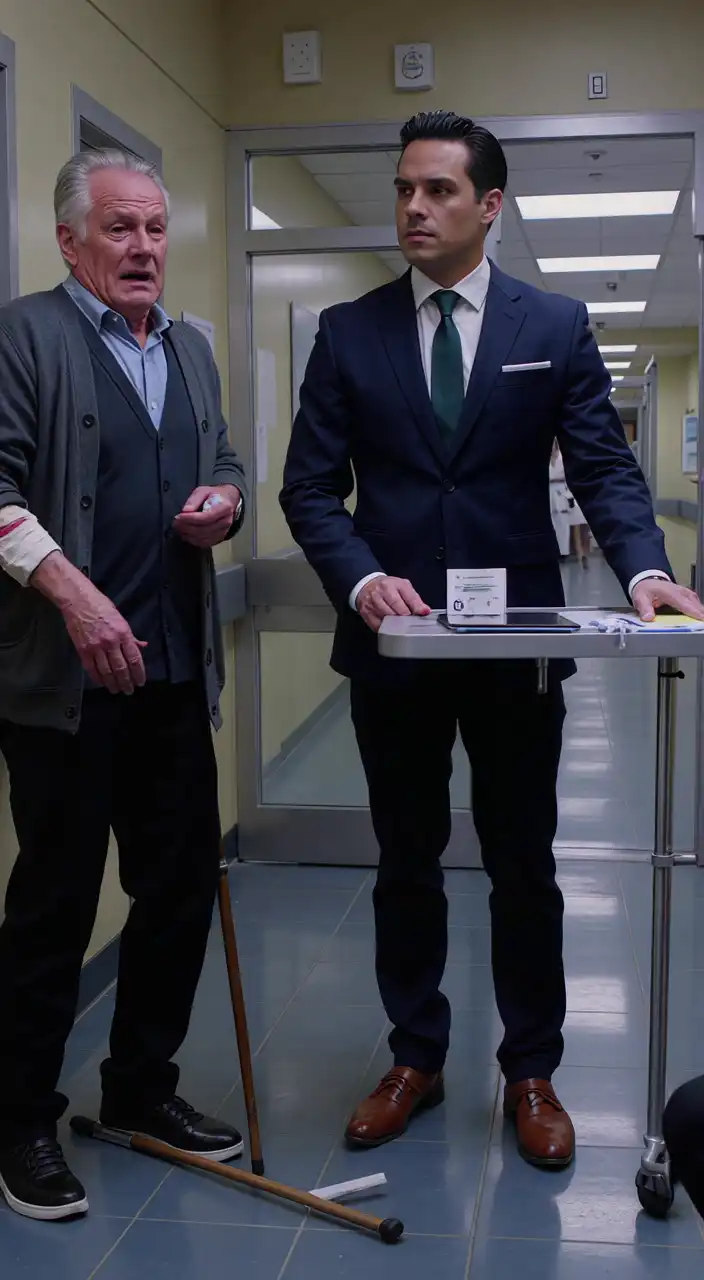
Victor's hand shot toward the cart first.
Not toward my father. Not toward my son. Toward the chart.
Dr. Ella caught that movement before I did. She slapped her palm over the file, turned her body between Victor and the cart, and snapped, "Security to triage threshold now. Adult post-op complication. Pediatric respiratory distress. We move first, paperwork later."
The entire hallway changed in one breath.
The nurse who had been calling for the next patient dropped the clipboard and came running with a wheelchair. Another tech knelt in front of Mateo with a pediatric emergency kit already open. My father's knees folded the rest of the way and he sank onto the tile, face gray under the fluorescent lights, sweat shining on his forehead. When I tried to go to both of them at once, Dr. Ella gripped my forearm hard enough to steady me.
"Who is the legal parent of the child?" she asked.
"I am."
"Then stay where your son can hear you. He needs to see your face."
She crouched to Mateo's level while the tech snapped a pulse ox onto his finger. The reading blinked low enough to make the tech's mouth flatten. Mateo reached for me with trembling hands, eyes too wide, chest pulling inward at the throat with every breath.
"My inhaler," he whispered.
"I know, baby, I know."
The tech looked up. "No rescue inhaler in the bag."
"I had one. I packed it before we left."
Victor tried to recover his authority voice. "Doctor, this family was advised to wait outside until account review was completed. There are consent concerns and-"
Dr. Ella didn't even turn. "If you speak over me one more time while two patients are decompensating, I will have you removed before security gets here."
She took the empty spacer off the cart and looked at it, then at Mateo, then at me. "Has he used this today?"
"No. It was missing when I reached for it."
Mateo gave a tight cough that sounded wrong, too hollow, too dry. The tech fitted a mask over his face and began albuterol from a unit-dose treatment. His shoulders still strained, but the medicine gave him something to pull against. I knelt beside him, speaking nonsense comfort into his hair while Dr. Ella turned to my father.
"Dad," I said. "Dad, stay with me."
William's eyes opened, unfocused. "Cold," he muttered.
Dr. Ella peeled back the edge of his sleeve and the smell hit us all at once. Not blood, not exactly. Something sour and infected beneath the clean hospital tape. The stain spreading through the bandage wasn't bright red. It was darker, watered at the edges, and there was a yellow shadow around it that made her expression sharpen.
"When was surgery?" she asked.
"Tuesday morning. Colon resection. They discharged him yesterday afternoon."
"Discharge papers?" she said.
"They're gone."
Victor said quickly, "They were instructed to contact their surgeon's office, not present through emergency triage without authorization from-"
Dr. Ella stood up so fast he took one involuntary step back.
"Authorization from whom?" she asked.
Victor lifted his chin. "The son's office. He manages the account."
"My patient manages his own body unless proven otherwise. Does he have a guardianship order filed? A psychiatric hold? Any legal incapacity?"
Victor's mouth worked once. "That is being clarified."
Security arrived before he found anything better to say. Two officers came through the sliding doors, both already reading the scene correctly from the sounds alone: a wheezing child, an elderly man on the floor, an administrator too close to a chart he wanted to hide. Dr. Ella pointed without wasting a word.
"Escort him away from this threshold. Preserve that cart, that chart, and whatever is in his possession. No one deletes anything."
Victor's badge swung as one officer moved toward him. "This is an internal financial matter," he snapped. "You are overstepping."
The older guard said, "Sir, put the tablet down."
Victor held on for one long second too many. In that second, my father tried to push himself upright and failed. His cane was still out near the chair where it had fallen. Mateo's small hand was locked around my sleeve. The hallway doors opened for another patient and shut again as if none of this should be happening in public. I remember thinking how close help had been the whole time. Ten feet. Maybe less.
Then the guard took Victor's elbow, and whatever spell he had cast over the doorway broke.
They rolled my father inside first because Dr. Ella shouted for a sepsis alert. She had not confirmed it yet, but I heard the word and felt the floor tilt under me. Another nurse guided Mateo and me into the adjacent bay, saying they would keep us side by side until they stabilized him. The oxygen hissed. Albuterol mist curled against his cheeks. He stared at me above the mask, terrified but still trying to be brave in that way children do when they realize the adults are scared too.
"Did I do something bad?" he asked between breaths.
The question went through me like a blade.
"No," I said. "No, sweetheart. You did exactly right. You stayed with me."
"But Grandpa needed the doctor."
"So did you."
He nodded because he wanted to believe me, then pointed weakly toward the hallway. "That man had my blue tube."
Blue tube. The inhaler. The spacer was clear plastic with a faded dinosaur sticker Mateo had half-peeled off months ago. I could see it now in Dr. Ella's hand, impossible to mistake once I knew to look. Why had Victor taken it? Why had it been next to my father's chart? Those two things did not belong together.
A respiratory therapist took over Mateo's treatment and asked me rapid questions while another nurse cut away my father's bandage in the next bay. I could hear fragments through the curtain. Temperature 102.9. Heart rate high. Dressing saturated. Abdomen tender. Confusion intermittent. When they asked him what day it was, he answered with the month.
Then a quieter voice. Dr. Ella's.
"Sir, do you know where your discharge papers are?"
My father coughed. "Andrew had them."
That name tightened everything.
Andrew was my older brother, fourteen years older than me, all pressed shirts and private parking and important phone calls. Dad trusted him because Andrew spoke the language of money and institutions. After our mother died, Andrew had slid into every practical space she left behind. He handled investments. He argued with insurers. He drove Dad to specialist appointments when I was at work. I used to be grateful. Lately, gratitude had become something heavier.
A nurse stepped through the curtain to ask me, "Who is Andrew?"
"My brother."
"Is he the medical proxy?"
"No. Not unless something changed without Dad telling me."
"Do you know if there is a power of attorney?"
"I know Andrew wanted one."
That answer earned me a longer look than the nurse had time to give. She wrote something down and hurried back out.
Security remained at the door. One of the guards spoke quietly into a radio. Victor's voice rose once from the hall, thin now, trying to sound outraged instead of cornered. Then it faded.
Twenty minutes later, after two breathing treatments and steroids for Mateo, he finally stopped clawing for air. His oxygen climbed slowly. The wildness left his eyes first, then the rigid panic in his shoulders. When the respiratory therapist said he was out of immediate danger, my body nearly collapsed from relief.
That was when Dr. Ella came back to me with the empty spacer in a specimen bag.
"This was found on the administrator's cart," she said. "You said it was in your purse before you arrived?"
"Yes."
"Did anyone handle your bag between the parking lot and the hallway?"
I thought about it. About juggling Dad's cane, the folder that should have held his discharge papers, Mateo's hand, my purse slipping off my shoulder while Victor had stepped in close and told us we were in the wrong line. About the moment he took the chart from a nurse and set his tablet on top of our things as if to help.
"He brushed against all of us," I said slowly. "He kept telling me to calm down and let him sort out the account."
She nodded once. "The child had no inhaler when he needed it. Your father had a post-op wound that should have been evaluated immediately. And that man tried to remove the chart when I approached. I don't know the motive yet, but I know enough to keep him away from both patients."
I swallowed hard. "Is my father going to be okay?"
"He is very sick," she said, not softening it. "But he is here now, and that matters."
In the next bay someone hung fluids. Someone else started broad-spectrum antibiotics. My father's wedding band flashed under the lights as a nurse taped an IV line to his hand. He looked smaller than he ever had in my life.
Then Dr. Ella asked the question that shifted everything again.
"Did anyone tell your father not to come back unless your brother approved it?"
I stared at her.
Because yes. Dad had said something strange in the car before we even got to the hospital. He had been sweating through his cardigan and shivering so hard his teeth clicked, and when I told him I was turning toward the ER he grabbed the door handle and said, "Andrew said don't embarrass him. He said we have to clear it through Victor first."
At the time it had sounded like confusion. Fever talk. Now, with the missing papers, the stolen inhaler, and Victor trying to guard the threshold, it sounded like a script.
Before I could answer, a case manager appeared in the doorway and said, "Ma'am, your brother is on speakerphone with hospital administration. He says Dr. William Mercer is not competent to consent and demands transfer to a private facility."
My father heard that through the curtain.
And for the first time all evening, he forced his eyes open wide and said, clear as a bell, "Don't let Andrew take me."
The case manager froze. Dr. Ella did not.
"Document that verbatim," she said.
Then she looked at me and added, "We are no longer dealing with a billing delay."
The first blood culture was barely labeled before Andrew arrived in person.
He came down the hallway fast, expensive coat unbuttoned, phone in hand, as if he expected sheer confidence to rearrange reality. I saw security step toward him and recognized the look on his face before he even spoke: offended authority, the kind that had spent years getting people to move because it was easier than arguing.
"I am his son," he said. "Where is Victor? Who authorized this chaos?"
Dr. Ella was writing orders at the workstation outside my father's bay. She didn't lift her head. "Your father authorized treatment by presenting in acute distress and verbally refusing removal."
Andrew laughed once, sharp and disbelieving. "My father is febrile and confused."
From inside the curtain, my father rasped, "Confused enough to know a vulture when I hear one."
The nurse nearest him made a sound that was almost a cough, almost a swallowed smile. Andrew heard it too and reddened.
I had not seen my brother lose his composure often. As children, he had always been calm, strategic, the one who could talk our parents into anything by sounding reasonable. Even after Mom died and all our old family rhythms broke, Andrew remained polished. He didn't shout; he defined. He didn't beg; he positioned. He had spent our entire adult lives explaining to me that I was emotional and he was useful.
Standing there with Mateo asleep against my shoulder and albuterol still clinging to his hair, I suddenly saw how many emergencies had been routed through that assumption.
"What did you do with Dad's papers?" I asked.
He didn't look at me. "Lucia, this is not the place."
"It became the place when you let him sit with a fever because a payment wasn't convenient."
He turned then, eyes hard. "You don't understand what was at stake."
Dr. Ella set down her pen. "Then explain it where security can hear you."
Andrew gave her the irritated smile men use on women they assume are temporary obstacles. "Doctor, with respect, this is a family matter involving continuity of care at a private post-surgical facility. Victor was trying to prevent a redundant admission that would not be covered. My father was scheduled for direct transport in the morning."
"In the morning?" I said. "He almost passed out tonight."
"He gets dramatic when he's uncomfortable."
The words landed and sat there. Even Andrew seemed to sense he had pushed too far, because he immediately pivoted. "He also has a history of refusing instructions. He removes dressings, forgets medications, misreports pain. My concern is that my sister panicked and brought him to the wrong place."
Wrong place. There was my son asleep with a nebulizer sticker still on his shirt because Victor had taken his inhaler. There was my father behind the curtain with IV antibiotics running because his wound smelled wrong. Wrong place.
Dr. Ella held up the specimen bag containing Mateo's spacer. "Would you like to explain why this was found on your administrator's cart?"
Andrew blinked. The pause was tiny, but it existed.
"I have no idea what that is."
"Then don't call him your administrator," she said.
Security shifted closer.
A charge nurse entered carrying a sealed plastic envelope. "Doctor, belongings inventory from the cart and Victor's jacket. Also this was wedged behind the tablet case."
She handed over a folded packet stained at one corner. I recognized the pale blue discharge folder from the surgery center before anyone opened it. My father's name was on the label, along with the post-op instructions we had spent half the day searching for.
Andrew saw it too.
His face didn't collapse. That would have been almost human. It narrowed.
"Those were being corrected," he said.
"Corrected?" I repeated.
The charge nurse, who had the unnerving calm of someone who had seen every flavor of institutional lie, looked at him and said, "By removing them from the patient?"
Dr. Ella unfolded the top sheet. Her eyes moved quickly.
"Return immediately for fever over 100.4, increased drainage, confusion, chills, or wound discoloration," she read aloud. "Do not delay emergency evaluation for any reason."
The hallway went dead quiet.
My father made a rough sound from the bed. Not quite a laugh. More like grief with edges. "He told me the papers said rest," he murmured.
Andrew raised his voice. "Because your surgeon was trying to avoid unnecessary readmissions. These templates are broad. They don't account for-"
"For what?" Dr. Ella asked. "For the fact that your father qualifies as a covered emergency if he presents through the ER and your preferred facility loses control of the billing?"
He straightened. There it was. The motive wasn't inheritance drama or cartoon evil. It was colder than that. Account retention. Revenue. Image. A wealthy family account anchored to a private facility where Andrew had influence and Victor had a job to protect. If Dad was admitted through our county hospital's emergency department, somebody lost money and somebody's arrangement got exposed.
Andrew must have heard it in his own head too, because he changed tactics again.
"My father signed limited authorization for me to coordinate care," he said. "He asked me to manage the administrative side because my sister cannot handle pressure without making scenes."
He said it while my son slept after an asthma attack and my father fought a post-op infection one curtain away.
The case manager stepped in then, a woman with silver braids and a badge crowded with credentials. "I am Marlene Shaw, evening clinical social worker. I need to know whether there is a signed medical power of attorney or guardianship on file. Not what should exist. What exists."
Andrew drew a breath. "The documents are with counsel."
"So no."
"They are pending execution."
"Then no," Marlene repeated.
Andrew tried to step around her toward my father's bed, but security blocked him. He looked at me as if I might restore the old order by backing down.
"Lucia," he said, voice dropping into that intimate family register he used when he wanted to sound like the only sane person in the room. "Dad hates scenes. He doesn't want strangers involved. Victor was preserving his dignity."
Preserving his dignity. On a tile floor outside triage while his fever climbed and his wound leaked through a cardigan our mother had bought him for church three winters ago.
I almost answered from pure rage. Instead, I remembered something small and ugly: the way Victor had asked for Andrew before he asked for insurance, how he had known exactly which son mattered. The way Dad had gripped the car door and repeated a line that didn't sound like his. Someone had been coaching him.
Marlene asked my father directly through the curtain, loud enough for all of us to hear. "Dr. Mercer, do you want your son Andrew making medical decisions for you tonight?"
There was a long pause.
Then my father said, "No."
Andrew closed his eyes briefly, as if his own father had committed a breach of etiquette.
The nurse from triage brought over another item from the belongings inventory: my purse. She set it on the counter beside me. "We found the zipper half-open. Nothing else missing that we can tell."
I checked automatically. Wallet. Keys. Phone. Mateo's granola bar. Insurance card. The side pocket where his rescue inhaler should have been was empty, but as I turned the bag upside down a tiny laminated card slid out from the lining and hit the floor.
A valet claim ticket.
No, not valet. Parking garage access from the surgery center's physician lot. On the back, in my father's slanted handwriting, were six words: Ask Ella about the yellow stain.
I stared at it so long Marlene had to say my name twice.
Dr. Ella took the card, eyebrows lifting. "He wrote this?"
"Dad?" I went to the curtain. "Did you write this?"
His face was drawn, but his eyes focused on the card. "Nurse in recovery," he whispered. "She said if the bandage turned yellow at the edges and I got the shakes, don't wait. Ask for Ella in the ER. Said she trained under her. Said Ella would look past paperwork."
A nurse in recovery had planted the name. Dad had hidden it in my purse lining where Andrew wouldn't find it. Which meant he had already been afraid someone would stop him from coming back.
Marlene's expression changed from concern to something closer to alarm. "When did he tell you not to wait?" she asked.
Dad swallowed. "He wasn't there. Andrew took the call outside."
The contradiction landed hard. If Andrew had taken a follow-up call from the surgery center and then hid the discharge instructions, this was no longer just financial bullying. He had actively intercepted medical advice.
Andrew spread his hands. "You are making insane inferences from scraps of paper."
At that exact moment, a lab runner handed Dr. Ella a preliminary result sheet. She read it, then looked straight at Andrew.
"Not scraps," she said. "Your father's lactate is elevated, his white count is through the roof, and his wound drainage is concerning for deep infection. He may need emergent imaging and a return to surgery."
My knees weakened. Mateo stirred against me, then settled again.
Andrew's jaw hardened, but fear flashed under it. Not fear for Dad. Fear for exposure.
Marlene caught it too. "Security, he does not enter that bay without patient permission."
Andrew snapped. "You cannot bar immediate family from treatment decisions."
Dr. Ella answered, "Watch me."
He took one more step anyway.
That was when his phone started ringing from Victor's name again and again, vibrating so hard against the counter that it nearly slid off. Security picked it up before he could. The screen lit with a text preview large enough for all of us to read:
Delete the hallway clip before Risk sees it.
Nobody spoke for a full second.
Then Andrew lunged for the phone, and security pinned his arm to the wall.
The sound he made then wasn't polished at all.
It was panic.
The charge nurse confiscated Andrew's phone while security held him in place. He fought just enough to embarrass himself, not enough to call it assault later. Marlene stepped back with professional disgust, and Dr. Ella had already turned away, because my father's blood pressure was dropping and the real emergency still sat behind the curtain.
That was the thing I would remember most later. Even when the lies cracked open, medicine did not pause for drama.
"Dad needs CT now," Dr. Ella said. "Portable if transport isn't immediate. Repeat vitals, cultures, broaden antibiotics. And page surgery."
A younger nurse rushed past to make the call. Another adjusted fluids. Someone asked for a urine sample. Someone else documented the patient's verbal refusal to transfer care to his son. Every word mattered now, but the words only mattered because they were attached to a body slipping toward danger.
I moved to my father's bedside while Mateo slept in the recliner under a warmed blanket. Dad's hand felt hotter than the sheet. His fingers twitched against mine.
"I'm sorry," he said.
"About what?"
"Believing Andrew."
My throat tightened. "You were sick."
"He said you worry too fast. Said private admission in the morning would be cleaner. Said emergency would ruin the account."
I almost laughed at the obscenity of that phrase in that room. Ruin the account. As if the account were the patient.
Dr. Ella examined the incision again, her gloved hand gentle but unhesitating. The bandage was off now. I looked once and wished I hadn't. Not because it was graphic, but because it was unmistakably wrong: angry skin, drainage, heat. An infection I could smell from the chair.
"Did they send a home nurse?" she asked.
"No," I said. "They said family could manage."
Andrew had said family could manage. He had stood in Dad's kitchen that morning sorting pills into a tray, speaking over me whenever I asked a question. He had kept the surgeon's office on speaker only when he wanted us to hear the parts about hydration and walking. When the callback came after lunch, he took it onto the porch.
I could see it now because the clues had finally arranged themselves.
The callback. The missing papers. The hidden note in the purse lining. The insistence on waiting until morning. Victor at the triage door already expecting us.
This wasn't a spontaneous act of cruelty in a hallway. It had been set up.
Marlene returned with a legal pad and a small digital recorder. "I need timeline statements while details are fresh," she said. "Not full depositions. Just sequence."
She started with me.
I told her about Dad's chills in the afternoon, the tremor in his hands, the damp patch on the bandage he tried to hide because he didn't want to "cause trouble." I told her how Andrew said the surgeon's office wasn't concerned, how he took calls privately, how Dad became more frightened each time Andrew came back with a softer voice and less information. I told her about loading Dad into my car after dinner because his fever broke into visible shaking. About Mateo insisting on coming because he was scared for Grandpa. About the missing inhaler discovered only when Victor blocked us at triage. About seeing the spacer on the cart.
Marlene wrote quickly, asking only enough to anchor the facts.
Then she asked Dad.
He drifted in and out, but when she prompted him with direct questions he answered with surprising precision. Yes, Andrew controlled the paperwork after discharge. Yes, Andrew told him his readmission would "damage relationships" if he went through county ER. Yes, he had overheard Andrew use the phrase "hold him at the threshold until we can reroute." No, he had never signed a final medical power of attorney. Yes, he had hidden the note because he feared Andrew would take it.
"Why were you afraid?" Marlene asked softly.
My father's eyes filled. "Because he was kind while refusing me."
No one in the room moved for a second.
That sentence explained more than a stack of records could. Cruelty is easy to resist when it is loud. When it wears concern and says it is preserving your dignity, it can get inside a sick person's shame and make them collaborate in their own delay.
A surgeon from the on-call team arrived, scanned the chart, and grimaced at the wound. "He should never have been kept outside," he muttered, not quite to us. He ordered imaging, a surgical consult, and preparation in case they had to take Dad back overnight for washout and repair.
When transport came to wheel him to CT, Dad caught my wrist. "Stay with Mateo."
"I can follow."
He shook his head faintly. "Stay where you can do both."
He was right. So much of the evening had been about forcing impossible choices: father or son, paperwork or breath, dignity or urgency. I kissed his forehead and watched them roll him away under bright hallway lights, his cane strapped uselessly to the side of the bed.
As soon as he disappeared around the corner, Andrew tried again.
He had been moved to a security-watched family room while administration sorted out what to do with him, but he convinced one guard to let him speak to me from the doorway. I should have refused. Instead I stood in the hall because some part of me still needed to hear whether there was any version of this that wasn't as bad as it looked.
"There is context you don't have," he said immediately.
"There always is with you."
He ignored that. "Victor manages preferred accounts for the surgical center's donor network. If Dad had a complication through county ER instead of direct transfer, there would be scrutiny. Reviews. Billing audits. Questions about discharge timing. The surgeon's partnership could implode."
I stared at him. "So you gambled with Dad's body to protect a business relationship?"
"It's not that simple."
"It is to me."
He exhaled hard. "They said likely superficial infection. Oral antibiotics in the morning. No need for dramatic intervention tonight."
"Who said that?"
He hesitated. There. Another crack.
"The coordinator."
"Name."
He said nothing.
Marlene had followed me out without my noticing. "If you cannot provide names, times, or documents, stop talking before you worsen your position."
Andrew looked at her with naked contempt. "You think this is abuse because you're addicted to narratives."
Marlene didn't blink. "I think a febrile post-op patient was obstructed from emergency care while a child's rescue inhaler somehow ended up on the cart of the man blocking triage. You can call that many things. Tonight I call it dangerous."
Andrew's mask slipped then. "You have no idea how much money was moving."
I laughed once, because what else do you do when someone finally says the quiet part out loud in a hospital corridor?
He heard himself too late. His face changed. He looked toward the guard, toward the recorder clipped on Marlene's lanyard, toward me.
Then he tried the family weapon one more time.
"If this turns formal," he said, low and urgent, "Dad will be humiliated. There will be board inquiries. Reporters if anyone leaks it. You know how he values privacy."
I took one step closer.
"Dad values being alive," I said. "You just forgot."
When I went back into the bay, Mateo was awake and watching the door.
"Is Grandpa in trouble?" he asked.
"No," I said. "Grandpa is getting help."
"Is the mean man gone?"
"One of them."
He digested that. Children understand more than we wish. He touched the edge of the blanket, then said, "I saw him take my blue tube when you were helping Grandpa stand up."
I sat down fast. "You saw that?"
He nodded. "I thought maybe he was helping because it fell. But he put it in the cart and shut the thing."
The thing. The tablet cover. So that was how it happened. While I was holding my father upright and trying to answer Victor's questions, he had lifted Mateo's inhaler from the open purse and hidden it. A small theft with huge consequences. Not random, then. Not panic. Intentional leverage. A family with two vulnerable people would fracture faster under divided attention.
I asked Marlene to write down Mateo's statement in simple language. She did, gently, without pressuring him. Then she called pediatric social services because a child's medication had been withheld during an active emergency. The story had widened again.
An hour later, CT confirmed what Dr. Ella feared: a deep post-surgical infection, fluid collection, and signs concerning enough that surgery booked an operating room. Dad would need another procedure before dawn.
The news hit me in waves. Relief that they had found it. Terror that they had almost missed the window. Fury that a hallway and a man with a lanyard had stood between him and this scan.
Dr. Ella came back one last time before they moved him upstairs. She had changed gloves so many times her hands looked raw at the knuckles. "He asked me to tell you something," she said.
"What?"
"He said the yellow stain looked small because Andrew kept folding the gauze."
I closed my eyes.
That was the second planted detail, though I didn't call it that then. The yellow edge on the bandage had seemed minor under the cardigan cuff. But if someone kept refolding the dressing, they could hide the spread while telling a sick old man he was overreacting. Quiet concealment dressed as care.
Then Dr. Ella added, "And there is more. The hallway camera clip Victor wanted deleted is already preserved. Risk Management pulled it before his text landed."
For the first time all night, something like justice entered the room.
Not full justice. Dad still had to survive surgery. Mateo still clung to me whenever a stranger walked too quickly toward the curtain. Andrew was still somewhere in the building trying to calculate angles. But a record existed outside our voices. The threshold itself had witnessed what happened.
When transport came, Dad was more lucid from fluids and pain control. He squeezed my hand before they rolled him toward pre-op.
"If I sleep," he murmured, "don't let him sign anything."
"I won't."
He looked past me to Mateo. "Buddy?"
Mateo lifted one hand.
"Good job breathing."
Mateo managed a solemn little nod.
Then they took my father through another set of doors that only staff could open, and I stayed behind with my son, a specimen bag holding a clear spacer with a dinosaur sticker, and the growing knowledge that whatever Andrew had built around money, access, and polished language was about to meet people who cared more about what they saw than who he knew.
I thought the next wait would be only medical.
I was wrong.
Because just before midnight, a hospital attorney arrived, pale and brisk, and told Marlene that a private transfer order had somehow been entered into my father's electronic chart under an attending name that did not match anyone on duty.
Someone inside was still trying to move him.
And the order had been placed six minutes after security took Andrew's phone.
The transfer order made the whole floor feel unsafe again.
Not physically unsafe in the obvious way. No one was waving a weapon. No alarms were screaming. Monitors still beeped in their indifferent rhythms, carts still rolled, doors still sighed open and shut. But once you know somebody is willing to reach into a live chart while a sick man is being prepped for surgery, every hallway starts to look like a hiding place for intent.
Marlene took the printout from the attorney and read it twice. "Who entered this?"
The attorney, whose badge said Naomi Kessler, pressed her lips together. "It was signed with physician credentials that should not have had access from this terminal. IT is locking the chart now and tracing the login path."
"Was the transport triggered?"
"No. Pre-op called to verify because the destination facility listed no accepting surgeon and the note contradicted the sepsis workup."
Dr. Ella let out one short breath through her nose. "So someone thought if they couldn't block the threshold, they could move the patient once he was inside."
Naomi nodded grimly. "That is what it looks like."
Mateo was awake again, curled against my side, his breathing finally even enough that I could hear words instead of fear between each inhale. He looked from face to face, sensing the shift without understanding the language.
"Are they taking Grandpa away?" he asked.
"No," I said quickly, before anyone else could answer. "Not anymore."
Naomi crouched to his level with the practiced gentleness of someone who had delivered hard things in hospitals for years. "Your grandpa is staying with the doctors who are helping him."
Mateo searched her face, accepted that, and leaned back into me.
Marlene straightened and looked at the attorney. "I want a hard flag on the chart. No transfers, no proxy changes, no release to outside family direction without direct patient consent if he is capable and dual physician review if he is not. And I want every access log preserved."
"Already requested," Naomi said. "Security is also pulling badge scans for Victor, Andrew, and anyone who entered pre-op holding in the last hour."
The clue moved again right there. Not just the inhaler, not just the missing papers, not just the hallway video. Now digital evidence. Logins, badge swipes, timestamps. The kind of trail men like Andrew always forgot because they were so used to people accepting the polished version.
A nurse hurried in from pre-op. "They need family signature for anesthesia backup because the patient is febrile and there may be debridement or revision beyond the initial consent scope."
Andrew's name hung in the air like a bad smell before anyone said it.
"I'll sign if Dad wants me to," I said.
Marlene checked the chart, then looked up. "He listed you as emergency contact after his last admission. No legal proxy supersedes that. If he reaffirmed your role in pre-op, you sign."
The nurse nodded once. "He did."
My hand shook when I took the clipboard. Not because I doubted the choice, but because I understood how close we had come to a different paper being put in front of a different child. Andrew would have signed anything if it routed Dad back into his network.
Naomi touched the edge of the form. "Before you go in, one more thing. If your brother or that administrator approach you about settlement, privacy, family discretion, or avoiding reports, do not agree to anything tonight."
I gave a hollow laugh. "You think they will?"
She met my eyes. "I think people who try to alter records during an active emergency rarely stop at one bad idea."
Pre-op smelled colder than the ER. Dad was under warmed blankets, an IV pump ticking beside him, his skin no longer gray but still too flushed. He looked smaller in that narrow bed than he had in the bay, maybe because the immediate rush had passed and the cost was showing.
"They tell me you're in charge now," he said when he saw me.
"They tell me you put me there."
He gave a tired half-smile. "About time."
I signed where they told me to sign. Debridement, washout, possible return to OR interventions, blood products if necessary. Every line felt like a door opening onto something I didn't want but could no longer pretend away.
Then Dad gripped my fingers with surprising force. "Listen to me."
"I am."
"If anything happens, don't let Andrew say I was confused all along."
Nothing in the room moved for a beat. The anesthesiologist looked politely at the monitor. The pre-op nurse pretended to check tubing. They were used to family truths arriving late and sharp.
"Nothing is happening to you except surgery," I said.
He held on. "Promise."
"I promise."
He released me only after I repeated it.
When I came back out, Andrew was waiting beyond the secured line with two men in suits and a woman carrying a leather folio. Not family. Not concern. Containment.
Naomi muttered under her breath, "That was fast."
Andrew saw me and lifted both hands, all conciliation now. "Lucia, before this spirals, let us talk privately."
One of the suited men added, "We represent interested parties connected to your father's surgical care."
"Interested parties?" Marlene said. "He has peritonitis risk, not a product launch."
The woman with the folio stepped forward. "My clients are prepared to ensure all care costs are covered and that misunderstandings involving staff conduct are reviewed internally, provided the family agrees to a confidential resolution while the patient is still in treatment."
I stared at her.
Mateo stared too, because even children know what buying silence sounds like when the words get too smooth.
"You brought lawyers to the operating floor," I said.
Andrew's jaw tightened. "I brought people who understand the damage a public claim can do when facts are incomplete."
Naomi moved in front of me before I had to answer. "This is not an appropriate contact. The patient is in active surgical preparation. Any attempt to influence reporting will be documented."
The suited man gave a thin smile. "No one is influencing. We are offering support."
From somewhere behind the OR doors a phone rang, then another. A nurse stepped out, saw the cluster, and immediately turned back inside. Even without hearing the words, staff could read pressure.
Marlene said, very clearly, "Security."
That should have been the end of it. It wasn't.
Because Andrew had one last card, and he played it in front of Mateo.
"Tell her what Grandpa said in the car," he said softly to my son. "About not wanting to stay here."
I felt Mateo go rigid against my side.
Predators always look for the weakest witness when the strong ones stop bending.
"Do not speak to the child," Marlene snapped.
But the damage was done. Mateo looked up at me with frightened confusion. "Grandpa said he didn't want to make trouble."
Andrew spread his hands, pouncing on that. "Exactly. He was embarrassed. He was not being held hostage, Lucia. He was trying to avoid this scene."
Emotional reversal. For one awful second, the old family script tried to reassemble itself around me. Me, dramatic. Andrew, practical. Dad, ashamed. Maybe the delay was confusion. Maybe the hidden papers were overreach, not intent. Maybe...
Then Mateo, who had nearly lost his breath because a man took his inhaler, frowned in concentration and said, "No. In the car he said, 'Don't let Andrew call the shoe man.'"
The hallway went silent.
The shoe man.
Victor. Spotless shoes blocking the door.
Children remember the wrong detail and therefore the exact one.
Marlene turned slowly toward Andrew. "The child just linked your father to the administrator before arrival."
Andrew actually tried to smile. "He is eight."
Naomi said, "And he has corroborated pre-threshold coordination."
The woman with the folio closed it. One of the suited men took a step back, recalculating whether this was still salvageable. I watched the equation change on all their faces. They had come expecting panic and gratitude. Instead they had walked into witnesses.
Andrew saw it too. His expression flattened into something colder than anger.
"You are blowing up a system you don't understand," he said to me.
"Then explain the fake transfer order."
He said nothing.
"Explain the missing papers."
Nothing.
"Explain the inhaler."
His silence was answer enough, but he tried one more pivot. "Victor overstepped."
There it was. The sacrifice. The loyal subordinate suddenly disposable.
Naomi looked almost bored. "Then I assume you will have no objection to us imaging your phone and obtaining all communications between you, Victor, the surgical center, and any donor relations office tied to this case."
His eyes flicked. Tiny, fast, fatal.
Security escorted the outside lawyers away first. They argued about access, process, representation. No one cared. Andrew stayed only because, technically, he was still immediate family in a building not yet ready to bar him entirely. But the axis had shifted. He was no longer the son who knew what to do. He was a person under scrutiny being tolerated near the edges of a crisis.
An hour later, while Dad was in surgery, Naomi returned with the first hard electronic clue.
"IT traced the transfer order entry," she said. "The attending credentials were spoofed through a workstation in the physician liaison office."
"Who had access?" Marlene asked.
"Victor badged into that office eighteen minutes before the order was entered. He was not assigned there."
"And the physician login?"
"Password compromise, likely shoulder surfing or saved credentials. They are still investigating. But there is more."
Of course there was.
She handed us another sheet. Badge log, timestamped.
Andrew had badged into the physician liaison corridor seven minutes after Victor.
"He said he was in traffic," I whispered.
Naomi nodded. "The garage camera disagrees."
Evidence moved again. Hallway clip. Purse. Spacer. Text. Badge scan. Fake order. The net tightened not because anyone gave a speech, but because systems kept records even when people lied.
Mateo had finally fallen asleep for real when the pediatric attending came to discharge him from observation. "He responded well," she said. "He can go home if you have a functioning rescue inhaler and can keep him away from stress tonight."
I almost laughed at the impossible phrase. Away from stress.
"I can't leave," I said.
"We can replace the inhaler and spacer from the pharmacy. If there is another adult to take him home-"
There wasn't. Not one I trusted enough to hand him over to at one in the morning, not while my father was in surgery and my brother was trying to reroute charts. I must have looked wrecked because the attending softened.
"We can hold him longer for social reasons if needed."
Marlene answered before I could. "Hold him. Family intimidation and evidence preservation are active concerns."
The doctor just nodded. In a hospital, that sentence may be unusual, but it is not incomprehensible.
At two sixteen in the morning the OR called.
I stood before I even heard the words.
Dr. Ella met us in the consult room, still in scrubs now, cap dangling from one hand. I hadn't known she had gone into the case. For one delirious second I thought that meant something had gone terribly wrong. Then I saw her face. Tired, intent, but not shattered.
"He made it through the procedure," she said.
The air left my body so hard I had to grab the chair.
"They found a deep wound infection and an abscess tracking below the incision. Surgery washed it out, opened part of the closure, placed drains, and started targeted management while cultures grow. He came in when he still had a recoverable window."
When he still had a recoverable window. Not when he was fine. Not when it was minor. When there was still time, barely.
I cried then, not neatly. Mateo woke enough to start crying because I was crying, and Marlene put a box of tissues between us with the solemn efficiency of someone who had done this too many times to make it awkward.
"Can I see him?" I asked.
"In recovery, soon," Dr. Ella said. "He will likely need several days here, maybe longer depending on cultures and wound response. But tonight's battle was the right one."
Then her face changed slightly.
"There is another issue," she said. "Risk Management reviewed the preserved hallway footage."
The suspense hook hit before she finished the sentence.
"What did it show?"
"It shows Victor removing an item from your purse while you were helping your father. It also shows him placing the blue inhaler in a locked side compartment of the cart before stepping in front of triage."
I shut my eyes.
Not because I doubted it. Because seeing it in my head from outside was almost worse than living it from inside. The calculation. The timing. He had looked at a sick child and made a tactical choice.
Dr. Ella continued. "It also captures him taking the discharge folder from your father when he tried to hold it in his lap."
Marlene swore softly under her breath.
So there it was. Exposure, undeniable now. Not misunderstanding. Not procedural confusion. Obstruction.
Naomi added the consequence a few minutes later. "Hospital police have been notified. Given the medication interference, possible elder coercion, attempted record manipulation, and evidence tampering, this is now beyond internal review."
I thought of Andrew's warnings about privacy and board inquiries and nearly smiled through my exhaustion. He had been right about one thing. It would not stay inside the family.
When I finally saw Dad in recovery, he was pale and groggy, drains in place, oxygen at his nose, but alive. More alive, somehow, than he had looked collapsed against the wall outside triage. Pain had replaced the fever-bright confusion. It was brutal, but it was honest.
"You stayed," he murmured.
"Of course."
"No Andrew?"
"Not here."
His eyes closed briefly in relief. "Good."
I told him only the part he needed then. That surgery found the infection. That the doctors moved fast. That Mateo was breathing well. That the inhaler had been found. I did not tell him about lawyers, badge logs, spoofed orders, or the hallway video. Not yet. His body had already carried enough betrayal for one night.
But he surprised me. He opened one eye and asked, "Did they catch the transfer trick?"
I stared.
"You knew?"
He gave the smallest nod. "He kept saying private room. Too many times."
Even drugged after surgery, he had tracked the pressure. Shame may cloud a person, but it does not erase instinct.
By dawn the consequences were no longer theoretical.
Victor was placed on administrative leave pending police interview, then escorted from the building through a staff exit because Risk feared a scene at the front. Andrew was informed, in language so formal it almost sounded ceremonial, that he was not to contact staff directly about his father's chart and that any further access attempts would be referred externally. The donor-network lawyers vanished. The surgical center's chief medical officer began calling every twenty minutes. Reporters had not appeared yet, but the fear of them had.
And then the emotional reversal I had not expected arrived from inside me.
I had been fueled all night by anger. Anger made me upright. Anger made me answer questions, sign forms, remember timelines, protect Mateo, follow gurneys, stare down my brother. But when sunrise leaked thin and gray through the waiting-room windows and the crisis stopped sprinting long enough to breathe, anger loosened.
In its place came grief.
Not only for what nearly happened to Dad. For what had already happened to us long before that hallway. For all the smaller moments when Andrew's competence had been purchased with somebody else's silence. For every time Dad had confused obedience with peace. For every time I had backed off because I did not want to be called difficult. Systems like Victor's do not invent themselves from nothing. They feed on family habits.
Dad was transferred to a monitored room just after seven. Mateo, exhausted beyond protest, slept across two chairs while I sat beside Dad's bed listening to the IV pump click. Morning staff came and went. A resident explained drains. A wound nurse discussed dressing changes. A pharmacist reconciled medications and quietly confirmed that oral antibiotics had indeed been recommended if symptoms progressed before morning, meaning someone had known exactly how urgent the warning signs were.
That was another clue, but by then it no longer surprised me. Every hour revealed that the truth had been present all along. It had merely been obstructed.
Around eight thirty, a detective from hospital police came to take a formal statement. She was plainspoken, hair pulled back, notebook already open. She asked about the threshold, the inhaler, the missing papers, Andrew's role, the calls, the note in the purse lining. When I mentioned Mateo's statement, she requested a child forensic interviewer rather than pressing him further herself. When I mentioned Dad's phrase, hold him at the threshold until we can reroute, she underlined it twice.
Before leaving, she said, "This may move into criminal territory depending on prosecutorial review."
I looked at Dad asleep under clean bandages and said, "It already did."
Near noon, while I was helping Mateo color on the back of a discharge brochure someone had repurposed into scrap paper, Andrew sent his first direct message since security had separated us.
Not apology. Not explanation.
A single line.
You are going to destroy Dad's name over a billing dispute.
I showed it to Marlene without answering.
She looked at it, then at me. "That message is for documentation, not conversation."
So I documented it.
By afternoon, the hospital had replaced Mateo's inhaler, arranged follow-up with his pediatrician, and connected us with an advocate who specialized in elder coercion cases. Dad slept through most of it, fever finally bending downward under antibiotics and surgery. Each time he woke, he looked for me first and Mateo second. Each time he found us, his face eased.
Late that evening, Dr. Ella stopped by one more time at the end of what must have been an endless shift. She checked Dad's chart, listened to his lungs, asked Mateo to show her how he used the new spacer, and then stood with me in the doorway for a moment while the room settled.
"You got him here," she said.
"Almost too late."
"But not too late."
I nodded, then asked the question that had been waiting under everything else. "What happens now?"
She looked back at my father, at the drains, at the fresh dressing, at my son curled in the chair with a stuffed bear some nurse had found, at the legal notices clipped discreetly inside the chart holder.
"Now he heals," she said. "And the people who counted on your silence learn that a threshold is not the same thing as control."
She was gone before I could answer.
That night, after Mateo fell asleep and Dad's breathing settled into a slower rhythm, I took the specimen bag from the drawer where the nurse had stored our belongings. Inside was the clear spacer with the faded dinosaur sticker, absurdly ordinary. Next to it, in another evidence sleeve, were the recovered discharge papers creased from being hidden.
One small plastic tube. One folded packet of instructions. Two ordinary objects that had nearly marked the difference between rescue and catastrophe.
I sat in the dim hospital room with both of them in my lap and understood something I had missed while the hallway was roaring: exposure does not always arrive as a dramatic speech or a confession. Sometimes it arrives because a doctor notices the wrong object beside the wrong chart. Because a child remembers spotless shoes. Because a sick father hides six words in a purse lining. Because a camera sees what power assumes no one will review.
Outside the room, carts rattled and phones rang and another crisis was already beginning for someone else. Inside, Dad slept under the care he had been denied at the door, and Mateo breathed softly through a nose still pink from oxygen. The consequences had only started. There would be interviews, records, maybe hearings, maybe headlines, certainly family wreckage that would not be patched by apology.
But the rescue had started too.
And this time, it had a chart nobody else could steal.
Disclaimer: Mention of any brand or trademark is for identification only and does not imply partnership or endorsement