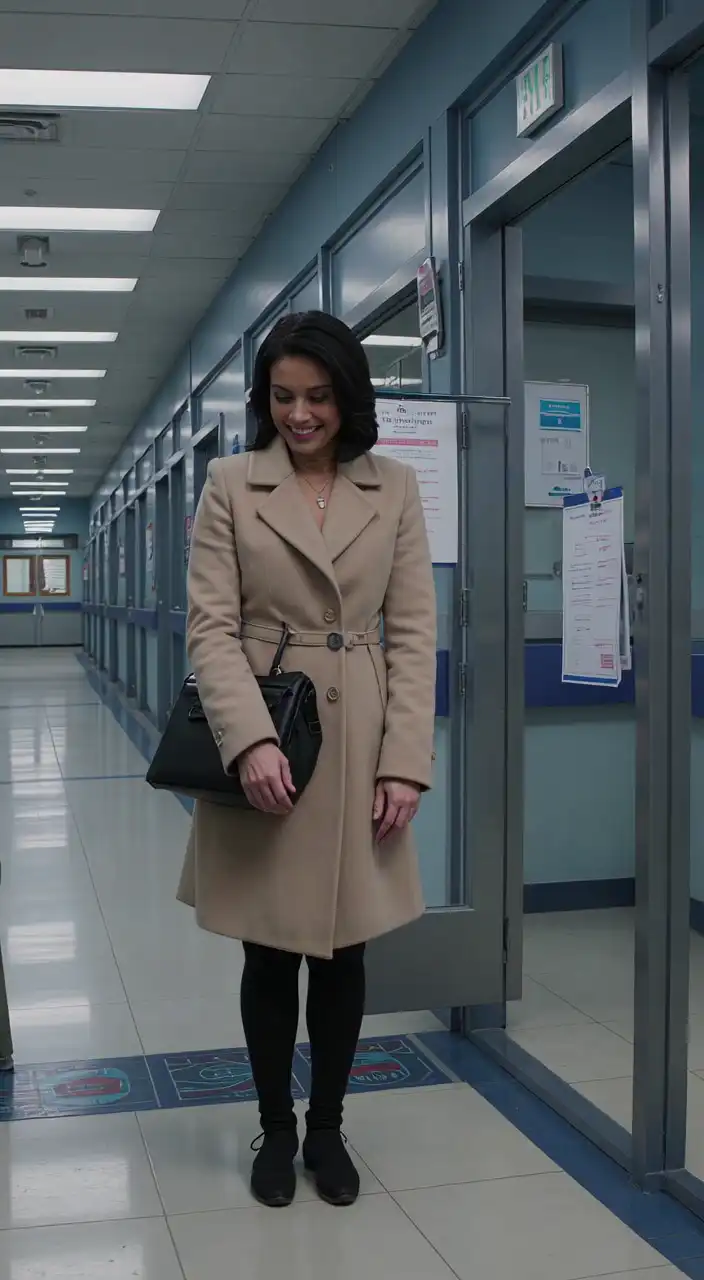
Scarlett tightened her grip on the purse strap until her knuckles blanched, and for one suspended second the whole hallway seemed to hold still around that bag.
Valerie was already moving. "Bring him in," she said, and two nurses came fast from opposite ends of the corridor with the rolling monitor and a wheelchair. Peter tried to stand on his own, maybe out of habit, maybe because children who are used to being called difficult learn to make themselves smaller even when their body is failing them. His knees buckled before he got fully upright.
"I said no." Scarlett stepped in front of the wheelchair with a hand out, still speaking in that maddeningly calm voice. "You're escalating him. He has panic attacks. His pediatrician said not to reward this behavior."
Peter made a dry, frightening sound trying to pull in air. Valerie didn't raise her voice. She didn't have to. "Ma'am, step aside."
Scarlett angled her body toward Peter and lowered her tone into something intimate and poisonous. "If you lie on me in this hospital, you know what happens when we get home."
Peter's eyes snapped open wider. He stopped reaching for the backpack. That tiny change told Valerie more than any chart could have.
The nearest nurse heard it too. Her badge said MORALES. She looked at Valerie once and then set her shoulders. "We're taking him."
Scarlett moved to block them again, but a security officer in gray was already striding down the hall, summoned by Valerie's order. He was broad shouldered, middle-aged, and not dramatic about it. He simply inserted himself at Scarlett's side and said, "Ma'am, you need to give the medical team space."
"This is my son." Scarlett's voice sharpened for the first time. "They are kidnapping my son because he had a tantrum."
Valerie crouched beside Peter as Morales slid the monitor leads onto him. The pulse ox clipped to his finger. His heart rate raced. His oxygen was dropping, not plummeting yet, but enough for every professional in range to stop pretending this might be ordinary. The amber light blinked again. Peter kept looking at the purse.
"Peter," Valerie said, her voice softer now. "Can you tell me where your inhaler is?"
His gaze darted to Scarlett, then to the security officer, then back to Valerie's trauma badge. He swallowed hard. "Blue one," he whispered. "She put it in there."
Scarlett gave a small laugh of disbelief, too polished to be real. "He hides things and blames me. Ask his school. Ask anybody. He likes attention."
Valerie stood. "Search is not my first step. Breathing is." She tapped the chart outside the room. "His clinic fax says active asthma, rescue inhaler renewed eight days ago, and recent urgent call about over-sedation after medication. Why did you say he doesn't use one anymore?"
Scarlett's answer came too quickly. "They forgot to update the file."
That wasn't impossible, but it landed wrong, especially with the yellow stain on the sleeve and the trembling child on the chair. Valerie nodded once as if storing the lie without argument. "Room three. Now."
They rolled Peter inside before Scarlett could frame another explanation. The room was small, bright, and cold, with one wall monitor already active and the amber alarm softening once the leads connected. Peter flinched at every touch, not from pain alone but from the learned fear of what attention might cost him later. Morales cut through the hoodie sleeve to get cleaner access for the blood pressure cuff, and the yellow residue darkened where the fabric split.
Valerie caught the smell before anyone else said it aloud. Cherry-sweet. Medicinal. Not the faint smell of a child who had taken one dose of cough syrup before coming in. More like repeated spills, or doses forced in a hurry.
She looked at the stain, then at Peter's face. "Did you spill medicine on yourself?"
He shook his head once.
"Did somebody give you medicine today?"
A pause. Then, almost invisibly, he nodded.
Scarlett tried to follow the wheelchair into the room and the security officer held out an arm. "You can wait right here until the doctor says otherwise."
"You cannot separate a child from his mother." Scarlett's volume rose enough that heads turned from the nurses' station.
Valerie did not look away from Peter. "A child who can't safely answer in front of an adult gets private evaluation. That is hospital policy. And if you keep interfering, I will make this a security hold."
That stunned Scarlett into silence for exactly two seconds. Then she switched strategies. Tears flooded in, sudden and practiced. "You people have no idea what I deal with. He has behavior problems. He lies. He wets the bed. He says things because he wants to break up homes." She pressed a hand to her chest like she was the one in danger. "I'm the only one taking care of him."
Those words did something to Peter. Not dramatic. Just a small collapse inward, as if humiliation was more familiar to him than fear. He stopped trying to look brave. Valerie saw it. So did Morales.
"Get respiratory," Valerie said. "And a tox screen."
Scarlett heard that through the partly open door. "A what? For what? This is insane."
Valerie turned her head just enough to answer. "Because his symptoms don't match your story."
Inside the room, once Scarlett was kept back and the door narrowed between them, Peter's breathing changed. Still labored, but less trapped. Valerie noticed that too. She drew a stool close so she wasn't towering over him.
"I'm Dr. Valerie Brooks," she said. "I'm going to ask a few short questions. You're not in trouble. If you don't know an answer, you can say that. Do you understand?"
He nodded.
"How old are you?"
"Eight."
"When did it get hard to breathe?"
"This morning. Then in the car. Then worse here."
"Did you ask for your inhaler?"
Another nod.
"What happened?"
Peter's eyes filled but he kept looking at the pulse ox number instead of her face. "She said I already had medicine. Said I was not wasting no more on fake wheezing."
Valerie kept her own face neutral. "What medicine?"
He glanced at the slit in his sleeve. "Pink spoon. Then yellow cup. Made me sleepy."
Valerie looked at the stain again. Yellow medicine. Respiratory depression could come from multiple things, but the more immediate problem was obvious: an asthmatic child was in distress and his rescue medication was being withheld by the very adult controlling his access to care.
Respiratory came in with a nebulizer. Peter recoiled when they raised the mask. Valerie caught it and slowed everything down. "No one is forcing this on you. I'm asking permission because I need your help. This medicine helps open your lungs. Can we do it together?"
That changed him more than the words themselves should have. He nodded again, tiny but certain. Morales helped hold the tubing while Peter took the first shaky breaths through the mask. Within a minute, the tightness in his shoulders eased a fraction.
Outside, Scarlett had regained enough composure to call someone. Her voice carried through the crack in the door. "Get down here now. They're accusing me of poisoning him because he had a cough medicine spill."
Valerie met Morales' eyes. The nurse already understood. "Chart every statement," she said quietly.
The clinic fax that had arrived with the chart became suddenly more important. Valerie pulled it from the rack and scanned the notes while Peter breathed treatment. It wasn't a full history, but there were flags. Missed follow-up. Refill requests inconsistent with expected use. One note from a pediatric nurse practitioner: caregiver reports inhaler lost repeatedly; child appears anxious when discussing home medications. Another line from a phone message two days earlier: school nurse concerned rescue inhaler not available during recess episode.
Valerie asked, "Peter, where do you usually keep your inhaler?"
"In my backpack."
"And today?"
He looked toward the hall. "She checked my bag before we came in."
There it was. Not proof of poisoning, not yet. But deliberate control.
Morales returned from the doorway. "Security is holding her outside. She wants to sign him out."
Valerie didn't even blink. "She can want."
Peter's pulse ox climbed a little with the neb. His hands stopped trembling enough for Valerie to see a thin plastic bracelet under his cuff. It was one of those cheap prize bracelets with glow-in-the-dark stars. The edge was worn nearly white. On the inside, in faded marker, a word had been written by an adult hand: BREATHE.
A planted reassurance, maybe from someone who once tried to help him remember what to do during an attack. Valerie touched it lightly. "Who gave you this?"
His lower lip trembled. "My daddy."
"Is your dad around?"
"No." Then after a long second: "She says he don't want me."
That answer sat in the room like a weight. Valerie had heard versions of it too many times. She kept her tone practical. "Do you know his phone number?"
Peter hesitated, then began reciting it in a whisper between breaths.
Morales wrote it down. Outside, Scarlett's voice rose again, now indignant and scared at once. "You do not need his father. He signed away everything."
Valerie looked toward the door. That was a useful sentence. Nobody had said father before Peter did.
The first movement of the rescue was simple and brutal: keep Peter breathing long enough for the truth to survive his caregiver's story. But even as the medicine started to work, Valerie knew this case was widening. The missing inhaler mattered. The yellow stain mattered. The clinic chart mattered. And the way Scarlett panicked at the idea of anyone else being called mattered most of all.
Then Peter lifted the neb mask just enough to whisper, "She said if the doctor found the other bottle, she'd say I stole it."
Valerie leaned closer. "What other bottle?"
He looked at Scarlett's purse through the narrow door opening and shut his eyes.
At that exact moment, a man in work boots barreled into the hallway shouting Scarlett's name, and Scarlett answered him with one sentence that made Valerie stand up so fast her stool scraped the floor.
"Don't let them open my bag."
The man who came charging down the hallway was breathing hard, smelling of motor oil and outside heat, as if he'd left a job site the second Scarlett called. He looked first at Scarlett, then at the room, then at the security officer, trying to figure out where force might fit. Scarlett rushed to him with tears on cue and clutched his forearm.
"They're saying I abused him," she cried. "They're trying to keep me from my baby."
The man squared himself toward security. "I'm his uncle. What's going on?"
Valerie stepped into the doorway before he could push closer. "What's going on is an eight-year-old in respiratory distress is being treated. Nobody is interrupting that."
He pointed past her. "You can't lock family out."
"No one is locked out," Valerie said. "You can wait. Or you can make this harder and get escorted off campus."
For a moment it looked like he might test her. Then he saw the monitor through the gap in the door, heard Peter's ragged breathing under the nebulizer, and recalculated. "Scar, did you give him too much cold medicine again?" he muttered, too low for Scarlett maybe, but not too low for Valerie.
Scarlett whipped toward him. "Shut up."
There it was: not a confession, but a crack.
Valerie filed the phrase away and went back in. Peter was sitting a little higher now, color creeping slowly back into his face, though the effort of breathing still showed under every rib. Respiratory therapist Jenna adjusted the treatment and murmured encouragement while Morales labeled tubes for bloodwork. Peter watched every movement like a child who had learned hospitals could be dangerous if the wrong adult controlled the conversation.
Valerie pulled the curtain most of the way and lowered her voice. "Peter, I need to ask about that bottle. You are safe to answer me."
He rubbed the faded bracelet with his thumb. "She keeps stuff in her purse. Says I don't need to know grownup things."
"What kind of stuff?"
He swallowed. "The red sleepy one. The yellow one. My puffer."
"Does she ever give you medicine that isn't yours?"
His eyes darted to Morales, then Jenna, then back to Valerie. "Sometimes she says if I sleep, I stop lying."
That landed like ice water. Valerie kept her tone even because panic from adults can shut children down. "Do you know the names?"
He shook his head. "Red one tastes like pennies."
Morales glanced up. She'd heard enough pediatric poison consults to know flavors and colors were often all a child could give. The incomplete explanation was starting to form: maybe Scarlett was sedating him to manage him, maybe to mute symptoms, maybe because she wanted a child who was easier to control. But it was still incomplete. It didn't yet explain why she would withhold the inhaler at the hospital threshold instead of simply handing it over once danger became visible.
Jenna checked the monitor again. "He's moving air better, but not great."
Valerie nodded. "Let's get a chest exam after this treatment, labs stat, and call poison control for consult. Also page social work and the child protection team."
She stepped out to update security and found Scarlett back in full performance mode. The tears were gone. She was angry now, which meant fear had outrun strategy.
"This is racial profiling and class profiling and every other kind," Scarlett snapped. "You see a tired Black mother with a sick kid and decide she's evil because she doesn't jump when you say jump."
Valerie had no interest in arguing feelings in a hallway while a child stabilized inside. "I see a child who said you took his inhaler."
"A child who lies."
"I see a clinic chart showing an active prescription renewed last week."
"They renew things automatically."
"I smell medication on his clothes."
"He spilled it."
"And your own relative just asked whether you gave him too much cold medicine again."
Scarlett's face locked. The man behind her muttered, "I didn't say that."
"You did," Valerie said.
He looked away. "I meant like, regular moms do that. You know. By accident."
Scarlett shot him a warning look so naked that even the security officer shifted his stance. The man, apparently the uncle or playing one, suddenly became less certain of his role. Valerie recognized the type: somebody called to reinforce a lie, now realizing he had walked into a staffed emergency department with cameras, monitors, and people trained to notice what families try to flatten.
A hospital social worker named Denise arrived carrying a slim binder and a calm face. Valerie gave the brief version in thirty seconds. Child in respiratory distress. Inhaler reportedly withheld. Possible overmedication. Child fearful of caregiver. Caregiver trying to remove him. Potential contact number for father.
Denise listened without interruption and then said, "I'll start the safe interview process." She looked through the door window at Peter. "Can he tolerate it?"
"Short questions only," Valerie said. "And she cannot be present."
Scarlett heard enough to lunge verbally if not physically. "You are not interrogating him. He gets confused."
Denise turned to her with professional gentleness that carried steel underneath. "Ms. Scarlett, right now the priority is his safety and medical stabilization. We will speak with him privately."
"You need my consent."
"For treatment already in progress under emergency need, no." Denise didn't blink. "For a private safety assessment in this context, also no."
The uncle exhaled like someone finally understanding the rules had changed.
Inside the room, Peter finished the first neb and took his first fuller breath without the hollow whistle under it. Relief touched his face, then vanished as soon as the door opened and he saw Scarlett's silhouette through the glass. Valerie noticed. Peter breathed better with distance from her. That contradiction was now medical data as much as emotional truth.
"Can I ask you something weird?" he whispered when Denise came in.
"You can ask anything," Denise said, pulling up a chair rather than standing.
"If she leaves, does she still know what I said?"
Denise took a beat before answering. "She may be told some things because adults have to make plans for safety. But you do not have to say things in front of her."
He considered that with solemn, frightened care. Children who have been managed by threats always measured risk precisely. "She checks my phone," he said at last.
"You have a phone?" Denise asked, surprised.
"A little one. No games. Just call."
"Where is it?"
He pointed weakly at the front pocket of the backpack. Morales checked and found a cheap prepaid phone with a cracked corner and no battery charge. Denise set it aside carefully. Another detail. Another possible trail.
Valerie examined Peter between answers. Mild wheeze, improving airflow, no fever. Pupils a little constricted earlier, maybe drowsiness from medication, maybe exhaustion. She asked about vomiting, headaches, dizziness. Peter answered simply. Dizziness in the car. Sleepy after the red medicine. Stomach hurt after the yellow one. Scarlett said not to tell because the doctor would "put him in foster care with strangers who hit harder."
Denise's pen paused at that. "Who says things like that to you?"
"She does."
"How often?"
He shrugged, which in children can mean too often to count.
Outside, security radioed that Scarlett wanted to go to the restroom and leave her purse with the uncle. Valerie immediately said no. "The bag stays with security observation."
Scarlett exploded. "You have no warrant to search my belongings."
The sentence was legally aware in a way that didn't fit her earlier image of the overwhelmed caregiver. Valerie tucked that away too. Maybe Scarlett had experience with institutions. Maybe this wasn't the first time a story had been rehearsed under pressure.
Morales came in with a printout from registration. "No legal father listed on today's forms. But previous encounter two years ago has emergency contact: Damon Reed. Same number the kid gave."
Peter watched their faces. "He'll come if he can," he said, but there was no childish certainty in it. More like hope he had taught himself not to trust.
Denise asked, "When did you last see him?"
"At the park. Long time." He touched the bracelet again. "He said if I get scared, breathe slow and count blue things."
Valerie followed his line of sight. There were blue glove boxes, blue monitor buttons, blue border on the privacy curtain. Peter had been using the bracelet as instruction and anchor. A planted detail, a small act of fatherly care that had survived even while access to that father had apparently not.
Then came the contradiction that changed movement two from suspicion into a deeper problem.
Poison Control called back after Valerie gave the medication clues and symptoms. The specialist said over-the-counter cough syrup alone could cause drowsiness if misdosed, but the pattern Valerie described, especially the breathing distress without access to rescue medication, could reflect both undertreatment of asthma and possible additional sedating substances. They recommended checking for antihistamines, clonidine, and prescription sedatives if any access existed.
Valerie thanked them and hung up just as Morales opened Peter's prepaid phone. It had powered on after plugging into a charger. On the lock screen was a photo of Peter and a man with the same deep-set eyes, both wearing paper crowns from a burger place. Under it, one unread text preview sat frozen from earlier that day from a number saved only as D.
If she says I stole your meds again, tell doctor check the chart note from school nurse.
Valerie stared at the message.
Someone had been trying to warn Peter before he got into the hospital. Someone knew this exact pattern. And if that someone was Damon, then Scarlett had not simply been controlling medicine. She had been intercepting a child from another adult who already suspected what she was doing.
Before Valerie could say a word, Scarlett began screaming in the hallway that she was calling the police on the hospital, and Denise quietly said, "We need to reach the father now, before she reaches him first with her version."
Damon picked up on the second ring, out of breath and angry before Valerie had even finished identifying herself. "Is Peter alive?"
That question told her everything about the kind of day he had already been having.
"He is being treated," Valerie said. "He's stable enough to speak, but I need to ask you some immediate questions."
A raw sound escaped him, part relief and part guilt. "She took him before school could call me back, didn't she? I told them she was going to do that."
Valerie moved farther into the corner of the room so Peter couldn't hear every adult word. "What do you mean, she took him?"
"I mean she is my ex. Not his mother. She's his aunt by marriage from years ago, and she has been keeping him because my job hours got wrecked and family court gave temporary placement when I was behind on rent. Temporary. I have paperwork. And she's been telling everybody she's the only stable one." He was breathing hard now, forcing himself not to spiral. "Peter has asthma. He needs a rescue inhaler at school and one at home. Last month the school nurse called because his spare inhaler never made it back after spring break. Then his teacher said he was falling asleep in class."
Valerie shut her eyes for one brief second. The incomplete explanation was becoming clearer: this wasn't just an overwhelmed caregiver oversedating a child. It might be a pattern of manufactured instability used to keep custody control.
"Has he seen a doctor for the drowsiness?" she asked.
"I tried. Scarlett kept changing appointments or showing up first and saying I was harassing them. I went to the clinic today because the nurse left me a voicemail saying there was something wrong with his chart and meds. Then I got a text from Peter's little backup phone and after that nothing. I called back, phone was dead." His voice broke. "Please tell me he didn't think I wasn't coming."
Valerie looked at Peter, who was counting blue things under his breath while Denise sat beside him. "He asked if you'd come."
"I'm leaving work now."
"Bring any custody paperwork, prescription records, school communication, anything you have."
"I have screenshots. School emails. A picture of the inhaler in her purse from last week because he took it when she fell asleep." Damon stopped, as if hearing how unbelievable that sounded. "I know how this sounds."
"It sounds useful," Valerie said.
Outside the room, Scarlett was back to bargaining. "You can ask him anything you want if I stay in the room. He gets scared alone."
That lie had become almost obscene in the face of how Peter's oxygen rose every minute she remained outside.
Then Morales stepped in with a new issue. "Doctor, security says she just texted someone to bring legal papers, and she keeps asking whether the child protection team has arrived yet. She knows exactly what happens next."
Valerie looked at the locked purse still looped over Scarlett's forearm and understood the next problem. Scarlett wasn't panicking because the child was sick. She was panicking because a hospital had become a place where her story could be checked against records, witnesses, and objects.
And somewhere in that purse was either the inhaler, the "other bottle," or both.
By the time child protection nurse consultant Elise arrived, the hallway had become a ring of contained tension. Scarlett sat rigid in a plastic chair pretending offense was the only emotion she felt. The uncle leaned against the wall, avoiding eye contact with everyone. Security stayed close without looming. Denise had already started the formal safety notes. Valerie gave Elise the essentials and included one crucial sentence: "The child points to the purse whenever he mentions withheld medicine."
Elise had spent enough years in pediatric abuse consults to know when an object had acquired story gravity. "Can the police lawfully search it?" she asked.
"Not yet, unless she consents or there's plain view," Valerie said. "But if she tries to remove it while a child alleges emergency medication is inside, I want that documented."
Inside the room, Peter had enough air now to speak in longer phrases. That didn't make the next part easier. Children often get more frightened as their body stabilizes because they have room again to think about consequences.
Denise asked, "Who usually gives you medicine at home?"
"Scarlett."
"Does anyone else?"
"Sometimes her friend Keisha if Scarlett is working."
"Does your dad?"
He shook his head. "He gives me the puffer and the orange one in the morning. Says read the sticker."
"What does Scarlett say?"
His mouth tightened in a way far older than eight. "She says stickers are for stupid people who can't remember."
Valerie felt her jaw clench. Dismissing labels wasn't laziness in a house with a medicated child. It was control.
Denise took out a sheet with child body silhouettes and medicine icons, tools used to help kids explain routines without forcing vocabulary. Peter pointed to chest for the puffer, throat for the yellow cup, head for the red sleepy one. Then he surprised all of them by adding, "Sometimes she says don't tell your dad because he'll use it against me and then you'll go live in a car."
There it was: motive. Maybe not the whole motive, but enough. Fear of losing custody. Fear of poverty. Fear weaponized into medical neglect.
Yet something still didn't fit. If Scarlett wanted to appear like the better guardian, why would she bring Peter to the hospital at all? Valerie asked it gently. "If she didn't want us involved, why come here today?"
Peter stared at the blanket. "I passed out at the bus stop."
That changed the timeline. He had not started this collapse in the safety of the home. There had been witnesses.
"Who was there?" Denise asked.
"Bus lady. Miss Anita from the apartments. Scarlett got mad because Miss Anita said call 911. Scarlett said no because ambulance bills ruin people."
A real enough excuse. Also a useful shield for low-income families used to being judged. Valerie could almost see the scene: a child weakening in public, a caregiver forced into visible action but still trying to control the route, refusing ambulance transport so she could keep hold of the story on the drive to the hospital.
Morales came in with another note. "School nurse from his elementary just called back. Says she faxed concerns to the clinic twice this month. Also says Peter used to keep an inhaler with a shark sticker, and last week he told her, 'I can't lose it if I never get it.'"
Peter's face flushed with shame. Denise immediately redirected. "That was smart information to tell the nurse."
He looked startled, as if no adult had framed his disclosure as intelligence before.
"Did she believe you?" he asked.
"She kept calling," Morales said from the doorway. "So yes."
That small answer mattered. It restored one thread of adult reliability in a child whose reality had been talked over repeatedly.
A police officer from the hospital substation arrived soon after, not yet to arrest anyone but to preserve order and take an initial report because a child in emergency care had alleged withheld medication. Scarlett straightened and smoothed her cardigan, every inch the composed caregiver wrongfully accused. The officer listened to Valerie first, then Denise, then security. When he turned to Scarlett, she delivered her story cleanly:
"Peter has attention-seeking behavior connected to trauma from his father. He exaggerates symptoms. He spilled cough medicine in the car because he was flailing. I locked my purse because children steal things. They are weaponizing normal parenting."
She was good. Not because the story was airtight, but because it braided plausible fragments with just enough class-coded reality to make outsiders hesitate. Plenty of tired caregivers lock purses. Plenty of poor families avoid ambulances because of bills. Plenty of traumatized kids dysregulate. A less attentive team might have settled for "messy but explainable."
Then the contradiction walked in on work boots and shaking hands.
Damon reached the nurses' station carrying a folder swollen with papers and an inhaler box still in the pharmacy bag. He looked younger than his voice had sounded, maybe thirty, maybe younger under the stress. The first thing he saw was Peter through the glass, nebulizer tubing and monitor wires framing a child he clearly knew by heart.
"Dad," Peter breathed, so softly that only Denise and Valerie heard it. But the change in his face was immediate, unmistakable. His whole body reached before his arms did.
Scarlett stood up so fast the chair legs screeched. "He should not be here."
Damon ignored her and looked only at Valerie. "This is the refill from last week. Two inhalers. One for home, one for school. I handed both to Scarlett because she said she'd label the backpack. School says they never got theirs."
He pulled out printed emails, screenshots, and a family court temporary guardianship order that named him father and Scarlett as kinship caregiver pending housing review, not permanent custodian. Another page showed a hearing in ten days.
Scarlett laughed sharply. "Of course he brought paperwork. He loves paperwork when he doesn't love parenting."
Damon flinched but kept going. "And this." He opened his phone to a photo dated six days earlier. It showed the inside of Scarlett's purse on a couch cushion, snapped at an angle. Visible in the photo: a blue inhaler, a spacer, and two medicine bottles, one with a pharmacy label partially turned. Enough to see Peter's last name on one and Scarlett's first name on another.
The room seemed to narrow around that image.
Officer Han stepped closer. "Can you send that to me?"
"I already emailed it to myself and the school nurse because I thought nobody would believe me," Damon said.
Scarlett lunged for the phone. Security intercepted her arm before she got close. "Do not touch me!" she shouted, and the mask finally slipped all the way. "He is trying to steal him back before court because he knows he can't keep a roof over his head."
Damon's eyes went red, but he didn't shout back. He looked through the glass at Peter and said, voice wrecked, "I know. I know what she told you. I still came."
That was the larger emotional reversal movement four had been waiting for. The father Scarlett had painted as absent was not absent by indifference. He had been blocked, discredited, and preempted. The bracelet reading BREATHE was no random keepsake. It was evidence of a continuing bond Scarlett had worked to erase.
Valerie asked Peter, "Do you want your dad in here?"
Children at the center of custody conflict often freeze at that question. Peter didn't. He nodded so hard the pulse ox trembled.
Scarlett shouted, "He'll say yes because his father bribes him with junk food and lies."
Officer Han turned to her. "Ms. Scarlett, lower your voice."
She didn't. "You all want a villain? Fine. Want to know what happens when I don't manage him? He screams, wheezes, misses school, and then everybody says I failed. I gave him medicine because somebody has to make him sleep. I kept the inhaler because he overuses it and makes himself worse. Doctors don't see what happens at three in the morning when a child is impossible."
Silence fell after that, the dangerous kind that follows a person stepping over a line they thought was private. She had not confessed to everything. But she had admitted enough: unprescribed control, rationing prescribed rescue, deciding alone that she knew better than asthma treatment instructions.
Damon covered his mouth with one hand.
Officer Han spoke carefully. "Did you say you withheld prescribed rescue medication?"
Scarlett realized too late what she had given away. "That's not what I meant."
Valerie didn't let the moment diffuse. "It is exactly what it sounded like."
Elise, the child protection nurse, stepped in with the cool certainty of someone who had waited years to hear caregivers accidentally say the quiet part aloud. "A child in respiratory distress reporting withheld inhaler, corroborated by photo evidence, school concerns, and your own statement. We are now beyond misunderstanding."
Scarlett's face hardened. The tears, the calm, the offense, all of it dropped away. What remained was fury and fear. "You don't get it," she said to no one and everyone. "If he went back to Damon before court, they'd say I couldn't handle basic care. They'd say the whole thing was a mistake. After everything I spent on him. After every night I sat up while he coughed. You think his father can do that?"
There, finally, was motive laid bare: not sadism for its own sake, but possession twisted by pride, resentment, and the need to win. It did not excuse the harm. It made the logic tragically believable.
Officer Han asked for consent to inspect the purse. Scarlett refused instantly. He nodded, unsurprised, and stepped aside to call for a warrant pathway and child endangerment guidance. But even without the purse opened, the story was shifting under her. The evidence seed had become a chain: school nurse warnings, clinic chart contradictions, Peter's statement, the yellow stain, Damon’s photo, Scarlett's own words.
Damon entered the room only when Valerie was sure Peter could tolerate the emotion. He came in slowly, hands visible, like approaching a skittish animal you love too much to startle. Peter stared at him for one heartbeat and then burst into tears so sudden they seemed to hurt his chest.
"I thought you weren't coming," he gasped.
Damon dropped to his knees beside the bed. "I was always coming."
Peter grabbed the bracelet with one hand and his father's sleeve with the other, as if confirming both were real. Damon didn't ask for explanations or loyalty or proof. He just put his forehead near Peter's hand and said, "You did good. You breathed. That's all you had to do."
Valerie turned away for half a second because she had work to do and because some scenes deserve privacy even in crisis.
Then the final obstacle announced itself.
Morales burst through the door holding the prepaid phone. "Doctor, we have a problem. A text just came in from Scarlett's number to a contact named Keisha. It says, 'Take the bottles out of my bathroom before they come.'"
Officer Han, hearing it from the hall, turned back immediately.
Scarlett went white.
The rescue had not finished exposing the danger. The danger was still moving.
Officer Han was already relaying the message to dispatch when Scarlett made her desperate move. She bolted.
Not down the main hallway toward the exit where security waited, but toward the side corridor that led to staff elevators and, more importantly, the public restrooms where someone could dump pills, flush labels, or make one last call unobserved. Security reacted fast, but panic makes adults unpredictable. Scarlett yanked her purse free, slammed it into one officer's chest, and sprinted in flats that slapped the tile loud enough to turn every head in the ER.
"Stop her!" Morales shouted.
Officer Han and the older security guard took off after her. The uncle froze, then made the fatal mistake of moving too. Not toward Peter. Toward the nearest exit. Another guard cut him off before he got three steps.
Inside room three, Peter jerked upright at the noise and his monitor chirped again, oxygen wavering under the adrenaline spike. Damon stood, instinct pulling him toward the hall, but Valerie put a hand on his arm. "If you go now, he thinks he's alone again."
That stopped him. It was the correct cruelty of a true sentence. Damon turned back to Peter, climbed onto the chair close enough to be seen and touched, and said, "Look at me. Blue things, remember? Count."
Peter's breaths were too fast. "Door. Gloves. Light. Your shirt logo."
"Good. Again."
Jenna was already swapping in a fresh neb because panic can close an already irritated airway fast. Valerie listened to his lungs while the hallway chase thundered out of sight. This was movement five's edge: truth near enough to hold, rescue nearly secured, and still the child's body was the thing that could collapse if the adults let drama outrun care.
Denise came in with a strained face. "She made it to the restroom and locked herself in."
Valerie didn't even look up from Peter. "Police?"
"On site. They're trying verbal first."
Damon's jaw flexed. "She has more medicine in that bag."
Peter, mask over his face, nodded frantically. He tugged it down. "Not just there. Bathroom at home. In the cereal box. Red one."
Denise leaned closer. "Can you tell me why in the cereal box?"
"Cause she said that's where people don't look."
Another planted detail. Another salvageable thread if home investigators moved quickly enough. Denise texted it to Elise and Officer Han at once.
In the hallway, voices sharpened. Scarlett yelled that she was being assaulted. Officer Han kept ordering her to open the door. A nurse pushed a medication cart away from the area to clear the corridor. The ER had that familiar split-screen quality of emergency medicine: one family catastrophe unfolding loudly while three other rooms still needed antibiotics, stitches, and discharge papers.
Valerie stayed inside Peter's room because the center had to hold. She examined the yellow-stained sleeve more closely while Jenna managed the treatment. Sticky residue at the cuff, thicker nearer the elbow where liquid had soaked and dried in layers. Not a single spill. Multiple drips, maybe from medicine running down when a child turned his face away. She bagged the cut fabric as potential evidence. Tiny things matter later.
Peter's lungs improved with each treatment, but fatigue was catching up. "Sleepy," he mumbled.
"You can rest," Damon said, fear flooding his words despite his effort to sound calm. "I'm right here."
Peter shook his head sharply. "Don't sleep."
Valerie understood. Children who have been medicated against their will often fear sleep itself. "You're in a monitored room," she told him. "If you close your eyes, we watch you breathe."
He studied the monitor as if making a contract with it. Amber light. Numbers. Proof someone would notice.
Outside, the locked restroom became a command center. Hospital security had control of both entrances. Officer Han had a supervisor. Because the purse might contain medications tied to an active child endangerment case and because Scarlett had attempted to flee while messaging someone to remove bottles, the threshold for forced intervention was collapsing fast.
Then Scarlett began vomiting inside the restroom.
That changed everything again.
Officer Han shouted through the door, "Open up now!"
No response, only retching and something plastic clattering to the floor.
Valerie heard enough from the hall to know what was happening. Either panic attack, self-induced drama, or ingestion. And if Scarlett had swallowed something from the purse to destroy evidence or stage a medical distraction, the case had become even more dangerous.
She made the call instantly. "Jenna, stay with Peter. Morales, with me."
Damon half rose. "What happened?"
"Stay with your son," Valerie said, already moving.
At the restroom door, Scarlett was now coughing and choking between hoarse curses. "Leave me alone," she yelled, but the words were thick.
Officer Han looked at Valerie. "Can we breach under medical emergency?"
"Yes."
Security forced the door. Scarlett was on the floor beside the toilet, purse dumped open, pills scattered in a shining arc across wet tile. One bottle had no label. Another did. Clonidine. A third was Peter's inhaler, blue and unmistakable, wedged under the sink pipe where it had skidded.
For a second nobody moved, not from indecision but from the sudden overload of confirmation. The hidden inhaler. The bottles. The attempted destruction.
Then training took over. Scarlett was responsive but drowsy, pulse thready, insisting she had "just taken my own medicine." Valerie told the team to treat and secure everything. Officer Han photographed the scene before items were moved. The unlabeled bottle smelled faintly sweet. Red residue clung inside the cap. Penny-taste, Peter had said.
Morales used a gloved hand to retrieve the blue inhaler and held it up like a tiny, devastating witness. "Found."
Officer Han turned to Scarlett. "You are being detained pending investigation into child endangerment and evidence tampering."
Scarlett laughed once, brokenly. "He was easier when he slept."
No one in that room would forget that sentence.
They wheeled her to another treatment bay under guard because even a person under arrest gets medical care. The purse and contents were secured. Elise relayed the cereal-box detail to responding officers heading to Scarlett's apartment. The uncle finally confessed in a rush at the nurses' station that Scarlett had asked him before to "back her story" if hospitals asked why Peter was groggy. He insisted he thought it was allergy medicine. Maybe he believed that. Maybe not. Either way, his fear had turned into cooperation.
When Valerie returned to room three with the recovered inhaler in an evidence bag, Peter was fighting sleep again. Damon sat close enough that their knees touched. Denise had dimmed the room. The amber monitor light blinked steadily now, no longer an alarm, just a watchful pulse.
Valerie showed Peter the inhaler without bringing it too near. "We found it."
His whole face changed. Relief and vindication and grief at once. "I told the truth."
"You did," Valerie said.
Damon bowed his head over his clasped hands. It looked like prayer, but maybe it was just a father trying not to fall apart in front of his child.
The final obstacle was no longer whether anyone believed Peter. It was whether his body and his future could be stabilized before the system that had failed him once tried to reduce this to paperwork again. Child protective services was en route. Police at the apartment were executing an emergency welfare-evidence entry because of the text about the bottles. The school nurse had agreed to send records and voice messages. The clinic was forwarding prior notes. Everything institutional was moving.
But in the room, what mattered first was smaller.
Peter looked at Denise and asked, "Do I have to go back tonight?"
Denise met Valerie's eyes, then Damon's, then answered with the care of someone making a promise inside a process. "Not if the safety team can help it."
Peter didn't cry this time. He simply unclenched around the answer. Then he said one more thing that none of them expected.
"The other kid."
Denise leaned in. "What other kid?"
"Keisha's little girl. Scarlett gave her the red one too when she babysat. Said her mama asked."
That sentence sent a fresh cold wave through the room.
Officer Han, called back in, heard it and immediately radioed dispatch to find Keisha and the child. The danger was now wider than one hospital room, one purse, one custody fight. Scarlett's methods might have touched another child. The rescue threshold expanded in real time, and Peter, exhausted and medicated and brave, had become the witness making that second rescue possible.
Only after that call went out did Valerie allow herself to believe the center had shifted for good. The truth was no longer trapped under one caregiver's voice. It was in records, photos, statements, evidence bags, and the breathing space around a boy who finally was not being spoken over.
The ending did not arrive as one dramatic triumph. It came in steps, each one earned.
The officers at Scarlett's apartment found a cereal box on the top pantry shelf with two medicine bottles inside, one prescribed to Scarlett, one old pediatric syrup not prescribed for current use. They also found school forms in a kitchen drawer, unopened pharmacy leaflets, and Peter's spare spacer still in packaging. Keisha answered her phone in terror because she had already seen Scarlett's text and hidden nothing, insisting she never medicated her own daughter and had once refused Scarlett's offer to "help the girl sleep before church." That child was safe. The second rescue was prevention, not aftermath, and Peter's final disclosure had mattered.
In the hospital, toxicology did not reveal some movie-level poison. It revealed something more realistic and, in some ways, sadder: clonidine in a child for whom it was not prescribed, plus sedating cold medicine in amounts high enough to make him dangerously drowsy, layered on top of an asthma flare worsened by withheld rescue treatment. The medicine clue mattered causally. He wasn't "faking." He had been slowed, clouded, and deprived of the one medication that could have interrupted the spiral earlier.
Scarlett, after being medically cleared, stopped performing. She asked for a lawyer. She alternated between insisting she was trying to manage a difficult child and blaming Damon for making her desperate. Her statements were recorded. The purse, the inhaler, the bottles, the restroom scene, the hallway witness accounts, the clinic chart, the school nurse notes, and Peter's disclosures formed a pattern no single excuse could erase.
CPS came that night with an emergency safety hold that kept Peter from returning to Scarlett. Because Damon had stable identification, prescription records, and a temporary guardianship history that showed he had been fighting, the placement decision did not have to vanish into anonymous foster care. It still wasn't instant. Social workers asked hard questions about housing, work hours, and where Peter would sleep. Damon answered every one without theatrics. He had a one-bedroom apartment now, recently secured, with a foldout bed and inhaler refills and the family court hearing papers in a folder bent at the corners from being opened too often. He admitted what he had lost before. He did not lie to look better.
That honesty helped more than any polished speech would have.
Valerie watched the social worker inspect the discharge plans like a battlefield map. Medication at bedside. Prescription teaching repeated to father and child. School nurse notified. Clinic follow-up scheduled before discharge. Emergency custody instructions pending judicial review. It was procedural, yes, but in the room it felt like pressure and grace. Every step answered Peter's question: Do I have to go back tonight?
No.
When the final breathing treatment was done and his oxygen held steady off the mask, Peter was allowed a popsicle because he had not thrown up and because little mercies matter in pediatric medicine. He chose blue without hesitation. Damon almost laughed at that, exhausted beyond dignity. Peter noticed and gave the smallest ghost of a smile.
"Blue things," he said.
"Blue things," Damon repeated.
Denise sat with them a while longer, explaining only what an eight-year-old needed to know. "A lot of adults are going to do paperwork because adults love paperwork. But tonight your job is breathing and resting. If somebody asks you a question and you don't know, you can say that. If you remember something later, you can tell us later. You don't have to carry the whole thing at once."
Peter nodded, licking the popsicle slowly. Then he held out his wrist. "Can you fix the word? It's fading."
The marker on the bracelet had almost rubbed away. Damon looked at Valerie, embarrassed by how much that tiny request undid him. Valerie found a black surgical marker in a drawer and handed it over.
Damon printed carefully on the inside of the bracelet, tracing the old letters so they looked almost the same.
BREATHE.
Peter watched every stroke. "Don't make it too dark," he said seriously. "I still want the stars."
Damon smiled for real that time. "Got it."
Near dawn, the school nurse called one last time, asking for news before classes started. Morales told her Peter was safe, being admitted for observation, and not returning with Scarlett. On the other end of the line, the nurse went silent in pure relief. "Thank God," she said. "He always apologized for needing help."
Valerie heard that and looked through the room window at the child now asleep at last, one hand curled over the bracelet, the other resting near the evidence bagged inhaler on the counter as if even unconscious he wanted it kept in sight.
Hospitals do not often get clean endings. Too many families leave with diagnoses but not solutions, with treatment but not safety. This one did not end perfectly. There would be hearings, reports, accusations, and the slow grind of systems deciding what should have been obvious in one hallway. Peter would not forget overnight that asking for help could be dangerous. Damon would have to prove stability to people who had not seen his son search a locked purse with his eyes while his lungs tightened. Valerie would likely be asked to summarize living terror into chart notes and testimony.
But the moral center held: blocked care became exposed care.
By the next afternoon, Peter was sitting up in a pediatric observation room coloring sharks on a worksheet someone had brought from child life. He still tired easily. He still startled when strangers entered. Yet when Valerie came by to check him one last time before her shift ended, he didn't look at the door first to see who else might be listening. He looked straight at her.
"Did I do bad?" he asked.
Valerie pulled the chair close. "No. You told the truth when breathing was hard. That's brave."
He considered that seriously. "Even if it got Scarlett in trouble?"
Valerie chose her answer with care. "People get in trouble for what they do, not for the truth about it."
He took that in, then nodded once as if placing a heavy object down.
Damon rose when Valerie left and caught her in the hallway. His eyes were swollen with missed sleep and spent fear. "I don't know how to thank you."
She shook her head. "Thank the nurse who kept calling. Thank the school. Thank your son."
He looked back through the window. "I will."
As Valerie walked away, she passed the same stretch of fluorescent hallway where Peter had hit the tile. Plastic chairs. Cold floor. Triage door close enough to see. It would look ordinary again by evening. Another family would sit there with a fever, a broken wrist, a chest pain scare. Nobody walking by tomorrow would know a child had crossed a threshold there between being managed and being heard.
But the chart would know. The evidence locker would know. The school nurse would know. The father with the re-inked bracelet would know. And most of all, Peter would know that one day, when he whispered, "She took it," the room had finally believed him before it was too late.
Disclaimer: Mention of any brand or trademark is for identification only and does not imply partnership or endorsement