
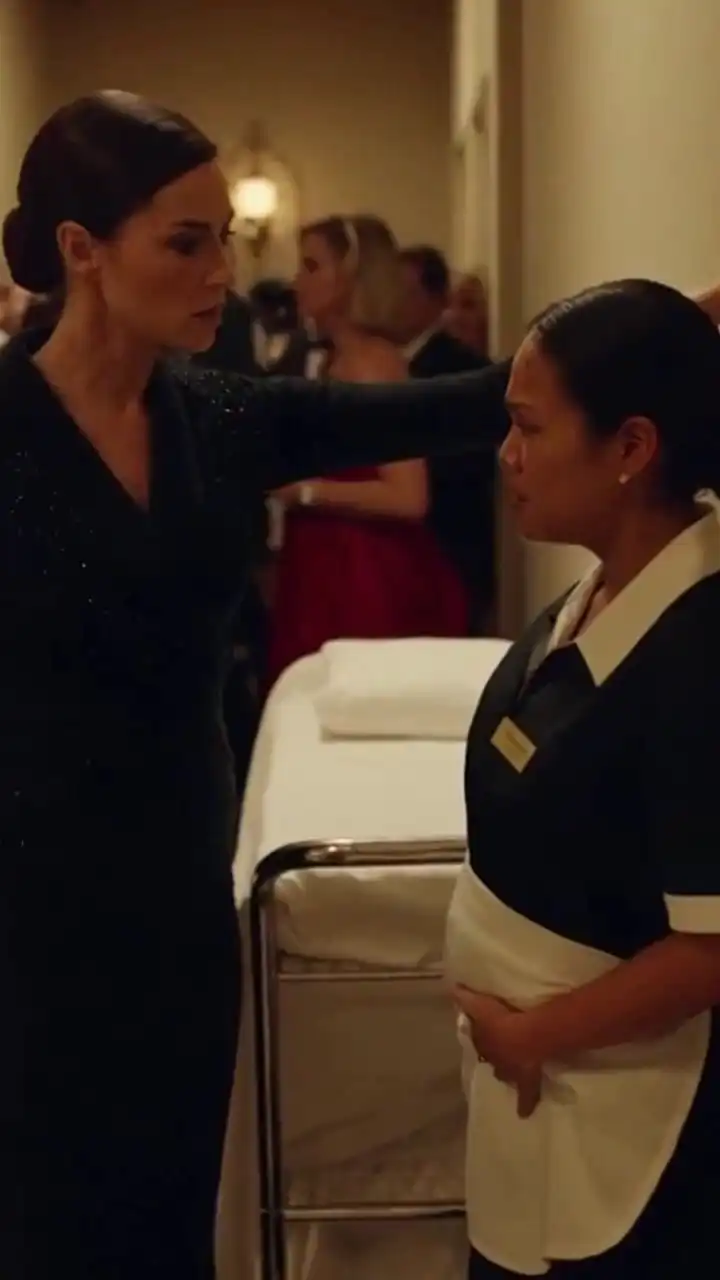


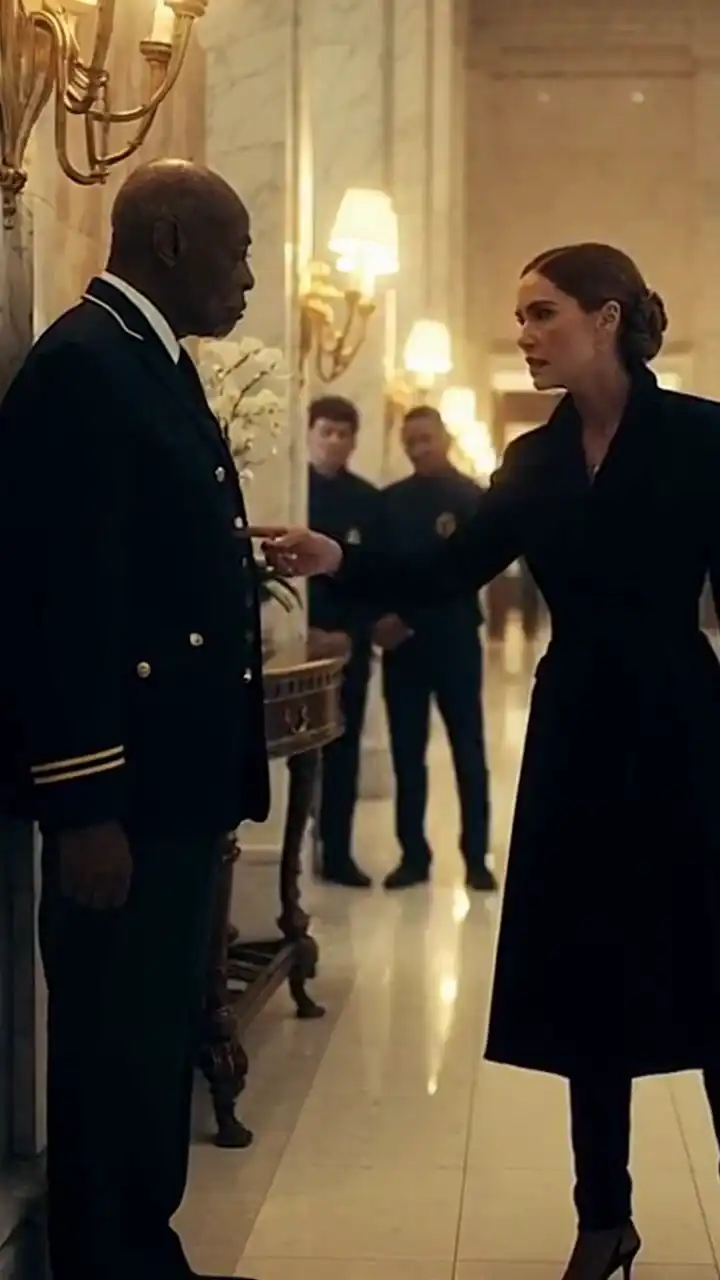
SHE USED AN ELDERLY PORTER AS A PUBLIC WARNING IN THE LOBBY OF A LUXURY TOWER—UNTIL THE PRIVATE ELEVATOR OPENED AND THE WRONG MAN SAW EVERYTHING
The physician beside him almost walked into his shoulder.
“Mr. Mercer?” she said quietly.
He didn’t answer her. His eyes were fixed on Walter.
Not vague curiosity. Not mild concern. He knew him.
Vanessa saw the pause and immediately put on her charity smile, the one she used at gala tables and camera walls. “Mr. Mercer, I’m so sorry you had to walk into this. Just a little staff correction. We have to protect standards.”
Walter felt the whole lobby hold its breath around that name.
Elias Mercer.
Even if residents never saw him, everybody who worked at Ashbourne knew it. Founder. Original developer. The man whose family still controlled the private trust behind the tower, the rehab floor, the adjoining clinic, half the land wrapped around the gated property. He almost never came down through the main lobby. He used the private entrance or stayed upstairs during board weekends.
Vanessa took one step toward him, eager now, like this could still become a performance in her favor.
“I was just explaining to your staff,” she said, “that mistakes have consequences. Honestly, if more people enforced discipline around here, service wouldn’t slide.”
Elias Mercer still didn’t look at her.
He looked at Walter’s hands first, then at the garment bag on the floor, then at the nurse in blue scrubs who had gone completely still.
“Walter,” he said, in a voice low enough to make everyone lean in, “why are you standing there?”
Nobody had ever asked the real question out loud.
Walter opened his mouth, closed it, and glanced once toward the concierge desk. He was still trying to protect the job they could all see slipping if he chose wrong.
Vanessa rushed in before he could answer. “Because he dropped a guest’s things, argued, and then tried to create a scene with hospital staff.”
Elena flinched at that. “That’s not what happened.”
Vanessa turned so fast her heel clicked hard on the marble. “Excuse me?”
Elena’s fingers tightened around the papers. She was scared. Walter could see it. Ashbourne had a way of making employees fear wealthy people more than policy.
Still, she spoke.
“He apologized immediately,” Elena said. “Nothing was damaged. He only looked at me because I know his wife is upstairs and he was trying not to—” She stopped herself, but too late. The truth was already in the air.
Elias’s face changed at the mention of Walter’s wife.
The physician beside him looked from Walter to Elena. “This is Mr. Bell? Mrs. Bell’s husband?”
Walter nodded once.
Now Elias finally turned to Vanessa.
“His wife is in our neuro-rehab unit,” he said. “Recovering from a stroke.”
Vanessa’s smile pulled tighter. “I’m sorry to hear that, but I don’t see how his personal situation excuses—”
“It doesn’t excuse anything,” Elias said. “It explains why a man old enough to be retired is still carrying bags in my building at seven-thirty at night.”
His building.
That landed harder than if he’d shouted.
One of the younger women beside Vanessa quietly took a half step away from her.
Vanessa tried again. “I think there’s been confusion. I support this residence immensely. Martin and I have donated—”
Elias cut across her. “I know exactly how much the Crains have donated.”
No warmth. No gratitude. Just numbers being moved somewhere in his head.
Walter wanted to disappear. That was the ugly part of humiliation: even when the current started turning, the body was still stuck inside the shame. His shoulders ached from holding still. His ears still rang with These people.
Elias took two steps toward him. “Did anyone tell you that you had to remain standing here?”
Walter hesitated.
That hesitation answered enough.
Vanessa laughed once, brittle and offended. “Oh, come on. Nobody forced him. I made a point. Staff need visible accountability.”
“Visible accountability?” Elias repeated.
He looked around the lobby as if he were seeing it fresh through everyone else’s eyes: the residents pretending to study their phones, the valet with his mouth set hard, the teenager lowering his camera, the assistant at the desk standing frozen with a key packet in hand.
Then he looked at Walter again. “How long?”
Walter said, “A few minutes, sir.”
Elena spoke over him. “Long enough for people to stop and stare.”
The jeweled-purse guest finally stepped in, trying to save herself from the wrong side of the moment. “Vanessa, maybe this is overblown.”
Vanessa rounded on her. “Don’t start. You saw him drop it.”
“And I saw you keep him there after he picked it up,” the guest said, voice thinner now.
That changed the room more than any speech could have. Her own guest was retreating.
Elias bent, picked up the garment bag himself, and handed it to a valet.
“Take this to Ms. Rollins’ car,” he said.
The valet took it instantly, relief flashing across his face at being given a useful order.
Then Elias turned to the concierge supervisor, a man who had somehow failed to appear until now.
“Mr. Gaines,” Elias said.
The supervisor came out from behind the side corridor so quickly he might as well have been pulled by a wire. “Yes, Mr. Mercer.”
“Were you aware that an employee was being held in the center of the lobby as a warning display?”
Gaines’s face blanched. “I was just informed there was a guest-service issue.”
“No,” Elias said. “You were just informed there was a witness with authority.”
Nobody moved.
Vanessa folded her arms, trying to recover height. “This is absurd. Since when do donors get treated like offenders because they expect professionalism?”
Elias gave her his full attention at last, and it was colder than anger.
“Donors are thanked,” he said. “Residents are served. Guests are welcomed. None of that gives anyone the right to stage a public degradation ritual in my lobby.”
The word ritual hit because it was exactly what she had done.
A few people looked down.
Vanessa’s color rose. “That is a very dramatic way to describe a correction.”
“No,” Elena said quietly, and somehow every person heard her. “It’s accurate.”
Vanessa spun toward her. “You need to remember who you’re speaking to.”
Elena’s face went pale, but she didn’t lower her eyes. “A woman who used a patient’s husband to entertain her friends.”
That one drew a sharp breath from somewhere near the revolving door.
Walter felt something shift inside him then. Not triumph. Just the first inch of air after being held underwater.
Elias asked Walter, “Did you argue with her?”
“No, sir.”
“Did you damage property?”
“No, sir.”
“Did you refuse instruction?”
Walter paused. “I asked if I could put the bag right.”
Vanessa snapped, “He challenged me.”
Elias looked at her as if she had just translated herself by mistake. “So the offense was that he wanted to fix a harmless error before you finished displaying him.”
Martin Crain wasn’t there, but his absence suddenly felt useful to nobody. Vanessa had been borrowing his status all evening, and everyone could see how thin it looked under direct light.
She took a breath and changed tactics. “I think this is becoming personal. If there’s some sentimental attachment here because he has a sick wife upstairs, that’s unfortunate but irrelevant to donor relations.”
Elias’s expression did not move.
Then the physician beside him stepped forward. She had been silent until now, but she wore the authority of someone accustomed to life-and-death decisions. “It is relevant,” she said, “because the ‘sick wife upstairs’ spent six weeks refusing physical therapy until Mr. Bell talked her through every session. Half my staff knows him because he sits with her and then works overnight to keep her covered. If this building markets dignity in care, you just let a guest strip it off in the lobby.”
That landed on management like a hammer.
The concierge assistant who had frozen earlier looked close to tears.
Vanessa glanced around and finally saw what everyone else had already seen: she no longer had the room. The audience she wanted had turned into witnesses.
So she did what people like her often did when power slipped. She reached for threat.
“Martin will hear about this,” she said. “Our family has funded enough here that I won’t be publicly insulted by employees and nursing staff.”
Elias gave the smallest nod, almost grateful she had made it simple.
“Good,” he said. “Then he can hear it from me first.”
He faced Mr. Gaines. “Effective immediately, Mrs. Crain’s host privileges for tonight’s donor preview are revoked.”
Vanessa blinked. “You can’t be serious.”
“I am.”
“The preview is in the west lounge. It’s my event.”
“It was your event,” Elias said. “Now it is Ashbourne’s event, and you are no longer hosting it.”
The words rolled through the lobby in a visible wave. One resident actually took off his glasses. The two younger women behind Vanessa looked at each other in alarm.
Vanessa laughed again, but this time there was panic under it. “On what grounds?”
“On the grounds that you used staff humiliation as social theater in a residential medical property partially governed by a dignity and care charter your husband signed before he ever wrote his second check.”
For the first time, she had no quick answer.
Elias continued, “You are also suspended from guest sponsorship access pending board review.”
Now even the concierge supervisor looked stunned. That was concrete. In a place like Ashbourne, sponsorship access was power. It got people through doors, onto event lists, into private dining rooms and restricted wellness floors. Losing it meant the building itself was withdrawing social endorsement.
“You’re suspending me?” Vanessa said. “Over him?”
Walter heard it plain as day. Over him. As if he were still only an object on a scale.
Elias answered without raising his voice. “No. Over what you chose to do when you believed ‘him’ could not cost you anything.”
Silence.
Not kind silence. Exposing silence.
The teenage boy by the door slowly lowered his phone all the way. His mother put a hand on his wrist and whispered something sharp.
Vanessa’s guest in white cleared her throat. “I think I should leave.”
“Yes,” Vanessa said, seizing at control. “Maybe you should.”
But the woman didn’t move toward Vanessa. She moved away from her. “I meant without you.”
That small rejection was almost crueler than the formal punishment. Social people knew the difference between public backing and private distancing. Her guest was making the split visible.
Mr. Gaines finally found his voice. “Mrs. Crain, I’ll have someone retrieve your wraps and escort you to the south exit.”
“Escort me?” she said.
“Yes, ma’am,” he said, and couldn’t quite hide the stiffness of relief in the title.
Vanessa looked at Walter then, maybe expecting satisfaction, maybe begging for quiet, maybe still hoping he would rescue her by minimizing what she had done. That was another habit of people who humiliated workers: once exposed, they expected the worker to help clean the scene.
Walter did not speak.
He only met her eyes.
No triumph. No speech. Just the same man she had pinned to a wall now standing under his own weight again.
She looked away first.
When she realized nobody was rushing to defend her, she straightened her coat and tried to leave with some shreds of dignity. One of the younger women followed. The other stayed behind for two painful seconds, murmured, “I’m so sorry, Mr. Bell,” and then hurried after them.
The lobby doors closed behind Vanessa, and the whole space seemed to exhale.
Elias turned immediately back to Walter, which told everyone what mattered more.
“You should sit down,” he said.
Walter almost said no out of habit. Workers in buildings like that learned to refuse comfort automatically. But his knees were weak, and Elena was already pulling a chair from the side writing desk.
He sat.
Only then did he realize how hard his heart was pounding.
Elena crouched beside him. “Are you okay?”
Walter gave a shaky nod. “I will be.”
The physician looked at him with a softer expression now. “Mrs. Bell had a strong afternoon,” she said. “She asked for you twice.”
He pressed his lips together and nodded again, this time because he couldn’t trust his voice.
Elias stood in front of him, hands clasped behind his back. “Walter, I owe you an apology.”
Walter looked up fast. “Sir, you don’t.”
“I do,” Elias said. “A building is responsible for the behavior it permits in its own lobby. If this can happen in open view, then the failure is larger than one woman.”
Mr. Gaines lowered his head.
Elias didn’t let him hide in silence either. “Prepare a written incident report tonight. Include every employee who witnessed this and every point where intervention failed. I want policy changes before the next board session. No resident, donor, or guest gets to detain or display staff in public areas for any reason. If there is a service complaint, management handles it privately and immediately. Is that understood?”
“Yes, Mr. Mercer.”
“Also,” Elias said, “remove the Crains’ names from tomorrow’s preview materials until review is complete.”
That was another concrete blow. Not just access stripped. Public branding stripped too.
Gaines nodded. “Right away.”
Elias glanced at Elena. “Will you take Mr. Bell upstairs when he’s ready?”
“Of course.”
Then he looked back at Walter. “And starting tomorrow, you are not lifting luggage.”
Walter blinked. “Sir?”
“I know your supervisor has been letting you take whatever shift keeps you near seventeen.” Elias’s tone softened by a degree. “That arrangement ends tonight. We’ll keep your hours. You move to desk and resident assistance only.”
Walter stared at him. “You’d do that?”
“I should have done it sooner.”
For a second, Walter couldn’t say anything. Nine years of swallowing embarrassment did strange things to gratitude. It got tangled up with disbelief.
“Thank you,” he said finally, rough-voiced.
Elias nodded once and started to turn away, then stopped. “And Walter?”
“Yes, sir?”
“When you go upstairs, tell your wife her garden request is approved.”
Walter frowned in confusion.
The physician smiled faintly. “The therapy terrace. She wanted railing planters out there because the current space ‘looks like a sad airport patio.’”
Elena laughed under her breath for the first time all night. “That sounds like her.”
Walter’s face cracked into a tired smile. “Yes, sir. It does.”
That small moment did more for him than any grand revenge could have. In the span of minutes, he had gone from being used as a warning sign to being spoken to like a human being in his own right.
Around them, the lobby had started moving again, but differently. The valet who had smirked earlier came over with a paper cup of water and held it out with both hands. The concierge assistant whispered a trembling apology. Even the residents waiting by the drive had the decency not to stare now.
Walter took the water.
He didn’t make a scene. He didn’t lecture anybody. He just sat until the shaking in his fingers eased.
A few minutes later, Elena rode up with him to seventeen.
The private rehab floor was quieter than the lobby, all muted lights and low voices. His wife, Denise, was awake, propped up in bed, silver hair pushed back, remote balanced against her blanket like she had been ready to wage war on the television.
“There you are,” she said the second he came in. “You look terrible.”
Walter laughed once despite everything. “Good evening to you too.”
Elena gave Denise a look that said later, not now, and slipped out.
Walter sat beside the bed and took his wife’s hand. She squeezed once, stronger than she had a month ago.
“What happened?” she asked.
He looked at her, at the woman he had kept this job for, the woman who was learning how to walk again one furious inch at a time.
“Nothing that gets to stay,” he said.
She studied his face, saw enough there, and didn’t push. “Did you bring my sweater?”
He blinked. “No.”
“So after all these years,” she said, “you finally fail at one task.”
He laughed harder then, and some of the last poison of the lobby drained out with it.
The next morning, Ashbourne staff received a written policy update. Complaints from residents, donors, or guests were to be directed only through management. Public detention, shaming, or “instruction” of staff by non-management parties would trigger immediate review of privileges. By noon, everyone also knew that Vanessa Crain had been removed from the donor preview committee and barred from sponsoring guests into restricted events until the board completed its investigation.
By the end of the week, the Crain name was gone from the event banner in the west lounge.
Walter saw the workers notice it first.
Nobody said much. They didn’t need to. The missing name said enough.
And every time he crossed the lobby after that, no one ever used that wall for a warning again.
Disclaimer: Mention of any brand or trademark is for identification only and does not imply partnership or endorsement

SHE RIPPED THE BADGE OFF A PREGNANT NURSE AIDE IN THE LOADING BAY TO SHOW EVERYONE WHO MATTERED—AND PICKED THE WORST POSSIBLE WITNESS
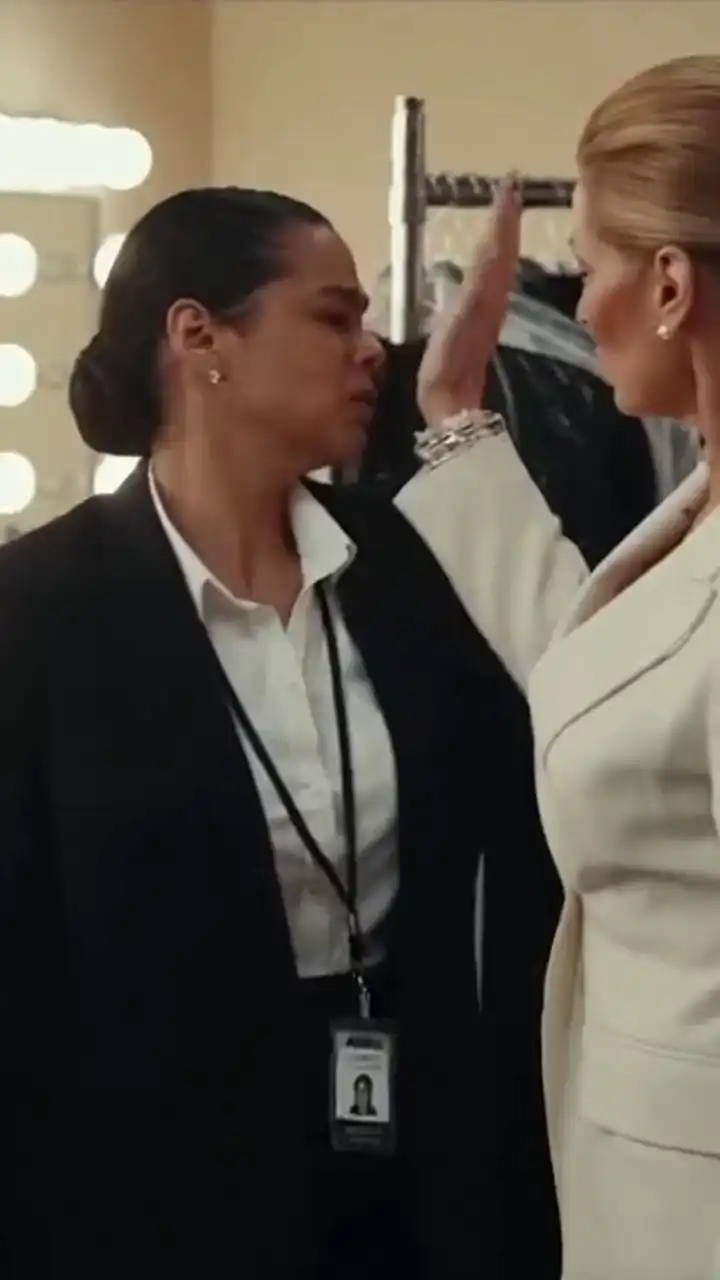
SHE SLAPPED THE THEATER USHER IN THE FITTING ROOM AND TURNED HER INTO A LESSON—UNTIL A QUIET VOICE FROM THE DOOR SAID HER NAME
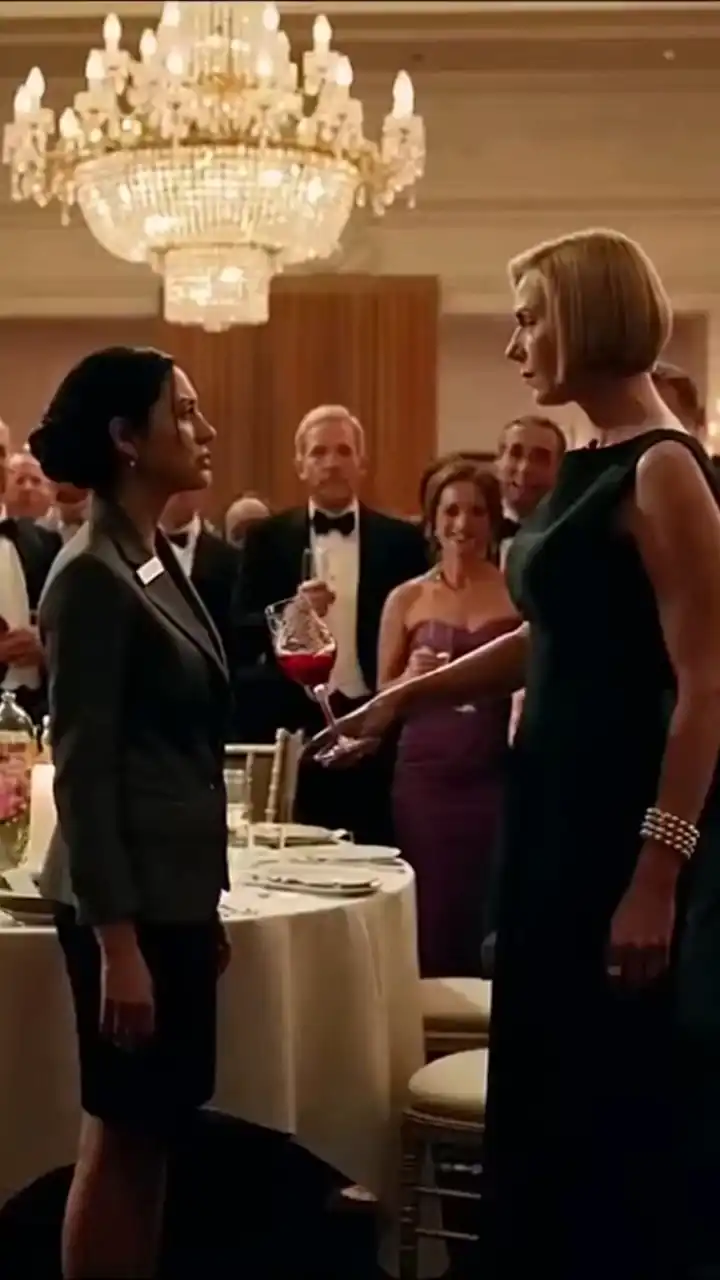
SHE MADE THE “HELP” STAND IN THE BANQUET HALL HOLDING A SPILLED WINE GLASS LIKE A CRIMINAL — UNTIL ONE NAME TURNED THE WHOLE ROOM AGAINST HER