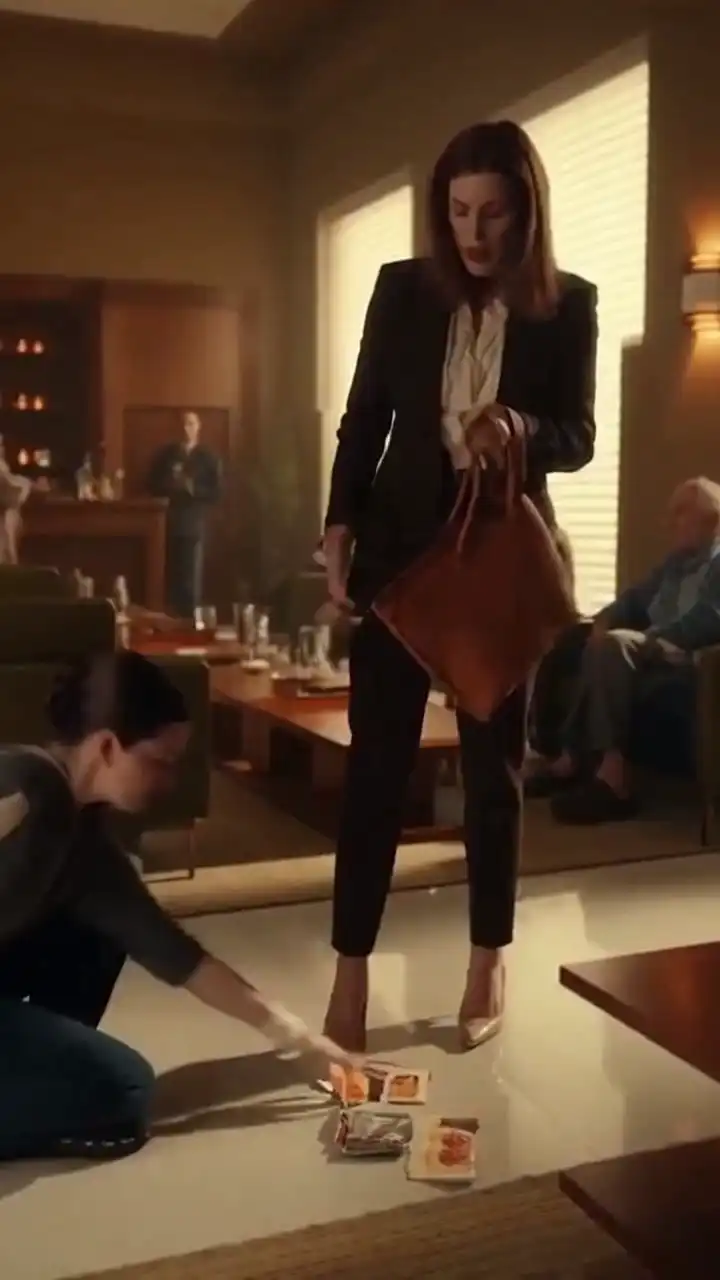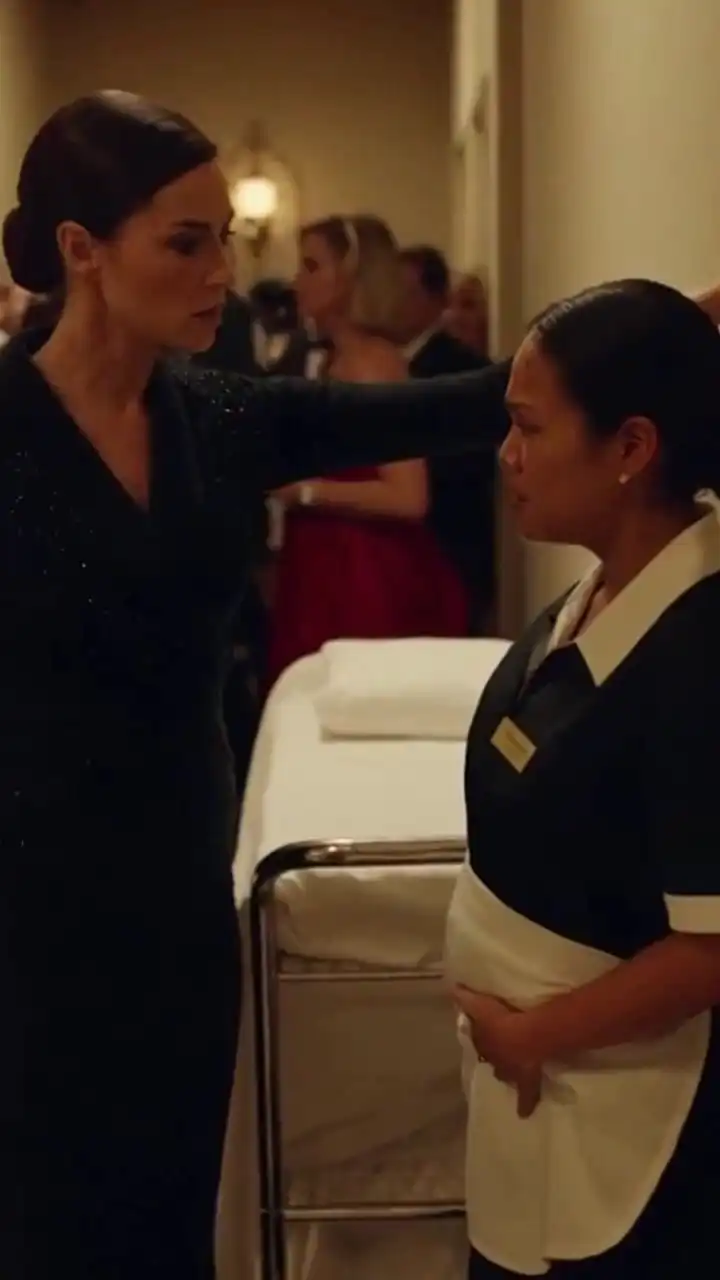
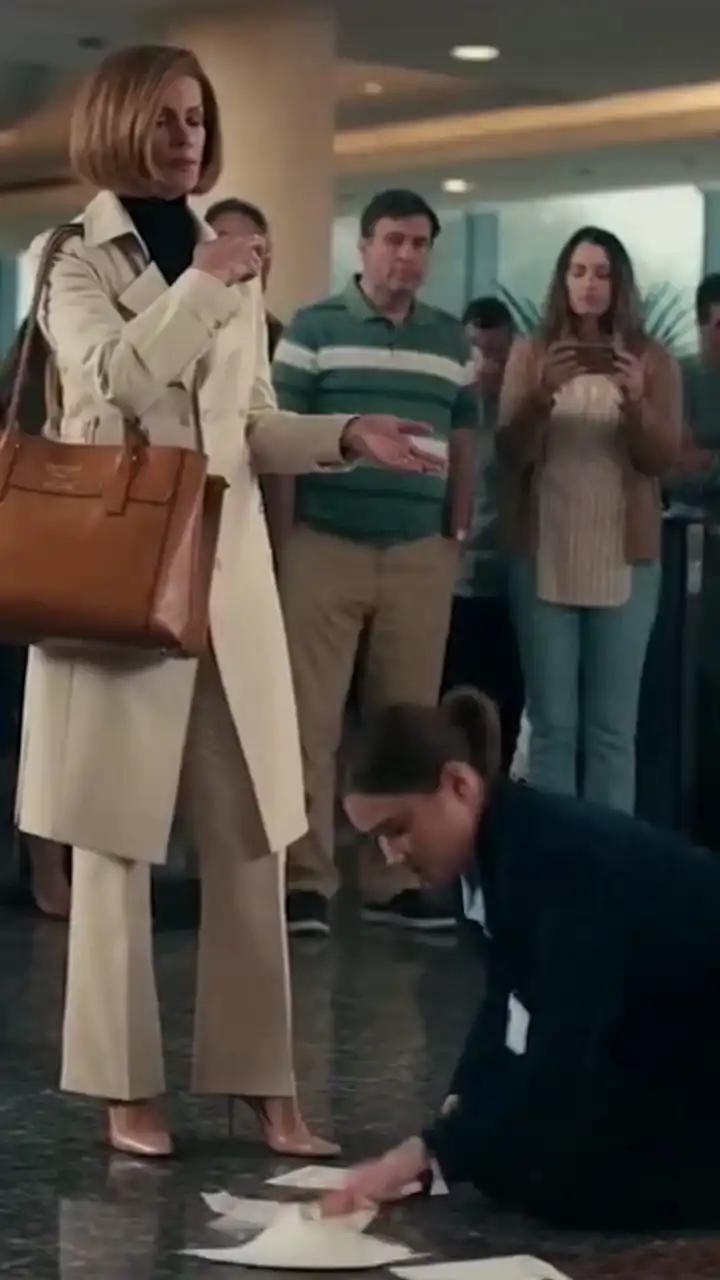
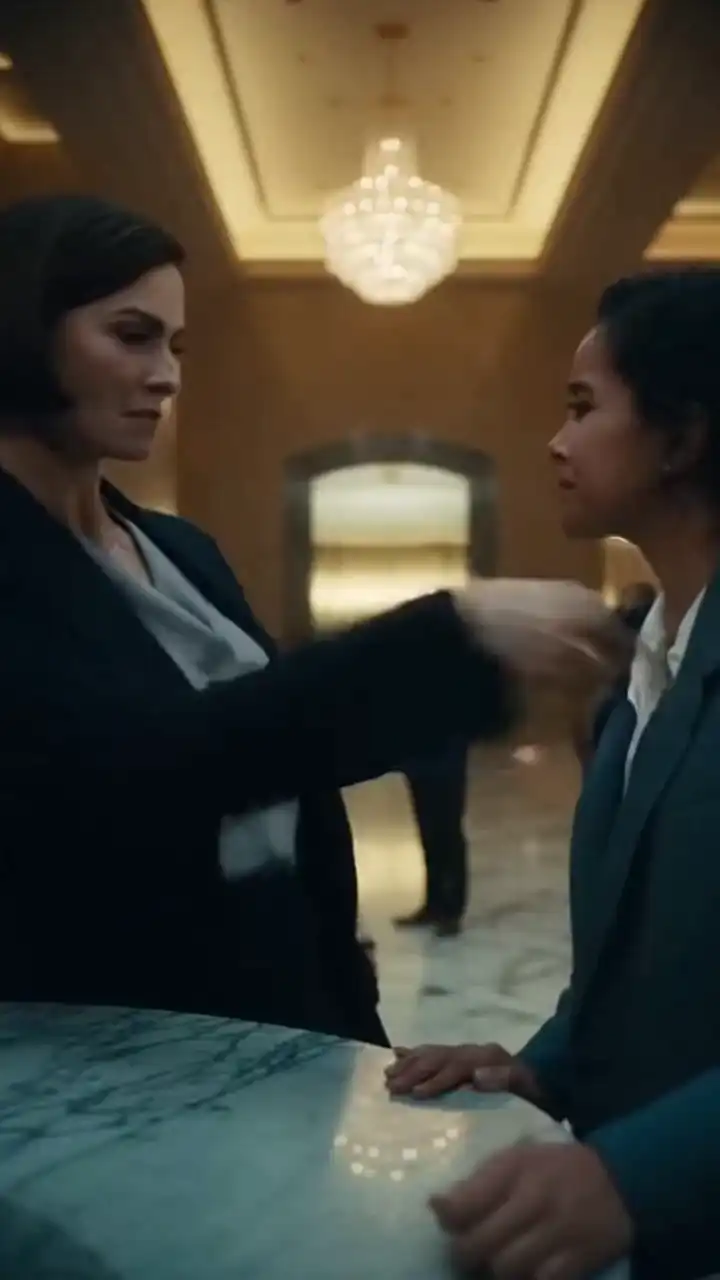

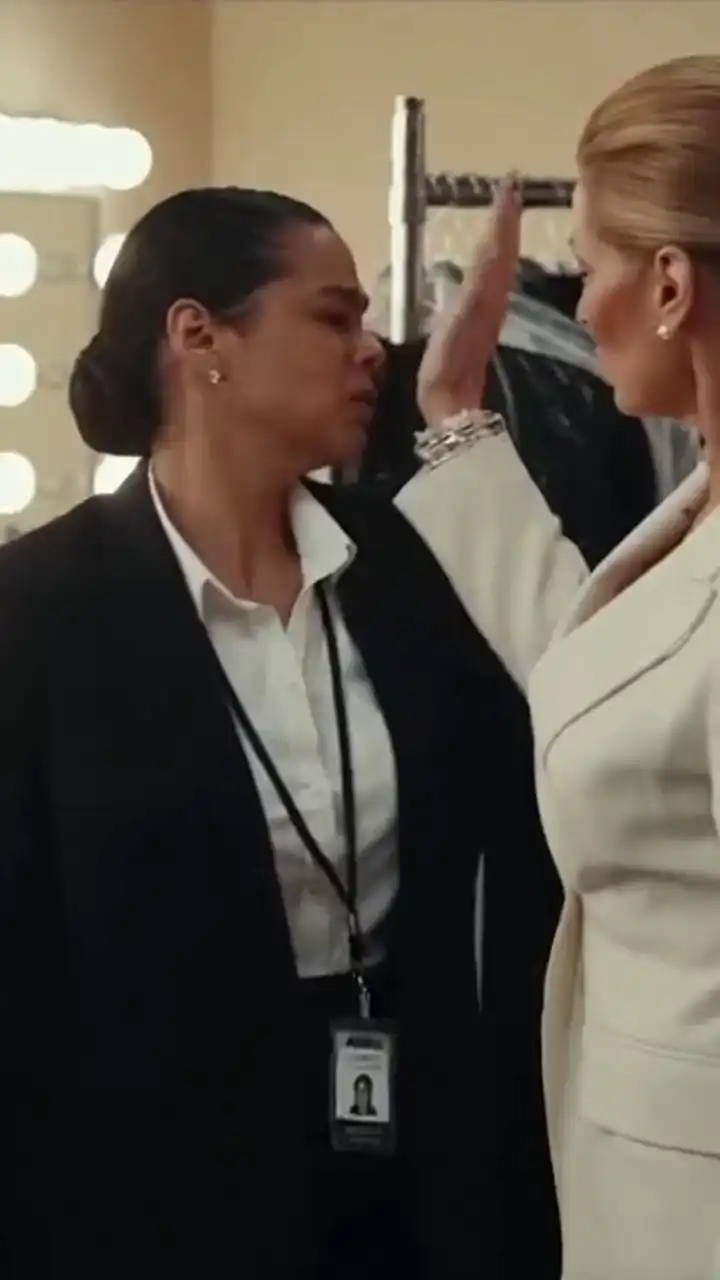
SHE SLAPPED THE THEATER USHER IN THE FITTING ROOM AND TURNED HER INTO A LESSON—UNTIL A QUIET VOICE FROM THE DOOR SAID HER NAME
The fitting room went so still that even Vanessa stopped talking.
Camila knew the man at the door before she fully placed his face. Not from theater work. Not from donor receptions where she poured sparkling water and got ignored.
From a hospital corridor.
From one brutal winter night three years earlier when her husband had been dying and a stranger with silver hair had been sitting alone under a vending machine light, waiting to hear whether his granddaughter would make it out of emergency surgery.
The man at the door looked older now, thinner through the jaw, but it was him.
Leonard Hale.
Chair of the Orpheum Board.
The single biggest donor the theater had.
Vanessa blinked, then smiled too quickly. “Leonard. Thank God. There’s been a staff issue.”
He didn’t look at her.
He walked into the room slowly, eyes still on Camila, then on Mateo, then on the broken badge lying near the hem of the gown. When he spoke again, his voice stayed soft, which somehow made everyone listen harder.
“It is Camila Reyes,” he said. “I thought so.”
Camila swallowed. Her throat hurt. “Mr. Hale.”
Vanessa let out a small laugh, trying to pull the room back under her control. “Yes, apparently everybody knows everybody tonight. But this woman dropped my gala dress, contaminated the hem, and then got argumentative. I was just asking staff to handle basic standards.”
Leonard finally turned toward her.
“By slapping her?” he asked.
Nobody answered.
Vanessa’s face changed by half an inch. “I—well, things got heated. She was careless with a custom piece, and—”
“You slapped her,” he repeated. Not louder. Just cleaner.
The younger dresser who had looked sick found her voice first. “Yes, sir.”
Vanessa snapped around. “Excuse me?”
The dresser flinched, but kept going. “You hit her. And shoved her. We all saw it.”
The security guard at the door straightened, realizing too late that pretending not to hear was no longer an option.
Vanessa laughed again, but this time it sounded brittle. “This is getting ridiculous. Leonard, surely we are not going to derail the evening because an usher can’t carry a garment bag and a few people got emotional.”
Mateo moved closer to Camila’s side. She kept one hand behind her, touching his arm without looking down. She was still shaking. The slap still rang in her ear. But the room had shifted just enough for her to breathe.
Leonard looked at the gown on the table, then at the garment bag on the floor.
“Who asked her to carry it?” he said.
Vanessa frowned. “What?”
“Who asked her to carry your dress?”
No answer.
The assistant stage manager cleared his throat. “Mrs. Barrington came in through the donor entrance and didn’t want to wait for wardrobe. She saw Ms. Reyes in the corridor and told her to bring the bag back here.”
Vanessa turned on him. “I did not tell her to mishandle it.”
Camila spoke for the first time since Leonard entered. Her voice was quiet, but steady. “I told you I’m house staff, not wardrobe. I said I could call a dresser.”
A few faces in the room shifted. That detail mattered. Vanessa had pulled an usher out of position like a maid and then punished her for not being specialized enough.
Vanessa threw up a hand. “This is absurd. Any competent adult can carry a dress.”
Leonard nodded once. “And any decent adult can keep their hands off employees.”
Vanessa stared at him. “Employees? Leonard, please. Don’t make this bigger than it is.”
He looked at the broken badge again. “You already made it bigger.”
Then he stepped closer to Camila.
“Does your cheek hurt?” he asked.
That nearly broke her more than the slap. Not because of the question itself. Because he asked it like she was a person in the room.
“I’m okay,” she said automatically.
He glanced at the red mark on her face and the lanyard welt at her neck. “No, you are not.”
Vanessa folded her arms. “With all respect, I think this is an internal staffing matter, and right now we have a gala starting. If the theater wants donor money, it should not let backstage help become so dramatic.”
Leonard turned fully toward her now, and the room finally got to see which name carried actual weight.
“Vanessa,” he said, “you are the ex-wife of a former board treasurer and a donor at one giving tier. You are not management. You are not ownership. You do not discipline staff. You do not put your hands on anyone in this building. And you do not get to call assault an internal staffing matter because you wore a gown into the room.”
A seamstress near the mirrors lowered her eyes to hide a reaction. One of Vanessa’s friends stepped back from her by instinct, as if the heat had moved.
Vanessa’s chin lifted. “Assault? That is a disgusting exaggeration.”
“It won’t sound exaggerated on security footage,” Leonard said.
That landed.
The guard by the door looked like he wanted the floor to open under him.
Vanessa’s voice sharpened. “There are cameras in the fitting corridor, not in here.”
“Correct,” Leonard said. “Which means they will show you dragging Ms. Reyes in by the bag while she was telling you her child was with her and she needed another staff member.”
Camila’s head turned. She hadn’t known that camera caught audio near the costume hallway.
Leonard continued, “And then we have forty witnesses for what happened after you entered this room.”
Forty was an overstatement, but not by much. The room had been crowded, and suddenly every person in it felt counted.
Vanessa looked around, searching for loyalty. She found less than she expected.
Her friend in the silver wrap murmured, “Vanessa, maybe just apologize.”
Vanessa rounded on her. “Absolutely not.”
That told everybody what they needed to know.
Leonard bent and picked up the broken badge from the floor himself. He turned it over once, thumb brushing the cracked plastic clip, then handed it back to Camila with care.
“I’m sorry,” he said.
Vanessa let out a short, incredulous breath. “You’re apologizing to an usher?”
“No,” Leonard said. “I’m apologizing to Ms. Reyes for what this institution allowed to happen in one of its rooms.”
The title hit harder than if he had raised his voice.
Camila took the badge. Her fingers trembled around it. Mateo looked up at her, then at Leonard, trying to understand why all the adults suddenly sounded different.
Vanessa tried another angle. “Leonard, you’re being emotional because you recognize her. Fine. Perhaps you know her from somewhere. That doesn’t change the damage done to my dress.”
Leonard’s eyes narrowed slightly. “No damage was done to your dress.”
The costume head, who had finally found a spine now that power had moved, stepped forward and examined the hem. “He’s right. The gown fell in the bag first. The beadwork protected the tulle. It needs a steam pass, not restoration.”
Vanessa stared at her. “Now you’re siding with staff over a patron?”
“I’m siding with facts,” the woman said.
Vanessa was losing ground in inches, and she could feel it. So she reached for the one thing people like her always reached for when the room stopped obeying: threat.
“If this theater wants to humiliate me over a misunderstanding, I can redirect my support very easily,” she said. “And I’m sure several friends here can do the same.”
No one jumped in to back her.
Leonard gave a small nod, as if she had finally said the useful part out loud. “Thank you. That makes the next step simpler.”
He took out his phone, tapped once, and looked at the assistant stage manager. “Please ask Elaine Porter and legal to come backstage now. Also inform front-of-house that Mrs. Barrington is no longer to be given unrestricted access to staff areas effective immediately.”
Vanessa went pale. “You can’t ban me from backstage over this.”
“I can bar anyone from staff spaces for striking an employee,” Leonard said. “Tonight, I can also suspend your gala privileges pending a board review. By Monday morning, there will be a formal vote on revoking your patron committee role.”
That was the first concrete loss she couldn’t laugh off.
Her mouth opened. “My committee role?”
“Yes.”
“I chair the spring donor luncheon.”
“You did,” Leonard said.
A murmur moved through the room. Not loud. Just enough for Vanessa to hear that people were no longer scared to make sound around her.
She took a step forward, lowering her voice like she could fix this privately now. “Leonard, this is insane. For her?”
He held her gaze. “For the employee you struck. For the child you forced to watch it. For every staff member in this building who has been trained to smile while people like you test how far you can go.”
That ended the private tone. There was nowhere left to shrink the incident back down.
Vanessa looked at Camila with open disbelief, like she still could not accept that the person she had treated like an object had become the center of the room.
“What exactly are you to him?” she asked.
Camila didn’t answer. She didn’t need to.
Leonard did. “A woman who once sat in a hospital waiting room with me for six hours when my granddaughter was bleeding internally and my son was still on a plane from Seattle.”
The room stayed fixed on him.
He didn’t dramatize it. He just kept speaking.
“I had no idea who she was then. She had a vending machine coffee in one hand and insurance papers in the other. Her own husband was in surgery. She saw me trying to sign forms without my glasses because my hands were shaking.” He glanced at Camila. “She read every line aloud. She found the pediatric nurse when no one answered the desk. She sat with my granddaughter after they stabilized her because my daughter collapsed in the hallway.”
Vanessa said nothing.
“I asked for her number later,” Leonard continued, “so I could thank her properly. She refused. She said people should help each other when things get ugly.” He paused. “I never forgot her name.”
Camila looked down for a second. She had not known he remembered that much. That night had blurred together with blood, fear, paperwork, and the call that her husband Daniel hadn’t made it.
Mateo pressed closer to her side. He knew the word husband only as the framed photo in the apartment and the stories people told softly.
Leonard’s voice lowered another notch. “When I saw her ushering the donor row last fall, I asked administration why a woman working double shifts here was also listed in our outreach records as applying for emergency tuition aid for her son.” He looked at the assistant stage manager. “Do you know what I learned?”
The man swallowed. “No, sir.”
“That she never stopped showing up. Not after widowhood. Not after losing her apartment. Not after taking two buses to make curtain call on time.” He looked back at Vanessa. “And tonight you decided she was useful enough to carry your dress and worthless enough to hit.”
Vanessa’s face hardened because shame was no longer available to her as an exit. “So this is favoritism.”
Leonard almost smiled. “No. This is memory. And governance.”
That was worse.
Elaine Porter, the theater’s executive director, appeared at the door with a lawyer from the board and two security supervisors. She took one look at Camila’s face and didn’t ask for small talk.
“What happened?”
Vanessa jumped in first. “A gross overreaction to a simple staff mistake.”
Leonard answered without looking away from Camila. “A donor struck an employee, tore her badge off, and created a hostile scene in front of a minor.”
Elaine’s expression changed instantly. “Whose minor?”
“Ms. Reyes’s son,” he said.
Elaine exhaled slowly. “All right.” Then to Camila, gently: “Do you need medical care?”
Camila almost said no again, out of habit, out of training, out of that old fear that needing help makes trouble bigger. But Mateo was staring at the mark on her cheek.
“My face is okay,” she said. “My neck hurts a little.”
Elaine nodded to one of the security supervisors. “Please take Ms. Reyes and her son to the green room. Get ice. And call HR now. I want statements taken tonight, before anyone leaves.”
Vanessa stepped in. “You are seriously documenting this?”
Elaine looked at her. “Yes.”
“I have supported this theater for years.”
“And Ms. Reyes has worked for it,” Elaine said. “Tonight only one of you was treated as disposable.”
That took the air out of Vanessa more effectively than shouting would have.
Still, she made one last attempt. “If you do this publicly, I will be forced to respond publicly.”
The board lawyer finally spoke. “You are free to do that. We would advise against making any false claims while witness statements and corridor footage are being preserved.”
The word preserved made Vanessa’s control slip for real.
“You recorded me like some criminal?”
“No,” Elaine said. “The building records everyone entering restricted areas. The criminal part would be the hitting.”
A tiny sound escaped one of the interns before she clamped a hand over her mouth.
Vanessa looked around the room again, but now the people avoiding her eyes were not doing it out of obedience. They were doing it because they no longer wanted to be attached to her.
Leonard stepped aside so security could move in.
“Mrs. Barrington,” one supervisor said, “we need you to come with us.”
She jerked back. “Do not touch me.”
“No one intends to,” he said. “Please walk with us.”
Vanessa drew herself up, trying to salvage elegance from the wreck. “This is outrageous. I’ll have every one of you hearing from my attorney.”
Leonard gave a single nod. “Good. Then your attorney can hear from ours.”
She left under her own power, but it was not a grand exit. It was the ugly, stiff walk of someone realizing that money had stopped translating into obedience for the first time in a very long while.
The second she disappeared into the hall, the room released a breath.
Nobody clapped. Nobody said anything cute. They just started acting like human beings again.
The younger dresser came straight to Camila. “I’m sorry,” she said, eyes wet. “I should’ve said something sooner.”
Camila was too tired to comfort anyone, but she nodded once. “Thank you for saying it when it counted.”
The costume head touched the gown, then looked ashamed. “I should have stopped her when she pulled you in.”
“Yes,” Camila said.
The woman accepted that.
Elaine walked over and crouched slightly so she was eye level with Mateo. “Hi, I’m Elaine. We’re going to get your mom some ice, okay?”
Mateo looked at Camila first before answering. When she nodded, he nodded too.
Then, in a small voice, he asked the question that cut through everything else.
“Is my mom in trouble?”
Elaine’s face softened. “No. Your mom is not in trouble.”
Leonard answered too, from just behind her. “Your mom is the only person in this room who acted with dignity.”
Camila had held herself together through the slap, the shove, the badge, the crowd, the waiting. That line nearly finished her. She turned slightly so Mateo wouldn’t see her mouth tremble.
They moved her to the green room, where someone brought ice in a clean towel and a bottle of water. HR arrived. Security took names. The lawyer asked careful questions. This time, nobody told her to keep it brief for donor comfort.
She gave her statement in full.
How Vanessa had stopped her in the hall.
How Camila had said she wasn’t wardrobe.
How Vanessa had insisted.
How she had dragged the bag when Camila shifted it to keep Mateo from being bumped.
How the slap came first, then the shove, then the badge.
When she finished, the HR director asked, “Would you like to file a police report?”
Camila looked at Mateo, who was drawing circles on a napkin at the snack table because children will find a way to do something normal even in the middle of adult ugliness.
“Yes,” she said.
No one tried to talk her out of it.
By the time officers came to take a report, the gala had started without Vanessa. Word had already spread through the donor floor in the sideways, whispered way it always did in big institutions. Not every detail, but enough: a patron had put hands on staff, Leonard Hale had intervened, and the theater was not burying it.
That mattered more than Camila expected.
It mattered again on Monday.
Vanessa’s committee role was formally revoked. Her backstage access was terminated permanently. The board issued a donor conduct policy that actually had teeth this time, including immediate removal for physical intimidation or abuse of staff. The police report stood. Her name hit a few local arts columns by the end of the week, not in headlines big enough to make national news, but big enough to stain the circles that had protected her.
And because wealthy people fear exclusion more than lectures, two other institutions quietly dropped her from host positions before the month was over.
Camila did not become some sudden celebrity out of it. She didn’t want that.
What she got was more useful.
The theater covered counseling through employee services for her and Mateo if they wanted it. Her emergency tuition request for Mateo’s school was approved through a board hardship fund Leonard expanded the same week. Elaine moved her into a senior front-of-house role with better pay and made it clear in staff training that no patron, donor, or committee member outranked basic human limits.
The security guard who had pretended not to hear was put under review. The assistant stage manager who spoke up got thanked in writing. The younger dresser who told the truth was offered a permanent position after the gala season ended.
As for Leonard, he did not hover after that night. He didn’t turn her life into a charity project she had to perform gratitude for. He checked in twice, made sure the policy changes actually happened, and sent one handwritten note to her apartment.
It said only: You helped my family when there was no audience. I am sorry we failed you in public.
She kept that note in the kitchen drawer under the phone charger and school forms.
A week later, Camila returned to work.
The first time she walked back into the Orpheum in her black jacket, her stomach tightened so hard she thought she might be sick. Mateo wasn’t with her this time. He was safe at school. But she could still feel his small hand on her sleeve from that night.
Staff greeted her differently now. Not with pity. With care. With respect that should have been there already.
At call time, Elaine approached with a new badge.
Not a temporary reprint. A clean engraved one with her full name and new title beneath it.
CAMILA REYES SENIOR HOUSE MANAGER
Elaine held it out. “Would you rather clip it yourself?”
Camila looked at the badge for a second before taking it. “No,” she said. “I want you to.”
Elaine nodded and clipped it carefully to her lapel, this time without anyone trying to rip it away.
That evening, as patrons filled the lobby in silk and tuxedos and expensive perfume, Camila stood at the grand staircase greeting them with the calm voice she had always had. But something in the building answered her differently now.
Not because she had become richer.
Because the lie had been broken in public.
Vanessa had believed an usher was a safe person to degrade. A woman carrying someone else’s gown. A widow working shifts. A mother trying not to scare her son. Somebody the room would sacrifice to keep donor money smooth.
Instead, the whole theater had to watch what she really was.
Not disposable. Not temporary. Not silent property in a black jacket.
When the first-act bell rang, Camila glanced through the lobby glass and saw Mateo outside with the sitter picking him up from tutoring, waving both arms when he spotted her through the doors.
This time, when she waved back, there was no shame in it at all.
Disclaimer: Mention of any brand or trademark is for identification only and does not imply partnership or endorsement
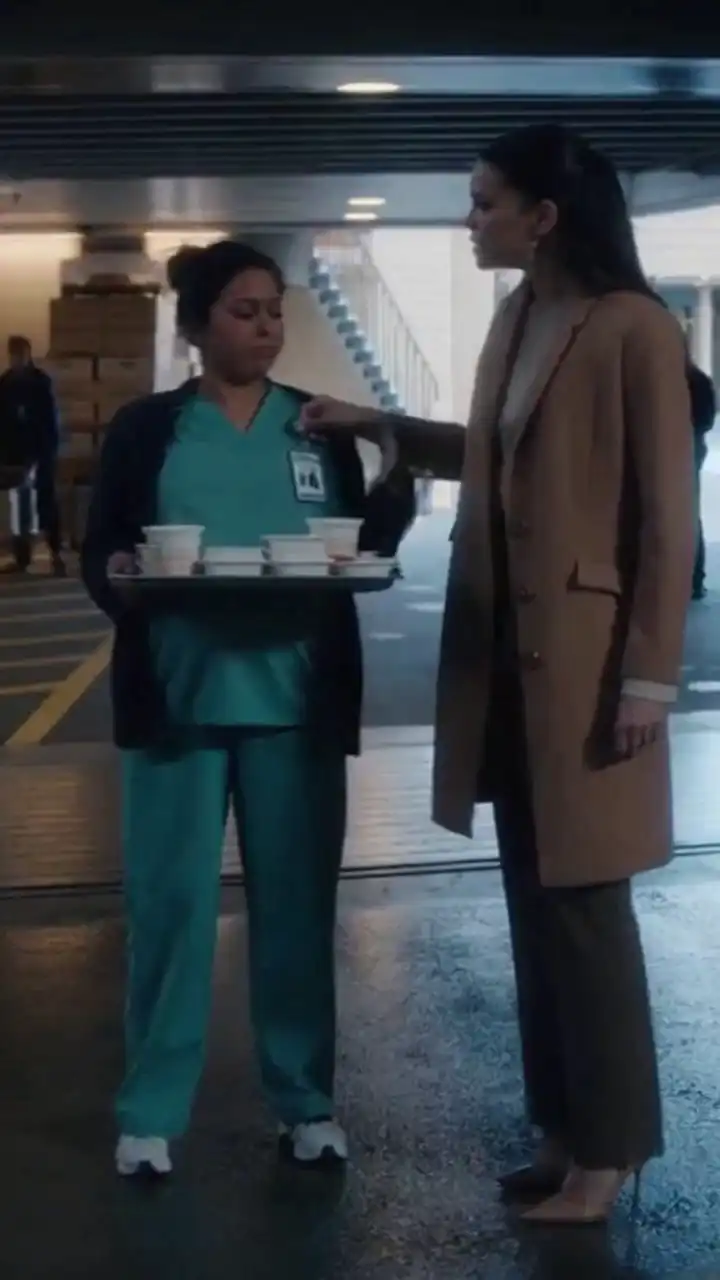
SHE RIPPED THE BADGE OFF A PREGNANT NURSE AIDE IN THE LOADING BAY TO SHOW EVERYONE WHO MATTERED—AND PICKED THE WORST POSSIBLE WITNESS
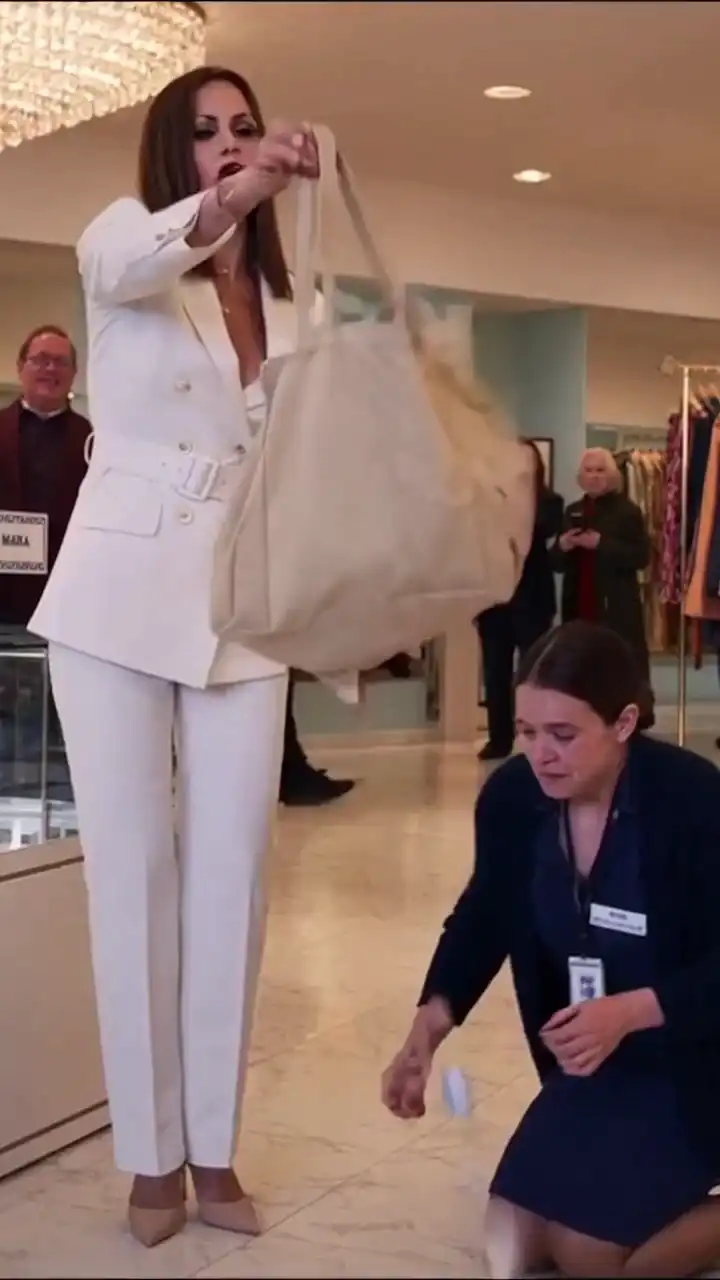
SHE DUMPED A CHURCH VOLUNTEER’S BAG ACROSS THE SHOWROOM FLOOR TO “PROVE A THEFT” — THEN THE QUIET WOMAN BY THE MIRROR SPOKE
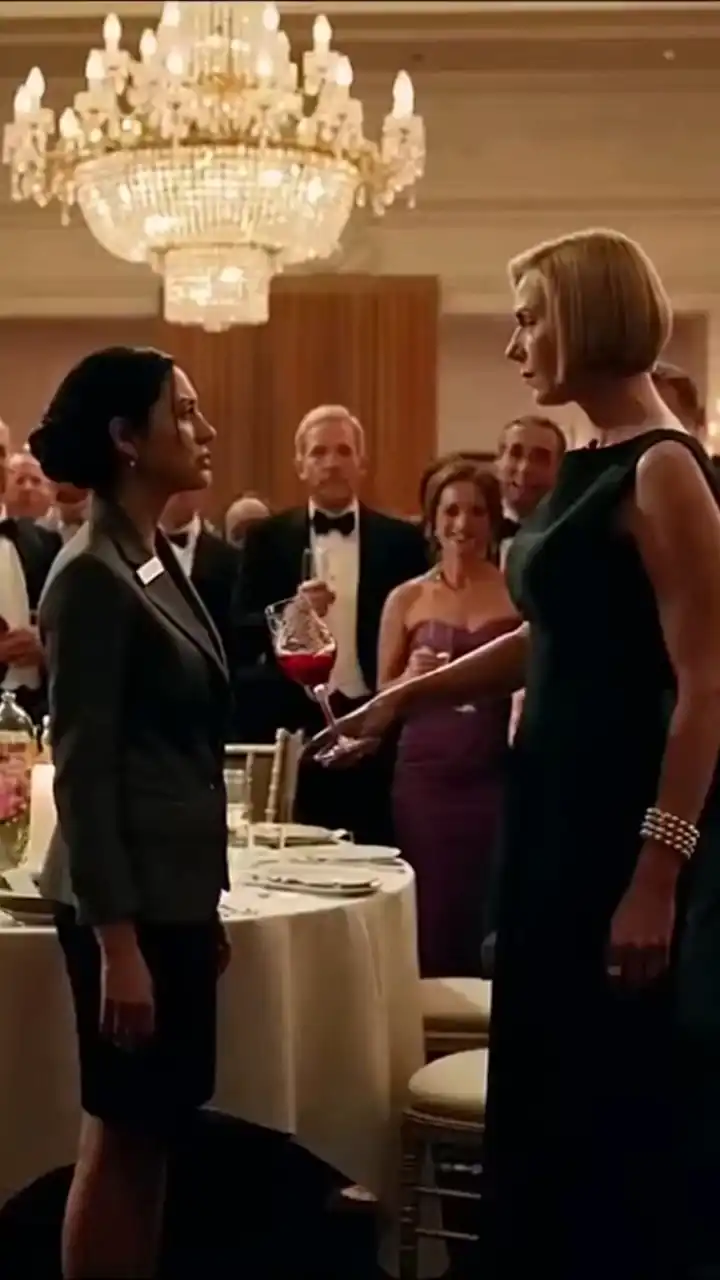
SHE MADE THE “HELP” STAND IN THE BANQUET HALL HOLDING A SPILLED WINE GLASS LIKE A CRIMINAL — UNTIL ONE NAME TURNED THE WHOLE ROOM AGAINST HER