

THE NAME ON MY HUSBANDS GRAVE WAS NEVER HIS AND THE LETTER READ AT DINNER SAID HE WAS STILL ALIVE
Every April, on the first Sunday after the dogwoods bloomed, Corinne Vale put on the same navy dress, drove the same black sedan through the same polished gates of Halcyon Glass Tower, and hosted the same memorial dinner for the man she had buried twelve years earlier.
Her employees called it a tribute.
The board called it legacy stewardship.
Her son had once called it “the saddest dinner in Raleigh with better silverware.”
Corinne had told him not to be disrespectful.
Then he left for graduate school in Seattle, and now the corner seat at her table sat empty except for a folded linen napkin and the ache she never let anyone see.
Halcyon Glass had been her husband’s company before the highway pileup, before the state trooper at her door, before the charred personal effects in a plastic evidence bag and the closed casket that everyone said was for the best. Nolan Vale had built the company from architectural salvage and stubbornness. Corinne had built the part after him—the schedules, the investor calm, the hard face that never trembled in front of staff.
People liked to call her disciplined.
They did not know discipline was sometimes just grief with its jaw locked.
That morning began at Lake Morrow Cemetery, where the air smelled of damp earth and cut stems. A gray sky hung low enough to feel personal. Corinne stood in heels that sank slightly into the grass while the grounds crew arranged white lilies around the granite marker she had paid extra to keep spotless.
NOLAN ELIAS VALE
1974–2014
BELOVED HUSBAND FATHER VISIONARY
She looked at the stone as she always did: not for comfort, but for order. For the simple correctness of a thing that had destroyed her and yet stayed contained within lines and dates.
Her son, Owen, was not there this year. He had called the night before.
“I can’t keep flying in for a ritual you hate,” he told her quietly.
“I don’t hate it.”
“You do. You freeze through it.”
“That’s enough.”
“Mom,” he said, softer now, “Dad is not in that stone.”
She had ended the call after that. Not because it was cruel, but because it was too close to something she had fought for years not to think.
At the cemetery, people from the company stood at a careful distance—senior executives in dark coats, assistants with flowers, one or two longtime vendors who still liked to say Nolan’s name as if proximity to his memory elevated them. Corinne tolerated them for twenty minutes. That was the agreement she had with memory: public grief, then paperwork, then dinner, then sleep.
When the pastor finished, everyone began drifting back toward the cars.
That was when the old woman came down the slope.
She wore a thrift-store camel coat buttoned wrong at the collar and carried a supermarket bouquet wrapped in crackling cellophane. Her shoes were sensible and worn. Her hair, once black, had thinned to a cloud of silver pinned at the nape. No one had invited her. Corinne knew that before the woman even reached the path, because the assistants had that panicked look they got when something unscripted entered executive space.
“Ma’am,” one of them said, stepping forward. “This is a private family—”
The woman raised one hand, not rude, just tired. “I know who she is.”
Corinne should have walked away. Instead she stayed, annoyed by the interruption, annoyed by her own curiosity, annoyed most of all by the old woman’s face, which carried the expression of someone who had lived too long with a sentence in her mouth.
The woman stopped at the headstone and looked down.
Then she said, “That is not your husband.”
The cemetery seemed to go silent in layers.
Corinne heard the distant scrape of a rake, the flap of a funeral tent at another site, a crow somewhere beyond the maples. But close by, around her, every breathing body stilled.
“What did you say?” Corinne asked.
The woman did not look at her immediately. She looked at the name on the stone as if it offended her.
“I said the man buried here was not Nolan Vale.”
One of the executives gave a nervous laugh, the way rich people do when they pray a scene can be dismissed as confusion.
Corinne turned cold from the inside out. “You need to leave.”
“I should have spoken years ago.”
“And yet you didn’t.”
“No.” The woman finally met her eyes. “I was afraid of the woman who had him.”
The sentence was so absurd that Corinne almost dismissed it on contact.
Had him.
Not loved him. Not knew him. Had him.
“I don’t know who you are,” Corinne said.
“My name is Elsbeth Quinn. I cleaned offices in this city for thirty-two years. Night shift. Including your twenty-ninth floor, back when your husband still worked late enough to know the names of the janitors.” Her voice shook once, then steadied. “He wasn’t dead when they took him away from the crash.”
That was too much. Too theatrical. Too impossible.
Corinne felt every eye in the cemetery shift toward her, waiting for command, for outrage, for the neat managerial solution she always produced.
“You are mistaken,” she said.
Elsbeth’s mouth tightened. “No. I am late.”
She bent with visible effort and laid her cheap bouquet against the granite. The wrapped stems slid sideways.
Corinne stepped forward and pulled them away. “Don’t.”
That was sharper than she intended. People flinched.
Elsbeth did not.
“He used to say,” the old woman whispered, “if he ever disappeared on you, you were to check the cuff of his winter coat before you believed any official story.”
Corinne’s fingers went numb around the flowers.
No one knew that.
Not Owen. Not the board. Not her sister. Not even the lawyer who handled the estate.
It was an old private joke from the first apartment she and Nolan shared over a laundromat on Bracey Street. Nolan hated losing things, so he once sewed emergency cash inside the cuff of his coat and told her, laughing, “If I ever vanish, check the cuff before you mourn me.”
A ridiculous line from a life before money.
A line buried so deep in her memory it hurt to hear it aloud.
Her voice came out flat. “Who told you that?”
“He did.”
Corinne stared at her.
Behind them, a gust moved through the cemetery and the lilies leaned toward the stone.
Elsbeth reached into her coat pocket and touched something inside, as if confirming it was still there.
“There’s a letter,” she said. “Sealed. He made me keep it until I saw this dinner happen again. He said if you were still honoring his grave after all these years, then no one had told you the truth.”
Corinne wanted to laugh in her face. Or shout. Or call security. Or collapse, though collapse was not a language she allowed herself.
Instead she said the one thing strict people say when they are terrified.
“This is over.”
But as she turned away from the wrong bouquet, the wrong woman, the impossible sentence, she looked back once at the stone she had worshiped with discipline for twelve years.
And for the first time, she saw not comfort in its clean authority, but a question.
The memorial dinner began at seven on the executive floor of Halcyon Glass Tower, where the windows looked out over the city like a polished threat. The event was held each year in the Atlas Room, a long private dining space paneled in walnut, with smoked-glass sconces and a view of downtown Raleigh stretching in silver and rain.
Nolan had loved views from high places.
Corinne had never asked whether that was ambition or warning.
By six forty-five, the guests had gathered with the familiar choreography of grief mixed with networking. Senior partners from Vale Urban Holdings stood near the bar. Two board members discussed zoning reforms in lowered voices. The communications director made sure the framed memorial photo—Nolan in shirtsleeves, laughing at something outside the frame—was angled under the warmest light.
Corinne stood near the head of the table accepting condolences she had heard so often they had become a dead language.
“He’d be proud of what you built.”
“His vision lives through you.”
“You’ve carried this family with such strength.”
Strength. Vision. Legacy.
No one ever said loneliness. No one ever said fear. No one ever said perhaps the thing you buried was never the truth.
At six fifty-eight, her chief of staff, Mariana Sloat, approached with a careful expression.
“There’s a woman downstairs insisting she was invited,” Mariana murmured. “Older. No badge. Security can remove her.”
Corinne’s stomach tightened.
“No scene,” she said.
“Should I send her away?”
Corinne looked toward the rain-dark windows. She should have said yes.
Instead: “Bring her up through service.”
Mariana blinked. “Corinne—”
“Do it quietly.”
Elsbeth Quinn entered the Atlas Room ten minutes later through the side corridor used by catering staff. She looked even more out of place under the soft executive lighting than she had in the cemetery. Her coat was damp at the hem. Her hands were gloved with the fingertips worn pale. Conversations stalled as she crossed the threshold.
The social gap in the room was brutal and immediate. The people at the table had watches worth more than her monthly rent. They smelled of cedar cologne, dry cleaning, and expensive restraint. Elsbeth smelled faintly of rain and old paper.
Mariana tried one last time. “This really isn’t appropriate.”
Elsbeth answered without looking at her. “Neither is letting a woman grieve over the wrong grave for twelve years.”
The room went fully silent.
Corinne felt anger rise because anger was easier to manage than terror. “You have two minutes.”
Elsbeth looked at the table, at the memorial photo, at the place settings arranged with military precision.
“I used to clean this floor after midnight,” she said. “Your husband always stayed later than the others. He’d wipe down his own desk before he left because he said he felt guilty watching someone else clean up after him.” Her eyes moved to Corinne. “The night before the crash, he told me if anything happened to him, and if a woman named Lena came asking questions, I was not to trust her.”
There it was. The second impossible thing.
Lena.
Lena Mercer.
The woman Nolan had once dated in college, who resurfaced as a consultant during the company expansion and, after his death, somehow became indispensable to the transition. Lena had handled vendor chaos, media calls, and estate logistics with almost frightening efficiency. She had also, three years later, quietly become Corinne’s closest operational ally. Not friend. Corinne did not use that word lightly. But ally, yes.
No one in this room knew that Nolan had mentioned Lena with unease in the weeks before he died. Corinne had almost forgotten it because grief had buried everything not directly tied to survival.
“You’re lying,” Corinne said.
Elsbeth nodded once, as if she had expected no other answer. “Then let the dead man speak.”
She took a sealed envelope from inside her coat.
The paper was yellowed at the edges, thick, old-fashioned, the flap closed with dark wax long cracked but still intact enough to show it had never been opened. Across the front, in large slanted handwriting that hit Corinne in the chest like impact, were four words:
FOR CORINNE IF NEEDED
Her knees nearly unlocked under her.
One of the board members stood. “This is insane. Corinne, this should be handled privately.”
But the room itself had become part of the ritual now. The memorial dinner had been interrupted, and with it the polished story everyone lived inside. A sealed letter in front of Nolan’s portrait. An old cleaner carrying it like a final debt.
Public grief had just become public danger.
Corinne’s hand hovered over the envelope but would not touch it.
“Where did you get that?” she asked.
“He gave it to me in the loading bay behind this building. Two nights after the crash was reported.” Elsbeth swallowed. “He had a bandage around his head. He was limping. There was a little girl in the back seat of the car.”
The words hit oddly. Not first as jealousy. Not first as betrayal.
First as impossibility.
“What little girl?”
“I don’t know her name. He said only this: ‘If I don’t come back, give my wife the letter when she stands at a grave that isn’t mine.’” Elsbeth’s eyes filled. “I thought he was confused. Hurt. I thought he would come back the next day. Then Lena Mercer found me.”
A pulse started beating at Corinne’s temple.
“What did Lena say?”
“She said Mr. Vale had suffered delusions after the accident. Said he had gone into psychiatric care. Said if I repeated anything, I could hurt his son and destroy the company. She offered me money. I refused. Then she told me where my grandson’s foster review was being held and reminded me that some women lose children over instability.” Elsbeth’s voice broke. “So I kept quiet.”
No one moved.
At the far end of the table, one of the younger executives whispered, “Jesus.”
Corinne took the envelope at last.
The paper was dry, delicate, and real under her fingers. Her husband’s handwriting was not something she could mistake. He made his capital F with a narrow top stroke and pressed too hard on the downward line.
Mariana said quietly, “Do you want me to clear the room?”
Corinne looked around at the faces—shocked, hungry, embarrassed, frightened of witnessing what they had no right to see.
“No,” she said.
She did not know why she said it. Maybe because the dinner had always been theater. Maybe because if the lie had lived in public ritual, the first crack should happen there too.
She slid her thumb under the old wax and opened the letter.
Inside was a single sheet, folded twice.
Her hands shook as she read the first line.
If you are hearing this read over a grave with my name on it then I failed you worse than I knew possible
Her breath caught hard enough that Mariana stepped toward her.
“Read it,” Elsbeth whispered. “Out loud.”
Corinne almost refused. Then she heard Nolan’s voice in the strokes on the page, impatient with ceremony, and she began.
“If you are hearing this read over a grave with my name on it, then I failed you worse than I knew possible. I was taken from the crash before police logged me because Lena said a child would die if I did not come with her. The child is mine.”
A sound rippled through the room.
Corinne stopped reading.
Her face did not move. That was the terrifying part. It was as if every muscle had left her body at once, leaving only posture.
“No,” she said softly.
Elsbeth looked at her with terrible pity. “Keep going.”
Corinne stared at the page until the words steadied again.
“She told me the girl had been hidden from me for six years. She said if I went to authorities before seeing the child safe, she would disappear with her. If I am gone, know this first: the grave is false. Second: the child did nothing wrong. Third: don’t trust any record Lena controls.”
There were more lines, but Corinne could not see them through the white noise roaring in her ears.
A child.
Not just a hidden woman. Not just survival. A child.
A whole second life concealed behind the official death of the man she had buried.
The room seemed to tilt around her.
And somewhere beneath the shock, beneath the humiliation, beneath the rage rising black and hot in her throat, another feeling broke through—the first crack in twelve years of control.
Not because Nolan had betrayed her.
Because he had been alive after the crash.
Alive.
Corinne did not remember dismissing the guests, but by eight fifteen the Atlas Room had emptied itself of witnesses. Plates sat untouched. Wine sweated in glasses no one had finished. Nolan’s memorial photo remained propped under warm light, his grin now feeling less like memory than accusation.
Only four people stayed: Corinne, Mariana, Elsbeth Quinn, and Halcyon’s general counsel, Russell Dane, who had looked gray since the letter’s first line and refused to leave without advising caution.
“Call the police,” Russell said for the third time.
“And tell them what?” Corinne snapped. “That an old woman walked in with my dead husband’s handwriting and a story about a secret child?”
“That your husband may have been abducted.”
“Twelve years ago.”
“That doesn’t make it less criminal.”
Corinne turned away from him. Her hands were still trembling, but anger now gave them purpose. She laid the letter flat on the dining table and read the remaining lines again.
There were no grand declarations in it. That was what made it feel so brutally Nolan. Direct. Mechanical under pressure. A man writing while afraid and trying not to sound afraid.
He wrote that Lena Mercer had called him after the crash, using a number he did not recognize. He wrote that she knew details no outsider should know about his route home and the pileup on I-87. He wrote that she said the girl—“my daughter, Corinne, and I cannot pretend otherwise”—had a fever and was in danger with people Lena no longer trusted. He wrote that he got into a car because he believed he had hours to fix one hidden wrong before coming home to confess everything.
Then, in one line pressed so hard the paper nearly tore, he wrote:
If anything happens next it will not be because I chose her over you
Corinne read that line three times.
Not forgiveness. Not absolution.
Just truth. Or what might be truth. A terrible human truth, not a clean one.
She swallowed and looked at Elsbeth. “You said the grave is false. How do you know?”
Elsbeth reached again into her coat and removed something else: a photograph, creased and faded. It showed a coffin tag tied to a metal handle. The image was grainy, clearly old, likely taken in secret with a cheap phone or disposable camera. But the printed name on the tag was visible enough to freeze the room.
N. E. VAIL
Not Vale.
Vail.
One letter off. Small enough to pass through chaos. Large enough to bury the wrong man.
Russell took the photo first, cursing under his breath. “This could be manipulated.”
“It’s from 2014,” Elsbeth said. “I had my nephew print it. I took it the day of the casket transfer behind Briar Glen Funeral Services.”
Corinne looked up sharply. Briar Glen had handled the closed-casket arrangements after the crash because the county morgue had been overwhelmed. She remembered signing documents in a room that smelled of carnations and copier toner. She remembered a funeral director speaking gently and too quickly. She remembered not insisting on seeing the body because she had been told there was trauma and because Owen, then fourteen, was already breaking.
“What were you doing there?” Corinne asked.
“I had a second job changing linens and mopping prep rooms. Temporary work.” Elsbeth looked ashamed and stubborn at once. “I saw the tag when they rolled the casket through receiving. I thought maybe I had read it wrong. Then I saw Lena in the back office with the director.”
Corinne’s pulse thudded. “You told no one.”
“I told the funeral director I thought the tag was wrong. He said I must have mistaken it. Later that afternoon Lena found me in the alley and said if I valued my grandson staying with me, I would learn the difference between a misspelling and a life I could ruin.”
Mariana exhaled sharply. “My God.”
Elsbeth looked at Corinne. “I was a coward.”
“No,” Corinne said, though she did not know if she meant it. “You were threatened.”
There was an exhausted honesty in Elsbeth’s face that made polished lies look childish by comparison. It did not erase the years. It did not erase the silence. But it gave the silence shape.
Russell put the photo down. “Even if this is authentic, a name discrepancy on a coffin tag does not prove Nolan survived long-term.”
“No,” Corinne said. “But it proves the certainty I built my life on was manufactured.”
She picked up her phone and searched the archived digital folder she had not opened in years: death certificate, funeral invoice, transportation release, insurance filings. The documents were scanned and neat and official. She enlarged the transportation release and felt the blood leave her face.
TRANSFERD DECEDENT
N E VAIL
It had been there all along. Hidden in grief, in administrative haze, in the way the mind reads what it expects to read.
“I signed this,” she whispered.
Russell leaned over. “Corinne, you signed twenty-seven forms in two days.”
“I signed his death.”
“No. You signed what they placed in front of a traumatized widow.”
The room was too warm. She walked to the window and pressed two fingers to the glass. Far below, headlights moved through rain like nervous veins.
A child is mine.
The sentence from the letter kept returning, not because it was the worst part, but because it widened the wound beyond widowhood. Somewhere in the city—or somewhere beyond it—there had been a little girl when Nolan wrote that letter. A child hidden in whatever shadow-world Lena Mercer had built around him.
“How old would she be now?” Mariana asked quietly.
Corinne closed her eyes. “Eighteen. Maybe nineteen.”
A whole human life.
Lived while Corinne lit candles under a false grave.
She turned back. “Where is Lena?”
Russell answered first. “Her consulting firm dissolved six years ago. Last known business address was in Durham. She vanished off most formal records after that.”
“People do not simply vanish,” Corinne said.
“They do if someone helps them.”
Elsbeth, who had been silent for a full minute, said, “I know one place she used to go.”
All three turned to her.
“There was a subsidized apartment complex off Radnor Street in East Haven,” she said. “Not Durham. Here. Hidden in plain sight. She used to pay cash for a woman there to watch the child. I cleaned that building for a while too.” Her eyes lowered. “I saw him once more. Your husband.”
No one breathed.
“When?”
“About three months after the funeral.”
Corinne gripped the back of a chair.
“He was thinner. Beard grown in. He looked… scared in a way grown men don’t like to be seen. The child was with him on the stairwell landing. She had a pink plastic raincoat and one shoe untied. He saw me and put his finger to his lips.”
“What did he say?” Corinne asked.
Elsbeth’s answer came in a whisper.
“He said, ‘Tell my wife I’m sorry if I don’t get out.’”
Corinne sat down because her legs gave out all at once.
The collapse was soundless, controlled even in its failure, but it was collapse.
Mariana knelt beside her. “Corinne.”
For years Corinne had survived by refusing the room inside herself where hope and pain touched. Now someone had kicked the door open.
Alive after the crash. Hidden. Afraid. Sorry.
And then what?
Dead later? Trapped? Forced away? Willing gone?
That uncertainty hurt more than widowhood ever had because widowhood at least had a shape.
She looked again at the coffin tag photo. N. E. VAIL.
One wrong letter. One false grave. One manufactured ending.
“Get me the file from Briar Glen,” she said to Russell.
“Tonight?”
“Tonight.”
“They may refuse.”
“Then wake up whoever owns the building and remind them how many funerals this company has funded through its charitable arm.”
Russell straightened. “Done.”
Corinne turned to Elsbeth. “And you are coming with me to Radnor Street.”
Elsbeth blinked. “Now?”
“Yes.”
“It’s late.”
“It has been late for twelve years.”
Rain struck the windows harder, streaking the city into broken lines. Somewhere in that rain was an apartment building, a stairwell, and the ghost of a man who might not have died where his name said he did.
Corinne took the letter, the photo, and her coat.
For the first time since the day of the crash, she was not going home after Nolan’s memorial dinner.
She was going after him.
East Haven was only fifteen minutes from downtown if you took the connector and didn’t mind the industrial stretch by the tracks, but it felt like another civic planet. Halcyon’s tower had glass elevators and biometric security. Radnor Street had chain-link fences, flickering laundromat signs, and porches held together by paint and weather.
The apartment complex Elsbeth led them to was called Juniper Court, though there were no junipers in sight. Three low brick buildings curved around a cracked central lot where rainwater had collected in black pools. A rusted play structure leaned behind one building. In one second-floor window, a blue TV glow lit a stack of moving boxes. In another, someone smoked with the curtain half-open.
Corinne stepped out of the car and nearly slipped on wet pavement. She had never worn this coat in a place like this. She knew how that sounded. The thought shamed her and also made her more alert. Whole worlds had existed under her city, under her company’s shadow, under her grief.
Mariana had insisted on coming. Russell had gone to Briar Glen and promised to call. So now it was Corinne, Mariana, and Elsbeth crossing the lot under a failing streetlamp.
“Building C,” Elsbeth said. “Second floor. Apartment 2B. The watcher’s name was Darlis Boone.”
“Was?” Corinne asked.
“She’d be old now. If she’s still alive.”
The stairwell smelled of bleach, mildew, and fried onions. On the second floor landing, Elsbeth stopped and touched the rail.
“This is where I saw him,” she said softly. “Right here.”
Corinne looked at the landing. Concrete, chipped paint, a child’s sticker faded on the wall. Not sacred. Not cinematic. Just ordinary space, which somehow made the possibility of Nolan’s hidden life even more devastating. People imagine betrayal in hotel rooms and dramatic exits. Real damage often happens in stairwells under bad lights.
Mariana knocked on 2B.
Nothing.
She knocked harder.
At last a chain rattled and the door opened two inches. An elderly woman peered out, one eye cloudy, a housecoat buttoned unevenly over a T-shirt. The apartment behind her was dark except for a lamp.
“Who’s asking?”
“Darlis Boone?” Elsbeth said.
The woman squinted. “Who wants to know?”
“Elsbeth Quinn.”
The old woman’s face changed. Not recognition first. Fear.
“No,” Darlis said immediately. “No, ma’am. Wrong time.”
Corinne stepped forward. “I need to ask you about Nolan Vale.”
The door tried to close. Mariana’s hand shot out and stopped it.
“Please,” Mariana said. “No one is here to hurt you.”
Darlis stared at Corinne’s face. Then at the expensive coat, the controlled posture, the desperation no amount of breeding could hide. Something in her seemed to give way.
“You better come in before anybody sees.”
The apartment was small and overheated. Plastic runners covered the carpet. A humidifier rattled in the corner. Family photos lined one wall, though Corinne noticed most of them held grandchildren and church hats and birthdays, not the people she came for.
Darlis lowered herself into a recliner and pointed them to the couch. “I don’t know what all you think you’re going to get from me.”
“The truth,” Corinne said.
Darlis gave a dry laugh. “Truth always comes too late.”
Elsbeth stood rather than sit. “You watched the girl.”
Darlis glared at her. “And you watched too.”
The shot landed because it was true.
Corinne said, “There was a child.”
“There was.”
“Nolan’s?”
Darlis folded and unfolded a tissue in her lap. “That’s what Lena said. Then later that’s what he believed. And then later still…” She looked up. “Later still, it got messier.”
Corinne’s voice sharpened. “Start at the beginning.”
So Darlis did, in the way old women sometimes tell horrifying things through domestic detail.
Lena Mercer had shown up at Juniper Court thirteen years earlier with a little girl named Ivy and enough cash to cover six months at a time. She said she traveled for work and needed someone discreet. She liked Darlis because Darlis had once raised two foster boys and “didn’t ask white-people questions,” as she put it with bitterness.
The girl was quiet, bright, and chronically watchful. She drew windows. She lined up spoons by size. She hated sirens. Sometimes a man came—Nolan, though Darlis hadn’t known his name at first. He brought books, fruit, and children’s medicine. He looked at the girl with a guilt so heavy Darlis noticed it before love.
“He was not living there?” Corinne asked.
“No. Not at first. He came in secret.”
“And later?”
Darlis hesitated.
Mariana leaned in. “Later what?”
“Later,” Darlis said, “after the crash, he stayed.”
The room went silent again.
Corinne felt every word entering her body like glass.
“For how long?”
“Off and on near a year. Maybe a little more. Hard to say. Lena moved them twice. Kept saying people were asking questions.”
“Did he try to contact me?”
Darlis looked at her with something almost like accusation. “Every day he said he would.”
“Then why didn’t he?”
“Because every time he pushed, Lena told him she’d take the girl where he’d never find her. She had school papers, fake lease names, medical cards. She knew how to disappear poor.” Darlis’s mouth tightened. “Rich folks think hiding is offshore accounts. Real hiding is when nobody in the system notices another child in a cheap coat.”
Corinne swallowed hard.
“She had leverage,” Darlis continued. “She said if he showed his face as alive before she was ready, she would tell the police he staged everything himself and kidnapped the child. Maybe they’d believe him, maybe not. But while they sorted it out, she’d be gone.” She looked down at the tissue. “He was trying to get the girl away clean.”
“Did he?” Corinne asked.
Darlis’s eyes filled. “No.”
The word hung there.
“What happened to him?” Corinne asked, and now the question sounded less like command than plea.
Before Darlis could answer, Corinne’s phone rang. Russell.
She answered at once. “Tell me.”
His voice was clipped. “I got into Briar Glen’s old archive with the owner on speaker. There’s no intake photo for Nolan Vale.”
“There should have been.”
“There is one for a body transferred from county overflow under the name Nathaniel Elias Vail. Highway pileup victim. Similar age. Severe burns.”
Corinne closed her eyes.
Russell continued, “And Corinne… the funeral director who signed your file retired three months later. Dead now. But there’s a notation added by hand to your transfer packet.”
“What notation?”
“Heavy instruction from family liaison Lena Mercer expedite no viewing due to trauma concerns.”
Family liaison.
Lena had inserted herself everywhere.
Darlis watched Corinne’s face and seemed to understand enough. “I told that woman she was wicked,” she muttered.
“What happened to my husband?” Corinne repeated.
Darlis looked toward the hallway, then back at them.
“There’s something I kept because I always thought somebody would come one day asking right.” She rose slowly, shuffled to a bedroom, and returned with a cracked plastic file box. From it she pulled a school composition notebook decorated with peeling butterfly stickers.
“Ivy used to draw in this,” she said. “One page is for you.”
Corinne took it carefully.
Most pages held a child’s world: crooked apartments, a blue cup, a woman with yellow hair who could only be Lena, an old woman in a pink robe likely Darlis. Then near the middle, a drawing in thicker pencil. A man with dark hair standing on a stairwell. Beside him, a little girl in a raincoat. Above them, in a child’s careful block letters:
DADDY SAID WAIT FOR MOM
Corinne made a broken sound she had not made in any room since 2014.
Mariana put a hand to her back.
Darlis spoke quietly now. “He told that girl for months that he was taking her to her mother. She used to ask, ‘Which one?’”
Corinne looked up sharply.
“Which one?” she repeated.
Darlis nodded. “That’s why I said it got messier. Lena told the child she was her mother. Then one day after a fight, the man told Ivy, ‘She gave birth to you but she is not the mother who should have raised you.’ I heard it through the wall.”
The first truth had already torn the floor open. Now another layer shifted beneath it.
“Where is Ivy?” Corinne asked.
Darlis pressed her lips together. “Gone. About ten years now.”
“With Lena?”
“No.” Darlis shook her head. “That’s the part I can give you. One winter night the man disappeared. Not ran off. Disappeared. Lena came back alone, frantic, throwing things into bags. Three days later social services came because somebody had reported neglect under one of Lena’s fake names. She vanished before they arrived. The child was taken into temporary care.”
Corinne’s chest tightened. “You’re telling me my husband vanished and his daughter went into the system.”
“Yes.”
“Why didn’t you testify? Why didn’t you tell them who she was?”
Darlis’s face hardened with shame. “Because by then Lena had papers saying the father was dead in a crash and the mother was traveling under treatment. Because I had priors from forty years ago and knew what officials hear when old Black women from cheap apartments start telling stories about rich men and hidden children.” She looked straight at Corinne. “Because I was afraid they’d think I was stealing somebody else’s tragedy.”
No one in the room had a clean soul anymore. That was what Corinne understood in that moment. Not even herself. She had trusted documents because documents let her survive. Others had stayed silent because silence let them keep children, housing, jobs, breath.
Mariana asked, “Did the child keep the name Ivy?”
“I don’t know. But I know where they first sent her.” Darlis reached back into the file box and pulled out a photocopied intake slip from a county family services office. “Maple Haven Assessment Center. It shut down years ago, but records moved to the county youth services branch.”
Corinne took it.
At the bottom, under child’s temporary alias, someone had written in pencil:
Ivy M
repeats phrase daddy said wait for mom
Corinne pressed the paper to her chest for one impossible second.
Then her phone buzzed with a message from Owen.
How did the dinner go
She stared at the screen.
How did the dinner go.
How do you answer your son when your dead husband may have lived, may have loved another child, may have been imprisoned by lies, and may have vanished trying to return?
She typed only: I need you home.
Then she looked at Darlis.
“One more question,” she said. “Did Nolan leave willingly at the end?”
Darlis’s answer came slow and careful.
“No. The last time I saw him, he had blood on his sleeve and he told the girl, ‘If she says I abandoned you, don’t believe that.’”
The room seemed to shrink.
Corinne rose with the notebook, the intake slip, the coffin-tag photo, and the letter. Her life had become evidence, but none of it felt procedural. Every page breathed.
At the door, Darlis spoke one last time.
“If you find the child first,” she said, “don’t make her pay for what he did. And don’t make her pay for what he failed to do.”
Corinne turned.
“What if I find him first?”
Darlis held her gaze. “Then make him tell you why he stayed gone.”
County Youth Services kept its archived files in a low brick annex behind the newer administration building off Colfax Avenue. At nine the next morning, the place smelled of stale coffee, old paper, and industrial carpet shampoo. The fluorescent lights flattened everyone equally, which Corinne almost appreciated. Grief, wealth, and status all looked sick under those lights.
Russell had managed to get them access through a board connection and a threat involving litigation over historic records tampering. Corinne came with Mariana, Elsbeth, and, to her own surprise, Owen—who had landed at dawn after receiving her message and one shattered midnight call.
He was twenty-six now, tall like Nolan but softer in the face, with glasses he removed when overwhelmed. He had listened to the entire story in Corinne’s kitchen without interrupting. When she finished, he sat for a long time staring at his hands.
Then he said, “So Dad might have cheated on you, had a daughter, got trapped with Lena, tried to come back, and someone buried a stranger in his place.”
“Yes.”
“That’s… not a sentence people practice for.”
“No.”
After another silence, he asked the question she had dreaded.
“If he was alive, why didn’t he get to us?”
Corinne had no answer then.
She still didn’t.
A records supervisor named Patrice Mays brought them three archive cartons and a legal pad for signing review notes. “Maple Haven closed in 2019,” she said. “A lot of those intakes were messy. Children came in under aliases, emergency names, incomplete guardianship reports.”
“We’re looking for a girl first documented as Ivy M approximately ten years ago,” Mariana said.
Patrice nodded. “We found one possible transfer trail. Emergency hold, then foster placement, then name change petition attached to later kinship review.”
“Kinship with whom?” Corinne asked.
Patrice opened the first file. “That’s where it gets unusual.”
Inside were photocopies, intake summaries, medication notes, and school transfer sheets. A child with large brown eyes stared from one assessment photo, hair unevenly cut, mouth set in wary determination. Age estimated eight. Temporary name Ivy Monroe.
Under behavioral notes: Repeats phrase during distress “Daddy said wait for mom” Draws stairwells windows and office buildings Resists name Ivy at times responds to Mae
Corinne touched the photo with one finger.
Owen leaned over her shoulder and inhaled sharply. “She has Dad’s ears.”
The resemblance was not theatrical. Not some miraculous perfect mirror. It was worse than that—small, precise, undeniable things. The slope of the eyelids. The crease by the mouth. Family lived there.
Patrice turned another page. “After six months in emergency foster care, child was moved under kinship exception to guardian listed as Alana Mercer.”
The room chilled.
“Lena,” Corinne said.
“No,” Patrice replied. “Alana Mercer. Birth year 1997. Relationship listed as maternal half-sister newly adult.”
Owen frowned. “That makes no sense.”
Elsbeth suddenly gripped the edge of the table. “The little girl in the car,” she whispered. “There was another child once. Older. I forgot because she wasn’t there long. Lena brought her to the loading bay one night. A teen.”
Patrice found the attached note. “There’s more. Alana Mercer petitioned for custody at eighteen, claiming she had been raising the child informally for years while their mother was unstable.”
Corinne read the name again.
Alana Mercer.
Not Lena’s daughter’s full appearance in the story, but proof enough that the hidden world had been larger than one child and one lie.
“Where is she now?” Corinne asked.
Patrice checked the system. “Current guardian address appears active. Miller’s Reach, just outside Garner. But before I print anything, I need authorization because this person may not know—”
“I am the widow of the father listed nowhere because someone falsified his death,” Corinne said, too sharply.
Patrice held her ground. “And she may be the one who kept the girl alive. We do this carefully.”
That sentence steadied the room.
Fifteen minutes later they sat in a conference cube with a printed address and a second file, this one for Alana Mercer. Community college withdrawals. Wage records from a grocery warehouse. One misdemeanor shoplifting charge dismissed. No major flags. No evidence of the manipulative polished violence Lena carried.
At the back of the file lay the hidden truth that split the story open wider.
A copy of a birth certificate amendment.
ALANA MERCER
Mother: Lena Mercer
Father: blank
Filed two years after birth by delayed registration.
Tucked behind it, mis-scanned and barely legible, was an older clinic intake sheet listing infant Alana under another surname and a note in a nurse’s cramped handwriting:
Father reported as Nolan Vale pending paternity discussion
Corinne stared until the letters blurred.
Owen read it and stepped back as if struck. “No.”
Patrice, not understanding the full blast radius, said gently, “Sometimes early records contradict later filings.”
But Corinne understood.
Lena had not just hidden one child.
She had hidden two.
Or rather, she had hidden one for years and used the older one as the scaffold for all the rest. Nolan’s affair or relationship with Lena had not produced a single secret crisis. It had produced a whole shadow family architecture—one child perhaps before his marriage or during some break, another later, and then years of manipulation built on his shame.
Elsbeth covered her mouth. “Lord help us.”
Owen’s face had gone white. “He knew?”
“I don’t know,” Corinne said, though she suddenly feared he had known part and not all.
There it was—the second twist, the morally larger truth behind the first one. The grave was false, yes. Nolan had lived after the crash, yes. But beneath that lay the real devastation: Lena had kept control not merely with one hidden daughter but with a secret history stretching back decades. A history Nolan had helped create, conceal, or fail.
Russell called then from his car, and Corinne put him on speaker.
“I found something on Lena,” he said. “Not under Mercer. Under a later name—Lena Morrow. She died eighteen months ago in Alamance County.”
Corinne gripped the phone. “Dead?”
“Pancreatic cancer. Sparse assets. One hospice note names emergency contact as Alana Morrow Mercer.”
“Did she leave anything?”
“A storage unit paid through date of death. It’s been delinquent since.”
Corinne looked at Owen. “We go there after Miller’s Reach.”
They drove south under a hard white noon sky. Miller’s Reach was a modest mobile-home community tucked behind a feed store and a tire shop, with neat gravel drives and porches decorated by hanging ferns. Children rode bikes between lots. Laundry moved on lines in the wind. It was clean in the way places stay clean when people have little and protect what they can.
Lot 14 had a blue ramp, two plastic chairs, and a row of tomato buckets.
When Corinne knocked, a young woman opened the door with a toddler on her hip and suspicion already sharpened in her face. She was twenty-eight or twenty-nine, dark-haired, beautiful in the tired unguarded way of people working too hard to curate themselves. Her eyes were Nolan’s. Not exactly. Enough.
“Can I help you?”
Corinne forgot every prepared line.
Alana’s gaze moved from one face to another, then stopped on Elsbeth. Something old flickered there.
“You,” Alana said.
Elsbeth nodded with tears already in her eyes. “Me.”
The toddler squirmed. A little boy, maybe two.
Alana shifted him and looked at Corinne again. “Why are you here?”
Corinne held out the butterfly notebook.
Alana went absolutely still.
“Where did you get that?”
“From Darlis Boone.”
A beat.
Then Alana said the quiet recognition line that changed the air.
“So he finally reached you.”
Not he came back. Not you found us.
He finally reached you.
Corinne’s throat tightened. “You knew who I was?”
“Always.”
“Then where is Nolan?”
Alana looked down at the toddler. “Jasper, go sit with your cartoons.” Her voice was gentle but firm. The boy obeyed, padding into the next room with total trust.
Alana opened the door wider. “Come in. But if you came for easy forgiveness, you can leave now.”
Inside, the home was small but warm, with thrifted furniture, crayon art on the fridge, and a jar of wooden clothespins by the sink. There on the mantel stood a photo turned face down.
Alana noticed Corinne notice it. She walked over and set it upright.
Nolan, older, beard threaded with gray, seated in a folding chair outside this very trailer. Beside him stood two girls: one around sixteen, wary and unsmiling—surely Mae, once Ivy—and another younger neighbor child perhaps. Alana stood behind the chair with one hand on his shoulder. The picture was only six years old.
Corinne felt the room tilt.
“He’s alive,” she whispered.
Alana’s face hardened, but grief moved under it. “Yes.”
“Where is he?”
“At Saint Brigid’s Transitional Care outside Benson.” She swallowed. “Stroke. Two years ago. Partial speech. Wheelchair now. Some days he remembers everything. Some days he remembers only us. He asked for you. I said no.”
Owen made a sound of disbelief. “You kept him from us?”
Alana swung toward him with sudden fire. “He kept himself from you long before I had that power.”
The truth landed because it was not entirely false.
Corinne stared at her. “Why?”
Alana’s eyes filled but did not soften. “Because by the time he found Mae back through the system, by the time he found me too, by the time Lena was dying and finally losing her grip, he was not a trapped man anymore. He was a guilty one. And guilt is not the same as love.”
The sentence cut clean.
Corinne had imagined rescue, coercion, maybe even imprisonment. But here was the unbearable human middle: a man who had been manipulated and endangered, yes, but who had also, once the bars loosened, failed to walk home in time.
Alana said, very quietly, “You deserve the full truth. So does Mae. But don’t come in here asking me to excuse what his silence did to all of us.”
Saint Brigid’s Transitional Care sat beyond a row of bare pecan trees and a pond filmed with afternoon light. It was one of those private religious facilities people barely notice until someone they love disappears inside it. Brick chapel. Low buildings. A nurse at the desk with kind eyes and tired shoes.
Corinne signed in with a hand that no longer belonged to the woman who had hosted memorial dinners.
Owen stood beside her. Alana waited near the window, arms folded tight, not from cold but from the strain of bringing two destroyed worlds into one hallway. Elsbeth had stayed in the car. She said she had already watched enough doors open too late.
Mae did not come. Alana said that was not negotiable. “She’ll decide for herself,” she said. “She spent enough of her life being delivered to adults without warning.”
Corinne accepted that. Barely.
The nurse led them to a room at the end of the hall.
Nolan sat by the window in a wheelchair with a blanket over his knees and a book open in his lap, though he was not reading. He had become smaller. That was the first shock. Not older—smaller. As if years of hiding and then illness had reduced the physical claim he once made on every room. His hair had gone silver at the temples. One side of his mouth rested lower from the stroke. His left hand lay curled on the blanket.
He turned at the sound of the door.
For one suspended second, no one moved.
Then Nolan looked at Corinne and said, with terrible effort and absolute recognition, “You came.”
All the speeches she might have imagined were gone.
Corinne stood in the doorway and cried for the first time in front of him.
Not elegantly. Not quietly. Not with disciplined tears that can be blotted and managed. Her body simply gave up its long contract with control. She covered her mouth and bent in on herself, and the sound that came out was the sound of twelve stolen years finding air.
Owen caught her elbow.
Nolan began to cry too, helplessly, angrily, like a man ashamed of needing his own face to do what it would now do.
“Corinne,” he said, and her name broke in the middle.
She walked to him at last.
Not to embrace him. Not yet.
Just close enough to see the scar by his hairline, pale and old. Close enough to smell soap and hospital linen. Close enough to know the dead had become flesh and failure and consequence.
“You let me bury a stranger,” she said.
He shut his eyes.
“Yes.”
“You let your son grow up at a grave.”
Tears moved into his beard. “Yes.”
“You let another daughter grow up hidden.”
His good hand shook. “Yes.”
Each yes was not defense. That almost made it worse.
Owen stepped forward then, years of restrained father-hunger cracking through his adulthood. “Why didn’t you come home?”
Nolan looked at him for a long time before answering.
“At first… trapped.” He struggled for breath, for words. “Then… ashamed. Then… time got bigger than me.”
Corinne stared at him.
It was not enough. It would never be enough. But it was horrifyingly human.
He looked at her again. “Lena had Alana… before us. I knew. I sent money. Coward.” He swallowed. “Didn’t know Mae… till later. She used both girls… to own every choice.”
Corinne felt cold settle around the truth. There it was, stripped down. He had known of one hidden child before their marriage or during its earliest fragile years. He had chosen secrecy instead of confession. Then later came Mae, more lies, more leverage, more fear. Lena had weaponized the children, yes. But Nolan had built the original vulnerability with his own silence.
“I waited for a version of this where you were innocent,” Corinne said.
Nolan’s face folded. “I know.”
“There isn’t one.”
“No.”
Silence stretched.
Then from the hallway came a second set of footsteps. Alana turned. Mae stood there.
She was nineteen now, slim, watchful, with a grocery-store apron still tied around her waist as if she had come straight from work. Her eyes went first to Alana, then to Nolan, then to Corinne and Owen.
No one had called her, apparently. She had called the facility herself after seeing Alana leave in a storm of emotion. She had decided to come.
That was who she was, Corinne realized. Not the little girl in the pink raincoat anymore. A young woman who entered hard rooms because no one else would keep them honest.
Mae looked at Corinne and said, “You’re the mom he meant.”
Corinne’s breath caught.
Not my mom. Not mother. Not something falsely assigned.
The mom he meant.
A title shaped by waiting.
Corinne nodded through tears. “I think so.”
Mae stepped into the room but stayed near the door. “I’m not here for a big family movie scene.”
A broken laugh escaped Owen despite everything.
Mae looked at Nolan. “And I’m still mad at you.”
He nodded once. “Should be.”
“I had to learn your name from a storage unit.” Her voice shook but stayed firm. “I had to watch Alana work doubles while you sat with your guilt.”
“I know.”
“No,” Mae said, fierce now. “You know now. We lived it then.”
Alana touched her shoulder, pride and pain mixing in her face.
Corinne saw in that moment what the ending would and would not be. Not a healed table. Not instant belonging. Not the fantasy where truth cancels damage. Too much had already taken shape in people’s bones.
But there was still something possible.
Not restoration.
Recognition.
Over the next hour, in that room, they built only the first rough bridge. Corinne learned that after Lena’s illness worsened, Alana had found documents in the storage unit—school records, false IDs, cash envelopes, old voicemails, and one cassette-to-digital transfer of Nolan begging Lena to let him call home. Mae had listened to it once and never again. Alana had hidden the existence of the facility from Corinne not to punish her, she said, but because “I needed him to tell us the truth before he got the comfort of being found.”
Corinne did not forgive her. But she understood.
When visiting hours ended, Nolan reached for Corinne’s hand. She let him hold it for one brief minute.
Not as wife restored.
As witness.
Outside, dusk had turned the pond to dull metal. Elsbeth stood by the car, clutching her purse in both hands. When Corinne approached, the old woman searched her face as if awaiting sentence.
“You were right,” Corinne said.
Elsbeth began to sob. “Too late.”
“Yes,” Corinne said. “Too late. But still right.”
She embraced her, and the old woman trembled like someone finally setting down a punishment she had carried alone.
Three months later, the grave marker at Lake Morrow Cemetery was removed pending legal review. Briar Glen’s parent company opened an internal investigation into historic identification failures. The story did not become a media spectacle only because Corinne refused interviews and Russell moved fast. Publicly, Halcyon Glass announced a family records correction and the creation of a survivor-support fund for children lost in custody gaps after emergency incidents. It was the closest thing to justice the corporate world knew how to speak.
Privately, Corinne drove every Thursday to Saint Brigid’s.
Some weeks Nolan remembered enough to apologize in full sentences. Some weeks he forgot what year it was and asked whether Owen had made varsity yet. Corinne learned that mercy and anger can sit in the same chair without resolving each other.
Owen came too. Slowly. Carefully. He never called it forgiveness.
Mae visited on her own terms. Sometimes she spoke. Sometimes she sat by the window and drew. Alana remained the one no one argued with for long, because she had earned the right to be difficult.
On a cool October afternoon, Corinne brought Nolan the butterfly notebook. He touched the page that read DADDY SAID WAIT FOR MOM and cried without sound.
“I kept waiting,” he whispered.
Corinne looked at him for a long time.
“So did we.”
When she left the facility that evening, she did not drive to the cemetery. There was no husband in the old grave and no clean marriage left to mourn there anyway.
Instead she drove past downtown, past Halcyon’s lit windows, past the life built on false closure, and stopped at a small playground near Miller’s Reach where Mae was pushing Alana’s little boy on a swing.
For a while Corinne only watched.
Then Mae looked over and lifted one hand, not fully inviting, not rejecting.
Just making space.
Corinne walked toward them slowly, the autumn air cool on her face, carrying no flowers, no speech, no polished ritual at all.
Only the truth, late and damaged and alive.
Disclaimer: Mention of any brand or trademark is for identification only and does not imply partnership or endorsement
SHE RIPPED THE BADGE OFF A PREGNANT NURSE AIDE IN THE LOADING BAY TO SHOW EVERYONE WHO MATTERED—AND PICKED THE WORST POSSIBLE WITNESS
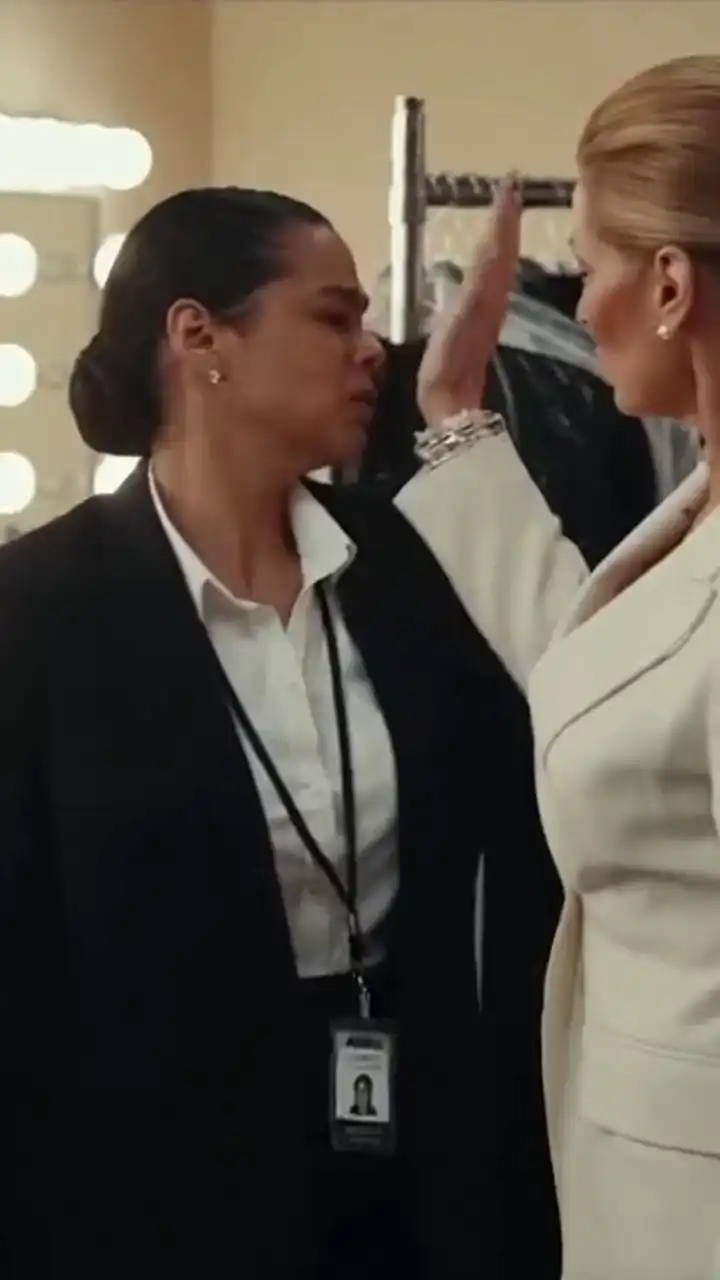
SHE SLAPPED THE THEATER USHER IN THE FITTING ROOM AND TURNED HER INTO A LESSON—UNTIL A QUIET VOICE FROM THE DOOR SAID HER NAME

SHE DUMPED A CHURCH VOLUNTEER’S BAG ACROSS THE SHOWROOM FLOOR TO “PROVE A THEFT” — THEN THE QUIET WOMAN BY THE MIRROR SPOKE