
HE SAW THE DAYCARE CLEANER STEALING HIS TRIPLETS—THEN SHE SHOWED HIM A PHOTO THAT BROKE HIM IN HALF
Mark Carter’s hands were still shaking when he turned off the ignition. The migraine had hit like a sledgehammer behind his left eye, sharp and sudden, forcing him to leave the job site early—a first in twelve years. He hadn’t slept more than four hours a night since Sarah’s funeral. Not really. Just dozed in fits between midnight feedings, diaper changes, and the hollow silence that filled their Chicago apartment like rising floodwater.
He’d enrolled Lily, Noah, and Emma at BrightSprout Daycare because it promised structure. Order. Safety. The kind of sterile predictability that might keep his world from spinning off its axis. Principal Vance had sold it with military precision: “Consistency breeds security,” he’d said, tapping a laminated schedule with a pen capped in gold. Mark had nodded, desperate for anything that might stitch his fractured life back together.
Now, as he stepped out of his truck into the late afternoon sun, something felt wrong.
The gravel lot was nearly empty. Only two cars remained—one belonging to the receptionist, the other to Ms. Rosa, the quiet cleaner who always lingered after closing. But it wasn’t her car that made his stomach drop.
It was the sight of her slipping out the back door of BrightSprout, all three of his children clinging to her like she was the only solid thing in a storm.
Lily, clutching Rosa’s sleeve with both hands. Noah, stumbling slightly but holding tight to her apron pocket. Emma, perched on Rosa’s hip like she belonged there.
Mark froze.
His pulse roared in his ears. Every parental nightmare he’d ever suppressed surged forward in a single, suffocating wave. Kidnapping. The word slammed into his skull like a brick. BrightSprout’s handbook—signed, initialed, and filed—explicitly forbade any staff member from removing children without written consent. Violation meant termination. Criminal charges. Custody reviews.
He started running before he even realized his legs had moved.
But then he heard it.
Laughter.
Not the forced, polite giggles they sometimes gave teachers during pickup. Real laughter. Unfiltered. Joyful. The kind that used to echo through their living room when Sarah would chase them around with a feather duster, pretending it was a dragon.
He skidded to a stop behind a row of overgrown lilac bushes bordering the playground. Peered through the leaves.
Rosa knelt on the grass, brushing dirt from Emma’s overalls with gentle fingers. She hummed softly—a Spanish lullaby, low and warm, like sunlight through old glass. Lily leaned against her shoulder, eyes half-closed in contentment. Noah sat cross-legged, watching as Rosa tied his shoe with careful, practiced motions.
They weren’t scared.
They were safe.
Mark’s breath hitched. Confusion warred with suspicion. Why would Rosa—a woman who barely spoke above a whisper, who vanished the moment parents arrived—risk everything to take his kids outside?
Then he remembered Vance’s warning last week, delivered over lukewarm coffee in the office that smelled of disinfectant and ambition.
“That cleaner,” Vance had said, adjusting his gold-rimmed glasses with a flick of his wrist. “Ms. Rosa. Doesn’t follow protocol. Lingers after hours. Asks too many questions about your children. I’ve told her—daycare staff don’t get ‘attached.’ It’s unprofessional. Emotional entanglement compromises objectivity.”
Mark had nodded, uneasy but compliant. After all, Vance ran BrightSprout like a fortress. Nap logs color-coded by mood. Snack portions measured to the gram. Even bathroom breaks scheduled in fifteen-minute windows. In a world that felt chaotic and cruel, that rigidity had been a lifeline.
But now… watching Rosa press a kiss to Lily’s forehead—soft, maternal, reverent—Mark felt the first crack in that rigid foundation.
He stepped out from behind the bushes.
“Rosa.”
His voice came out rougher than he intended, edged with fear and accusation.
She spun around so fast she nearly toppled. Her eyes—dark, wide, terrified—locked onto his. But not with guilt. With something else. Something raw and pleading.
She stood slowly, shielding the triplets behind her like a hen gathering chicks beneath her wings.
“Mr. Carter…” Her voice trembled. “I—I can explain.”
Before Mark could speak, the back door of BrightSprout slammed open.
Principal Vance stormed out, face flushed crimson, tie askew. “There you are!” he barked, pointing at Rosa like she was a criminal caught red-handed. “I knew it! You’ve been undermining my authority for weeks. Well, this is the final straw.” He turned to Mark, voice dropping into a tone of grave concern. “Mr. Carter, I strongly advise you to press charges. This woman removed your children from the premises without authorization. It’s a clear violation of state childcare regulations—and possibly federal kidnapping statutes.”
Mark opened his mouth—to demand answers, to yell, to call the police—but Rosa cut in.
“They were having nightmares again,” she said, voice breaking. “All three. Every night this week. They’d wake up screaming, crying for their mom… saying they saw her standing in the hallway, just watching them.” She swallowed hard, eyes glistening. “I tried to tell you, Principal Vance. I said they needed comfort. A hug. Someone to sit with them until the fear passed. But you said—” Her voice dropped to a whisper. “You said ‘emotional coddling ruins discipline.’”
Vance scoffed. “Children thrive on boundaries, not indulgence. Trauma isn’t an excuse for regression.”
Rosa didn’t look at him. She looked at Mark. And in that gaze, Mark saw something he hadn’t seen in months—not from teachers, not from neighbors, not even from his own sister: understanding.
Then, slowly, she reached into the front pocket of her worn denim apron.
She pulled out a photograph.
Faded. Creased. Water-stained at the edges.
She held it out with trembling fingers.
Mark took it.
And the world stopped.
The image showed a rain-slicked highway at dusk. His own younger self—blood streaking his temple, unconscious, sprawled across the guardrail after swerving to avoid a deer. Kneeling beside him, soaked to the bone, holding his hand with desperate urgency, was a teenage boy with dark, worried eyes and a bike helmet dangling from his elbow.
On the back, in shaky ink that had bled over time:
“You saved my brother’s life that night. We never got to thank you.”
Memory crashed over Mark like a tidal wave.
Ten years ago. Late shift. Rain coming down in sheets. He’d seen the deer too late, yanked the wheel, and plowed into the barrier. Woke up to a kid—couldn’t have been older than sixteen—pressing a crumpled T-shirt to his head wound, refusing to leave even as paramedics shouted at him to step back.
“I’m not leaving him alone,” the boy had said, voice firm despite the tremor. “He stayed awake long enough to ask if I was okay. That matters.”
Mark had tried to find him afterward. Asked hospitals, police, local schools. Nothing. The boy vanished like smoke.
Now, staring at the photo, Mark’s throat closed up.
Rosa’s voice was barely audible. “That boy… was my older brother, Mateo.”
A tear slipped down her cheek. “He died last year. Cancer. Fast and brutal.” She looked at the triplets, now hugging her legs, sensing the shift in the air. “Before he passed… he made me promise. If I ever met you—if I ever had the chance—I’d watch over your family. Like you watched over him.”
Mark’s knees buckled.
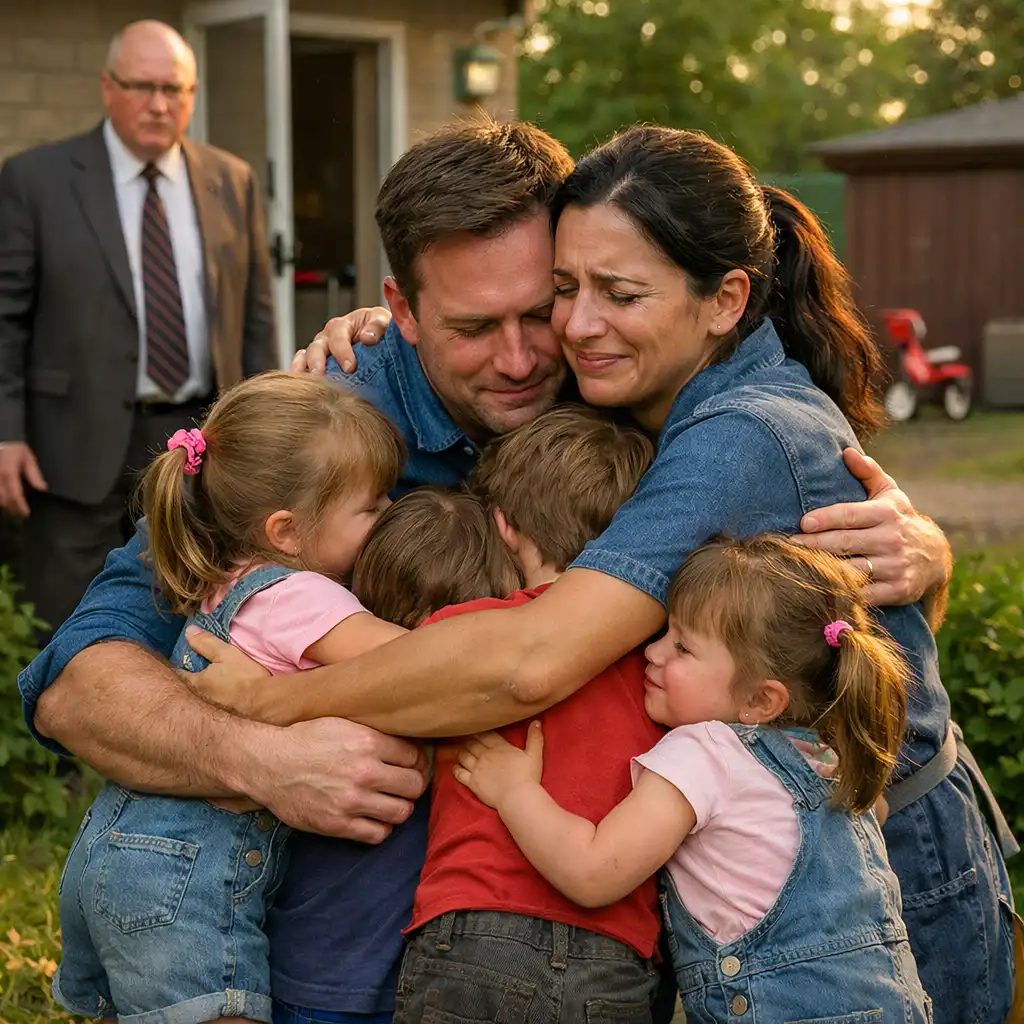
He sank to the grass, the photo clutched in one hand, the other reaching out blindly. Rosa didn’t flinch. She stepped forward, and he pulled her into a crushing embrace, his body shaking with silent sobs he hadn’t allowed himself since the funeral.
The triplets crowded around them, small arms wrapping around both adults, as if they understood—on some primal level—that this moment was stitching something broken back together.
Principal Vance stood frozen, mouth slightly open, as if witnessing something beyond his comprehension. Rules. Protocols. Color-coded schedules. None of it mattered here, in the messy, human truth of grief and gratitude.
“You’re fired,” Vance finally muttered, but the words lacked their usual authority. They sounded hollow. Small.
Mark didn’t look up. “No,” he said, voice thick but steady. “She’s not.”
Vance blinked. “Excuse me?”
Mark lifted his head, tears still wet on his cheeks, but his eyes were clear. Focused. “You don’t get to fire someone for loving my children when no one else would.”
“She broke policy—”
“Your policy forgot that kids aren’t machines,” Mark shot back, standing now, Rosa still close beside him. “They’re hurting. And she saw it. While you were busy logging nap times, she was holding them through the night terrors.”
Vance’s face tightened. “Sentiment doesn’t run a daycare, Mr. Carter. Structure does.”
“Structure without compassion is just a cage,” Mark said quietly. “And my kids have been trapped long enough.”
He turned to Rosa. “You took this job… just to be near them?”
She nodded, eyes downcast. “When I saw your name on the enrollment form—Mark Carter—I couldn’t believe it. I’d spent years wondering what happened to the man who stayed awake long enough to ask my brother if he was okay.” A faint smile touched her lips. “Mateo always said you had kind eyes. Even bleeding and half-conscious.”
Mark exhaled, the weight on his chest lighter than it had been in months. “You should’ve told me.”
“I was afraid,” she admitted. “Afraid you’d think I was using the job to intrude. Or that you wouldn’t believe me. Or worse—that you’d say it didn’t matter anymore.”
“It matters,” Mark said fiercely. “More than you know.”
He looked at his children. Lily was tracing the lines on Rosa’s palm. Noah was showing her a dandelion he’d picked. Emma had fallen asleep against her hip, thumb in mouth, utterly at peace.
For the first time since Sarah died, Mark didn’t feel alone.
Two Weeks Later
BrightSprout Daycare didn’t close.
But it changed.
Principal Vance resigned—quietly, without fanfare—after a parent meeting where Mark stood up and recounted everything. Not as an accusation, but as a plea: We need caregivers who see our children, not just manage them.
The board listened.
Rosa wasn’t rehired as a cleaner.
She was promoted to Lead Emotional Support Specialist—a new role, crafted specifically for her. Her responsibilities? Sit with kids during meltdowns. Read stories in both English and Spanish. Teach breathing exercises for anxiety. And, most importantly, be present.
Mark visited every day at lunch, not just for pickup. Sometimes he brought tacos from the place Rosa loved. Sometimes he just sat on the floor in the quiet corner she’d created—a space with soft rugs, weighted blankets, and a shelf of books about loss, love, and brave little hearts.
One afternoon, as he watched Rosa help Emma draw a picture of “Mommy in the stars,” he realized something.
Sarah would’ve loved her.
Would’ve hugged her tight and said, “Thank you for holding them when I couldn’t.”
That night, for the first time in ten months, Mark slept through the night.
No nightmares. No empty spaces.
Just the soft sound of three steady breaths from the next room—and the quiet certainty that love, even when buried under years of silence, always finds its way home.
Epilogue: Six Months Later
The backyard barbecue was small—just Mark, Rosa, his sister Claire, and a few neighbors who’d become friends. The triplets ran barefoot through the grass, chasing fireflies as dusk settled over the city.
Rosa handed Mark a plate of grilled corn, their fingers brushing briefly.
“You okay?” she asked softly.
He smiled. “Better than okay.”
He’d started therapy. Joined a dads’ support group. Even planted a lilac bush by the back fence—the same kind that had hidden him the day everything changed.
Claire watched them from the porch swing, sipping lemonade. “You two are good together,” she said later, when Rosa went inside to check on the kids.
Mark didn’t deny it. “She sees them. Really sees them.”
“And you?”
He looked toward the window, where Rosa was helping Noah wash his hands, laughing at something he’d said. “She sees me too.”
Three days later, Mark asked Rosa to move in.
Not as a favor. Not as a guardian. But as family.
She said yes.
And when the triplets woke up the next morning to find her making pancakes in their kitchen—humming that same Spanish lullaby—they didn’t ask why.
They just climbed onto stools beside her, chattering about dreams and dinosaurs and the way the sky turned pink at sunrise.
Mark stood in the doorway, coffee in hand, watching the scene unfold.
No rules. No schedules. Just love, messy and imperfect and real.
And for the first time in a long time, it was enough.
Disclaimer: Mention of any brand or trademark is for identification only and does not imply partnership or endorsement
SHE RIPPED THE BADGE OFF A PREGNANT NURSE AIDE IN THE LOADING BAY TO SHOW EVERYONE WHO MATTERED—AND PICKED THE WORST POSSIBLE WITNESS
SHE SLAPPED THE THEATER USHER IN THE FITTING ROOM AND TURNED HER INTO A LESSON—UNTIL A QUIET VOICE FROM THE DOOR SAID HER NAME

SHE DUMPED A CHURCH VOLUNTEER’S BAG ACROSS THE SHOWROOM FLOOR TO “PROVE A THEFT” — THEN THE QUIET WOMAN BY THE MIRROR SPOKE